Radiative leptonic decays on the lattice
arXiv:1907.00279v2 · This workspace stays on this version. Check arXiv for newer versions
Some source details need review 1 to check
Original formulas, table values and figures are preserved. Comparison can miss differences; use the original PDF to check details.
Reading view checked: 143 math expressions, 3 rendering failures; 5 of 5 images available.
Compared 34 of 34 source passages against 7 of 7 PDF pages.
- Some formulas could not be rendered; their original TeX is shown. Check the original PDF. (3)
5 of 5 figure, table and graphic images captured. Open original PDF
Abstract
Adding a hard photon to the final state of a leptonic pseudoscalar-meson decay lifts the helicity suppression and can provide sensitivity to a larger set of operators in the weak effective Hamiltonian. Furthermore, radiative leptonic decays at high photon energy are well suited to constrain the first inverse moment of the -meson light-cone distribution amplitude, an important parameter in the theory of nonleptonic decays. We demonstrate that the calculation of radiative leptonic decays is possible using Euclidean lattice QCD, and present preliminary numerical results for and .
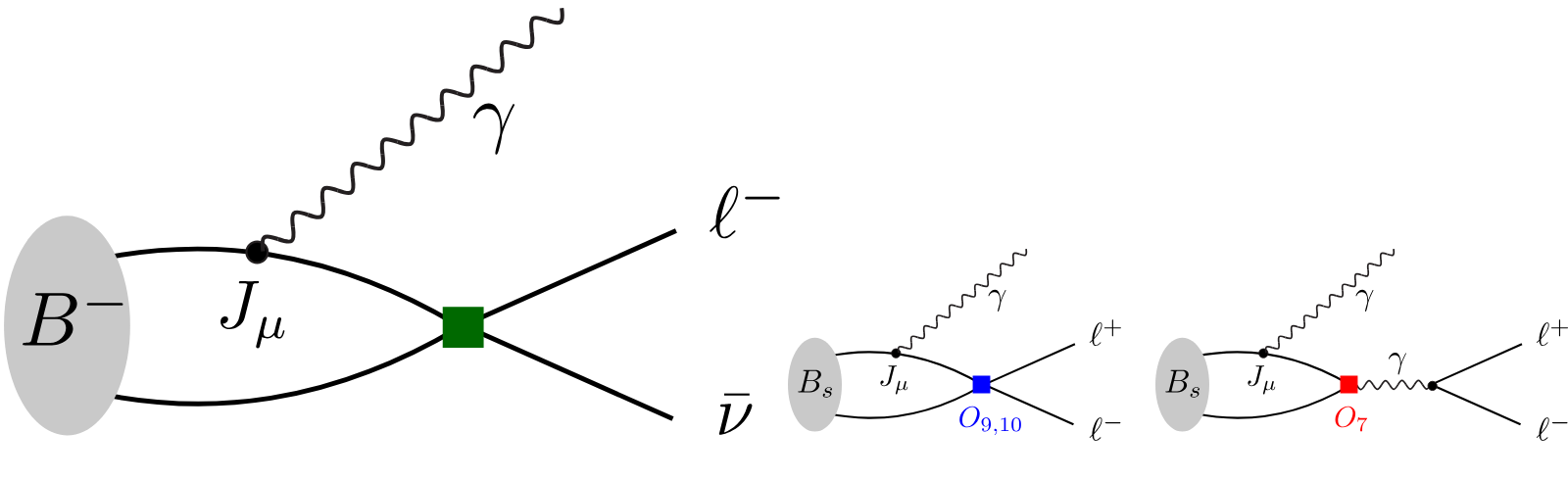
Radiative leptonic decays of pseudoscalar mesons probe both the weak interaction and the hadronic structure in useful ways. Adding a sufficiently energetic photon to the final state can actually increase the branching fraction [2], as it removes the helicity suppression. Perhaps the most interesting example is , shown in Fig. 1 (left). For large , this process is the cleanest probe of the first inverse moment of the -meson light-cone distribution amplitude, , an important input in QCD-factorization predictions for nonleptonic decays that is presently poorly determined [3, 4, 5, 6, 7, 8, 9]. A recent search for this decay by Belle gave an upper limit , close to the Standard-Model expectation [10]. Lattice QCD results for the form factors could be used to constrain . Also very interesting are the flavor-changing neutral-current decays and (shown in Fig. 1, right). While the purely leptonic decays are sensitive to only, the radiative leptonic decays probe all Wilson coefficients in the weak effective Hamiltonian, including , in which global fits of experimental results for other decays indicate a deviation from the Standard Model that violates lepton flavor universality (LFU) [1]. Since the radiative leptonic decays are not helicity-suppressed, they are well-suited for testing LFU with light leptons [11, 12]. For the charmed-meson radiative leptonic decays and , the BESIII collaboration has reported upper limits on the branching fractions with of and , respectively [13, 14]. Finally, in contrast to the heavy-meson decays, there are already precise measurements of the differential branching fractions of , , , and , as reviewed in Ref. [15]. These decay modes can therefore be used to test the lattice QCD methods.
In the following, we show how radiative leptonic decays can be calculated on a Euclidean lattice, and we present early numerical results. One of us previously reported on this project at the Lattice 2018 conference [16]. At Lattice 2019, radiative leptonic decays were also discussed by G. Martinelli [17].
To define the form factors for charged-current radiative leptonic decays of pseudoscalar mesons, we use the notation for . The quark electromagnetic and weak currents are given by and . The decay amplitude depends on the hadronic tensor, which is defined as
in Minkowski space. Throughout this work, we asssume that the photon is real, i.e., . The hadronic tensor can be decomposed as [7]
\begin{aligned}\displaystyle T_{\mu\nu} & \displaystyle= & \displaystyle\epsilon_{\mu\nu\tau\rho}p_{\gamma}^{\tau}{\textsl{v}}^{\,\rho}{F_{V}}+i[-g_{\mu\nu}(p_{\gamma}\cdot{\textsl{v}})+{\textsl{v}}_{\mu}(p_{\gamma})_{\nu}]{F_{A}}-i\frac{{\textsl{v}}_{\mu}{\textsl{v}}_{\nu}}{p_{\gamma}\cdot{\textsl{v}}}m_{B}{f_{B}}+(p_{\gamma})_{\mu}\text{-terms},\end{aligned}\tag{(2)}where p_{B}=m_{B}{\textsl{v}} and the will disappear when contracting with the photon polarization vector. The form factors and are functions of the photon energy in the -meson rest frame, E_{\gamma}^{(0)}=p_{\gamma}\cdot{\textsl{v}}=(m_{B}^{2}-q^{2})/(2m_{B}). Also appearing in Eq. (2) is the -meson decay constant .
To prepare for the discussion in the next section, it is useful to write down the spectral representation of in Minkowski space for the two different time orderings of the currents. By inserting complete sets of energy/momentum eigenstates and performing the time integrals, we find
(in infinite volume, the sums over and include integrals over the continuous spectrum of multi-particle states).
In this section, we show that can be extracted from the Euclidean three-point function
where is an interpolating field for the meson, and , now denote the Euclidean time. We define the integrals
with a finite integration range . Here we take to be large and negative (with ), such that ground-state saturation is achieved for the meson. Inserting again complete sets of energy/momentum eigenstates, we find, for the first time ordering,
The sum over states in Eq. (7) differs from the sum in Eq. (3) by the factor in the last line. However, the exponential will vanish for large if . Because the states have the same quark-flavor quantum numbers as the meson, we have . Thus, we need . This is in fact always true if .
For the other time ordering, we find
The unwanted exponential in the last line goes to zero for large if . Because the states are hadronic and have nonzero masses, their energies are larger than the energy of a photon with the same spatial momentum, showing that this condition is also always satisfied. In summary, for ,
where is the integral from to . The energy and the overlap factor can be obtained from the two-point function .
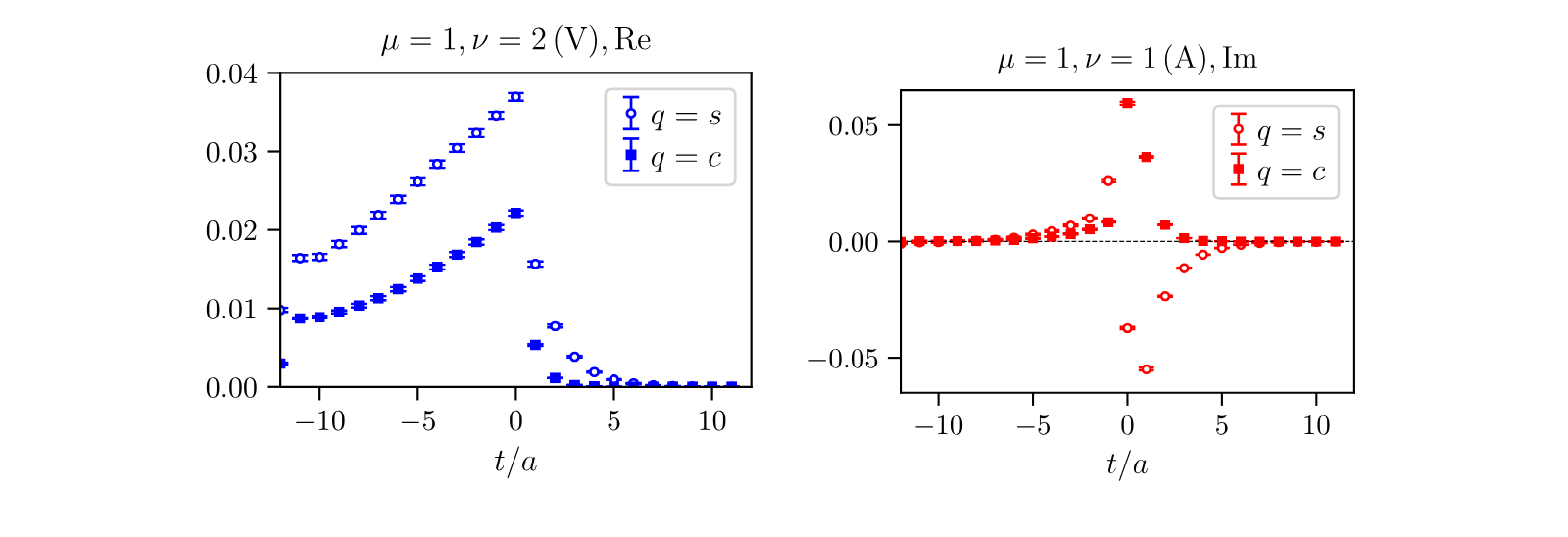
In this section, we present some early numerical results for the and form factors. These results are from only 25 configurations of the “24I” RBC/UKQCD ensemble [22] with flavors of domain-wall fermions and the Iwasaki gauge action, with GeV and MeV. For the light and strange valence quarks, we use the same domain-wall action as in Ref. [22]. The valence charm quark is implemented with a Möbius domain-wall action with stout-smeared gauge links (, ), , , [23], which approximately corresponds to the physical charm-quark mass. We use local currents with “mostly nonperturbative” renormalization. Gaussian smearing is performed for the lighter quark in the meson interpolating field. We start with a random-wall source at the time slice of the weak current (denoted as time “0” here) and perform sequential inversions through the meson interpolating field; disconnected diagrams are presently neglected. All-mode averaging [24] with 16 sloppy and 1 exact samples per configuration is employed; the 16 sloppy samples correspond to 16 different starting time slices. Our initial calculations used and .
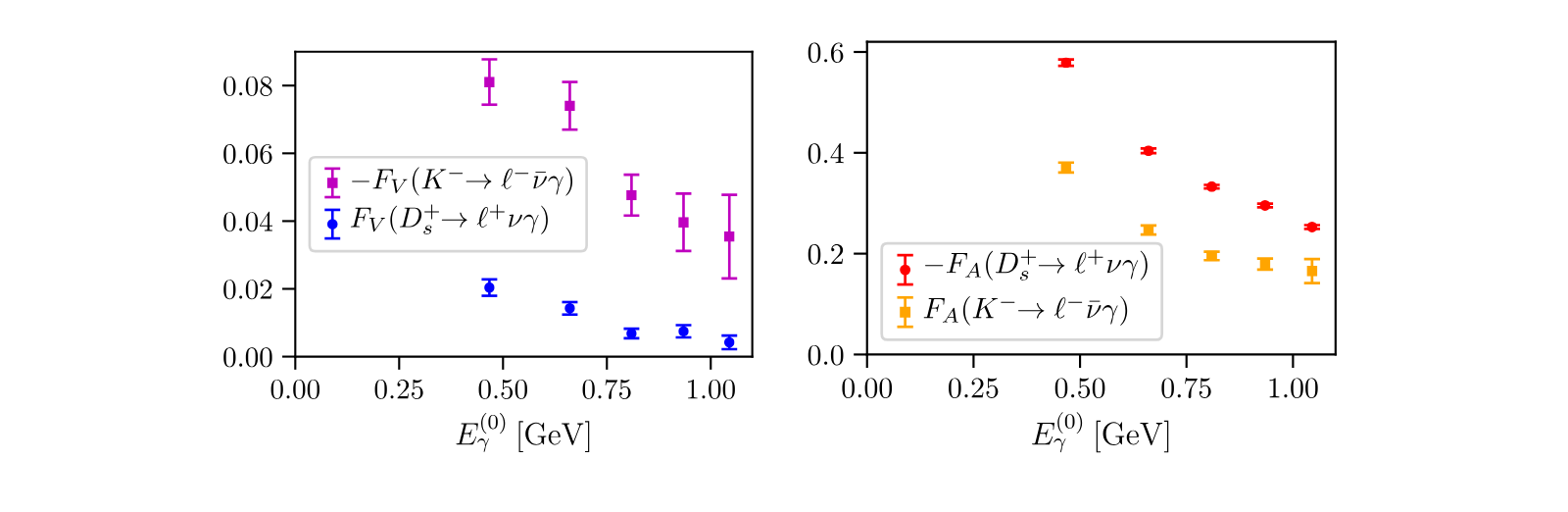
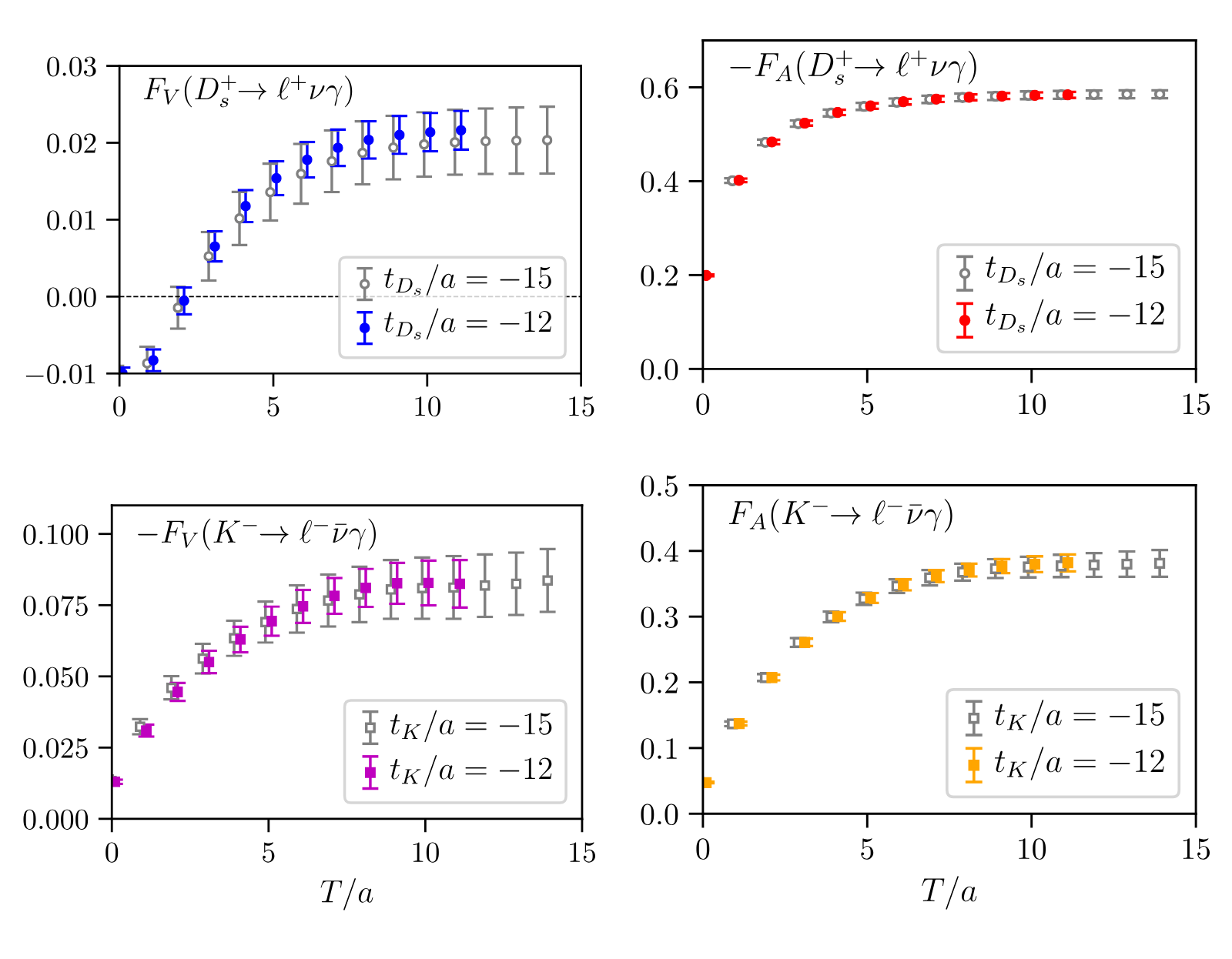
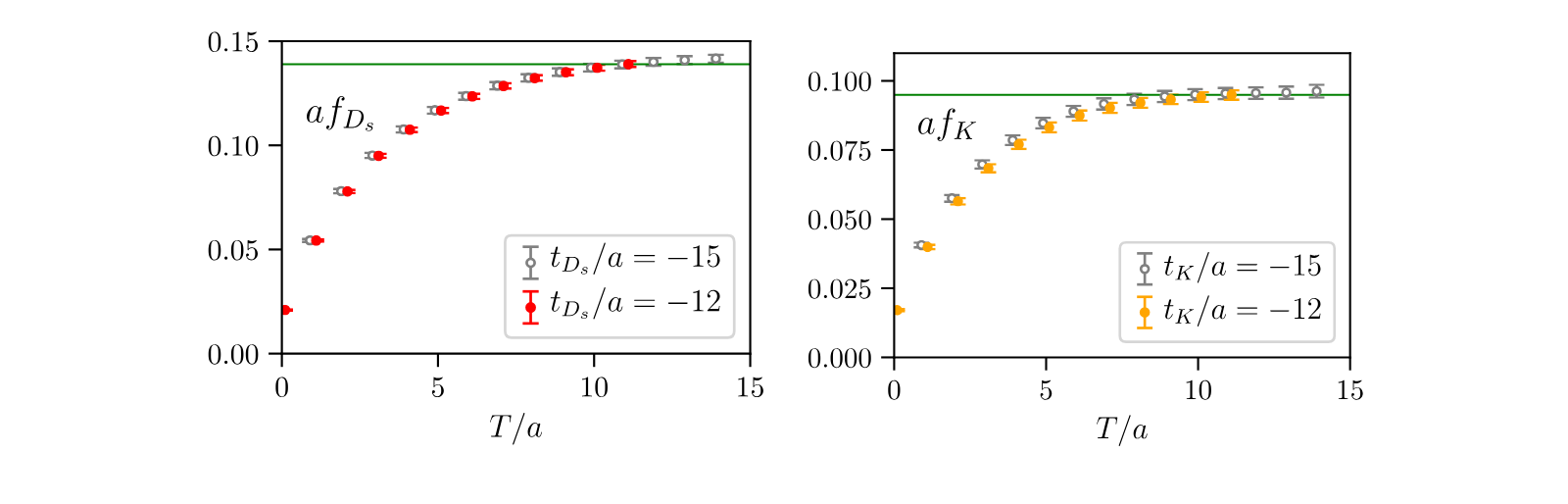
Figure 2 shows examples of the three-point functions. Multiplying by and summing over gives for sufficiently large summation range . The form factors and extracted from (at the lowest photon momentum) are shown as a function of in Fig. 3. The results plateau at approximately . We also extracted the meson decay constants from the term in . As can be seen in Fig. 4, the results agree with the known values, which is a valuable test of our calculation. Finally, Fig. 5 shows the form factors and as a function of the photon energy. Note that, with our current choice of momenta, all of the photon energies are above the physical region for . The results for are dominated by the point-like contribution equal to .
We have shown that the form factors describing radiative leptonic decays can be calculated on the lattice; even though they involve a nonlocal matrix element, the use of imaginary time poses no difficulty in this case. The early results shown here for and cover photon energies from approximately 0.5 to 1 GeV. For we need to reach lower photon energies to compare with experiment; this can be achieved by using moving frames (i.e., nonzero ) and/or a larger volume. To study the radiative leptonic decays with the domain-wall action for the heavy quark, we will need to extrapolate in the mass. We are also considering calculations directly at the physical -quark mass using the “relativistic heavy-quark action” [25], but, because this action is only on-shell improved, additional steps are likely needed to remove unphysical behavior occurring when the electromagnetic and weak currents get close to each other.
Acknowledgments: We thank the RBC and UKQCD Collaborations for providing the gauge-field configurations. C.K. and S.M. are supported by the US DOE, Office of Science, Office of HEP under award number DE-SC0009913. S.M. is also supported by the RIKEN BNL Research Center. A.S. and C.L. are supported in part by US DOE Contract No. DESC0012704(BNL). During a part of this work, C.L. was also supported by a DOE Office of Science Early Career Award. This work used resources at TACC that are part of XSEDE, supported by NSF grant number ACI-1548562.
References
- [1] J. Aebischer, W. Altmannshofer, D. Guadagnoli, M. Reboud, P. Stangl, and D. M. Straub, “$B$-decay discrepancies after Moriond 2019,” arXiv:1903.10434.Source
- [2] D. Atwood, G. Eilam, and A. Soni, “Pure leptonic radiative decays $B^{\pm},D_{s}\to\ell\nu\gamma$ and the annihilation graph,” Mod. Phys. Lett. A11 (1996) 1061, arXiv:hep-ph/9411367.SourceSource
- [3] G. P. Korchemsky, D. Pirjol, and T.-M. Yan, “Radiative leptonic decays of B mesons in QCD,” Phys. Rev. D61 (2000) 114510, arXiv:hep-ph/9911427.SourceSource
- [4] S. Descotes-Genon and C. T. Sachrajda, “Factorization, the light cone distribution amplitude of the B meson and the radiative decay $B\to\gamma\ell\nu_{\ell}$,” [Nucl. Phys. B650 (2003) 356](http://dx.doi.org/10.1016/S0550-3213(02)01066-0), arXiv:hep-ph/0209216.SourceSource
- [5] E. Lunghi, D. Pirjol, and D. Wyler, “Factorization in leptonic radiative $B\to\gamma e\nu$ decays,” [Nucl. Phys. B649 (2003) 349](http://dx.doi.org/10.1016/S0550-3213(02)01032-5), arXiv:hep-ph/0210091.SourceSource
- [6] V. M. Braun and A. Khodjamirian, “Soft contribution to $B\to\gamma\ell\nu_{\ell}$ and the $B$-meson distribution amplitude,” Phys. Lett. B718 (2013) 1014, arXiv:1210.4453.SourceSource
- [7] M. Beneke, V. M. Braun, Y. Ji, and Y.-B. Wei, “Radiative leptonic decay $B\to\gamma\ell\nu_{\ell}$ with subleading power corrections,” [JHEP 07 (2018) 154](http://dx.doi.org/10.1007/JHEP07(2018)154), arXiv:1804.04962.SourceSource
- [8] Y.-M. Wang and Y.-L. Shen, “Subleading-power corrections to the radiative leptonic $B\to\gamma\ell\nu$ decay in QCD,” [JHEP 05 (2018) 184](http://dx.doi.org/10.1007/JHEP05(2018)184), arXiv:1803.06667.SourceSource
- [9] M. Beneke, G. Buchalla, M. Neubert, and C. T. Sachrajda, “QCD factorization for $B\to\pi\pi$ decays: Strong phases and CP violation in the heavy quark limit,” Phys. Rev. Lett. 83 (1999) 1914, arXiv:hep-ph/9905312.SourceSource
- [10] Belle Collaboration, M. Gelb et al., “Search for the rare decay of $B^{+}\to\ell^{\,+}\nu_{\ell}\gamma$ with improved hadronic tagging,” Phys. Rev. D98 (2018) 112016, arXiv:1810.12976.SourceSource
- [11] D. Guadagnoli, M. Reboud, and R. Zwicky, “$B_{s}^{0}\to\ell^{+}\ell^{-}\gamma$ as a test of lepton flavor universality,” [JHEP 11 (2017) 184](http://dx.doi.org/10.1007/JHEP11(2017)184), arXiv:1708.02649.SourceSource
- [12] F. Dettori, D. Guadagnoli, and M. Reboud, “$B^{0}_{s}\to\mu^{+}\mu^{-}\gamma$ from $B^{0}_{s}\to\mu^{+}\mu^{-}$,” Phys. Lett. B768 (2017) 163, arXiv:1610.00629.SourceSource
- [13] BESIII Collaboration, M. Ablikim et al., “Search for the radiative leptonic decay $D^{+}\to\gamma e^{+}{\nu}_{e}$,” Phys. Rev. D95 (2017) 071102, arXiv:1702.05837.SourceSource
- [14] BESIII Collaboration, M. Ablikim et al., “Search for the decay $D_{s}^{+}\rightarrow\gamma e^{+}\nu_{e}$,” Phys. Rev. D99 (2019) 072002, arXiv:1902.03351.SourceSource
- [15] Particle Data Group Collaboration, M. Tanabashi et al., “Review of Particle Physics,” Phys. Rev. D98 (2018) 030001.Source
- [16] A. Soni, “Flavor anomalies & the lattice,” 2018. Presentation at Lattice 2018, East Lansing, MI, USA.
- [17] RM123 Collaboration, G. Martinelli, “Electromagnetic Corrections to Decay Amplitudes: Real Emissions in Leptonic Decays,” 2019. Presentation at Lattice 2019, Wuhan, China.
- [18] X.-d. Ji and C.-w. Jung, “Studying hadronic structure of the photon in lattice QCD,” Phys. Rev. Lett. 86 (2001) 208, arXiv:hep-lat/0101014.SourceSource
- [19] J. J. Dudek and R. G. Edwards, “Two Photon Decays of Charmonia from Lattice QCD,” Phys. Rev. Lett. 97 (2006) 172001, arXiv:hep-ph/0607140.SourceSource
- [20] X. Feng, S. Aoki, H. Fukaya, S. Hashimoto, T. Kaneko, J.-i. Noaki, and E. Shintani, “Two-photon decay of the neutral pion in lattice QCD,” Phys. Rev. Lett. 109 (2012) 182001, arXiv:1206.1375.SourceSource
- [21] Flavour Lattice Averaging Group Collaboration, S. Aoki et al., “FLAG Review 2019,” arXiv:1902.08191.Source
- [22] RBC/UKQCD Collaboration, Y. Aoki et al., “Continuum Limit Physics from 2+1 Flavor Domain Wall QCD,” Phys. Rev. D83 (2011) 074508, arXiv:1011.0892.SourceSource
- [23] RBC/UKQCD Collaboration, P. A. Boyle, L. Del Debbio, N. Garron, A. Jüttner, A. Soni, J. T. Tsang, and O. Witzel, “SU(3)-breaking ratios for $D_{(s)}$ and $B_{(s)}$ mesons,” arXiv:1812.08791.Source
- [24] E. Shintani, R. Arthur, T. Blum, T. Izubuchi, C. Jung, and C. Lehner, “Covariant approximation averaging,” Phys. Rev. D91 (2015) 114511, arXiv:1402.0244.SourceSource
- [25] N. H. Christ, M. Li, and H.-W. Lin, “Relativistic Heavy Quark Effective Action,” Phys. Rev. D76 (2007) 074505, arXiv:hep-lat/0608006.SourceSource