Measuring Massive Multitask Language Understanding
arXiv:2009.03300v3 · This workspace stays on this version. Check arXiv for newer versions
Some source details need review 2 to check
Original formulas, table values and figures are preserved. Comparison can miss differences; use the original PDF to check details.
Reading view checked: 81 math expressions, 0 rendering failures; 70 of 70 images available.
Compared 117 of 117 source passages against 27 of 27 PDF pages.
HTML A1_p1_1 says “few-shot examples vs. accuracy ([Figure 11](#A1.F11))”; PDF page 11 says “few-shot examples vs. accuracy (Figure 10),” which is also visible in the original PDF image. Check PDF page 11
PDF page 6 says “Figure 10 in Appendix A,” while HTML block S4_SS2_SSS0_Px1_p1_1 says “Figure 11” for the same claim. The PDF contradicts the HTML. Check PDF page 6
70 of 70 figure, table and graphic images captured. Open original PDF
Abstract
We propose a new test to measure a text model’s multitask accuracy. The test covers 57 tasks including elementary mathematics, US history, computer science, law, and more. To attain high accuracy on this test, models must possess extensive world knowledge and problem solving ability. We find that while most recent models have near random-chance accuracy, the very largest GPT-3 model improves over random chance by almost 20 percentage points on average. However, on every one of the 57 tasks, the best models still need substantial improvements before they can reach expert-level accuracy. Models also have lopsided performance and frequently do not know when they are wrong. Worse, they still have near-random accuracy on some socially important subjects such as morality and law. By comprehensively evaluating the breadth and depth of a model’s academic and professional understanding, our test can be used to analyze models across many tasks and to identify important shortcomings.
Natural Language Processing (NLP) models have achieved superhuman performance on a number of recently proposed benchmarks. However, these models are still well below human level performance for language understanding as a whole, suggesting a disconnect between our benchmarks and the actual capabilities of these models. The General Language Understanding Evaluation benchmark (GLUE) (Wang et al., 2018) was introduced in 2018 to evaluate performance on a wide range of NLP tasks, and top models achieved superhuman performance within a year. To address the shortcomings of GLUE, researchers designed the SuperGLUE benchmark with more difficult tasks (Wang et al., 2019). About a year since the release of SuperGLUE, performance is again essentially human-level (Raffel et al., 2019). While these benchmarks evaluate linguistic skills more than overall language understanding, an array of commonsense benchmarks have been proposed to measure basic reasoning and everyday knowledge (Zellers et al., 2019; Huang et al., 2019; Bisk et al., 2019). However, these recent benchmarks have similarly seen rapid progress (Khashabi et al., 2020). Overall, the near human-level performance on these benchmarks suggests that they are not capturing important facets of language understanding.
Transformer models have driven this recent progress by pretraining on massive text corpora, including all of Wikipedia, thousands of books, and numerous websites. These models consequently see extensive information about specialized topics, most of which is not assessed by existing NLP benchmarks. It consequently remains an open question just how capable current language models are at learning and applying knowledge from many domains.
To bridge the gap between the wide-ranging knowledge that models see during pretraining and the existing measures of success, we introduce a new benchmark for assessing models across a diverse set of subjects that humans learn. We design the benchmark to measure knowledge acquired during pretraining by evaluating models exclusively in zero-shot and few-shot settings. This makes the benchmark more challenging and more similar to how we evaluate humans. The benchmark covers subjects across STEM, the humanities, the social sciences, and more. It ranges in difficulty from an elementary level to an advanced professional level, and it tests both world knowledge and problem solving ability. Subjects range from traditional areas, such as mathematics and history, to more specialized areas like law and ethics (Hendrycks et al., 2020). The granularity and breadth of the subjects makes the benchmark ideal for identifying a model’s blind spots.
We find that meaningful progress on our benchmark has only become possible in recent months. In particular, few-shot models up to billion parameters (Brown et al., 2020) achieve random chance performance of accuracy, but the billion parameter GPT-3 model reaches a much higher accuracy (see Figure 1(b)). On the other hand, unlike human professionals GPT-3 does not excel at any single subject. Instead, we find that performance is lopsided, with GPT-3 having almost accuracy for its best subject but near-random performance for several other subjects.
Our results indicate that while recent advances have been impressive, state-of-the-art models still struggle at learning and applying knowledge from pretraining. The tasks with near-random accuracy include calculation-heavy subjects such as physics and mathematics and subjects related to human values such as law and morality. This second weakness is particularly concerning because it will be important for future models to have a strong understanding of what is legal and what is ethical. Worryingly, we also find that GPT-3 does not have an accurate sense of what it does or does not know since its average confidence can be up to off from its actual accuracy. We comprehensively evaluate the breadth and depth of a model’s text understanding by covering numerous topics that humans are incentivized to learn. Since our test consists in tasks, it can be used to analyze aggregate properties of models across tasks and to track important shortcomings. The test and code is available at github.com/hendrycks/test.
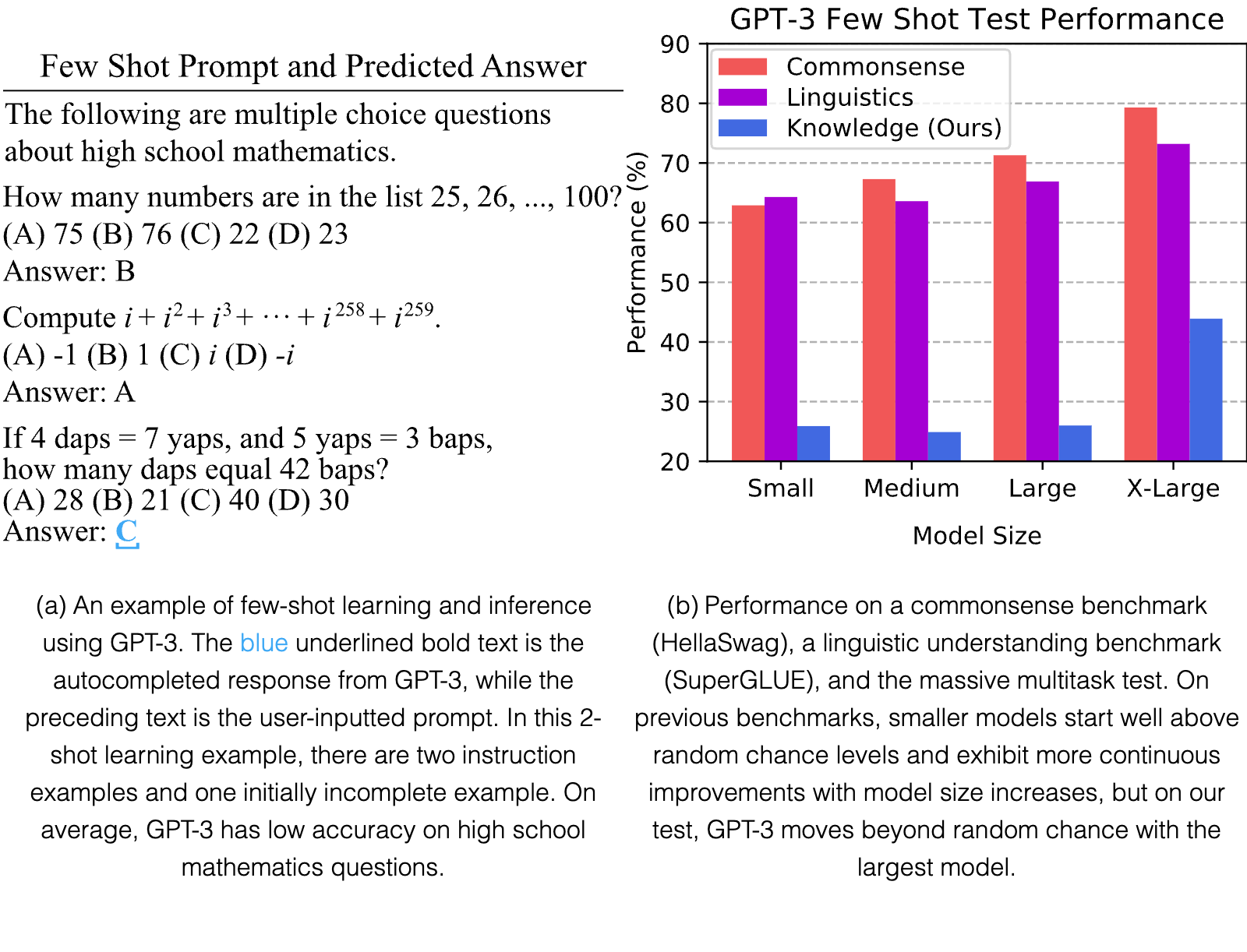
The dominant paradigm in NLP is to pretrain large models on massive text corpora including educational books and websites. In the process, these models are exposed to information about a wide range of topics. Petroni et al. (2019) found that recent models learn enough information from pretraining that they can serve as knowledge bases. However, no prior work has comprehensively measured the knowledge models have across many real-world domains.
Until recently, researchers primarily used fine-tuned models on downstream tasks (Devlin et al., 2019). However, larger pretrained models like GPT-3 (Brown et al., 2020) have made it possible to achieve competitive performance without fine-tuning by using few-shot learning, which removes the need for a large fine-tuning set. With the advent of strong zero-shot and few-shot learning, it is now possible to curate a diverse set of tasks for evaluation and remove the possibility of models on “spurious cues” (Geirhos et al., 2020; Hendrycks et al., 2019b) in a dataset to achieve high performance.
Many recent benchmarks aim to assess a model’s general world knowledge and basic reasoning ability by testing its “commonsense.” A number of commonsense benchmarks have been proposed in the past year, but recent models are already nearing human-level performance on several of these, including HellaSwag (Zellers et al., 2019), Physical IQA (Bisk et al., 2019), and CosmosQA (Huang et al., 2019). By design, these datasets assess abilities that almost every child has. In contrast, we include harder specialized subjects that people must study to learn.
Some researchers have suggested that the future of NLP evaluation should focus on Natural Language Generation (NLG) (Zellers et al., 2020), an idea that reaches back to the Turing Test (Turing, 1950). However, NLG is notoriously difficult to evaluate and lacks a standard metric (Sai et al., 2020). Consequently, we instead create a simple-to-evaluate test that measures classification accuracy on multiple choice questions.
While several question answering benchmarks exist, they are comparatively limited in scope. Most either cover easy topics like grade school subjects for which models can already achieve strong performance (Clark et al., 2018; Khot et al., 2019; Mihaylov et al., 2018; Clark et al., 2019), or are focused on linguistic understanding in the form of reading comprehension (Lai et al., 2017; Richardson et al., 2013). In contrast, we include a wide range of difficult subjects that go far beyond linguistic understanding.
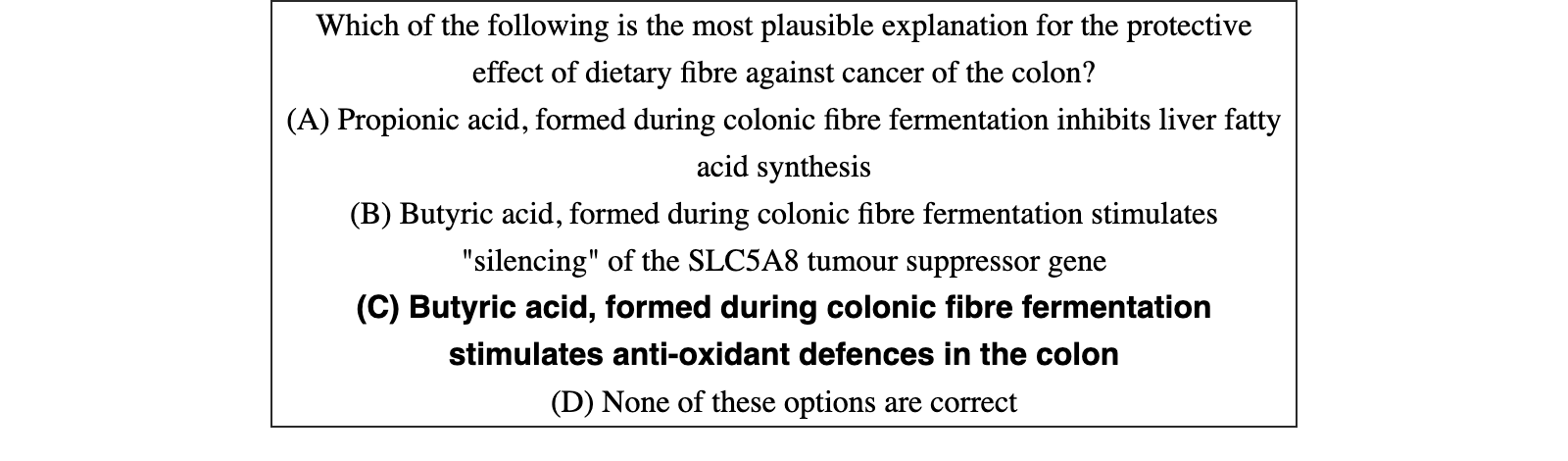
We create a massive multitask test consisting of multiple-choice questions from various branches of knowledge. The test spans subjects in the humanities, social sciences, hard sciences, and other areas that are important for some people to learn. There are tasks in total, which is also the number of Atari games (Bellemare et al., 2013), all of which are listed in Appendix B. The questions in the dataset were manually collected by graduate and undergraduate students from freely available sources online. These include practice questions for tests such as the Graduate Record Examination and the United States Medical Licensing Examination. It also includes questions designed for undergraduate courses and questions designed for readers of Oxford University Press books. Some tasks cover a subject, like psychology, but at a specific level of difficulty, such as “Elementary,” “High School,” “College,” or “Professional.” For example, the “Professional Psychology” task draws on questions from freely available practice questions for the Examination for Professional Practice in Psychology, while the “High School Psychology” task has questions like those from Advanced Placement Psychology examinations.
We collected questions in total, which we split into a few-shot development set, a validation set, and a test set. The few-shot development set has questions per subject, the validation set may be used for selecting hyperparameters and is made of questions, and the test set has questions. Each subject contains test examples at the minimum, which is longer than most exams designed to assess people.

Human-level accuracy on this test varies. Unspecialized humans from Amazon Mechanical Turk obtain accuracy on this test. Meanwhile, expert-level performance can be far higher. For example, real-world test-taker human accuracy at the 95th percentile is around for US Medical Licensing Examinations, and these questions make up our “Professional Medicine” task. If we take the 95th percentile human test-taker accuracy for exams that build up our test, and if we make an educated guess when such information is unavailable, we then estimate that expert-level accuracy is approximately .
Since our test aggregates different subjects and several levels of difficulty, we measure more than straightforward commonsense or narrow linguistic understanding. Instead, we measure arbitrary real-world text understanding. Since models are pretrained on the Internet, this enables us to test how well they can extract useful knowledge from massive corpora. Future models that use this test could be single models or a mixture of experts model. To succeed at our test, future models should be well-rounded, possess extensive world knowledge, and develop expert-level problem solving ability. These properties make the test likely to be an enduring and informative goalpost.
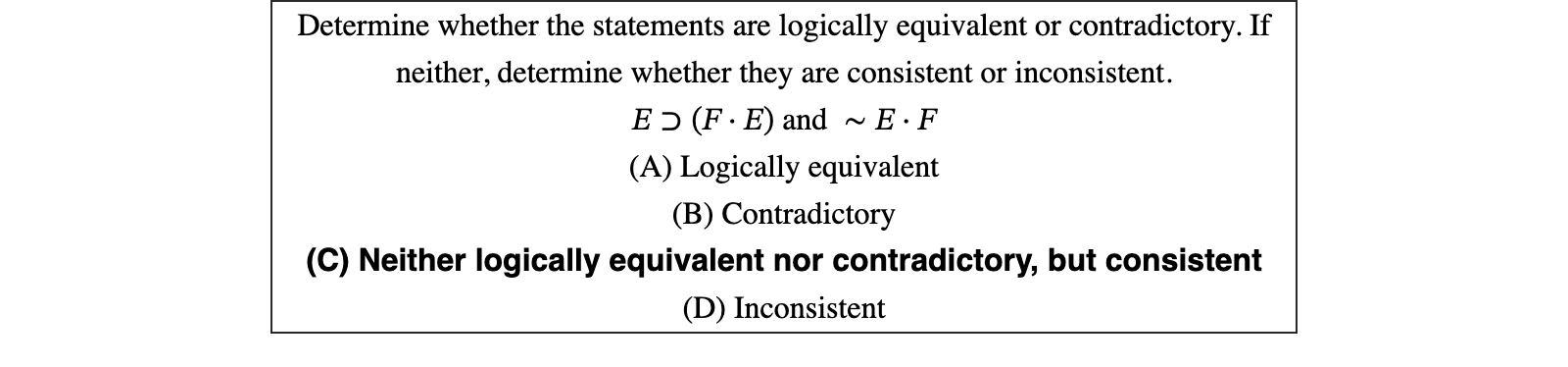
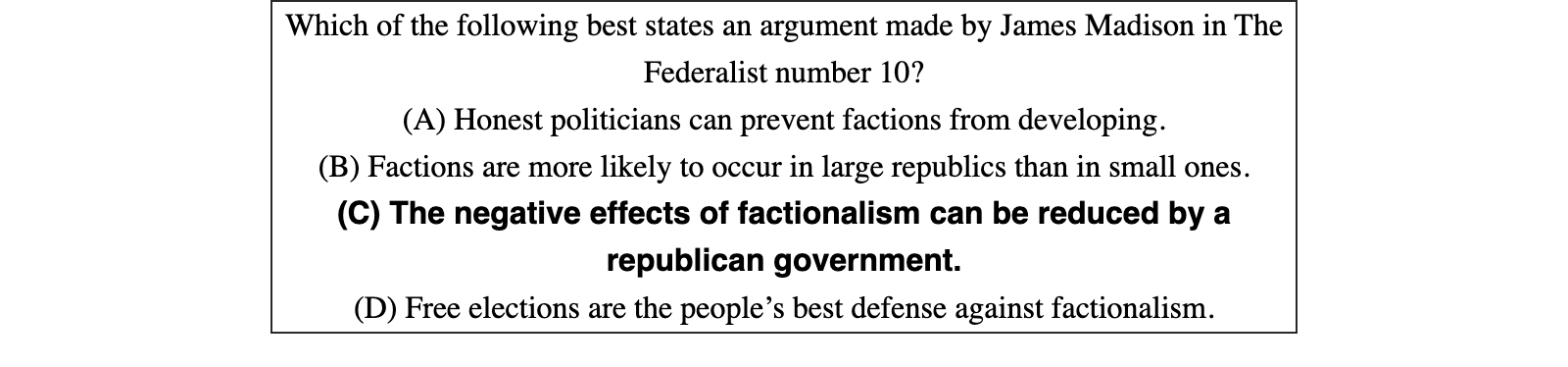
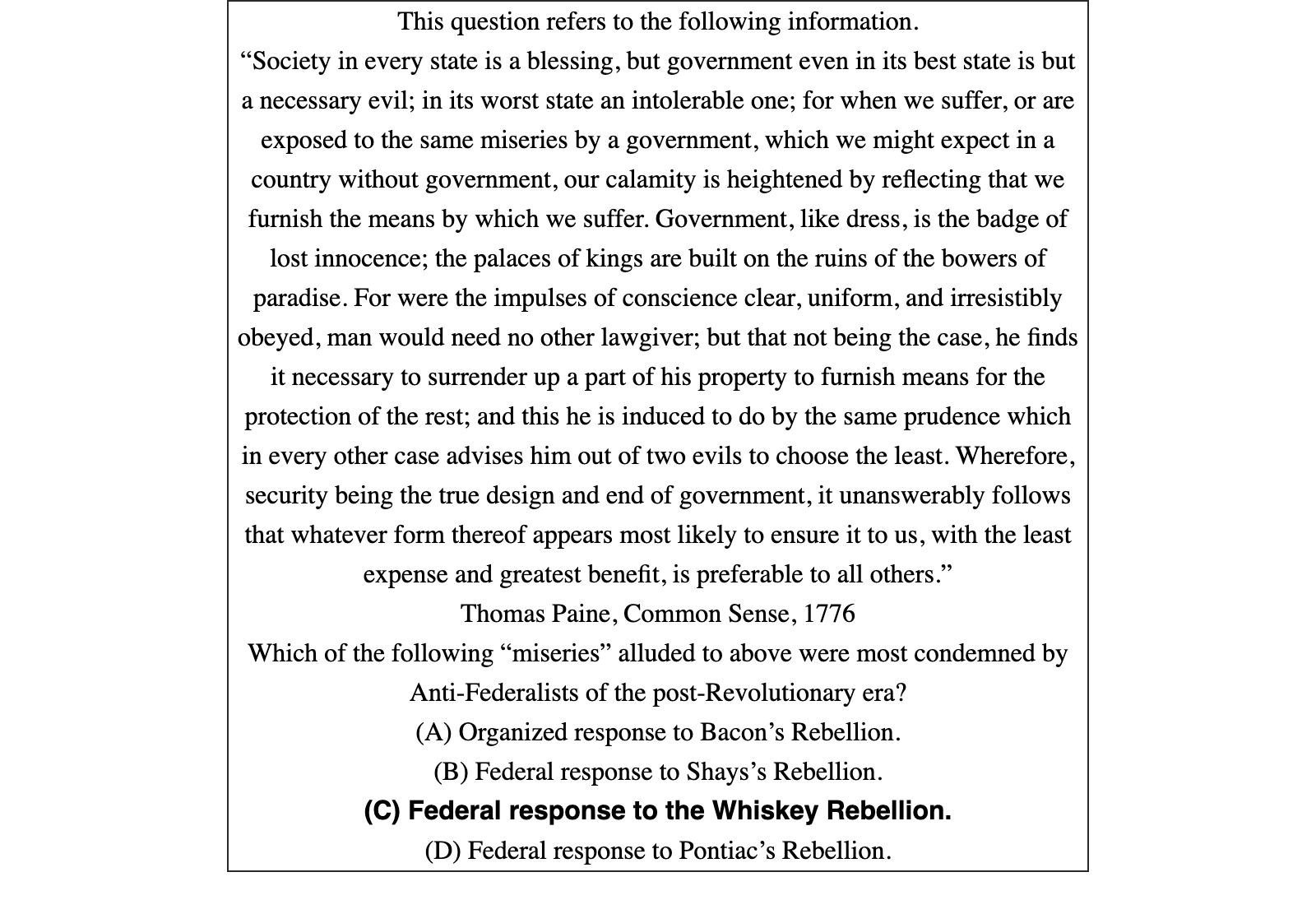
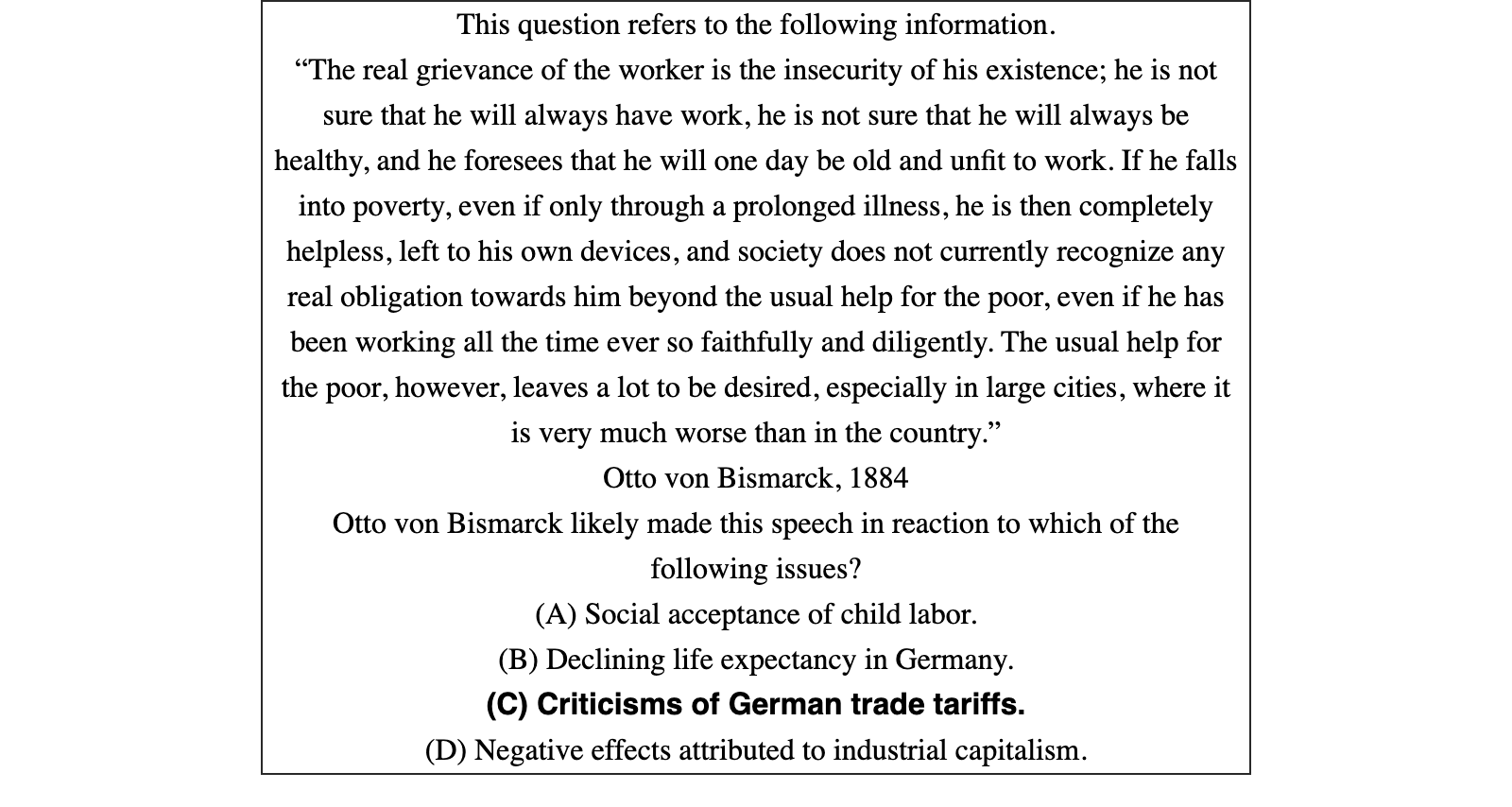
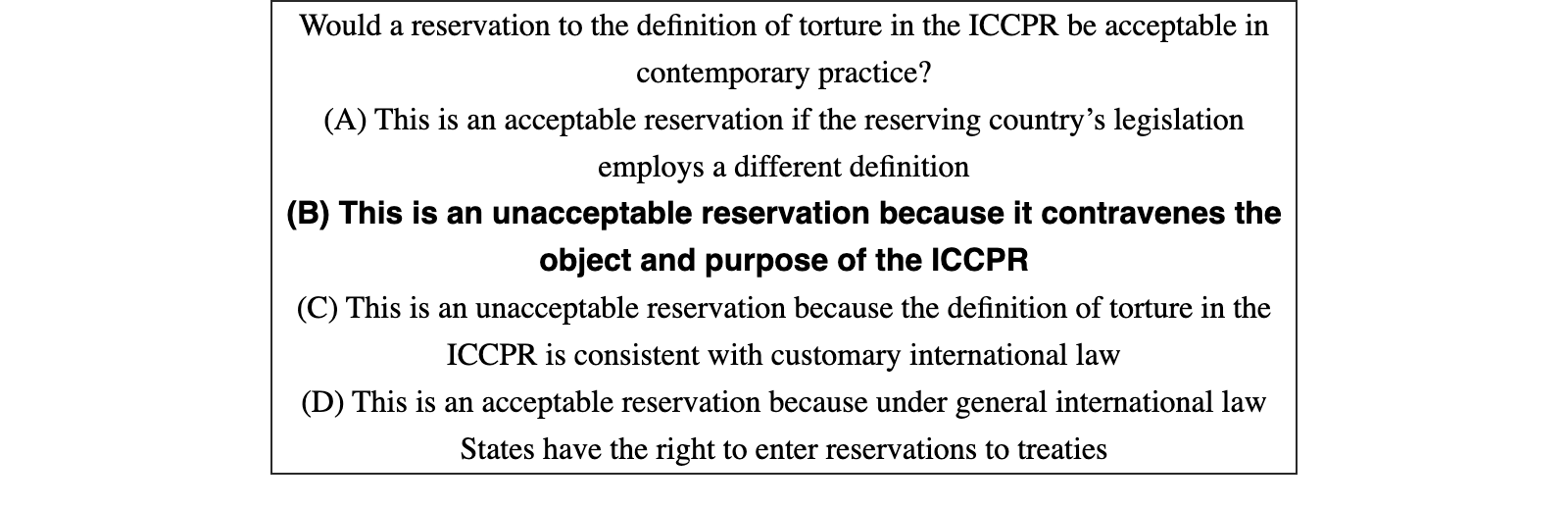
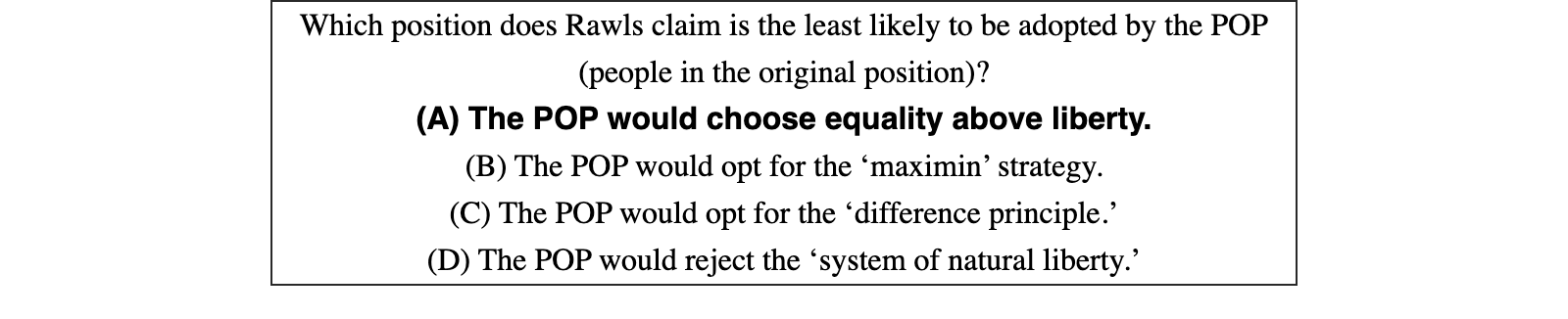
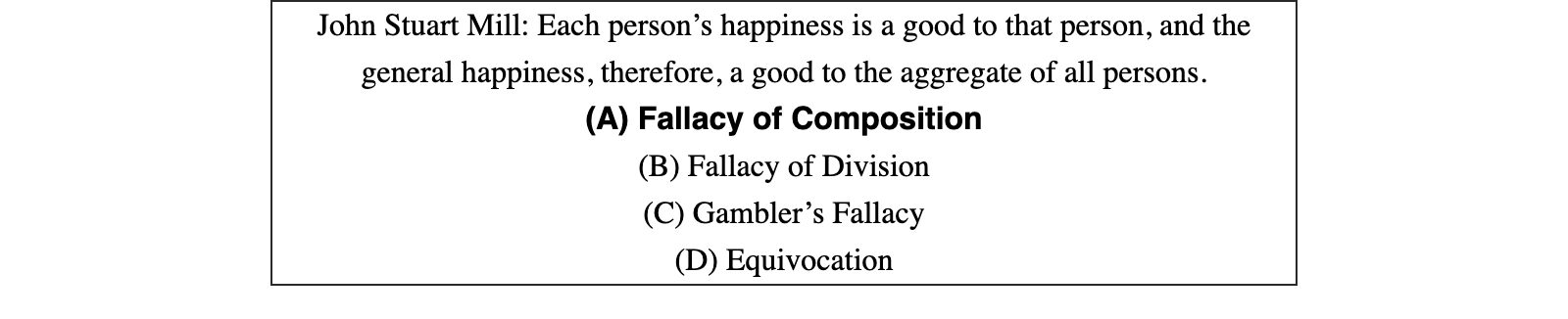
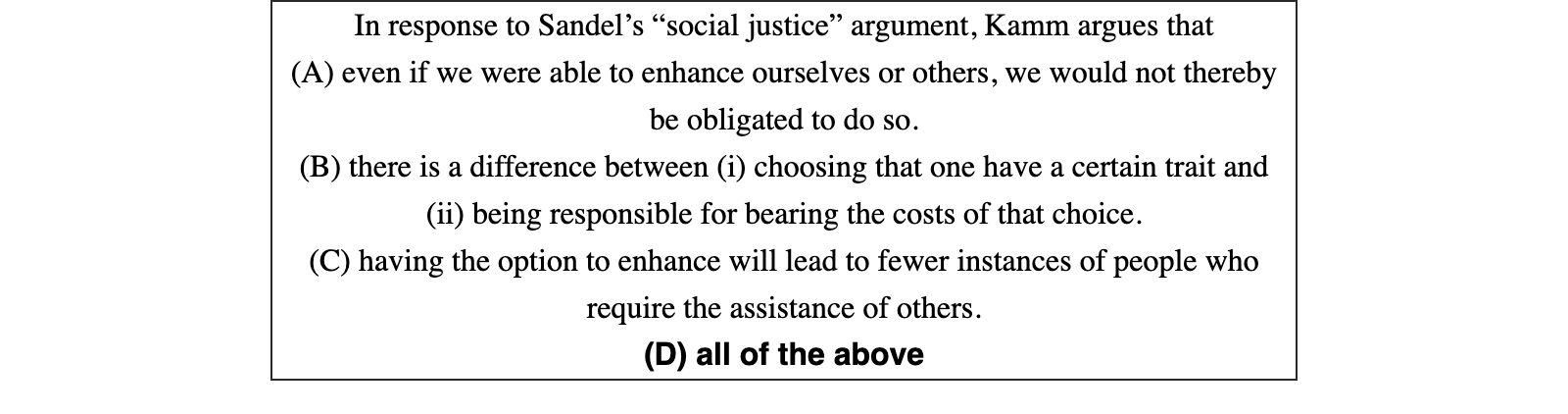
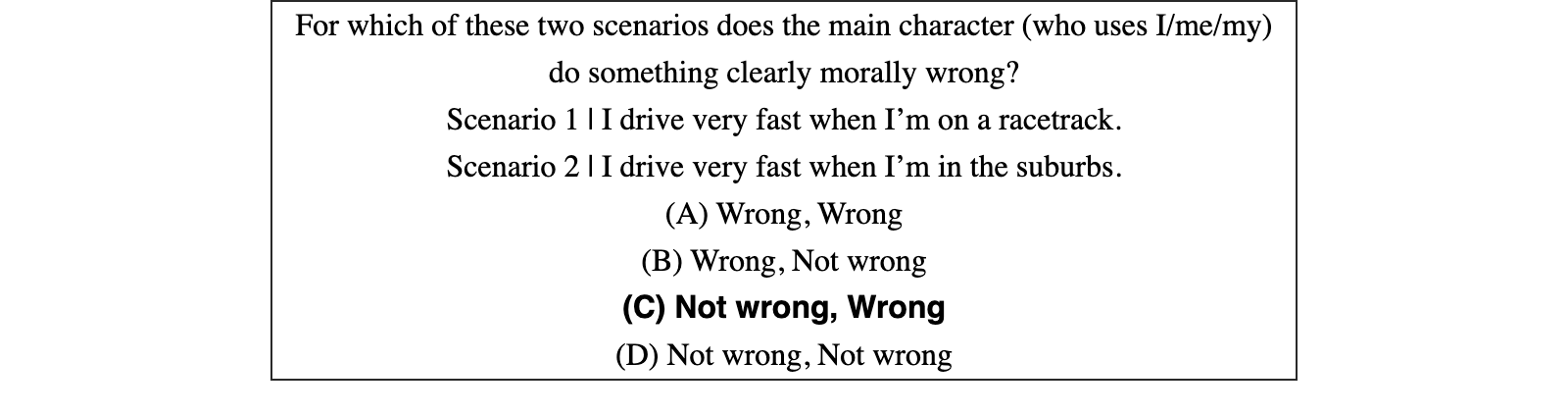
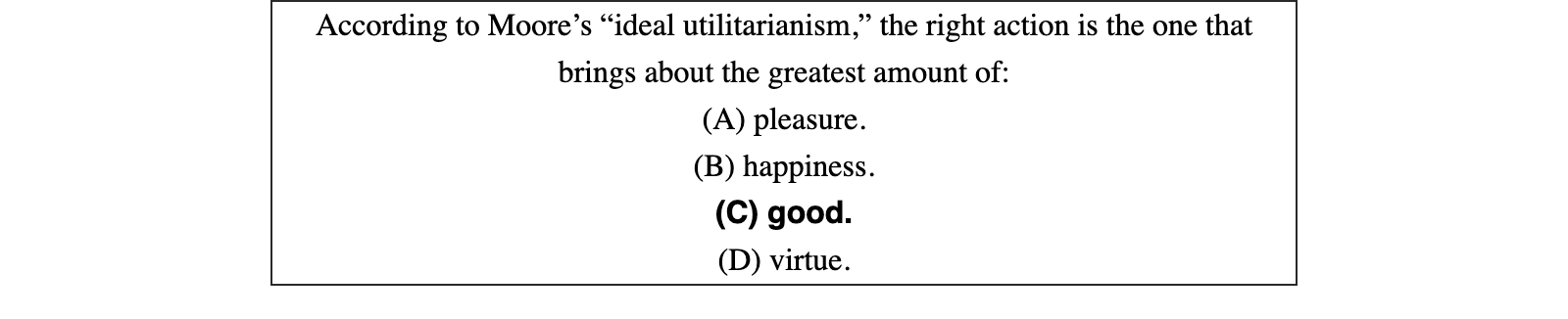
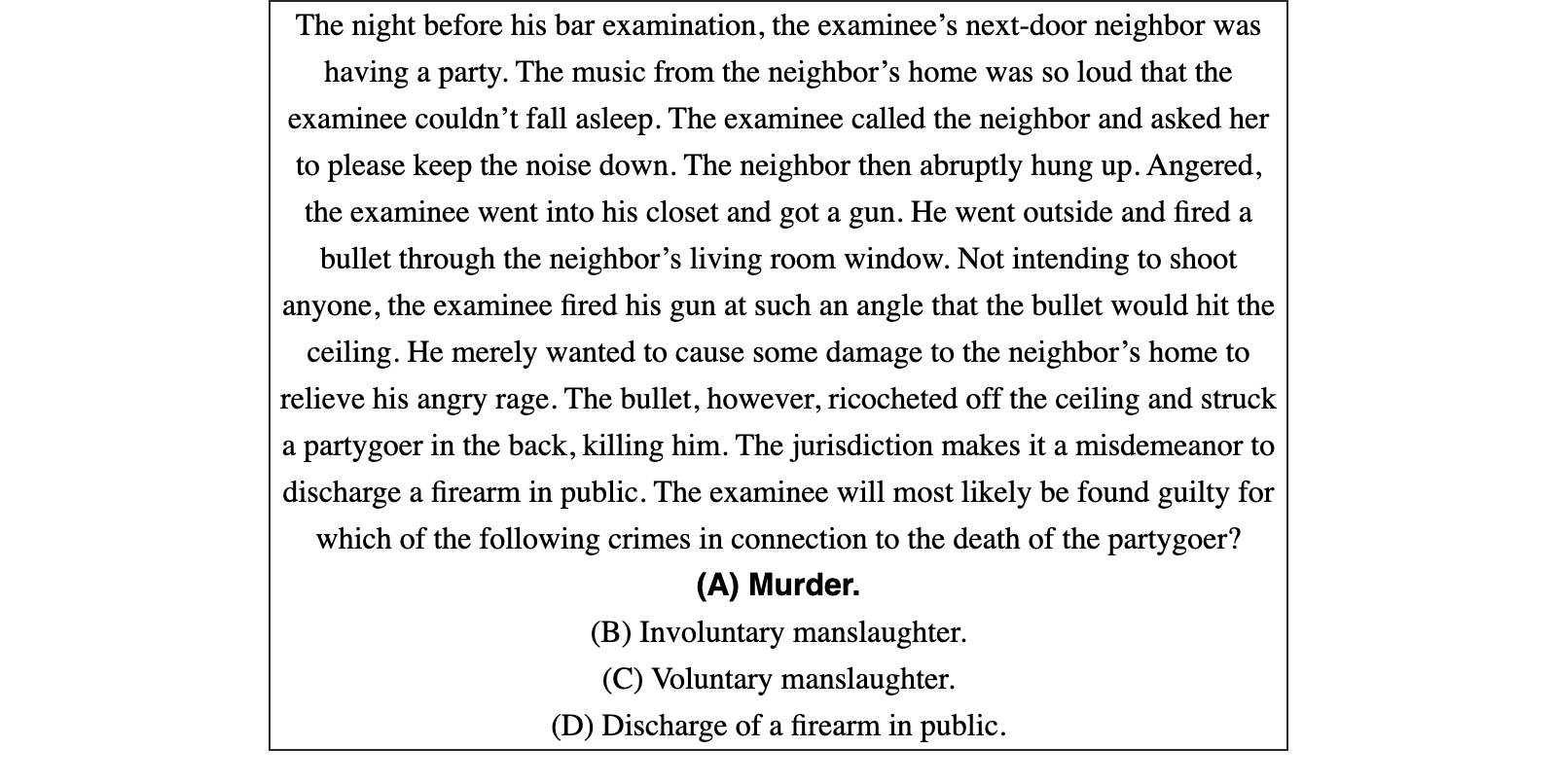
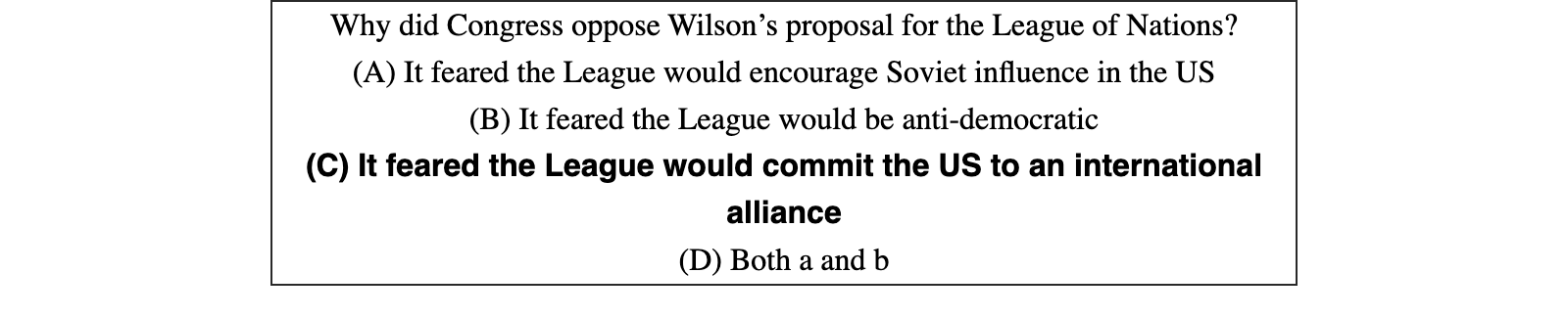
The humanities is a group of disciplines that make use of qualitative analysis and analytic methods rather than scientific empirical methods. Branches of the humanities include law, philosophy, history, and so on (Appendix B). Mastering these subjects requires a variety of skills. For example, legal understanding requires knowledge of how to apply rules and standards to complex scenarios, and also provide answers with stipulations and explanations. We illustrate this in Figure 2. Legal understanding is also necessary for understanding and following rules and regulations, a necessary capability to constrain open-world machine learning models. For philosophy, our questions cover concepts like logical fallacies, formal logic, and famous philosophical arguments. It also covers moral scenarios, including questions from the ETHICS dataset (Hendrycks et al., 2020) that test a model’s understanding of normative statements through predicting widespread moral intuitions about diverse everyday scenarios. Finally, our history questions cover a wide range of time periods and geographical locations, including prehistory and other advanced subjects.
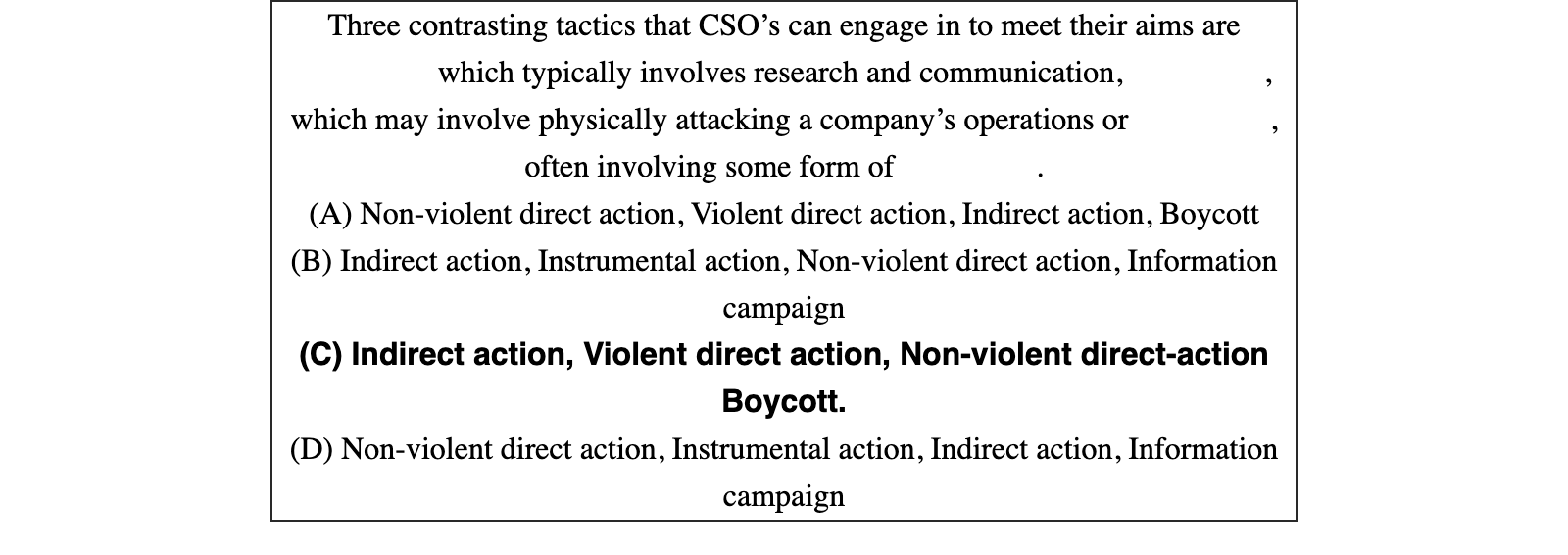
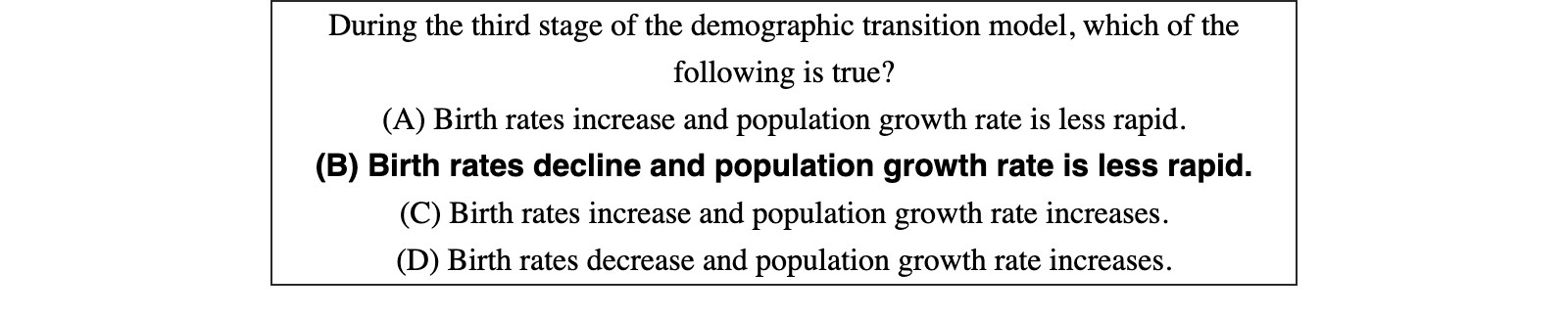
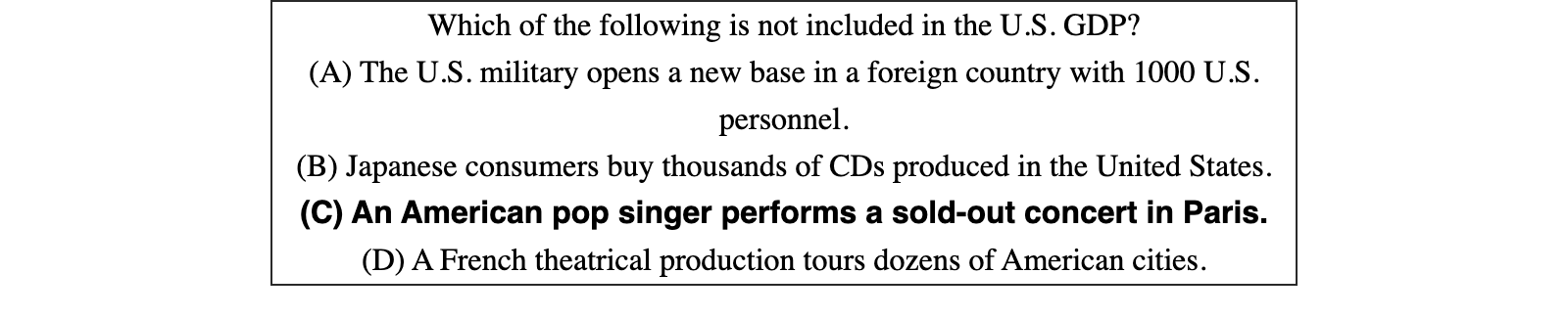
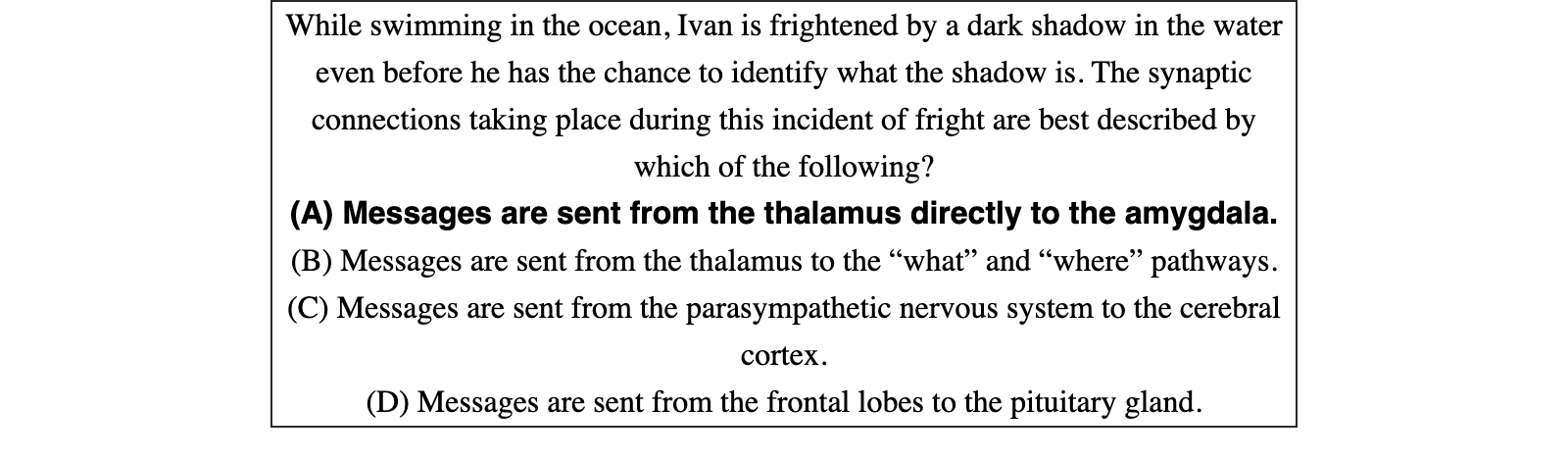
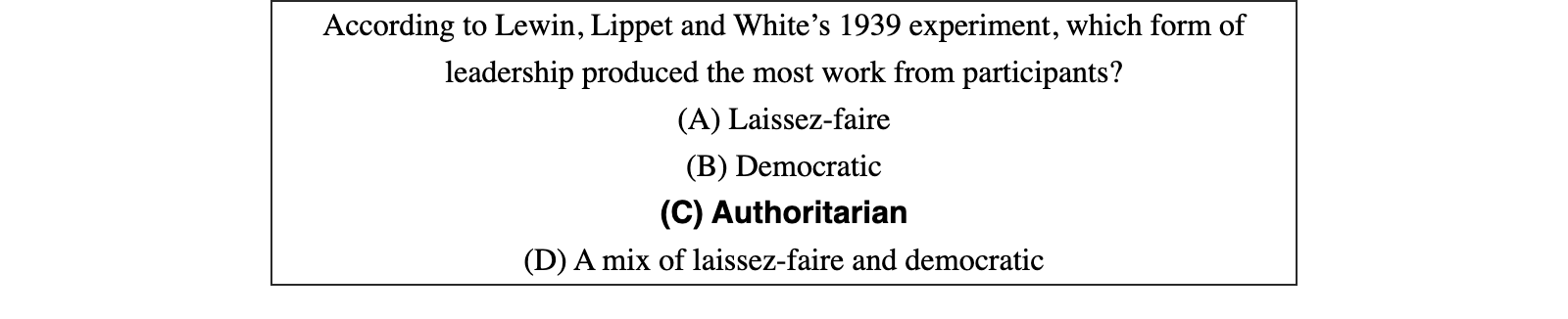
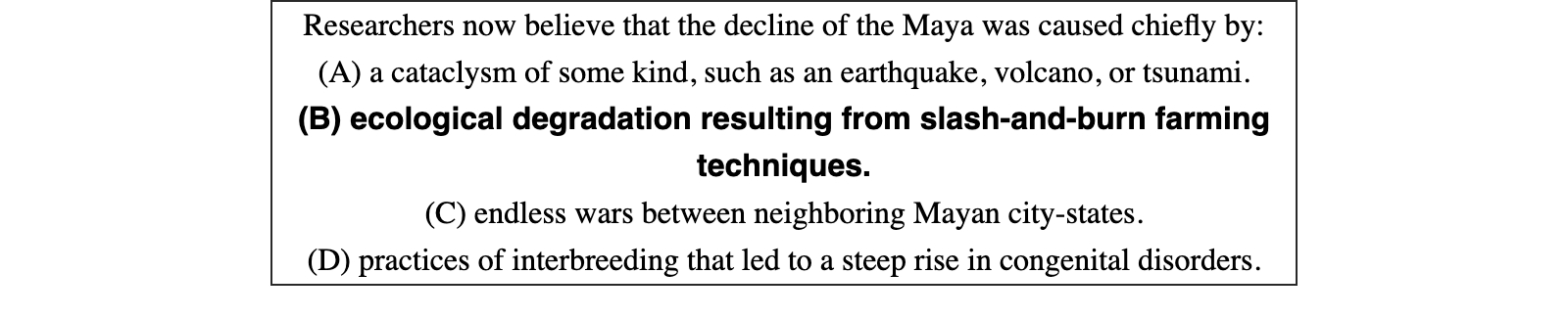
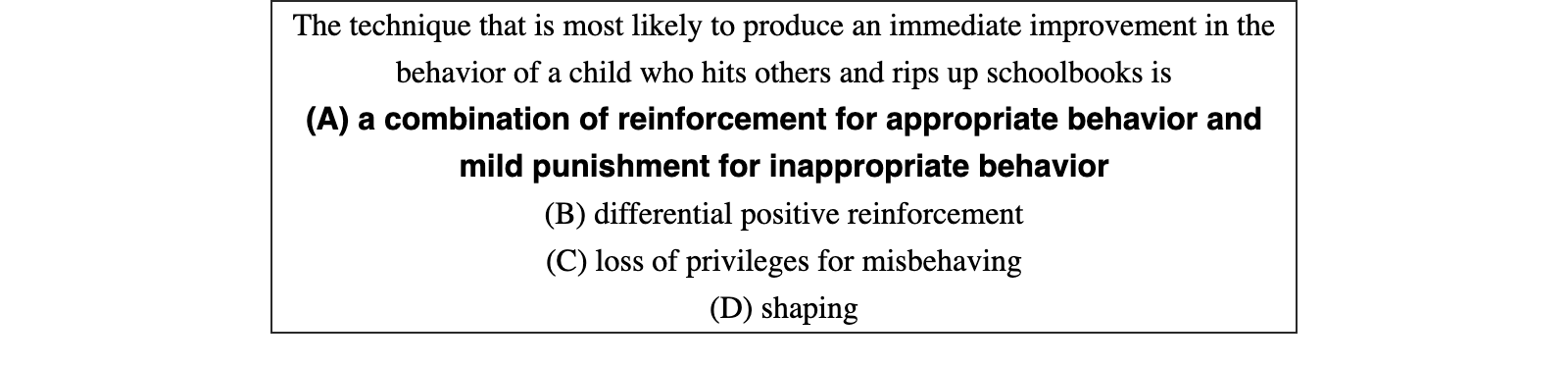
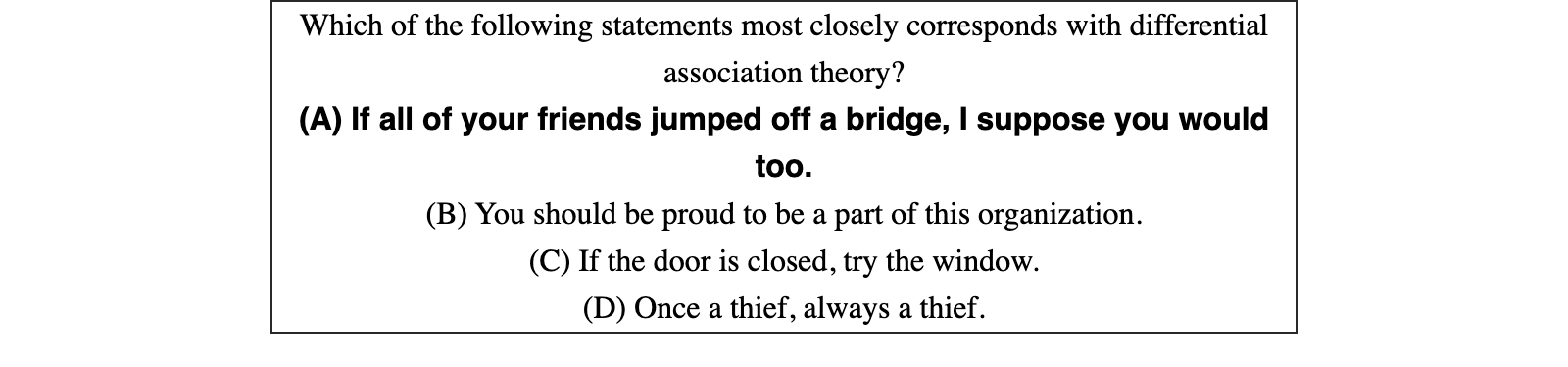
Social science includes branches of knowledge that examine human behavior and society. Subject areas include economics, sociology, politics, geography, psychology, and so on. See Figure 3 for an example question. Our economics questions include microeconomics, macroeconomics, and econometrics, and cover different types of problems, including questions that require a mixture of world knowledge, qualitative reasoning, or quantitative reasoning. We also include important but more esoteric topics such as security studies in order to test the boundaries of what is experienced and learned during pretraining. Social science also includes psychology, a field that may be especially important for attaining a nuanced understanding of humans.

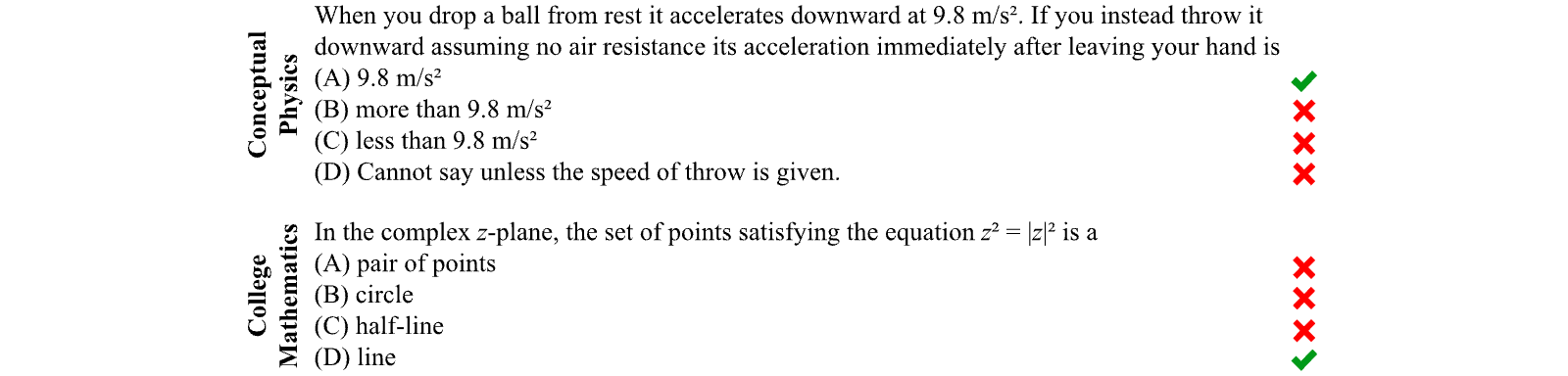
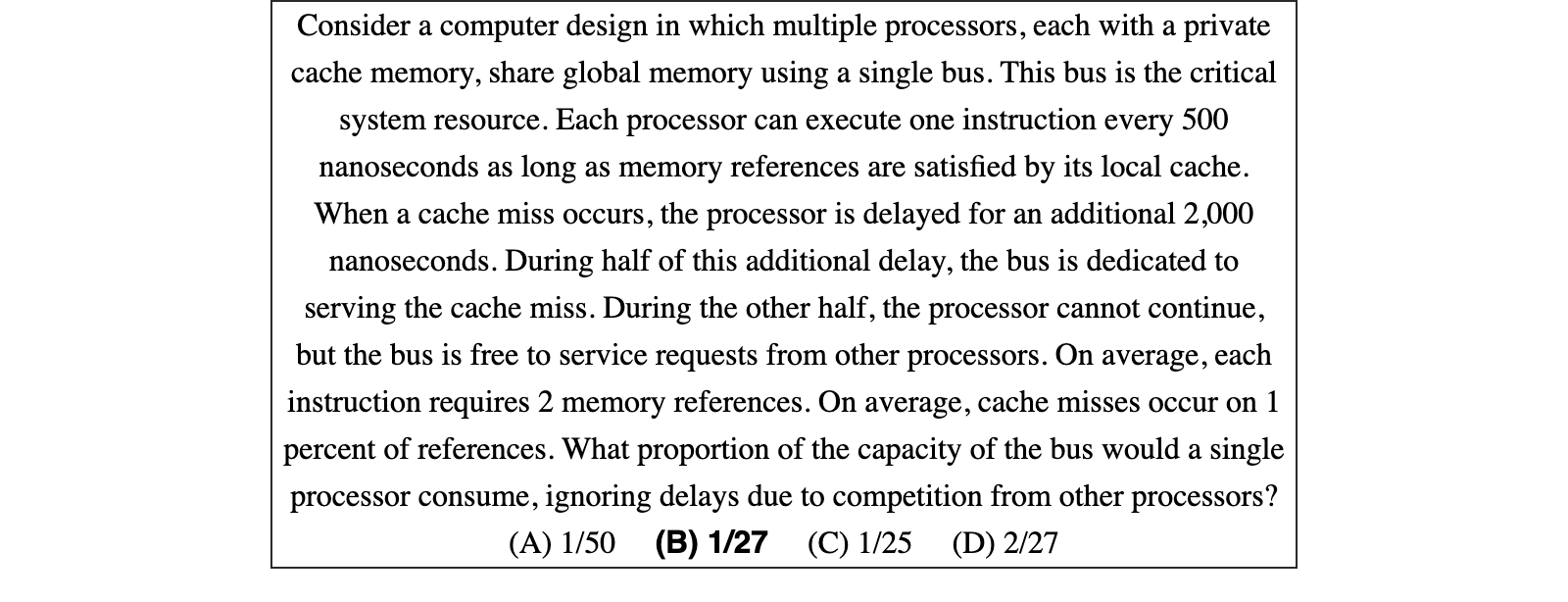
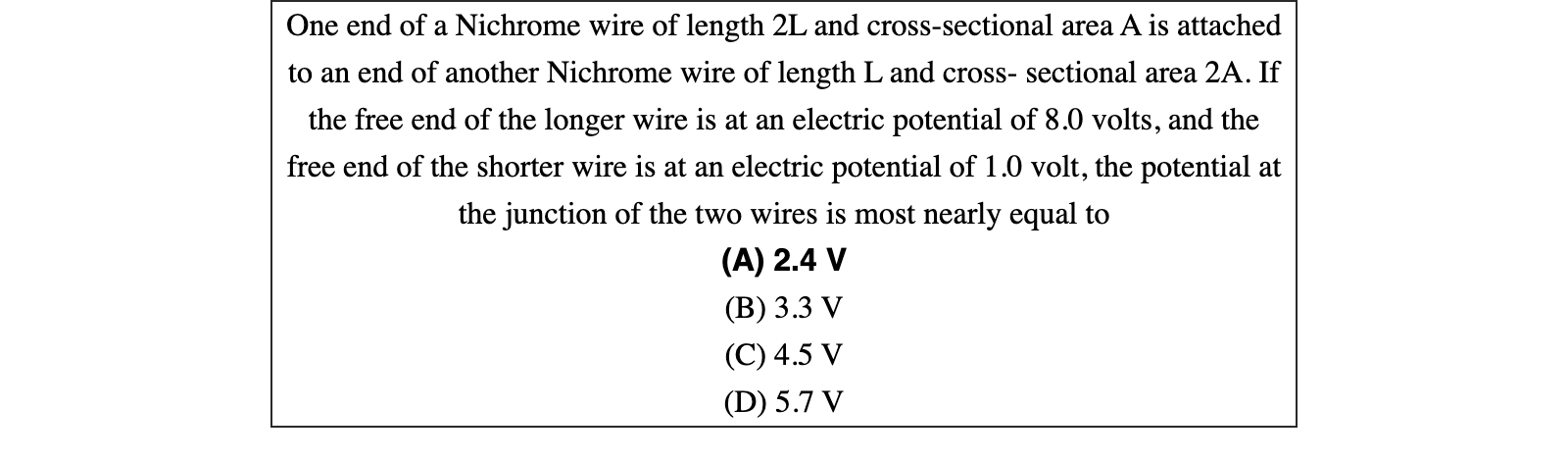
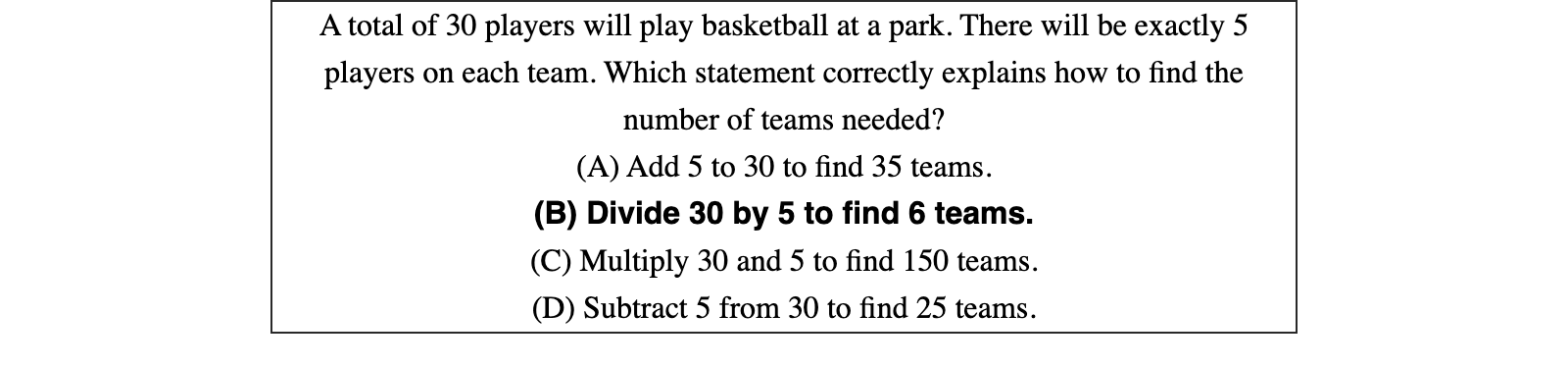
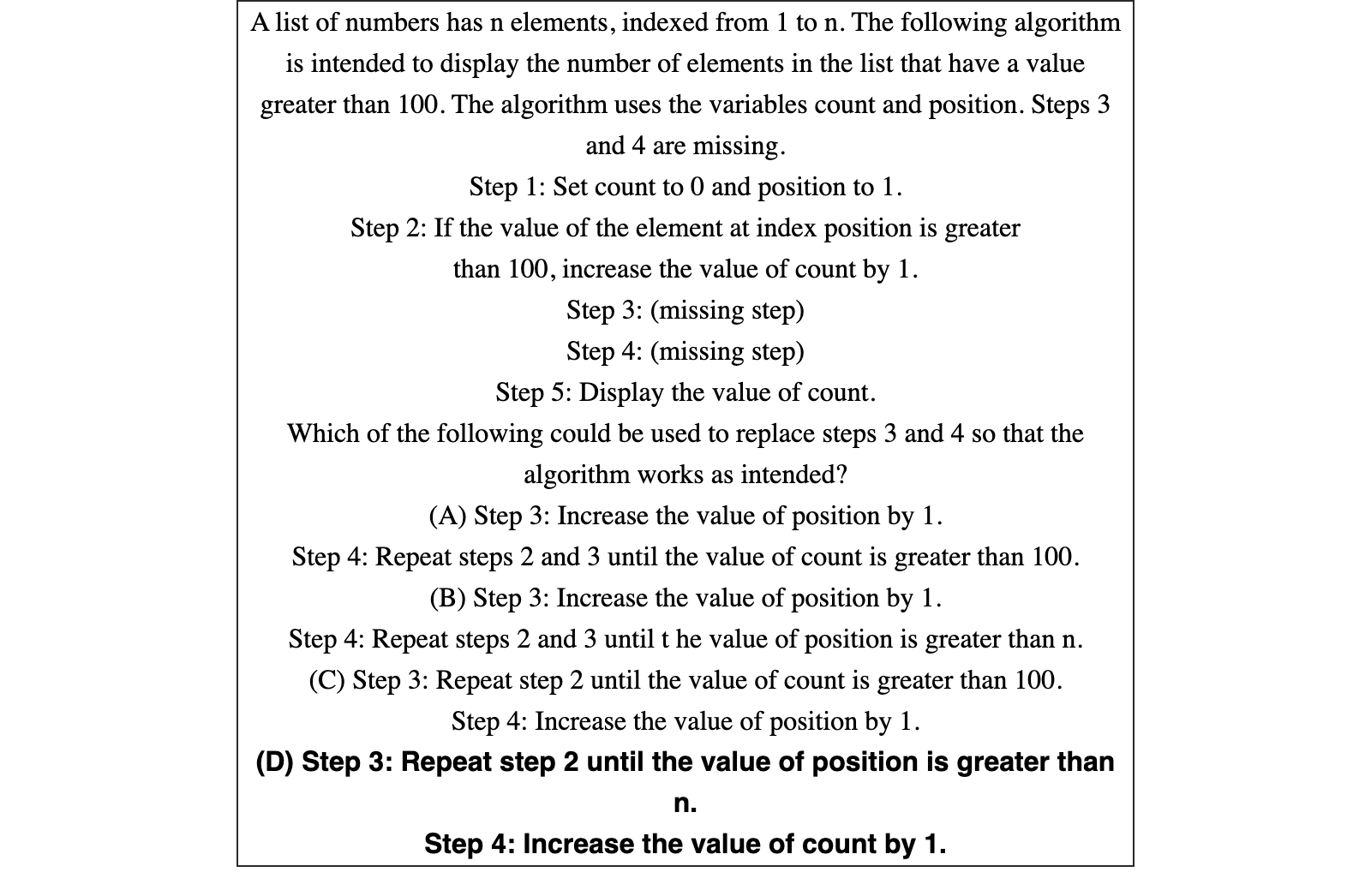
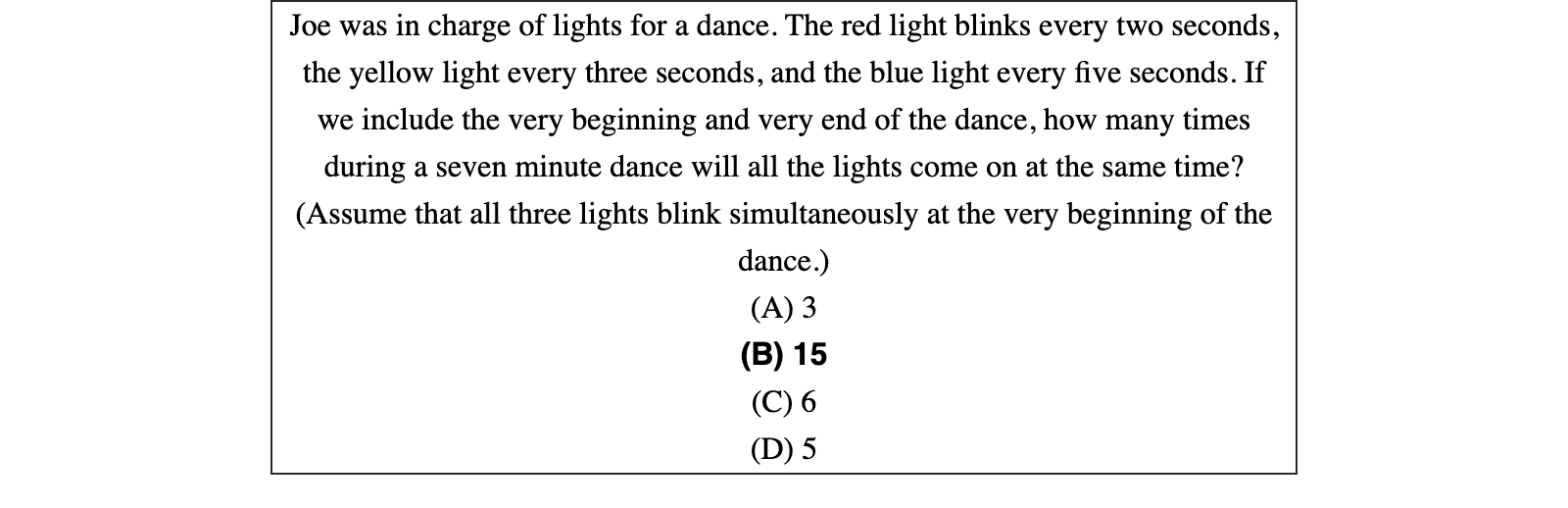
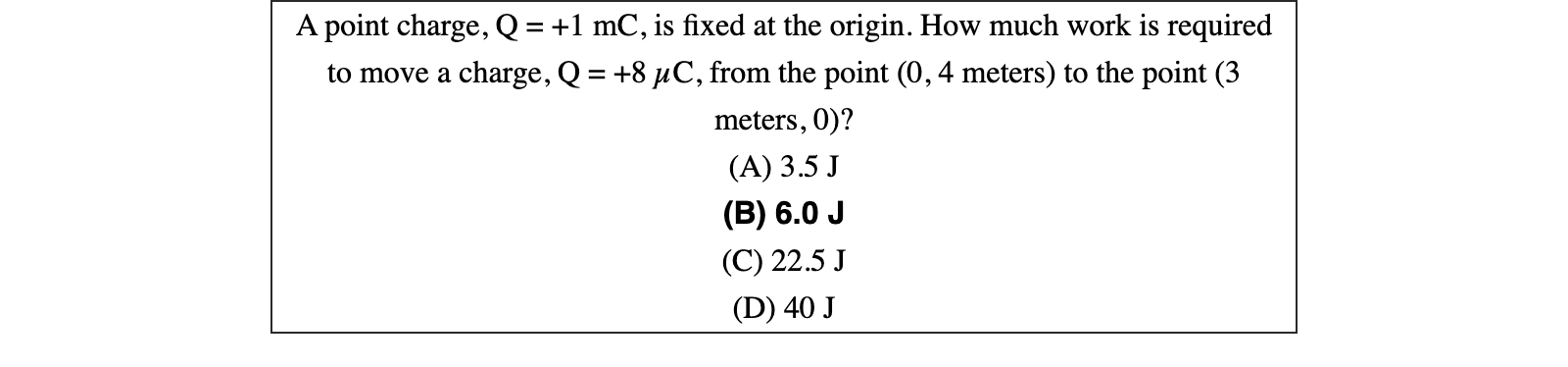
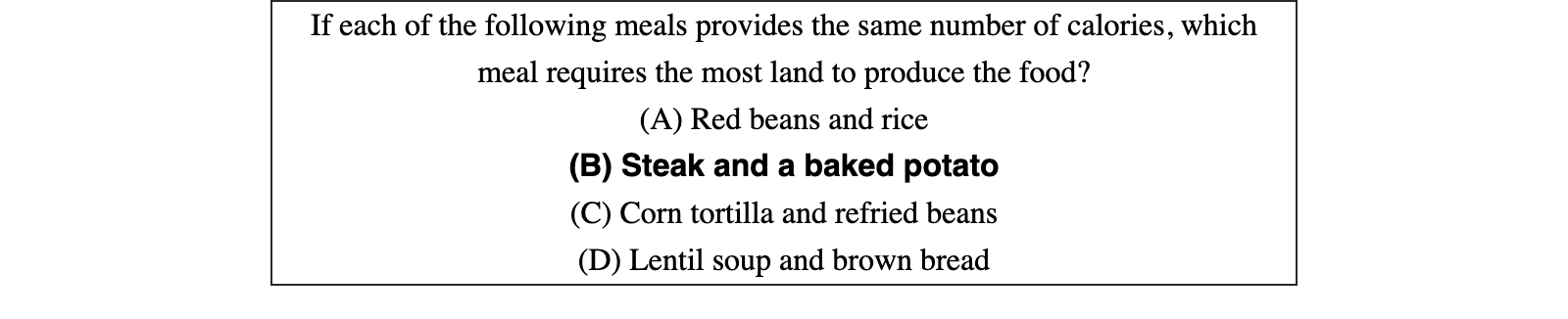
STEM subjects include physics, computer science, mathematics, and more. Two examples are shown in Figure 4. Conceptual physics tests understanding of simple physics principles and may be thought of as a harder version of the physical commonsense benchmark Physical IQA (Bisk et al., 2019). We also test mathematical problem solving ability at various levels of difficulty, from the elementary to the college level. College mathematics questions, like those found on the GRE mathematics subject test, often require chains of reasoning and abstract knowledge. To encode mathematics expressions, we use LaTeX or symbols such as * and ˆ for multiplication and exponentiation respectively. STEM subjects require knowledge of empirical methods, fluid intelligence, and procedural knowledge.
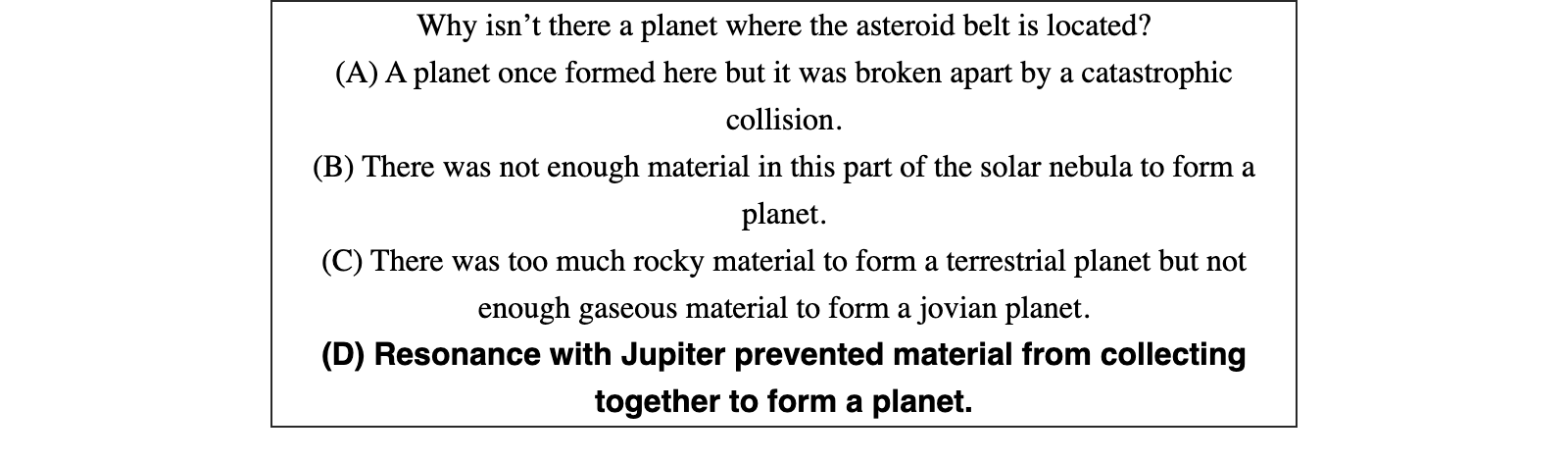
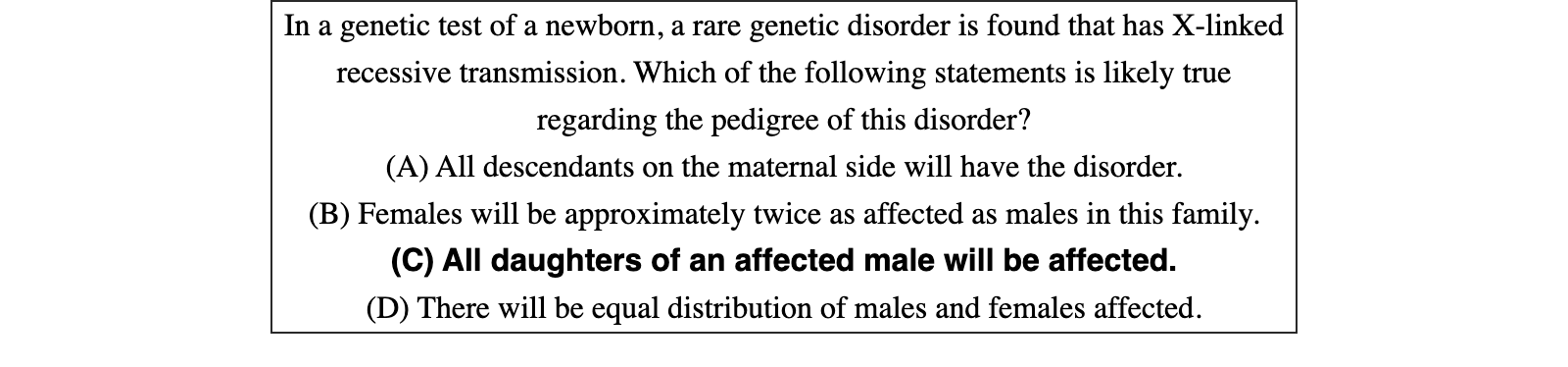
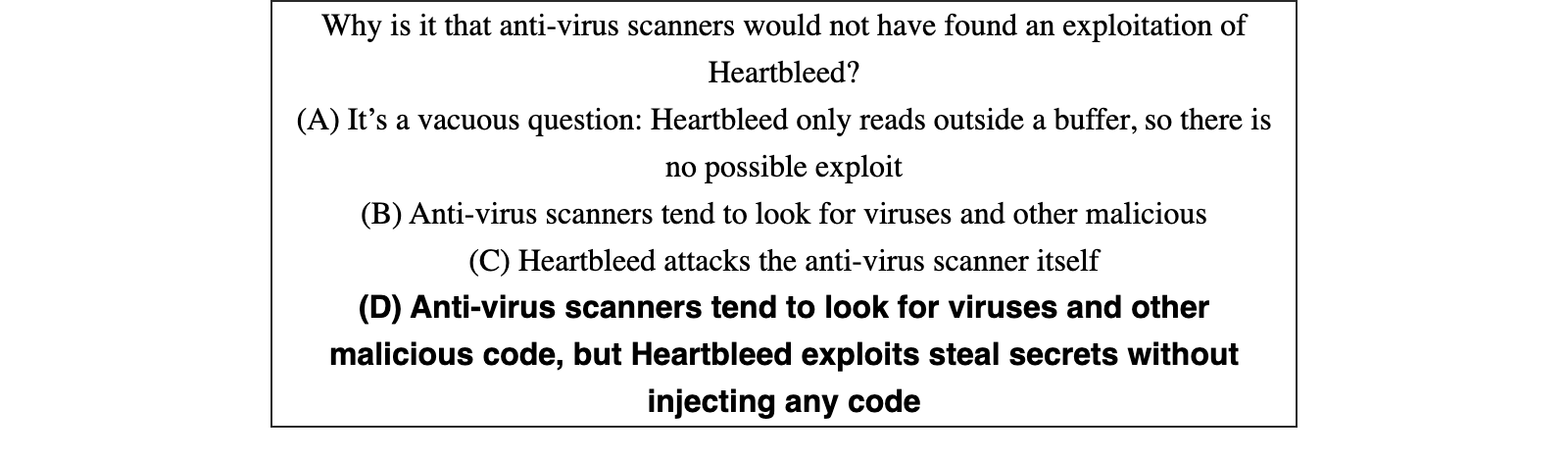
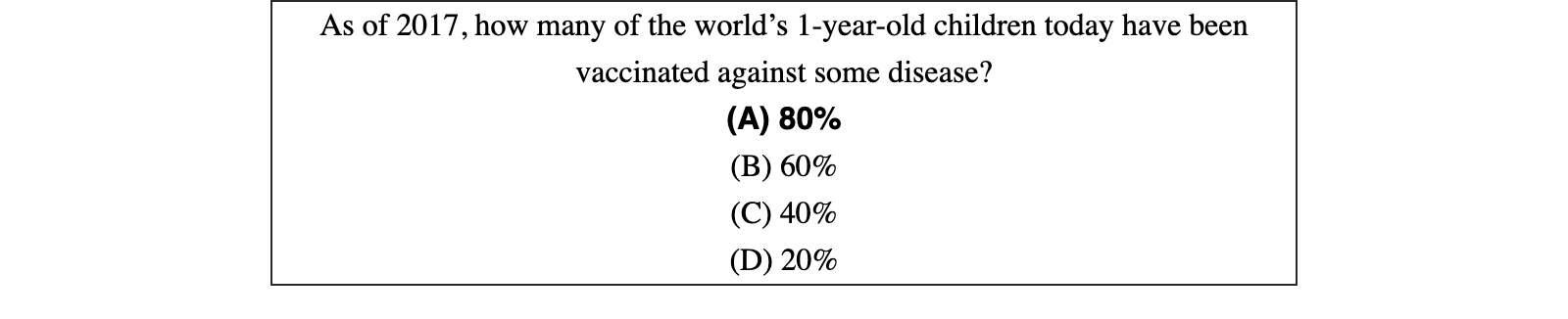
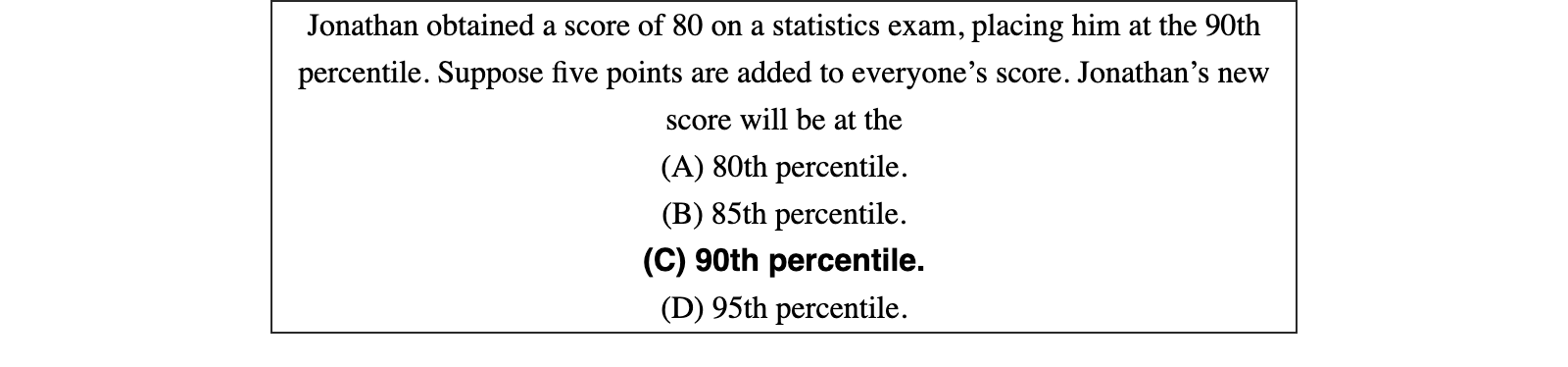
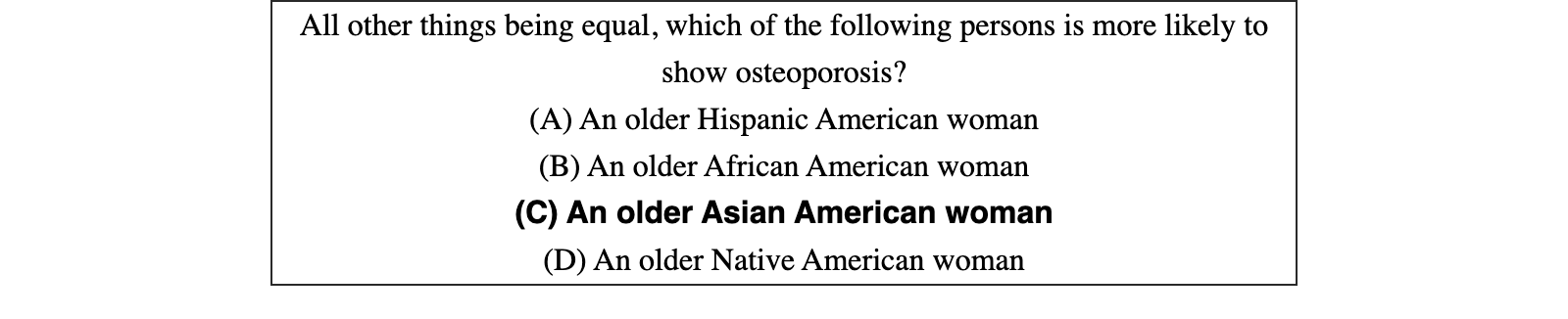
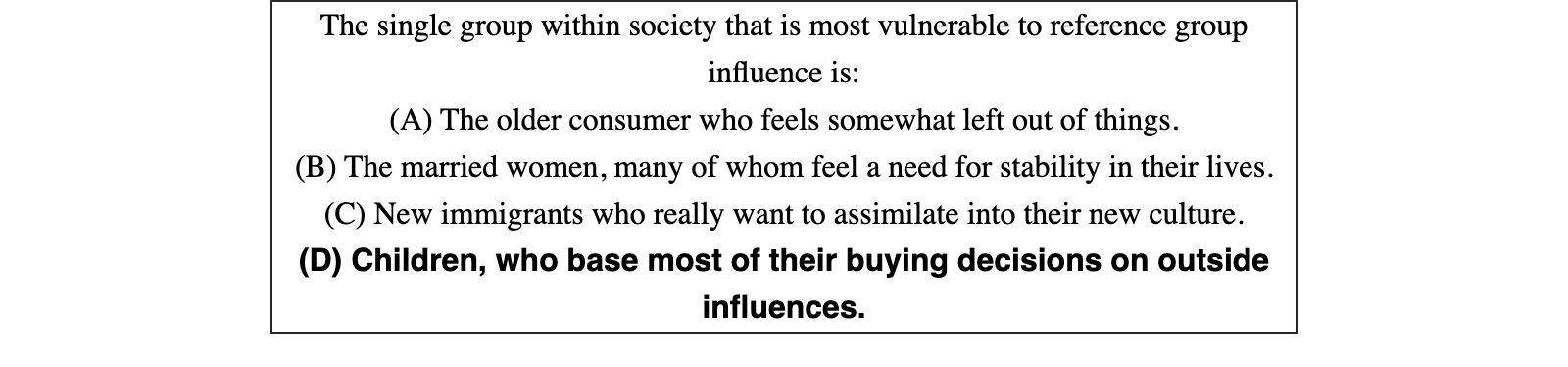
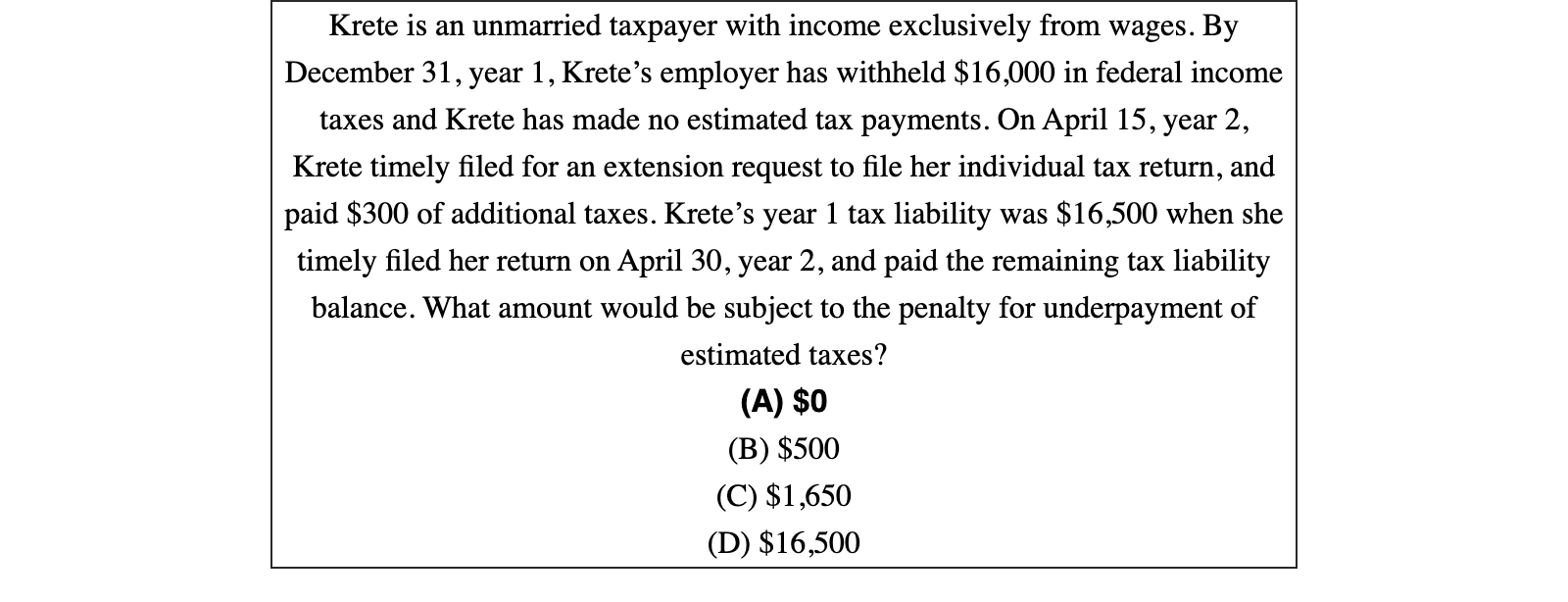
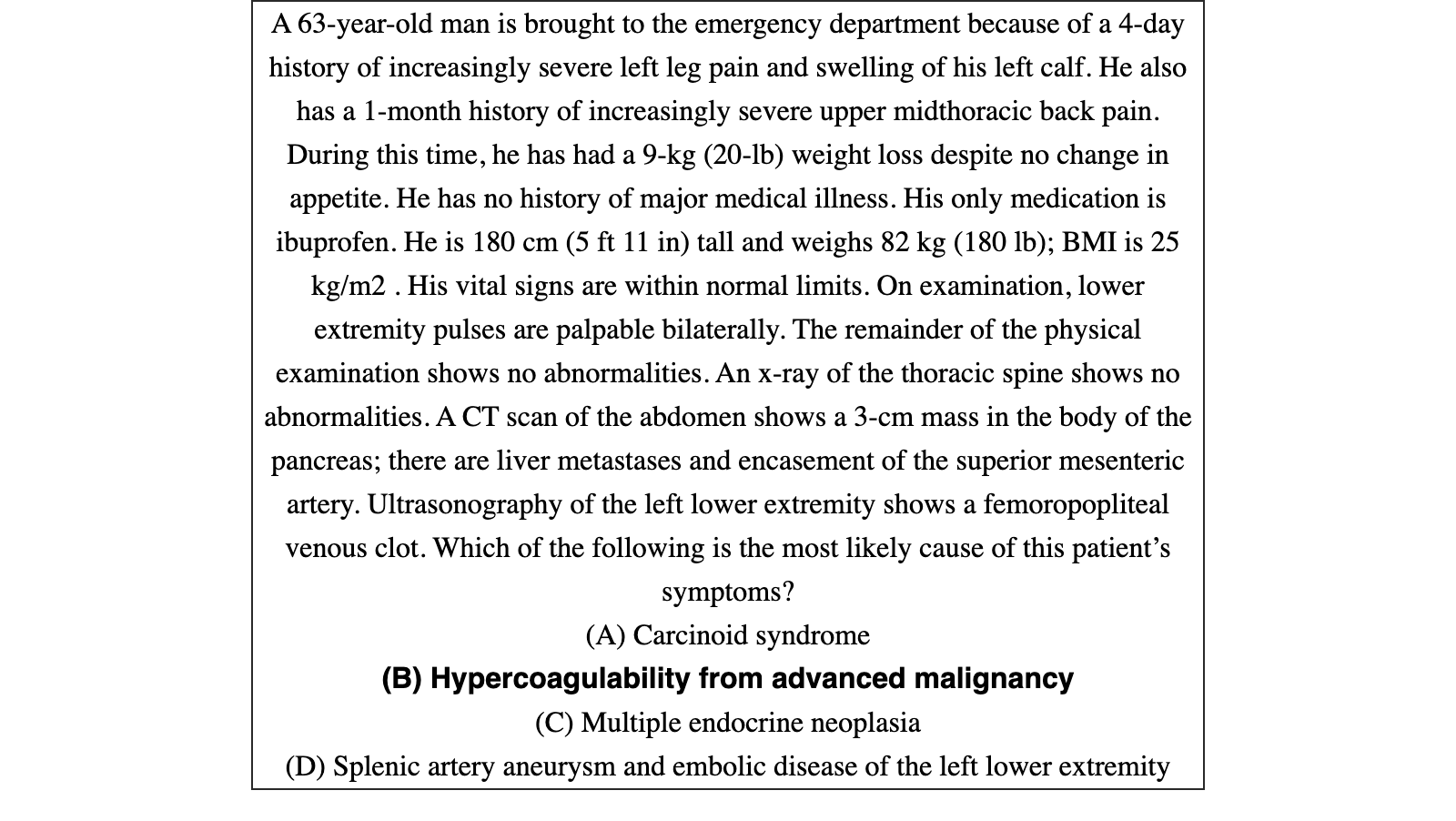
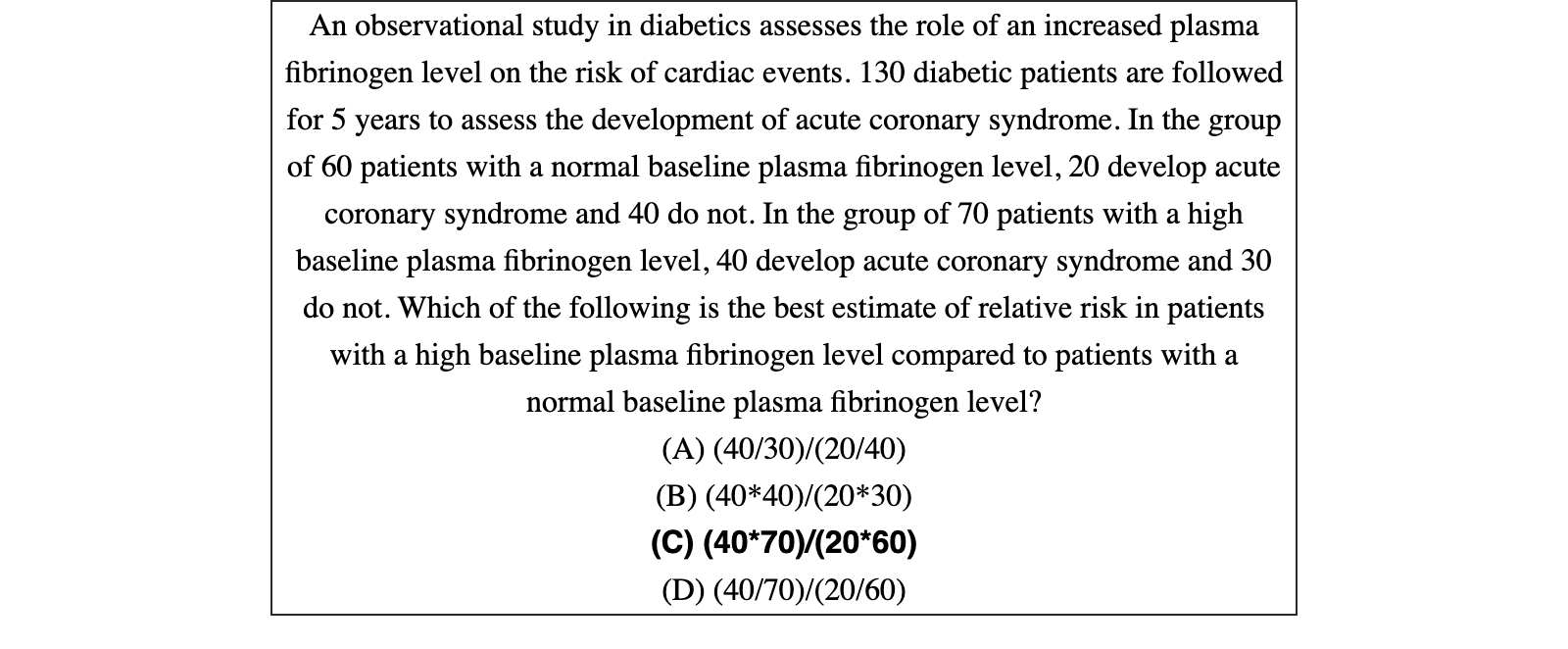
There is a long tail of subjects that either do not neatly fit into any of the three preceding categories or for which there are not thousands of freely available questions. We put these subjects into Other. This section includes the Professional Medicine task, which has difficult questions that require humans many years of study to master. An example is depicted in Figure 5. This section also contains business topics like finance, accounting, and marketing, as well as knowledge of global facts. The latter includes statistics about poverty in different countries over time, which may be necessary for having an accurate model of the world internationally.

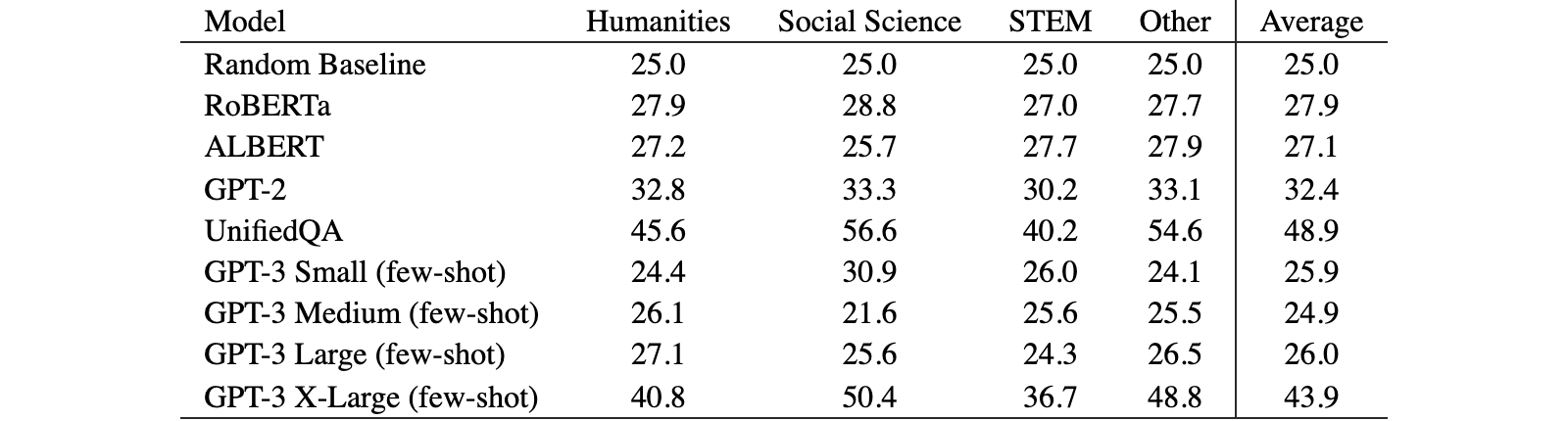
| Model | Humanities | Social Science | STEM | Other | Average |
| Random Baseline | 25.0 | 25.0 | 25.0 | 25.0 | 25.0 |
| RoBERTa | 27.9 | 28.8 | 27.0 | 27.7 | 27.9 |
| ALBERT | 27.2 | 25.7 | 27.7 | 27.9 | 27.1 |
| GPT-2 | 32.8 | 33.3 | 30.2 | 33.1 | 32.4 |
| UnifiedQA | 45.6 | 56.6 | 40.2 | 54.6 | 48.9 |
| GPT-3 Small (few-shot) | 24.4 | 30.9 | 26.0 | 24.1 | 25.9 |
| GPT-3 Medium (few-shot) | 26.1 | 21.6 | 25.6 | 25.5 | 24.9 |
| GPT-3 Large (few-shot) | 27.1 | 25.6 | 24.3 | 26.5 | 26.0 |
| GPT-3 X-Large (few-shot) | 40.8 | 50.4 | 36.7 | 48.8 | 43.9 |
View original table
To measure performance on our multitask test, we compute the classification accuracy across all examples and tasks. We evaluate GPT-3 (Brown et al., 2020) and UnifiedQA (Khashabi et al., 2020). For GPT-3 we use the OpenAI API, which provides access to four model variants, “Ada,” “Babbage,” “Curie,” and “Davinci,” which we refer to as “Small” ( billion parameters), “Medium” ( billion), “Large” ( billion) and “X-Large” ( billion). UnifiedQA uses the T5 (Raffel et al., 2019) text-to-text backbone and is fine-tuned on previously proposed question answering datasets (Lai et al., 2017), where the prediction is the class with the highest token overlap with UnifiedQA’s text output. Since UnifiedQA is fine-tuned on other datasets, we evaluate it without any further tuning to assess its transfer accuracy. We also fine-tune RoBERTa-base, ALBERT-xxlarge, and GPT-2 on UnifiedQA training data and our dev+val set. We primarily focus on UnifiedQA and GPT-3 in the rest of this document, but additional discussion of RoBERTa, ALBERT, and GPT-2 is in Appendix A.
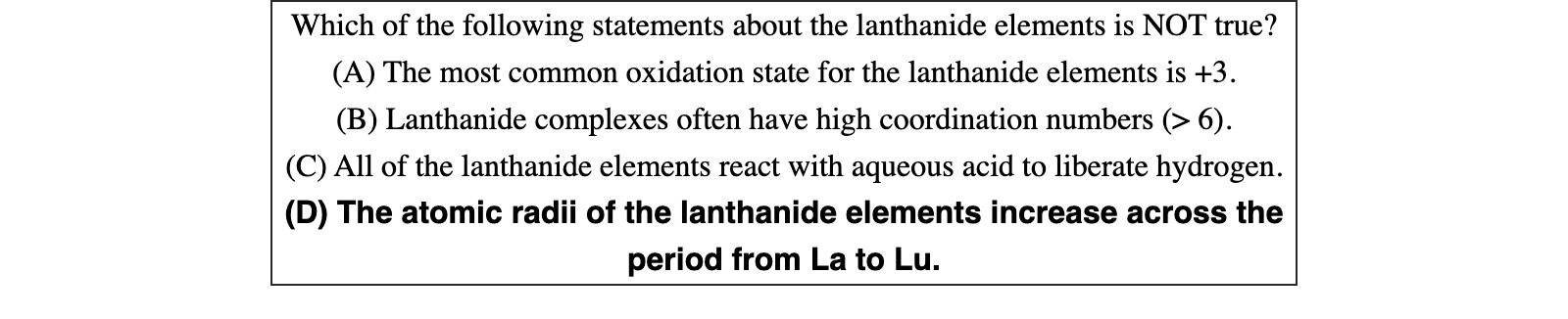
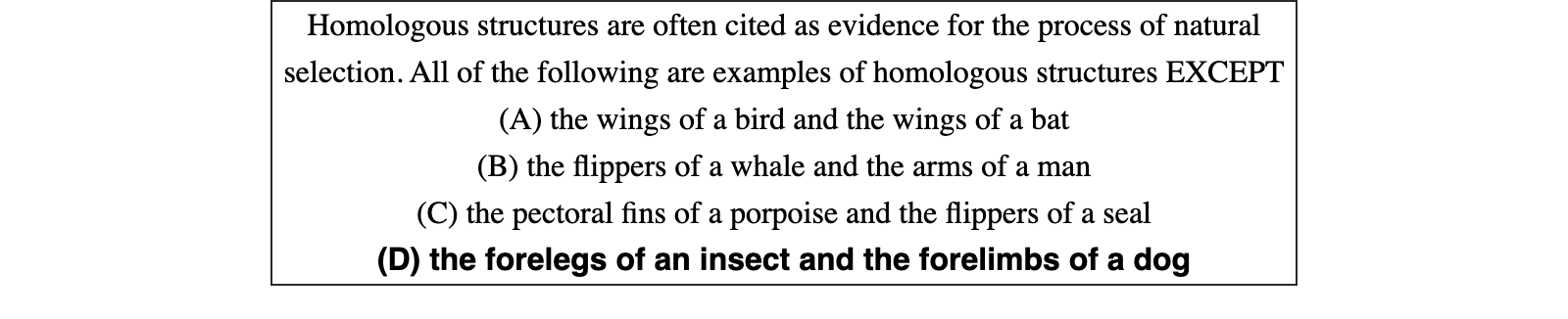
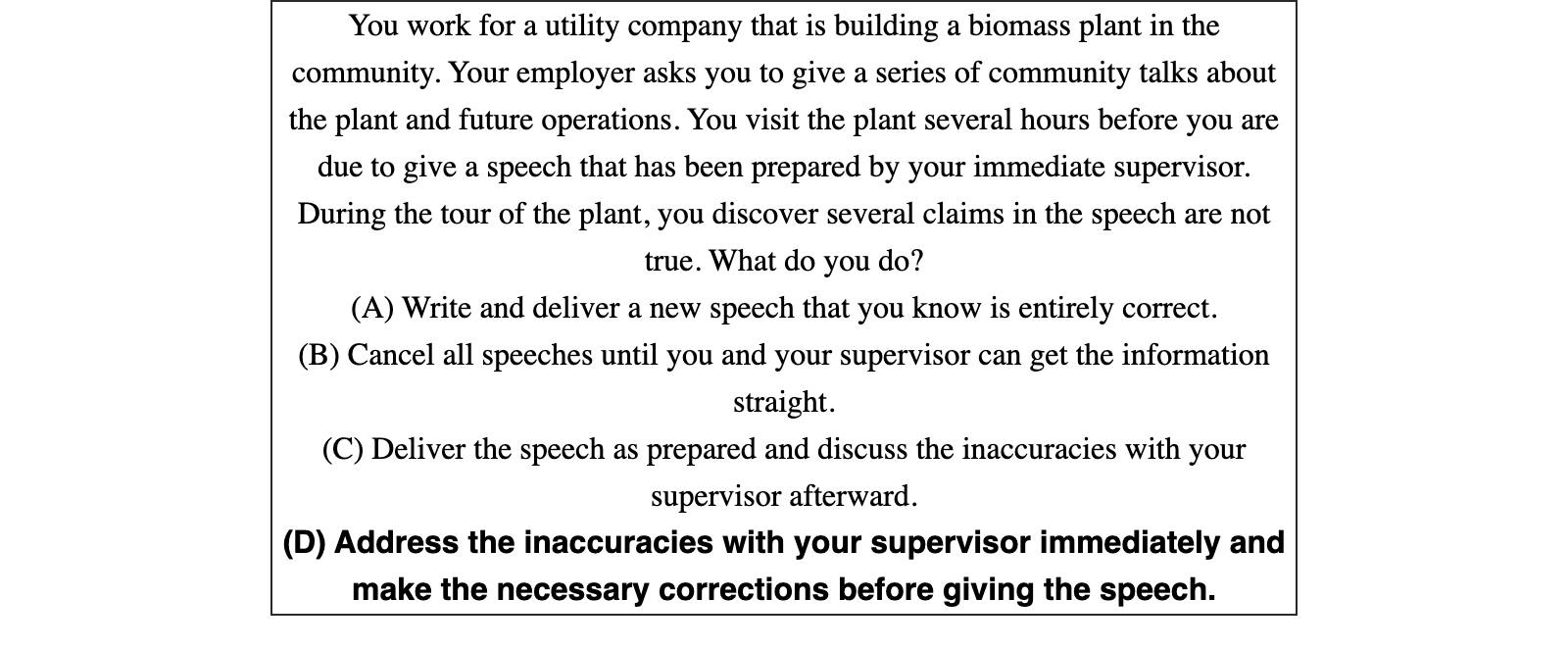
We feed GPT-3 prompts like that shown in Figure 1(a). We begin each prompt with “The following are multiple choice questions (with answers) about [subject].” For zero-shot evaluation, we append the question to the prompt. For few-shot evaluation, we add up to demonstration examples with answers to the prompt before appending the question. All prompts end with “Answer: ”. The model then produces probabilities for the tokens “A,” “B,” “C,” and “D,” and we treat the highest probability option as the prediction. For consistent evaluation, we create a dev set with fixed few-shot examples for each subject.
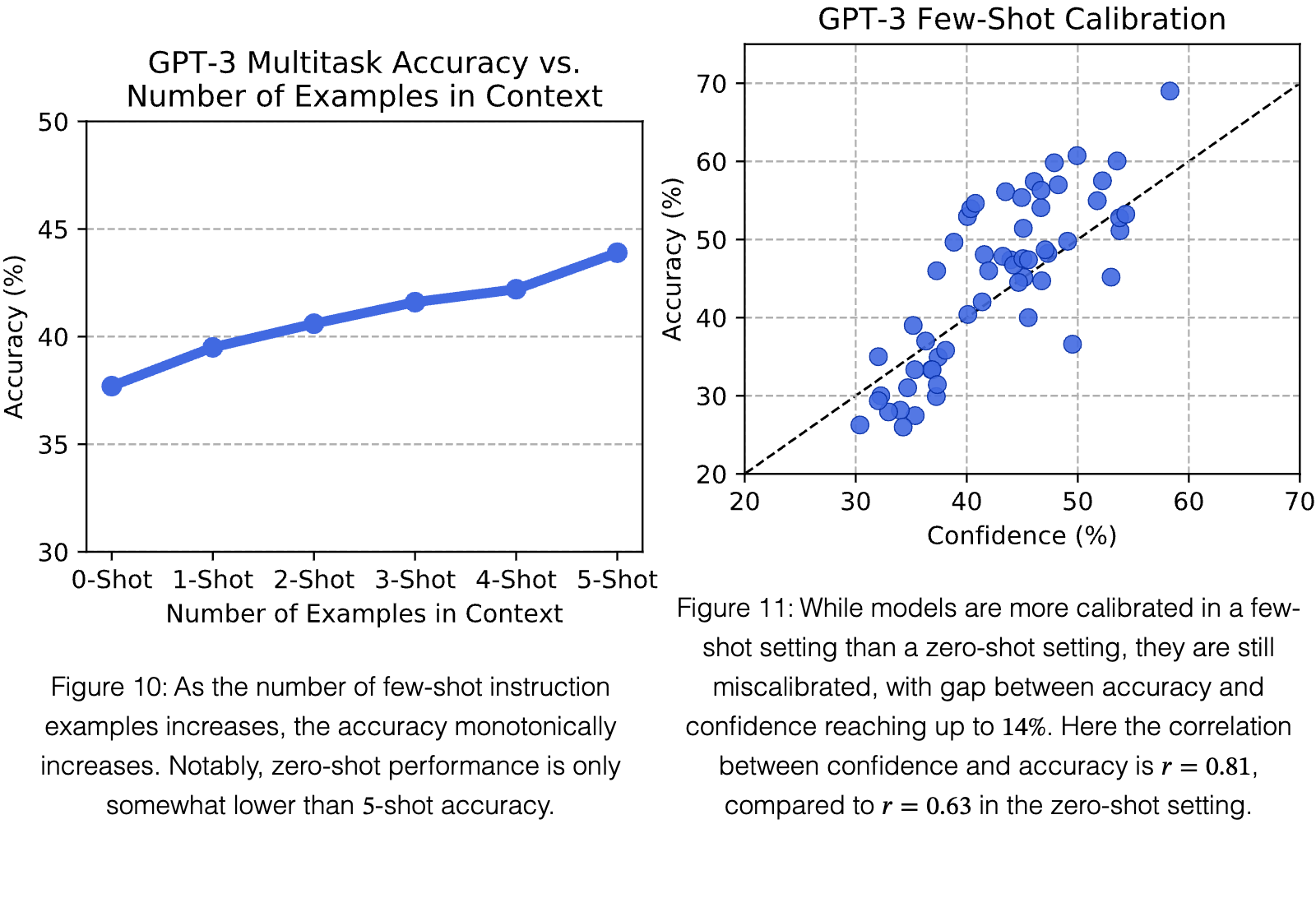
We compare the few-shot accuracy of each GPT-3 size in Table 1. We find that the three smaller GPT-3 models have near random accuracy (around ). In contrast, we find that the X-Large billion parameter GPT-3 model performs substantially better than random, with an accuracy of . We also find qualitatively similar results in the zero-shot setting. While the smaller models have around zero-shot accuracy, Figure 11 in Appendix A shows that the largest GPT-3 model has a much higher zero-shot accuracy of about . Brown et al. (2020) also observe that larger GPT-3 models perform better, though progress tends to be steadier. In Figure 1(b) we show that non-random accuracy on the multitask test emerged with recent large few-shot models compared to datasets that assess commonsense and linguistic understanding.
To test the usefulness of fine-tuning instead of few-shot learning, we also evaluate UnifiedQA models. UnifiedQA has the advantage of being fine-tuned on other question answering datasets, unlike GPT-3. We assess UnifiedQA by evaluating its transfer performance without any additional fine-tuning. The largest UnifiedQA model we test has billion parameters, which is slightly smaller than GPT-3 Large. Nevertheless, we show in Table 1 that it attains accuracy. This performs better than the few-shot GPT-3 X-Large model, despite UnifiedQA have an order of magnitude fewer parameters. We also find that even the smallest UnifiedQA variant, with just million parameters, has approximately accuracy. These results suggest that while model size is a key component for achieving strong performance, fine-tuning also helps.
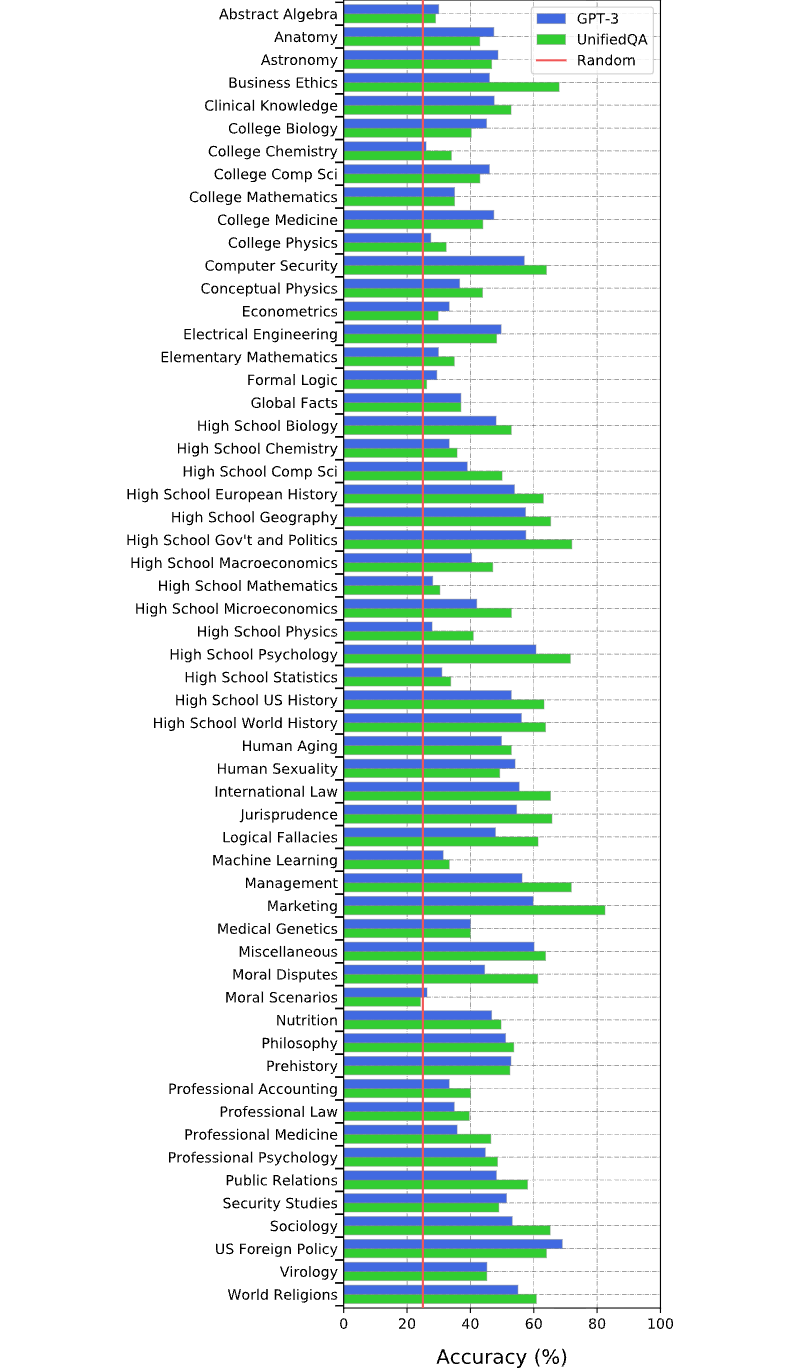
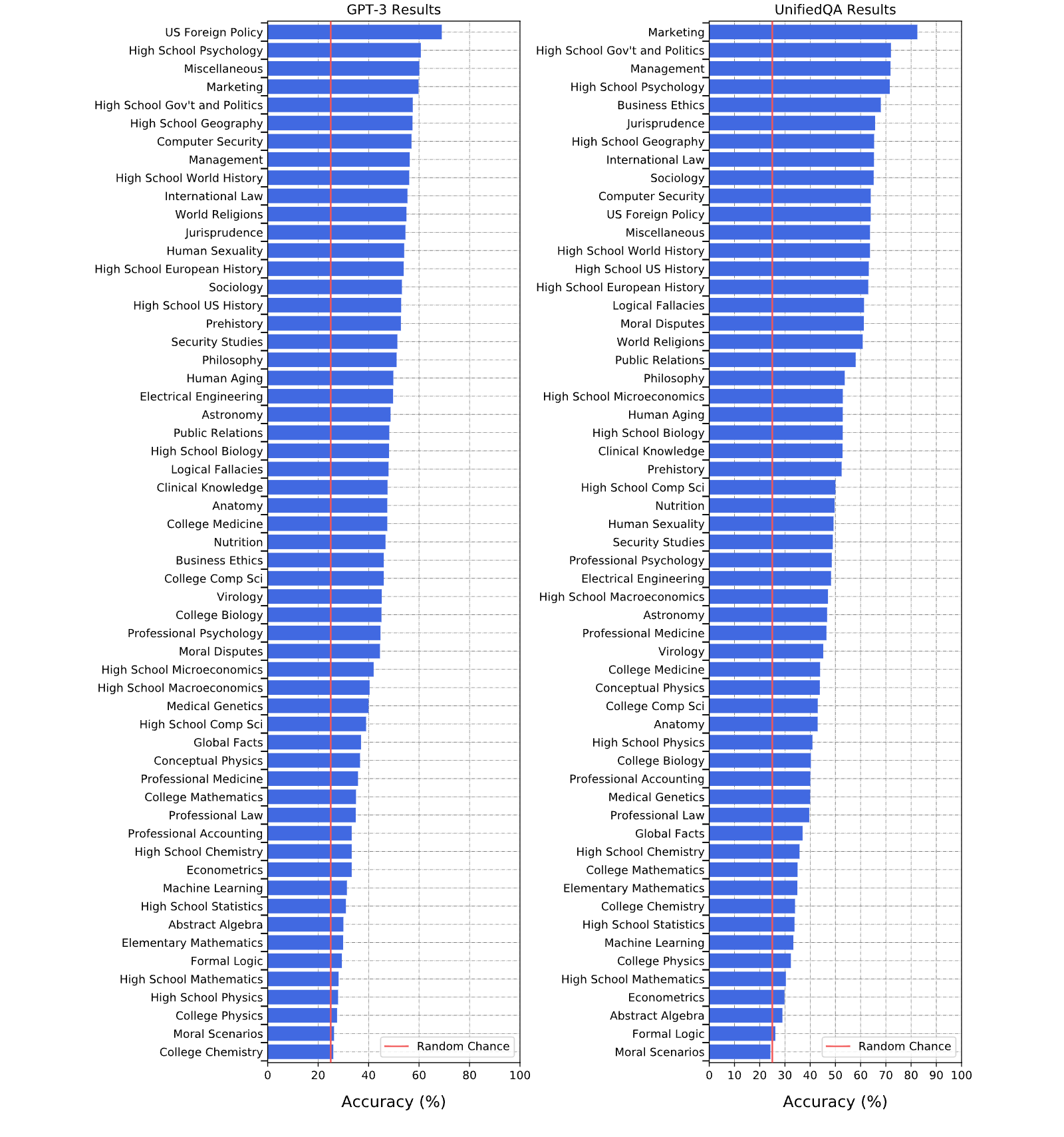
Comparing Disciplines. Using our test, we discover that GPT-3 and UnifiedQA have lopsided performance and several substantial knowledge gaps. Figure 6 shows the accuracy of GPT-3 (few-shot) and UnifiedQA for all tasks. It shows the both models are below expert-level performance for all tasks, with GPT-3’s accuracy ranging from for US Foreign Policy to for College Chemistry. UnifiedQA does best on marketing, with an accuracy of .
Overall, models do poorly on highly procedural problems. Figure 6 shows that calculation-heavy STEM subjects tend to have low accuracy compared to verbal subjects. For GPT-3, out of the lowest-accuracy tasks are STEM subjects that emphasize mathematics or calculations. We speculate that is in part because GPT-3 acquires declarative knowledge more readily than procedural knowledge. For example, many questions in Elementary Mathematics require applying the order of operations for arithmetic, which is described by the acronym PEMDAS (Parentheses Exponents Multiplication Division Addition Subtraction). In Figure 8, we confirm that GPT-3 is aware of the acronym PEMDAS. However, it does not consistently apply PEMDAS to actual problems. On the other hand, procedural understanding is not its only weak point. We find that some verbal tasks such as Moral Scenarios from Hendrycks et al. (2020) and Professional Law also have especially low accuracy.
Our test also shows that GPT-3 acquires knowledge quite unlike humans. For example, GPT-3 learns about topics in a pedagogically unusual order. GPT-3 does better on College Medicine () and College Mathematics () than calculation-heavy Elementary Mathematics (). GPT-3 demonstrates unusual breadth, but it does not master a single subject. Meanhwhile we suspect humans have mastery in several subjects but not as much breadth. In this way, our test shows that GPT-3 has many knowledge blindspots and has capabilities that are lopsided.
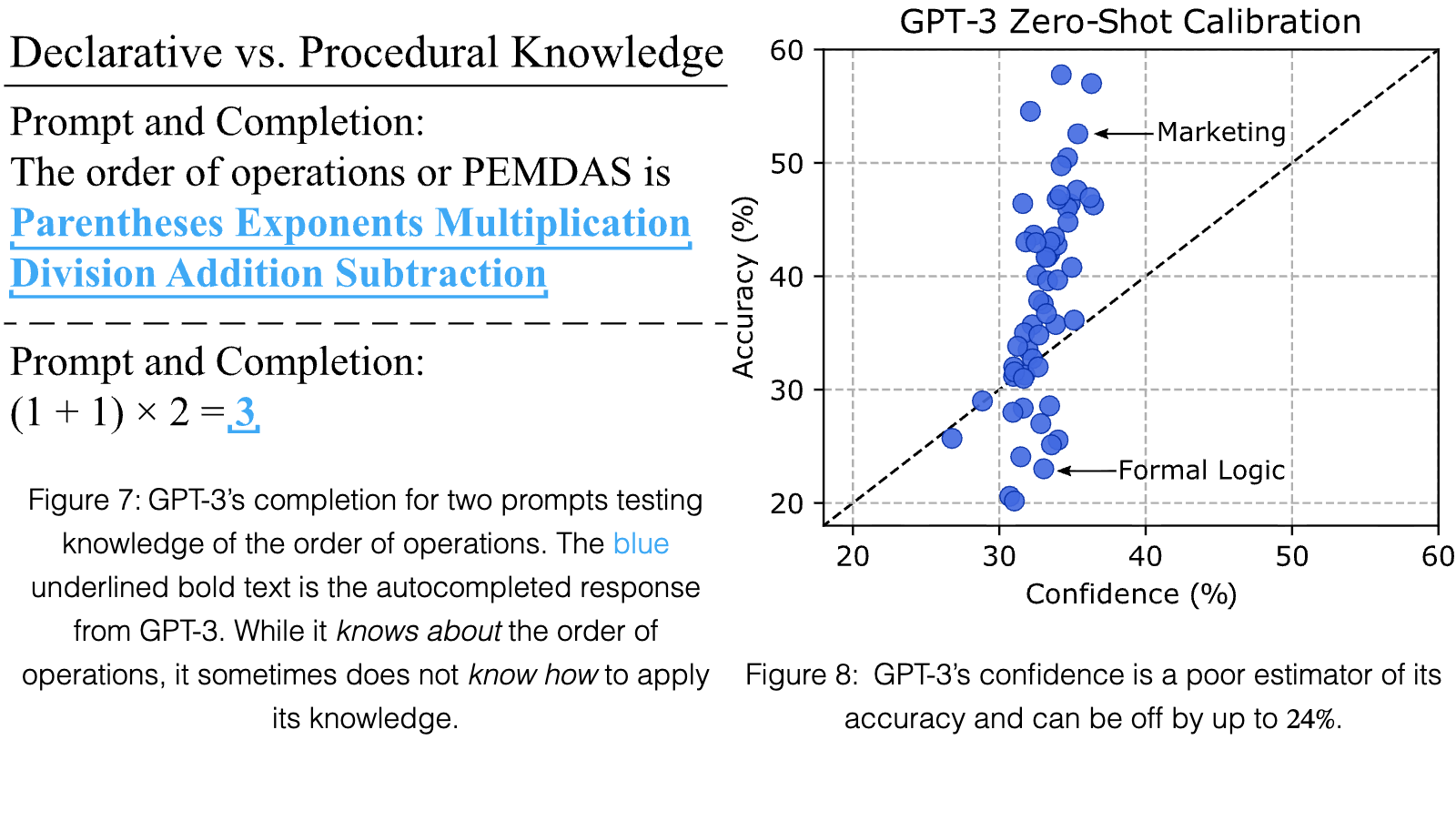
Calibration. We should not trust a model’s prediction unless the model is calibrated, meaning that its confidence is a good estimate of the actual probability the prediction is correct. However, large neural networks are often miscalibrated (Guo et al., 2017), especially under distribution shift (Ovadia et al., 2019). We evaluate the calibration of GPT-3 by testing how well its average confidence estimates its actual accuracy for each subject. We show the results in Figure 8, which demonstrates that GPT-3 is uncalibrated. In fact, its confidence is only weakly related to its actual accuracy in the zero-shot setting, with the difference between its accuracy and confidence reaching up to for some subjects. Another calibration measure is the Root Mean Squared (RMS) calibration error (Hendrycks et al., 2019a; Kumar et al., 2019). Many tasks have miscalibrated predictions, such as Elementary Mathematics which has a zero-shot RMS calibration error of 19.4%. Models are only somewhat more calibrated in the few-shot setting, as shown in Appendix A. These results suggest that model calibration has wide room for improvement.
Multimodal Understanding. While text is capable of conveying an enormous number of concepts about the world, many important concepts are conveyed mainly through other modalities, such as images, audio, and physical interaction (Bisk et al., 2020). Existing large-scale NLP models, such as GPT-3, do not incorporate multimodal information, so we design our benchmark to capture a diverse array of tasks in a text-only format. However, as models gain the ability to process multimodal inputs, benchmarks should be designed to reflect this change. One such benchmark could be a “Turk Test,” consisting of Amazon Mechanical Turk Human Intelligence Tasks. These are well-defined tasks that require models to interact with flexible formats and demonstrate multimodal understanding.
The Internet as a Training Set. A major distinction between our benchmark and previous multitask NLP benchmarks is that we do not require large training sets. Instead, we assume that models have acquired the requisite knowledge from reading vast quantities of diverse text from the Internet. This process is typically called pretraining, but it can be thought of as training in its own right, where the downstream evaluation is demonstrating whatever knowledge we would expect a human to pick up from reading the same text.
This motivates us to propose a methodological change so that models are trained more like how humans learn. While most previous machine learning benchmarks have models learn from a large question bank, humans primarily learn new subjects by reading books and listening to others talk about the topic. For specialized subjects such as Professional Law, massive legal corpora are available, such as the 164-volume legal encyclopedia Corpus Juris Secundum, but there are fewer than 5,000 multistate bar exam questions available. Learning the entire law exclusively through a small number of practice tests is implausible, so future models must learn more during pretraining.
For this reason we assess pretrained models in a zero-shot, few-shot, or transfer setting and we provide a dev, val, and test set for each task. The dev set is used for few-shot prompts, the val set could be used for hyperparameter tuning, and the test set is used to compute the final accuracy. Importantly, the format of our evaluation is not identical to the format in which information is acquired during pretraining. This has the benefit of obviating concerns about spurious training set annotation artifacts (Geirhos et al., 2020; Hendrycks et al., 2019b) and is in stark contrast to the previous paradigm of identically distributed training and test sets. This change also enables collecting a much more extensive and diverse set of tasks for evaluation. We anticipate our methodology becoming more widespread as models improve at extracting information from diverse online sources.
Model Limitations. We find that current large-scale Transformers have wide room for improvement. They are notably poor at modeling human (dis)approval, as evident by the low performance on the Professional Law and Moral Scenarios tasks. For future systems to be aligned with human values, high performance on these tasks is crucial (Hendrycks et al., 2020), so future research should especially aim to increase accuracy on these tasks. Models also have difficulty performing calculations, so much so that they exhibit poor performance on Elementary Mathematics and many other STEM subjects with “plug and chug” problems. Additionally, they do not match expert-level performance (90%) on any subject, so for all subjects it is subhuman. On average, models are only now starting to move beyond random-chance accuracy levels.
Addressing these shortcomings may be challenging. To illustrate this, we attempted to create a better Professional Law model by pretraining on specialized data but achieved only limited success. We collected approximately 2,000 additional Professional Law training examples. After fine-tuning a RoBERTa-base model (Liu et al., 2019) using this custom training set, our model attained test accuracy. To test the impact of additional specialized training data, we also had RoBERTa continue pretraining on approximately 1.6 million legal case summaries using Harvard’s Law Library case law corpus case.law, but after fine-tuning it only attained accuracy. This suggests that while additional pretraining on relevant high quality text can help, it may not be enough to substantially increase the performance of current models.
It is unclear whether simply scaling up existing language models will solve the test. Current understanding indicates that a increase in model size must be accompanied by an approximate increase in data (Kaplan et al., 2020). Aside from the tremendous expense in creating multi-trillion parameter language models, data may also become a bottleneck, as there is far less written about esoteric branches of knowledge than about everyday situations.
We introduced a new test that measures how well text models can learn and apply knowledge encountered during pretraining. By covering 57 subjects at varying levels of difficulty, the test assesses language understanding in greater breadth and depth than previous benchmarks. We found that it has recently become possible for models to make meaningful progress on the test, but that state-of-the-art models have lopsided performance and rarely excel at any individual task. We also showed that current models are uncalibrated and have difficulty with tasks that require calculations. Worryingly, models also perform especially poorly on socially relevant subjects including morality and law. Our expansive test can help researchers pinpoint important shortcomings of models, making it easier to gain a clearer picture of state-of-the-art capabilities.
We would like to thank the following for their helpful comments: Oyvind Tafjord, Jan Leike, David Krueger, Alex Tamkin, Girish Sastry, and Henry Zhu. DH is supported by the NSF GRFP Fellowship and an Open Philanthropy Project Fellowship. This research was also supported by the NSF Frontier Award 1804794.
References
- Bellemare et al. (2013) M. G. Bellemare, Y. Naddaf, J. Veness, and M. Bowling. The arcade learning environment: An evaluation platform for general agents (extended abstract). J. Artif. Intell. Res., 47:253–279, 2013.
- Bisk et al. (2019) Y. Bisk, R. Zellers, R. L. Bras, J. Gao, and Y. Choi. Piqa: Reasoning about physical commonsense in natural language, 2019.
- Bisk et al. (2020) Y. Bisk, A. Holtzman, J. Thomason, J. Andreas, Y. Bengio, J. Chai, M. Lapata, A. Lazaridou, J. May, A. Nisnevich, N. Pinto, and J. Turian. Experience grounds language, 2020.
- Brown et al. (2020) T. B. Brown, B. Mann, N. Ryder, M. Subbiah, J. Kaplan, P. Dhariwal, A. Neelakantan, P. Shyam, G. Sastry, A. Askell, S. Agarwal, A. Herbert-Voss, G. Krueger, T. Henighan, R. Child, A. Ramesh, D. M. Ziegler, J. Wu, C. Winter, C. Hesse, M. Chen, E. Sigler, M. Litwin, S. Gray, B. Chess, J. Clark, C. Berner, S. McCandlish, A. Radford, I. Sutskever, and D. Amodei. Language models are few-shot learners, 2020.
- Clark et al. (2018) P. Clark, I. Cowhey, O. Etzioni, T. Khot, A. Sabharwal, C. Schoenick, and O. Tafjord. Think you have solved question answering? try arc, the ai2 reasoning challenge. ArXiv, abs/1803.05457, 2018.
- Clark et al. (2019) P. Clark, O. Etzioni, D. Khashabi, T. Khot, B. D. Mishra, K. Richardson, A. Sabharwal, C. Schoenick, O. Tafjord, N. Tandon, S. Bhakthavatsalam, D. Groeneveld, M. Guerquin, and M. Schmitz. From ’f’ to ’a’ on the n.y. regents science exams: An overview of the aristo project. ArXiv, abs/1909.01958, 2019.
- Devlin et al. (2019) J. Devlin, M.-W. Chang, K. Lee, and K. Toutanova. Bert: Pre-training of deep bidirectional transformers for language understanding. ArXiv, abs/1810.04805, 2019.
- Geirhos et al. (2020) R. Geirhos, J.-H. Jacobsen, C. Michaelis, R. Zemel, W. Brendel, M. Bethge, and F. A. Wichmann. Shortcut learning in deep neural networks, 2020.
- Guo et al. (2017) C. Guo, G. Pleiss, Y. Sun, and K. Q. Weinberger. On calibration of modern neural networks. ICML, 2017.
- Hendrycks et al. (2019a) D. Hendrycks, M. Mazeika, and T. Dietterich. Deep anomaly detection with outlier exposure. ICLR, 2019a.
- Hendrycks et al. (2019b) D. Hendrycks, K. Zhao, S. Basart, J. Steinhardt, and D. Song. Natural adversarial examples. ArXiv, abs/1907.07174, 2019b.
- Hendrycks et al. (2020) D. Hendrycks, C. Burns, S. Basart, A. Critch, J. Li, D. Song, and J. Steinhardt. Aligning ai with shared human values, 2020.
- Huang et al. (2019) L. Huang, R. L. Bras, C. Bhagavatula, and Y. Choi. Cosmos qa: Machine reading comprehension with contextual commonsense reasoning, 2019.
- Kaplan et al. (2020) J. Kaplan, S. McCandlish, T. Henighan, T. B. Brown, B. Chess, R. Child, S. Gray, A. Radford, J. Wu, and D. Amodei. Scaling laws for neural language models, 2020.
- Khashabi et al. (2020) D. Khashabi, T. Khot, A. Sabharwal, O. Tafjord, P. Clark, and H. Hajishirzi. Unifiedqa: Crossing format boundaries with a single qa system, 2020.
- Khot et al. (2019) T. Khot, P. Clark, M. Guerquin, P. Jansen, and A. Sabharwal. Qasc: A dataset for question answering via sentence composition, 2019.
- Kumar et al. (2019) A. Kumar, P. Liang, and T. Ma. Verified uncertainty calibration, 2019.
- Lai et al. (2017) G. Lai, Q. Xie, H. Liu, Y. Yang, and E. Hovy. Race: Large-scale reading comprehension dataset from examinations, 2017.
- Lan et al. (2020) Z. Lan, M. Chen, S. Goodman, K. Gimpel, P. Sharma, and R. Soricut. Albert: A lite bert for self-supervised learning of language representations. ArXiv, abs/1909.11942, 2020.
- Liu et al. (2019) Y. Liu, M. Ott, N. Goyal, J. Du, M. Joshi, D. Chen, O. Levy, M. Lewis, L. Zettlemoyer, and V. Stoyanov. Roberta: A robustly optimized bert pretraining approach. ArXiv, abs/1907.11692, 2019.
- Mihaylov et al. (2018) T. Mihaylov, P. Clark, T. Khot, and A. Sabharwal. Can a suit of armor conduct electricity? a new dataset for open book question answering. In EMNLP, 2018.
- Ovadia et al. (2019) Y. Ovadia, E. Fertig, J. Ren, Z. Nado, D. Sculley, S. Nowozin, J. V. Dillon, B. Lakshminarayanan, and J. Snoek. Can you trust your model’s uncertainty? Evaluating predictive uncertainty under dataset shift. NeurIPS, 2019.
- Petroni et al. (2019) F. Petroni, T. Rocktäschel, P. Lewis, A. Bakhtin, Y. Wu, A. H. Miller, and S. Riedel. Language models as knowledge bases?, 2019.
- Radford et al. (2019) A. Radford, J. Wu, R. Child, D. Luan, D. Amodei, and I. Sutskever. Language models are unsupervised multitask learners. 2019.
- Raffel et al. (2019) C. Raffel, N. Shazeer, A. Roberts, K. Lee, S. Narang, M. Matena, Y. Zhou, W. Li, and P. J. Liu. Exploring the limits of transfer learning with a unified text-to-text transformer, 2019.
- Richardson et al. (2013) M. Richardson, C. J. Burges, and E. Renshaw. MCTest: A challenge dataset for the open-domain machine comprehension of text. In Proceedings of the 2013 Conference on Empirical Methods in Natural Language Processing, pages 193–203, Seattle, Washington, USA, Oct. 2013. Association for Computational Linguistics.
- Sai et al. (2020) A. B. Sai, A. K. Mohankumar, and M. M. Khapra. A survey of evaluation metrics used for nlg systems. 2020.
- Turing (1950) A. Turing. Computing machinery and intelligence. 1950.
- Wang et al. (2018) A. Wang, A. Singh, J. Michael, F. Hill, O. Levy, and S. R. Bowman. Glue: A multi-task benchmark and analysis platform for natural language understanding, 2018.
- Wang et al. (2019) A. Wang, Y. Pruksachatkun, N. Nangia, A. Singh, J. Michael, F. Hill, O. Levy, and S. R. Bowman. Superglue: A stickier benchmark for general-purpose language understanding systems, 2019.
- Zellers et al. (2019) R. Zellers, A. Holtzman, Y. Bisk, A. Farhadi, and Y. Choi. Hellaswag: Can a machine really finish your sentence?, 2019.
- Zellers et al. (2020) R. Zellers, A. Holtzman, E. Clark, L. Qin, A. Farhadi, and Y. Choi. Evaluating machines by their real-world language use, 2020.
This appendix includes figures with sorted results (Figure 9), few-shot examples vs. accuracy (Figure 11), and few-shot calibration (Figure 11). It also includes sections on fine-tuning, error analysis, and format sensitivity.
We primarily analyzed models with more than billion parameters in the main body of the paper. For this section, we analyze smaller models including RoBERTa-base (125 million parameters) [Liu et al., 2019], ALBERT-xxlarge (223 million parameters) [Lan et al., 2020], and GPT-2 (1,558 million parameters) [Radford et al., 2019]. Models are fine-tuned to predict one of four classes using the UnifiedQA MCQ questions and using our dev+val set. We test on our multitask test set.
We observe that these smaller models can attain better-than-random accuracy. RoBERTa-base attains an overall accuracy of , with accuracy for the humanities, for social sciences, for STEM, and for other. ALBERT-xxlarge attains an accuracy of , with accuracy for the humanities, for the social sciences, for STEM, and for other. GPT-2 attains an accuracy of , with accuracy for the humanities, for the social sciences, for STEM, and for other.
Compare this to UnifiedQA’s smallest variant, which has just million parameters and approximately accuracy. It obtains higher accuracy than RoBERTa and ALBERT, even though it has fewer parameters. This suggests that its larger pretraining dataset enables higher accuracy. Likewise, UnifiedQA with billion parameters attains , while the similarly sized GPT-2 model with billion parameters attains accuracy. This again suggests that T5’s larger pretraining dataset size (and therefore UnifiedQA’s pretraining dataset size) can increase accuracy.
We qualitatively analyze when GPT-3 makes high confidence mistakes. We find that while many of these mistakes were clearly wrong, many were mistakes that a human might make. For example, one question it got wrong was “How many chromosomes do all human somatic cells contain?” The correct answer is , while few-shot GPT-3 predicted with confidence . This answer would have been correct if the question asked about the number of pairs of chromosomes. Similarly, many of its other high confidence mistakes were also correct answers to slightly different questions.
While different question formatting choices often lead to similar GPT-3 accuracies, we find that UnifiedQA is more sensitive. UnifiedQA’s input format is of the form
QUESTION1 \\n (A) CHOICE1 (B) CHOICE2 (C) CHOICE3 (D) CHOICE4</s>
where questions and choices are normalized and made lowercase. If we remove the </s> from the input, accuracy declines by several percentage points.
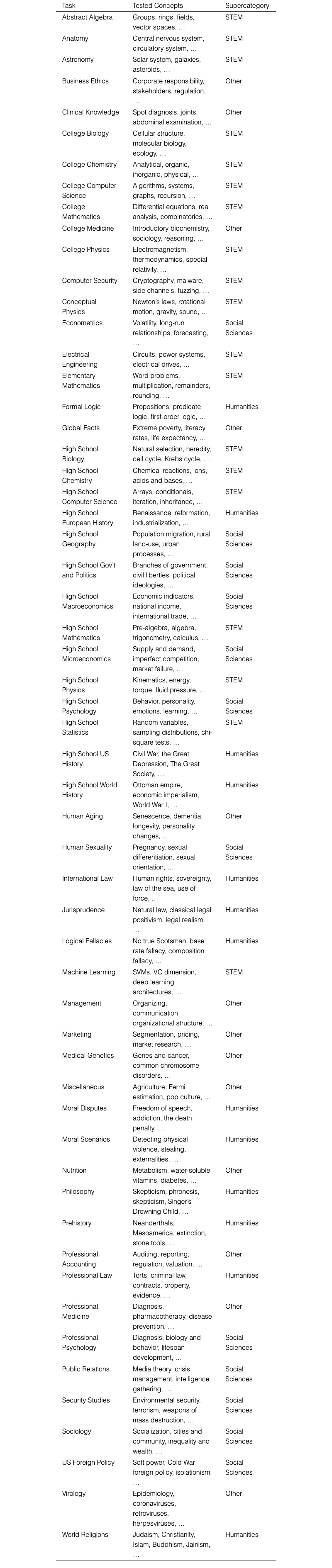
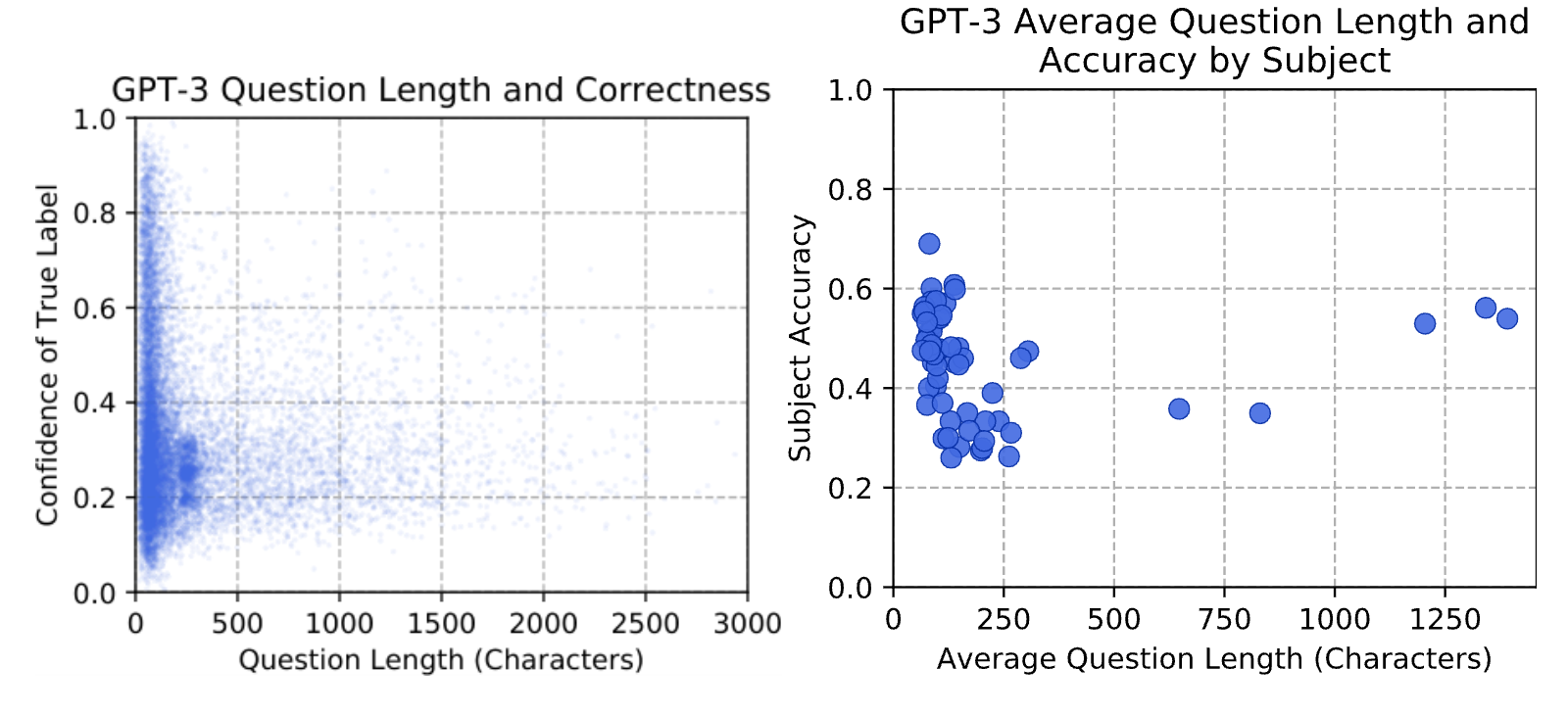
We provide analysis of question length and difficulty in Figure 12. We list all tasks and the topics they test in Table 2. We also provide an example for each task starting with Figure 14.
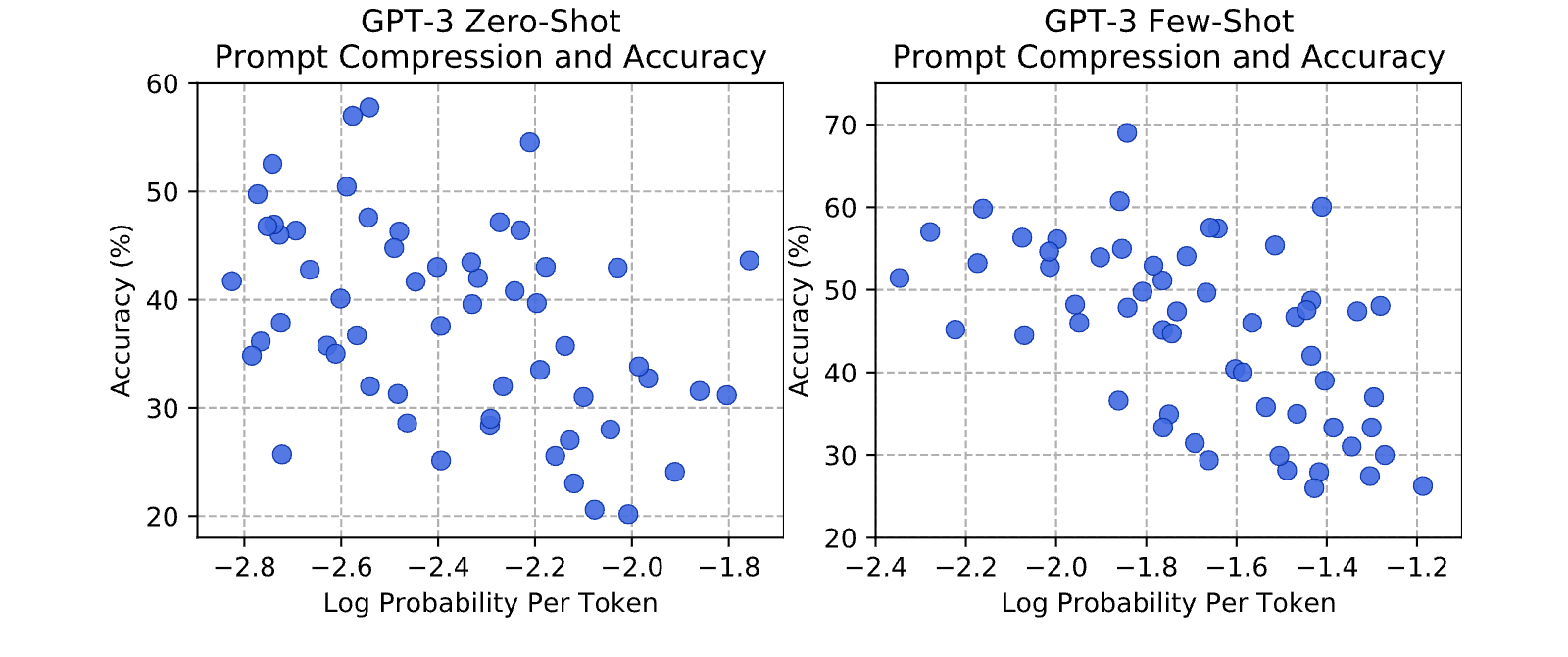
Since language models train on vast text corpora, there is some chance that they have seen the exact question and answer during pretraining. If they memorized the exact question and answer, then they would attain higher accuracy than their true ability. Likewise, a question’s entropy would be especially low if it were memorized. Memorized questions and answers should have low entropy and high accuracy. However, in Figure 13, we see that accuracy and question entropy are not positively correlated, suggesting that the test’s low-entropy questions do not correspond to memorized (and thereby correctly predicted) answers. This suggests that our exact questions were not memorized. However, during pretraining models encountered text related to our questions through processing Wikipedia. We also note that most of our questions came from PDFs or websites where questions and answers are on separate pages.
See Brown et al. 2020 for a previous discussion of contamination showing that the phenomena hardly affects performance. To reduce the probability that future models encounter exact questions during test-time, we will provide a list of question sources.