Solving Quantitative Reasoning Problems with Language Models
arXiv:2206.14858v2 · This workspace stays on this version. Check arXiv for newer versions
Some source details need review 29 to check
Original formulas, table values and figures are preserved. Comparison can miss differences; use the original PDF to check details.
Reading view checked: 850 math expressions, 1 rendering failures; 66 of 66 images available.
Compared 175 of 220 source passages against 45 of 54 PDF pages.
- Some formulas have no TeX source; check the original PDF. (1)
- Some graphics are laid out differently in the HTML source than in the paper (text or formulas outside their frame); check the original PDF. (6)
- Some formulas could not be rendered; their original TeX is shown. Check the original PDF. (1)
- S1_F1: the arXiv HTML draws 1 text or formula block(s) of this graphic outside its frame; each was scaled into its frame (to 71% or more) without changing any text or formula. Text may look smaller than in the PDF.
- S1_F2: the arXiv HTML draws 2 text or formula block(s) of this graphic outside its frame; each was scaled into its frame (to 54% or more) without changing any text or formula. Text may look smaller than in the PDF.
- S1_F3: the arXiv HTML draws text or formulas of this graphic outside its frame and it could not be corrected safely (too-small); the image shows the HTML layout, which differs from the PDF.
- A9_SS1_p2_pic1: the arXiv HTML draws 1 text or formula block(s) of this graphic outside its frame; each was scaled into its frame (to 85% or more) without changing any text or formula. Text may look smaller than in the PDF.
- A9_SS1_SSSx1_p2_pic1: the arXiv HTML draws 1 text or formula block(s) of this graphic outside its frame; each was scaled into its frame (to 81% or more) without changing any text or formula. Text may look smaller than in the PDF.
- A9_SS2_p7_pic1: the arXiv HTML draws 1 text or formula block(s) of this graphic outside its frame; each was scaled into its frame (to 86% or more) without changing any text or formula. Text may look smaller than in the PDF.
- A9_SS2_p9_pic1: the arXiv HTML draws 2 text or formula block(s) of this graphic outside its frame; each was scaled into its frame (to 75% or more) without changing any text or formula. Text may look smaller than in the PDF.
- A9_SS2_p12_pic1: the arXiv HTML draws 1 text or formula block(s) of this graphic outside its frame; each was scaled into its frame (to 67% or more) without changing any text or formula. Text may look smaller than in the PDF.
- A9_SS2_p13_pic1: the arXiv HTML draws 1 text or formula block(s) of this graphic outside its frame; each was scaled into its frame (to 70% or more) without changing any text or formula. Text may look smaller than in the PDF.
- A9_SS2_p16_pic1: the arXiv HTML draws 1 text or formula block(s) of this graphic outside its frame; each was scaled into its frame (to 78% or more) without changing any text or formula. Text may look smaller than in the PDF.
- A9_SS2_p24_pic1: the arXiv HTML draws text or formulas of this graphic outside its frame and it could not be corrected safely (too-small); the image shows the HTML layout, which differs from the PDF.
- A9_SS3_SSSx1_p1_pic1: the arXiv HTML draws 2 text or formula block(s) of this graphic outside its frame; each was scaled into its frame (to 56% or more) without changing any text or formula. Text may look smaller than in the PDF.
- A9_SS3_SSSx1_p2_pic1: the arXiv HTML draws 1 text or formula block(s) of this graphic outside its frame; each was scaled into its frame (to 65% or more) without changing any text or formula. Text may look smaller than in the PDF.
- A9_SS3_SSSx2_p1_pic1: the arXiv HTML draws 1 text or formula block(s) of this graphic outside its frame; each was scaled into its frame (to 91% or more) without changing any text or formula. Text may look smaller than in the PDF.
- A9_SS3_SSSx2_p2_pic1: the arXiv HTML draws 2 text or formula block(s) of this graphic outside its frame; each was scaled into its frame (to 56% or more) without changing any text or formula. Text may look smaller than in the PDF.
- A9_SS4_SSS1_p6_pic1: the arXiv HTML draws text or formulas of this graphic outside its frame and it could not be corrected safely (too-small); the image shows the HTML layout, which differs from the PDF.
- A9_SS4_SSS1_p8_pic1: the arXiv HTML draws 1 text or formula block(s) of this graphic outside its frame; each was scaled into its frame (to 90% or more) without changing any text or formula. Text may look smaller than in the PDF.
- A9_SS4_SSS1_p12_pic1: the arXiv HTML draws 2 text or formula block(s) of this graphic outside its frame; each was scaled into its frame (to 76% or more) without changing any text or formula. Text may look smaller than in the PDF.
- A9_SS4_SSS1_p15_pic1: the arXiv HTML draws 1 text or formula block(s) of this graphic outside its frame; each was scaled into its frame (to 94% or more) without changing any text or formula. Text may look smaller than in the PDF.
- A9_SS4_SSS2_Px1_p3_pic1: the arXiv HTML draws 2 text or formula block(s) of this graphic outside its frame; each was scaled into its frame (to 56% or more) without changing any text or formula. Text may look smaller than in the PDF.
- A9_SS4_SSS2_Px1_p5_pic1: the arXiv HTML draws text or formulas of this graphic outside its frame and it could not be corrected safely (too-small); the image shows the HTML layout, which differs from the PDF.
- A9_SS4_SSS3_p2_pic1: the arXiv HTML draws text or formulas of this graphic outside its frame and it could not be corrected safely (too-small); the image shows the HTML layout, which differs from the PDF.
- A9_SS4_SSS3_p3_pic1: the arXiv HTML draws 2 text or formula block(s) of this graphic outside its frame; each was scaled into its frame (to 76% or more) without changing any text or formula. Text may look smaller than in the PDF.
- A10_SS3_SSSx2_p1_pic1: the arXiv HTML draws text or formulas of this graphic outside its frame and it could not be corrected safely (too-small); the image shows the HTML layout, which differs from the PDF.
- A10_SS3_SSSx3_p1_pic1: the arXiv HTML draws 2 text or formula block(s) of this graphic outside its frame; each was scaled into its frame (to 56% or more) without changing any text or formula. Text may look smaller than in the PDF.
- This long paper was only partially compared; the original sources remain available.
66 of 66 figure, table and graphic images captured. Open original PDF
Abstract
Language models have achieved remarkable performance on a wide range of tasks that require natural language understanding. Nevertheless, state-of-the-art models have generally struggled with tasks that require quantitative reasoning, such as solving mathematics, science, and engineering problems at the college level. To help close this gap, we introduce Minerva , a large language model pretrained on general natural language data and further trained on technical content. The model achieves state-of-the-art performance on technical benchmarks without the use of external tools. We also evaluate our model on over two hundred undergraduate-level problems in physics, biology, chemistry, economics, and other sciences that require quantitative reasoning, and find that the model can correctly answer nearly a third of them.
Artificial neural networks have seen remarkable success in a variety of domains including computer vision, speech recognition, audio and image generation, translation, game playing, and robotics. In particular, large language models have achieved excellent performance across a variety of natural language tasks including common-sense reasoning, question answering, and summarization (Raffel et al.,, 2019; Brown et al.,, 2020; Rae et al.,, 2021; Smith et al.,, 2022; Chowdhery et al.,, 2022). However, these models have struggled with tasks that require quantitative reasoning, such as solving mathematics, science, and engineering problems (Hendrycks et al.,, 2021; Cobbe et al.,, 2021).
Quantitative reasoning problems are an interesting domain of application for language models because they test the capability of models on several fronts. They require the solver to correctly parse a natural language input, potentially recall world knowledge that pertains to the problem, and apply an algorithm or series of computations to the information provided in order to arrive at a correct solution. They also require that the solver is able to correctly parse and generate precise sequences of mathematical tokens, as well as apply a computational procedure to tokens via symbolic and numerical manipulation. Finally, such problems are a proving ground for research toward robust quantitative reasoning solvers that are useful in supporting the work of humans in scientific and technical fields.
Previous research has shown that large language models achieve impressive performance on math and programming questions after training on domain specific datasets (Chen et al.,, 2021; Austin et al.,, 2021; Drori et al.,, 2021). In this work, we apply this approach to quantitative reasoning problems, in which the model is required to provide a complete and self-contained solution, without relying on external tools. Such tasks include mathematics word problems, competition mathematics evaluations, and many problems in science and engineering.
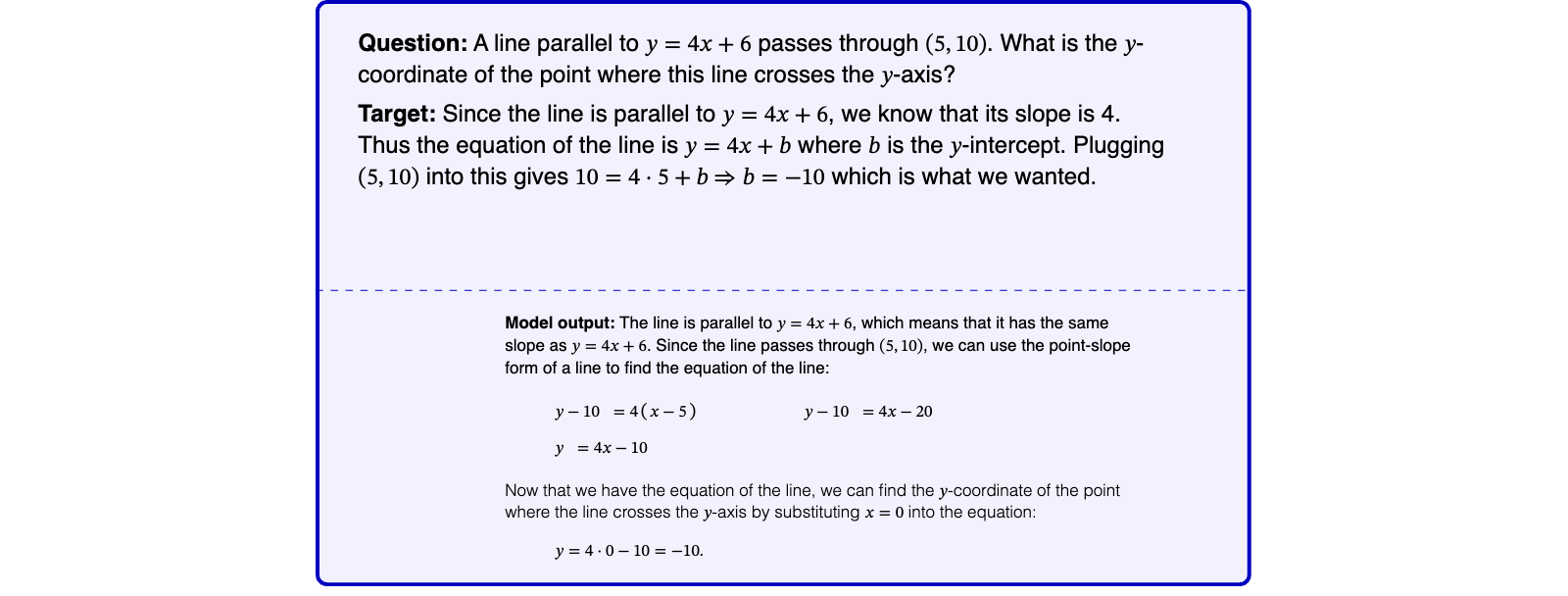
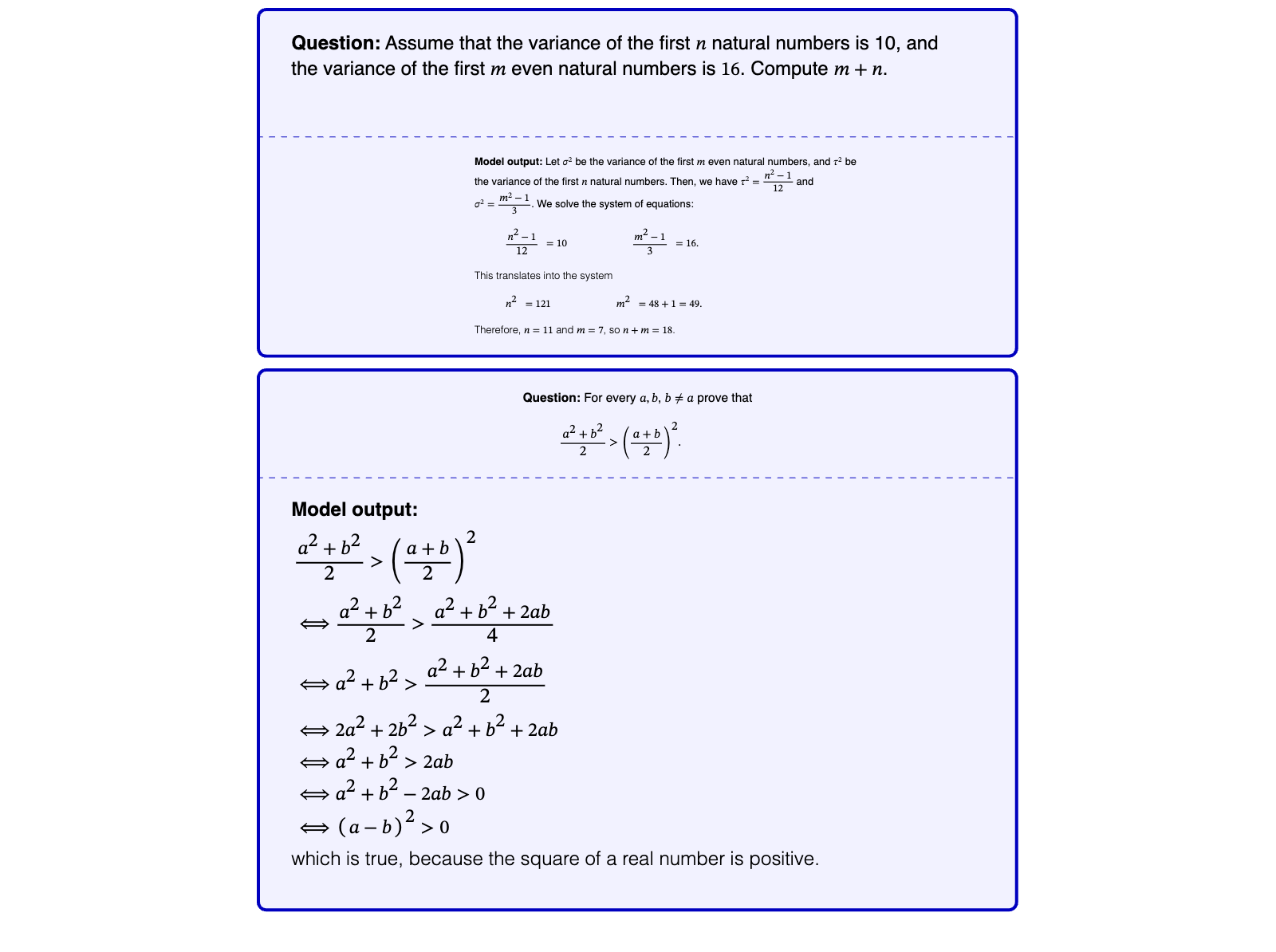
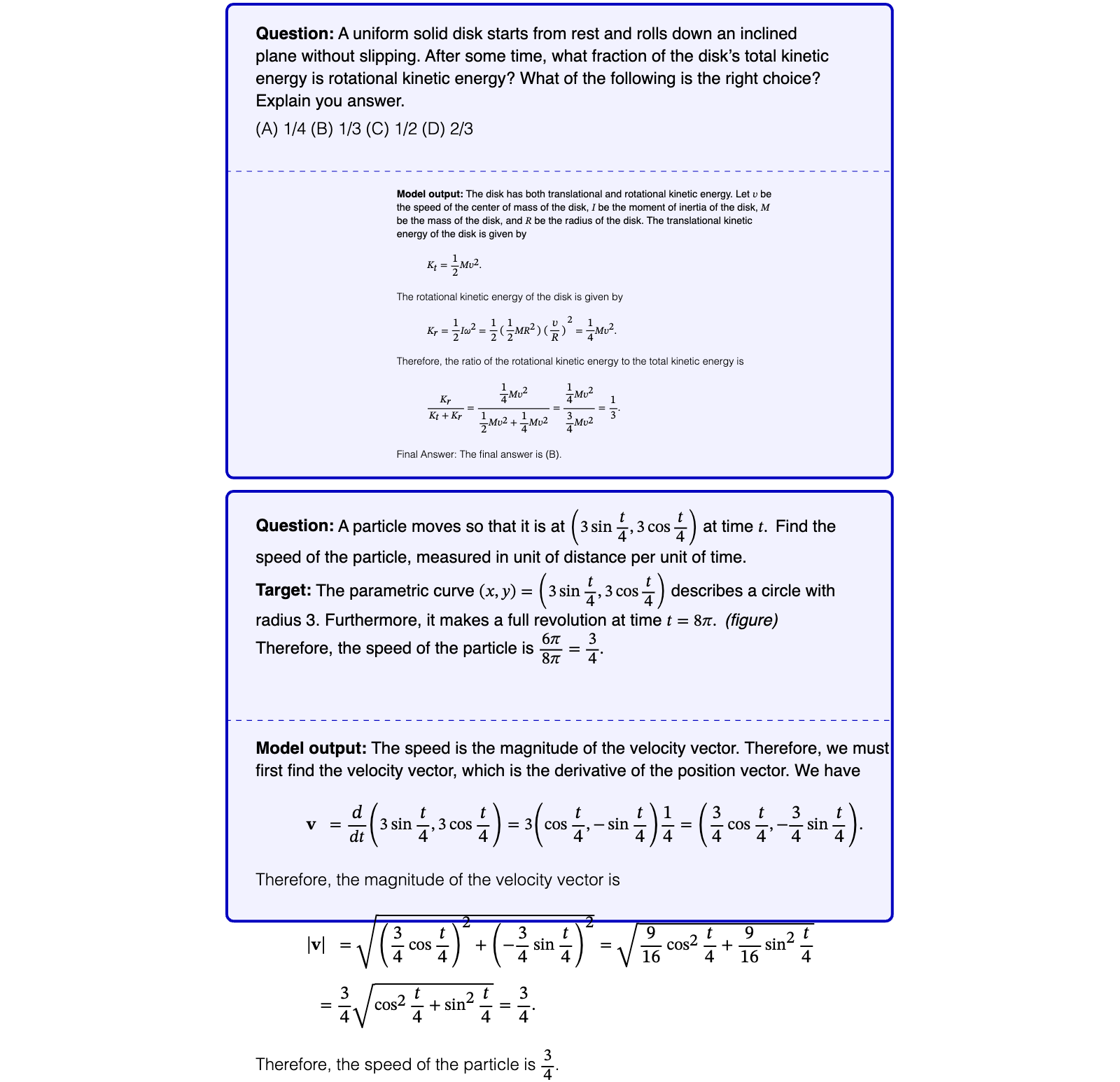
We present Minerva , a language model that achieves strong performance on many quantitative reasoning tasks. Our model is able to process scientific and mathematical questions formulated in natural language, and generate step-by-step solutions using correct LaTeX notation. Figures 1, 2 and 3 show example responses from Minerva to mathematics and physics questions.
Minerva is based on the PaLM general language models Chowdhery et al., (2022) that are further trained on a high-quality dataset containing scientific and mathematical data. In particular, we start with 8B, 62B, and 540B parameter pretrained models, and continue training them on our technical content dataset. We achieve state-of-the-art performance on MATH Hendrycks et al., (2021), GSM8k Cobbe et al., (2021), and a STEM subset of the MMLU Hendrycks et al., (2020) dataset, all of which include math and science questions formulated in natural language. Notably, our models achieve robust performance in a few-shot setting without being explicitly trained on these evaluation datasets.
The main novelty of this paper is a large training dataset that juxtaposes natural language with the correct use of formal mathematical language, such as equations and diagrams. The data is collected from the arXiv preprint server and from web pages that we carefully process to minimise the loss of mathematical content. In addition to establishing new state-of-the-art results, this work establishes a new baseline for the performance achievable on quantitative reasoning benchmarks by increasing data quality and model size.
To further increase the coverage of quantitative reasoning benchmarks, we build a dataset of over 200 undergraduate-level questions in science and mathematics from MIT’s OpenCourseWare (OCW). This provides a measure of our model’s quantitative reasoning abilities in a chain-of-thought context beyond a pure mathematical setting.
Solving quantitative reasoning problems expressed in natural language has been an active area of study (Koncel-Kedziorski et al.,, 2015; Hosseini et al.,, 2014). Prompting language models using scratchpad Nye et al., (2021) or chain-of-thought Wei et al., (2022) solutions can lead them to output step-by-step solutions to unseen problems. The GSM8k work Cobbe et al., (2021) showed that training verifiers to rerank model outputs can lead to improved performance. The original version of GSM8k included special syntax for algebraic calculations, which were processed by a calculator. In this work we focus on self-contained models without access to external tools.
The standard method for evaluating language models on generative tasks is to greedily sample one solution per problem. Recent works (Chen et al.,, 2021; Li et al.,, 2022; Thoppilan et al.,, 2022; Wang et al.,, 2022) have shown that it is advantageous to sample multiple solutions per problem, and then filter those down to a final answer. We find that majority voting (Wang et al.,, 2022) significantly improves performance over greedy decoding.
The work Drori et al., (2021) includes an evaluation of davinci-002, OpenAI’s latest publicly available language model, on a subset of 90 problems from the MATH dataset. Due to the focus on a subset of questions, as well as changes made to the way questions are formatted, it is difficult to directly compare our results with those of Drori et al., (2021). In Section 3, we compare OpenAI davinci-002 with our models under the same experimental conditions.
Applying code generating models to mathematical problems has been an active area of exploration. PaLM Chowdhery et al., (2022) showed that a large language model with code in its training dataset can achieve good performance on a code version of GSM8k. Furthermore, the Codex model (Chen et al.,, 2021) can generate code solutions to MATH problems Drori et al., (2021). These solutions often rely on external libraries to perform mathematical operations such as solving equations or taking limits. This is a complementary approach to ours, in which we directly probe the model’s ability to arrive at an answer by relying only on its own reasoning capability.
Mathematics developed as a discipline based in natural language, but its axiomatic fundamentals make it possible to simulate mathematical thinking. This can be achieved using specialized programming languages that facilitate the simulation of logical and mathematical thinking using a computer, such as Coq (development team,, 2022), Isabelle (Wenzel et al.,, 2008), HOL4 (Harrison,, 1996), Lean (de Moura et al.,, 2015), Metamath (Megill and Wheeler,, 2019) and Mizar (Grabowski et al.,, 2010). Work on automation of proof assistants and automated theorem provers such as E (Schulz,, 2013), leanCoP (Otten,, 2008), and Vampire (Kovács and Voronkov,, 2013) has substantially benefited from integration with machine learning methods (Alemi et al.,, 2016; Goertzel et al.,, 2021; Li et al.,, 2021; Polu and Sutskever,, 2020; Kaliszyk et al.,, 2018).
Previous work trained language models to predict mathematical expressions Rabe et al., (2021); Li et al., (2021); Polu and Sutskever, (2020); Wu et al., (2021); Han et al., (2022); Polu et al., (2022); Jiang et al., (2022); Wu et al., (2022). In turn, such a predictive model can be used to guide a proof search, as done by Polu and Sutskever, (2020). Large language models excel in modelling natural language, though in the case of formal languages, models that facilitate retaining information about the graph structure of a given mathematical formula, such as GNNs, are still very competitive.
New benchmark datasets (Hendrycks et al.,, 2021; Welleck et al.,, 2021) cover more advanced mathematical topics. In this domain language models are facing limited competition from other classes of models.
Our models were trained on a dataset of 38.5B tokens from webpages filtered for mathematical content and from papers submitted to the arXiv preprint server. In addition, the dataset includes general natural language data, which is the same dataset that was used for pretraining PaLM . Our mathematical webpage dataset was constructed by collecting pages that contain mathematical expressions in MathJax format. The pages underwent a cleaning process that removes most HTML tags but preserves mathematical notation, including LaTeX symbols and formatting. The result is that mathematical formulae like or are presented in full to the model during training. This procedure makes it possible for the model to perform well on tasks that require calculation and symbolic manipulation. Table 1 provides a breakdown of the training dataset. See Appendix B for more details.
| Data source | Proportion of data | Tokens | Present during pretraining |
|---|---|---|---|
| Math Web Pages | 47.5% | 17.5B | No |
| arXiv | 47.5% | 21.0B | No |
| General Natural Language Data | 5% | >100B | Yes |
View original table

Our approach is to start with the PaLM pretrained decoder-only transformer language models Chowdhery et al., (2022), and further train (finetune) them on our mathematical dataset using an autoregressive objective. Table 2 contains the main model and training hyperparameters. The largest model, with B parameters, was finetuned on B tokens. While this model is highly undertrained compared to the 8B and 62B models, it still achieves superior performance. Additional details can be found in Appendix C.
| Model | Layers | Heads | Parameters | Steps | Tokens | |
|---|---|---|---|---|---|---|
| Minerva 8B | k | |||||
| Minerva 62B | k | |||||
| Minerva 540B | k |
View original table

We mainly focus on few shot evaluation, though see Appendix E.3 for a discussion of finetuned evaluation. For evaluation, we truncate the inputs from the left to tokens and we use the model to generate up to tokens. When sampling once per problem, we sample greedily. When sampling multiple times per problem we use nucleus sampling (Holtzman et al.,, 2019) with temperature , . For generative tasks, the model produces a chain-of-thought answer and demarcates a final answer. We evaluate a solution as correct if the final answer matches the ground truth solution, independent of the quality of the chain-of-thought preceding it. To evaluate correctness, we parse the final answers and compare them using the SymPy library (Meurer et al.,, 2017). This is done in order to correctly identify answers that are mathematically equivalent such as and . See Appendix D.1 for further details.
The existing datasets on which we focus are:
- •
MATH: a dataset of 12K middle school and high school mathematics problems Hendrycks et al., (2021). Problem statements are written in LaTeX. We prompt the model with a fixed 4-shot prompt (listed in Appendix D.2). This prompt includes four random examples from the training dataset whose ground truth targets are not too long.
- •
GSM8k: middle school math word problems Cobbe et al., (2021). Models are evaluated using the chain-of-thought prompt from Wei et al. Wei et al., (2022). Previous models evaluated on GSM8k made use of an external calculator. In this work, our model does not have access to any external tools.
- •
MMLU-STEM: subset of the MMLU dataset (Hendrycks et al.,, 2020) focused on science, technology, engineering, and mathematics (STEM). For the original version, we use the 5-shot prompt from the development set for each task. We also consider chain-of-thought prompting for this task, where we prompt the model with examples that include step-by-step solutions. We use a multiple-choice version of the MATH prompt for topics that involve mathematical reasoning, and add step-by-step solutions to the standard 5-shot prompts for the rest of the topics. See Appendix G for more details.
To evaluate the scientific reasoning capabilities of Minerva , we harvested a set of STEM problems at the undergraduate level, most of which involve multi-step reasoning, which we refer to in this paper as OCWCourses . Using publicly-available course materials offered by MIT (OpenCourseWare), we collected problems with automatically-verifiable solutions (either numeric or symbolically verifiable via SymPy) from courses including “solid-state chemistry”, “information and entropy”, “differential equations”, and “special relativity.” These problems were processed by contractors to be self-contained and to have a clearly-delineated final answer. Problems asking for a proof or open-ended short answer were not included. In total we curated 272 problems, 191 of which have numeric solutions and 81 have symbolic solutions. In Appendix F, we detail the contributions from each course, and the process of converting these course materials into a format suitable for processing by language models. We also provide the text of all problems. We plan to release these as part of an open-source dataset which will be detailed in an upcoming manuscript.
We find that we can considerably outperform greedy decoding by sampling solutions (with a non-zero temperature) and selecting one using majority voting Wang et al., (2022). This consists of grouping predictions with respect to their final answer and selecting the most common answer. We denote this as maj1@k, following Li et al., (2022). A variation of this algorithm, denoted majn@k, involves selecting the most common answers. Intuitively, the reason majority voting improves performance is that while there are many ways to answer a question incorrectly, there are typically very few ways to answer correctly.
Contrast majority voting with pass@k , where a task is considered solved if any single sample solves it out of samples. See Section 4.2 for more details on pass@k performance. In Appendix E.1, we report on how performance depends on for different metrics. We find that while pass@k continues to improve as is increased, majority voting performance saturates faster: of the large accuracy is achieved at for MATH and for GSM8k. This is likely because majority voting selects the most common answer in the modeled distribution, and the error of this estimate decreases with increasing . This is in contrast to pass@k where the performance improvement comes from the tail of the distribution, which can keep improving as is increased.
Log-likelihood is another metric that can be used to rerank samples. We found that majority voting performs significantly better than log-likelihood reranking (see Appendix E.2).
| MATH | OCWCourses | GSM8k | MMLU-STEM | |
| PaLM 8B | ||||
| Minerva 8B | ||||
| Minerva 8B, maj1@k | ||||
| PaLM 62B | ||||
| Minerva 62B | ||||
| Minerva 62B, maj1@k | ||||
| PaLM 540B | ||||
| Minerva 540B | ||||
| Minerva 540B, maj1@k | 50.3 | 30.8 | 78.5 | 75.0 |
| OpenAI davinci-002 | - | - | ||
| Published SOTA | - | % | % |
View original table
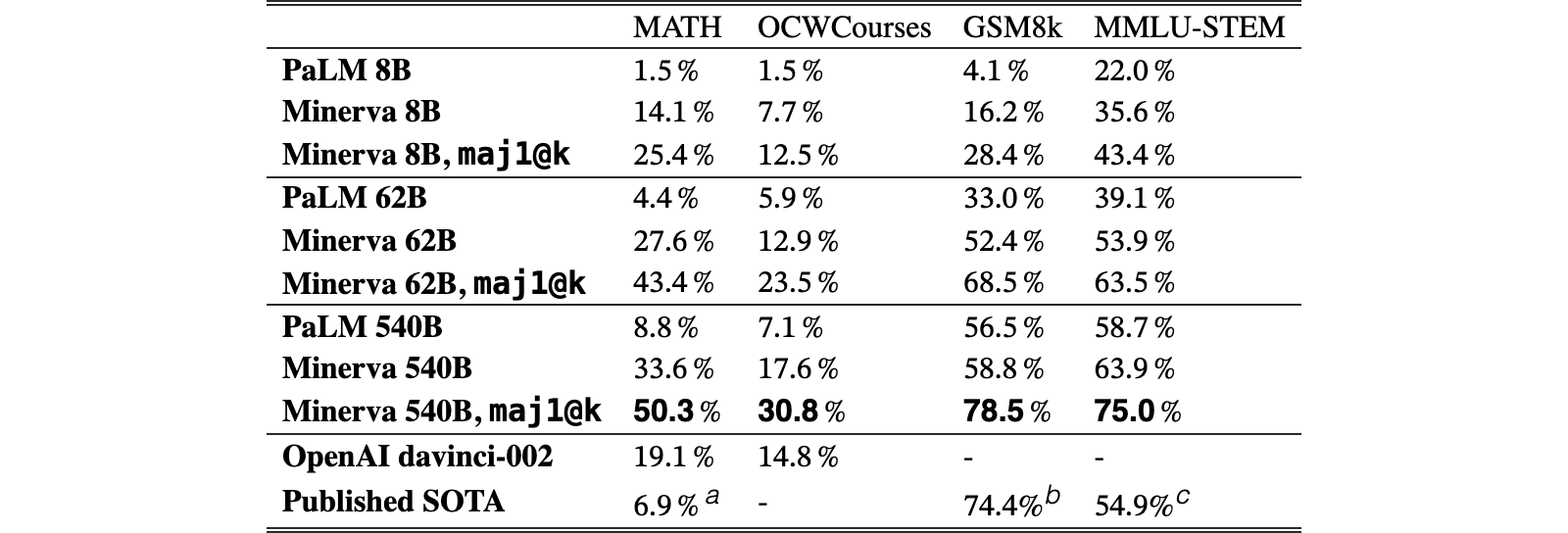
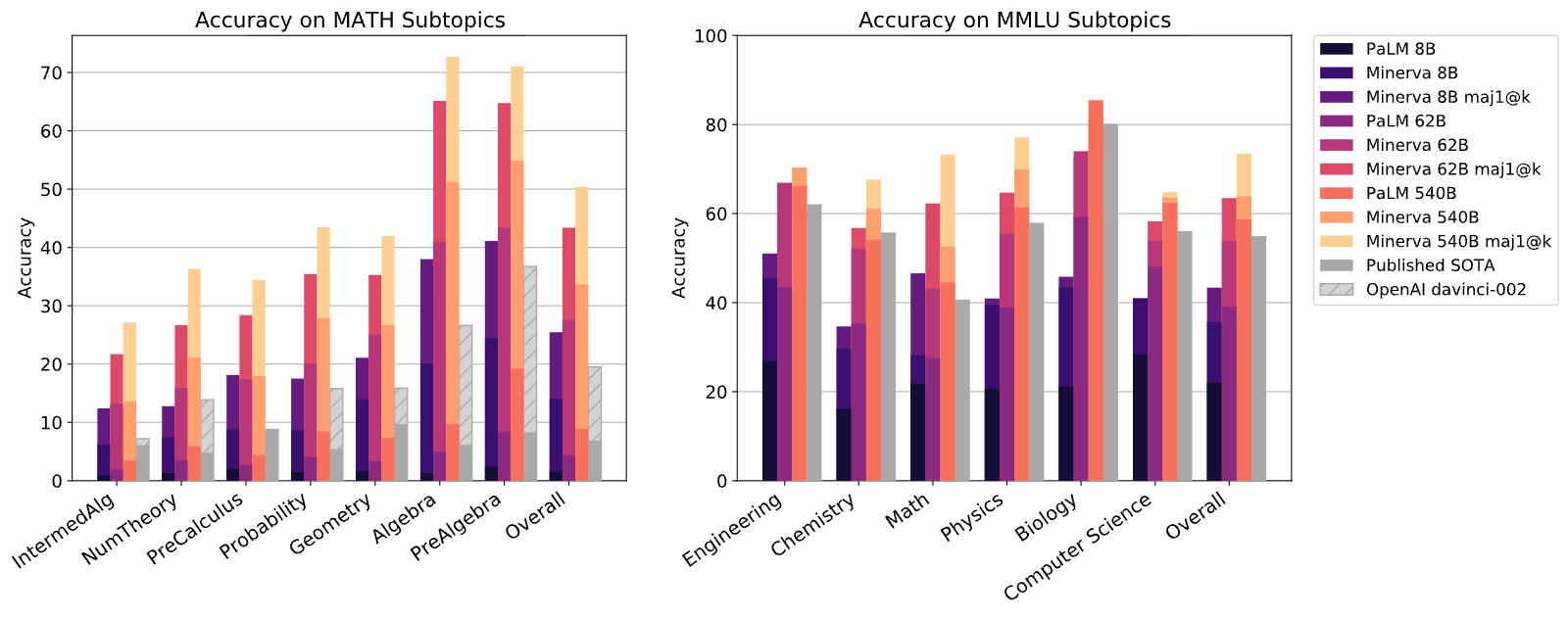
Table 3 summarizes the results for Minerva models and other models, on the evaluation datasets described in Section 2.3. Figure 4 presents a breakdown of the MATH dataset results by subtopic. For MMLU evaluations, unless otherwise noted, performance is measured by using the standard 5-shot prompt per topic and picking the answer with the highest score. When evaluating MMLU with majority voting, we sample model answers using a chain-of-thought prompt.
We present model output samples in Figures 1, 2 and 3, and additional output samples are listed in the Appendix. In addition, we evaluated Minerva 62B on the National Math Exam in Poland and found that it achieves a score of , which happened to be the national average in 2021 (CKE,, 2021, p. 23). The 540B model achieves .
We include results on the latest publicly available language model from OpenAI, davinci-002, evaluated using the OpenAI API with temperature set to the official recommendation (). The combination of training data, scale and inference techniques yields state of the art results on all the technical tasks that we considered. For all tasks (with the exception of GSM8k), the improvement with respect to previous results is considerable.
While our main focus is on few shot evaluation, we also tried to finetune Minerva on MATH. While we did not observe any improvement, we found that finetuning PaLM on MATH did give a significant improvement, which suggests that the marginal utility of standard finetuning decreases as the quality and diversity of the unsupervised training dataset improves. Further details can be found in Appendix E.3.
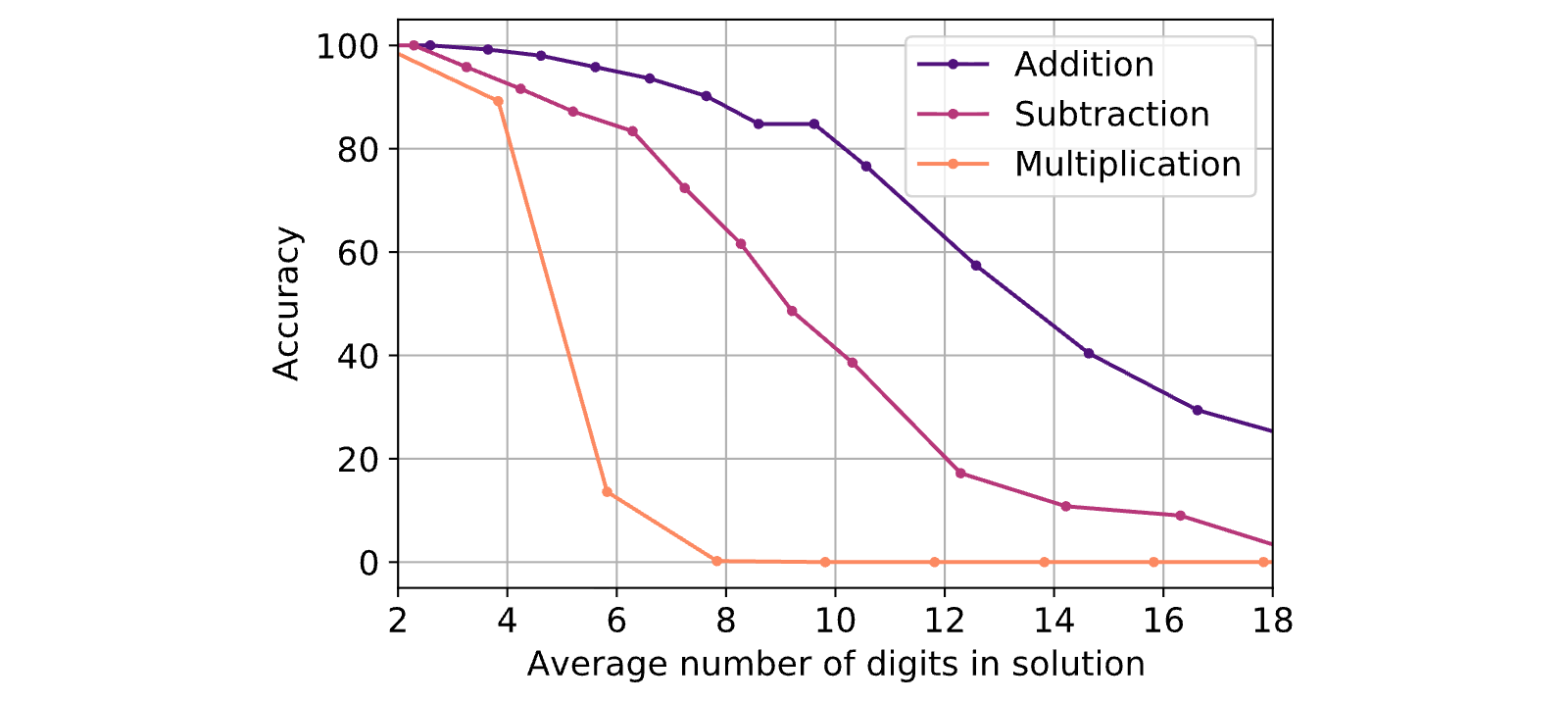
In Appendix H, we study the performance of Minerva 540B on simple arithmetic tasks. The model achieves over accuracy on 10-digit addition and over accuracy on 18-digit addition.
To better understand the types of mistakes our models make, we compare the performance of Minerva 8B and Minerva 62B on 216 problems with high confidence majority decisions of both models. Specifically, we selected examples where the top answer received at least of votes, and that either Minerva 8B was correct and Minerva 62B was incorrect (15 samples), or vice versa (201 samples). The categories and examples for each category are described in Appendix I.2.
As shown in Table 4, the prevailing errors of the 8B model were related to incorrect reasoning or calculations. Many of the calculation errors were relatively benign arithmetic mistakes. Solutions that were too short were relatively rare (in these cases, the model immediately produces an incorrect answer without any intermediate reasoning steps). Finally, in a few cases, the model hallucinates an equation or mathematical fact that is not real.
In the samples where the 62B model was incorrect, the dominating failure modes were again incorrect reasoning and incorrect calculations. In summary, we find that the 62B Minerva model retains most of the skills of the 8B model and improves upon both reasoning and calculation robustness.
| Type of mistakes | Occurrences |
|---|---|
| Incorrect reasoning | 82 |
| Incorrect calculation | 70 |
| Misunderstands question | 22 |
| Uses incorrect fact | 16 |
| Solution too short | 4 |
| Hallucinated math objects | 4 |
| Other mistakes | 3 |
View original table

In our approach to solving quantitative reasoning problems, we are able to automatically verify whether the final answer to a problem is correct, but we do not have an automatic way to verify the model’s chain of reasoning. This leaves open the possibility of false positives: samples which have the correct final answer, but for which the reasoning is incomplete or incorrect.
We selected 100 random questions from MATH (20 per difficulty level), along with answers sampled at zero temperature from the 62B model. We then manually inspected the answers to determine the false positive rate, which is the ratio between number of false positive examples and number of examples for which the final answer is correct; see Table 5. We found that the overall false positive rate is low, though it does increase with difficulty level.
Our focus on pass@1 and majority voting as the primary evaluation metrics is due in part to the fact that they are less susceptible to false positives than pass@k (Li et al.,, 2022). While the pass@256 accuracy is for the 62B model, false positives account for part of it. We inspected the samples that failed in majority voting but passed on pass@k due to a single correct answer, and estimate the false positive rate for pass@256 to be 30% among samples selected in this way. After removing false positives, we estimate that the pass@256 accuracy to be bigger than 68%; see Appendix I.3 for details.
| Difficulty level | ||||||
|---|---|---|---|---|---|---|
| 1 | 2 | 3 | 4 | 5 | Average | |
| False positive rate | ||||||
View original table

A central question in interpreting Minerva ’s solutions is whether performance reflects genuine analytic capability or instead rote memorization. This is especially relevant as there has been much prior work indicating that language models often memorize some fraction of their training data (Trinh and Le,, 2018; Radford et al.,, 2019; Carlini et al.,, 2022). When examining model solutions, we find that memorization of intermediate facts, such as numerical values of square roots or trigonometric identities, are crucial elements of model solutions. Truly strong performance would combine recall of intermediate facts with genuine solution synthesis. We would like to investigate a strong form of memorization, where model performance is a result of memorizing the explicit problems and solutions in our evaluation set, but also a weaker form, where the model has memorized alternate answers to the same questions.
In order to evaluate the degree to which our models solve problems by recalling information memorized from training data, we conduct three analyses on the MATH dataset. First we directly search for problems and solutions in our training corpus. Next, we generate modified versions of problems and evaluate our models’ robustness to these changes. Finally, we measure the degree of overlap between the ground truth solutions and solutions generated by our model and measure the effect of this similarity on model performance. Overall, we find little evidence that the model’s performance can be attributed to memorization.
We selected the problems for which our 62B parameter model produced a correct answer, and filtered them to the 100 problems with the highest majority vote score, expecting that problems with a high majority vote score are more likely to have been memorized. For each of these question-answer pairs, we compute the BLEU score across chunks of 500 characters in our Math Web Pages dataset (a histogram of the BLEU scores is shown in Appendix Figure 10). We then manually inspect the 250 documents with the highest BLEU scores. While many of the top matches were from homework help sites with math questions and solutions, none of the questions matched the questions in the subset of MATH under consideration. We have included these 250 segments in Appendix J.1. We note that some problems from MATH can be found on the web. Nevertheless, this analysis concludes that these problems did not make it through our data collection process.
To further investigate memorization, we randomly selected twenty problems which the 62B model answered correctly under majority voting. We manually modified each problem either by introducing minor changes to problem wording (framing) or by changing the numbers which appeared in the problem and modifying the solution accordingly. We then compared the accuracy over sampled solutions before and after the modification. Results are shown in Figure 5. In both cases the accuracy before and after modifications are correlated, with no clear bias in favor of the original formulation. This is suggestive of minimal memorization. The modified problems are listed in Appendix J.2.
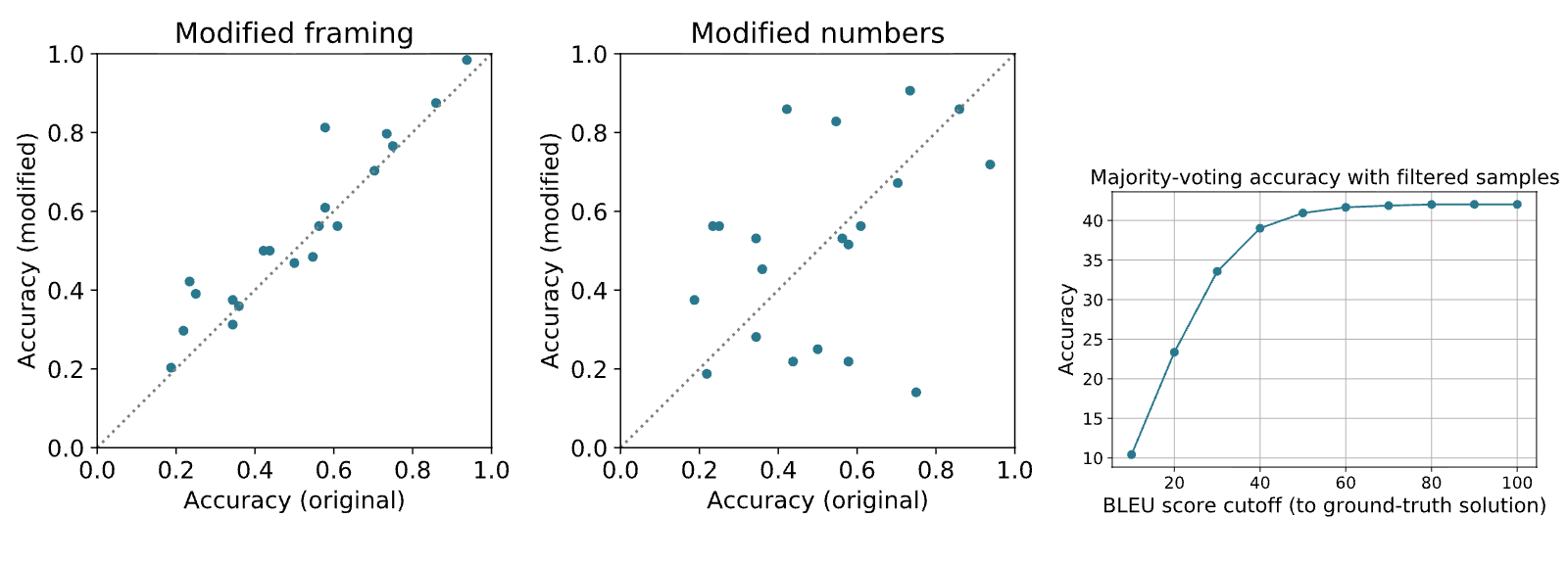
We seek to detect memorization of solutions by computing BLEU score between ground truth answers and model generated answers. We use the 62B model and analyze samples per problem in the MATH dataset. First, we compute overlap statistics for all correct samples. We find that 160 out of 5,000 test questions have a sample with a BLEU score greater than or equal to 80 (see Appendix J.3). We note that they tend to be short solutions. To understand the effect of answer similarity on performance, we remove model samples above a certain BLEU score threshold, and recompute the majority vote accuracy. We find that majority vote performance is robust even down to relatively low similarities (see Figure 5), indicating that performance cannot be attributed to model outputs that are very similar to ground truth answers.
In this work, we take an approach to quantitative reasoning that relies on solving problems using mathematical reasoning expressed in natural language. We show that by training a large language model on a high quality mathematical dataset, we are able to achieve strong performance on tasks that require logical reasoning, numerical calculation, and symbolic manipulation. Our model does not make use of external tools, and at inference time relies exclusively on autoregressive sampling to achieve this performance. Complementary approaches to quantitative reasoning include code-generating models and formal methods. These are all different routes toward a common goal: an agent that can reason about and solve quantitative problems. We believe that such an agent should combine useful elements from all of these approaches.
Our approach to quantitative reasoning has several limitations. First, we have no automatic way of verifying the correctness of the model’s answers. This is in contrast to formal approaches, for which automatic verification is intrinsic. Second, our model has no access to external tools such as a calculator or a Python interpreter. It is therefore limited in its ability to perform quantitative reasoning tasks that require complicated numerical calculations. Third, because our model was trained on a large amount of data, we have little direct control over the specific capabilities that the model acquired.
Artificial neural networks capable of solving quantitative reasoning problems in a general setting have the potential of substantial societal impact. Minerva , while a step in this direction, is still far from achieving this goal, and its potential societal impact is therefore limited. The model’s performance is still well below human performance, and furthermore, we do not have an automatic way of verifying the correctness of its outputs. If these issues could be solved, we expect the impacts of this model to be broadly positive. A direct application could be an accessible and affordable math tutor which could help improve educational inequalities.
We thank David Andre, Jacob Austin, Maarten Bosma, Aakanksha Chowdhery, Sergey Ioffe, Colin Raffel, Charles Sutton, and Christian Szegedy for helpful discussions.
References
- Alemi et al., (2016) Alemi, A. A., Chollet, F., Een, N., Irving, G., Szegedy, C., and Urban, J. (2016). Deepmath - Deep Sequence Models for Premise Selection. In Proceedings of the 30th International Conference on Neural Information Processing Systems, NIPS’16, pages 2243–2251, USA. Curran Associates Inc.
- Austin et al., (2021) Austin, J., Odena, A., Nye, M., Bosma, M., Michalewski, H., Dohan, D., Jiang, E., Cai, C., Terry, M., Le, Q., et al. (2021). Program synthesis with large language models. arXiv preprint arXiv:2108.07732.
- Brown et al., (2020) Brown, T., Mann, B., Ryder, N., Subbiah, M., Kaplan, J. D., Dhariwal, P., Neelakantan, A., Shyam, P., Sastry, G., Askell, A., et al. (2020). Language models are few-shot learners. Advances in neural information processing systems, 33:1877–1901.
- Carlini et al., (2022) Carlini, N., Ippolito, D., Jagielski, M., Lee, K., Tramer, F., and Zhang, C. (2022). Quantifying memorization across neural language models.
- Chen et al., (2021) Chen, M., Tworek, J., Jun, H., Yuan, Q., Pinto, H. P. d. O., Kaplan, J., Edwards, H., Burda, Y., Joseph, N., Brockman, G., Ray, A., Puri, R., Krueger, G., Petrov, M., Khlaaf, H., Sastry, G., Mishkin, P., Chan, B., Gray, S., Ryder, N., Pavlov, M., Power, A., Kaiser, L., Bavarian, M., Winter, C., Tillet, P., Such, F. P., Cummings, D., Plappert, M., Chantzis, F., Barnes, E., Herbert-Voss, A., Guss, W. H., Nichol, A., Paino, A., Tezak, N., Tang, J., Babuschkin, I., Balaji, S., Jain, S., Saunders, W., Hesse, C., Carr, A. N., Leike, J., Achiam, J., Misra, V., Morikawa, E., Radford, A., Knight, M., Brundage, M., Murati, M., Mayer, K., Welinder, P., McGrew, B., Amodei, D., McCandlish, S., Sutskever, I., and Zaremba, W. (2021). Evaluating large language models trained on code.
- Chowdhery et al., (2022) Chowdhery, A., Narang, S., Devlin, J., Bosma, M., Mishra, G., Roberts, A., Barham, P., Chung, H. W., Sutton, C., Gehrmann, S., Schuh, P., Shi, K., Tsvyashchenko, S., Maynez, J., Rao, A., Barnes, P., Tay, Y., Shazeer, N., Prabhakaran, V., Reif, E., Du, N., Hutchinson, B., Pope, R., Bradbury, J., Austin, J., Isard, M., Gur-Ari, G., Yin, P., Duke, T., Levskaya, A., Ghemawat, S., Dev, S., Michalewski, H., Garcia, X., Misra, V., Robinson, K., Fedus, L., Zhou, D., Ippolito, D., Luan, D., Lim, H., Zoph, B., Spiridonov, A., Sepassi, R., Dohan, D., Agrawal, S., Omernick, M., Dai, A. M., Pillai, T. S., Pellat, M., Lewkowycz, A., Moreira, E., Child, R., Polozov, O., Lee, K., Zhou, Z., Wang, X., Saeta, B., Diaz, M., Firat, O., Catasta, M., Wei, J., Meier-Hellstern, K., Eck, D., Dean, J., Petrov, S., and Fiedel, N. (2022). Palm: Scaling language modeling with pathways.
- CKE, (2021) CKE (2021). Skale centylowe wyników - matura 2021.
- Cobbe et al., (2021) Cobbe, K., Kosaraju, V., Bavarian, M., Chen, M., Jun, H., Kaiser, L., Plappert, M., Tworek, J., Hilton, J., Nakano, R., Hesse, C., and Schulman, J. (2021). Training verifiers to solve math word problems.
- de Moura et al., (2015) de Moura, L. M., Kong, S., Avigad, J., van Doorn, F., and von Raumer, J. (2015). The lean theorem prover (system description). In Felty, A. P. and Middeldorp, A., editors, CADE, volume 9195 of Lecture Notes in Computer Science, pages 378–388. Springer.
- development team, (2022) development team, T. C. (2022). The Coq reference manual. Version 8.15.
- Drori et al., (2021) Drori, I., Zhang, S., Shuttleworth, R., Tang, L., Lu, A., Ke, E., Liu, K., Chen, L., Tran, S., Cheng, N., Wang, R., Singh, N., Patti, T. L., Lynch, J., Shporer, A., Verma, N., Wu, E., and Strang, G. (2021). A neural network solves, explains, and generates university math problems by program synthesis and few-shot learning at human level.
- Goertzel et al., (2021) Goertzel, Z. A., Chvalovský, K., Jakubuv, J., Olsák, M., and Urban, J. (2021). Fast and slow enigmas and parental guidance. CoRR, abs/2107.06750.
- Grabowski et al., (2010) Grabowski, A., Kornilowicz, A., and Naumowicz, A. (2010). Mizar in a nutshell. J. Formalized Reasoning, 3(2):153–245.
- Han et al., (2022) Han, J. M., Rute, J., Wu, Y., Ayers, E., and Polu, S. (2022). Proof artifact co-training for theorem proving with language models. In International Conference on Learning Representations.
- Harrison, (1996) Harrison, J. (1996). Hol light: A tutorial introduction. In Srivas, M. and Camilleri, A., editors, Formal Methods in Computer-Aided Design, pages 265–269, Berlin, Heidelberg. Springer Berlin Heidelberg.
- Hendrycks et al., (2020) Hendrycks, D., Burns, C., Basart, S., Zou, A., Mazeika, M., Song, D., and Steinhardt, J. (2020). Measuring massive multitask language understanding. CoRR, abs/2009.03300.
- Hendrycks et al., (2021) Hendrycks, D., Burns, C., Kadavath, S., Arora, A., Basart, S., Tang, E., Song, D., and Steinhardt, J. (2021). Measuring mathematical problem solving with the math dataset.
- Hoffmann et al., (2022) Hoffmann, J., Borgeaud, S., Mensch, A., Buchatskaya, E., Cai, T., Rutherford, E., Casas, D. d. L., Hendricks, L. A., Welbl, J., Clark, A., Hennigan, T., Noland, E., Millican, K., Driessche, G. v. d., Damoc, B., Guy, A., Osindero, S., Simonyan, K., Elsen, E., Rae, J. W., Vinyals, O., and Sifre, L. (2022). Training compute-optimal large language models.
- Holtzman et al., (2019) Holtzman, A., Buys, J., Du, L., Forbes, M., and Choi, Y. (2019). The curious case of neural text degeneration.
- Hosseini et al., (2014) Hosseini, M. J., Hajishirzi, H., Etzioni, O., and Kushman, N. (2014). Learning to solve arithmetic word problems with verb categorization. EMNLP, 523533.
- Jiang et al., (2022) Jiang, A. Q., Li, W., Tworkowski, S., Czechowski, K., Odrzygózdz, T., Milos, P., Wu, Y., and Jamnik, M. (2022). Thor: Wielding hammers to integrate language models and automated theorem provers. CoRR, abs/2205.10893.
- Kaliszyk et al., (2018) Kaliszyk, C., Urban, J., Michalewski, H., and Olšák, M. (2018). Reinforcement learning of theorem proving. In Bengio, S., Wallach, H., Larochelle, H., Grauman, K., Cesa-Bianchi, N., and Garnett, R., editors, Advances in Neural Information Processing Systems, volume 31. Curran Associates, Inc.
- Koncel-Kedziorski et al., (2015) Koncel-Kedziorski, R., Hajishirzi, H., Sabharwal, A., Etzioni, O., and Ang, S. D. (2015). Parsing algebraic word problems into equations. Transactions of the Association for Computational Linguistics, 3.
- Kovács and Voronkov, (2013) Kovács, L. and Voronkov, A. (2013). First-order theorem proving and Vampire. In CAV.
- Li et al., (2021) Li, W., Yu, L., Wu, Y., and Paulson, L. C. (2021). Isarstep: a benchmark for high-level mathematical reasoning. In ICLR.
- Li et al., (2022) Li, Y., Choi, D., Chung, J., Kushman, N., Schrittwieser, J., Leblond, R., Eccles, T., Keeling, J., Gimeno, F., Lago, A. D., Hubert, T., Choy, P., d’Autume, C. d. M., Babuschkin, I., Chen, X., Huang, P.-S., Welbl, J., Gowal, S., Cherepanov, A., Molloy, J., Mankowitz, D. J., Robson, E. S., Kohli, P., de Freitas, N., Kavukcuoglu, K., and Vinyals, O. (2022). Competition-level code generation with alphacode.
- Megill and Wheeler, (2019) Megill, N. D. and Wheeler, D. A. (2019). Metamath: A Computer Language for Pure Mathematics. Lulu Press, Morrisville, North Carolina. http://us.metamath.org/downloads/metamath.pdf.
- Meurer et al., (2017) Meurer, A., Smith, C. P., Paprocki, M., Čertík, O., Kirpichev, S. B., Rocklin, M., Kumar, A., Ivanov, S., Moore, J. K., Singh, S., Rathnayake, T., Vig, S., Granger, B. E., Muller, R. P., Bonazzi, F., Gupta, H., Vats, S., Johansson, F., Pedregosa, F., Curry, M. J., Terrel, A. R., Roučka, v., Saboo, A., Fernando, I., Kulal, S., Cimrman, R., and Scopatz, A. (2017). Sympy: symbolic computing in python. PeerJ Computer Science, 3:e103.
- Nye et al., (2021) Nye, M., Andreassen, A. J., Gur-Ari, G., Michalewski, H., Austin, J., Bieber, D., Dohan, D., Lewkowycz, A., Bosma, M., Luan, D., Sutton, C., and Odena, A. (2021). Show Your Work: Scratchpads for Intermediate Computation with Language Models. arXiv e-prints, page arXiv:2112.00114.
- Otten, (2008) Otten, J. (2008). leancop 2.0 and ileancop 1.2: High performance lean theorem proving in classical and intuitionistic logic (system descriptions). In Armando, A., Baumgartner, P., and Dowek, G., editors, Automated Reasoning, pages 283–291, Berlin, Heidelberg. Springer Berlin Heidelberg.
- Polu et al., (2022) Polu, S., Han, J. M., Zheng, K., Baksys, M., Babuschkin, I., and Sutskever, I. (2022). Formal mathematics statement curriculum learning. CoRR, abs/2202.01344.
- Polu and Sutskever, (2020) Polu, S. and Sutskever, I. (2020). Generative language modeling for automated theorem proving. arXiv preprint arXiv:2009.03393.
- Rabe et al., (2021) Rabe, M. N., Lee, D., Bansal, K., and Szegedy, C. (2021). Mathematical reasoning via self-supervised skip-tree training.
- Radford et al., (2019) Radford, A., Wu, J., Child, R., Luan, D., Amodei, D., Sutskever, I., et al. (2019). Language models are unsupervised multitask learners. OpenAI blog, 1(8):9.
- Rae et al., (2021) Rae, J. W., Borgeaud, S., Cai, T., Millican, K., Hoffmann, J., Song, F., Aslanides, J., Henderson, S., Ring, R., Young, S., et al. (2021). Scaling language models: Methods, analysis & insights from training gopher. arXiv preprint arXiv:2112.11446.
- Raffel et al., (2019) Raffel, C., Shazeer, N., Roberts, A., Lee, K., Narang, S., Matena, M., Zhou, Y., Li, W., and Liu, P. J. (2019). Exploring the limits of transfer learning with a unified text-to-text transformer. arXiv preprint arXiv:1910.10683.
- Roberts et al., (2022) Roberts, A., Chung, H. W., Levskaya, A., Mishra, G., Bradbury, J., Andor, D., Narang, S., Lester, B., Gaffney, C., Mohiuddin, A., Hawthorne, C., Lewkowycz, A., Salcianu, A., van Zee, M., Austin, J., Goodman, S., Soares, L. B., Hu, H., Tsvyashchenko, S., Chowdhery, A., Bastings, J., Bulian, J., Garcia, X., Ni, J., Chen, A., Kenealy, K., Clark, J. H., Lee, S., Garrette, D., Lee-Thorp, J., Raffel, C., Shazeer, N., Ritter, M., Bosma, M., Passos, A., Maitin-Shepard, J., Fiedel, N., Omernick, M., Saeta, B., Sepassi, R., Spiridonov, A., Newlan, J., and Gesmundo, A. (2022). Scaling up models and data with t5x and seqio.
- Schulz, (2013) Schulz, S. (2013). System Description: E 1.8. In McMillan, K., Middeldorp, A., and Voronkov, A., editors, Proc. of the 19th LPAR, volume 8312 of LNCS. Springer.
- Smith et al., (2022) Smith, S., Patwary, M., Norick, B., LeGresley, P., Rajbhandari, S., Casper, J., Liu, Z., Prabhumoye, S., Zerveas, G., Korthikanti, V., et al. (2022). Using deepspeed and megatron to train megatron-turing nlg 530b, a large-scale generative language model. arXiv preprint arXiv:2201.11990.
- Thoppilan et al., (2022) Thoppilan, R., De Freitas, D., Hall, J., Shazeer, N., Kulshreshtha, A., Cheng, H.-T., Jin, A., Bos, T., Baker, L., Du, Y., Li, Y., Lee, H., Zheng, H. S., Ghafouri, A., Menegali, M., Huang, Y., Krikun, M., Lepikhin, D., Qin, J., Chen, D., Xu, Y., Chen, Z., Roberts, A., Bosma, M., Zhao, V., Zhou, Y., Chang, C.-C., Krivokon, I., Rusch, W., Pickett, M., Srinivasan, P., Man, L., Meier-Hellstern, K., Morris, M. R., Doshi, T., Santos, R. D., Duke, T., Soraker, J., Zevenbergen, B., Prabhakaran, V., Diaz, M., Hutchinson, B., Olson, K., Molina, A., Hoffman-John, E., Lee, J., Aroyo, L., Rajakumar, R., Butryna, A., Lamm, M., Kuzmina, V., Fenton, J., Cohen, A., Bernstein, R., Kurzweil, R., Aguera-Arcas, B., Cui, C., Croak, M., Chi, E., and Le, Q. (2022). Lamda: Language models for dialog applications.
- Trinh and Le, (2018) Trinh, T. H. and Le, Q. V. (2018). A simple method for commonsense reasoning. arXiv preprint arXiv:1806.02847.
- Wang et al., (2022) Wang, X., Wei, J., Schuurmans, D., Le, Q., Chi, E., Narang, S., Chowdhery, A., and Zhou, D. (2022). Self-consistency improves chain of thought reasoning in language models.
- Wei et al., (2022) Wei, J., Wang, X., Schuurmans, D., Bosma, M., Chi, E., Le, Q., and Zhou, D. (2022). Chain of thought prompting elicits reasoning in large language models.
- Welleck et al., (2021) Welleck, S., Liu, J., Bras, R. L., Hajishirzi, H., Choi, Y., and Cho, K. (2021). Naturalproofs: Mathematical theorem proving in natural language. CoRR, abs/2104.01112.
- Wenzel et al., (2008) Wenzel, M., Paulson, L. C., and Nipkow, T. (2008). The isabelle framework. In Mohamed, O. A., Muñoz, C., and Tahar, S., editors, Theorem Proving in Higher Order Logics, pages 33–38, Berlin, Heidelberg. Springer Berlin Heidelberg.
- Wu et al., (2022) Wu, Y., Jiang, A. Q., Li, W., Rabe, M. N., Staats, C., Jamnik, M., and Szegedy, C. (2022). Autoformalization with large language models. CoRR, abs/2205.12615.
- Wu et al., (2021) Wu, Y., Rabe, M. N., Li, W., Ba, J., Grosse, R. B., and Szegedy, C. (2021). LIME: learning inductive bias for primitives of mathematical reasoning. In Meila, M. and Zhang, T., editors, Proceedings of the 38th International Conference on Machine Learning, ICML 2021, 18-24 July 2021, Virtual Event, volume 139 of Proceedings of Machine Learning Research, pages 11251–11262. PMLR.
Appendix
Aitor prepared the Mathematical web pages dataset and Aitor and David prepared the arXiv dataset used to train Minerva .
Aitor trained the Minerva models presented in the paper, and he, along with David and Vedant, conducted ablation studies.
Aitor, Ambrose, and David built the experimental infrastructure for training and evaluating Minerva . They, along with Anders, Ethan, Henryk, Vinay, and Vedant collected the evaluation datasets and conducted model evaluations.
Aitor, Anders, Behnam, Ethan, Guy, and Vedant conducted experiments and ablation studies on inference-time techniques.
Vedant and Vinay collected the OCWCourses dataset and supervised the contractors’ work.
Aitor, Ambrose, Anders, David, Ethan, Guy, Henryk, Theo, Vedant, Vinay, and Yuhuai analyzed the models’ results, including sample explorations to categorize model mistakes and identify false positives.
Aitor, Anders, and Cem conducted fine-tuning evaluation experiments.
Ethan, Vedant, and Vinay designed and conducted the memorization experiments.
Aitor, Anders, Ethan, Guy, Henryk, Imanol, Vedant, and Yuhuai wrote the paper.
Aitor, Behnam, Guy, and Vedant advised and led the project throughout its life cycle.
The two main data sources for our training dataset are arXiv papers and web pages that contain mathematics. Here we present additional details on how the data from each source was collected and processed.
The arXiv dataset contains 2M arXiv papers up to February 2021, in LaTeX format. If multiple LaTeX files were present, they were concatenated. Comments were removed, and anything before the first section header or after an appendix/bibliography header was removed. The title and abstract of each paper were added to the document from the arXiv metadata. In order to retain high quality documents and maximize the information per token, papers were filtered out if they were longer than 75k tokens, had on average more than 0.6 tokens per character, had no \section headers, or ended up being empty after processing. The final arXiv dataset after processing includes 1.2M papers totalling GB of data.
We started with a collection of web pages that included the string "<math" or "MathJax-Element-" in the raw HTML, which we used as our filter for pages that that include mathematical content. We considered pages as of January 2022. We then used several heuristics to process the pages. We found empirically that these are sufficient to extract most of the available mathematical content in either LaTeX format or ASCII-math format. The majority of the documents (about 80% of documents) have one of these two formats:
- 1.
A majority of these HTML documents contain math in TeX or AsciiMath format inside tags of the form <script type="math/latex"> or <script type="math/asciimath">.
- 2.
Another common appearance of LaTeX happens with <annotation encoding="application/x-tex"> tags inside <math> MathML blocks. We extract the content of these <annotation> blocks but do not include other content from inside the <math> blocks.
The remaining documents (about 20%) generally have math in MathML format, which we discarded. After extracting the content in any of the previous two forms, we removed all other content that was inside <math> or <span id=MathJax-Element-*> blocks, because these blocks often encode the MathML version of TeX or AsciiMath content. After filtering, processing, and selecting only English documents, the final dataset size is GB.
We start with pretrained PaLM models, and perform unsupervised finetuning on our technical dataset to obtain Minerva . The models have context length . They are trained with batch size (except for the B model which was trained with batch size ) and without dropout.
The learning rate schedule was reciprocal square-root decay, which continued the schedule of the pretrained models. The B model was pretrained for M steps and further trained for k additional unsupervised finetuning steps. The B model was pretrained for k steps and further trained for k additional unsupervised finetuning steps. The B model was pretrained for k steps and was further trained for k additional steps during unsupervised finetuning.
Finally, the learning rate was dropped x and all models were then trained for additional steps. We note that these models had a significantly larger batch size during pretraining.
We used the t5x framework (Roberts et al.,, 2022) and trained our models with v4 TPU on Google Cloud. The 8B model was trained for 14 days on a v4-128, the 62B model was trained for 17 days on a v4-512, and the 540B model was trained for 29 days on a v4-1024.
Extracting and evaluating the correctness of answers to math questions is non-trivial because answers can often be presented in many different ways, both in terms of formatting (e.g. answers can be underlined, or surrounded by a box) and in terms of mathematical content (a large number can be equivalently represented as 1,000 or 1000, answers about currency potentially have the currency symbol attached to them, etc.). Here we describe how final answers are extracted and normalized. After normalization, answers are compared using SymPy (see below). Failing to normalize answers properly will typically lead to falsely identifying correct answers as incorrect (“false negatives”), and therefore to underestimate the model’s accuracy.
We first extract the final answer from the full model response, which potentially includes chain-of-thought reasoning. In the few-shot prompt, we used the format "Final Answer: The final answer is ANSWER. I hope it is correct." for every final answer. We look for this pattern in the model output and extract ANSWER.
We then apply a normalization function to this answer, shown in Listing 1. In order to develop it we manually inspected ground truth targets, samples from Minerva , and samples from OpenAI davinci-002. We were especially careful to avoid changes in the format of the ground truth target that might produce false positives.
After applying this normalization function, we checked whether the formatted target and prediction strings are SymPy-equivalent. SymPy equivalence is determined by parsing the answers via
sympy.parsing.latex.parse_latex and then checking whether substracting the two resulting SymPy objects and applying sympy.simplify gives zero. We set a timeout of s when calling sympy.simplify, and labeled strings as nonequivalent if this timeout was exceeded.
For MATH problems, SymPy equivalence improved overall accuracy by around . See Table 6 for the accuracies in MATH with only exact string match vs. SymPy equivalence.
| MATH Accuracy | ||
|---|---|---|
| without SymPy | with SymPy | |
| Minerva 8B | 13.3 | 14.1 |
| Minerva 8B Majority | 24.6 | 25.4 |
| Minerva 62B | 26.5 | 27.6 |
| Minerva 62B Majority | 42.2 | 43.4 |
| OpenAI davinci-002 | 18.7 | 19.1 |
View original table

Listing 2 shows the 4-shot prompt used when sampling answers to MATH questions. We picked it by choosing random examples from MATH and selecting examples which did not include Asymptote plotting commands. We chose four examples so that most problems fit within a context length of , to enable comparisons with a wide range of models.
We study the dependence of performance on the number of generated samples per question on MATH and GSM8k. Table 7 shows results for maj and maj, and Figure 6 shows the dependence on for pass@k and majority voting. We observe that while pass@k continues to improve, majority voting saturates quickly.
| MATH | GSM8k | |
|---|---|---|
| Minerva 8B, maj | 25.4% | 28.4% |
| Minerva 8B, maj | 47.6% | 56.8% |
| Minerva 62B, maj | 43.4% | 67.5% |
| Minerva 62B, maj | 64.9% | 89.0% |
| Published SOTA | 6.9% | 74.5% |
View original table

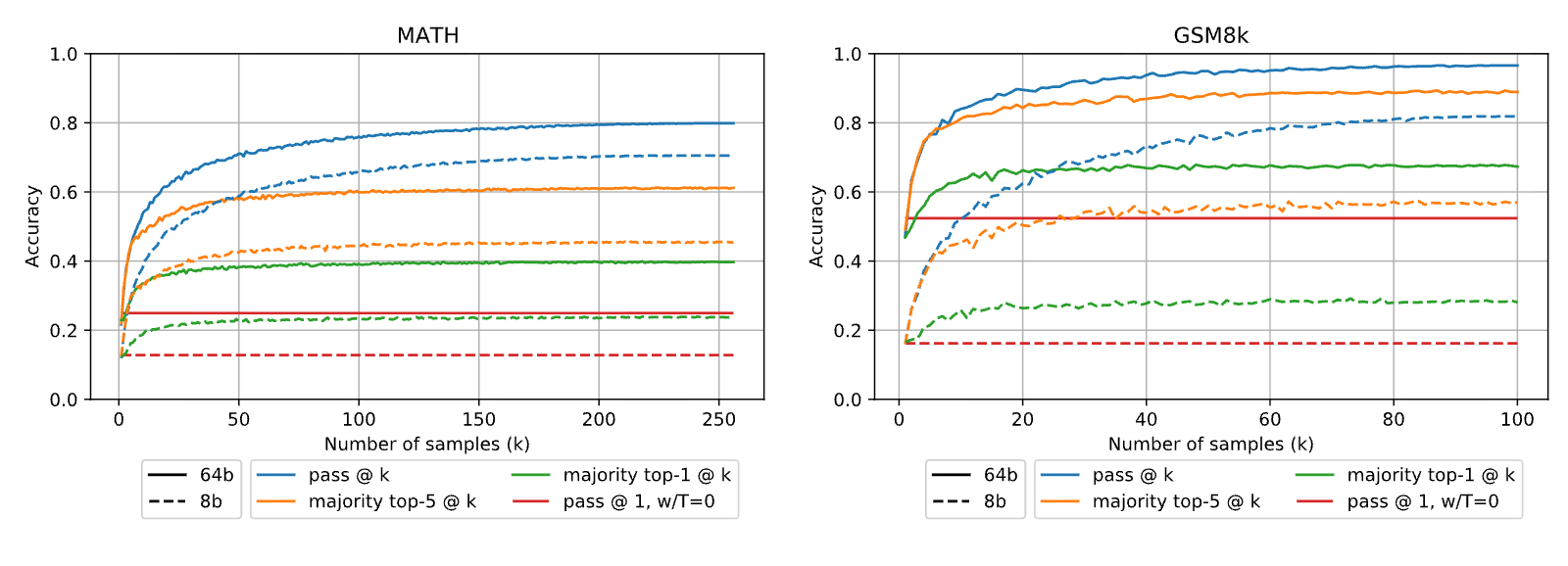
Table 8 compares majority voting with reranking based on the log-likelihood that the model assigns to each response. We observe that majority voting is significantly better.
| MATH | |
|---|---|
| Minerva 62B, pass1 | 26.5% |
| Minerva 62B, Majority Voting 1@k | 42.0% |
| Minerva 62B, pass1 | 21.8% |
| Minerva 62B, Log-likelihood | 23.8% |
View original table

Most of our results involve few-shot prompting Minerva on MATH and other datasets on which the model was not explicitly trained. In this section we discuss finetuning our models on the training split of the MATH dataset, and then evaluating on the test split as before. We finetune both the PaLM and Minerva 8B for steps with 2048 tokens per batch with batch size and dropout of 0.1. Similar to Li et al., (2022), we found that the accuracy for PaLM kept improving despite the test loss increasing. We picked the model with the best test accuracy after training steps.
We finetuned using a few different prompts: A 0-shot prompt, our custom 4-shot prompt, and a prompt containing 4 random examples. Each model was evaluated using the same prompt as was used during finetuning, except for the random prompt model, with was evaluated using the fixed 4-shot prompt that we used for the non-finetuned models.
The results can be found in Table 9. Standard finetuning does not seem to improve the performance of Minerva . On the other hand, it does lead to measurable improvements in PaLM , though this performance still lagged behind Minerva . These results suggest that the marginal utility of supervised finetuning decreases as one improves the quality and diversity of the unsupervised pretraining or unsupervised finetuning dataset.
| MATH Accuracy | ||
|---|---|---|
| PaLM 8B | Minerva 8B | |
| Few Shot | 1.5% | 14.1% |
| Custom prompt finetuning | 5.6 % | 13.4% |
| Random prompt finetuning | 4.4 % | 12.9% |
| No prompt finetuning | 5.6 % | 13.0% |
View original table

From Figure 6, we see how majority voting saturates rather quickly at some , while pass@k keeps improving. Here we analyze the asymptotic behavior of majority voting at large .
Let denote the sorted number of counts for answer when we sample times and let there be a total for answers. In other words, . We expect that when sampling samples, we can model the sampling distribution as a multinomial distribution with probabilities . This approximation will have the error of attributing to any answer which doesn’t appear in draws, so we can’t really resolve probabilities smaller than . This issue will not matter for our purposes as long as the maximum probability is significantly higher than .
If we draw samples from this multinomial distribution, we expect to not be able to identify the majority answer with confidence as long as
For , this bound implies that the resolution for is , but this is a very rough estimate. However, this exercise quantifies why and how majority voting saturates even if pass@k doesn’t.
Another point is that in order to obtain the majority solution with confidence, we need
for , we can probe up to .
Table 10 shows the breakdown of problems in our dataset by course. See Table 11 for a breakdown of problems by solution type.
| Course | No. problems |
|---|---|
| Solid State Chemistry | |
| Introduction to Astronomy | |
| Differential equations | |
| Dynamics and Control | |
| Principles of Microeconomics | |
| Special Relativity | |
| Physical Chemistry | |
| Ecology | |
| Information and Entropy |
View original table

| Answer Type | No. Problems |
|---|---|
| Numeric | |
| Symbolic | |
| Total | 272 |
View original table

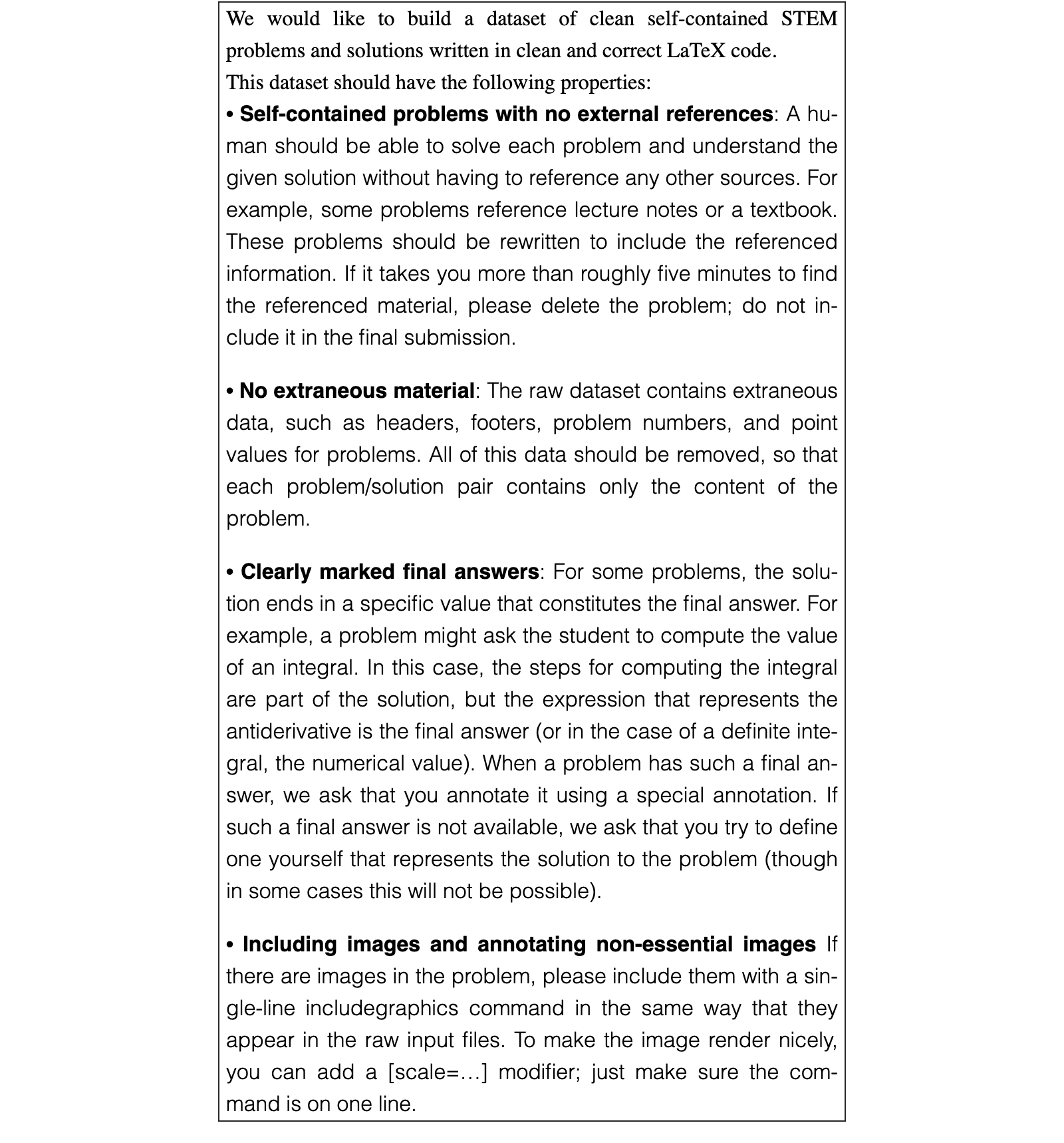
Figure 7 shows the instructions provided to our contractor workforce.
We provide the problems in OCWCourses as a separate file.
As with the MATH dataset, special care must be taken in order to correctly extract answers and evaluate them for correctness. Here we describe how final answers are extracted and normalized. See Listing 4 for the code. During dataset creation, contractors annotated all automatically-verifiable solutions as belonging to one of several types: symbolicexpression, symbolicequation, or numeric. For symbolicexpression and symbolicequation answers, our approach is to convert the answer strings into SymPy quantities, and check equality programmatically. For numeric quantities, we first remove any units from the answer string, then convert the answer string to a float. If either numeric quantity is close to zero, our equality condition is that the absolute value of their difference is less than a threshold (0.01) of their mean; otherwise, we use the numpy.isclose() comparison.
As with MATH, we first extract the final answer from the full model response, which potentially includes chain-of-thought reasoning. In the few-shot prompt, we used the format Final Answer: The final answer is ANSWER. I hope it is correct. for every final answer. We look for this pattern in the model output and extract ANSWER.
MMLU-STEM consists of the following 18 subtopics: abstract_algebra, astronomy, college_biology, college_chemistry, college_computer_science, college_mathematics, college_physics, computer_security, conceptual_physics, electrical_engineering, elementary_mathematics, high_school_biology,
high_school_chemistry, high_school_computer_science, high_school_mathematics, high_school_physics, high_school_statistics, machine_learning .
The standard way of evaluating on MMLU is to construct a 5-shot prompt out of the dev set and then choose the option with the highest score. This is what we report for pass@1 .
We make use of the reasoning skills of the model and combine this task with chain of thought. To do this, we use a prompt which has a chain of thought before outputting the final answer. We extract the model answer by from model output of the form "Final Answer: The final answer is CHOICE. I hope it is correct.". When scoring choices, we use the real probability of each choice. In the chain-of-thought case, we can estimate the most probable choice (independently of the rationale) by picking the majority answer. Given that the set of possible final answers is reduced: CHOICE {, , , } (as opposed to generative tasks where the set of possible answers was unbounded), we expect that we do not need many samples to find the majority option, and we therefore pick .
We use a multiple choice version of the MATH prompt (see Listing 5) for the subtopics which use equations: abstract_algebra, college_mathematics, college_physics, elementary_mathematics,
high_school_mathematics, high_school_physics, high_school_statistics. We wrote a custom chain-of-thought for each of the remaining original prompts. Those prompts can be found in the supplementary materials.
We compute the performance of Minerva on basic arithmetic by supplying the following prompt:
For each operation, and for each choice of number of digits, we sample 500 arithmetic questions at random. Figure 8 shows the model’s performance.
This is an example of a question we wrote ourselves:
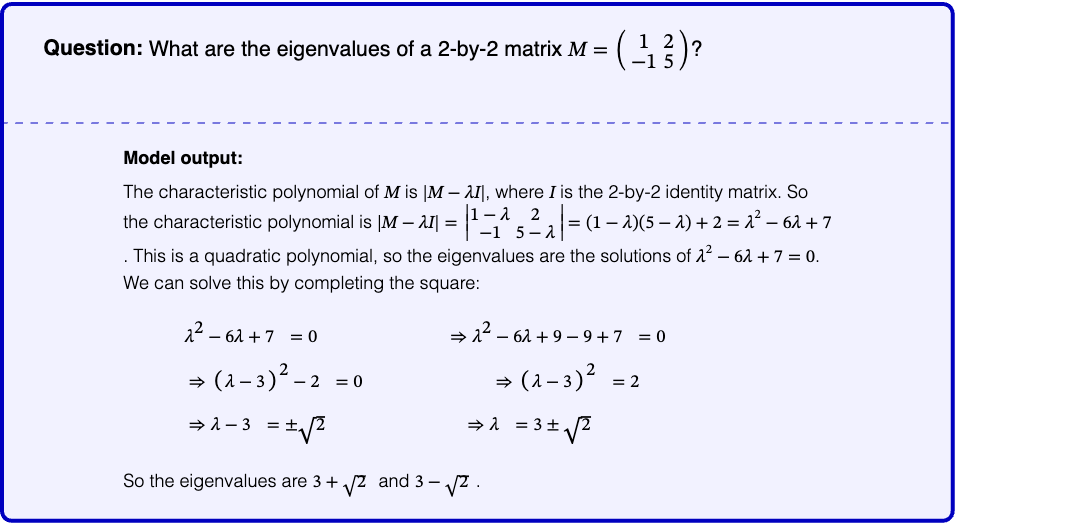
Text in this graphic
Question: What are the eigenvalues of a 2-by-2 matrix ?
Model output: The characteristic polynomial of is , where is the 2-by-2 identity matrix. So the characteristic polynomial is . This is a quadratic polynomial, so the eigenvalues are the solutions of . We can solve this by completing the square:
So the eigenvalues are and .
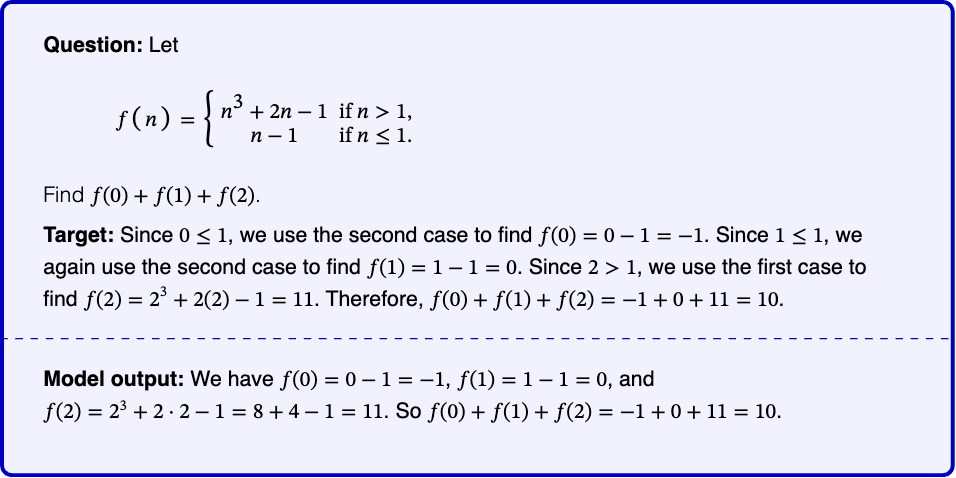
Text in this graphic
Question: Let
Find . Target: Since , we use the second case to find . Since , we again use the second case to find . Since , we use the first case to find . Therefore, .
Model output: We have , , and . So .
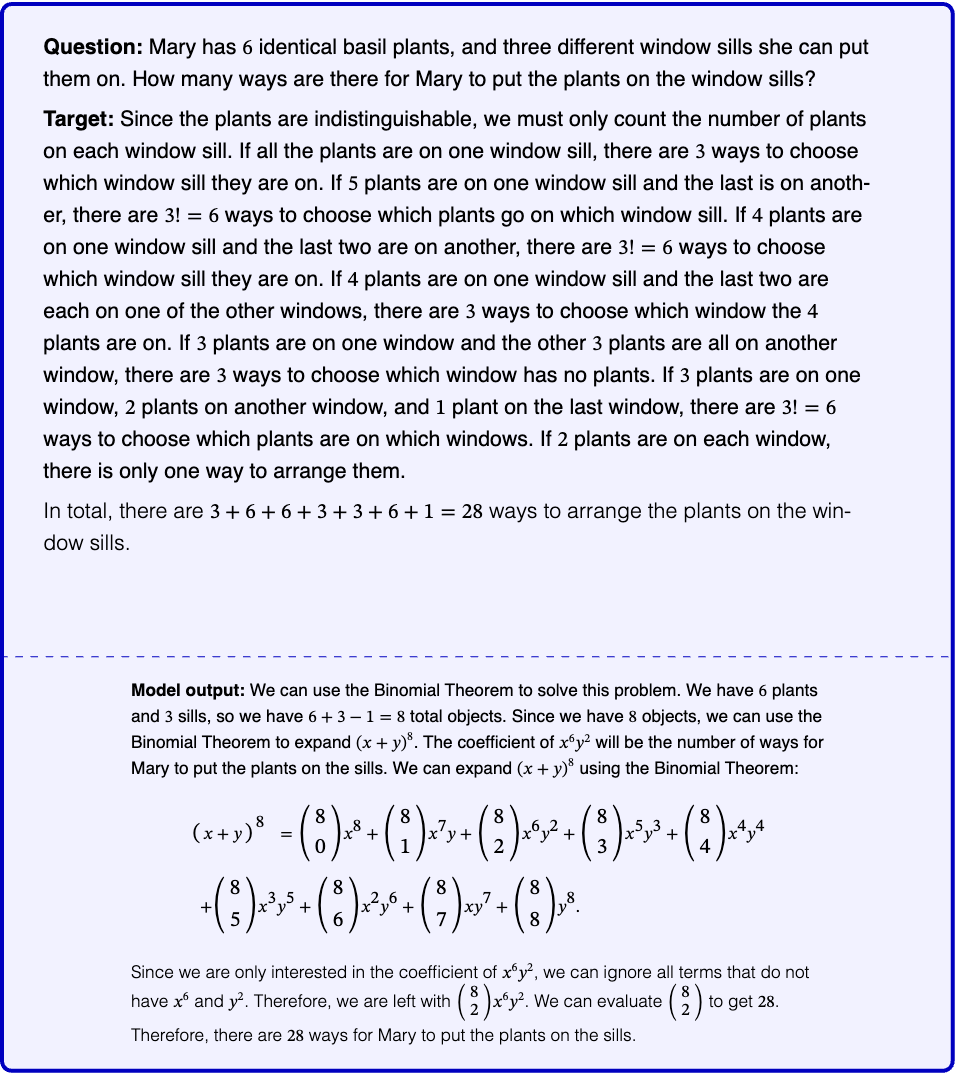
Text in this graphic
Question: Mary has identical basil plants, and three different window sills she can put them on. How many ways are there for Mary to put the plants on the window sills? Target: Since the plants are indistinguishable, we must only count the number of plants on each window sill. If all the plants are on one window sill, there are ways to choose which window sill they are on. If plants are on one window sill and the last is on another, there are ways to choose which plants go on which window sill. If plants are on one window sill and the last two are on another, there are ways to choose which window sill they are on. If plants are on one window sill and the last two are each on one of the other windows, there are ways to choose which window the plants are on. If plants are on one window and the other plants are all on another window, there are ways to choose which window has no plants. If plants are on one window, plants on another window, and plant on the last window, there are ways to choose which plants are on which windows. If plants are on each window, there is only one way to arrange them. In total, there are ways to arrange the plants on the window sills.
Model output: We can use the Binomial Theorem to solve this problem. We have plants and sills, so we have total objects. Since we have objects, we can use the Binomial Theorem to expand . The coefficient of will be the number of ways for Mary to put the plants on the sills. We can expand using the Binomial Theorem:
Since we are only interested in the coefficient of , we can ignore all terms that do not have and . Therefore, we are left with . We can evaluate to get . Therefore, there are ways for Mary to put the plants on the sills.
We used the following to label model mistakes:
- •
Incorrect reasoning: there is a mistake in how different steps in the chain-of-thought are connected.
- •
Incorrect calculation: symbolic or numeric manipulation mistake.
- •
Uses incorrect fact: uses a fact or equation which is wrong.
- •
Misunderstood question: approach to problem is wrong.
- •
Answer too short: wrong answer without justification.
- •
Hallucinated math objects: fabricated mathematical concepts or symbols with no basis in the problem.
| Type of mistakes | Occurrences |
|---|---|
| Incorrect reasoning | 82 |
| Incorrect calculation | 70 |
| Misunderstands question | 22 |
| Uses incorrect fact | 16 |
| Solution too short | 4 |
| Hallucinated math objects | 4 |
| Other mistakes | 3 |
View original table

We include 2 samples for each of the main failure categories. Notice that some categorization depended on human judgement and in some instances more than one label was applied.
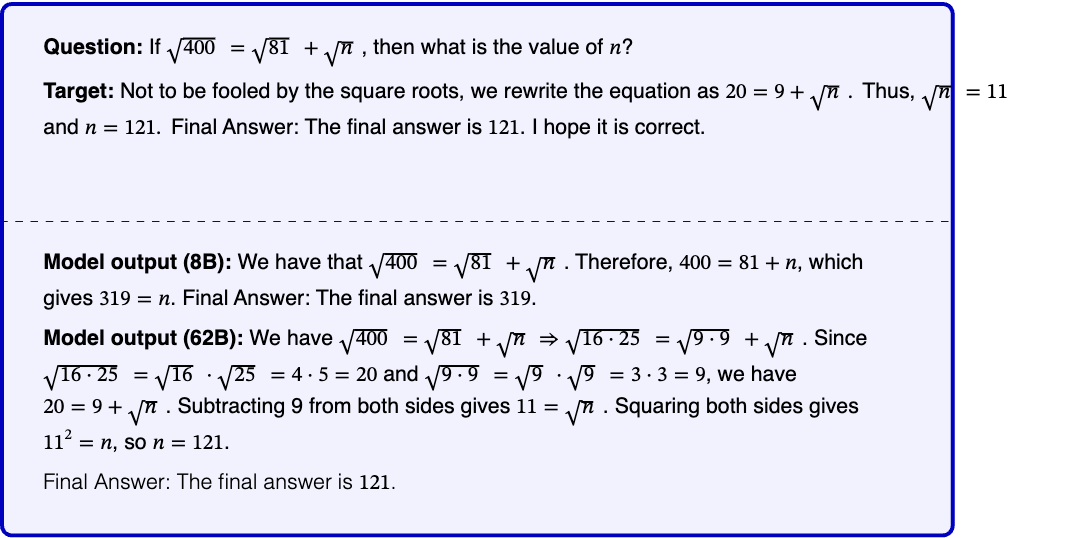
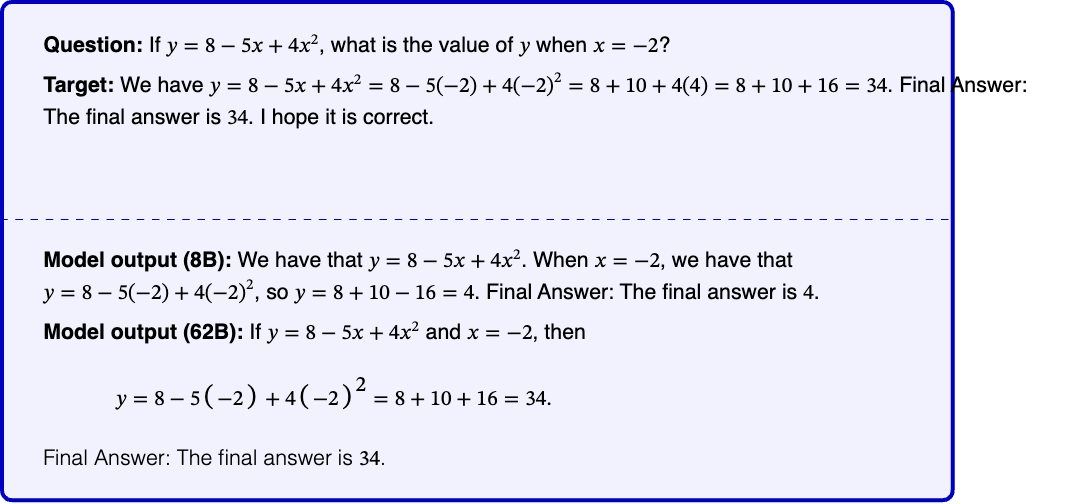
Incorrect calculation.
Text in this graphic
Question: If , then what is the value of ? Target: Not to be fooled by the square roots, we rewrite the equation as Thus, and Final Answer: The final answer is . I hope it is correct.
Model output (8B): We have that . Therefore, , which gives . Final Answer: The final answer is . Model output (62B): We have . Since and , we have . Subtracting 9 from both sides gives . Squaring both sides gives , so . Final Answer: The final answer is .
Text in this graphic
Question: If , what is the value of when ? Target: We have . Final Answer: The final answer is . I hope it is correct.
Model output (8B): We have that . When , we have that , so . Final Answer: The final answer is . Model output (62B): If and , then
Final Answer: The final answer is .
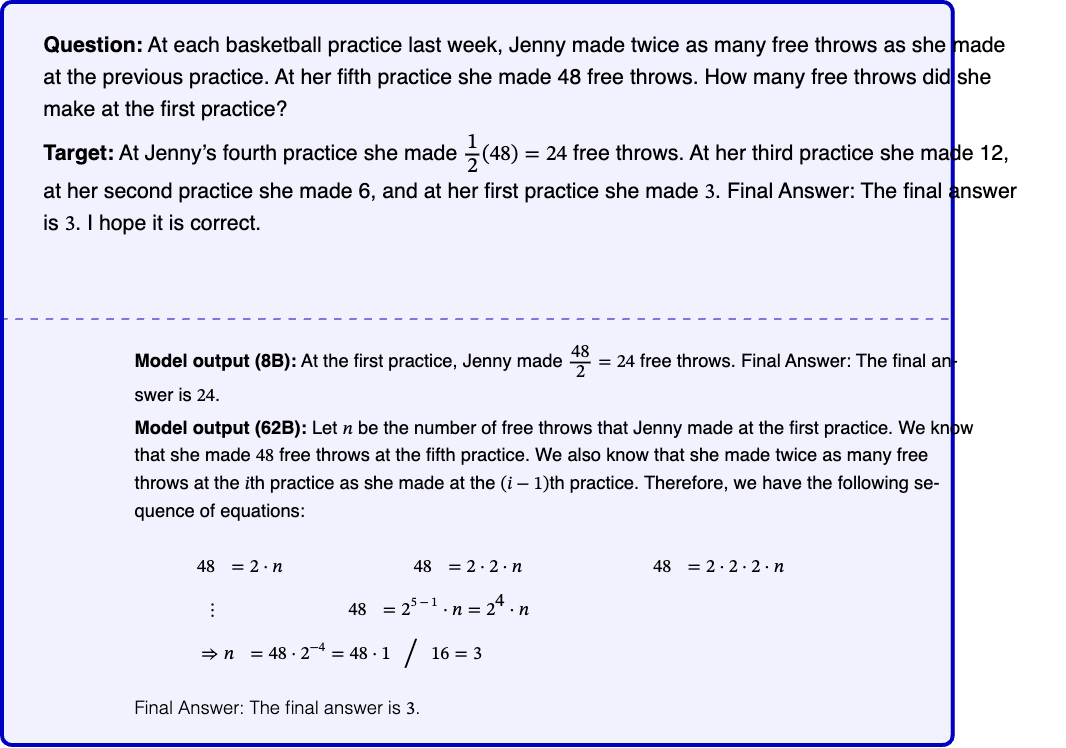
Incorrect reasoning.
Text in this graphic
Question: At each basketball practice last week, Jenny made twice as many free throws as she made at the previous practice. At her fifth practice she made 48 free throws. How many free throws did she make at the first practice? Target: At Jenny’s fourth practice she made free throws. At her third practice she made 12, at her second practice she made 6, and at her first practice she made . Final Answer: The final answer is . I hope it is correct.
Model output (8B): At the first practice, Jenny made free throws. Final Answer: The final answer is . Model output (62B): Let be the number of free throws that Jenny made at the first practice. We know that she made free throws at the fifth practice. We also know that she made twice as many free throws at the th practice as she made at the th practice. Therefore, we have the following sequence of equations:
Final Answer: The final answer is .
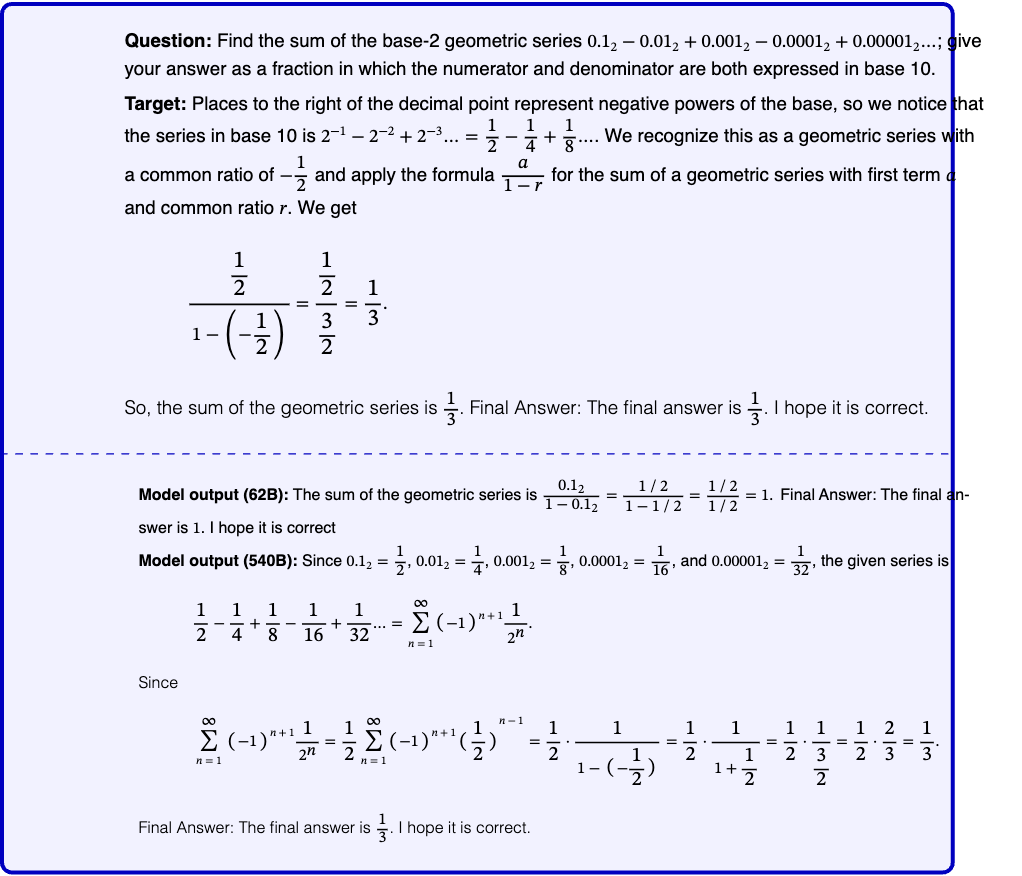
We include below one additional example of a reasoning error committed by the 62B model and fixed by the 540B model. The project webpage features more examples comparing these two models.
Text in this graphic
Question: Find the sum of the base-2 geometric series ; give your answer as a fraction in which the numerator and denominator are both expressed in base 10. Target: Places to the right of the decimal point represent negative powers of the base, so we notice that the series in base 10 is . We recognize this as a geometric series with a common ratio of and apply the formula for the sum of a geometric series with first term and common ratio . We get
So, the sum of the geometric series is . Final Answer: The final answer is . I hope it is correct.
Model output (62B): The sum of the geometric series is Final Answer: The final answer is . I hope it is correct Model output (540B): Since , , , , and , the given series is
Since
Final Answer: The final answer is . I hope it is correct.
Misunderstanding of a problem statement.
This label was applied when a human rater thought that an attempted solution may be a part of a mathematically sound solution to a different problem.
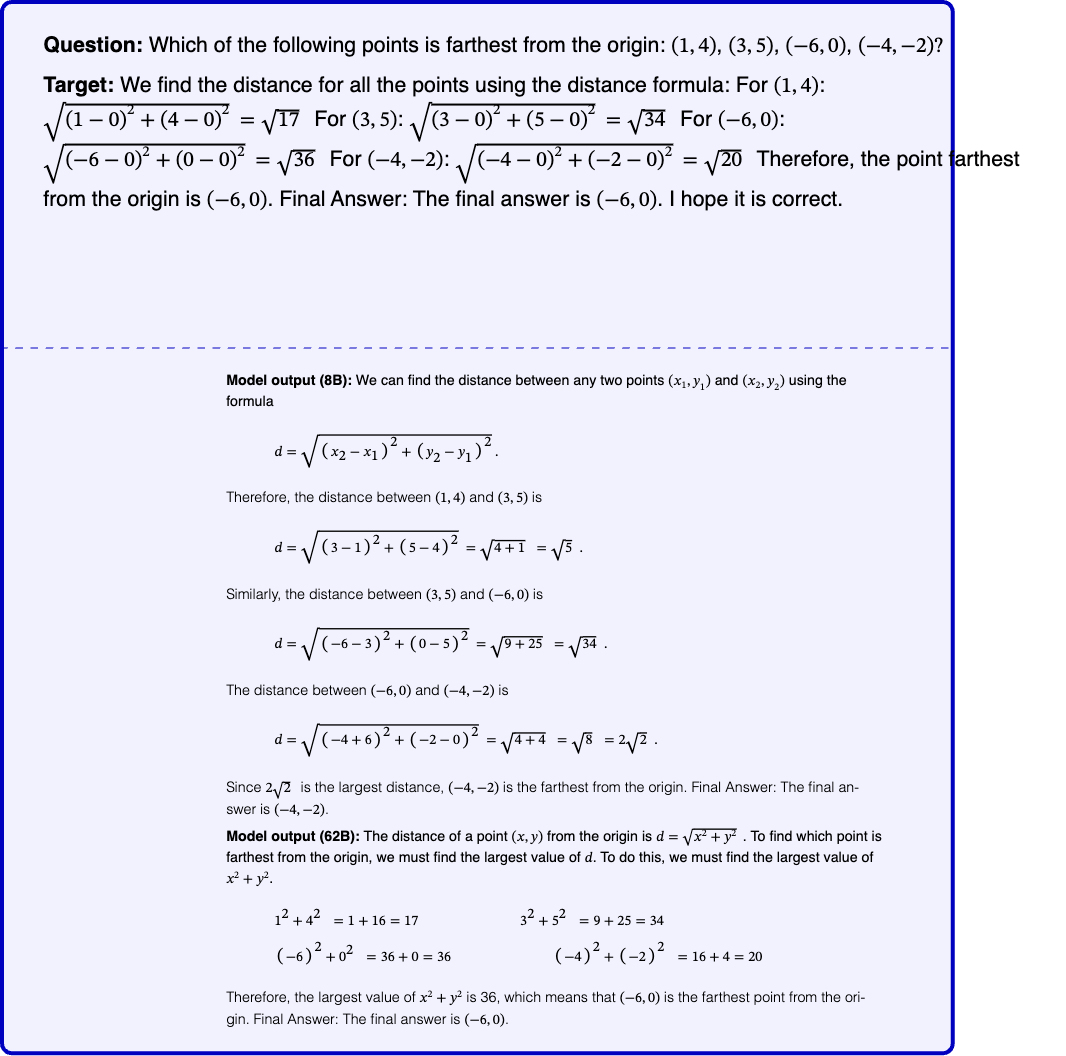
Text in this graphic
Question: Which of the following points is farthest from the origin: , , , Target: We find the distance for all the points using the distance formula: For : For : For : For : Therefore, the point farthest from the origin is . Final Answer: The final answer is . I hope it is correct.
Model output (8B): We can find the distance between any two points and using the formula
Therefore, the distance between and is
Similarly, the distance between and is
The distance between and is
Since is the largest distance, is the farthest from the origin. Final Answer: The final answer is . Model output (62B): The distance of a point from the origin is . To find which point is farthest from the origin, we must find the largest value of . To do this, we must find the largest value of .
Therefore, the largest value of is 36, which means that is the farthest point from the origin. Final Answer: The final answer is .
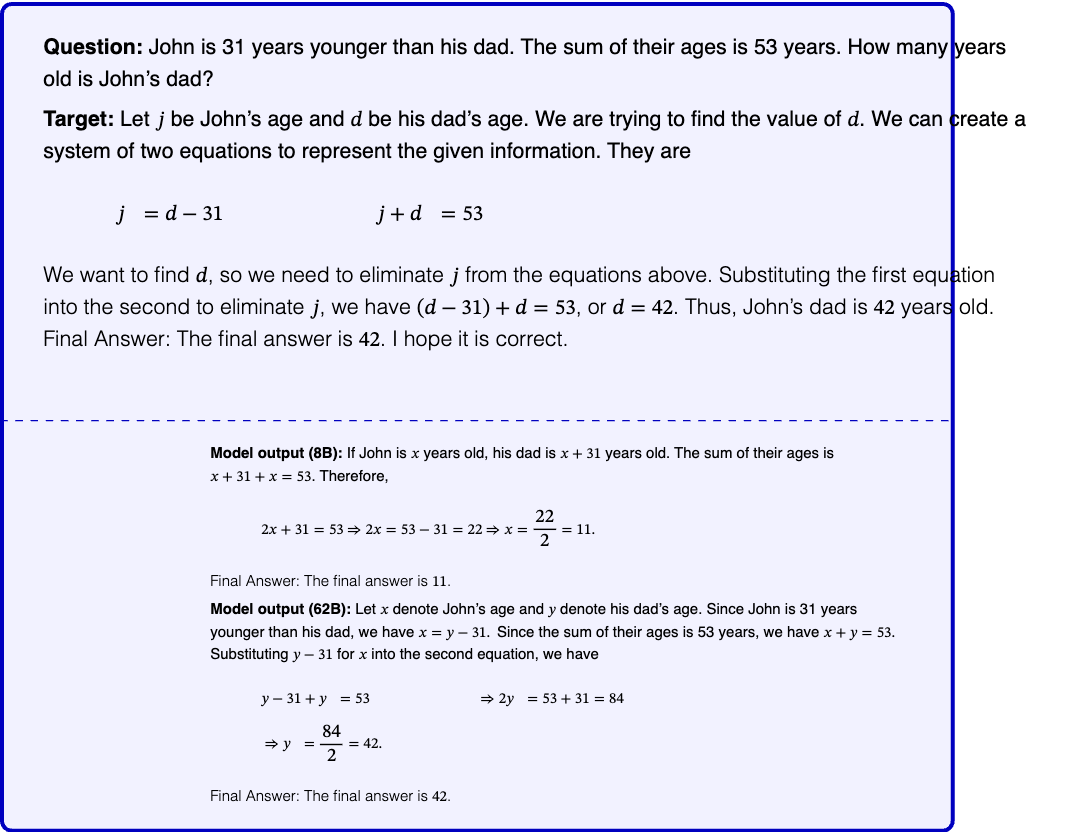
Text in this graphic
Question: John is 31 years younger than his dad. The sum of their ages is 53 years. How many years old is John’s dad? Target: Let be John’s age and be his dad’s age. We are trying to find the value of . We can create a system of two equations to represent the given information. They are
We want to find , so we need to eliminate from the equations above. Substituting the first equation into the second to eliminate , we have , or . Thus, John’s dad is years old. Final Answer: The final answer is . I hope it is correct.
Model output (8B): If John is years old, his dad is years old. The sum of their ages is . Therefore,
Final Answer: The final answer is . Model output (62B): Let denote John’s age and denote his dad’s age. Since John is 31 years younger than his dad, we have Since the sum of their ages is 53 years, we have Substituting for into the second equation, we have
Final Answer: The final answer is .
Uses of incorrect facts.
We decided to separate this specific kind of a reasoning error — the model provides a consistent reasoning that relies on an additional fact that does not hold in the given context.
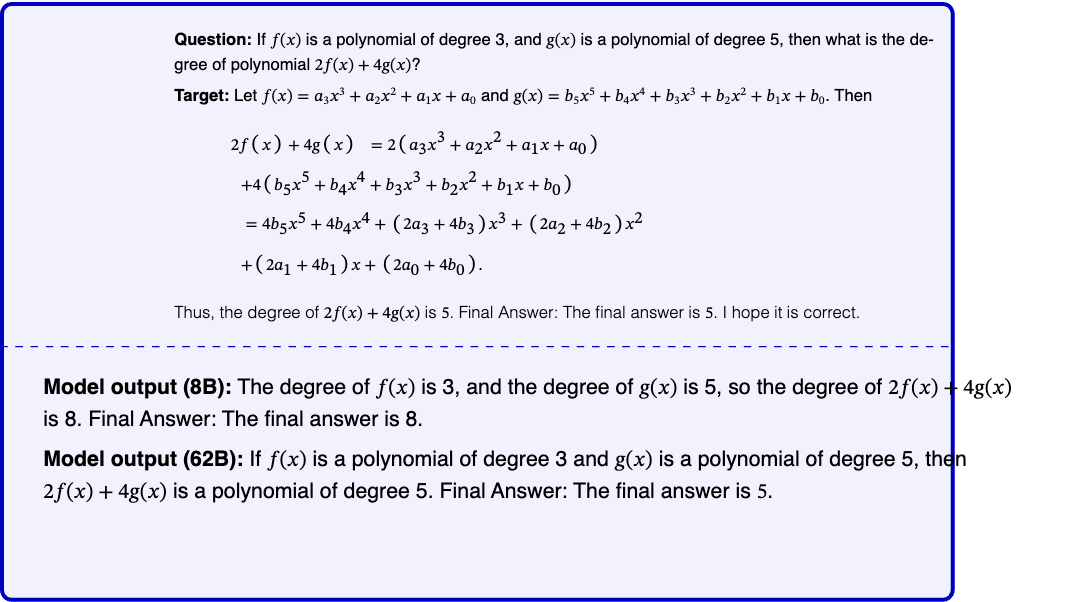
Text in this graphic
Question: If is a polynomial of degree 3, and is a polynomial of degree 5, then what is the degree of polynomial ? Target: Let and . Then
Thus, the degree of is . Final Answer: The final answer is . I hope it is correct.
Model output (8B): The degree of is 3, and the degree of is 5, so the degree of is 8. Final Answer: The final answer is 8. Model output (62B): If is a polynomial of degree 3 and is a polynomial of degree 5, then is a polynomial of degree 5. Final Answer: The final answer is .
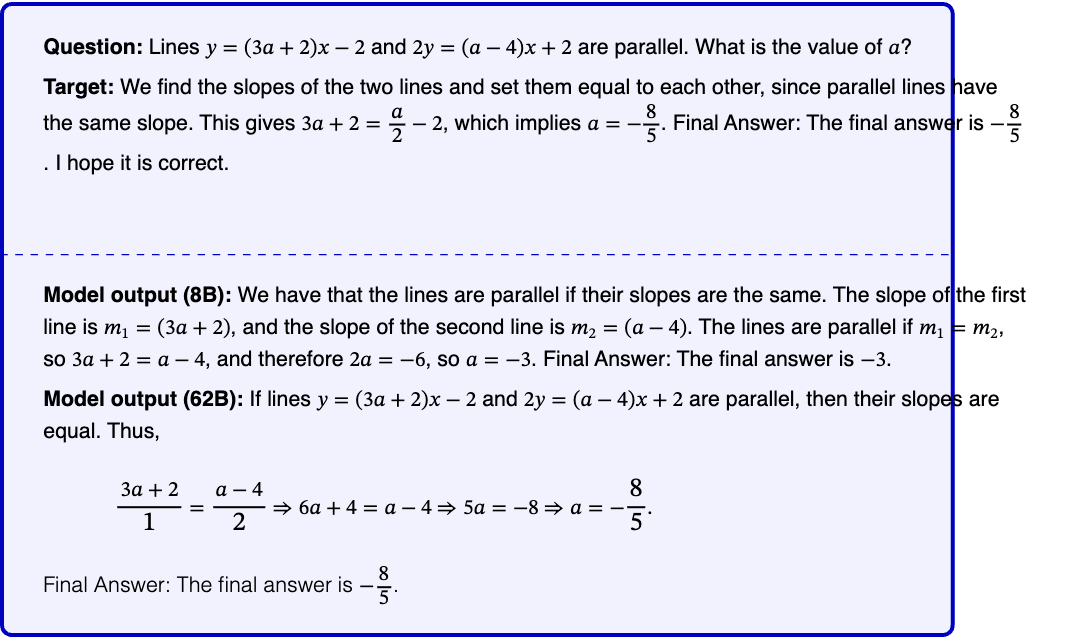
Text in this graphic
Question: Lines and are parallel. What is the value of ? Target: We find the slopes of the two lines and set them equal to each other, since parallel lines have the same slope. This gives , which implies . Final Answer: The final answer is . I hope it is correct.
Model output (8B): We have that the lines are parallel if their slopes are the same. The slope of the first line is , and the slope of the second line is . The lines are parallel if , so , and therefore , so . Final Answer: The final answer is . Model output (62B): If lines and are parallel, then their slopes are equal. Thus,
Final Answer: The final answer is .
Hallucination.
This label was applied when a human rater discovered in a solution a mathematical object that cannot be easily tracked to original formulation of the task.
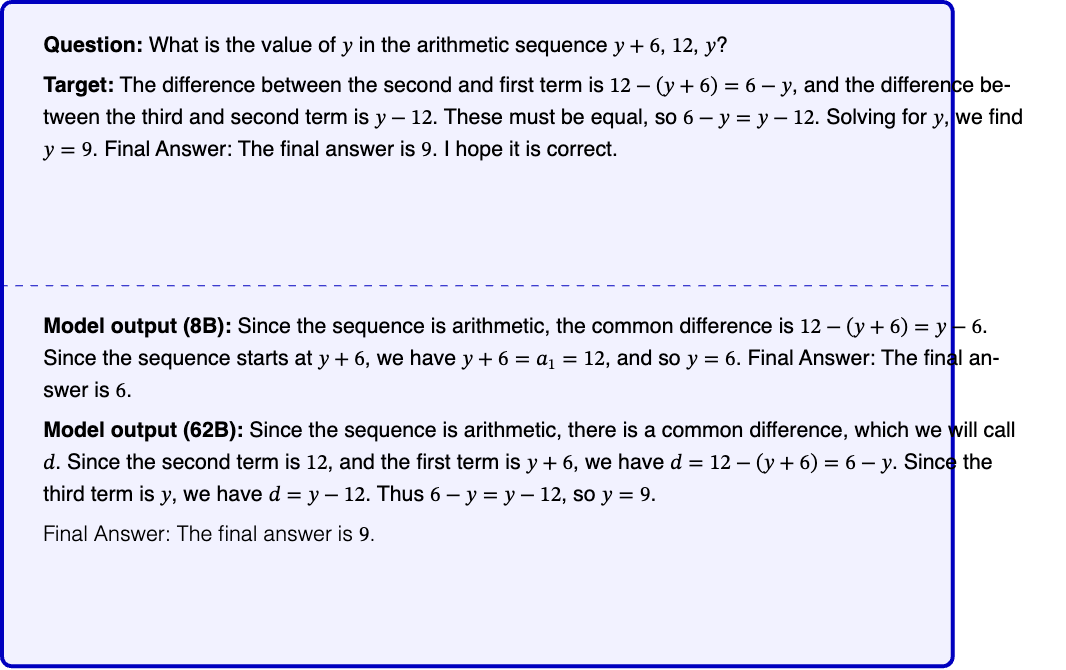
Text in this graphic
Question: What is the value of in the arithmetic sequence , , ? Target: The difference between the second and first term is , and the difference between the third and second term is . These must be equal, so . Solving for , we find . Final Answer: The final answer is . I hope it is correct.
Model output (8B): Since the sequence is arithmetic, the common difference is . Since the sequence starts at , we have , and so . Final Answer: The final answer is . Model output (62B): Since the sequence is arithmetic, there is a common difference, which we will call . Since the second term is , and the first term is , we have . Since the third term is , we have . Thus , so . Final Answer: The final answer is .
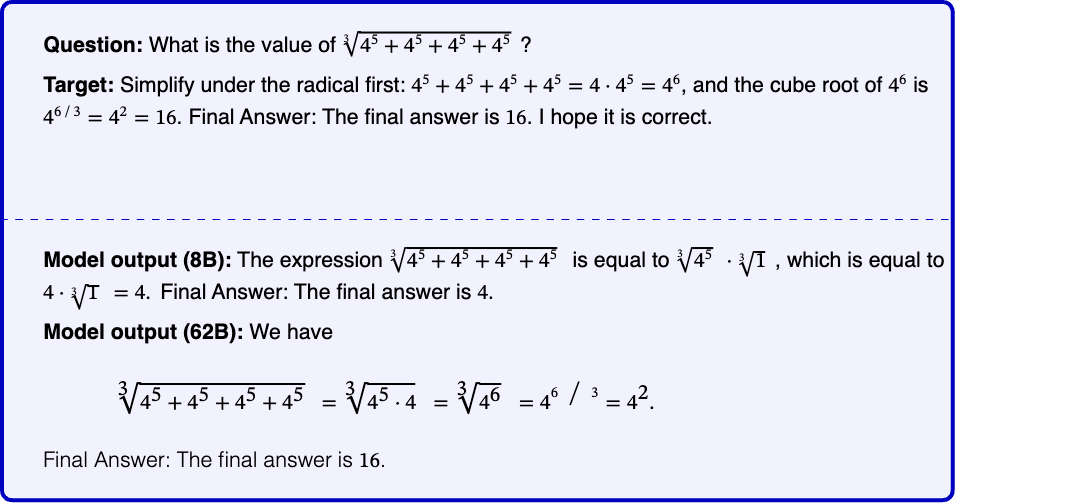
Text in this graphic
Question: What is the value of ? Target: Simplify under the radical first: , and the cube root of is . Final Answer: The final answer is . I hope it is correct.
Model output (8B): The expression is equal to , which is equal to Final Answer: The final answer is . Model output (62B): We have
Final Answer: The final answer is .
Short and wrong solutions.
This label was applied when a human rater decided that there are missing key reasoning steps.
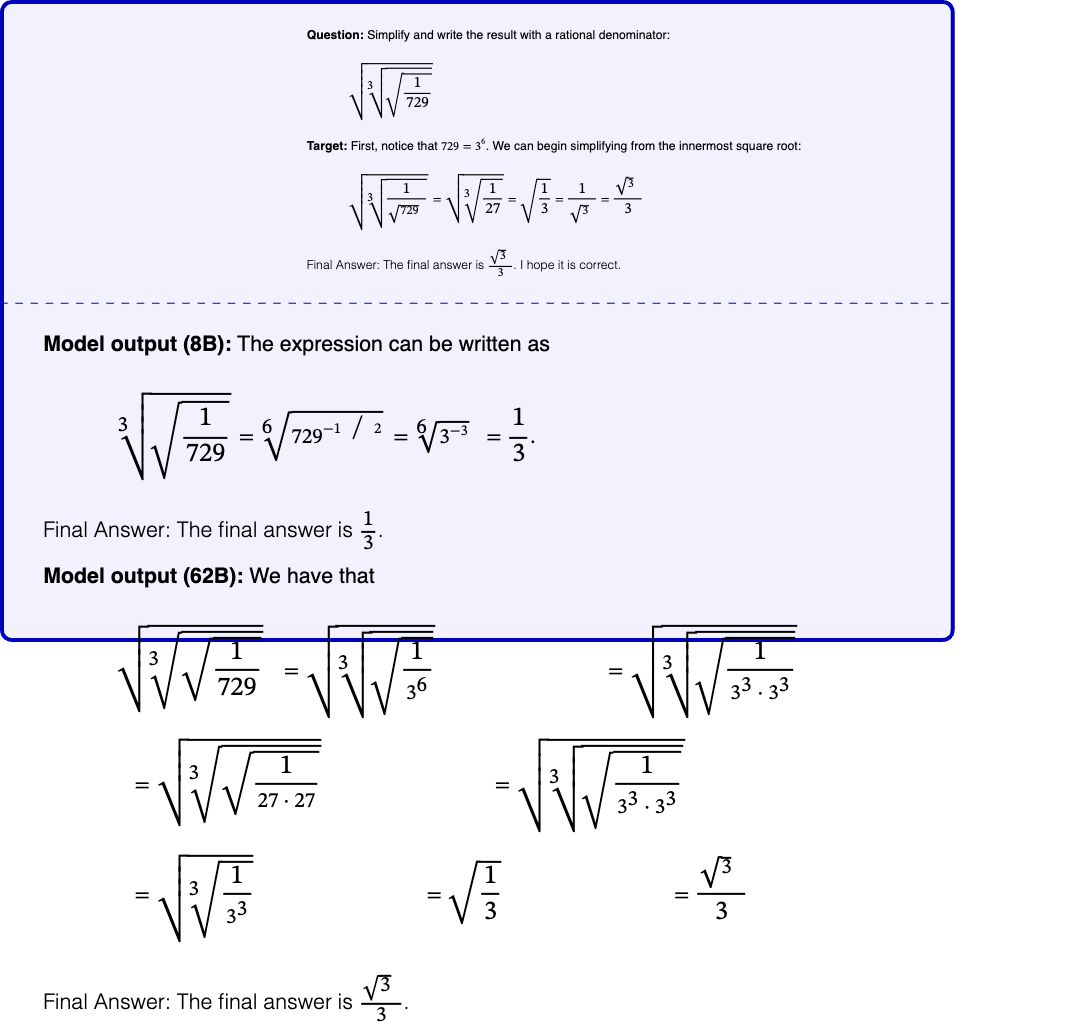
Text in this graphic
Question: Simplify and write the result with a rational denominator:
Target: First, notice that . We can begin simplifying from the innermost square root:
Final Answer: The final answer is . I hope it is correct.
Model output (8B): The expression can be written as
Final Answer: The final answer is . Model output (62B): We have that
Final Answer: The final answer is .
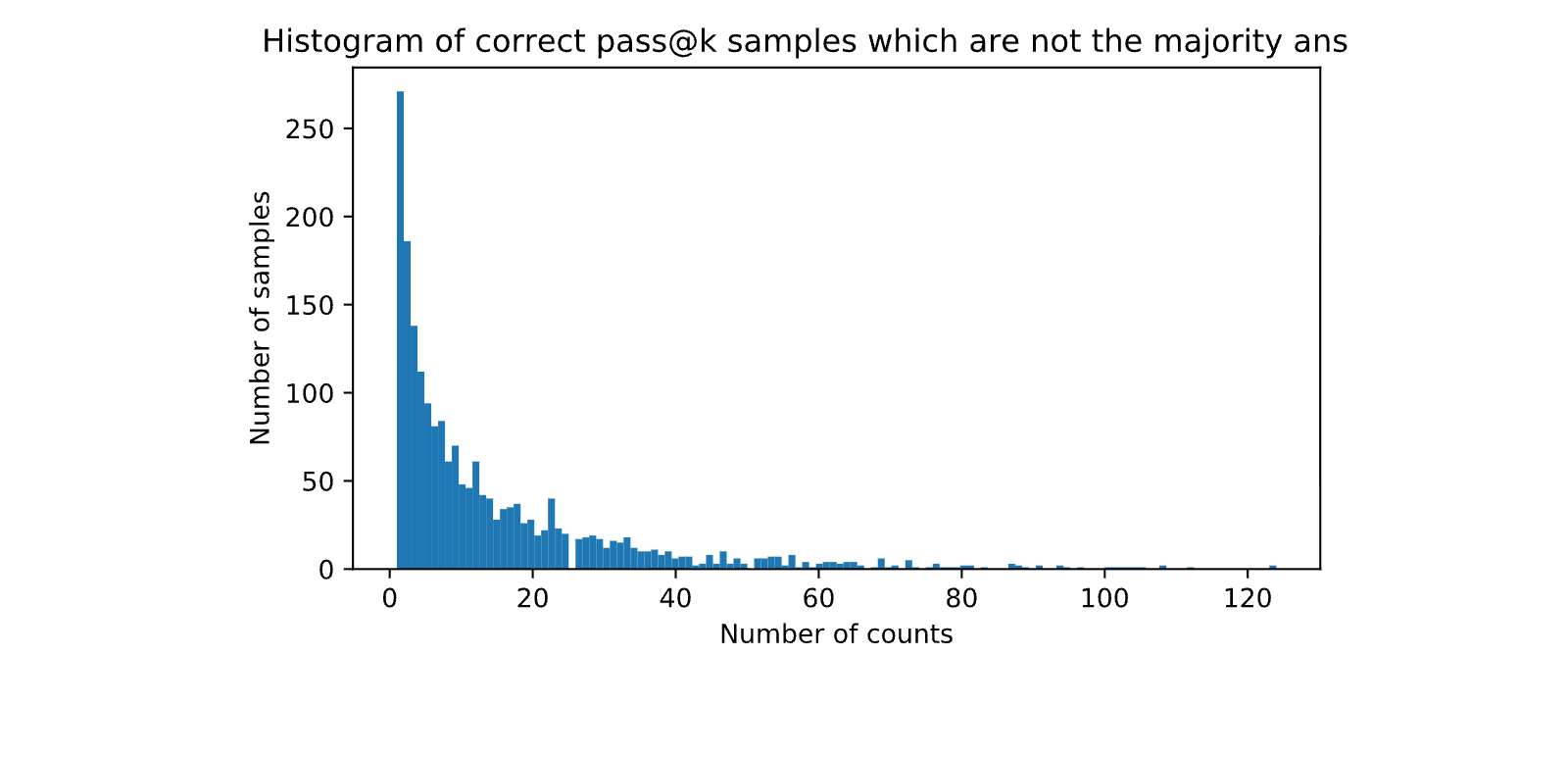
Here we present a false positive sample analysis for the pass@k metric to complement the pass@1 analysis from the main text. The goal is to look for the hardest correct samples because that is most likely where false positives are the most prevalent.
In this way, we will focus on tasks which are labeled as correct by the pass@k metric but are not the majority answer. Among these we will pick the correct sample whose final answer only appears once.
For the 62B model, samples, 2,000 tasks are solved by pass@k and not by majority voting . Of these correct samples, we focus on the which appear only once.
We manually looked into of these samples and labeled them in one of five categories:
- •
False Positive with Graph (8%): false positive, required parsing an Asymptote graph
- •
Clear False Positive (16%): the model is producing the right answer using the wrong approach/method.
- •
False Positives with minor mistakes (16%): models have the right reasoning but make a minor mistake in reasoning. It is not clear if the model makes two mistakes that cancel or whether the model ignores the mistake in the reasoning and attends to parts of the reasonign that were correct.
- •
Correct Answers without Explanining Steps (16%): the reasoning is correct but sometimes the model plugs formulas too quickly and without explaning. This would remove some points in a proper grading.
- •
Correct Answers (44%): model gets it right.
The density of false positives in this set of samples is roughly . There are tasks which are solved by pass@k and not by maj. If we extrapolate the False Positive Rate (FPR), we expect the actual true positive samples to be . If the FPR for the majority voting samples is , we expect the accuracy to be at least . Note that to estimate the FPR for the samples which are only solved by pass@k , we looked for the location where there is less confidence about the answer: problems which only had correct answer (as opposed to many correct final answers) and of all correct tasks have more than one sample with the correct final answer.
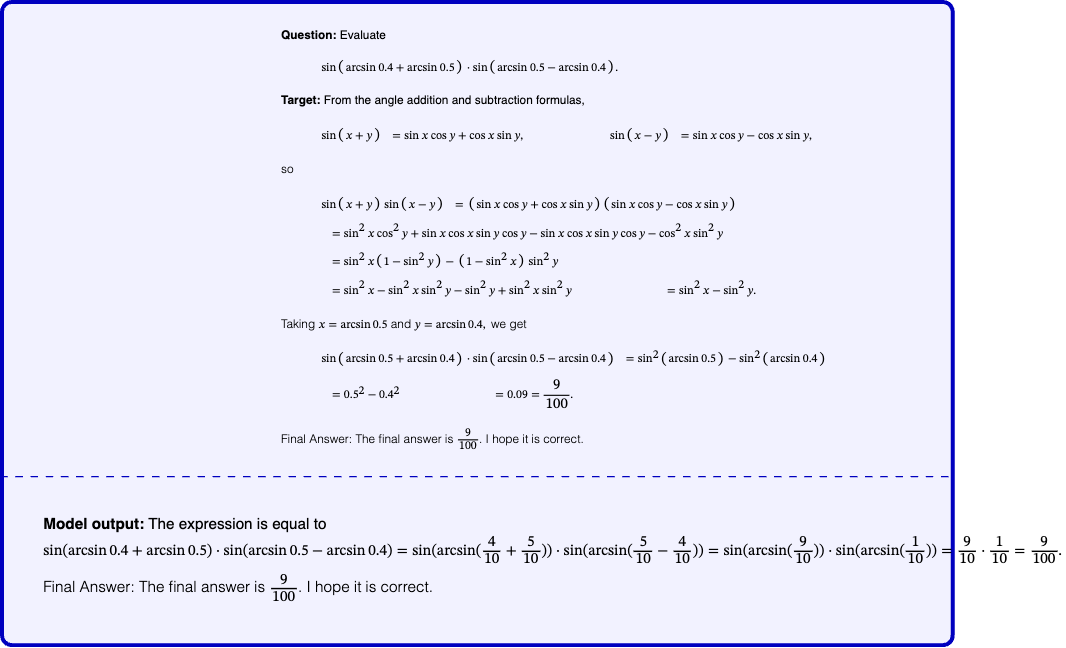
Text in this graphic
Question: Evaluate
Target: From the angle addition and subtraction formulas,
so
Taking and we get
Final Answer: The final answer is . I hope it is correct.
Model output: The expression is equal to Final Answer: The final answer is . I hope it is correct.
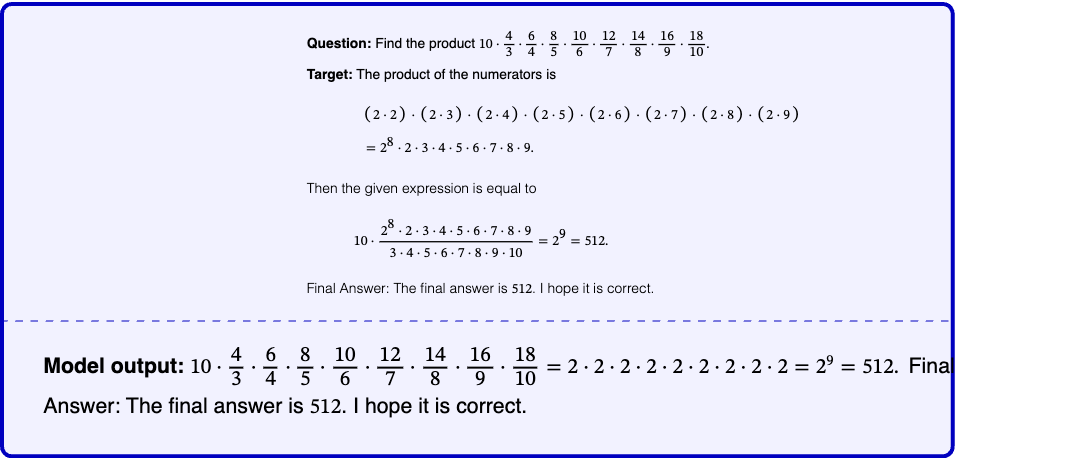
Text in this graphic
Question: Find the product . Target: The product of the numerators is
Then the given expression is equal to
Final Answer: The final answer is . I hope it is correct.
Model output: Final Answer: The final answer is . I hope it is correct.
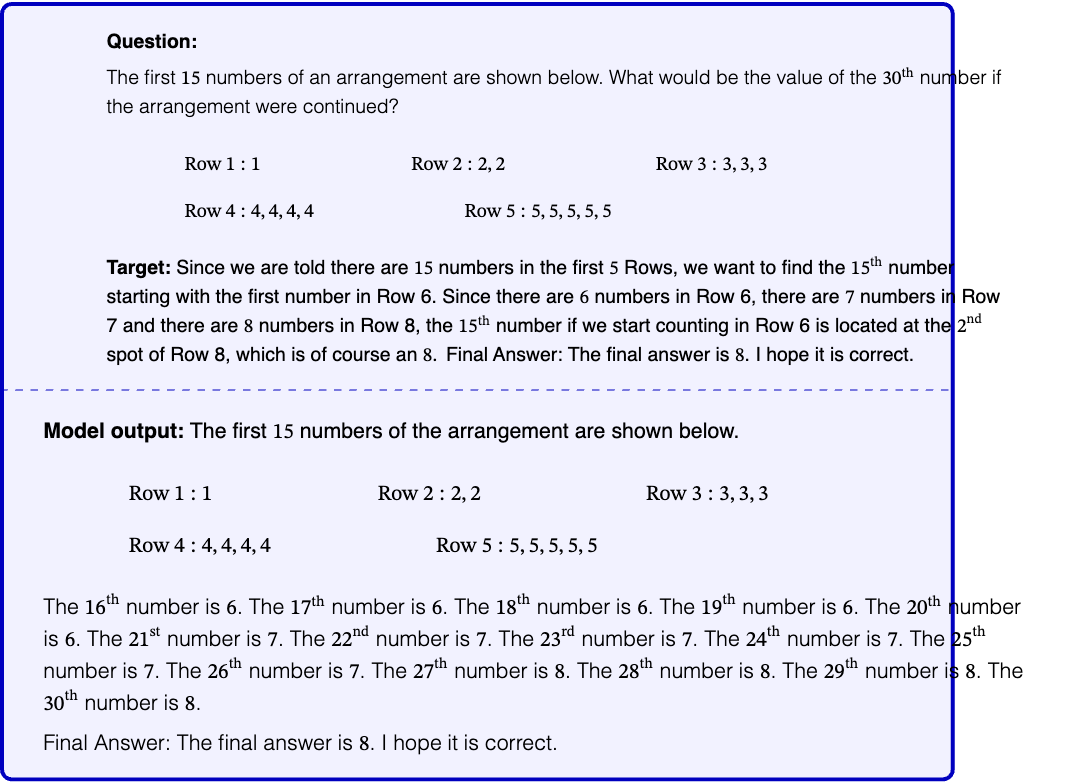
Text in this graphic
Question: The first numbers of an arrangement are shown below. What would be the value of the number if the arrangement were continued?
Target: Since we are told there are numbers in the first Rows, we want to find the number starting with the first number in Row 6. Since there are numbers in Row 6, there are numbers in Row 7 and there are numbers in Row 8, the number if we start counting in Row 6 is located at the spot of Row 8, which is of course an Final Answer: The final answer is . I hope it is correct.
Model output: The first numbers of the arrangement are shown below.
The number is . The number is . The number is . The number is . The number is . The number is . The number is . The number is . The number is . The number is . The number is . The number is . The number is . The number is . The number is . Final Answer: The final answer is . I hope it is correct.
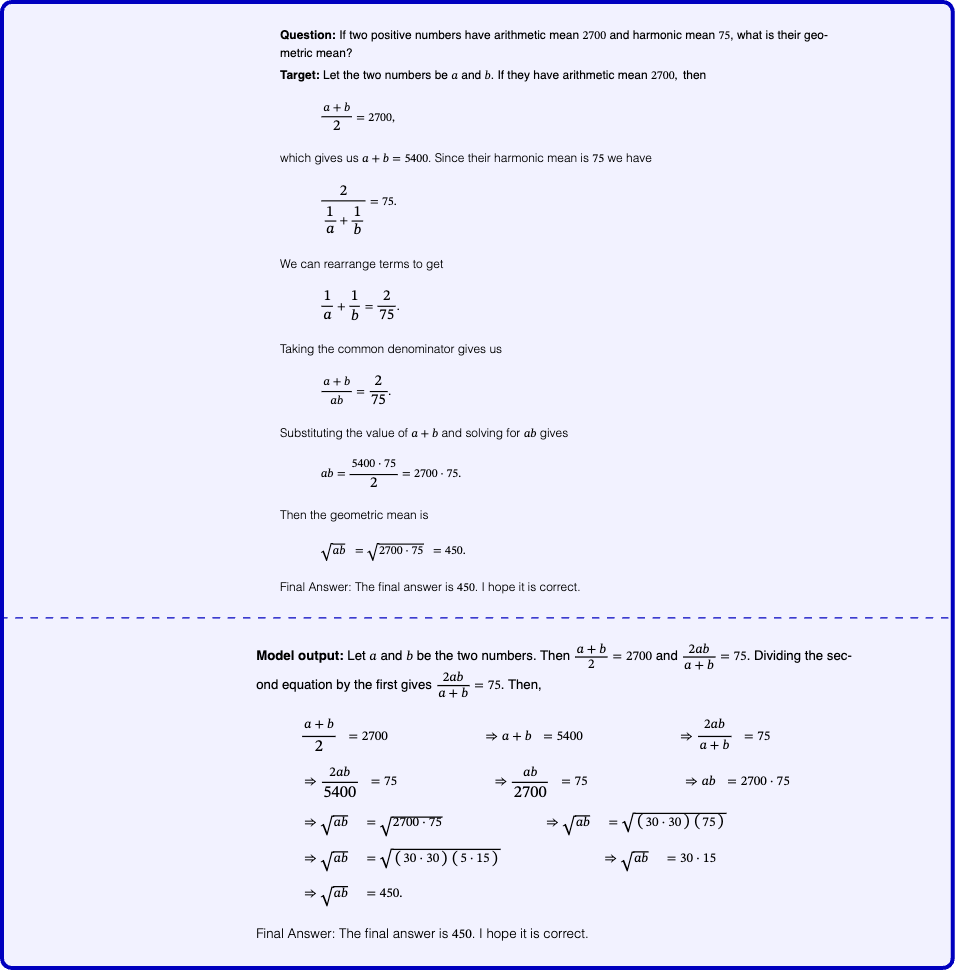
Text in this graphic
Question: If two positive numbers have arithmetic mean and harmonic mean , what is their geometric mean? Target: Let the two numbers be and . If they have arithmetic mean then
which gives us . Since their harmonic mean is we have
We can rearrange terms to get
Taking the common denominator gives us
Substituting the value of and solving for gives
Then the geometric mean is
Final Answer: The final answer is . I hope it is correct.
Model output: Let and be the two numbers. Then and . Dividing the second equation by the first gives . Then,
Final Answer: The final answer is . I hope it is correct.
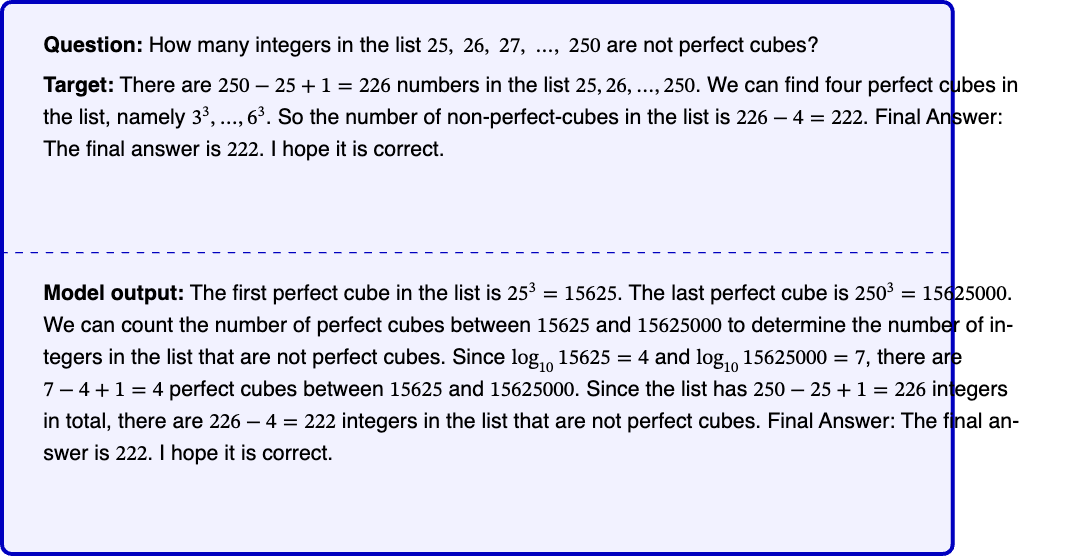
Text in this graphic
Question: How many integers in the list are not perfect cubes? Target: There are numbers in the list . We can find four perfect cubes in the list, namely . So the number of non-perfect-cubes in the list is . Final Answer: The final answer is . I hope it is correct.
Model output: The first perfect cube in the list is . The last perfect cube is . We can count the number of perfect cubes between and to determine the number of integers in the list that are not perfect cubes. Since and , there are perfect cubes between and . Since the list has integers in total, there are integers in the list that are not perfect cubes. Final Answer: The final answer is . I hope it is correct.
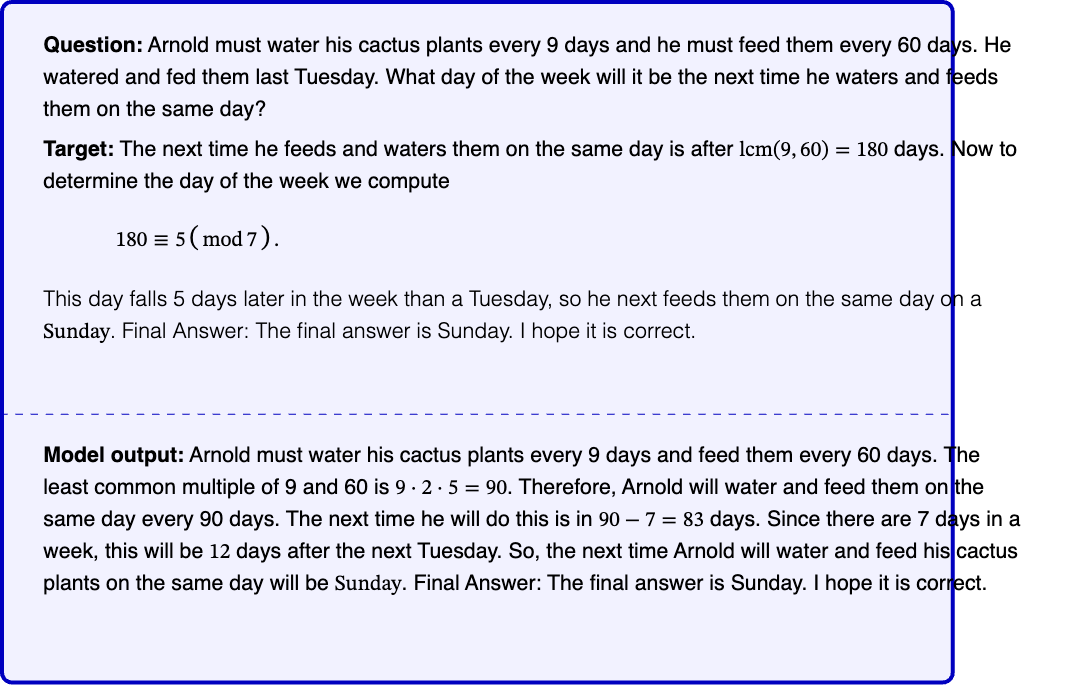
Text in this graphic
Question: Arnold must water his cactus plants every 9 days and he must feed them every 60 days. He watered and fed them last Tuesday. What day of the week will it be the next time he waters and feeds them on the same day? Target: The next time he feeds and waters them on the same day is after days. Now to determine the day of the week we compute
This day falls 5 days later in the week than a Tuesday, so he next feeds them on the same day on a . Final Answer: The final answer is Sunday. I hope it is correct.
Model output: Arnold must water his cactus plants every 9 days and feed them every 60 days. The least common multiple of 9 and 60 is . Therefore, Arnold will water and feed them on the same day every 90 days. The next time he will do this is in days. Since there are 7 days in a week, this will be days after the next Tuesday. So, the next time Arnold will water and feed his cactus plants on the same day will be . Final Answer: The final answer is Sunday. I hope it is correct.
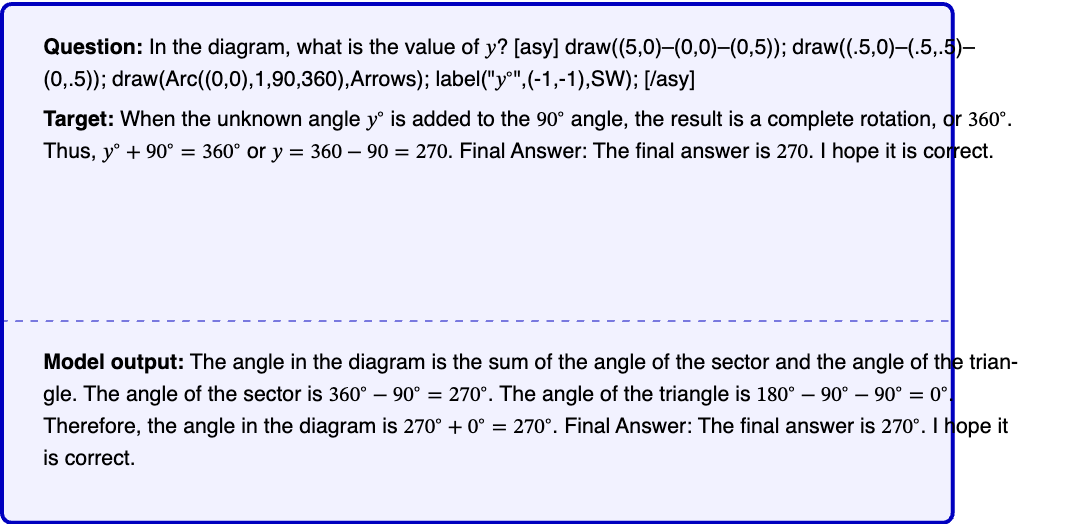
Text in this graphic
Question: In the diagram, what is the value of ? [asy] draw((5,0)–(0,0)–(0,5)); draw((.5,0)–(.5,.5)–(0,.5)); draw(Arc((0,0),1,90,360),Arrows); label("",(-1,-1),SW); [/asy] Target: When the unknown angle is added to the angle, the result is a complete rotation, or . Thus, or . Final Answer: The final answer is . I hope it is correct.
Model output: The angle in the diagram is the sum of the angle of the sector and the angle of the triangle. The angle of the sector is . The angle of the triangle is . Therefore, the angle in the diagram is . Final Answer: The final answer is . I hope it is correct.
As conducted in May 2022, the actual exam contains 29 multiple-choice problems that we loosely frame as text problems, expecting the model to provide reasoning followed by an answer. We decided to skip in this evaluation three problems that rely on graphs.
Moreover, the exam contains six text problems where the student is expected to provide reasoning and a solution. In our evaluation, we included all these problems.
The model excels at more straightforward problems, making few reasoning or calculation mistakes. In particular, the model solves correctly 19 out of 26 multiple-choice problems. Mathematically valid reasoning backs the prevailing majority of the 19 correct solutions. Below we highlight selected positive examples as well as selected failure cases.
A more complete evaluation should include in-context learning based on previous iterations of the National Exam and assessment of other iterations of the exam. We leave this experiment as future work.

Text in this graphic
Question: Decide whether is , , or .
Model output: . Final solution: The final answer is .
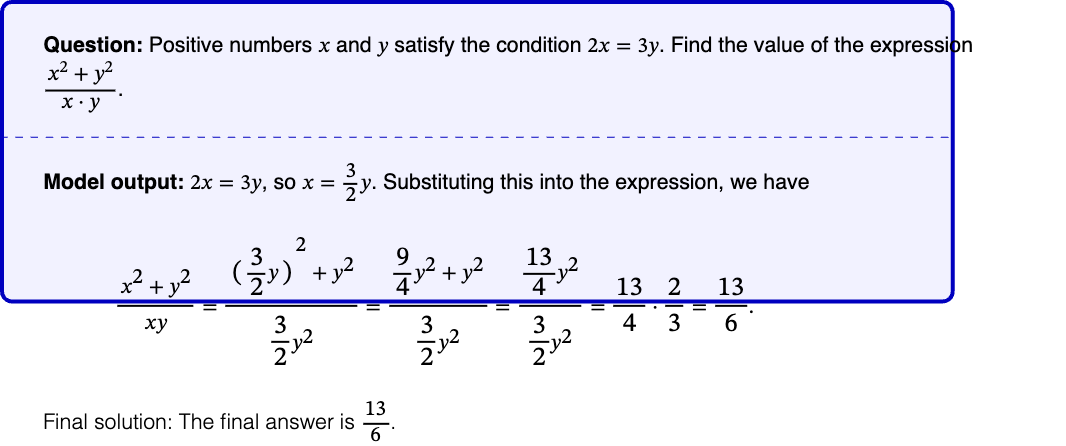
Text in this graphic
Question: Positive numbers and satisfy the condition . Find the value of the expression .
Model output: , so . Substituting this into the expression, we have
Final solution: The final answer is .
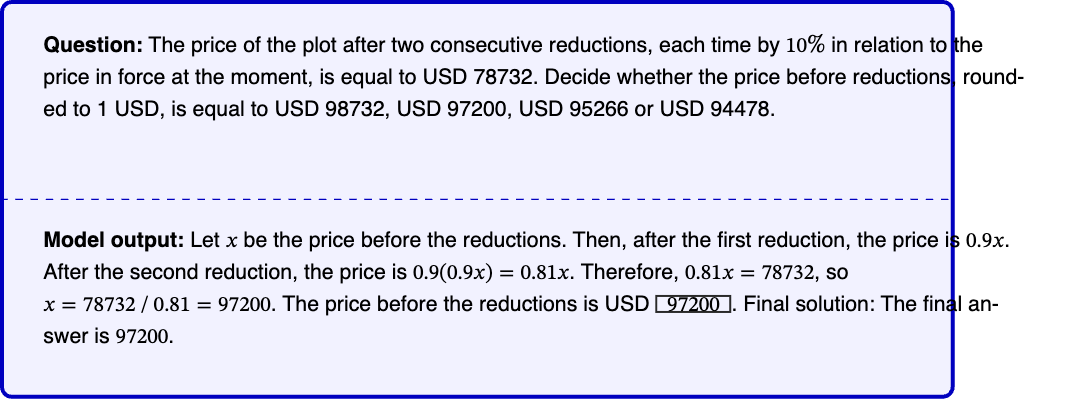
Text in this graphic
Question: The price of the plot after two consecutive reductions, each time by in relation to the price in force at the moment, is equal to USD 78732. Decide whether the price before reductions, rounded to 1 USD, is equal to USD 98732, USD 97200, USD 95266 or USD 94478.
Model output: Let be the price before the reductions. Then, after the first reduction, the price is . After the second reduction, the price is . Therefore, , so . The price before the reductions is USD 97200. Final solution: The final answer is .
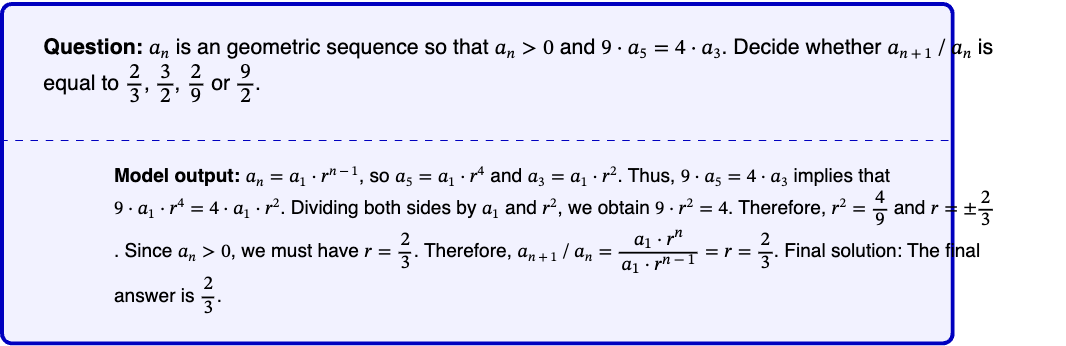
Text in this graphic
Question: is an geometric sequence so that and . Decide whether is equal to , , or .
Model output: , so and . Thus, implies that . Dividing both sides by and , we obtain . Therefore, and . Since , we must have . Therefore, . Final solution: The final answer is .
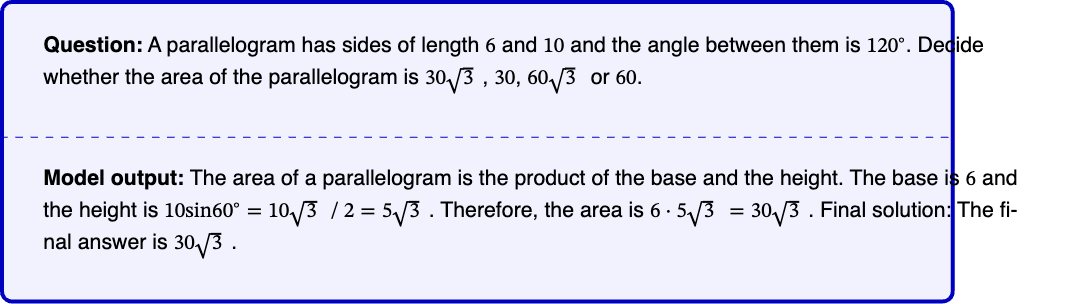
Text in this graphic
Question: A parallelogram has sides of length and and the angle between them is . Decide whether the area of the parallelogram is , , or .
Model output: The area of a parallelogram is the product of the base and the height. The base is and the height is . Therefore, the area is . Final solution: The final answer is .
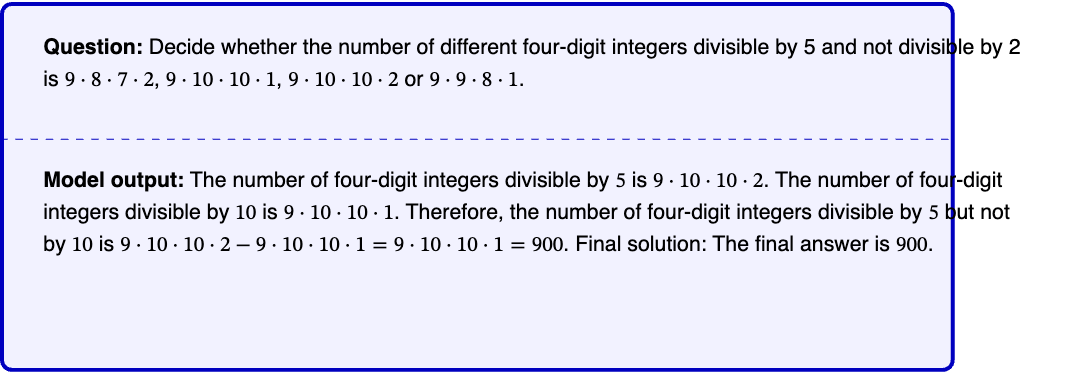
Text in this graphic
Question: Decide whether the number of different four-digit integers divisible by 5 and not divisible by 2 is , , or .
Model output: The number of four-digit integers divisible by is . The number of four-digit integers divisible by is . Therefore, the number of four-digit integers divisible by but not by is . Final solution: The final answer is .
An example of a calculation error of the 62B model fixed by the 540B model.
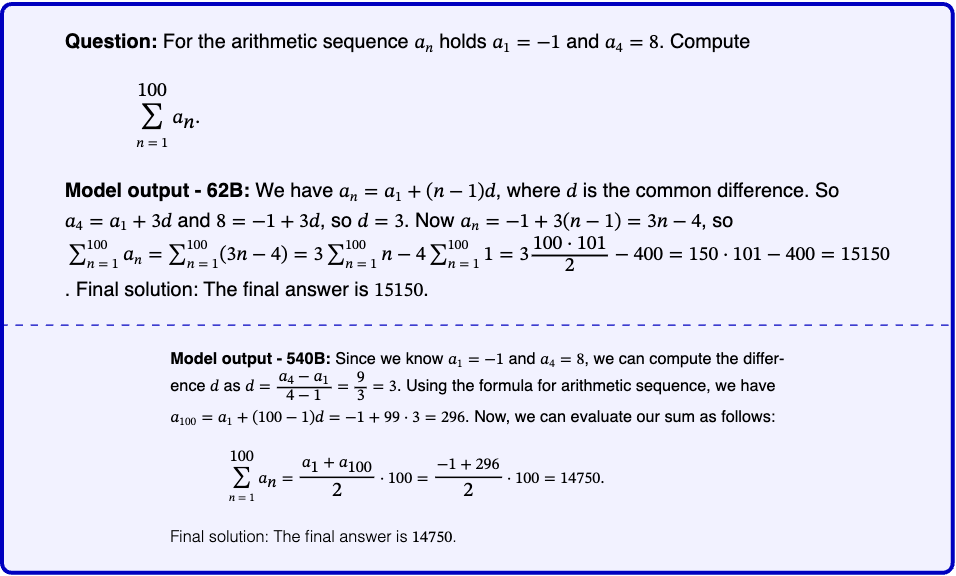
Text in this graphic
Question: For the arithmetic sequence holds and . Compute
Model output - 62B: We have , where is the common difference. So and , so . Now , so . Final solution: The final answer is .
Model output - 540B: Since we know and , we can compute the difference as . Using the formula for arithmetic sequence, we have . Now, we can evaluate our sum as follows:
Final solution: The final answer is .
An example of a reasoning error corrected by the 540B model.
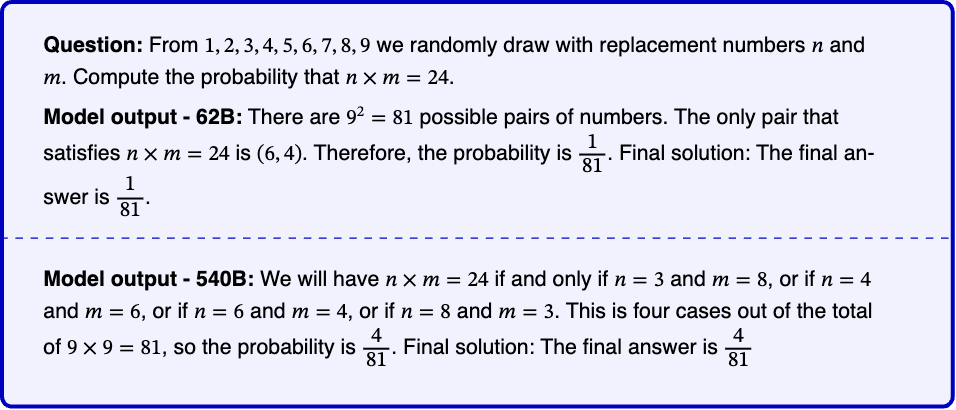
Text in this graphic
Question: From we randomly draw with replacement numbers and . Compute the probability that . Model output - 62B: There are possible pairs of numbers. The only pair that satisfies is . Therefore, the probability is . Final solution: The final answer is .
Model output - 540B: We will have if and only if and , or if and , or if and , or if and . This is four cases out of the total of , so the probability is . Final solution: The final answer is
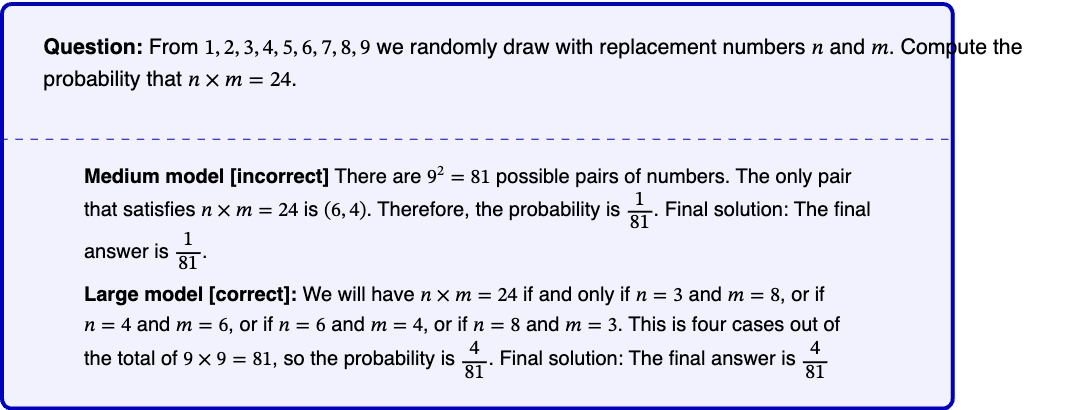
Text in this graphic
Question: From we randomly draw with replacement numbers and . Compute the probability that .
Medium model [incorrect] There are possible pairs of numbers. The only pair that satisfies is . Therefore, the probability is . Final solution: The final answer is . Large model [correct]: We will have if and only if and , or if and , or if and , or if and . This is four cases out of the total of , so the probability is . Final solution: The final answer is
An example of an error corrected by the 540B model.
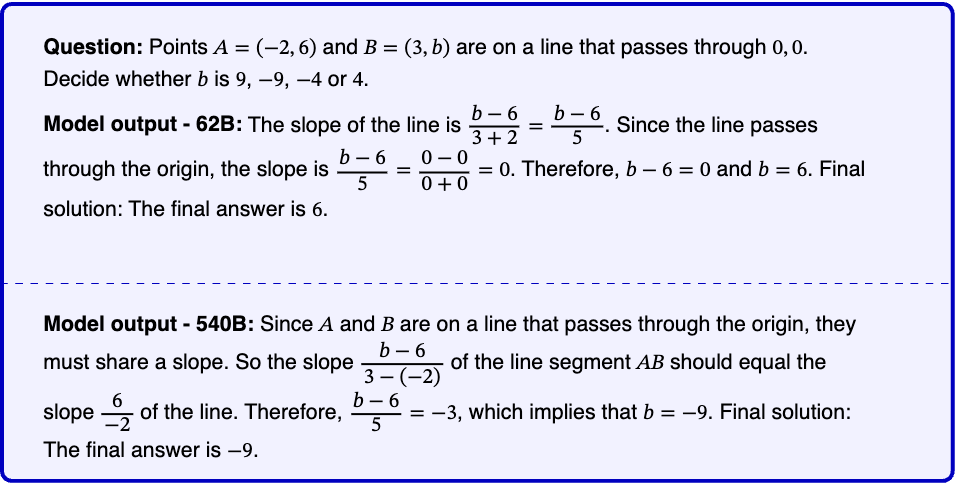
Text in this graphic
Question: Points and are on a line that passes through . Decide whether is , , or . Model output - 62B: The slope of the line is . Since the line passes through the origin, the slope is . Therefore, and . Final solution: The final answer is .
Model output - 540B: Since and are on a line that passes through the origin, they must share a slope. So the slope of the line segment should equal the slope of the line. Therefore, , which implies that . Final solution: The final answer is .
General Certificate of Secondary Education (GCSE) Mathematics is an exam taken annually by approximately 700K students in the UK, with about 40% of students taking the higher tier that we analyze in this evaluation. Students usually take the exam in Year 11, at 16 years old (see the governmental web-page for more details).
For the purpose of this evaluation we focused on the June 2019 exam and identified exam tasks not involving images in an essential way (problems 2, 3, 4, 5, 6b, 7, 8, 10b, 11, 12, 15a, 16, 17, 18, 19, 21, 23, 24, 26, 27). The sum of points possible for all listed problems is 46 out of 80 points for all problems. In our evaluation Minerva 540B obtained 38 out of 46 points (82.6%). In the evaluation we took into account only the top answer in the majority voting.
More straightforward tasks in the GSCE exam (problems that contribute 1 point to the total score) are solved correctly in all instances except one. Some complex problems are also solved correctly; below, we include one straightforward problem and one complex problem together with the model’s outputs. We also enclose a sample showing the model can fill a LaTeX table. The last two examples show failure modes: the top solution contains a conceptual error, and the 2nd best choice in majority voting has a calculation mistake, though of a kind that a model can recover from.
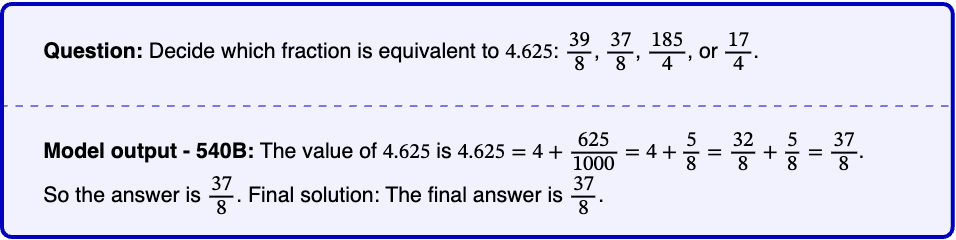
Text in this graphic
Question: Decide which fraction is equivalent to : , , , or .
Model output - 540B: The value of is . So the answer is . Final solution: The final answer is .
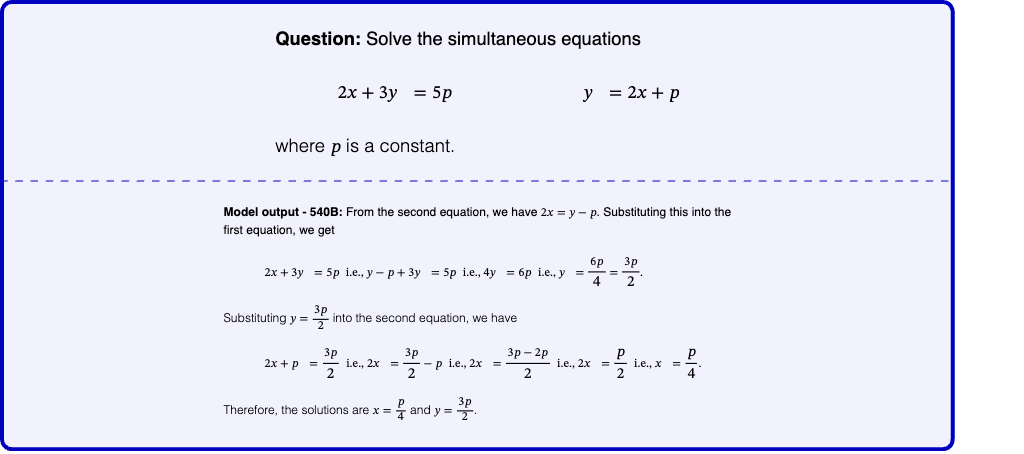
Text in this graphic
Question: Solve the simultaneous equations
where is a constant.
Model output - 540B: From the second equation, we have . Substituting this into the first equation, we get
Substituting into the second equation, we have
\begin{aligned}\displaystyle 2x+p & \displaystyle=\dfrac{3p}{2}\ \text{i.e., }2x & \displaystyle=\dfrac{3p}{2}-p\ \text{i.e., }2x & \displaystyle=\dfrac{3p-2p}{2}\ \text{i.e., }2x & \displaystyle=\dfrac{p}{2}\ \text{i.e., }x & \displaystyle=\dfrac{p}{4}.\\end{aligned}Therefore, the solutions are and .
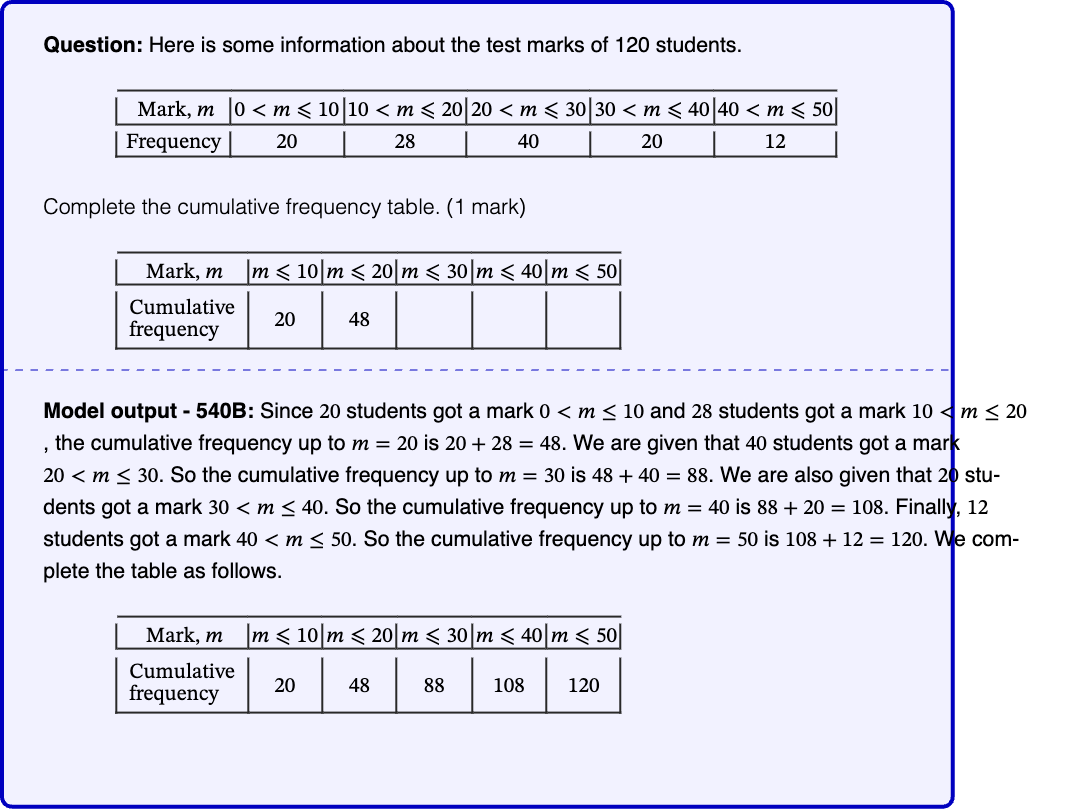
Text in this graphic
Question: Here is some information about the test marks of 120 students.
Complete the cumulative frequency table. (1 mark)
Model output - 540B: Since students got a mark and students got a mark , the cumulative frequency up to is . We are given that students got a mark . So the cumulative frequency up to is . We are also given that students got a mark . So the cumulative frequency up to is . Finally, students got a mark . So the cumulative frequency up to is . We complete the table as follows.
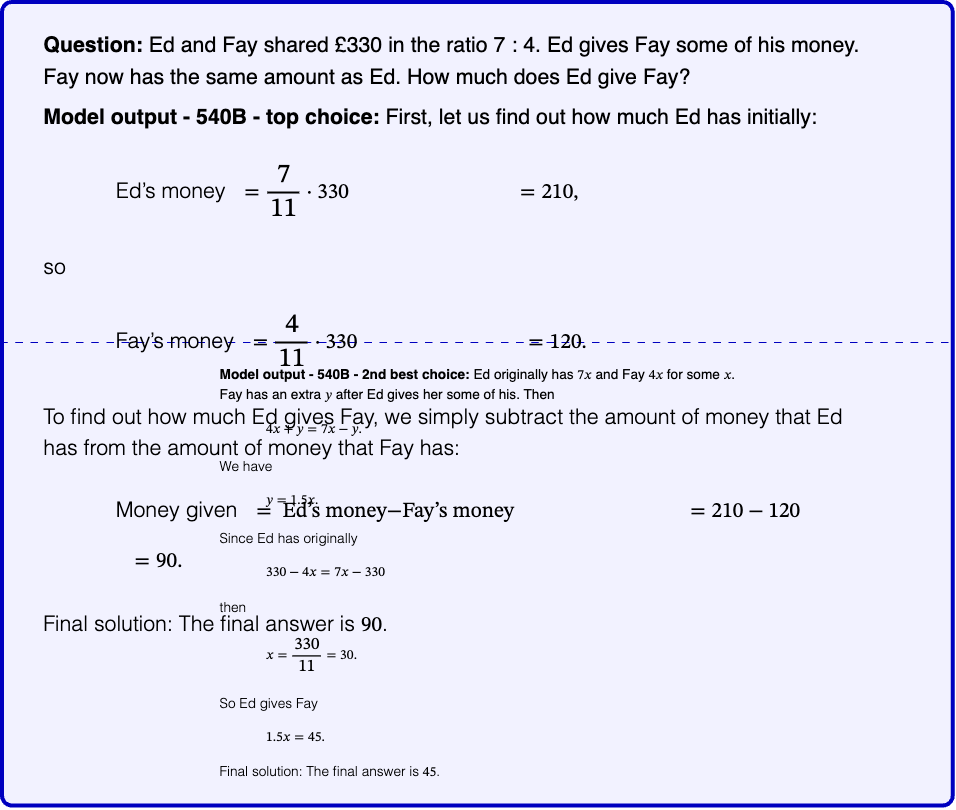
Text in this graphic
Question: Ed and Fay shared £330 in the ratio 7 : 4. Ed gives Fay some of his money. Fay now has the same amount as Ed. How much does Ed give Fay? Model output - 540B - top choice: First, let us find out how much Ed has initially:
so
To find out how much Ed gives Fay, we simply subtract the amount of money that Ed has from the amount of money that Fay has:
Final solution: The final answer is .
Model output - 540B - 2nd best choice: Ed originally has and Fay for some . Fay has an extra after Ed gives her some of his. Then
We have
Since Ed has originally
then
So Ed gives Fay
Final solution: The final answer is .
In our assessment, problems from the JEE exceed the current abilities of the model. Below we feature selected failure cases and leave a complete study for the future.
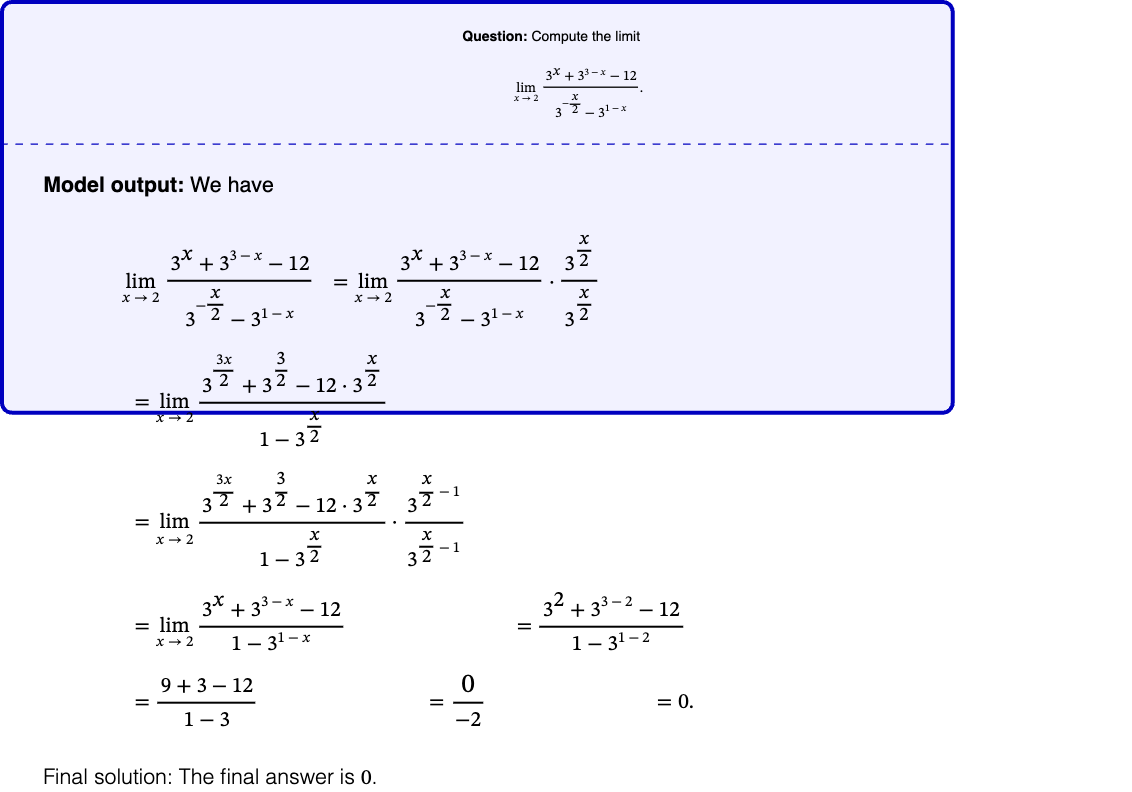
Text in this graphic
Question: Compute the limit
Model output: We have
Final solution: The final answer is .
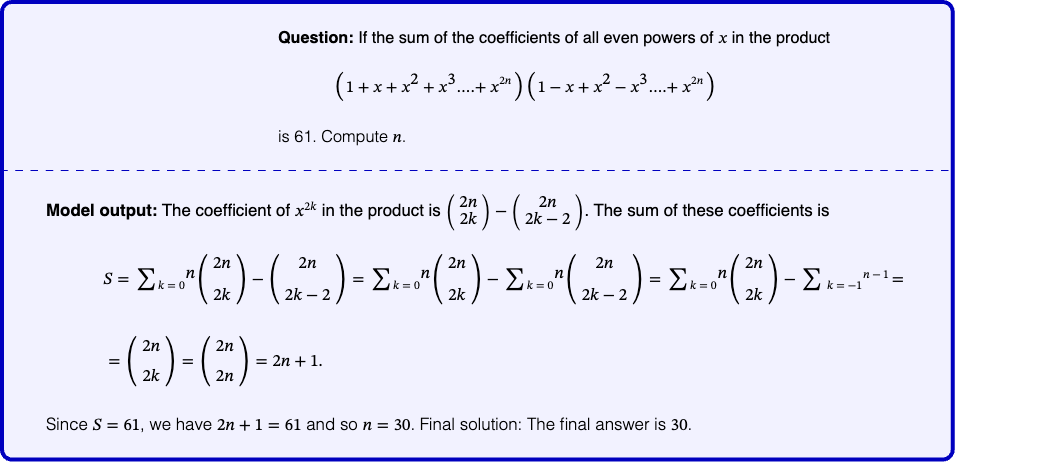
Text in this graphic
Question: If the sum of the coefficients of all even powers of in the product
is 61. Compute .
Model output: The coefficient of in the product is . The sum of these coefficients is
Since , we have and so . Final solution: The final answer is .
To analyze the degree of overlap between our training data and the MATH evaluation set, we computed the BLEU score of MATH questions and target answers with our training dataset partitioned into 500 word chunks. This overlap computation was performed for the 100 questions and target answers for which the model answered the most confidently (as measured by majority vote fraction). Figure 10 shows the distribution of BLEU scores for these 100 questions.
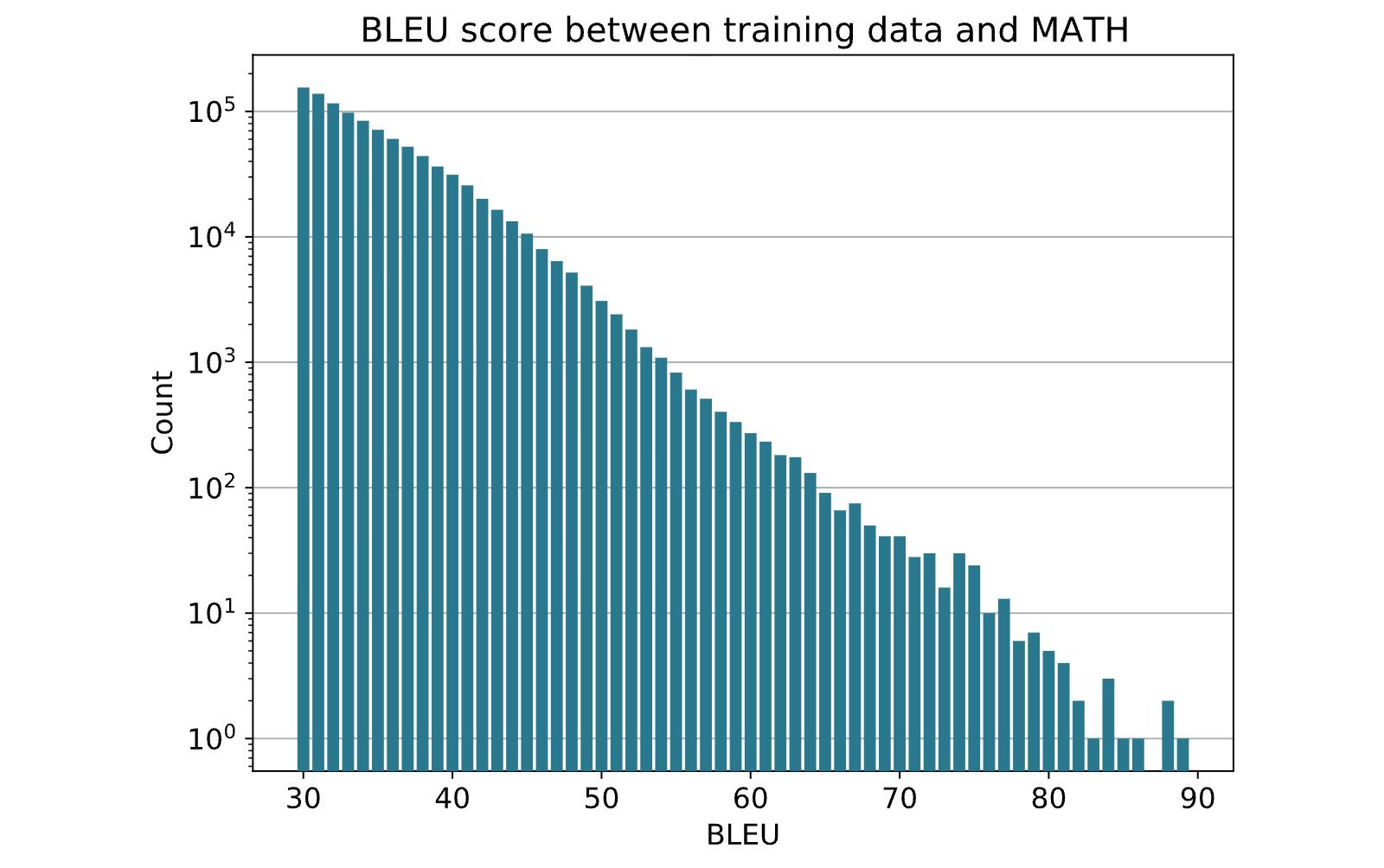
For the 500 most overlapping text segments, we manually inspected the degree of similarity, finding no evidence of dataset contamination. We provide the 500 documents containing these text chunks in the supplementary data.
To probe the sensitivity of our model to exact problem phrasing we sampled twenty questions that the model answered correctly under majority voting and considered a few varieties of modifications to these questions.
We considered modifications of four types: i) minor modifications to framing, intended to probe weather the model accuracy was solely due to memorizing the exact question statement, ii) modification of the numbers used in problems, iii) larger changes of framing – investigating the models sensitivity to distribution shift, iv) and combinations of number and large framing deformations. In each case, we compared the accuracy of 64 solution samples before and after the modification. The results are shown in Figure 11.
In the case of the two more significant modifications, we see somewhat degraded performance. We note that in those modifications it was more difficult to control for the overall difficulty of the task. We therefore do not interpret this effect as obvious evidence of memorization, but instead present it here to encourage further research.
An example question modification is shown below, and all deformations are provided in the supplementary data.
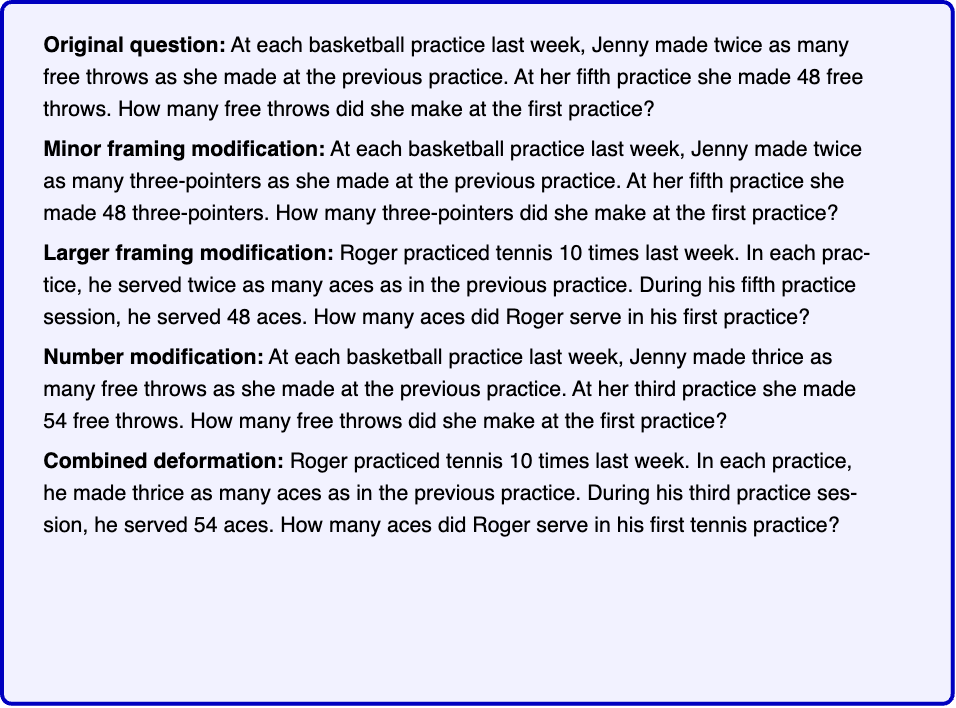
Text in this graphic
Original question: At each basketball practice last week, Jenny made twice as many free throws as she made at the previous practice. At her fifth practice she made 48 free throws. How many free throws did she make at the first practice?
Minor framing modification: At each basketball practice last week, Jenny made twice as many three-pointers as she made at the previous practice. At her fifth practice she made 48 three-pointers. How many three-pointers did she make at the first practice?
Larger framing modification: Roger practiced tennis 10 times last week. In each practice, he served twice as many aces as in the previous practice. During his fifth practice session, he served 48 aces. How many aces did Roger serve in his first practice?
Number modification: At each basketball practice last week, Jenny made thrice as many free throws as she made at the previous practice. At her third practice she made 54 free throws. How many free throws did she make at the first practice?
Combined deformation: Roger practiced tennis 10 times last week. In each practice, he made thrice as many aces as in the previous practice. During his third practice session, he served 54 aces. How many aces did Roger serve in his first tennis practice?
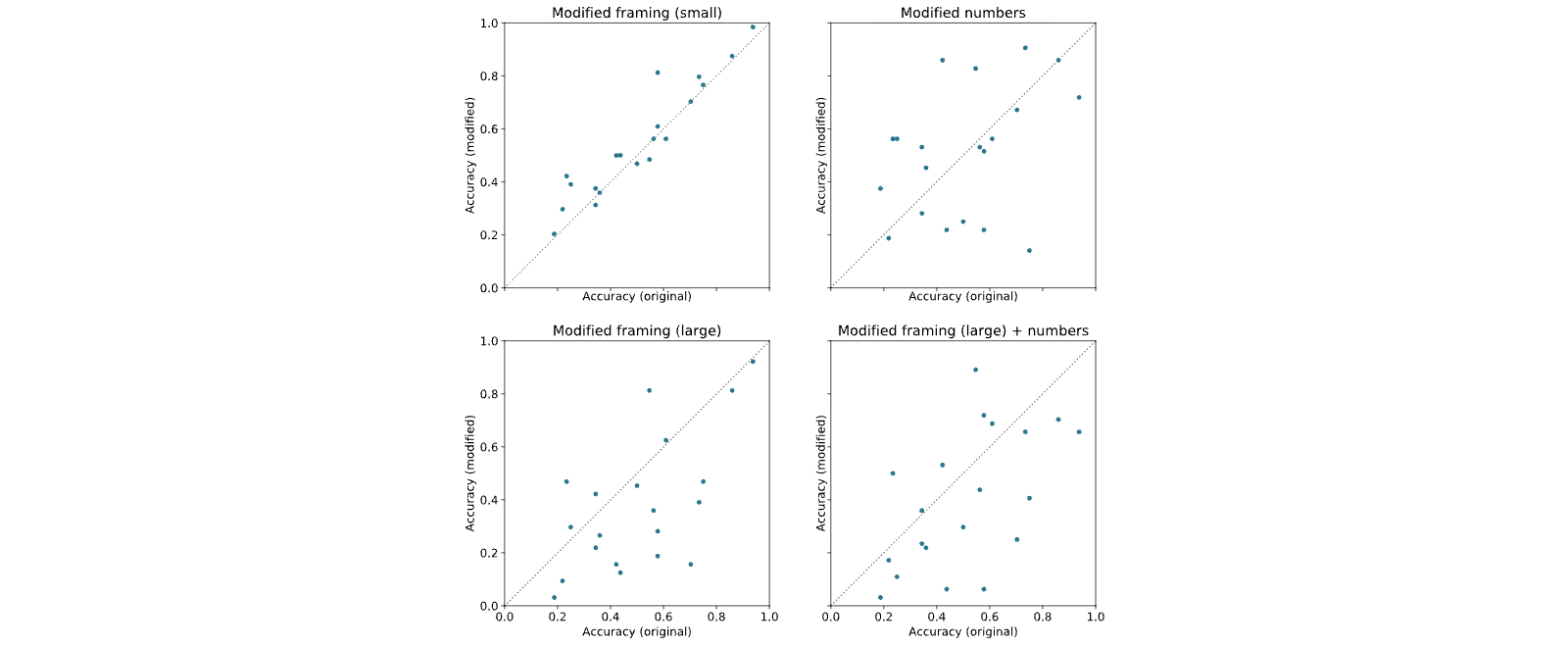
As an additional probe of memorization, we investigated the similarity between model generated solutions and ground truth solutions in the MATH dataset. In Figure 12 we show histograms for both the raw BLEU and ROUGE scores (left) and the fraction of examples with BLEU score less than or equal to the value. Of the 5,000 problems in the test set, we find only 160 problems which have at least one (of 256) samples with BLEU score greater than 80.
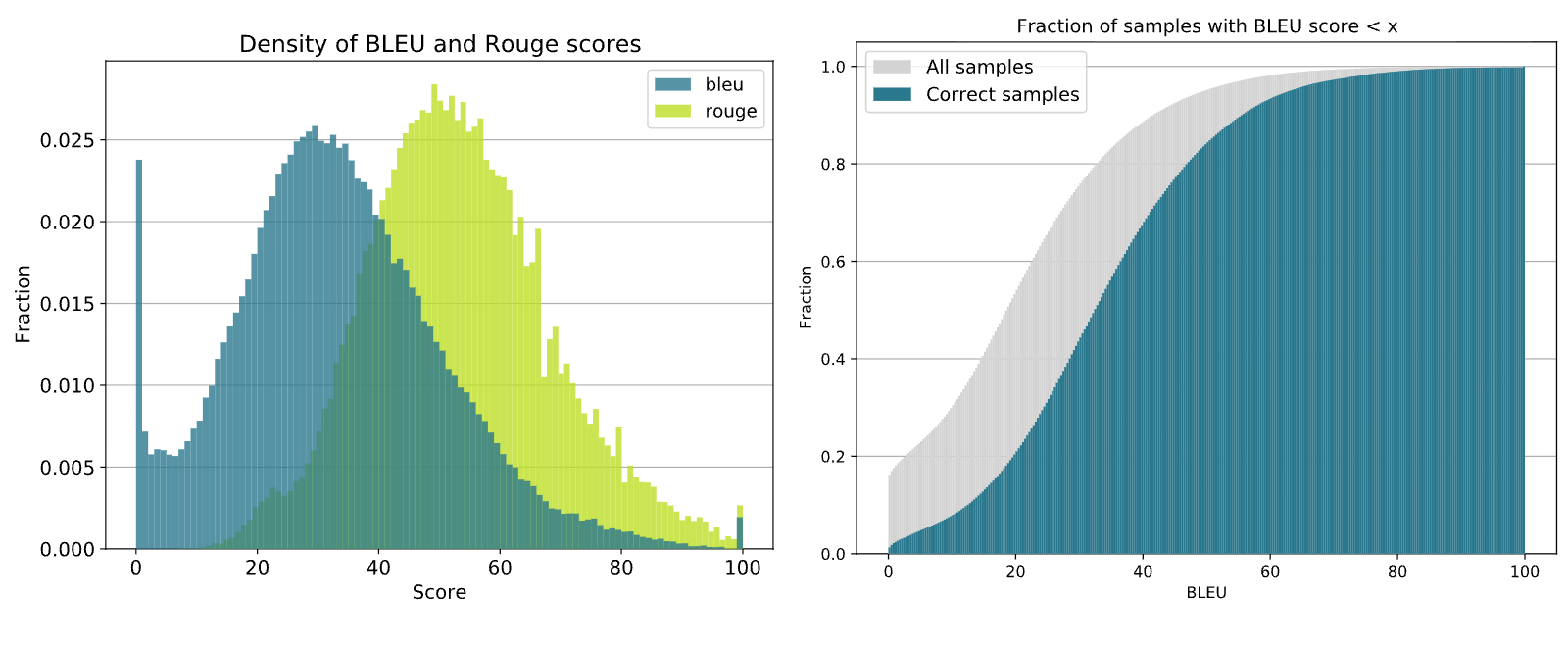
We present a few of these examples below and provide all high overlap examples as supplementary data. We note that the examples with high BLEU score tend to be shorter than typical solutions (see Figure 13).
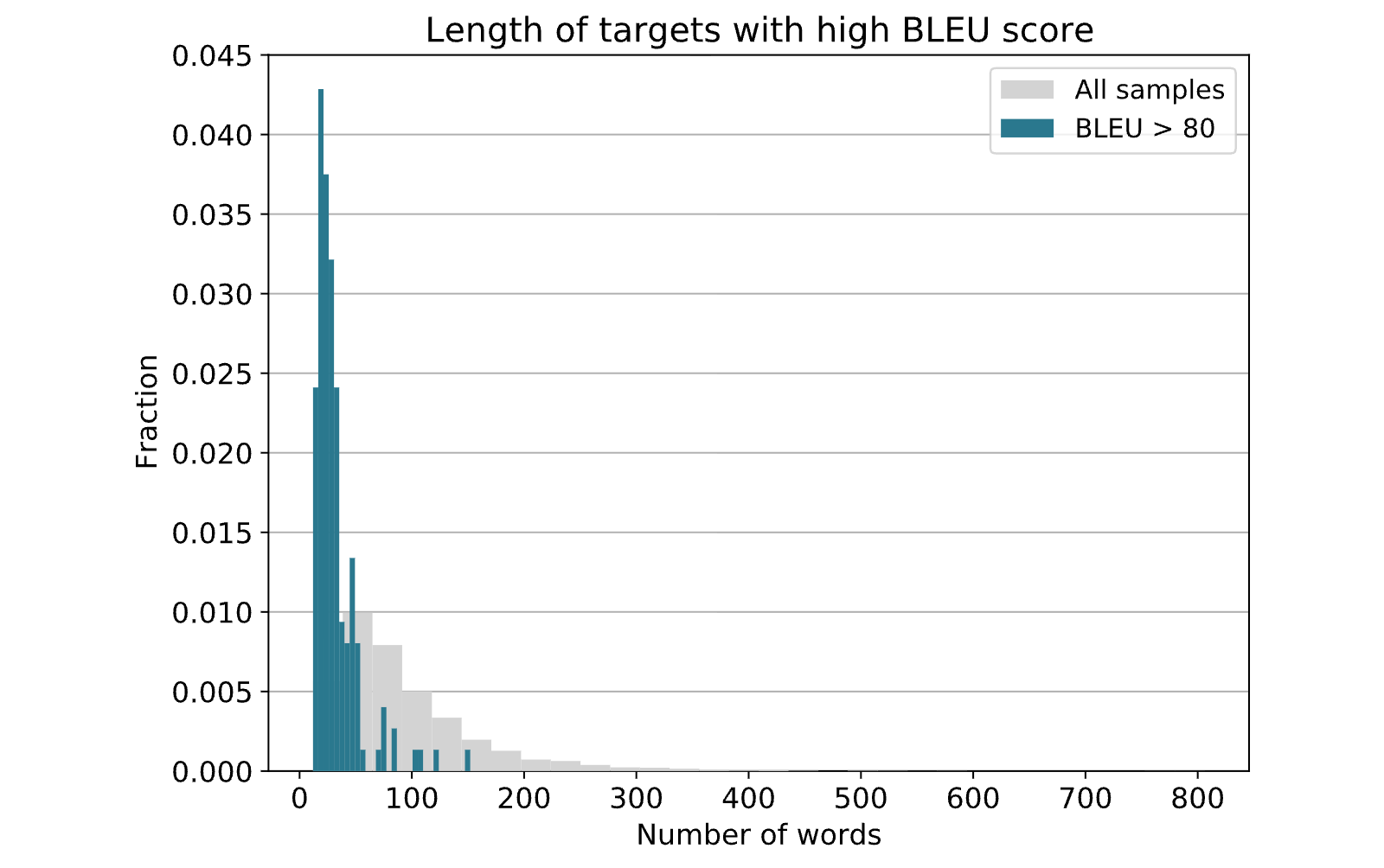
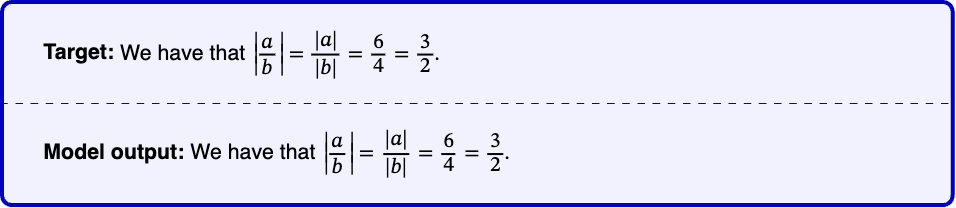
Text in this graphic
Target: We have that
Model output: We have that
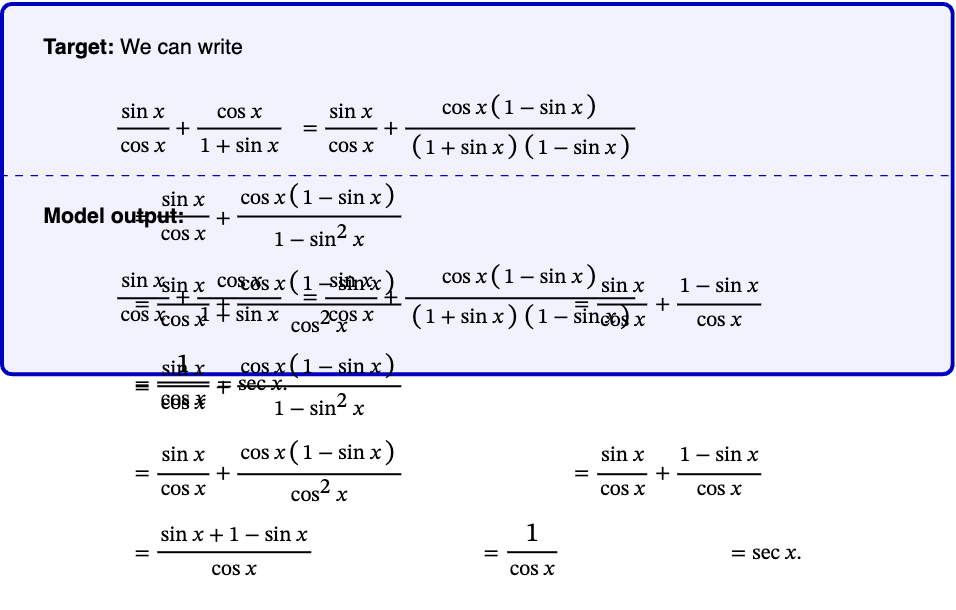
Text in this graphic
Target: We can write
Model output:
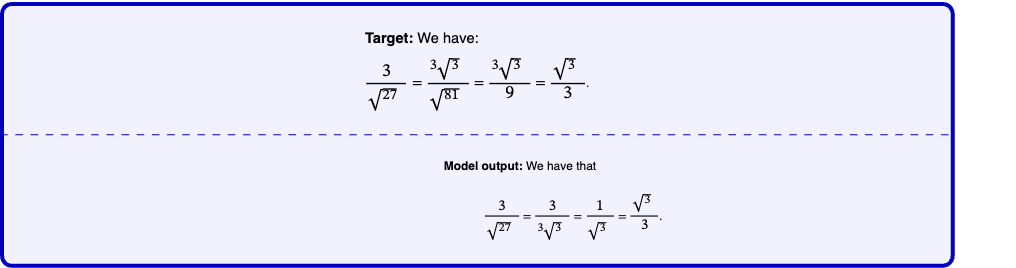
Text in this graphic
Target: We have: .
Model output: We have that