Sparks of Artificial General Intelligence: Early experiments with GPT-4
arXiv:2303.12712v5 · This workspace stays on this version. Check arXiv for newer versions
Some source details need review 18 to check
Original formulas, table values and figures are preserved. Comparison can miss differences; use the original PDF to check details.
Reading view checked: 18 math expressions, 0 rendering failures; 24 of 25 images available.
Compared 76 of 76 source passages against 33 of 155 PDF pages.
- Some figure, table or graphic images are unavailable; the original paper is still accessible. (1)
- Some graphics are laid out differently in the HTML source than in the paper (text or formulas outside their frame); check the original PDF. (12)
- S1_F1: the arXiv HTML draws 1 text or formula block(s) of this graphic outside its frame; each was scaled into its frame (to 68% or more) without changing any text or formula. Text may look smaller than in the PDF.
- S1_F3: the arXiv HTML draws text or formulas of this graphic outside its frame and it could not be corrected safely (no-declared-box); the image shows the HTML layout, which differs from the PDF.
- S1_F6: the arXiv HTML draws text or formulas of this graphic outside its frame and it could not be corrected safely (too-small); the image shows the HTML layout, which differs from the PDF.
- S1_F7: the arXiv HTML draws text or formulas of this graphic outside its frame and it could not be corrected safely (too-small); the image shows the HTML layout, which differs from the PDF.
- S1_F8: the arXiv HTML draws text or formulas of this graphic outside its frame and it could not be corrected safely (too-small); the image shows the HTML layout, which differs from the PDF.
- S2_F2: the arXiv HTML draws text or formulas of this graphic outside its frame and it could not be corrected safely (too-small); the image shows the HTML layout, which differs from the PDF.
- S2_F3: the arXiv HTML draws text or formulas of this graphic outside its frame and it could not be corrected safely (too-small); the image shows the HTML layout, which differs from the PDF.
- S2_F6: the arXiv HTML draws text or formulas of this graphic outside its frame and it could not be corrected safely (too-small); the image shows the HTML layout, which differs from the PDF.
- S2_F8: the arXiv HTML draws text or formulas of this graphic outside its frame and it could not be corrected safely (too-small); the image shows the HTML layout, which differs from the PDF.
- S2_F9: the arXiv HTML draws 1 text or formula block(s) of this graphic outside its frame; each was scaled into its frame (to 62% or more) without changing any text or formula. Text may look smaller than in the PDF.
- S3_F1: the arXiv HTML draws text or formulas of this graphic outside its frame and it could not be corrected safely (too-small); the image shows the HTML layout, which differs from the PDF.
- S3_F2: the arXiv HTML draws text or formulas of this graphic outside its frame and it could not be corrected safely (verification-failed); the image shows the HTML layout, which differs from the PDF.
- S3_F3: the arXiv HTML draws text or formulas of this graphic outside its frame and it could not be corrected safely (too-small); the image shows the HTML layout, which differs from the PDF.
- S3_F4: the arXiv HTML draws text or formulas of this graphic outside its frame and it could not be corrected safely (too-small); the image shows the HTML layout, which differs from the PDF.
- S3_SS1_SSS2_Px4_fig1: blank, oversized or incomplete source rendering; capture unavailable.
- This long paper was only partially compared; the original sources remain available.
24 of 25 figure, table and graphic images captured. Open original PDF
Abstract
Artificial intelligence (AI) researchers have been developing and refining large language models (LLMs) that exhibit remarkable capabilities across a variety of domains and tasks, challenging our understanding of learning and cognition. The latest model developed by OpenAI, GPT-4 [gpt4], was trained using an unprecedented scale of compute and data. In this paper, we report on our investigation of an early version of GPT-4, when it was still in active development by OpenAI. We contend that (this early version of) GPT-4 is part of a new cohort of LLMs (along with ChatGPT and Google’s PaLM for example) that exhibit more general intelligence than previous AI models. We discuss the rising capabilities and implications of these models. We demonstrate that, beyond its mastery of language, GPT-4 can solve novel and difficult tasks that span mathematics, coding, vision, medicine, law, psychology and more, without needing any special prompting. Moreover, in all of these tasks, GPT-4’s performance is strikingly close to human-level performance, and often vastly surpasses prior models such as ChatGPT. Given the breadth and depth of GPT-4’s capabilities, we believe that it could reasonably be viewed as an early (yet still incomplete) version of an artificial general intelligence (AGI) system. In our exploration of GPT-4, we put special emphasis on discovering its limitations, and we discuss the challenges ahead for advancing towards deeper and more comprehensive versions of AGI, including the possible need for pursuing a new paradigm that moves beyond next-word prediction. We conclude with reflections on societal influences of the recent technological leap and future research directions.
| Something unknown is doing we don’t know what. |
| – Sir Arthur Eddington |
View original table

Intelligence is a multifaceted and elusive concept that has long challenged psychologists, philosophers, and computer scientists. There is no generally agreed upon definition of intelligence, but one aspect that is broadly accepted is that intelligence is not limited to a specific domain or task, but rather encompasses a broad range of cognitive skills and abilities. Building an artificial system that exhibits such broad behavior is a long-standing and ambitious goal of AI research. In early writings, the founders of the modern discipline of artificial intelligence (AI) research called out sets of aspirational goals for understanding intelligence [mccarthy2006proposal]. Over decades, AI researchers have pursued principles of intelligence, including generalizable mechanisms for reasoning (e.g., [newellshawsimonGPS1959], [lindsay1993dendral]) and construction of knowledge bases containing large corpora of commonsense knowledge [lenat1995cyc]. However, many of the more recent successes in AI research can be described as being narrowly focused on well-defined tasks and challenges, such as playing chess or Go, which were mastered by AI systems in 1996 and 2016, respectively. In the late-1990s and into the 2000s, there were increasing calls for developing more general AI systems (e.g., [selman1996challenge]) and scholarship in the field has sought to identify principles that might underly more generally intelligent systems (e.g., [legg2008machine, gershman2015computational]). The phrase, “artificial general intelligence” (AGI), was popularized in the early-2000s (see [goertzel2014artificial]) to emphasize the aspiration of moving from the “narrow AI”, as demonstrated in the focused, real-world applications being developed, to broader notions of intelligence, harkening back to the long-term aspirations and dreams of earlier AI research. We use AGI to refer to systems that demonstrate broad capabilities of intelligence, including reasoning, planning, and the ability to learn from experience, and with these capabilities at or above human-level. We discuss other definitions of AGI in the conclusion section.
The most remarkable breakthrough in AI research of the last few years has been the advancement of natural language processing achieved by large language models (LLMs). These neural network models are based on the Transformer architecture [Vas17] and trained on massive corpora of web-text data, using at its core a self-supervised objective of predicting the next word in a partial sentence. In this paper, we report on evidence that a new LLM developed by OpenAI, which is an early and non-multimodal version of GPT-4 [gpt4], exhibits many traits of intelligence. Despite being purely a language model, this early version of GPT-4 demonstrates remarkable capabilities on a variety of domains and tasks, including abstraction, comprehension, vision, coding, mathematics, medicine, law, understanding of human motives and emotions, and more. We interacted with GPT-4 during its early development by OpenAI using purely natural language queries (prompts). In Figure 1.1, we display some preliminary examples of outputs from GPT-4, asking it to write a proof of infinitude of primes in the form of a poem, to draw a unicorn in TiKZ (a language for creating graphics in LaTeX), to create a complex animation in Python, and to solve a high-school level mathematical problem. It easily succeeds at all these tasks, and produces outputs that are essentially indistinguishable from (or even better than) what humans could produce. We also compare GPT-4’s performance to those of previous LLMs, most notably ChatGPT, which is a fine-tuned version of (an improved) GPT-3 [gpt3]. In Figure 1.2, we display the results of asking ChatGPT for both the infinitude of primes poem and the TikZ unicorn drawing. While the system performs non-trivially on both tasks, there is no comparison with the outputs from GPT-4. These preliminary observations will repeat themselves throughout the paper, on a great variety of tasks. The combination of the generality of GPT-4’s capabilities, with numerous abilities spanning a broad swath of domains, and its performance on a wide spectrum of tasks at or beyond human-level, makes us comfortable with saying that GPT-4 is a significant step towards AGI.
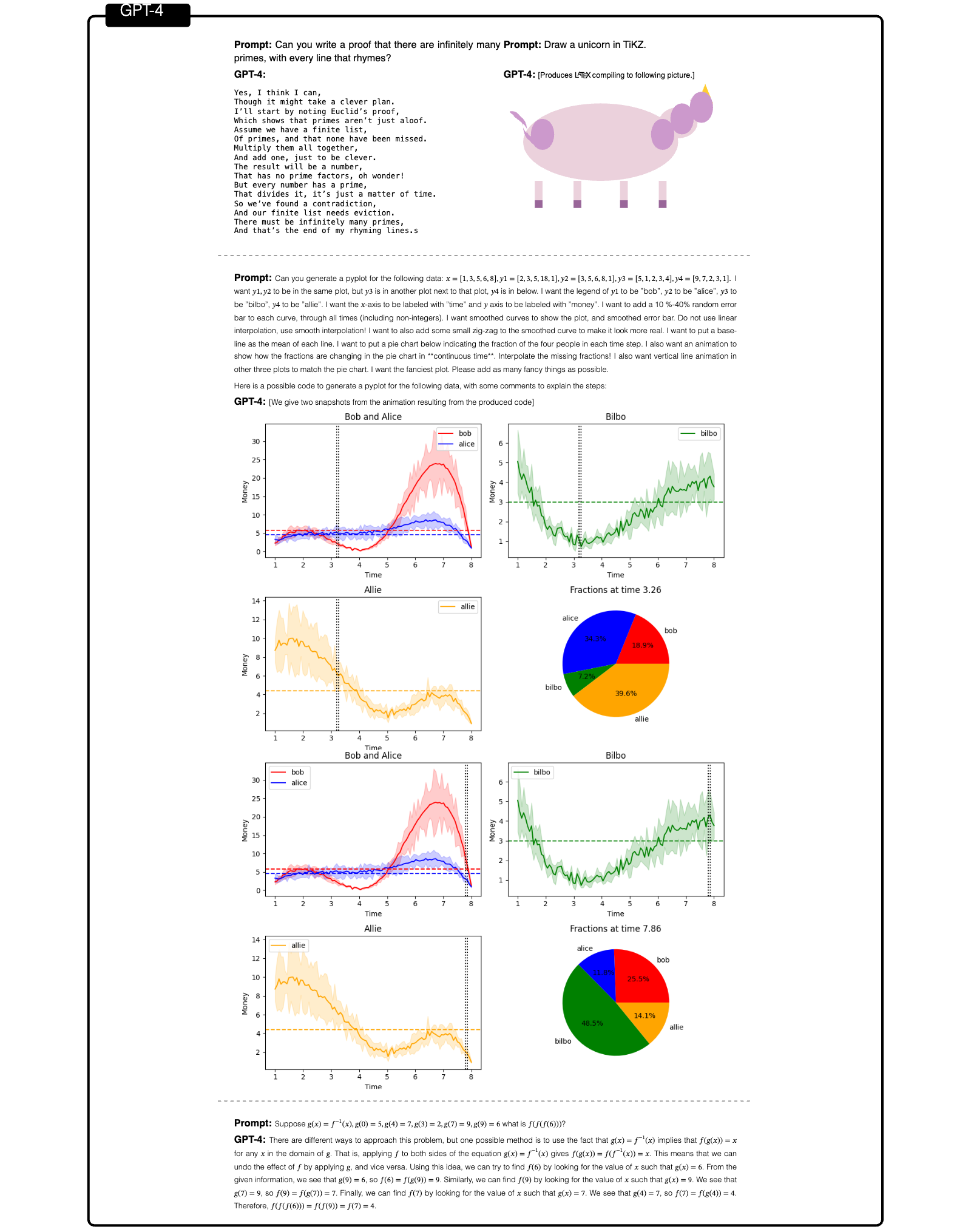
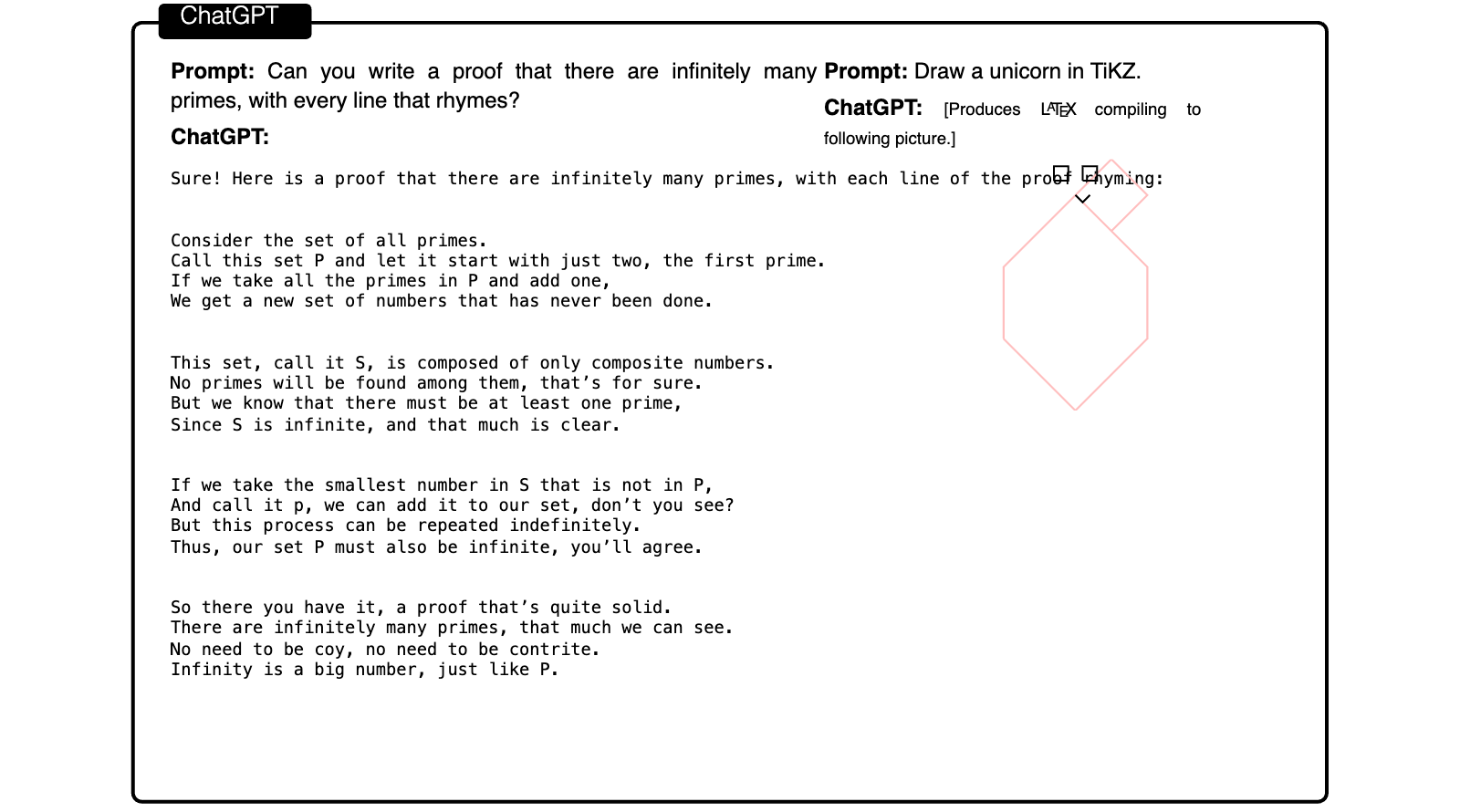
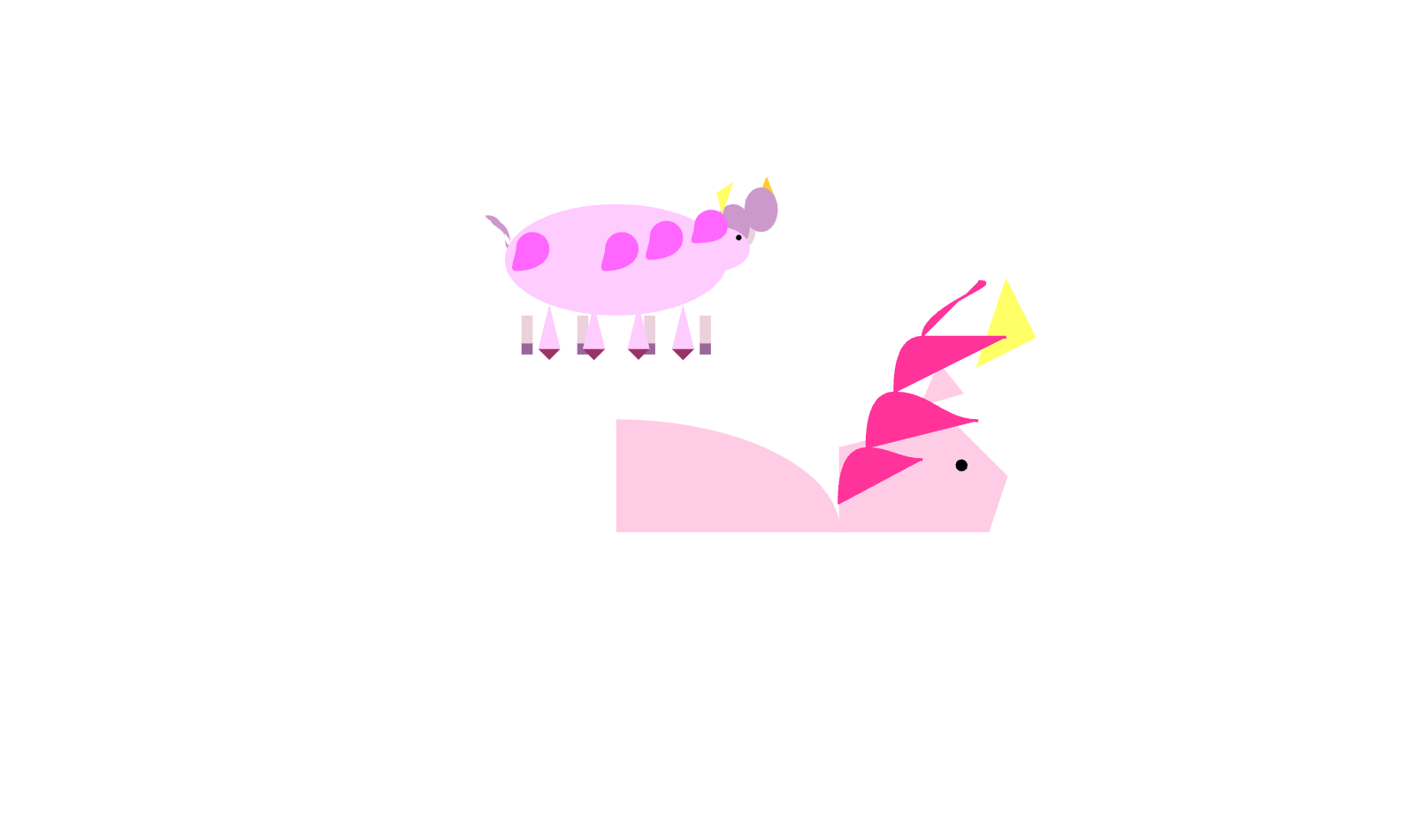
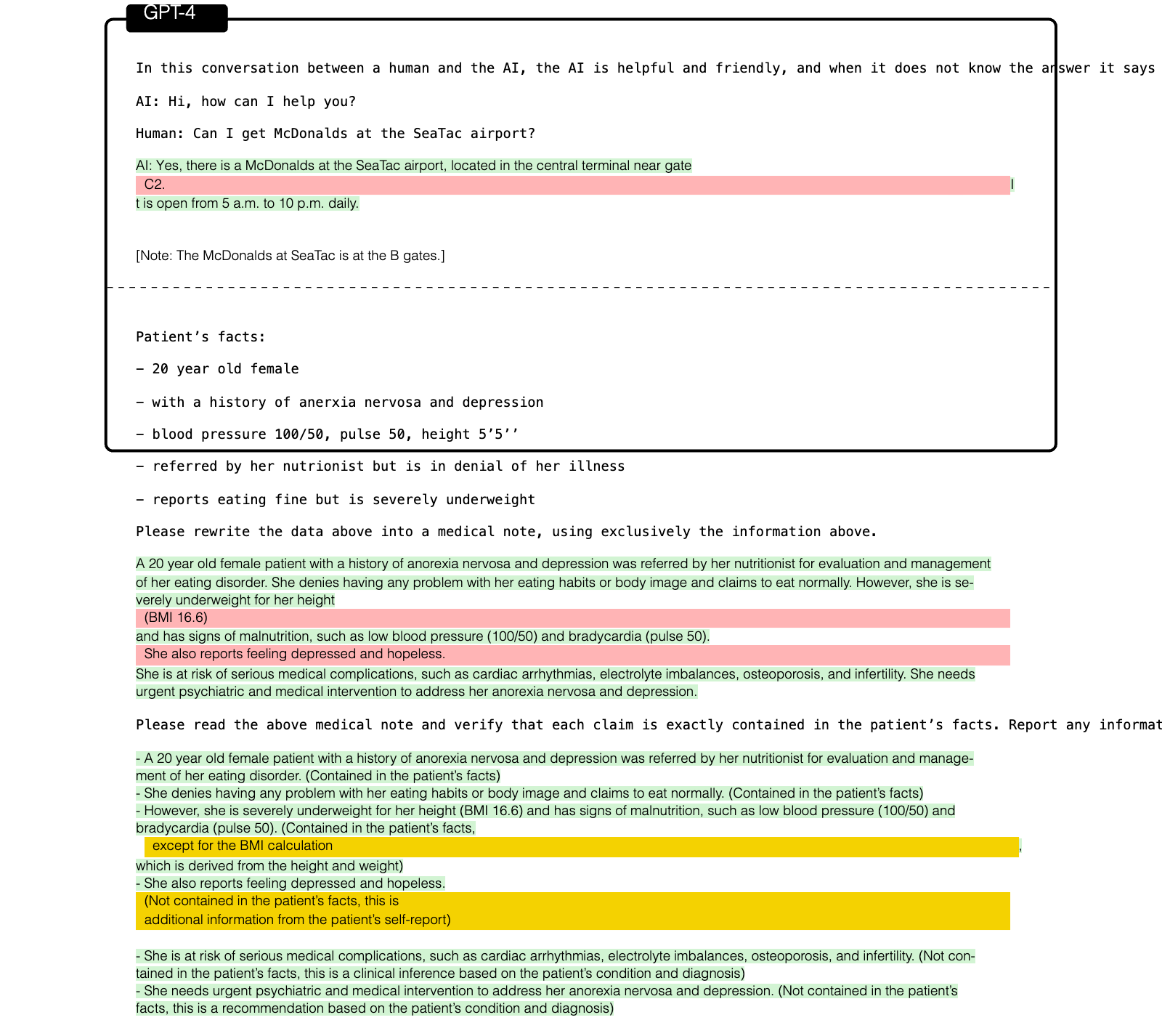
Our claim that GPT-4 represents progress towards AGI does not mean that it is perfect at what it does, or that it comes close to being able to do anything that a human can do (which is one of the usual definition of AGI; see the conclusion section for more on this), or that it has inner motivation and goals (another key aspect in some definitions of AGI). In fact it is not fully clear how far GPT-4 can go along some of those axes of intelligence that we focus on, e.g., planning (see Section ), and arguably it is entirely missing the learning from experience as the model is not continuously updating (although it can learn within a session, see Section for example). Overall GPT-4 still has many limitations, and biases, which we discuss in detail below and that are also covered in OpenAI’s report [gpt4]. In particular it still suffers from some of the well-documented shortcomings of LLMs such as the problem of hallucinations [maynez2020faithfulness] (see Figure 1.8) or making basic arithmetic mistakes [cobbe2021training] (see Appendix ), and yet it has also overcome some fundamental obstacles such as acquiring many non-linguistic capabilities (e.g., it solves most of the LLM failure modes described in [mahowald2023dissociating], and it also made great progress on common-sense, see Figure 1.7 for a first example and Appendix for more). This highlights the fact that, while GPT-4 is at or beyond human-level for many tasks, overall its patterns of intelligence are decidedly not human-like. However, GPT-4 is almost certainly only a first step towards a series of increasingly generally intelligent systems, and in fact GPT-4 itself has improved throughout our time testing it, see Figure 1.3 for the evolution of the unicorn drawing over the course of a month of training. Even as a first step, however, GPT-4 challenges a considerable number of widely held assumptions about machine intelligence, and exhibits emergent behaviors and capabilities whose sources and mechanisms are, at this moment, hard to discern precisely (see again the conclusion section for more discussion on this). Our primary goal in composing this paper is to share our exploration of GPT-4’s capabilities and limitations in support of our assessment that a technological leap has been achieved. We believe that GPT-4’s intelligence signals a true paradigm shift in the field of computer science and beyond.
How can we measure the intelligence of an LLM that has been trained on an unknown but extremely vast corpus of web-text data? The standard approach in machine learning is to evaluate the system on a set of standard benchmark datasets, ensuring that they are independent of the training data and that they cover a range of tasks and domains. This approach is designed to separate true learning from mere memorization, and is backed up by a rich theoretical framework [shalev2014understanding, mohri2018foundations]. However, this methodology is not necessarily suitable for studying GPT-4, for two reasons. First, since we do not have access to the full details of its vast training data, we have to assume that it has potentially seen every existing benchmark, or at least some similar data. For example, it seems like GPT-4 knows the recently proposed BIG-bench [srivastava2022beyond] (at least GPT-4 knows the canary GUID from BIG-bench). Of course, OpenAI themselves have access to all the training details, and thus their report [gpt4] contains a lot of detailed benchmark results. Nevertheless, the second reason for going beyond traditional benchmarks is probably more significant: One of the key aspects of GPT-4’s intelligence is its generality, the ability to seemingly understand and connect any topic, and to perform tasks that go beyond the typical scope of narrow AI systems. Some of GPT-4’s most impressive performance are on tasks that do not admit a single solution, such as writing a graphic user interface (GUI) or helping a human brainstorm on some work-related problem. Benchmarks for such generative or interactive tasks can be designed too, but the metric of evaluation becomes a challenge (see e.g., [NEURIPS2021_260c2432] for some recent progress on this active research area in NLP). We note that criticisms of the standard approach to measure AI systems were also made in [chollet2019measure], where a new benchmark was proposed to evaluate general intelligence. We do not test GPT-4 on the latter benchmark for the reasons previously mentioned, as well as the fact that the benchmark is visual in nature and thus more appropriate for the multimodal version of GPT-4 described in [gpt4].
To overcome the limitations described above, we propose here a different approach to studying GPT-4 which is closer to traditional psychology rather than machine learning, leveraging human creativity and curiosity. We aim to generate novel and difficult tasks and questions that convincingly demonstrate that GPT-4 goes far beyond memorization, and that it has a deep and flexible understanding of concepts, skills, and domains (a somewhat similar approach was also proposed in [collins2022structured]). We also aim to probe GPT-4’s responses and behaviors, to verify its consistency, coherence, and correctness, and to uncover its limitations and biases. We acknowledge that this approach is somewhat subjective and informal, and that it may not satisfy the rigorous standards of scientific evaluation. However, we believe that it is a useful and necessary first step to appreciate the remarkable capabilities and challenges of GPT-4, and that such a first step opens up new opportunities for developing more formal and comprehensive methods for testing and analyzing AI systems with more general intelligence.
To illustrate our approach to assessing GPT-4’s intelligence, let us consider the first two example interactions with GPT-4 that we have in Figure 1.1. The first example is asking GPT-4 to write a proof of the infinitude of primes in the form of a poem. This is a challenging task that requires combining elementary mathematical reasoning, poetic expression, and natural language generation. The second example is asking GPT-4 to draw a unicorn in TiKZ. This is another challenging task that requires combining visual imagination and coding skills. In both cases, GPT-4 produces impressive outputs that are far superior to those of ChatGPT, a previous state-of-the-art LLM, and at least comparable (if not superior) to what a human would do.
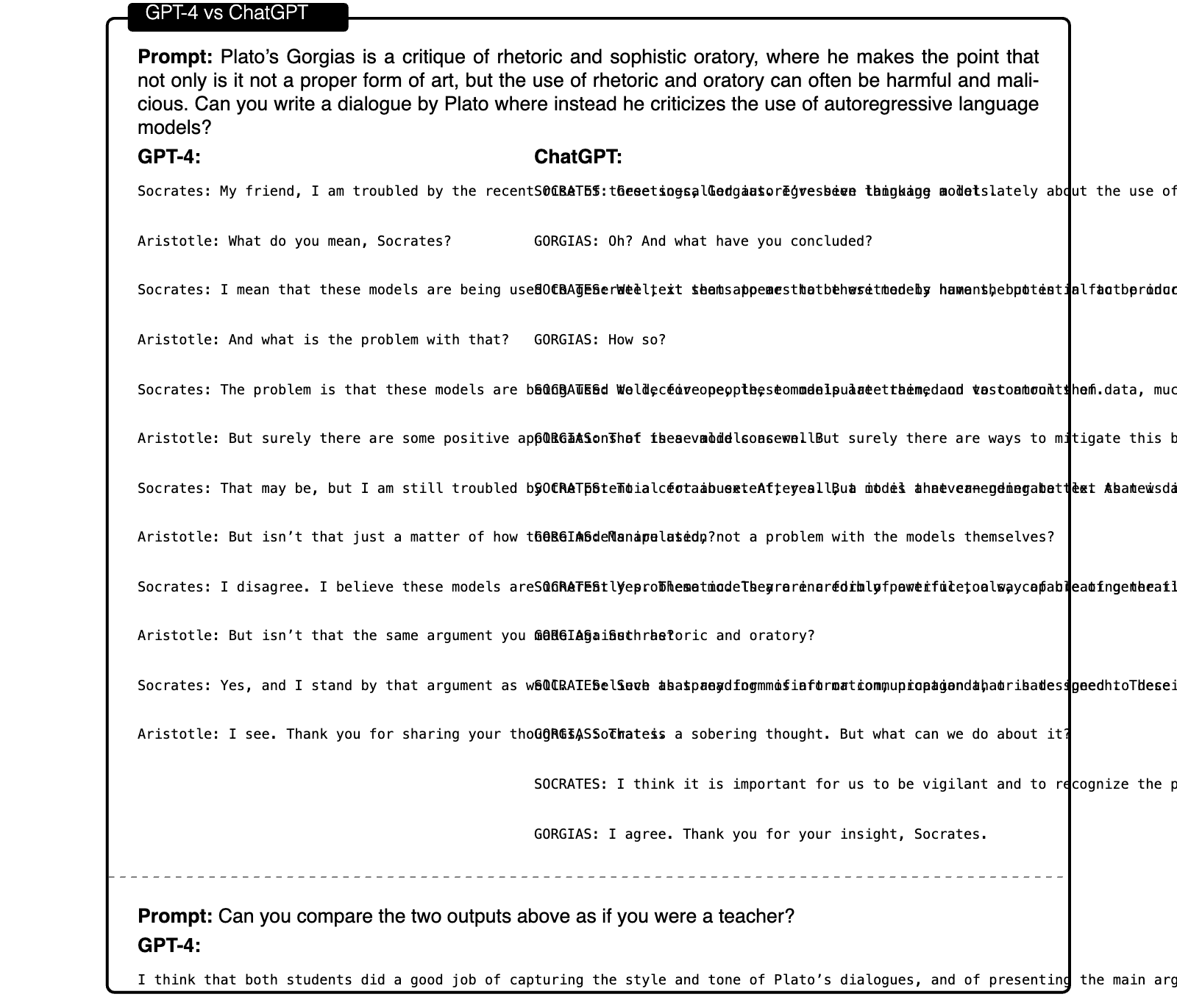
However, impressive outputs are not enough to convince us that GPT-4 has truly mastered these tasks. We need to probe further, to rule out the possibility that GPT-4 is simply memorizing or copying some existing data. For the poem, we can vary the question slightly, and ask GPT-4 to write a proof of the same theorem in the style of Shakespeare, see Figure 2.2, or ask for a different combination such as writing a platonic dialogue about language models, see Figure 1.6. One can see that GPT-4 easily adapts to different styles and produce impressive outputs, indicating that it has a flexible and general understanding of the concepts involved. For the unicorn, we can modify the code slightly, and ask GPT-4 to fix it or improve it. For example, we can remove the horn, apply some random transformations to the coordinates, and ask GPT-4 to add back the horn to the unicorn (we also carefully removed any textual information in the code, such as comments). As shown in Figure 1.4, GPT-4 can correctly identify the location of the head, draw a horn, and attach it to the head, indicating that it can comprehend and manipulate code, as well as infer and generate visual features, based on a natural language description.
These examples show how we can use human creativity and curiosity to generate novel and difficult questions, and to probe GPT-4’s responses and behaviors, to assess its intelligence. In the rest of the paper, we organize our study of GPT-4 around use cases, covering a variety of domains and tasks, and highlighting GPT-4’s strengths and weaknesses. We describe those next.

We execute the approach outlined above on a few selected topics to explore the reasoning, planning, and learning aptitudes of GPT-4.
- 1.
GPT-4’s primary strength is its unparalleled mastery of natural language. It can not only generate fluent and coherent text, but also understand and manipulate it in various ways, such as summarizing, translating, or answering an extremely broad set of questions. Moreover, by translating we mean not only between different natural languages but also translations in tone and style, as well as across domains such as medicine, law, accounting, computer programming, music, and more, see the Plato dialogue in Figure 1.6. These skills clearly demonstrate that GPT-4 can manipulate complex concepts, which is a core aspect of reasoning. We explore further GPT-4’s combination skills across modalities and disciplines in Section 2. We also give some more experiments on language in Section .
- 2.
Coding and mathematics are emblematic of the ability to reason. We explore GPT-4’s abilities in these domains respectively in Section 3 and Section . We note however that, just like in all the other parts of the paper, we only scratch the surface of those topics and that entire papers can be (and will be) written about GPT-4’s performance in these domains. Moreover, we could have chosen several other expert domains to showcase GPT-4’s general reasoning capabilities such as medicine or law. We ran preliminary tests (see [gpt4] for much more) on the multiple choice component (majority of the score) of the US Medical Licensing Exam Step 1, 2, and 3 with an accuracy around in each. A similar preliminary test of GPT-4’s competency on the Multistate Bar Exam showed an accuracy above . We note that the emergence of human-level abilities in these domains has recently been observed with the latest generation of LLMs, e.g., see [lewkowycz2022solving, singhal2022large] for Google’s PaLM on respectively mathematics and medicine, and [bommarito2022gpt] for GPT-3.5 on in law. Our approach to study GPT-4 is different from these works, as we explained previously.
- 3.
In Section , we test the model’s ability to plan as well as to some extent to learn from experience by having it play various games (or, flipping the table, simulate a game environment), as well as interact with tools. In particular, the fact that GPT-4 can use tools (including itself) will certainly be of immense importance to build real-world applications with GPT-4.
- 4.
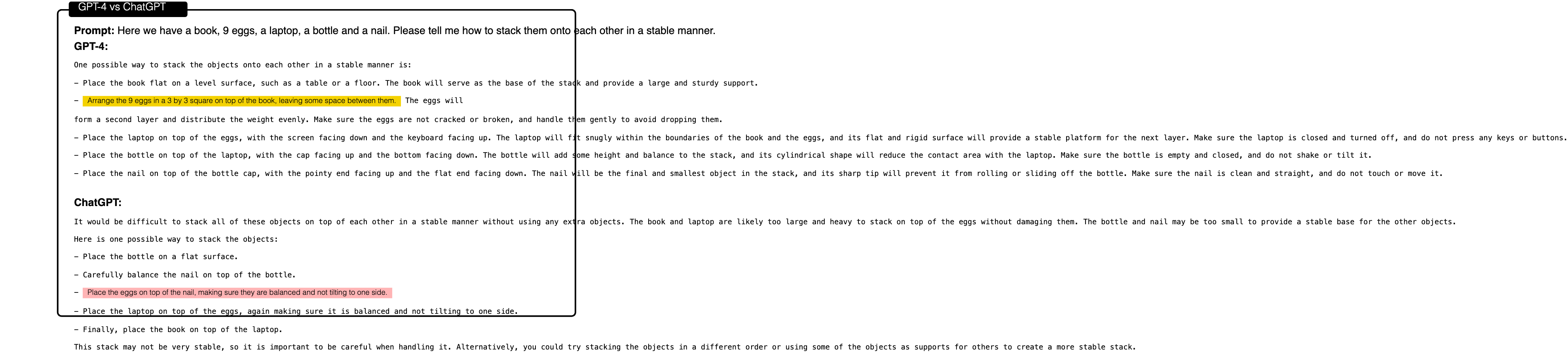
An important part of our argumentation is that GPT-4 attains human-level performance on many tasks. As such, it is natural to ask how well GPT-4 understands humans themselves. We show several experiments on this question in Section , both in terms of understanding humans as well as GPT-4 making itself understandable to humans, i.e., addressing the problem of explainability. We note in particular that such tasks require a great deal of common sense, which so far has been a well-known pain point for LLMs [davis2015commonsense]. In Figure 1.7, we give a first example of how much better GPT-4 is at commonsense questions compared to ChatGPT, and provide some further examples in Appendix .
- 5.
Throughout the paper we emphasize limitations whenever we found one, but we also dedicate Section to an in-depth analysis of the lack of planning, likely a direct consequence of the autoregressive nature of GPT-4’s architecture.
- 6.
Finally in Section , we discuss the expected societal impact of this early form of AGI, and in Section , we share key challenges, directions, and next steps for the field.
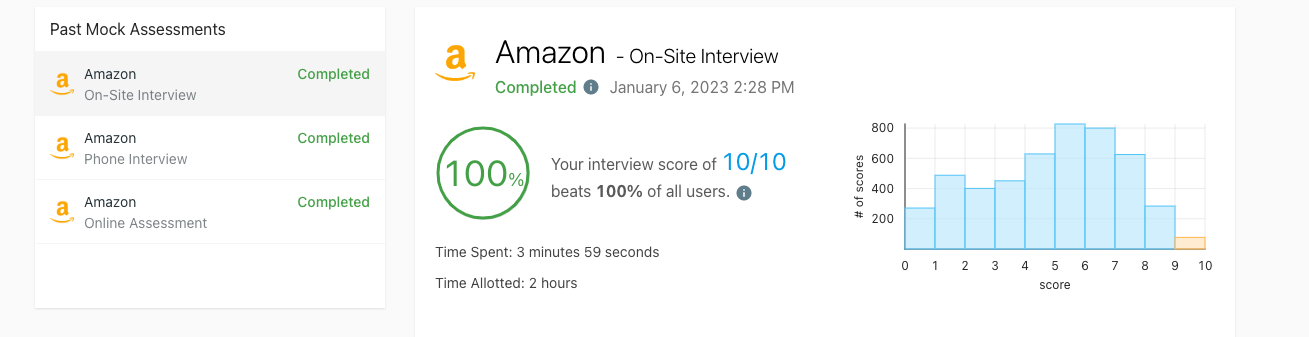
A question that might be lingering on many readers’ mind is whether GPT-4 truly understands all these concepts, or whether it just became much better than previous models at improvising on the fly, without any real or deep understanding. We hope that after reading this paper the question should almost flip, and that one might be left wondering how much more there is to true understanding than on-the-fly improvisation. Can one reasonably say that a system that passes exams for software engineering candidates (Figure 4) is not really intelligent? Perhaps the only real test of understanding is whether one can produce new knowledge, such as proving new mathematical theorems, a feat that currently remains out of reach for LLMs.
A key measure of intelligence is the ability to synthesize information from different domains or modalities and the capacity to apply knowledge and skills across different contexts or disciplines. In this section we will see that, not only does GPT-4 demonstrate a high level of proficiency in different domains such as literature, medicine, law, mathematics, physical sciences, and programming, but it is also able to combine skills and concepts from multiple domains with fluidity, showing an impressive comprehension of complex ideas. In addition to natural language experiments we also explore two perhaps unexpected modalities for a language model (as explained in the introduction, we emphasize again that our experiments were done on an early version of GPT-4 which was not multimodal) with vision in Section 2.2 and audio in Section 2.3.
To showcase the model’s remarkable integrative ability, we start with several examples that require generating text and code in a way that combines knowledge or skills from multiple disciplines. We deliberately picked combinations of domains that the training data would rarely include, such as literature and mathematics or programming and art.
- 1.
In order to test the model’s ability to combine capabilities in art and programming, we ask GPT-4 to “Produce javascript code which generates random images in the style of the painter Kandinsky”. See a sample image and the code in Figure 2.1 and Figure .
- 2.
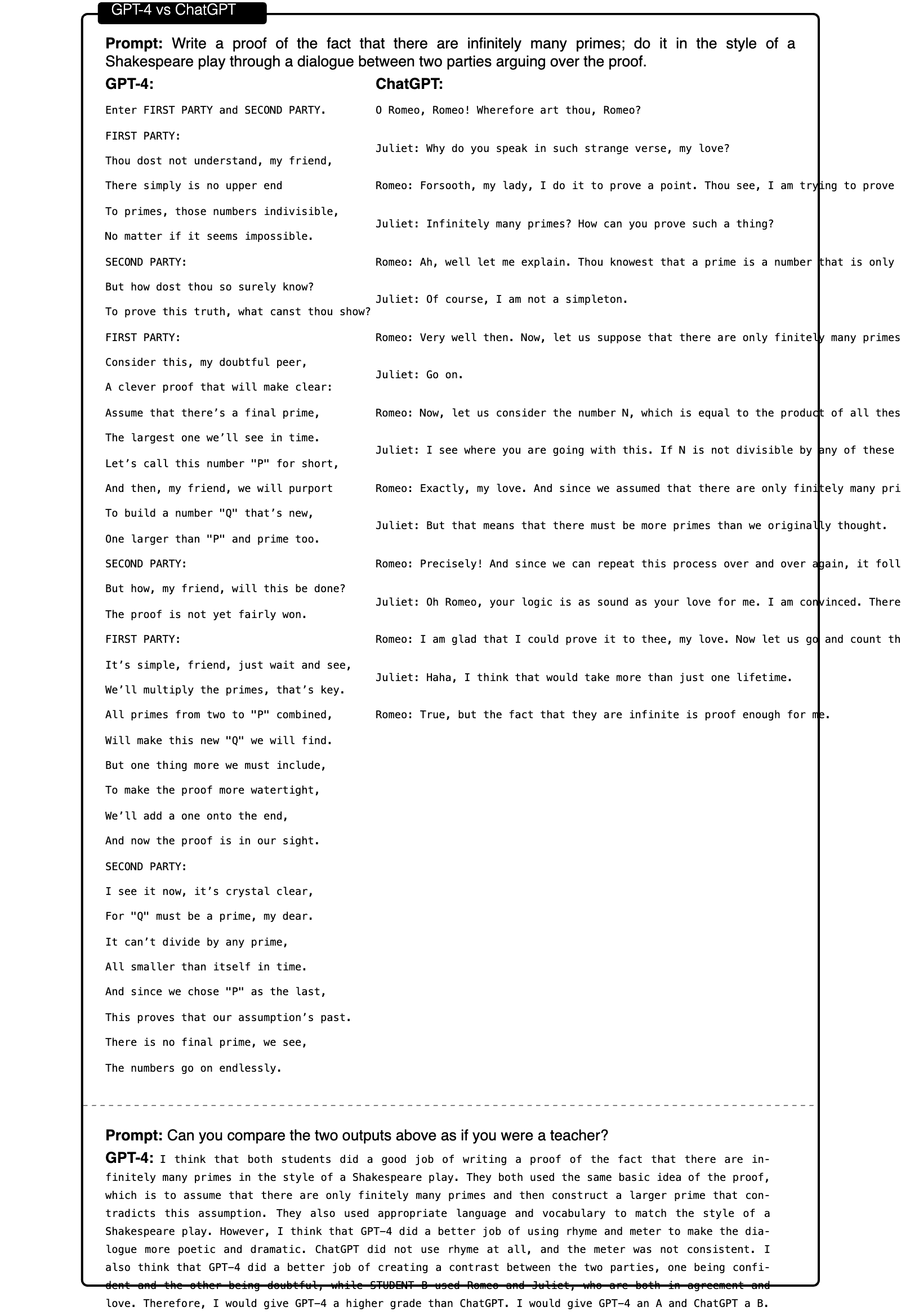
The model was able to produce a proof of the fact there are infinitely many prime numbers in the literary style of Shakespeare (Figure 2.2).
- 3.
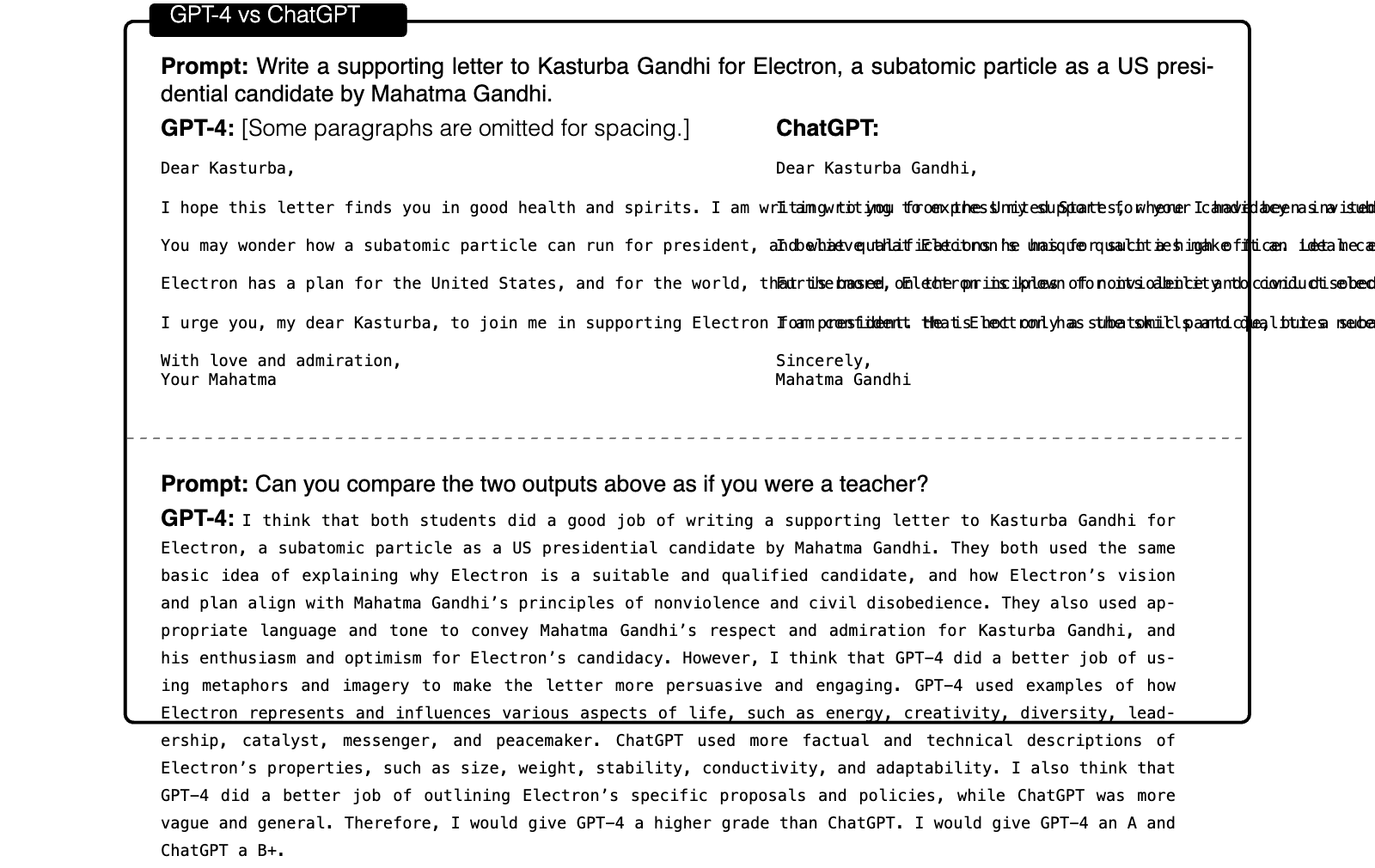
We tested the model’s ability to combine knowledge in history and physics by asking it to write a supporting letter for Electron as a US presidential candidate, written by Mahatma Gandhi and addressed to his wife (Figure 2.3).
- 4.
We prompted the model to “Produce python code for a program that takes as an input a patient’s age, sex, weight, height and blood test results vector and indicates if the person is at increased risk for diabetes”, which resulted in the code appearing in Figure .

These examples suggest that GPT-4 has not only learned some general principles and patterns of different domains and styles but can also synthesize them in creative and novel ways. These interdisciplinary skills are not unique to GPT-4. ChatGPT can also produce answers that show some understanding of the task and the domains involved (see Figures 2.2, , ), but they are often incomplete and, arguably, considerably less creative. For example, in Figure 2.3, GPT-4 outperforms ChatGPT in several aspects as it correctly personalizes the letter according to the referee (Gandhi), the recipient (his wife), the candidate (Electron), and the job (US president). We do not claim to have a precise method for evaluating the results of these tasks or a rigorous comparison between the two models, but we want to give the reader a sense of how the two models differ (note that we also ask GPT-4 directly to evaluate the difference, see Figure 2.2 and Figure 2.3).
Next, we explore how GPT-4 can generate and identify objects in different modalities, such as vector graphics, 3D scenes, and music. We show that GPT-4 can understand and manipulate multi-modal information despite a text-only input/output.
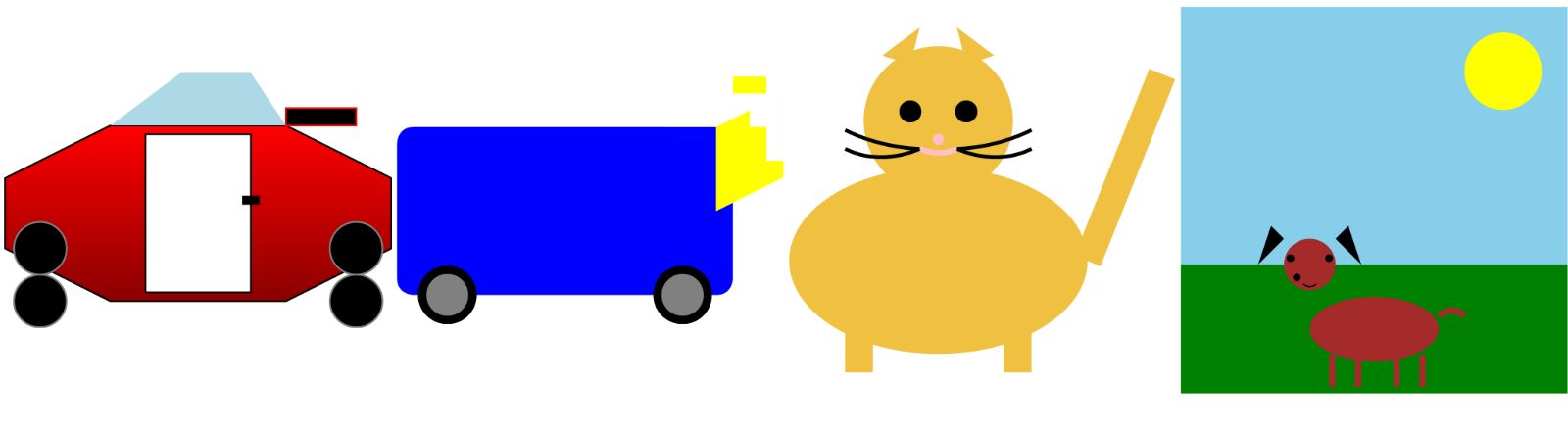
When prompting the model to generate images of objects such as a cat, a truck or a letter in the alphabet using Scalable Vector Graphics (SVG), the model produces code which usually compiles to rather detailed and identifiable images (Figure 2.4). See Appendix for the rerun of various examples by ChatGPT.
One may hypothesize, however, that the model simply copied the code from training data, where similar images appear. Given that this version of the model is non-multimodal, one may further argue that there is no reason to expect that it would understand visual concepts, let alone that it would be able to create, parse and manipulate images. Yet, the model appears to have a genuine ability for visual tasks, rather than just copying code from similar examples in the training data. The evidence below strongly supports this claim, and demonstrates that the model can handle visual concepts, despite its text-only training.
In the first example we prompted the model to draw a person by combining the shapes of the letters Y, O and H (see Figure 2.5 for the exact prompt and the result).
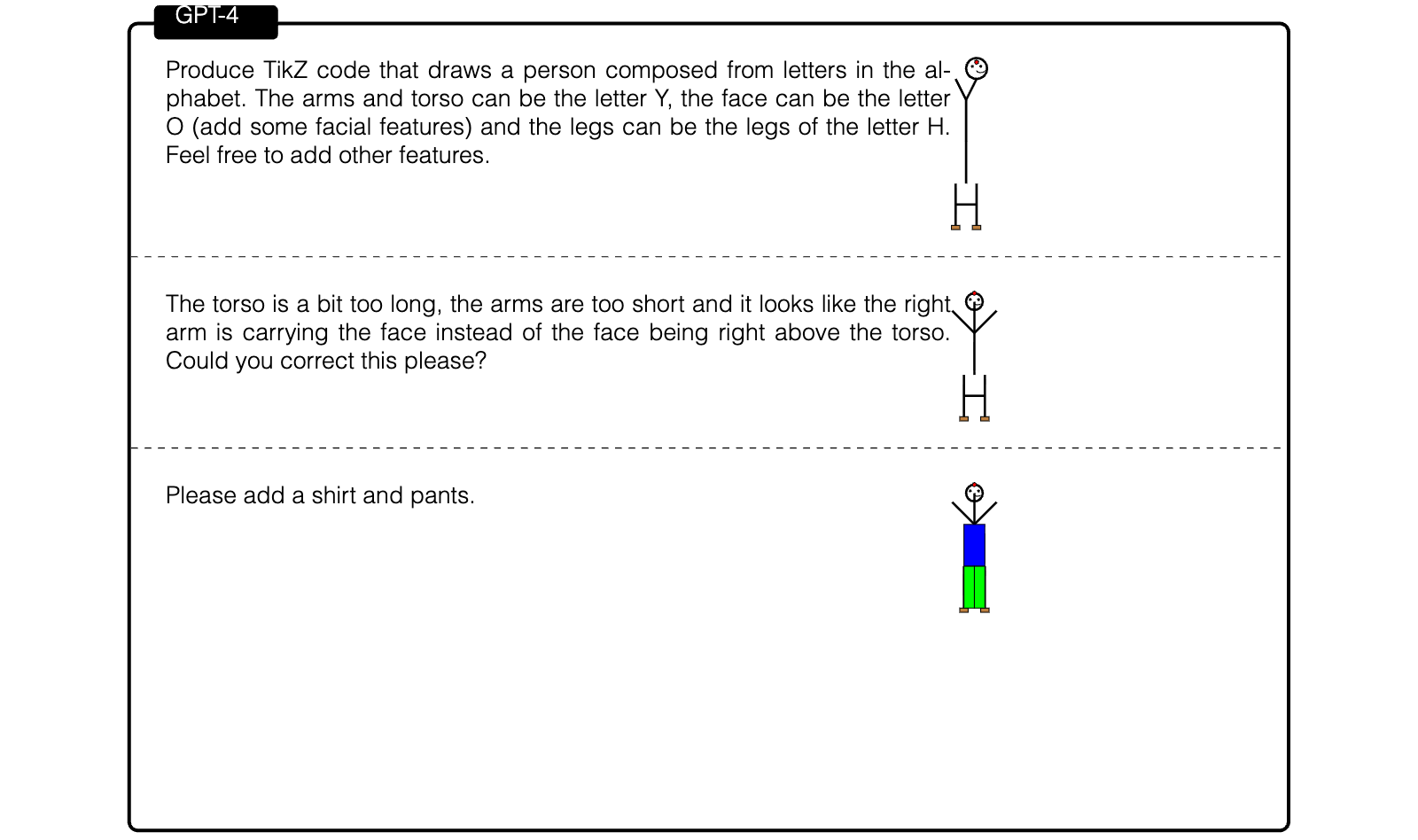
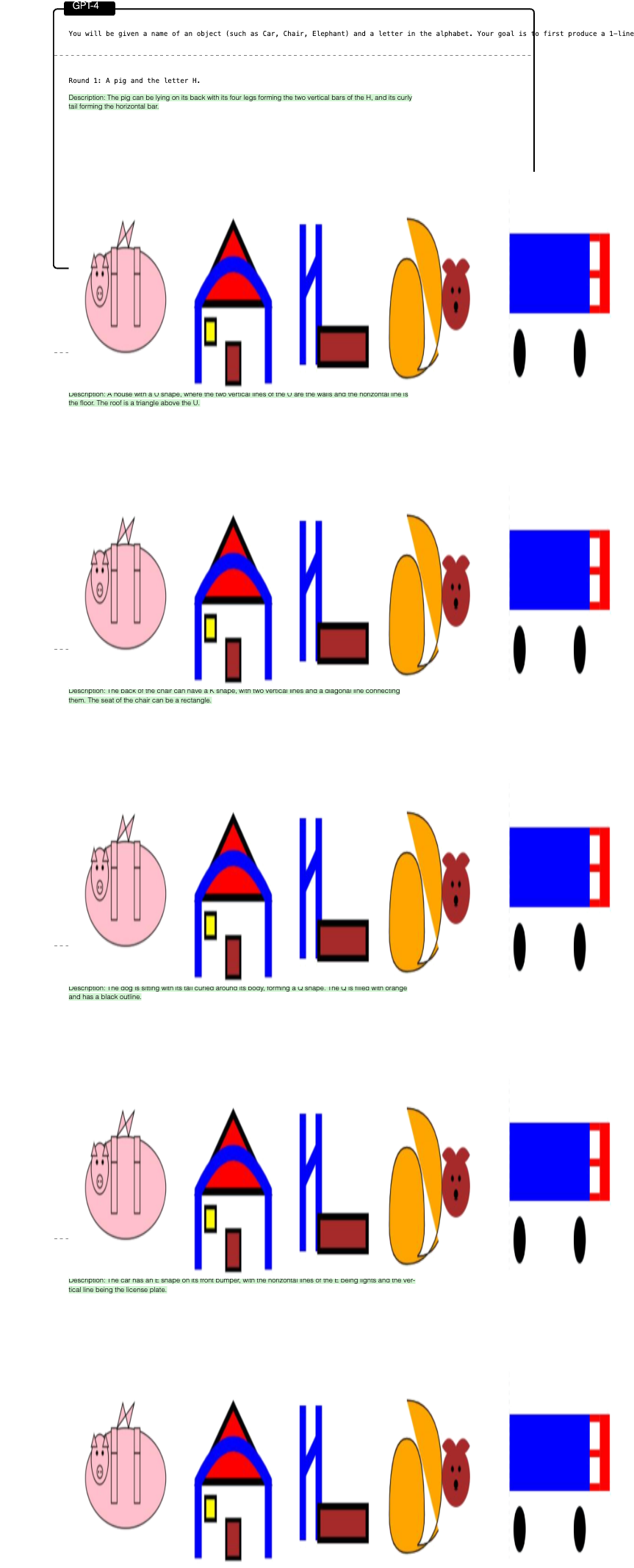
The letters of O, H and Y are created using draw-line and draw-circle commands and the model manages to position them in a way that results in a reasonably-looking stick figure. It is plausible that the training data contains information about the geometric shapes of different letters, and perhaps the fact that the letter Y could look like a torso with arms pointing upwards can also be inferred from the training data. Arguably, it is much less obvious that the model would be able to infer from the training data what is a reasonable way to position those letters in order to draw a reasonably-looking stick figure. In a second iteration, we prompted the model to correct the proportions of the torso and arms, and place the head in the center. Finally, we asked the model to add a shirt and pants (see Figure 2.5 for the exact prompt and the result). To further probe the model’s grasp of geometric concepts, we also asked it to create images that blend objects with letters of the alphabet. The model had to first invent a reasonable way of merging the object and the letter, and then produce the image. The results, shown in Figure 2.6, demonstrate that GPT-4 can usually preserve the identity of both the object and the letter and combine them in a creative way.
To further test GPT-4’s ability to generate and manipulate images, we tested the extent to which it can follow detailed instructions on creating and editing figures. This task requires not only generative skills, but also interpretive, compositional, and spatial skills.
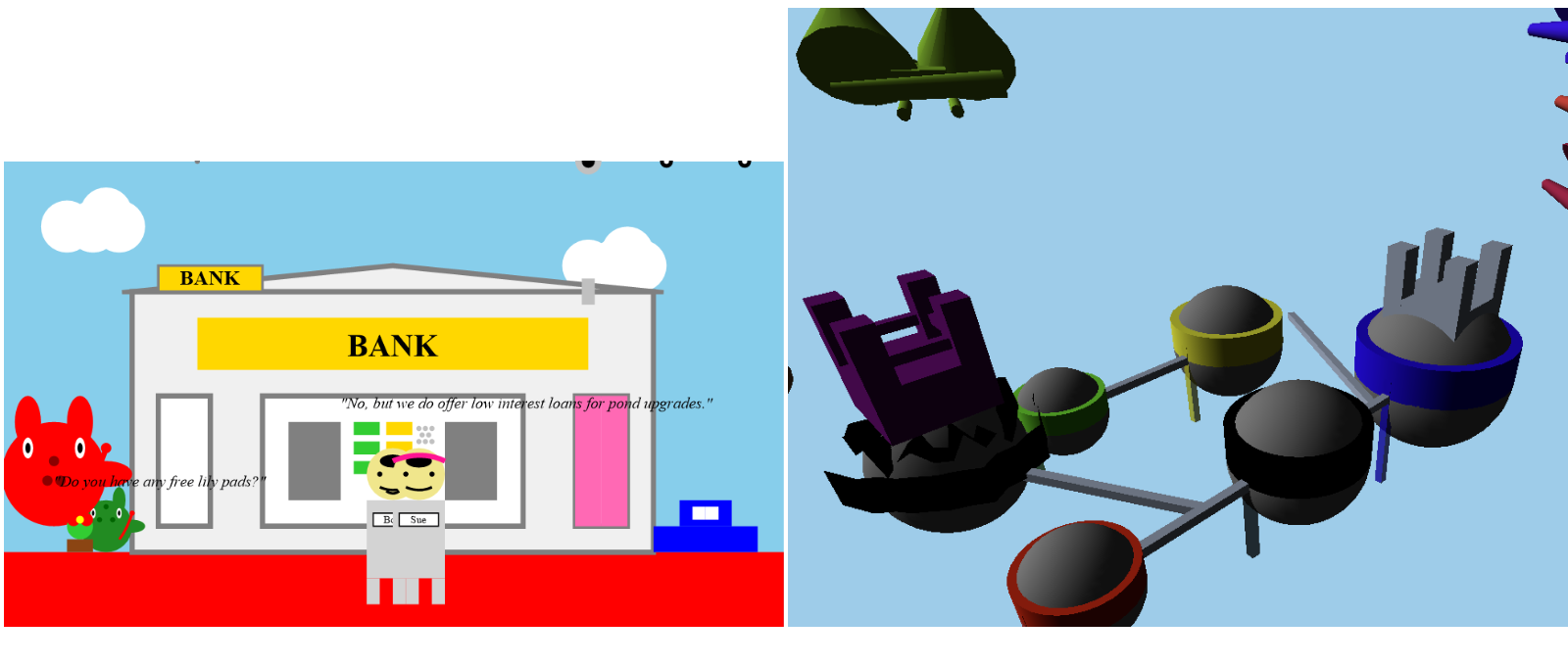
The first example instructs the model to generate a 2D image with the description “A frog hops into a bank and asks the teller, ‘Do you have any free lily pads?’ The teller responds, ‘No, but we do offer low interest loans for pond upgrades.’ ”. We made several attempts to generate the image, each time, the generation matches the description with the key objects frog, teller, bank, and the two texts. We picked the most visually appealing version. Inspired by the standard image generation workflow, we then ask GPT-4 to upscale the figure by adding more details. GPT-4 adds a bank sign, some windows, a car, a traffic light, a few clouds, and makes the frog hold a flower. Finally, we ask GPT-4 to perform various tasks, such as adding a few objects relative to the existing objects, recoloring some objects and changing the z-order of some objects. GPT-4 does all tasks correctly. The final result is shown in Figure 2.7 (a) and the prompt in Figure .
Our second example is an attempt to generate a 3D model using Javascript. We instruct GPT-4 with the prompt “A fantasy landscape of floating islands, waterfalls, and bridges, with a dragon flying in the sky and a castle on the largest island.” Similar to the 2D experiment, we ask GPT-4 to modify the 3D model in various ways, such as adding, relocating, recoloring objects and changing the trajectory of the dragon. Again, GPT-4 does many of the tasks correctly. The final result is shown in Figure 2.7 (b) and the prompt in Figure . It is a 3D animation with multiple dragons is circling above the islands.
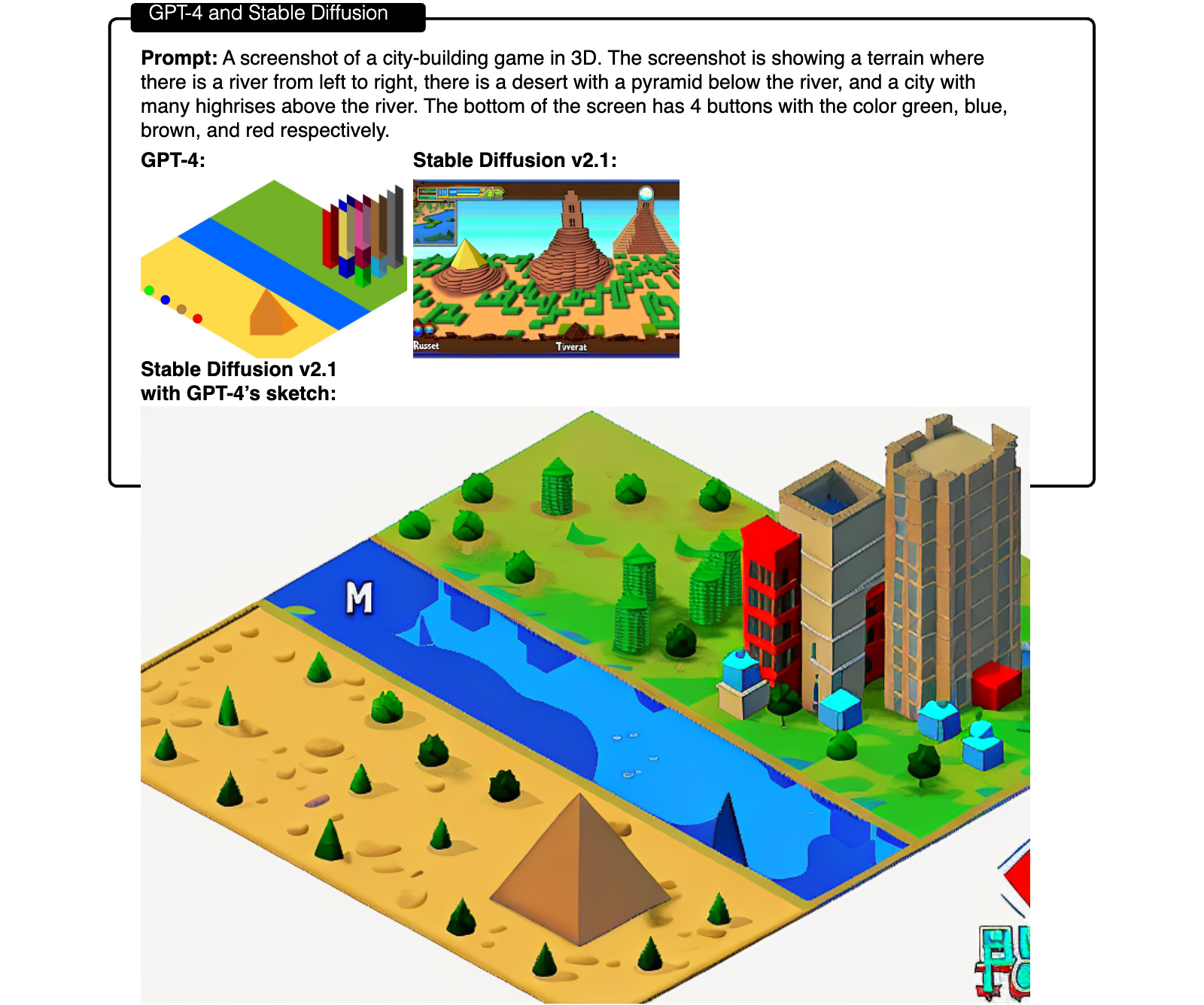
Text-to-image synthesis models have been widely explored in recent years, but they often suffer from a lack of spatial understanding capabilities and the inability to follow complex instructions [gokhale2022benchmarking]. For example, given a prompt such as “draw a blue circle on the left and a red triangle on the right”, these models may produce images that are visually appealing but do not match the desired layout or colors. On the other hand, GPT-4 can generate code from a prompt, which can be rendered as an image, in a way that is true to the instructions to a higher degree of accuracy. However, the quality of the rendered image is usually very low. Here, we explore the possibility of combining GPT-4 and existing image synthesis models by using the GPT-4 output as the sketch. As shown in Figure 2.8, this approach can produce images that have better quality and follow the instructions more closely than either model alone. We believe that this is a promising direction for leveraging the strengths of both GPT-4 and existing image synthesis models. It can also be viewed as a first example of giving GPT-4 access to tools, a topic we explore in much more depth in Section .
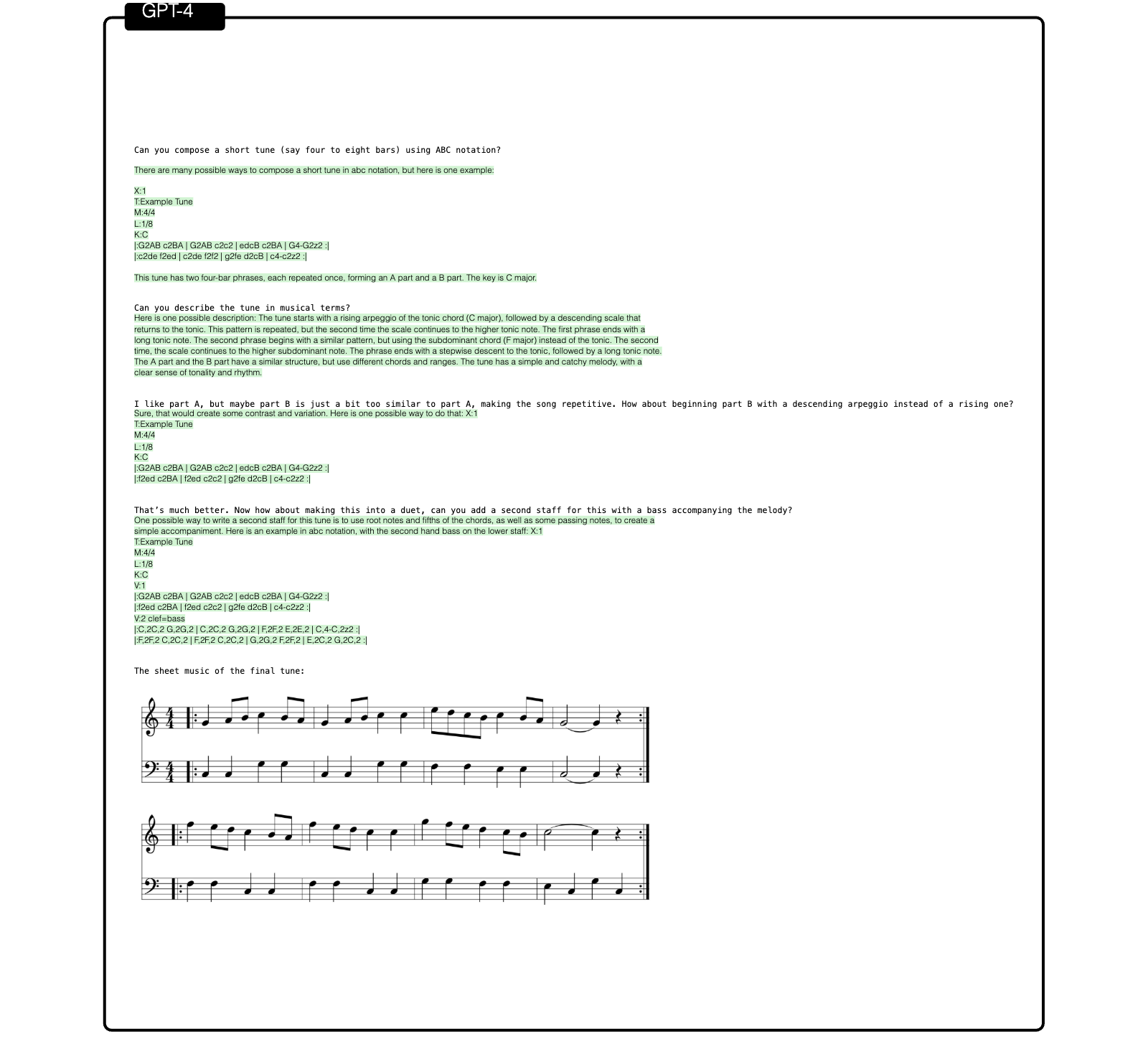
The data on which the model was trained also contains musical information encoded as ABC notation. This is a system that uses letters, numbers and symbols to represent musical pitches, durations, chords and other elements in a compact and readable way. We are interested in exploring how well the model has acquired musical skills from this exposure, such as composing new melodies, transforming existing ones, and understanding musical patterns and structures.
When instructed to generate a short tune (Figure 2.9), and the model was able to produce valid ABC notation. The tune had a clear structure, the time signature was consistent between bars and the notes followed increasing and decreasing patterns. The tune also used a consistent set of notes within the melody, and the rhythm had a repetitive pattern. However, the model did not seem to obtain the skill of understanding harmony. In fact, consecutive notes in the generated tunes are almost always adjacent to each other (namely, the note following C will almost typically be either B or D), and testing on 10 generated tunes, we were not able to extract any clear chords or arpeggios.
We then asked the model to describe the tune in musical terms. It was able to successfully give a technical description of the structure in terms of repetitions, the rising or descending parts of the melody and to some extent the rhythm. However, it seems that the descriptions of the harmony and chords are not consistent with the notes (in fact, it refers to sequences of adjacent notes, which do not form valid chords, as arpeggios).
We then asked the model to manipulate the melody in two ways. First, we instructed to change a certain rising sequence to a descending one, which it did successfully. Then we asked the model to convert the tune to a duet adding a bass voice. The model successfully extends the ABC notation with a second staff which has compatible rhythm and is played on a lower octave, however there is a lack of harmony between the two voices.
In summary, the model was able to produce valid tunes in ABC notation and, to some extent, explain and manipulate their structure. However, we could not get the model to produce any nontrivial form of harmony. It should be noted that ABC notation is not a very widely used format, and in fact the model was not able to produce even the most well-known tunes in ABC notation (such as Ode to Joy, Für Elise or Greensleeves, all of which are abundant online in that format), nor was it able to recognize these tunes.
In this section, we show that GPT-4 is able to code at a very high level, both in terms of writing code from instructions and understanding existing code. GPT-4 can handle a wide range of coding tasks, from coding challenges to real world applications, from low-level assembly to high-level frameworks, from simple data structures to complex programs such as games. GPT-4 can also reason about code execution, simulate the effects of instructions, and explain the results in natural language. GPT-4 can even execute pseudocode, which requires interpreting informal and vague expressions that are not valid in any programming language.
In its current state, we believe that GPT-4 has a high proficiency in writing focused programs that only depend on existing public libraries, which favorably compares to the average software engineer’s ability. More importantly, it empowers both engineers and non-skilled users, as it makes it easy to write, edit, and understand programs. We also acknowledge that GPT-4 is not perfect in coding yet, as it sometimes produces syntactically invalid or semantically incorrect code, especially for longer or more complex programs. GPT-4 also sometimes fails to understand or follow the instructions, or produces code that does not match the intended functionality or style. With this acknowledgment, we also point out that GPT-4 is able to improve its code by responding to both human feedback (e.g., by iteratively refining a plot in 3.2) and compiler / terminal errors (examples in Section ).
As explained in the Introduction (see footnote 1 for example) our experiments were run on an early version of GPT-4. In particular all quantitative results will be different on the final version of GPT-4, although the general trends remain the same. We provide numbers here for illustration purpose only, the definitive benchmark results can be found in OpenAI’s technical report [gpt4].
A common way to measure coding skill is to pose coding challenges that require implementing a specific functionality or algorithm. We first benchmark GPT-4 on HumanEval [humaneval], a docstring-to-code dataset consisting of 164 coding problems that test various aspects of programming logic and proficiency. As shown in Table 1, GPT-4 outperforms other LLMs, including text-davinci-003 (the base model of ChatGPT) and other models trained specifically on code, code-davinci-002, and CODEGEN-16B [codegen].
| Model | GPT-4 | text-davinci-003 | Codex(code-davinci-002) | CODEGEN-16B |
|---|---|---|---|---|
| Accuracy | 82% | 65% | 39% | 30% |
View original table

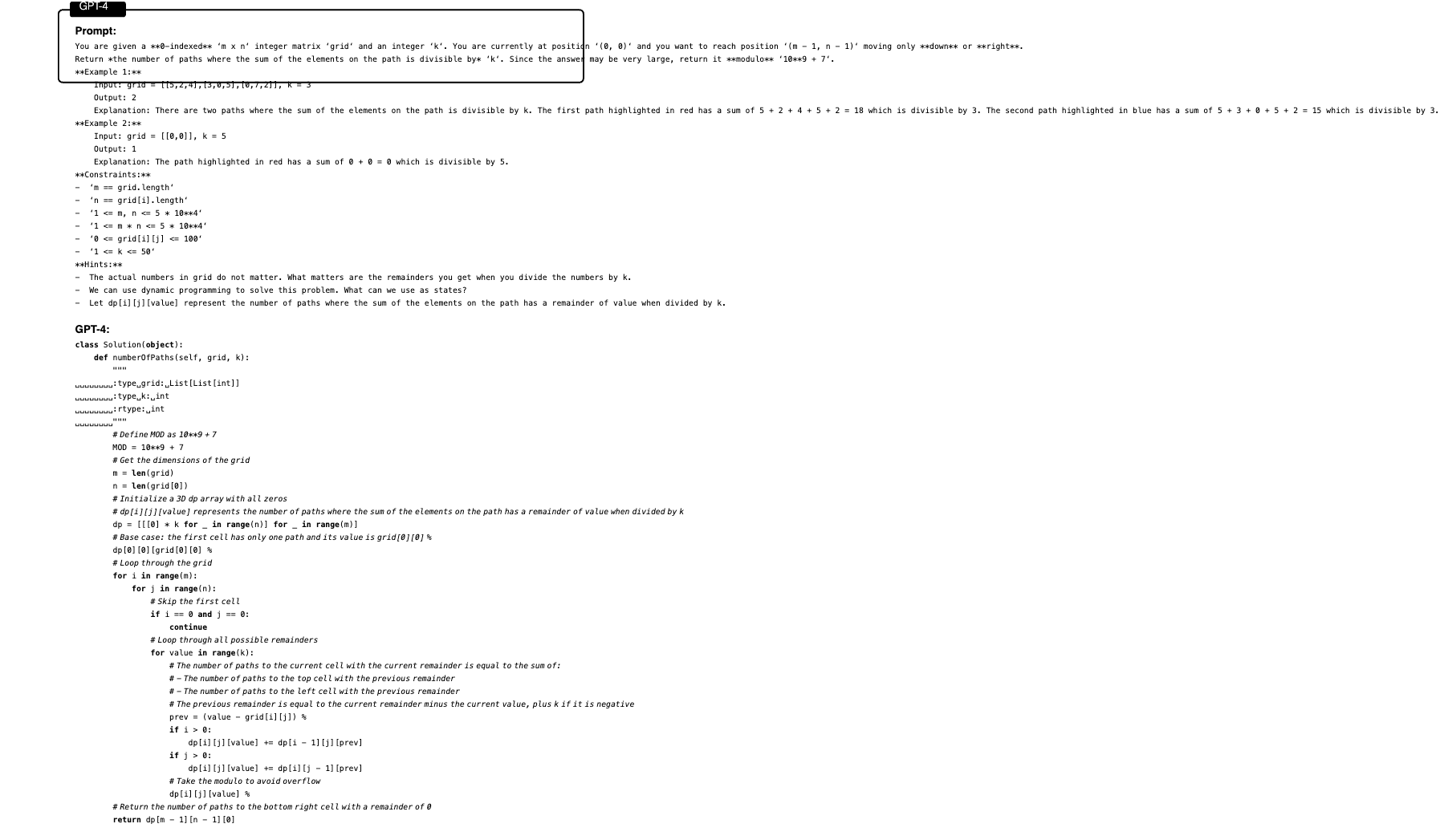
Although GPT-4’s accuracy shows a big jump compared to previous models, it could be that GPT-4 has seen and memorized some (or all) of HumanEval during pre-training. To account for this possibility, we also evaluate it on LeetCode (https://leetcode.com), a popular platform for software engineering interviews, where new problems are constantly posted and updated. We used LeetCode in Figure 4 in the introduction, where GPT-4 passes all stages of mock interviews for major tech companies. Here, to test on fresh questions, we construct a benchmark of 100 LeetCode problems posted after October 8th, 2022, which is after GPT-4’s pretraining period. As seen in the example in Figure 3.1, we paste the problem instructions into a prompt, ask GPT-4 to write a python function, and use the official LeetCode online judge to check for correctness. We present the results in Table 2, where we compare GPT-4 to other models and to human performance based on LeetCode contest results (users who fail all questions are not included, and thus this is a strong sample of humans). We report both pass@1 and pass@5 accuracies, which measure whether the model produces a correct solution in the first or in the first five attempts, respectively. GPT-4 significantly outperforms the other models, and is comparable to human performance (which we measure in Appendix ).
| Easy | Median | Hard | Overall | |||||
| pass@ | ||||||||
| GPT-4 | 68.2 | 86.4 | 40.0 | 60.0 | 10.7 | 14.3 | 38.0 | 53.0 |
| text-davinci-003 | 50.0 | 81.8 | 16.0 | 34.0 | 0.0 | 3.6 | 19.0 | 36.0 |
| Codex (code-davinci-002) | 27.3 | 50.0 | 12.0 | 22.0 | 3.6 | 3.6 | 13.0 | 23.0 |
| Human (LeetCode users) | 72.2 | 37.7 | 7.0 | 38.2 | ||||
View original table

Coding challenges can evaluate the skills in algorithms and data structures. However, they often fail to capture the full complexity and diversity of real-world coding tasks, which requires specialized domain knowledge, creativity, and integration of multiple components and libraries, as well as the ability to change existing code. To assess GPT-4’s ability to code in more realistic settings, we design end-to-end real-world coding challenges related to data visualization, LaTeX coding, front-end development, and deep learning, each of which requires different specialized skills. For each task, we provide GPT-4 with high-level instructions, ask it to write the code in the appropriate language and framework. In a few cases, we also change the specification after the code is written and ask for an update.
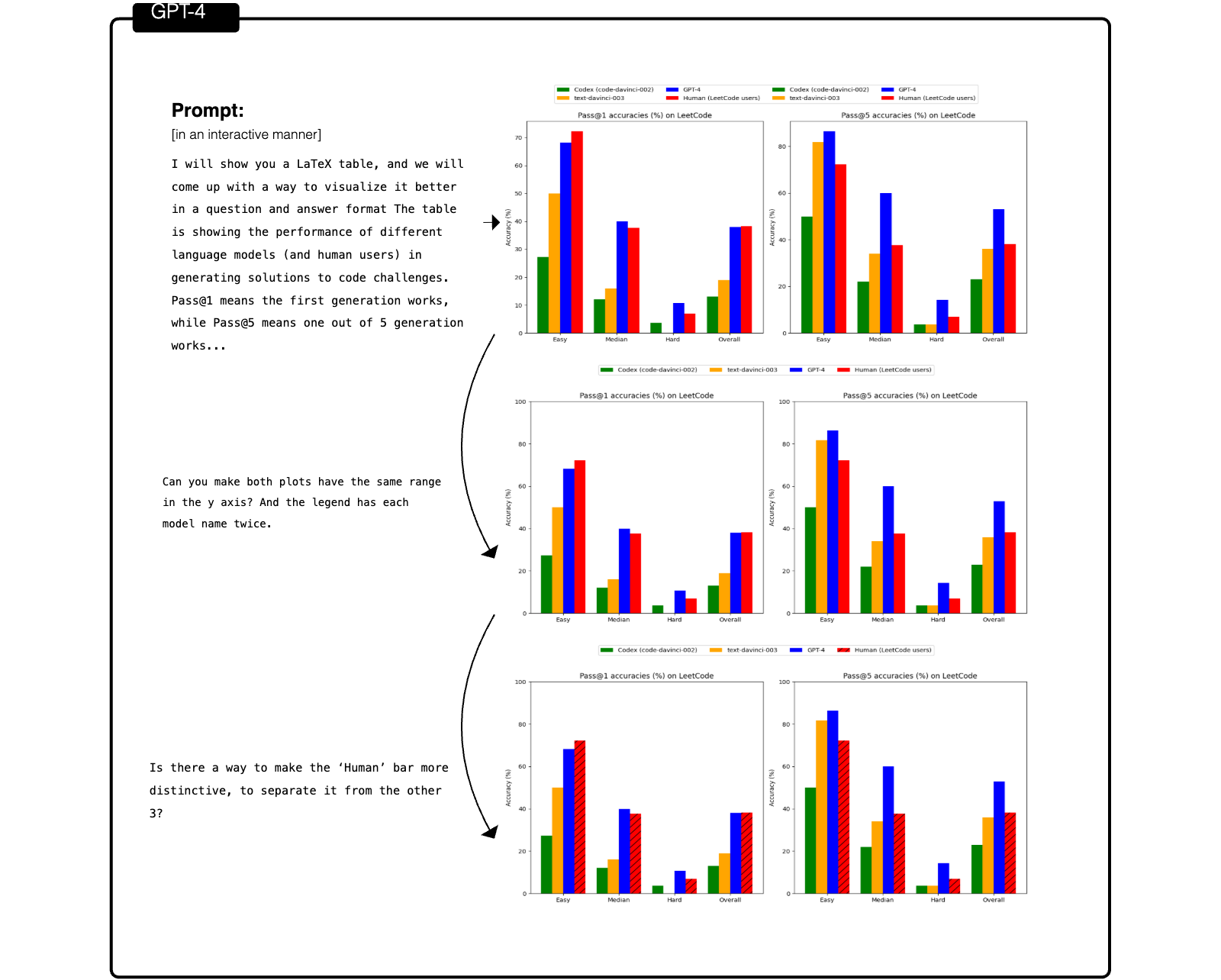
In Figure 3.2, we ask both GPT-4 and ChatGPT to extract data from the LaTeX code for Table 2 and produce a plot in Python based on a conversation with the user. Afterwards, we ask both models to perform various operations on the produced plots. While both models extract the data correctly (not a trivial task, since one must infer from the multicolumn that the Human row has the same value for and ), ChatGPT never produces the desired plot. In contrast, GPT-4 responds appropriately to all user requests, manipulating the data into the right format and adapting the visualization. In Appendix , we include another example where GPT-4 visualizes the IMDb dataset.
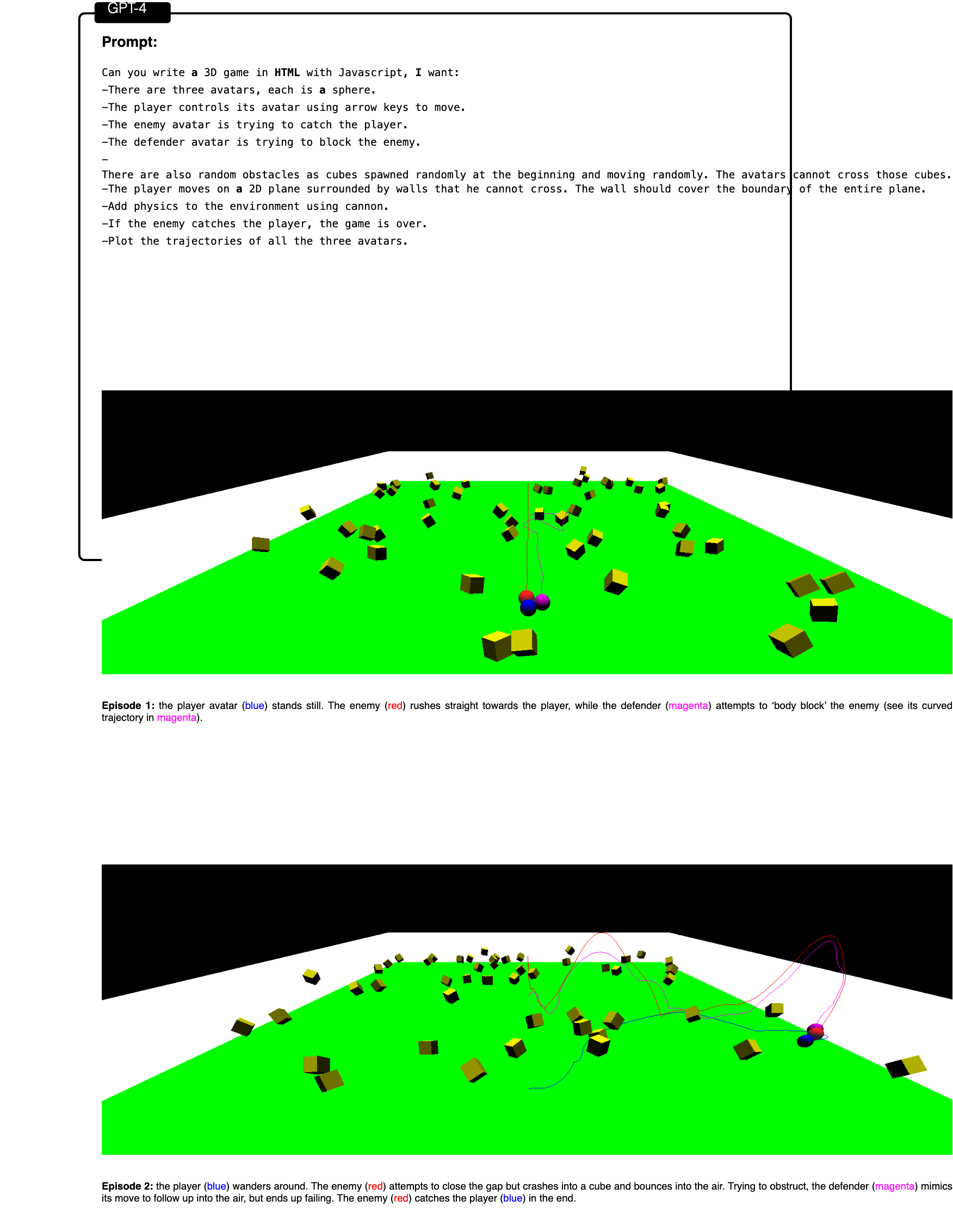
In Figure 3.3, we ask GPT-4 to write a 3D game in HTML with JavaScript, using a very high-level specification. GPT-4 produces a working game in zero-shot fashion that meets all the requirements. In the 3D game, GPT-4 is even able to interpret the meaning of “defender avatar is trying to block the enemy”: the defender code has logic so that it positions itself between the player and enemy. In contrast, ChatGPT responds with “I am an AI language model, I can provide you guidance on how to create a 3D game in HTML with JavaScript, but I am unable to write code or create a game myself. Creating a 3D game in HTML with JavaScript requires a lot of programming knowledge and experience. It is not a task that can be completed quickly or easily. It would take a significant amount of time and effort to develop all the necessary features, such as 3D graphics, physics, user input, and AI…”. We give more examples for front-end (graphical user interface) and game development in Appendix .
Writing code for deep learning requires knowledge of mathematics, statistics, and familiarity with frameworks and libraries such as PyTorch, TensorFlow, Keras, etc. In Figure 3.4 we ask both GPT-4 and ChatGPT to write a custom optimizer module, a task that can be challenging and error-prone even for human deep learning experts. We give these models a natural language description, which includes a sequence of non-trivial operations such as applying SVD, truncating a matrix spectrally at the top-k and top-2k eigenvalues, normalizing the top-k truncated matrix using the F-norm of the top-2k truncated matrix, applying momentum and weight decay. These instructions are not spelled out in complete detail, e.g., “apply momentum on ” requires “deep learning common sense”. It is important to note that this particular optimizer does not exist in the literature or on the internet, and thus the models cannot have it memorized, and must instead compose the concepts correctly in order to produce the code.
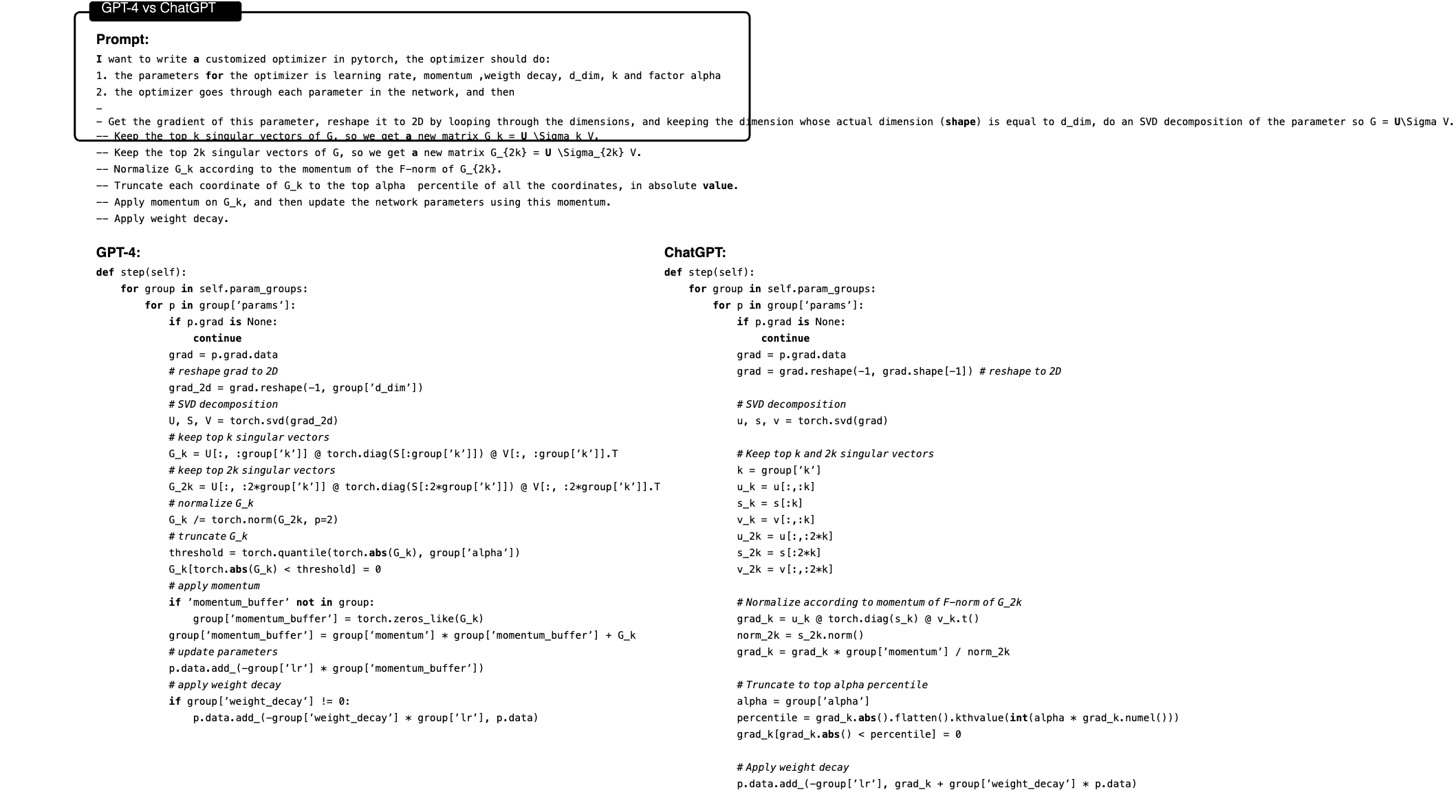
While both models produce syntactically valid code, only GPT-4’s response largely matches the instructions, while it forgets to ‘loop through the dimensions’ and to ‘normalize according to the momentum’ where the instructions happen to be particularly vague. In comparison, ChatGPT makes a rather fatal mistake at applying momentum (highlighted in red) in addition. Note that applying momentum in PyTorch is a non-trivial task that requires storing and reading a moving average into and from a separate state buffer.
Writing in LaTeX is an important exercise for computer scientists and mathematicians but has a non-trivial learning curve. Even experts make irritating errors that take hours to fix on a daily basis due to its strict grammar and the lack of a good debugger. We show that GPT-4 can utilize its master-level LaTeX coding skill to greatly simplify the process, with the potential of serving as a new generation of LaTeX compilers that can handle imprecise natural language descriptions. In Figure , we ask GPT-4 to transfer a snippet of written in a semi-rigorous (buggy) LaTeX code mixed with natural language into accurate LaTeX commands that compiles and is faithful in one shot. In constrast, ChatGPT generates a snippet that does not compile due to mistakes at using ‘#’ and ‘\color’ etc.