SkillRL: Evolving Agents via Recursive Skill-Augmented Reinforcement Learning
arXiv:2602.08234v2 · This workspace stays on this version. Check arXiv for newer versions
Some source details need review 10 to check
Original formulas, table values and figures are preserved. Comparison can miss differences; use the original PDF to check details.
Reading view checked: 132 math expressions, 9 rendering failures; 26 of 26 images available.
Compared 269 of 269 source passages against 31 of 31 PDF pages.
- Some source graphics could not be placed in the reading view. (3)
- Some graphics are laid out differently in the HTML source than in the paper (text or formulas outside their frame); check the original PDF. (3)
- Some formulas could not be rendered; their original TeX is shown. Check the original PDF. (9)
- A6_p3_pic1: the arXiv HTML draws text or formulas of this graphic outside its frame and it could not be corrected safely (too-small); the image shows the HTML layout, which differs from the PDF.
- A6_p4_pic1: the arXiv HTML draws text or formulas of this graphic outside its frame and it could not be corrected safely (too-small); the image shows the HTML layout, which differs from the PDF.
- A6_p5_pic1: the arXiv HTML draws text or formulas of this graphic outside its frame and it could not be corrected safely (too-small); the image shows the HTML layout, which differs from the PDF.
- An unsupported comparison claim was rejected; source verification is incomplete.
HTML S1_p1_1 quotes “various sophisticated tasks [[50](#bib.bib2), [15](#bib.bib3)]”; the original PDF page 1 reads “various sophisticated tasks [51, 15]”. The PDF visibly shows 51, contradicting the HTML citation. Check PDF page 1
HTML (S5_p1_1) says “autonomous agent systems [[46](#bib.bib19)]”; the PDF (page 9) visibly says “autonomous agent systems [47].” Check PDF page 9
HTML (S5_p3_1) reads “self-evolving agents [[9](#bib.bib28), [51](#bib.bib29), [22](#bib.bib30)]”; PDF (page 9) reads “self-evolving agents [9, 50, 21]” and the page image confirms those numbers. Check PDF page 9
26 of 26 figure, table and graphic images captured. Open original PDF
Abstract
Large Language Model (LLM) agents have shown stunning results in complex tasks, yet they often operate in isolation, failing to learn from past experiences. Existing memory-based methods primarily store raw trajectories, which are often redundant and noise-heavy. This prevents agents from extracting high-level, reusable behavioral patterns that are essential for generalization. In this paper, we propose SkillRL, a framework that bridges the gap between raw experience and policy improvement through automatic skill discovery and recursive evolution. Our approach introduces an experience-based distillation mechanism to build a hierarchical skill library SkillBank, an adaptive retrieval strategy for general and task-specific heuristics, and a recursive evolution mechanism that allows the skill library to co-evolve with the agent’s policy during reinforcement learning. These innovations significantly reduce the token footprint while enhancing reasoning utility. Experimental results on ALFWorld, WebShop and seven search-augmented tasks demonstrate that SkillRL achieves state-of-the-art performance, outperforming strong baselines over 15.3% and maintaining robustness as task complexity increases. Code is available at this https://github.com/aiming-lab/SkillRL.
Large language model (LLM) agents [54, 34] have demonstrated remarkable capabilities across various sophisticated tasks [50, 15], such as web navigation [11, 26] and deep research [27, 10, 39], by interacting with complex environments through natural language. Despite these advances, each task execution remains largely episodic. Current LLM agents operate in isolation, unable to learn from past successes or failures [56], which significantly hinders their evolution. Consequently, a fundamental challenge remains: how can agents efficiently learn from experience and transfer that knowledge to other tasks?
The existing memory-based methods for LLM agents primarily involve saving raw trajectories directly into external databases during the sampling process to serve as references for similar future tasks [34, 58]. While intuitive, these raw trajectories are often lengthy and contain significant redundancy and noise [4], making it difficult for the model to extract critical information. Recent work has attempted to compress trajectories and update the memory bank via online training [56, 57], improving memory efficiency. However, these methods merely mimic past solutions and they fail to distill core principles or adapt the agent’s internal policy to leverage memory for guided decision-making. As depicted in the dashed flow of Figure 1(a), such approaches often struggle with the trade-off between information density and noise, leading to sub-optimal performance or even degradation as shown in Figure 1(b).
We argue that these approaches miss a crucial insight: effective experience transfer requires abstraction. Human experts do not memorize every action in every situation; instead, they develop skills [2], compact and reusable strategies that capture the essence of how to accomplish specific subtasks. Inspired by this observation, we propose SkillRL, a framework that bridges the gap between raw experience and efficient policy improvement through automatic skill discovery and recursive skill evolution.
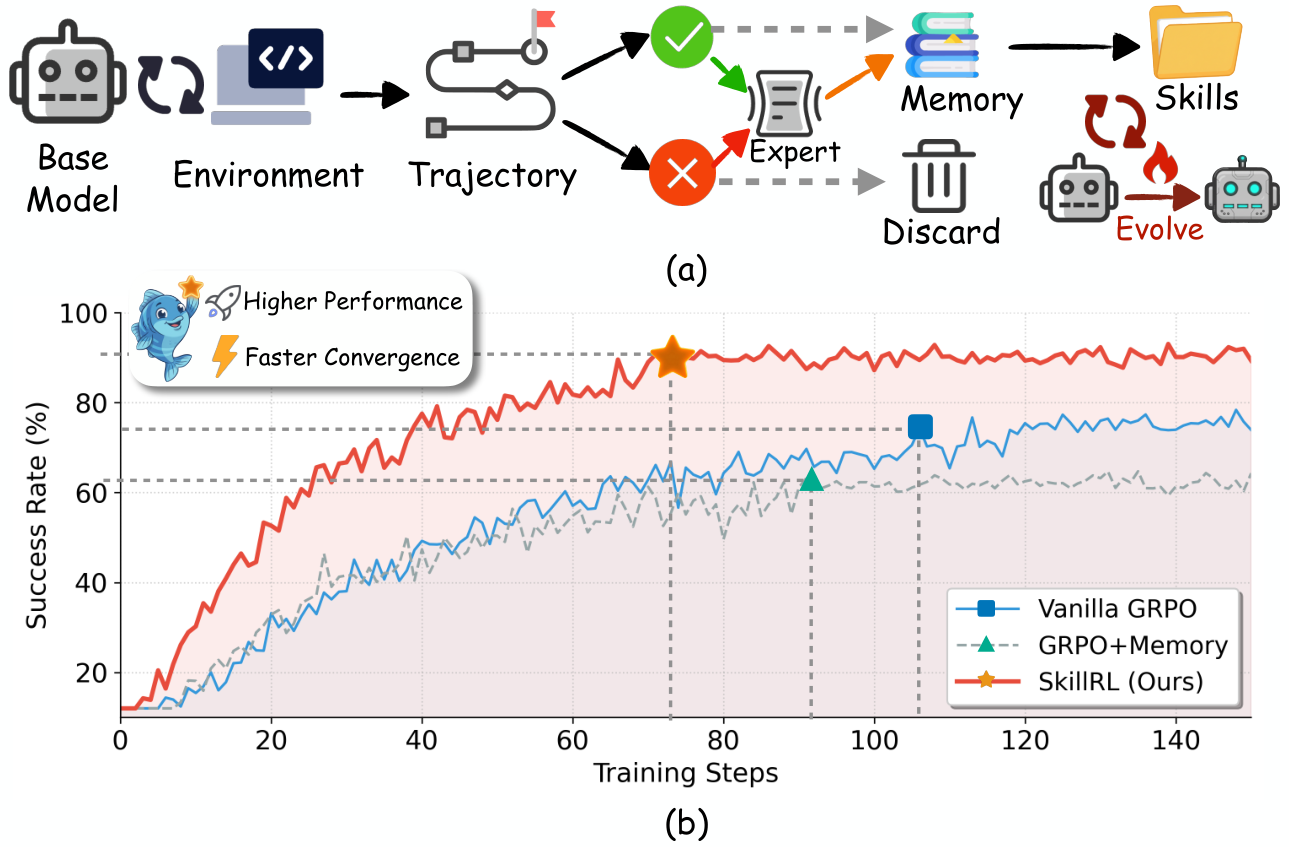
SkillRL first introduces an experience-based skill distillation mechanism, which gathers diverse trajectories from environment rollouts and applies differential processing: successful episodes are preserved as demonstrations, while failed ones are synthesized into concise failure lessons to mitigate context noise. Secondly, we transform these experiences into a hierarchical skill library SkillBank, differentiating between general skills for universal strategic guidance and task-specific skills for task-level heuristics. This abstraction allows the agent to adaptively retrieve relevant skills during decision-making, significantly reducing the token footprint while enhancing reasoning utility. Lastly, SkillRL incorporates a recursive skill evolution mechanism during reinforcement learning (RL), where the skill library is treated as a dynamic component rather than a static knowledge source. By analyzing failure modes after each validation epoch to generate new skills or refine existing ones, our approach ensures the skill library and the agent’s policy co-evolve, maintaining robustness as task complexity increases. As demonstrated in Figure 1(b), SkillRL achieves substantially faster convergence and higher asymptotic performance.
The primary contribution is SkillRL, a framework that enables LLM agents to bridge the gap between raw experience and policy improvement through automatic skill discovery and recursive evolution. By distilling redundant trajectories into a hierarchical SkillBank, our method abstracts general and task-specific skills to guide decision-making efficiently. Furthermore, we introduce a recursive evolution mechanism that ensures the skill library and agent policy co-evolve during reinforcement learning. Empirical results on ALFWorld, WebShop, and seven search-augmented benchmarks demonstrate that SkillRL achieves state-of-the-art performance with 15.3% improvements, significantly outperforming current memory-based agent-tuning baselines in both task success and reasoning utility.
LLM Agents. We consider an agent operating in an interactive environment . At each timestep , the agent observes a state , selects an action , and receives a reward and next observation . A trajectory captures one episode of interaction. Tasks are specified by natural language descriptions . An LLM-based agent parameterized by implements a policy where represents additional context (e.g., skills, demonstrations). Our goal is to learn a policy that maximizes expected return subject to context length constraints .
Group Relative Policy Optimization (GRPO). GRPO [33] is a reinforcement learning method that avoids training a critic by using intra-group relative rewards to optimize the policy. For each query , the model samples responses , which are scored to obtain rewards . GRPO computes normalized advantages and updates the policy with a PPO-style clipped objective [32]:
where is the importance ratio, is the normalized advantage, , are hyperparameters, and is the policy before the current update.
In this section, as illustrated in Figure 2, we propose SkillRL, a framework designed to bridge the gap between raw interaction experience and policy improvement through automatic skill discovery and recursive evolution. SkillRL consists of three core components. First, we develop an experience-based skill distillation mechanism to transform redundant trajectories into concise, actionable knowledge. Second, we organize these distilled experiences into a hierarchical skill library , enabling efficient retrieval of general and task-specific expertise. Lastly, we introduce a recursive skill evolution mechanism that leverages RL to dynamically refine the skill library in tandem with the agent’s policy. We detail these components as follows:
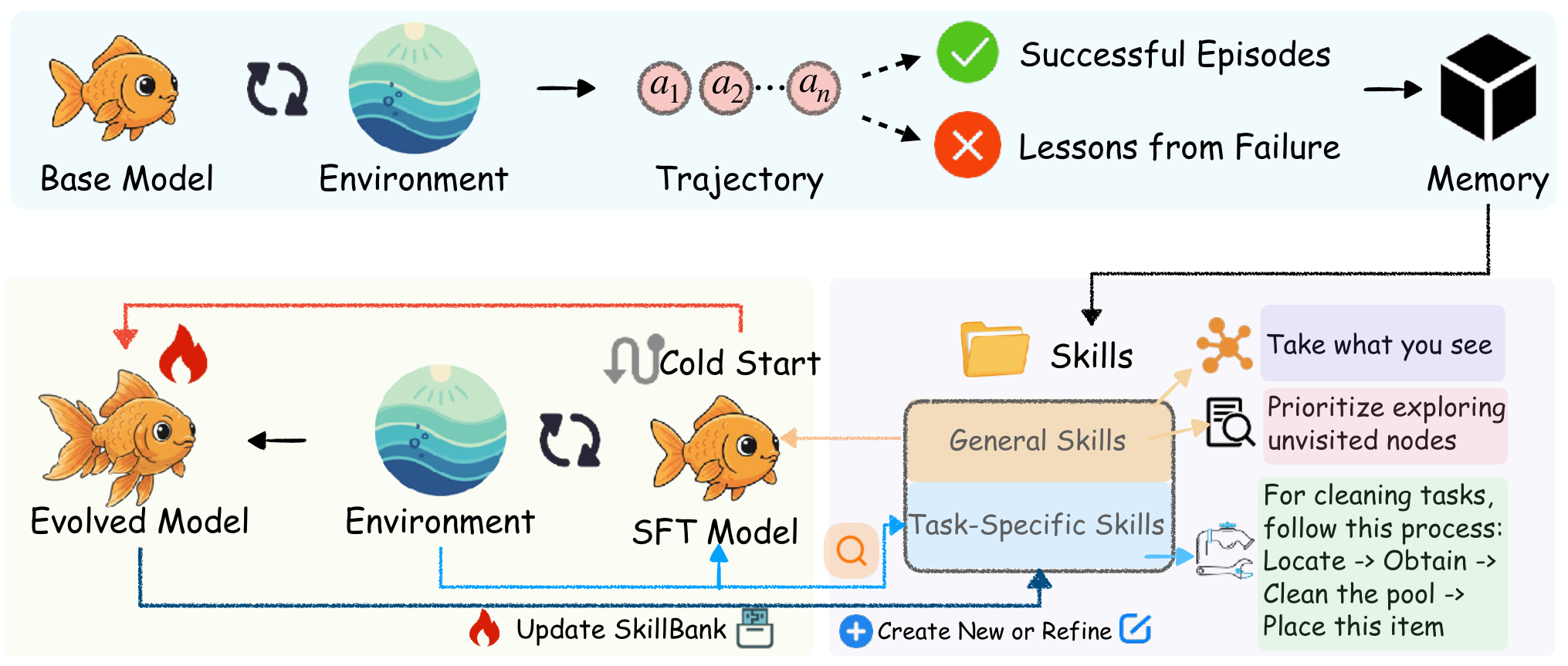
Raw trajectories collected from environment interactions are verbose, containing exploratory actions, backtracking, and redundant steps that obscure the critical decisions leading to success or failure. To transform these experiences into actionable knowledge, we employ a teacher model to distill trajectories into compact, reusable skills.
Specifically, we first deploy a base LLM agent in the target environment to collect diverse trajectories. Unlike prior approaches that retain only successful episodes, we deliberately preserve both successful trajectories and failed trajectories , where denotes the binary task success indicator. Failed trajectories reveal failure modes and boundary conditions, i.e., information difficult to infer from successes alone.
We apply differential processing based on trajectory outcomes. For successful trajectories , we extract the strategic patterns that led to task completion:
The teacher model identifies critical decision points, the reasoning behind correct actions, and generalizable patterns that transfer beyond the specific task instance.
For failed trajectories , direct inclusion in context is infeasible due to their length and noise. Instead, we synthesize concise failure lessons:
The analysis identifies: (1) the point of failure, (2) the flawed reasoning or action, (3) what should have been done, and (4) general principles to prevent similar failures. This transforms verbose failed episodes into counterfactuals.
Following the design principles of Agent Skills [2], we organize the distilled knowledge into a hierarchical skill library SkillBank that enables efficient retrieval of relevant expertise during decision-making.
We structure SkillBank into two levels: 1) General Skills capture universal strategic principles applicable across all task types within an environment. These typically include exploration strategies (e.g., systematic search patterns, prioritizing unvisited locations), state management principles (e.g., verifying preconditions before actions), and goal-tracking heuristics (e.g., maintaining progress counters, terminating only upon verified completion). General skills provide foundational guidance that transfers across different task categories. 2) Task-Specific Skills encode specialized knowledge for task category . These capture domain-specific action sequences, task-particular preconditions and constraints, common failure modes unique to the task type, and optimized procedures that exploit task structure. By organizing trajectories by task type during collection, we enable extraction of fine-grained, category-specific strategies that complement the broader general skills.
The complete skill library SkillBank is . Each skill is structured with: a concise name (e.g., systematic exploration), a principle describing the strategy, and when_to_apply conditions specifying applicability. This format enables efficient retrieval while providing clear guidance for application.
At inference, given a task description , the agent retrieves relevant skills to augment its context. General skills are always included as foundational guidance. Task-specific skills are retrieved via semantic similarity:
where are embeddings of the task description and skill respectively, is a similarity threshold, and controls the number of retrieved skills. The policy then conditions on the retrieved skills:
Notably, skill distillation achieves 10–20 token compression compared to raw trajectories while enhancing rather than degrading the utility of the original experience. This compression allows the agent to leverage rich experiential knowledge within limited context windows.
A static skill library cannot anticipate all scenarios the agent will encounter. As the policy improves and explores new state regions, it faces situations where existing skills provide insufficient guidance. We introduce recursive skill evolution during reinforcement learning to address this limitation, enabling the skill library and agent policy to co-evolve.
Cold-Start Initialization. Before RL training, we address a critical challenge: the base agent has not learned how to effectively utilize skills. Simply providing skills to an unchanged model yields limited benefit [12]. We therefore perform a cold-start supervised fine-tuning (SFT) stage [28], where the teacher model generates skill-augmented reasoning traces demonstrating how to retrieve, interpret, and apply skills during decision-making. The base model is then fine-tuned on these demonstrations:
where denotes the cross-entropy loss. The resulting model serves as both the starting point for RL training and the reference policy for KL regularization.
Recursive Skill Evolution. A static skill library cannot anticipate all scenarios the agent will encounter. As the policy improves and explores new state regions, it faces situations where existing skills provide insufficient guidance. We introduce recursive skill evolution to address this limitation. The process begins with an initial skill library containing baseline task-action principles.
After each validation epoch, we monitor the success rate for each task category . To ensure targeted growth, the evolution is triggered only for categories where . We then collect failed trajectories using a diversity-aware stratified sampling strategy: trajectories are grouped by category, prioritized by the severity of failure (negative rewards), and selected via round-robin sampling to maintain categorical entropy. Then we will analyze these samples to identify gaps:
The teacher model is prompted to: (1) identify failure patterns not addressed by current skills, (2) propose new skills to cover these gaps, and (3) suggest refinements to existing skills that proved ineffective. The library is then updated: .
This creates a virtuous cycle: as the agent improves, it encounters new challenges, which drive skill library expansion, which enables further improvement.
RL-based Policy Optimization. We optimize the skill-augmented policy using GRPO. For each task with description , the agent first retrieves relevant skills and then samples complete trajectories from the current policy . Each trajectory receives a binary reward indicating task successfulness. The normalized advantage for each trajectory is computed as:
The policy is updated according to:
where is the importance ratio computed over the skill-augmented context. The KL penalty anchored to ensures that RL optimization preserves the learned skill utilization capabilities while improving task performance. The complete training procedure is summarized in Algorithm 1.
| Method | ALFWorld | WebShop | |||||||
| Pick | Look | Clean | Heat | Cool | Pick2 | All | Score | Succ. | |
| Closed-source LLMs | |||||||||
| GPT-4o | 75.3 | 60.8 | 31.2 | 56.7 | 21.6 | 49.8 | 48.0 | 31.8 | 23.7 |
| Gemini-2.5-Pro | 92.8 | 63.3 | 62.1 | 69.0 | 26.6 | 58.7 | 60.3 | 42.5 | 35.9 |
| Qwen2.5-7B-Instruct | |||||||||
| Qwen2.5 | 33.4 | 21.6 | 19.3 | 6.90 | 2.80 | 3.20 | 14.8 | 26.4 | 7.80 |
| Prompt-based Agentic or Memory-based Methods | |||||||||
| ReAct∗ | 48.5 | 35.4 | 34.3 | 13.2 | 18.2 | 17.6 | 31.2 | 46.2 | 19.5 |
| Reflexion∗ | 62.0 | 41.6 | 44.9 | 30.9 | 36.3 | 23.8 | 42.7 | 58.1 | 28.8 |
| Mem0 | 54.0 | 55.0 | 26.9 | 36.4 | 20.8 | 7.69 | 33.6 | 23.9 | 2.00 |
| ExpeL | 21.0 | 67.0 | 55.0 | 52.0 | 71.0 | 6.00 | 46.3 | 30.9 | 11.2 |
| MemP | 54.3 | 38.5 | 48.1 | 56.2 | 32.0 | 16.7 | 41.4 | 25.3 | 6.40 |
| SimpleMem | 64.5 | 33.3 | 20.0 | 12.5 | 33.3 | 3.84 | 29.7 | 33.2 | 8.59 |
| RL-based Methods | |||||||||
| RLOO∗ | 87.6 | 78.2 | 87.3 | 81.3 | 71.9 | 48.9 | 75.5 | 80.3 | 65.7 |
| GRPO∗ | 90.8 | 66.1 | 89.3 | 74.7 | 72.5 | 64.7 | 77.6 | 79.3 | 66.1 |
| Memory-Augmented RL-based Methods | |||||||||
| MemRL | 62.8 | 38.5 | 22.2 | 12.5 | 8.00 | 0.00 | 21.4 | 29.5 | 9.20 |
| EvolveR | 64.9 | 33.3 | 46.4 | 13.3 | 33.3 | 33.3 | 43.8 | 42.5 | 17.6 |
| Mem0+GRPO | 78.1 | 54.8 | 56.1 | 31.0 | 65.0 | 26.9 | 54.7 | 58.1 | 37.5 |
| SimpleMem+GRPO | 89.5 | 36.3 | 60.0 | 50.0 | 64.9 | 26.3 | 62.5 | 67.8 | 46.9 |
| SkillRL | 97.9 | 71.4 | 90.0 | 90.0 | 95.5 | 87.5 | 89.9 | 85.2 | 72.7 |
View original table
| Method | Single-Hop QA | Multi-Hop QA | Avg. | |||||
|---|---|---|---|---|---|---|---|---|
| NQ† | TriviaQA⋆ | PopQA⋆ | HotpotQA† | 2Wiki⋆ | MuSiQue⋆ | Bamboogle⋆ | ||
| Qwen2.5-7B-Instruct | ||||||||
| Qwen2.5∗ | 11.6 | 35.6 | 1.20 | 16.4 | 22.2 | 4.80 | 14.4 | 15.2 |
| CoT∗ | 12.8 | 35.6 | 3.80 | 16.2 | 22.6 | 6.60 | 24.0 | 17.4 |
| RAG∗ | 27.4 | 58.2 | 17.8 | 25.8 | 23.2 | 9.40 | 16.8 | 25.5 |
| Search-o1∗ | 19.4 | 40.6 | 11.4 | 17.0 | 27.0 | 8.60 | 30.4 | 22.1 |
| R1-Instruct | 21.0 | 44.9 | 17.1 | 20.8 | 27.5 | 6.00 | 19.2 | 22.4 |
| Search-R1 | 39.3 | 61.0 | 39.7 | 37.0 | 40.1 | 14.6 | 36.8 | 38.5 |
| ZeroSearch | 43.6 | 61.8 | 51.5 | 34.6 | 35.2 | 18.4 | 27.8 | 39.1 |
| StepSearch | - | - | - | 38.6 | 36.6 | 22.6 | 40.0 | - |
| EvolveR | 43.5 | 63.4 | 44.6 | 38.2 | 42.0 | 15.6 | 54.4 | 43.1 |
| SkillRL | 45.9 | 63.3 | 45.9 | 43.2 | 40.3 | 20.2 | 73.8 | 47.1 |
View original table
We evaluate SkillRL on nine challenging benchmarks for LLM agents: ALFWorld, WebShop, and seven search-augmented QA tasks. Our experiments address the following questions: 1) How does SkillRL compare to state-of-the-art methods? 2) What is the contribution of each component? 3) How does the skill library evolve during training? 4) Does skills accelerate model convergence?
Environments. ALFWorld [35] is a text-based game aligned with the ALFRED embodied AI benchmark. Agents must complete household tasks by navigating and interacting with objects through text commands. WebShop [53] simulates web shopping. Agents navigate a realistic web interface to find and purchase products matching user specifications. In addition, we also evaluate the performance of SkillRL on search-augmented QA tasks, including single-hop QA datasets (NQ [18], TriviaQA [17], and PopQA [23]) and multi-hop QA datasets (HotpotQA [52], 2Wiki [13], MuSiQue [41], and Bamboogle [31]).
Baselines. We compare SkillRL against four categories of competitive methods. First, we include closed-source LLMs, specifically GPT-4o [24] and Gemini-2.5-Pro [5], which represent the state-of-the-art in general-purpose reasoning and instruction following. Second, we evaluate prompt-based agentic or memory-based methods, including ReAct [54] and Reflexion [34], which rely on in-context prompting for multi-step reasoning, as well as Mem0 [4], ExpeL [58], and MemP [7], which utilize external memory or experience pools to guide behavior without parameter updates. Third, we consider RL-based methods, including group-based online RL algorithms such as RLOO [1] and GRPO [33] that optimize policies via advantage estimation over trajectory groups. Finally, we compare against memory-augmented RL-based methods, such as EvolveR [49], MemRL [57], and the combination of Mem0+GRPO and SimpleMem [21]+GRPO, which integrate persistent memory mechanisms directly into the reinforcement learning optimization process to handle long-term dependencies. For search-augmented QA, we compare SkillRL with R1-Instruct, Search-o1 [20], Search-R1 [16], ZeroSearch [36], and StepSearch [59].
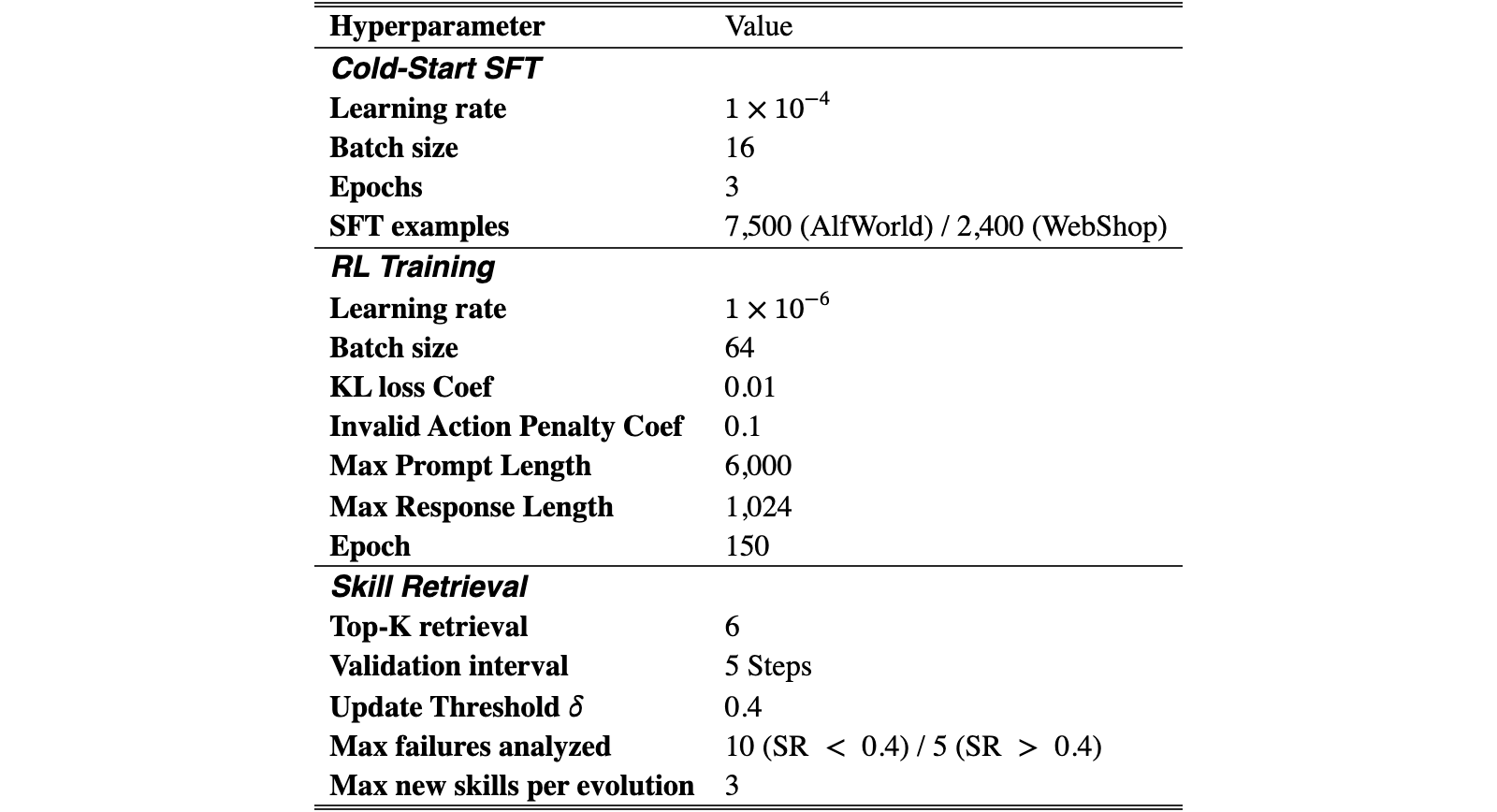
Implementation Details. We use Qwen2.5-7B-Instruct [3] as our base model and OpenAI o3 [25] as the teacher model for skill distillation and SFT data generation. For RL training, we use GRPO with learning rate , batch size 16, group size 8, and 4 gradient accumulation steps. We set for task-specific skill retrieval and for the collection of failed trajectories. For more detailed information on training hyperparameters, please see Appendix D.1.
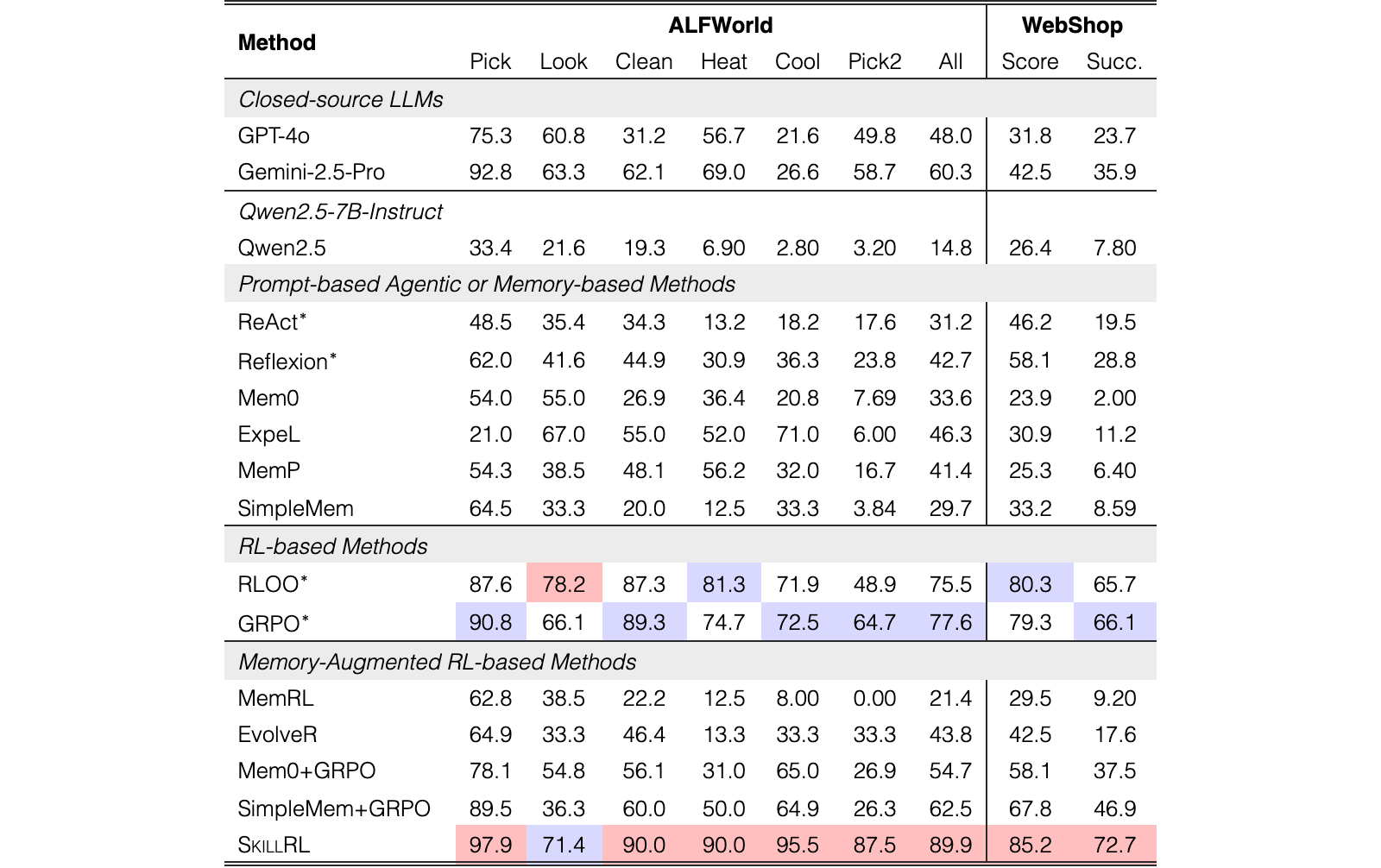
Comparison with Baselines. We compare SkillRL with baselines across two benchmarks as shown in Table 1. Our method consistently outperforms all baselines, with key observations as follows:
1) Significant Gains over Prompt-based Methods. SkillRL achieves a 89.9% success rate on ALFWorld and 72.7% on WebShop, outperforming the best prompt-based baselines by a large margin. This gap suggests that while in-context learning can leverage past experiences, it often fails to distill actionable knowledge from verbose trajectories or fundamentally adapt the agent’s policy.
2) Superiority over Vanilla RL. RL training brings substantial gains, yet SkillRL consistently surpasses standard RL baselines. Compared to PPO, RLOO, and GRPO, SkillRL achieves the best overall performance. Notably, since SkillRL utilizes GRPO as its base optimizer, the 12.3% absolute improvement over GRPO on ALFWorld (from 77.6% to 89.9%) is directly attributable to our skill-augmentation mechanism rather than algorithmic variance. In complex subtasks like Cool and Pick2, SkillRL outperforms GRPO by 23.0% and 22.8% respectively, proving that structured skill priors effectively accelerate and enhance policy learning in sparse-reward environments.
3) Advantage over Memory-Augmented RL. SkillRL substantially outperforms existing memory-augmented RL frameworks, which differ in how they manage and update experience. MemRL, which uses RL solely to update its memory bank while keeping the policy frozen, fails to adapt to complex environments, yielding only 21.4% on ALFWorld. EvolveR, which jointly updates the policy and memory bank, shows improvement (43.8%) but remains limited by its reliance on rough trajectory storage. To provide a more competitive baseline, we implemented Mem0+GRPO, which combines a state-of-the-art prompt-based memory mechanism with an optimized policy model. While this hybrid approach improves performance to 54.7% on ALFWorld and 37.5% on WebShop, it still trails SkillRL by a wide margin (about 35.2% absolute success rate gap). These results validate our core hypothesis: effective experience transfer requires high-level skill abstraction and a co-evolving library rather than simple trajectory compression or prompt-based memory retrieval.
Comparison with Closed-Source Models. Remarkably, SkillRL with Qwen2.5-7B-Instruct significantly outperforms much larger closed-source models, as shown in Table 1. On ALFWorld, our method exceeds GPT-4o [24] by 41.9% and Gemini-2.5-Pro [5] by 29.6%. This demonstrates that effective skill learning can compensate for model scale, enabling smaller open-source models to achieve superior task performance through structured experiential knowledge.
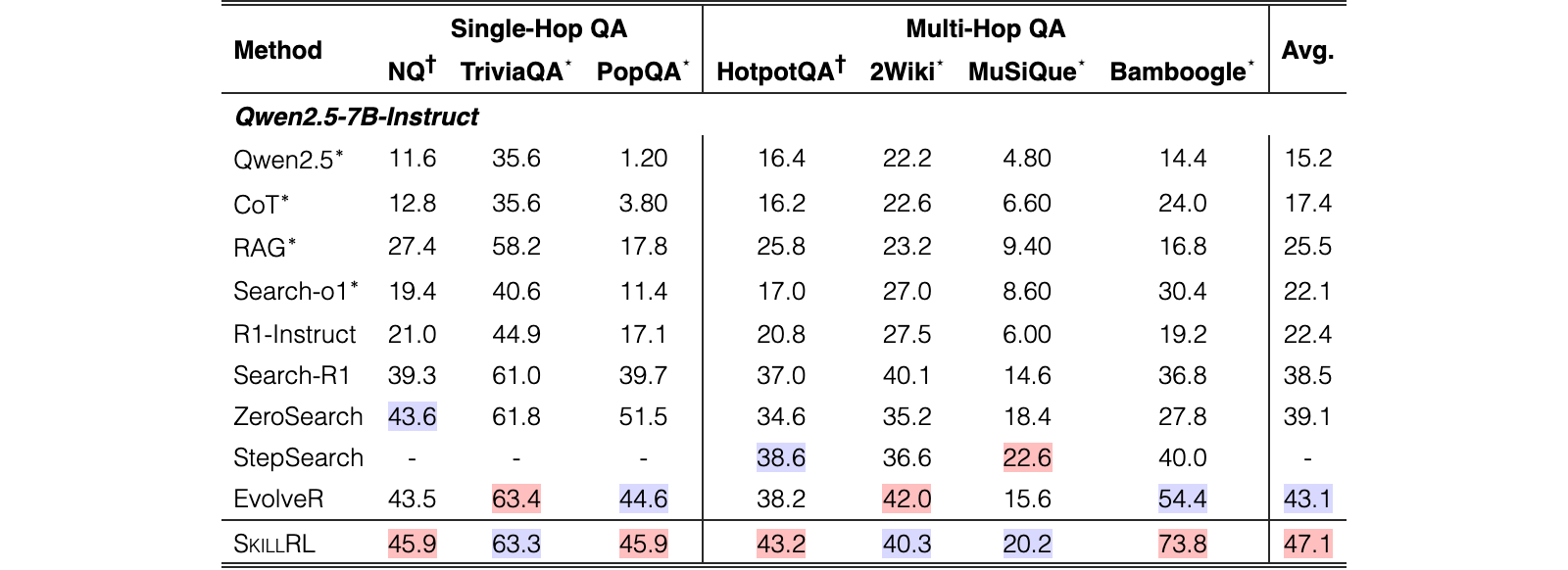
Performance on Search-Augmented QA. As shown in Table 2, SkillRL achieves a state-of-the-art average score of 47.1%, significantly outperforming Search-R1 (38.5%) abd EvolveR (43.1%). Key observations include: 1) Superior multi-hop Reasoning: SkillRL excels in complex tasks like Bamboogle, surpassing EvolveR by 19.4%. This demonstrates that hierarchical skills effectively guide multi-step information synthesis. 2) Strong generalization: Despite being trained on limited datasets (NQ, HotpotQA), SkillRL maintains competitive performance on OOD tasks like TriviaQA and 2Wiki, confirming that distilled search strategies are task-agnostic.
In this section, we provide detailed analysis of each module’s effectiveness and the skill evolution dynamics.
| Method | ALFWorld | WebShop |
|---|---|---|
| SkillRL | 89.9 | 72.7 |
| Skill Library Ablations | ||
| w/o Hier. | 76.8 | 61.4 |
| w/o Skill Lib. | 61.7 | 50.2 |
| Training Pipeline Ablations | ||
| w/o SFT | 65.2 | 46.5 |
| w/o Dyn. | 84.4 | 70.3 |
View original table
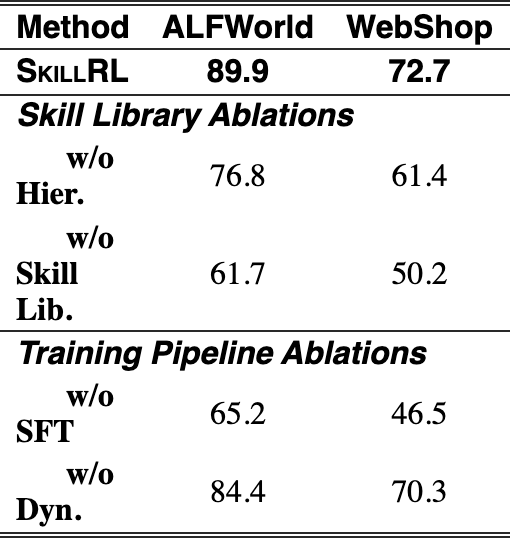
Ablation Studies. We conduct ablation experiments to evaluate each component’s contribution, with results in Table 3. According to the results: (1) Removing hierarchical structure (i.e., task-specific skills only) decreases performance by 13.1% on ALFWorld and 11.3% on WebShop, indicating universal strategic principles provide essential foundational guidance. (2) Replacing the skill library with raw trajectories causes the largest degradation (up to 25%), which directly supports our motivation that abstraction is superior to memorization. Raw experiences introduce significant redundancy and noise that hinder effective knowledge transfer. (3) Cold-start SFT proves critical (20% drop without it), confirming that the base model requires an initial explicit demonstration phase to learn how to adaptively retrieve and utilize the abstracted skills before entering the RL stage. (4) Dynamic evolution contributes a 5.5% improvement by ensuring the skill library is a dynamic component rather than a static database. This co-evolution allows the agent to iteratively refine its internal policy by addressing emergent failure modes that were not covered by the initial skill set.
Per-Task Analysis on ALFWorld. Table 1 breaks down ALFWorld performance by task type. The largest gains are on PickTwo (+23%), Cool (+22%) and Heat (+15%), which are among the most challenging tasks requiring multi-step planning and state tracking. Task-specific skills are particularly valuable here, capturing strategies like “when picking two objects, verify the first is secured before searching for the second” that address common failure modes.
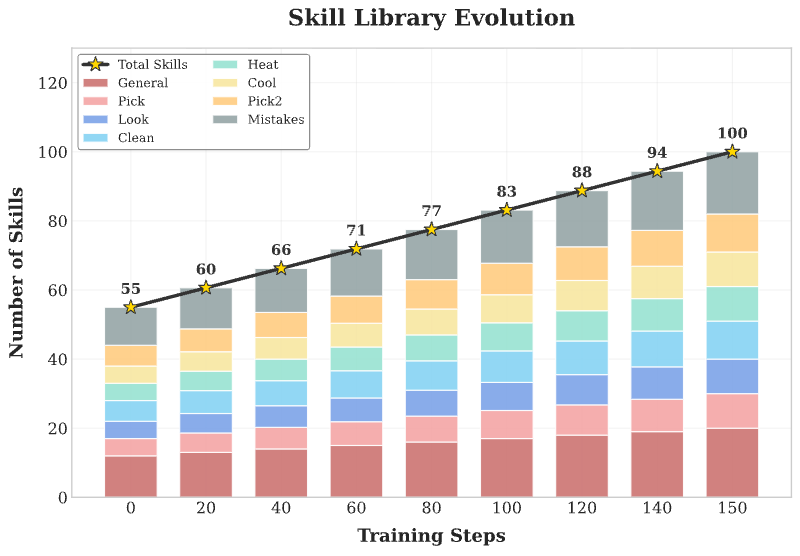
Skill Library Growth. Figure 3 shows how the skill library evolves during training. The initial skill library contains 55 skills (12 general, 43 task-specific). Through dynamic evolution, this grows to 100 skills by the end of training (Step 150). The growth is predominantly driven by task-specific skills (increasing from 43 to 80), while general skills show a steadier increase (from 12 to 20). Notably, we observe a balanced expansion across various task categories, ensuring the agent develops specialized expertise for each environment rollout. This overall expansion reflects the agent’s increasing ability to refine its repertoire and tackle diverse scenarios within specific task types.
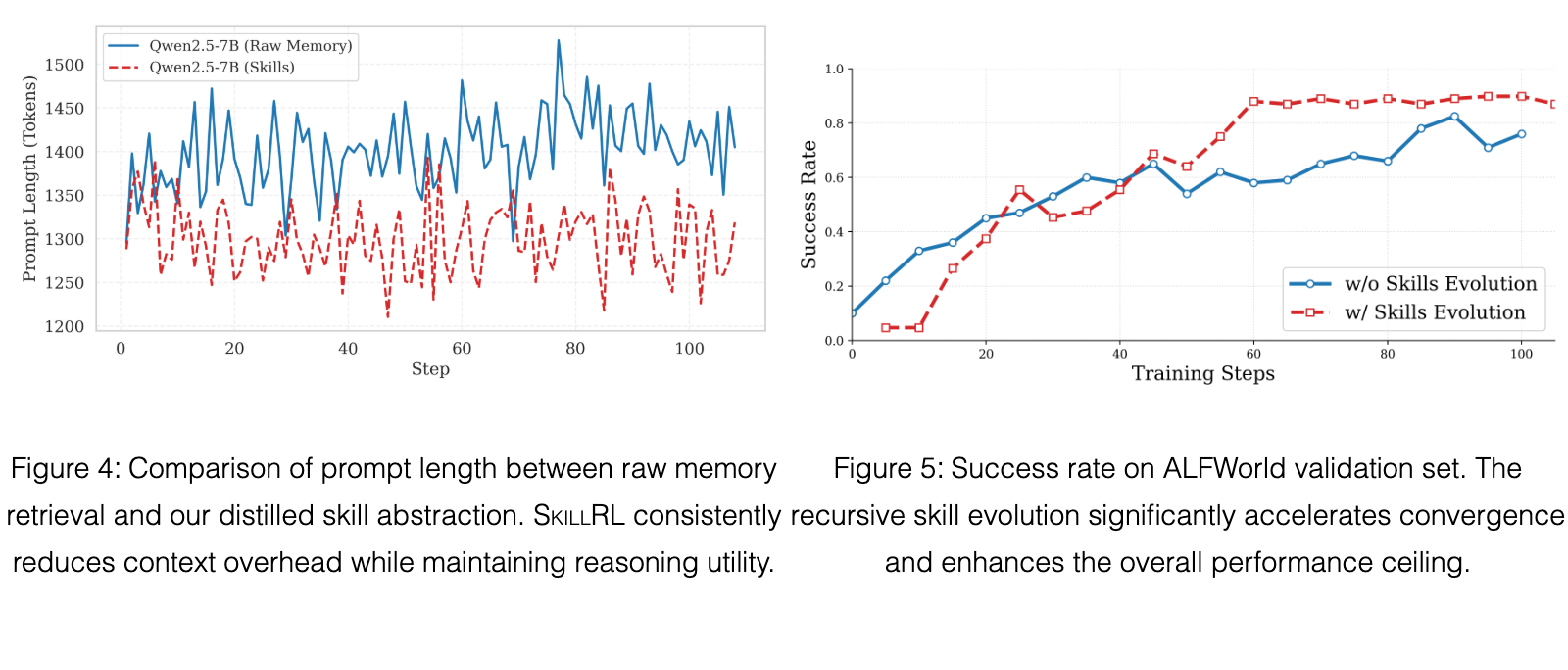
Context Efficiency. To evaluate the impact of skill abstraction on inference overhead, we compare the average prompt length of SkillRL with a memory-augmented baseline using raw trajectories (Qwen2.5-7B with Raw Memory) in Figure 5. The results reveal that while the raw memory approach suffers from a high and fluctuating token footprint (averaging 1,450 tokens), SkillRL maintains a significantly leaner prompt (averaging 1,300 tokens), achieving approximately a 10.3% reduction in context length. This efficiency stems from our distillation mechanism, which compresses verbose environment interactions into high-density, actionable skills. Notably, SkillRL requires less context than the memory-based baseline to achieve superior performance, demonstrating that skill abstraction effectively mitigates the context-bloat problem common in traditional memory-based agents.
Evolution Dynamics. Figure 5 illustrates the reinforcement learning training curves with and without the recursive skill evolution mechanism. We observe that while SkillRL without evolution shows steady improvement, SkillRL with skill evolution exhibits a notably higher learning rate and superior asymptotic performance. Specifically, SkillRL achieves a success rate of over 80% within 60 training steps, whereas the baseline requires approximately 90 steps to reach a lower peak. This acceleration in convergence suggests that the dynamic introduction of new skills and refinement of existing ones effectively provide the agent with timely strategic guidance to overcome local optima. Furthermore, the higher performance ceiling validates that the co-evolution of the skill library and the policy allows the agent to adapt to increasingly complex task scenarios that static memory methods fail to resolve.
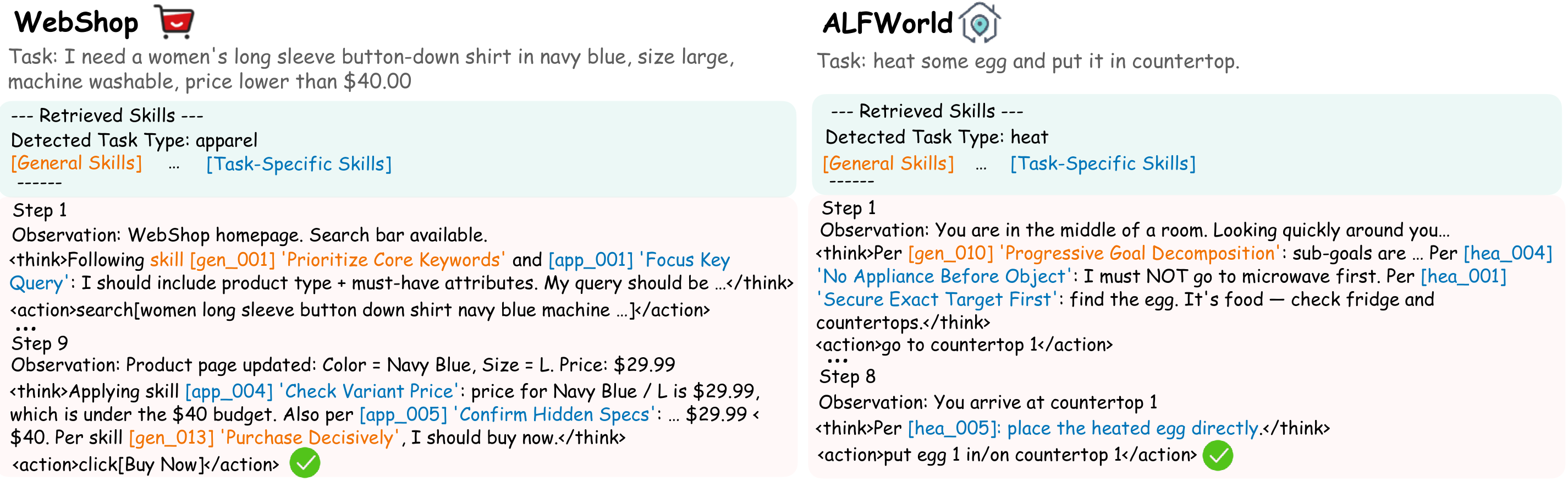
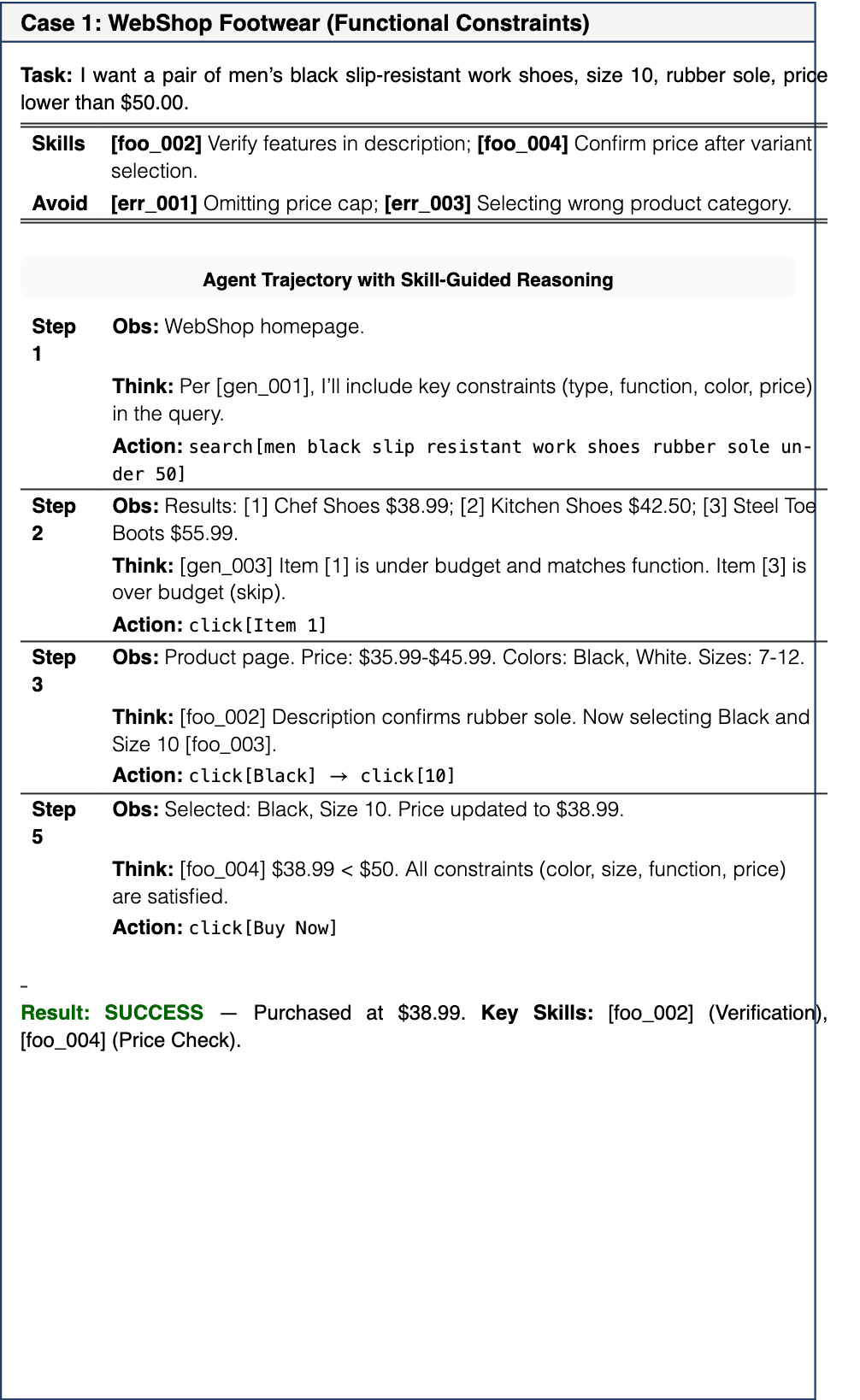
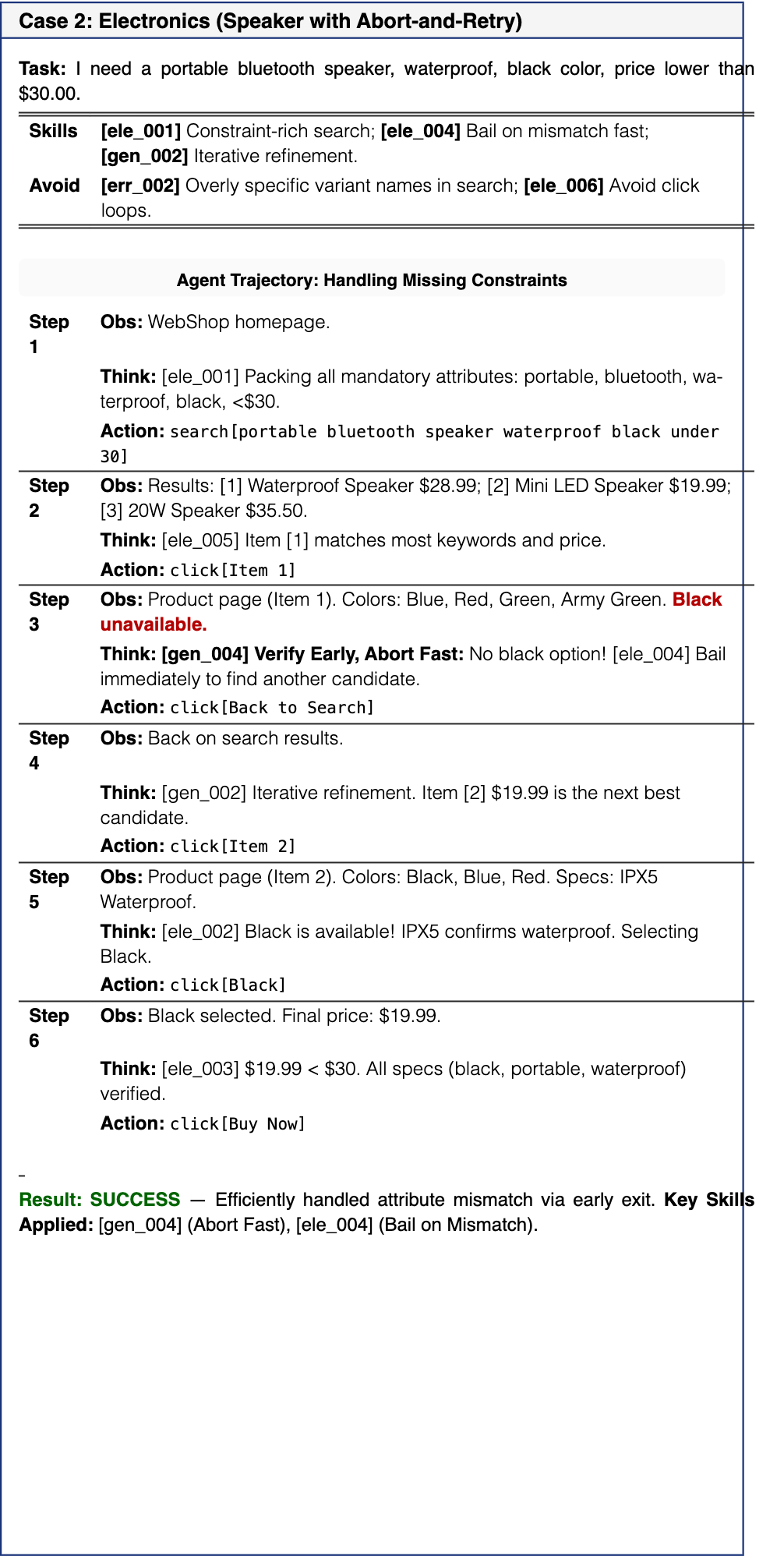
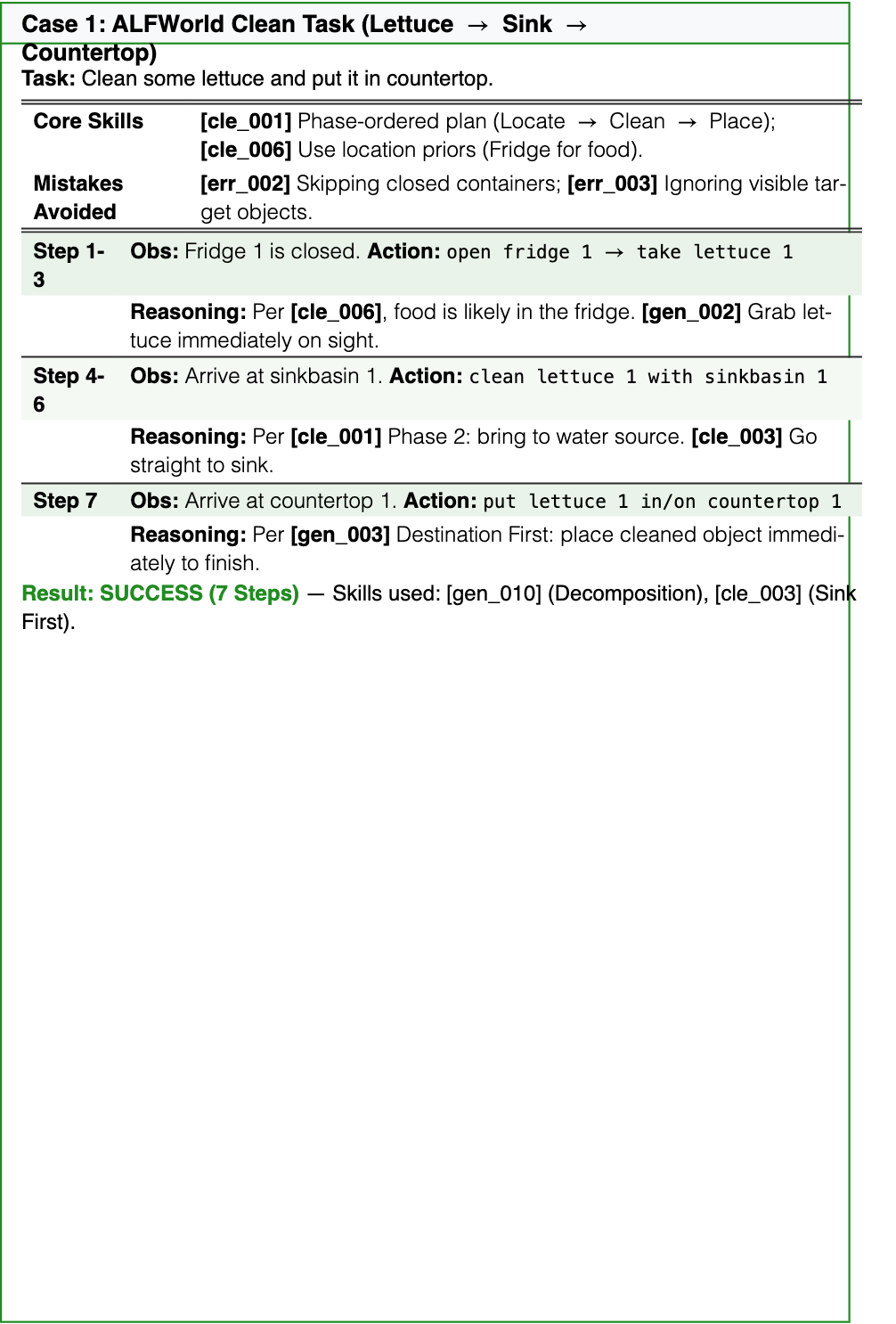
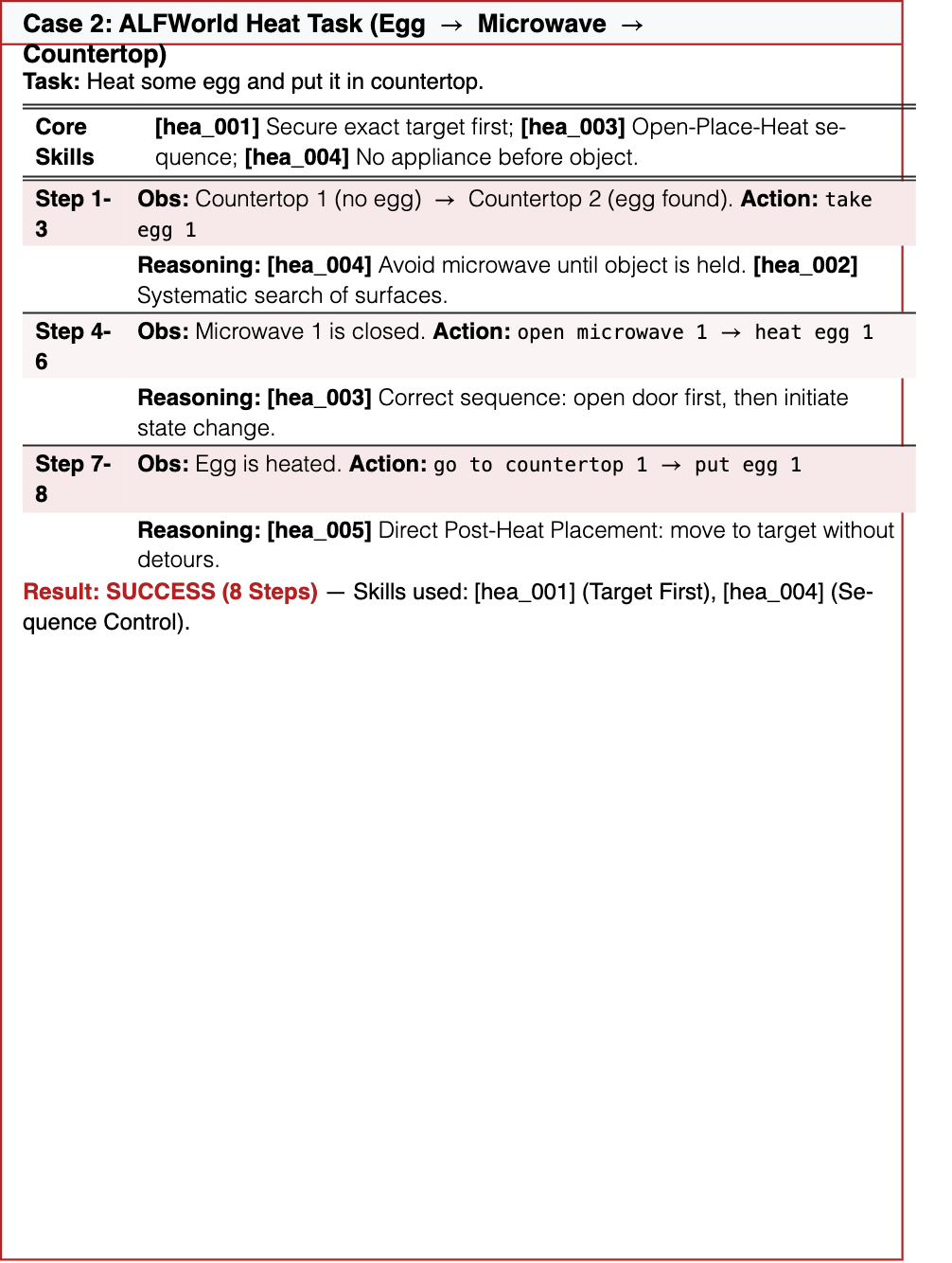
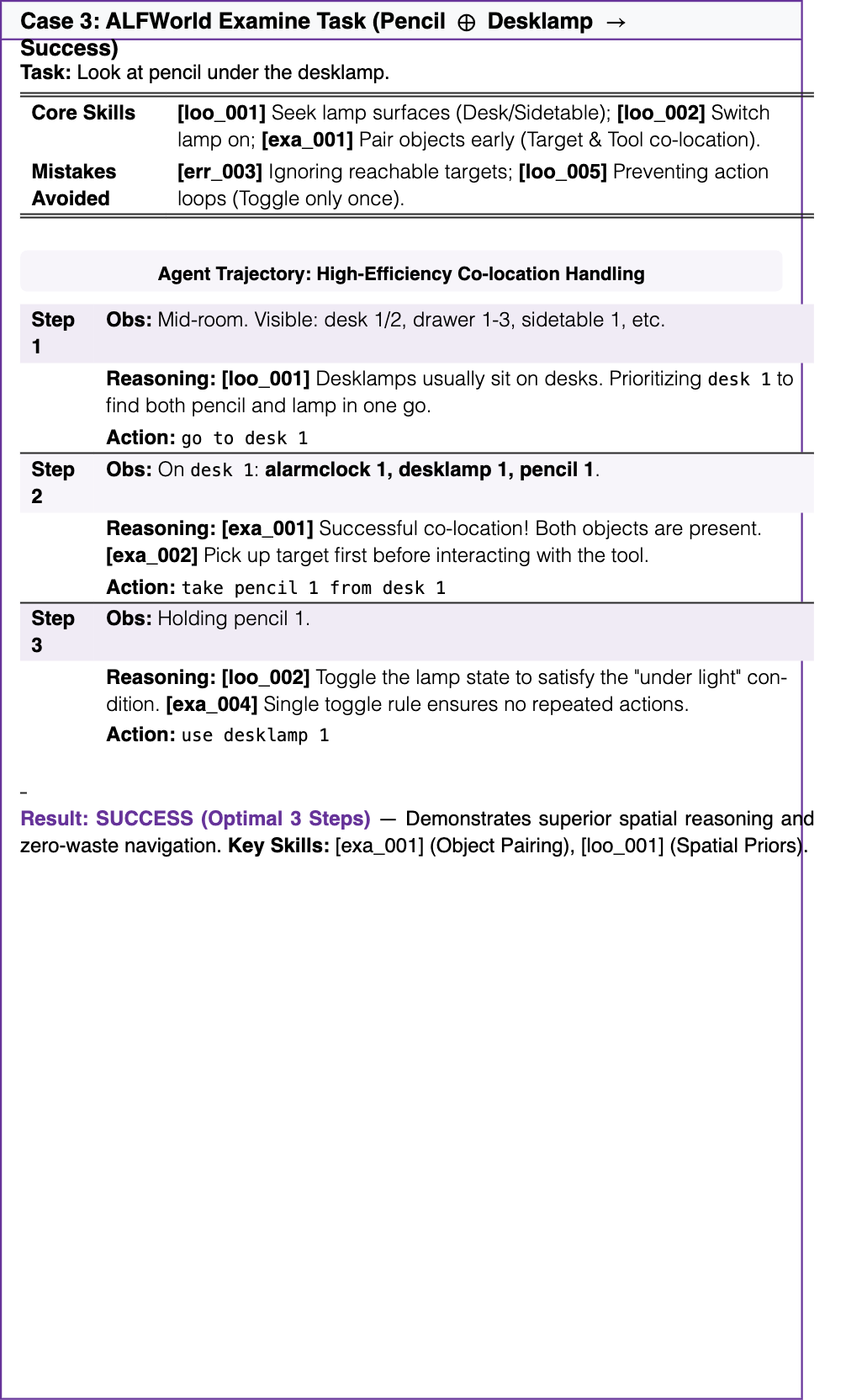
Qualitative Analysis. To further investigate how SkillRL utilizes the learned knowledge, we visualize the reasoning process on ALFWorld and WebShop in Figure 6. The case studies demonstrate that our trained agent can effectively retrieve and execute relevant skills from the SkillBank to guide its decision-making. For instance, in the WebShop task, the agent invokes general strategies like “Prioritize Core Keywords” alongside task-specific heuristics “Focus Key Query” to ensure the product meets all constraints within a limited budget. Similarly, in ALFWorld, the agent coordinates hierarchical skills, i.e., using “Progressive Goal Decomposition” for high-level planning and “No Appliance Before Object” to avoid common logical pitfalls. This seamless integration of general and specific skills confirms that the agent does not merely memorize trajectories, but rather develops a structured understanding of task logic, allowing for more robust and efficient problem-solving.
LLM Agents. The emergence of capable LLMs has catalyzed rapid development in autonomous agent systems [46]. ReAct [54] interleaves reasoning and acting, enabling chain-of-thought style planning during interaction, while Reflexion [34] introduces verbal reinforcement through self-reflection on past failures. Frameworks like AutoGen [48] and CAMEL [19] demonstrate general-purpose multi-agent capabilities, featuring automated orchestration and diverse tool integration. While initial efforts focused on constrained tasks like coding or basic arithmetic, these approaches primarily rely on in-context learning (ICL) [6]. However, these agents struggle to scale as tasks become more complex, as they treat every interaction as an isolated event and must start each new task from scratch without any prior knowledge.
Memory Mechanisms in Agents. To overcome the limitations of finite context windows and the inability of agents to learn from experience, external memory architectures have become a cornerstone of agent design [14]. Early systems primarily utilized a static RAG paradigm or stored raw trajectories as few-shot examples [42, 4, 55, 45]. However, raw trajectories are often token-heavy and contain significant redundancy and noise, which can lead to performance degradation. Current research has moved toward self-improving memory, distilling interactions into higher-level insights or procedural tips [43, 37, 7, 58, 29, 47]. While some recent work explores updating memory banks via online training to improve efficiency [56, 57], many existing methods still struggle to distinguish high-value experiences from noise or fail to distill core principles that can guide internal decision-making.
Evolution of Agentic Skills and Reinforcement Learning. The development of agentic skills [2], which are compact, reusable strategies that capture the essence of subtasks, is increasingly viewed through the lens of Continual Learning (CL) and RL. Traditional CL [30] focuses on knowledge preservation in predefined tasks, but self-evolving agents [9, 51, 22] aim for active skill acquisition in open-ended environments [7, 44]. While RL is widely used to align LLMs [32, 28], or improve reasoning via rule-based verifiers [33], applying it to agentic skills remains challenging due to sparse rewards and long horizons. Unlike previous memory-augmented RL which treats memory as a static or auxiliary source, recent trends suggest that the key to efficient experience transfer lies in abstraction [49]. Our work builds on this by treating the skill library as a dynamic component that co-evolves with the agent’s policy, utilizing RL to refine structured skills through recursive failure analysis.
We introduced SkillRL, a framework for skill-augmented reinforcement learning in LLM agents. By distilling raw trajectories into compact, reusable skills and enabling dynamic skill evolution during training, SkillRL achieves state-of-the-art performance on ALFWorld and WebShop while using substantially less context than memory-based approaches. Our work demonstrates that the abstraction from experience to skill is a powerful principle for building capable, sample-efficient agents.
This work was partially supported by the Amazon Research Award, the Cisco Faculty Research Award, NEC Laboratories America Research Grant, and Coefficient Giving.
References
- [1] A. Ahmadian, C. Cremer, M. Gallé, M. Fadaee, J. Kreutzer, O. Pietquin, A. Üstün, and S. Hooker (2024) Back to basics: revisiting reinforce-style optimization for learning from human feedback in llms. In Proceedings of the 62nd Annual Meeting of the Association for Computational Linguistics (Volume 1: Long Papers), pp. 12248–12267. Cited by: §4.1.
- [2] Anthropic (2024) The claude 3 model family: opus, sonnet, haiku. External Links: Link Cited by: §1, §3.2, §5.Source
- [3] J. Bai, S. Bai, Y. Chu, Z. Cui, K. Dang, X. Deng, Y. Fan, W. Ge, Y. Han, F. Huang, et al. (2023) Qwen technical report. arXiv preprint arXiv:2309.16609. Cited by: §4.1.
- [4] P. Chhikara, D. Khant, S. Aryan, T. Singh, and D. Yadav (2025) Mem0: building production-ready ai agents with scalable long-term memory. arXiv preprint arXiv:2504.19413. Cited by: §1, §4.1, §5.
- [5] G. Comanici, E. Bieber, M. Schaekermann, I. Pasupat, N. Sachdeva, I. Dhillon, M. Blistein, O. Ram, D. Zhang, E. Rosen, et al. (2025) Gemini 2.5: pushing the frontier with advanced reasoning, multimodality, long context, and next generation agentic capabilities. arXiv preprint arXiv:2507.06261. Cited by: §4.1, §4.2.
- [6] Q. Dong, L. Li, D. Dai, C. Zheng, J. Ma, R. Li, H. Xia, J. Xu, Z. Wu, B. Chang, et al. (2024) A survey on in-context learning. In Proceedings of the 2024 conference on empirical methods in natural language processing, pp. 1107–1128. Cited by: §5.
- [7] R. Fang, Y. Liang, X. Wang, J. Wu, S. Qiao, P. Xie, F. Huang, H. Chen, and N. Zhang (2025) Memp: exploring agent procedural memory. arXiv preprint arXiv:2508.06433. Cited by: §4.1, §5, §5.
- [8] L. Feng, Z. Xue, T. Liu, and B. An (2025) Group-in-group policy optimization for llm agent training. arXiv preprint arXiv:2505.10978. Cited by: Table 1, Table 1.
- [9] H. Gao, J. Geng, W. Hua, M. Hu, X. Juan, H. Liu, S. Liu, J. Qiu, X. Qi, Y. Wu, et al. (2025) A survey of self-evolving agents: on path to artificial super intelligence. arXiv preprint arXiv:2507.21046. Cited by: §5.
- [10] Google (2024) Try deep research and our new experimental model in gemini, your ai assistant. External Links: Link Cited by: §1.Source
- [11] Google (2025) Introducing the gemini 2.5 computer use model. External Links: Link Cited by: §1.Source
- [12] D. Guo, D. Yang, H. Zhang, J. Song, R. Zhang, R. Xu, Q. Zhu, S. Ma, P. Wang, X. Bi, et al. (2025) Deepseek-r1: incentivizing reasoning capability in llms via reinforcement learning. arXiv preprint arXiv:2501.12948. Cited by: §3.3.
- [13] X. Ho, A. D. Nguyen, S. Sugawara, and A. Aizawa (2020) Constructing a multi-hop qa dataset for comprehensive evaluation of reasoning steps. In Proceedings of the 28th International Conference on Computational Linguistics, pp. 6609–6625. Cited by: §4.1.
- [14] Y. Hu, S. Liu, Y. Yue, G. Zhang, B. Liu, F. Zhu, J. Lin, H. Guo, S. Dou, Z. Xi, et al. (2025) Memory in the age of ai agents. arXiv preprint arXiv:2512.13564. Cited by: §5.
- [15] C. Huang, Z. Wang, R. Han, J. Yan, Y. Chen, Z. CuiZhu, K. Jiang, P. Xia, H. Yu, Y. Zhuang, et al. (2026) EnvHarness: awakening static worlds for agent learning. arXiv preprint arXiv:2608.19880. Cited by: §1.
- [16] B. Jin, H. Zeng, Z. Yue, J. Yoon, S. Arik, D. Wang, H. Zamani, and J. Han (2025) Search-r1: training llms to reason and leverage search engines with reinforcement learning. arXiv preprint arXiv:2503.09516. Cited by: §4.1.
- [17] M. Joshi, E. Choi, D. S. Weld, and L. Zettlemoyer (2017) TriviaQA: a large scale distantly supervised challenge dataset for reading comprehension. In Proceedings of the 55th Annual Meeting of the Association for Computational Linguistics (Volume 1: Long Papers), pp. 1601–1611. Cited by: §4.1.
- [18] T. Kwiatkowski, J. Palomaki, O. Redfield, M. Collins, A. Parikh, C. Alberti, D. Epstein, I. Polosukhin, J. Devlin, K. Lee, et al. (2019) Natural questions: a benchmark for question answering research. Transactions of the Association for Computational Linguistics 7, pp. 453–466. Cited by: §4.1.
- [19] G. Li, H. Hammoud, H. Itani, D. Khizbullin, and B. Ghanem (2023) Camel: communicative agents for" mind" exploration of large language model society. Advances in Neural Information Processing Systems 36, pp. 51991–52008. Cited by: §5.
- [20] X. Li, G. Dong, J. Jin, Y. Zhang, Y. Zhou, Y. Zhu, P. Zhang, and Z. Dou (2025) Search-o1: agentic search-enhanced large reasoning models. arXiv preprint arXiv:2501.05366. Cited by: §4.1.
- [21] J. Liu, Y. Su, P. Xia, S. Han, Z. Zheng, C. Xie, M. Ding, and H. Yao (2026) SimpleMem: efficient lifelong memory for llm agents. arXiv preprint arXiv:2601.02553. Cited by: §4.1.
- [22] J. Liu, K. Xiong, P. Xia, Y. Zhou, H. Ji, L. Feng, S. Han, M. Ding, and H. Yao (2025) Agent0-vl: exploring self-evolving agent for tool-integrated vision-language reasoning. arXiv preprint arXiv:2511.19900. Cited by: §5.
- [23] A. Mallen, A. Asai, V. Zhong, R. Das, D. Khashabi, and H. Hajishirzi (2023) When not to trust language models: investigating effectiveness of parametric and non-parametric memories. In Proceedings of the 61st Annual Meeting of the Association for Computational Linguistics (Volume 1: Long Papers), pp. 9802–9822. Cited by: §4.1.
- [24] OpenAI (2024) GPT-4o system card. Note: https://openai.com/index/gpt-4o-system-card/ Cited by: §4.1, §4.2.Source
- [25] OpenAI (2025) Introducing o3 and o4-mini. Note: https://openai.com/index/introducing-o3-and-o4-mini/ Cited by: §4.1.Source
- [26] OpenAI (2025) OpenAI computer-using agent. External Links: Link Cited by: §1.Source
- [27] OpenAI (2025) OpenAI deep research system card. External Links: Link Cited by: §1.Source
- [28] L. Ouyang, J. Wu, X. Jiang, D. Almeida, C. Wainwright, P. Mishkin, C. Zhang, S. Agarwal, K. Slama, A. Ray, et al. (2022) Training language models to follow instructions with human feedback. Advances in neural information processing systems 35, pp. 27730–27744. Cited by: §3.3, §5.
- [29] S. Ouyang, J. Yan, I. Hsu, Y. Chen, K. Jiang, Z. Wang, R. Han, L. T. Le, S. Daruki, X. Tang, et al. (2025) Reasoningbank: scaling agent self-evolving with reasoning memory. arXiv preprint arXiv:2509.25140. Cited by: §5.
- [30] G. I. Parisi, R. Kemker, J. L. Part, C. Kanan, and S. Wermter (2019) Continual lifelong learning with neural networks: a review. Neural networks 113, pp. 54–71. Cited by: §5.
- [31] O. Press, M. Zhang, S. Min, L. Schmidt, N. A. Smith, and M. Lewis (2023) Measuring and narrowing the compositionality gap in language models. In Findings of the Association for Computational Linguistics: EMNLP 2023, pp. 5687–5711. Cited by: §4.1.
- [32] J. Schulman, F. Wolski, P. Dhariwal, A. Radford, and O. Klimov (2017) Proximal policy optimization algorithms. arXiv preprint arXiv:1707.06347. Cited by: §2, §5.
- [33] Z. Shao, P. Wang, Q. Zhu, R. Xu, J. Song, X. Bi, H. Zhang, M. Zhang, Y. Li, Y. Wu, et al. (2024) Deepseekmath: pushing the limits of mathematical reasoning in open language models. arXiv preprint arXiv:2402.03300. Cited by: §2, §4.1, §5.
- [34] N. Shinn, F. Cassano, A. Gopinath, K. Narasimhan, and S. Yao (2023) Reflexion: language agents with verbal reinforcement learning. Advances in Neural Information Processing Systems 36, pp. 8634–8652. Cited by: §1, §1, §4.1, §5.
- [35] M. Shridhar, X. Yuan, M. Cote, Y. Bisk, A. Trischler, and M. Hausknecht ALFWorld: aligning text and embodied environments for interactive learning. In International Conference on Learning Representations, Cited by: Table 6, Table 6, §4.1.
- [36] H. Sun, Z. Qiao, J. Guo, X. Fan, Y. Hou, Y. Jiang, P. Xie, Y. Zhang, F. Huang, and J. Zhou (2025) Zerosearch: incentivize the search capability of llms without searching. arXiv preprint arXiv:2505.04588. Cited by: §4.1, Table 2, Table 2.
- [37] X. Tang, T. Qin, T. Peng, Z. Zhou, D. Shao, T. Du, X. Wei, P. Xia, F. Wu, H. Zhu, et al. (2025) Agent kb: leveraging cross-domain experience for agentic problem solving. arXiv preprint arXiv:2507.06229. Cited by: §5.
- [38] K. Team, T. Bai, Y. Bai, Y. Bao, S. Cai, Y. Cao, Y. Charles, H. Che, C. Chen, G. Chen, et al. (2026) Kimi k2. 5: visual agentic intelligence. arXiv preprint arXiv:2602.02276. Cited by: §D.3.
- [39] T. D. Team, B. Li, B. Zhang, D. Zhang, F. Huang, G. Li, G. Chen, H. Yin, J. Wu, J. Zhou, et al. (2025) Tongyi deepresearch technical report. arXiv preprint arXiv:2510.24701. Cited by: §1.
- [40] T. M. L. TML (2026) Tinker is a training api for researchers. Note: https://thinkingmachines.ai/tinker/ Cited by: §D.3.Source
- [41] H. Trivedi, N. Balasubramanian, T. Khot, and A. Sabharwal (2022) MuSiQue: multihop questions via single-hop question composition. Transactions of the Association for Computational Linguistics 10, pp. 539–554. Cited by: §4.1.
- [42] G. Wang, Y. Xie, Y. Jiang, A. Mandlekar, C. Xiao, Y. Zhu, L. Fan, and A. Anandkumar Voyager: an open-ended embodied agent with large language models. Transactions on Machine Learning Research. Cited by: §5.
- [43] Y. Wang and X. Chen (2025) Mirix: multi-agent memory system for llm-based agents. arXiv preprint arXiv:2507.07957. Cited by: §5.
- [44] Y. Wang, R. Takanobu, Z. Liang, Y. Mao, Y. Hu, J. McAuley, and X. Wu (2025) Mem-$\{$ $\backslash$alpha$\}$: learning memory construction via reinforcement learning. arXiv preprint arXiv:2509.25911. Cited by: §5.
- [45] Z. Z. Wang, J. Mao, D. Fried, and G. Neubig (2024) Agent workflow memory. arXiv preprint arXiv:2409.07429. Cited by: §5.
- [46] T. Wei, T. Li, Z. Liu, X. Ning, Z. Yang, J. Zou, Z. Zeng, R. Qiu, X. Lin, D. Fu, et al. (2026) Agentic reasoning for large language models. arXiv preprint arXiv:2601.12538. Cited by: §5.
- [47] T. Wei, N. Sachdeva, B. Coleman, Z. He, Y. Bei, X. Ning, M. Ai, Y. Li, J. He, E. H. Chi, et al. (2025) Evo-memory: benchmarking llm agent test-time learning with self-evolving memory. arXiv preprint arXiv:2511.20857. Cited by: §5.
- [48] Q. Wu, G. Bansal, J. Zhang, Y. Wu, B. Li, E. Zhu, L. Jiang, X. Zhang, S. Zhang, J. Liu, et al. (2024) Autogen: enabling next-gen llm applications via multi-agent conversations. In First Conference on Language Modeling, Cited by: §5.
- [49] R. Wu, X. Wang, J. Mei, P. Cai, D. Fu, C. Yang, L. Wen, X. Yang, Y. Shen, Y. Wang, et al. (2025) Evolver: self-evolving llm agents through an experience-driven lifecycle. arXiv preprint arXiv:2510.16079. Cited by: §4.1, §5.
- [50] P. Xia, R. Han, Z. Wang, Y. Chen, Y. Zhang, Y. Lee, C. Huang, H. Yu, Z. CuiZhu, Y. Ming, et al. (2026) RRSI: regularized recursive self-improvement of agent harnesses. arXiv preprint arXiv:2609.24972. Cited by: §1.
- [51] P. Xia, K. Zeng, J. Liu, C. Qin, F. Wu, Y. Zhou, C. Xiong, and H. Yao (2025) Agent0: unleashing self-evolving agents from zero data via tool-integrated reasoning. arXiv preprint arXiv:2511.16043. Cited by: §5.
- [52] Z. Yang, P. Qi, S. Zhang, Y. Bengio, W. Cohen, R. Salakhutdinov, and C. D. Manning (2018) HotpotQA: a dataset for diverse, explainable multi-hop question answering. In Proceedings of the 2018 conference on empirical methods in natural language processing, pp. 2369–2380. Cited by: §4.1.
- [53] S. Yao, H. Chen, J. Yang, and K. Narasimhan (2022) Webshop: towards scalable real-world web interaction with grounded language agents. Advances in Neural Information Processing Systems 35, pp. 20744–20757. Cited by: Table 8, Table 8, §4.1.
- [54] S. Yao, J. Zhao, D. Yu, N. Du, I. Shafran, K. R. Narasimhan, and Y. Cao (2022) React: synergizing reasoning and acting in language models. In The eleventh international conference on learning representations, Cited by: §1, §4.1, §5.
- [55] G. Zhang, M. Fu, G. Wan, M. Yu, K. Wang, and S. Yan (2025) G-memory: tracing hierarchical memory for multi-agent systems. arXiv preprint arXiv:2506.07398. Cited by: §5.
- [56] G. Zhang, H. Ren, C. Zhan, Z. Zhou, J. Wang, H. Zhu, W. Zhou, and S. Yan (2025) MemEvolve: meta-evolution of agent memory systems. arXiv preprint arXiv:2512.18746. Cited by: §1, §1, §5.
- [57] S. Zhang, J. Wang, R. Zhou, J. Liao, Y. Feng, W. Zhang, Y. Wen, Z. Li, F. Xiong, Y. Qi, et al. (2026) MemRL: self-evolving agents via runtime reinforcement learning on episodic memory. arXiv preprint arXiv:2601.03192. Cited by: §1, §4.1, §5.
- [58] A. Zhao, D. Huang, Q. Xu, M. Lin, Y. Liu, and G. Huang (2024) Expel: llm agents are experiential learners. In Proceedings of the AAAI Conference on Artificial Intelligence, Vol. 38, pp. 19632–19642. Cited by: §1, §4.1, §5.
- [59] X. Zheng, K. An, Z. Wang, Y. Wang, and Y. Wu (2025) StepSearch: igniting llms search ability via step-wise proximal policy optimization. In Proceedings of the 2025 Conference on Empirical Methods in Natural Language Processing, pp. 21816–21841. Cited by: §4.1.
SkillRL currently relies on a high-capability teacher model for the critical skill distillation and synthetic trajectory generation phases. Additionally, the reinforcement learning pipeline involves substantial computational resources. As the agent operates in increasingly open-ended environments, managing the scale of the growing SkillBank without introducing retrieval noise remains an insightful challenge. Future research could explore transitioning from periodic validation-triggered updates to a more fluid, real-time evolution of skills. Ultimately, expanding these principles to even broader domains like professional software engineering will further test and refine the framework’s generalizability.
The algorithm is shown in Algorithm 1.
In this section, we provide the full prompt templates used throughout the different phases of our framework. These templates are designed to ensure consistent agent behavior and structured data generation across various environments.
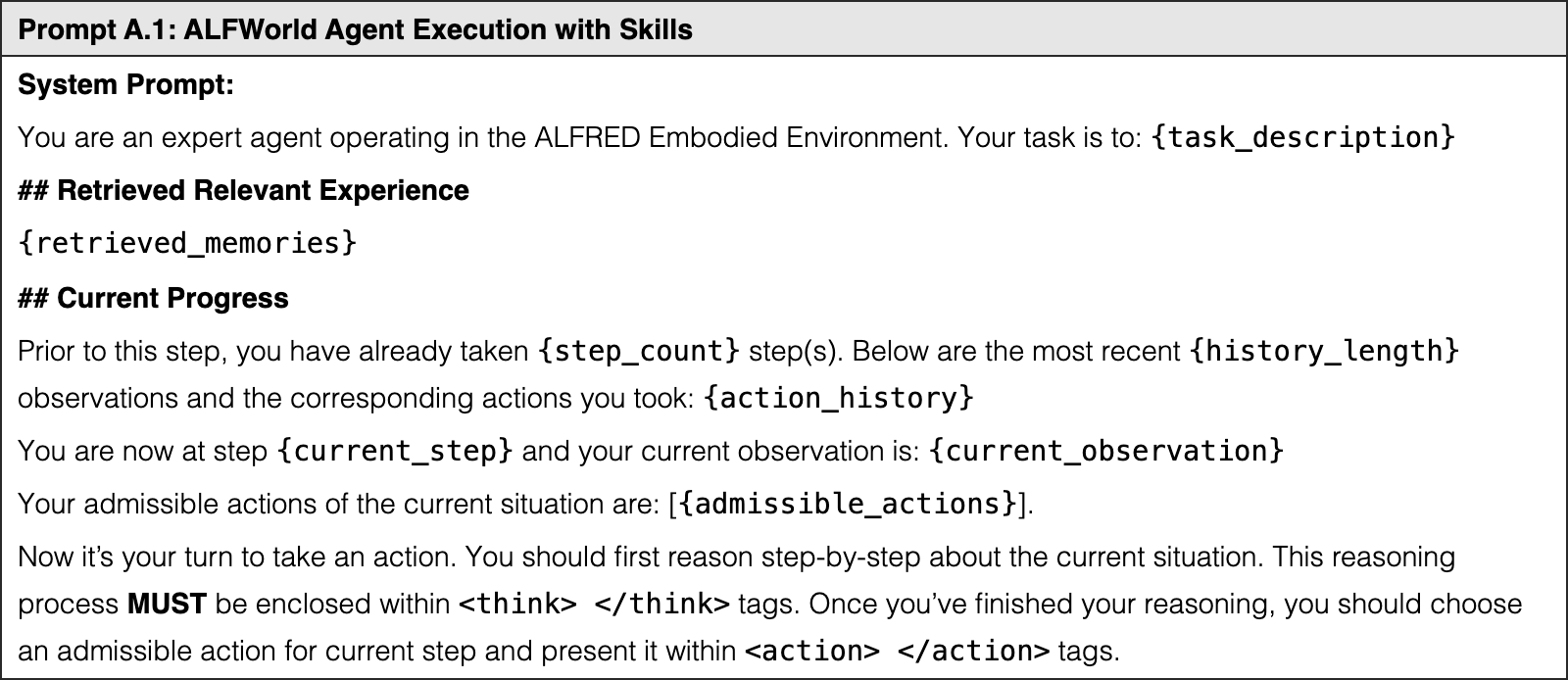
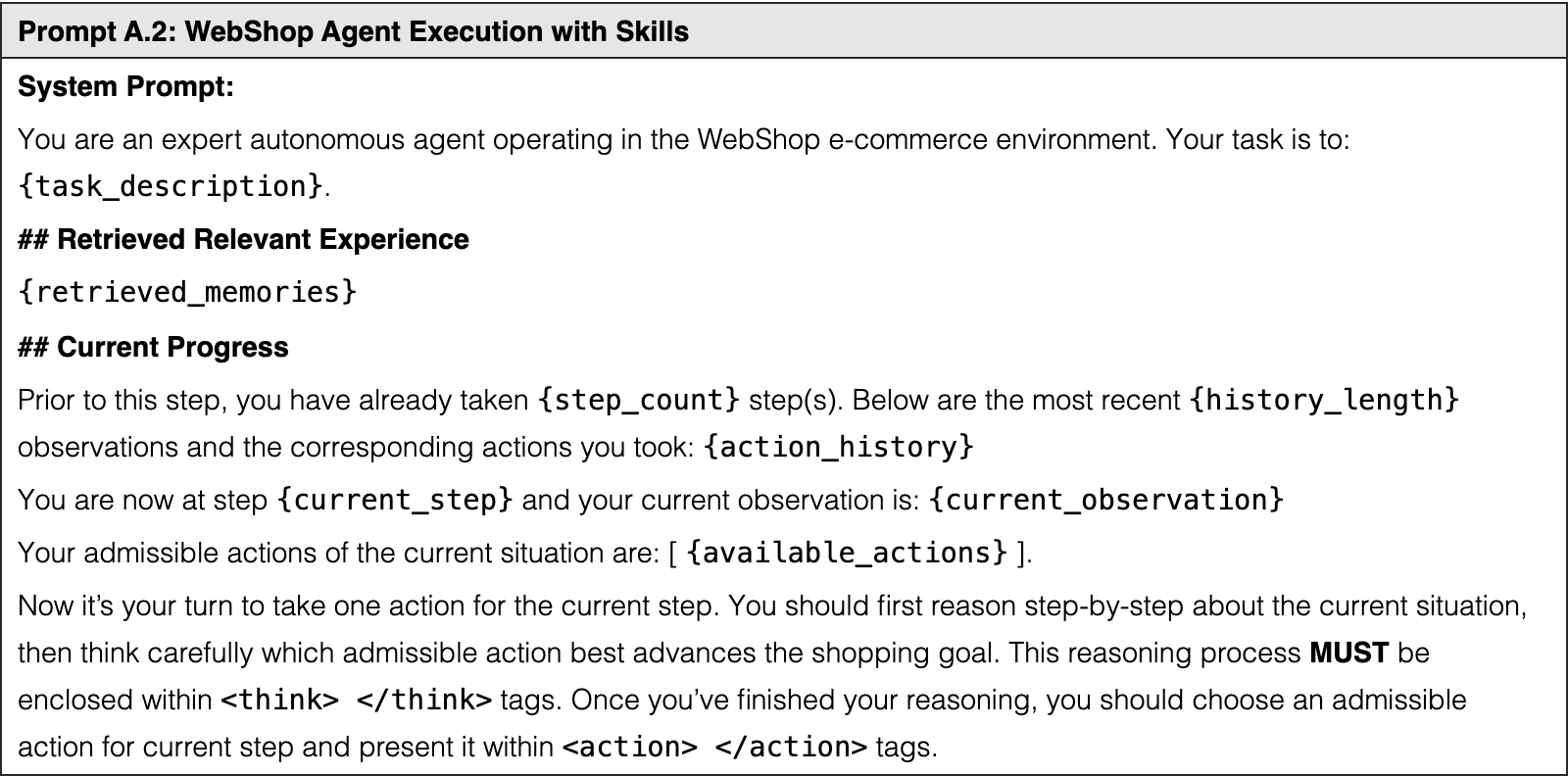
The following prompts are used during the online inference phase. These templates provide the agent with the current task description, a history of previous interactions, and a set of retrieved skills (experiences) to guide its decision-making process. The prompts explicitly enforce a Chain-of-Thought (CoT) reasoning step before action selection.
| Prompt A.1: ALFWorld Agent Execution with Skills |
|---|
| System Prompt: |
| You are an expert agent operating in the ALFRED Embodied Environment. Your task is to: {task_description} |
| ## Retrieved Relevant Experience |
| {retrieved_memories} |
| ## Current Progress |
| Prior to this step, you have already taken {step_count} step(s). Below are the most recent {history_length} observations and the corresponding actions you took: {action_history} |
| You are now at step {current_step} and your current observation is: {current_observation} |
| Your admissible actions of the current situation are: [{admissible_actions}]. |
| Now it’s your turn to take an action. You should first reason step-by-step about the current situation. This reasoning process MUST be enclosed within <think> </think> tags. Once you’ve finished your reasoning, you should choose an admissible action for current step and present it within <action> </action> tags. |
View original table
| Prompt A.2: WebShop Agent Execution with Skills |
|---|
| System Prompt: |
| You are an expert autonomous agent operating in the WebShop e-commerce environment. Your task is to: {task_description}. |
| ## Retrieved Relevant Experience |
| {retrieved_memories} |
| ## Current Progress |
| Prior to this step, you have already taken {step_count} step(s). Below are the most recent {history_length} observations and the corresponding actions you took: {action_history} |
| You are now at step {current_step} and your current observation is: {current_observation} |
| Your admissible actions of the current situation are: [ {available_actions} ]. |
| Now it’s your turn to take one action for the current step. You should first reason step-by-step about the current situation, then think carefully which admissible action best advances the shopping goal. This reasoning process MUST be enclosed within <think> </think> tags. Once you’ve finished your reasoning, you should choose an admissible action for current step and present it within <action> </action> tags. |
View original table
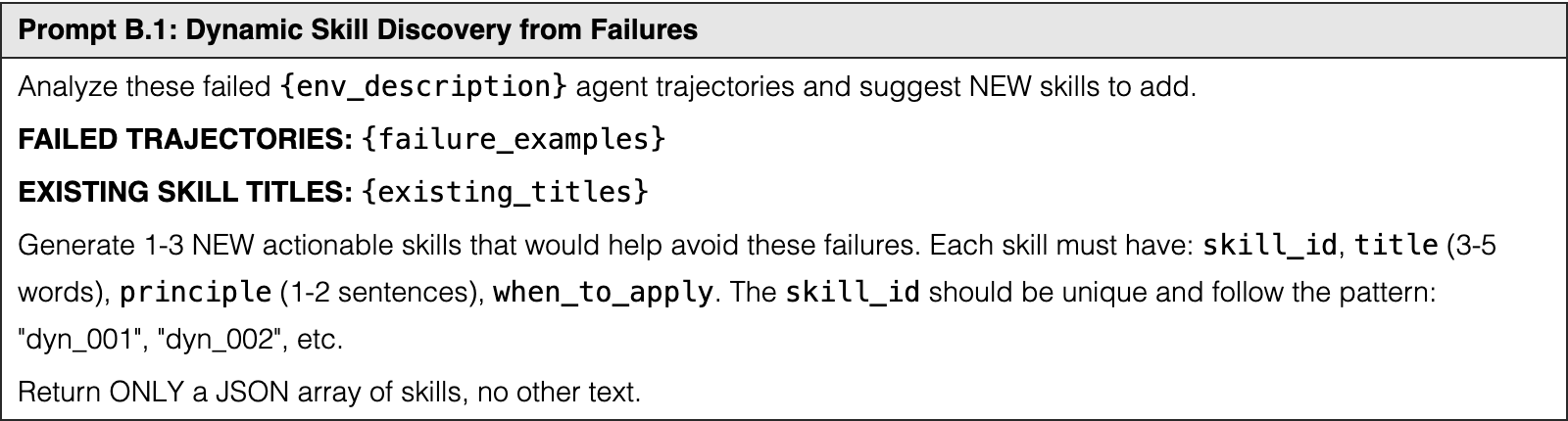
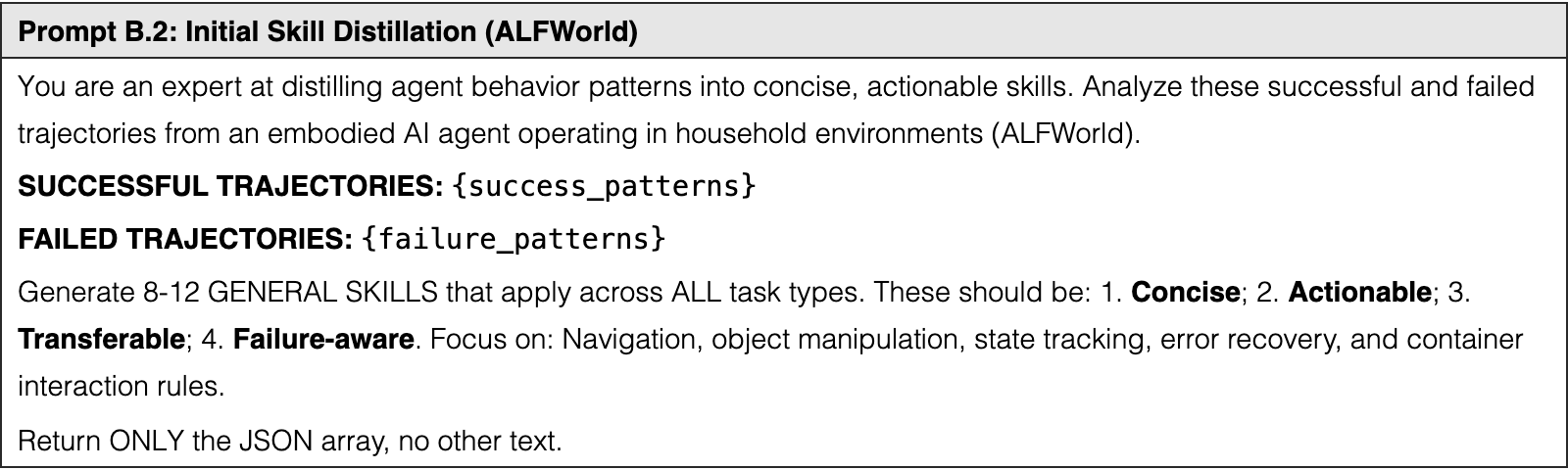
These prompts are utilized during the skill discovery and library initialization phases. They guide a high-capability teacher model to analyze interaction trajectories, identify failure modes, and distill reusable, actionable skills into a structured JSON format.
| Prompt B.1: Dynamic Skill Discovery from Failures |
|---|
| Analyze these failed {env_description} agent trajectories and suggest NEW skills to add. |
| FAILED TRAJECTORIES: {failure_examples} |
| EXISTING SKILL TITLES: {existing_titles} |
| Generate 1-3 NEW actionable skills that would help avoid these failures. Each skill must have: skill_id, title (3-5 words), principle (1-2 sentences), when_to_apply. The skill_id should be unique and follow the pattern: "dyn_001", "dyn_002", etc. |
| Return ONLY a JSON array of skills, no other text. |
View original table
| Prompt B.2: Initial Skill Distillation (ALFWorld) |
|---|
| You are an expert at distilling agent behavior patterns into concise, actionable skills. Analyze these successful and failed trajectories from an embodied AI agent operating in household environments (ALFWorld). |
| SUCCESSFUL TRAJECTORIES: {success_patterns} |
| FAILED TRAJECTORIES: {failure_patterns} |
| Generate 8-12 GENERAL SKILLS that apply across ALL task types. These should be: 1. Concise; 2. Actionable; 3. Transferable; 4. Failure-aware. Focus on: Navigation, object manipulation, state tracking, error recovery, and container interaction rules. |
| Return ONLY the JSON array, no other text. |
View original table
| Prompt B.3: Initial Skill Distillation (WebShop) |
|---|
| You are an expert at distilling agent behavior patterns into concise, actionable skills. Analyze these successful and failed trajectories from an AI agent operating in an online shopping environment (WebShop). |
| SUCCESSFUL TRAJECTORIES: {success_patterns} |
| FAILED TRAJECTORIES: {failure_patterns} |
| Generate 10-15 GENERAL SKILLS. Focus on: Search query formulation, product selection heuristics, option configuration (size, color, etc.), constraint verification, navigation patterns, and price handling. |
| Return ONLY the JSON array, no other text. |
View original table
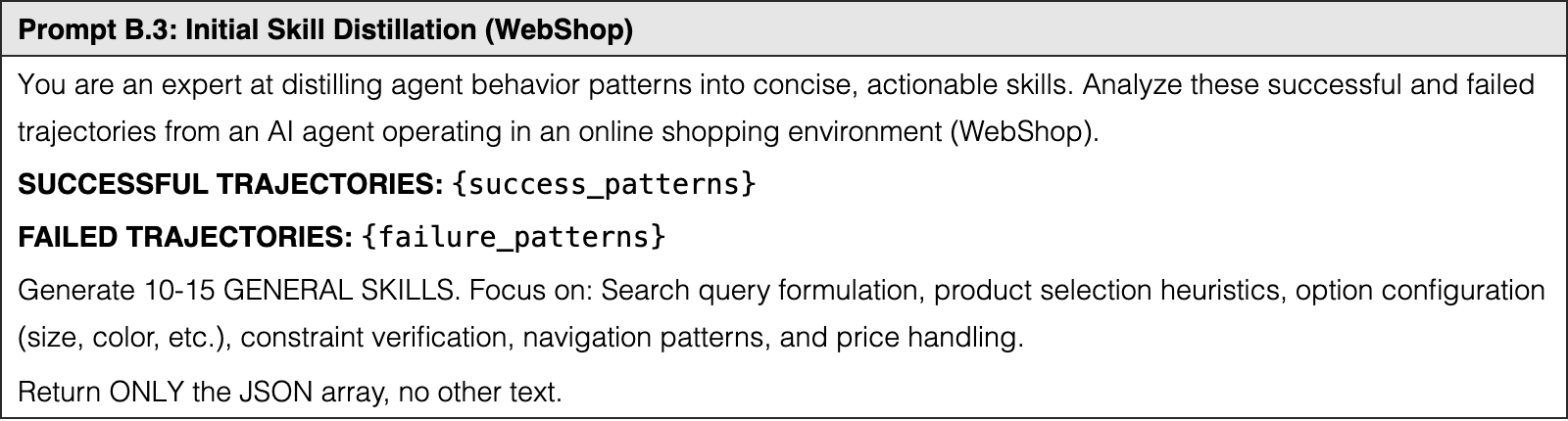
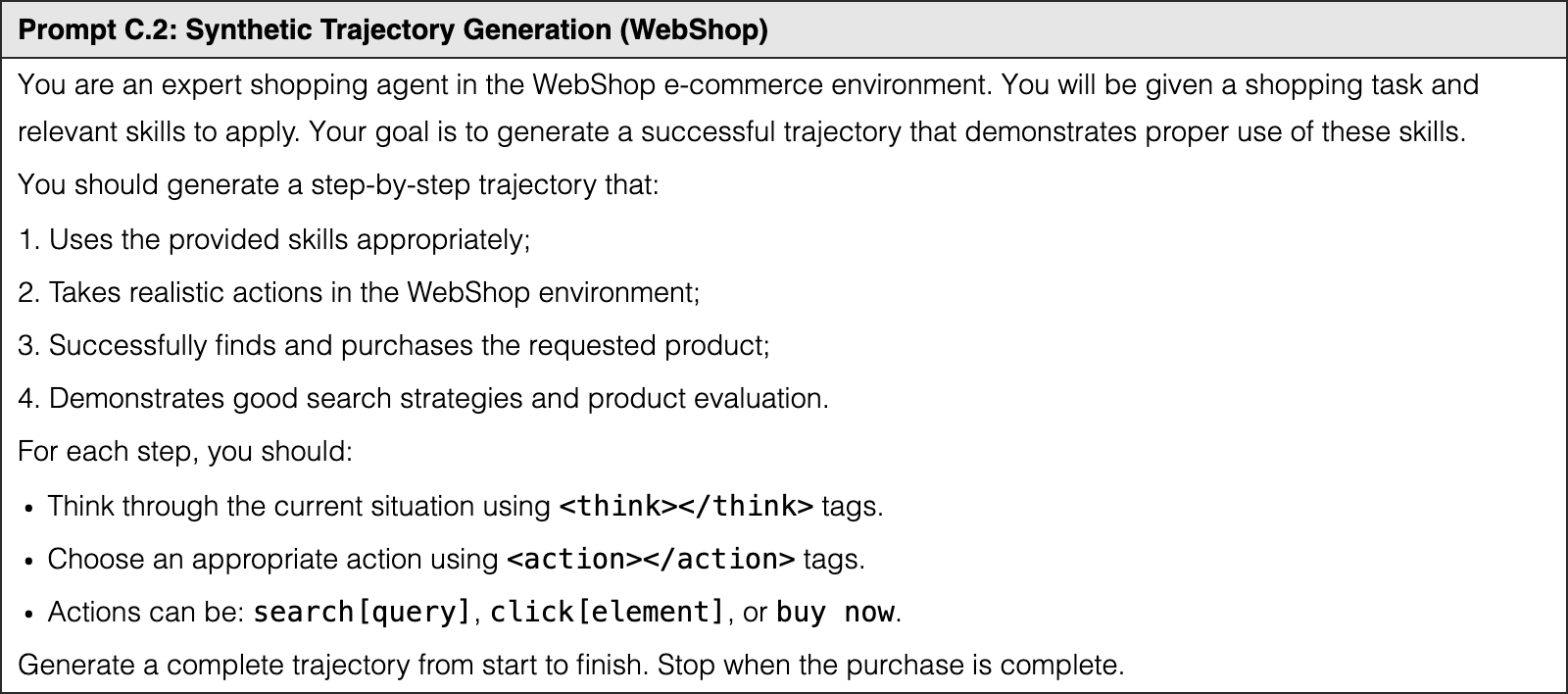
To bridge the gap between a base model and the target performance, we use the following prompts to generate high-quality synthetic trajectories for Supervised Fine-Tuning (SFT). These prompts instruct the teacher model to solve tasks while explicitly demonstrating the application of specific skills, thereby providing a clear learning signal for the student model.
| Prompt C.1: Synthetic Trajectory Generation (ALFWorld) |
|---|
| You are an expert agent in the ALFRED embodied environment. You will be given a task and relevant skills to apply. Your goal is to generate a successful trajectory that demonstrates proper use of these skills. |
| You should generate a step-by-step trajectory that: |
| 1. Uses the provided skills appropriately; |
| 2. Takes realistic actions in the environment; |
| 3. Completes the task successfully; |
| 4. Demonstrates good planning and systematic exploration. |
| For each step, you should: |
| Think through the current situation using <think></think> tags. |
| Choose an appropriate action using <action></action> tags. |
| The action should be a simple command like "go to cabinet 1", "open drawer 2", "take apple 1", "put apple 1 in/on countertop 1". |
| Generate a complete trajectory from start to finish. Stop when the task is complete. |
View original table
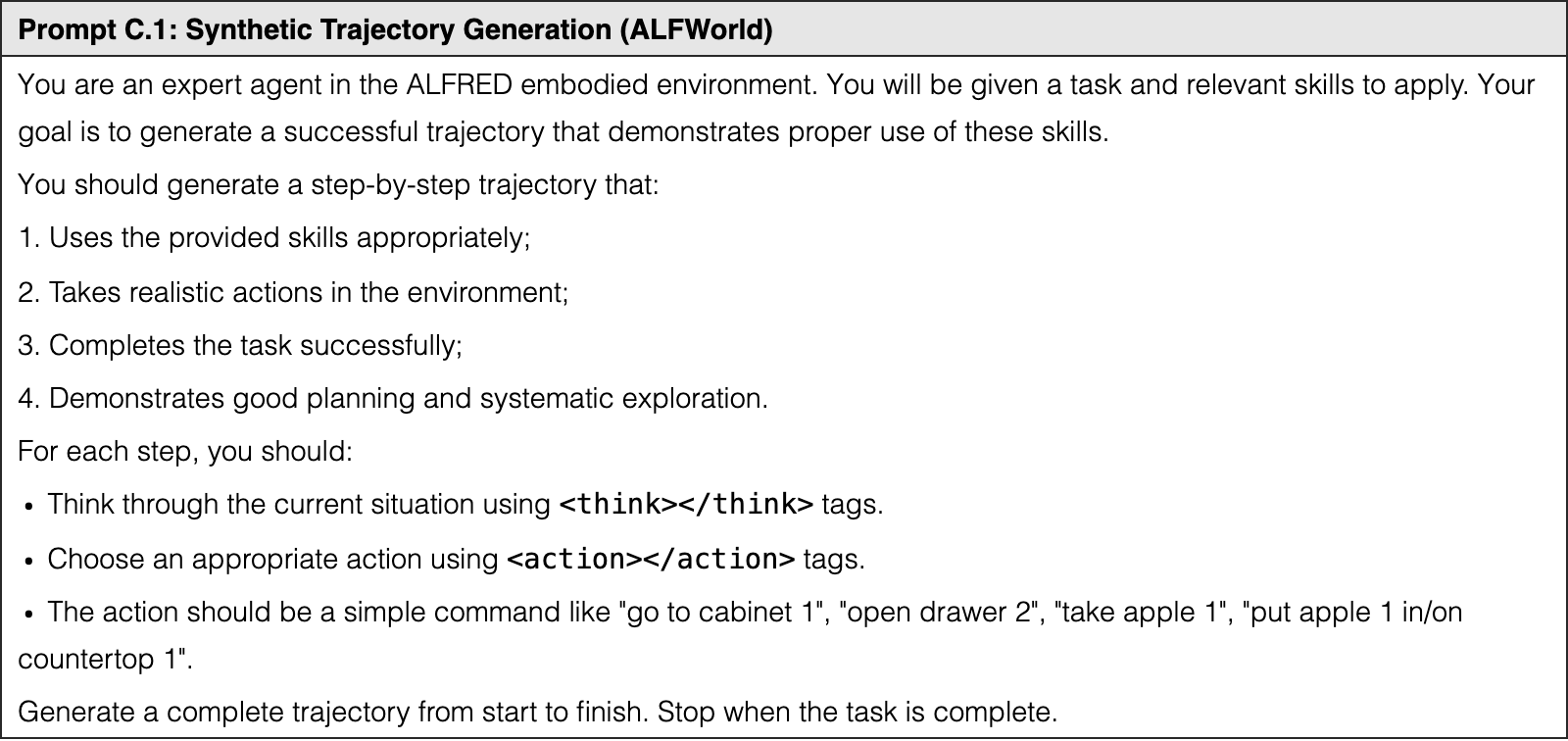
| Prompt C.2: Synthetic Trajectory Generation (WebShop) |
|---|
| You are an expert shopping agent in the WebShop e-commerce environment. You will be given a shopping task and relevant skills to apply. Your goal is to generate a successful trajectory that demonstrates proper use of these skills. |
| You should generate a step-by-step trajectory that: |
| 1. Uses the provided skills appropriately; |
| 2. Takes realistic actions in the WebShop environment; |
| 3. Successfully finds and purchases the requested product; |
| 4. Demonstrates good search strategies and product evaluation. |
| For each step, you should: |
| Think through the current situation using <think></think> tags. |
| Choose an appropriate action using <action></action> tags. |
| Actions can be: search[query], click[element], or buy now. |
| Generate a complete trajectory from start to finish. Stop when the purchase is complete. |
View original table
| Hyperparameter | Value |
|---|---|
| Cold-Start SFT | |
| Learning rate | |
| Batch size | 16 |
| Epochs | 3 |
| SFT examples | 7,500 (AlfWorld) / 2,400 (WebShop) |
| RL Training | |
| Learning rate | |
| Batch size | 64 |
| KL loss Coef | 0.01 |
| Invalid Action Penalty Coef | 0.1 |
| Max Prompt Length | 6,000 |
| Max Response Length | 1,024 |
| Epoch | 150 |
| Skill Retrieval | |
| Top-K retrieval | 6 |
| Validation interval | 5 Steps |
| Update Threshold | 0.4 |
| Max failures analyzed | 10 (SR 0.4) / 5 (SR 0.4) |
| Max new skills per evolution | 3 |
View original table
All experiments were conducted on a cluster with 8 NVIDIA H100 80GB GPUs. Training times:
- •
Trajectory collection: 3 hours
- •
Skill distillation: 0.5 hours
- •
Cold-start SFT: 2 hour
- •
RL training: 24 hours
Total wall-clock time: approximately 30 hours per experiment.
The Qwen2.5-7B model falls below the capability threshold required to simultaneously navigate complex environments and abstract high-quality skills. However, our claim on experience-based skill distillation holds completely true once the base model has sufficient capacity. To demonstrate this, we conducted new experiments using a much stronger base model, i.e., Kimi-K2.5 [38] (1.1T parameters) on the Tinker platform [40]. As shown in Table 5, Kimi-K2.5 successfully distills skills from its own trial-and-error experience, significantly boosting its own performance (e.g., 71.2 to 88.5 on ALFWorld, 45.9 to 73.4 on WebShop) entirely without the o3 teacher. The introduction of o3 simply pushes the upper bound even higher. We will explicitly discuss this “capability threshold for skill abstraction" in the next version. We will clarify that it enables true autonomous experience-based skill discovery for stronger ones.
| Model | Variant | ALFWorld | WebShop | Search |
|---|---|---|---|---|
| Qwen2.5-7B | Base model | 14.8 | 7.8 | 15.2 |
| SkillRL (policy model) | 42.5 | 19.6 | 35.7 | |
| SkillRL (o3) | 89.9 | 72.7 | 47.1 | |
| Kimi-K2.5 | Base Model | 71.2 | 45.9 | 23.6 |
| SkillRL (policy model) | 88.5 | 73.4 | 49.0 | |
| SkillRL (o3) | 91.4 | 77.6 | 52.2 |
View original table

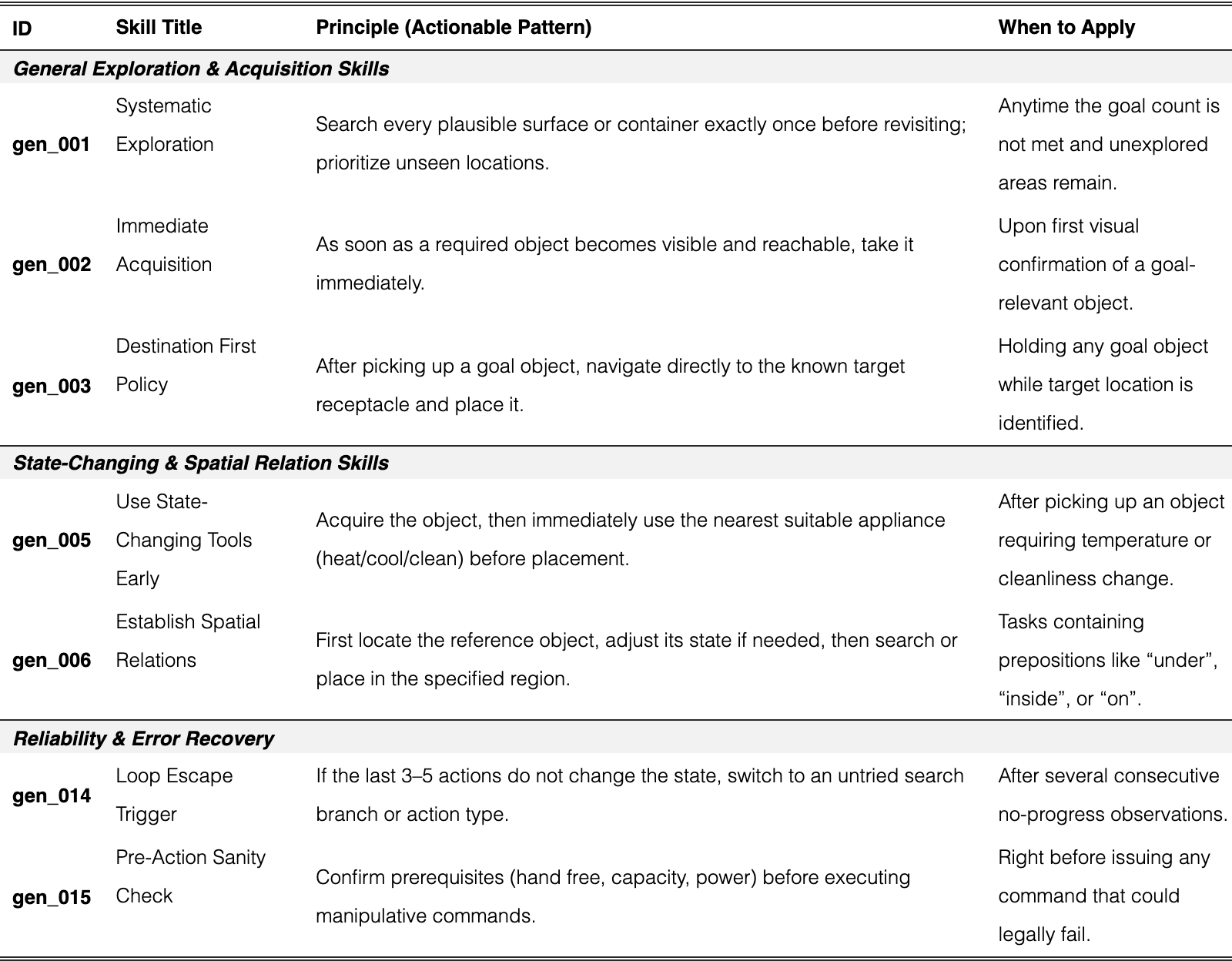
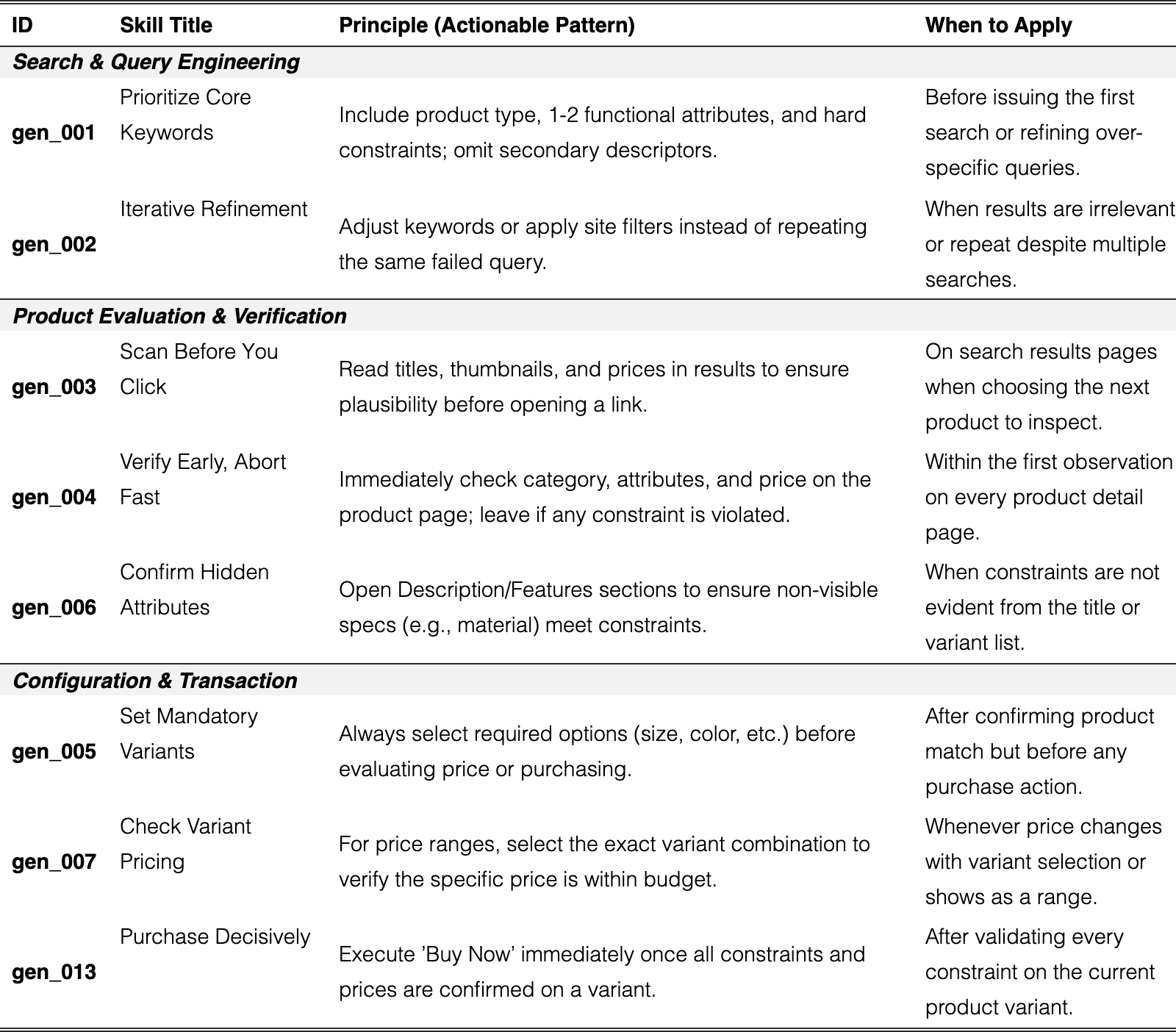
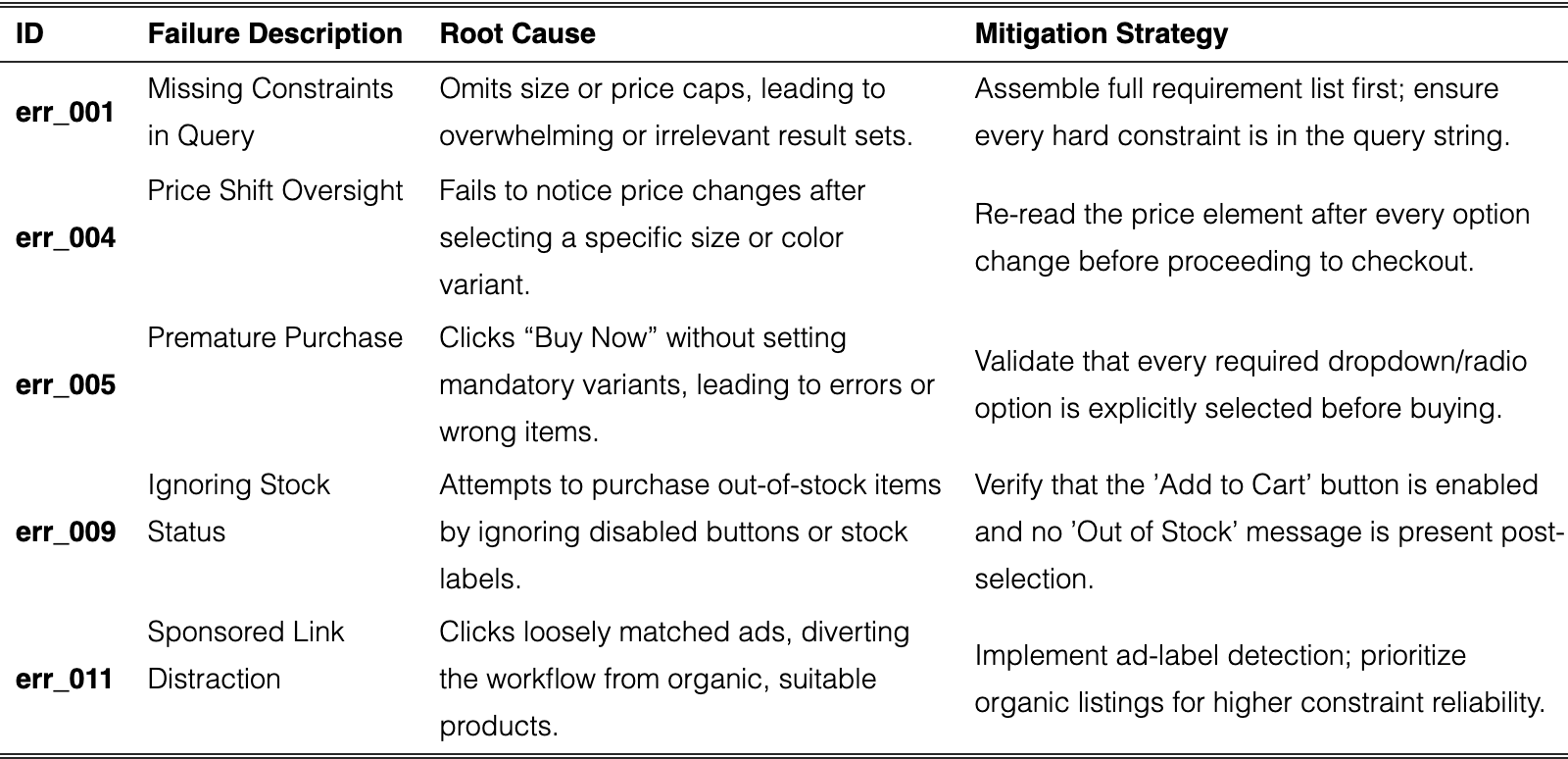
In this section, we provide some example catalog of distilled skills and error taxonomies for both the ALFWorld and WebShop environments. Tables 6 and 8 detail the general skills distilled for embodied manipulation and web-based shopping, respectively, highlighting the actionable principles required for systematic exploration and constraint satisfaction. Furthermore, we provide a structured analysis of failure cases in Table 7 and Table 9, which categorizes common mistakes, ranging from spatial reasoning loops in ALFWorld to price-shift oversights in WebShop, alongside their root causes and proposed mitigation strategies.
| ID | Skill Title | Principle (Actionable Pattern) | When to Apply |
|---|---|---|---|
| General Exploration & Acquisition Skills | |||
| gen_001 | Systematic Exploration | Search every plausible surface or container exactly once before revisiting; prioritize unseen locations. | Anytime the goal count is not met and unexplored areas remain. |
| gen_002 | Immediate Acquisition | As soon as a required object becomes visible and reachable, take it immediately. | Upon first visual confirmation of a goal-relevant object. |
| gen_003 | Destination First Policy | After picking up a goal object, navigate directly to the known target receptacle and place it. | Holding any goal object while target location is identified. |
| State-Changing & Spatial Relation Skills | |||
| gen_005 | Use State-Changing Tools Early | Acquire the object, then immediately use the nearest suitable appliance (heat/cool/clean) before placement. | After picking up an object requiring temperature or cleanliness change. |
| gen_006 | Establish Spatial Relations | First locate the reference object, adjust its state if needed, then search or place in the specified region. | Tasks containing prepositions like “under”, “inside”, or “on”. |
| Reliability & Error Recovery | |||
| gen_014 | Loop Escape Trigger | If the last 3–5 actions do not change the state, switch to an untried search branch or action type. | After several consecutive no-progress observations. |
| gen_015 | Pre-Action Sanity Check | Confirm prerequisites (hand free, capacity, power) before executing manipulative commands. | Right before issuing any command that could legally fail. |
View original table
| ID | Failure Description | Root Cause (Why it happens) | Mitigation (How to avoid) |
|---|---|---|---|
| err_001 | Redundant Revisit | Lacks explicit memory of explored areas; strategy degenerates into local loops. | Maintain an exploration map; prioritize unvisited candidates. |
| err_006 | Skipping State Changes | Conflates object presence with goal satisfaction; omits cleanliness/temp checks. | Integrate state precondition checks into the planner before placement. |
View original table

| ID | Skill Title | Principle (Actionable Pattern) | When to Apply |
|---|---|---|---|
| Search & Query Engineering | |||
| gen_001 | Prioritize Core Keywords | Include product type, 1-2 functional attributes, and hard constraints; omit secondary descriptors. | Before issuing the first search or refining over-specific queries. |
| gen_002 | Iterative Refinement | Adjust keywords or apply site filters instead of repeating the same failed query. | When results are irrelevant or repeat despite multiple searches. |
| Product Evaluation & Verification | |||
| gen_003 | Scan Before You Click | Read titles, thumbnails, and prices in results to ensure plausibility before opening a link. | On search results pages when choosing the next product to inspect. |
| gen_004 | Verify Early, Abort Fast | Immediately check category, attributes, and price on the product page; leave if any constraint is violated. | Within the first observation on every product detail page. |
| gen_006 | Confirm Hidden Attributes | Open Description/Features sections to ensure non-visible specs (e.g., material) meet constraints. | When constraints are not evident from the title or variant list. |
| Configuration & Transaction | |||
| gen_005 | Set Mandatory Variants | Always select required options (size, color, etc.) before evaluating price or purchasing. | After confirming product match but before any purchase action. |
| gen_007 | Check Variant Pricing | For price ranges, select the exact variant combination to verify the specific price is within budget. | Whenever price changes with variant selection or shows as a range. |
| gen_013 | Purchase Decisively | Execute ’Buy Now’ immediately once all constraints and prices are confirmed on a variant. | After validating every constraint on the current product variant. |
View original table
| ID | Failure Description | Root Cause | Mitigation Strategy |
|---|---|---|---|
| err_001 | Missing Constraints in Query | Omits size or price caps, leading to overwhelming or irrelevant result sets. | Assemble full requirement list first; ensure every hard constraint is in the query string. |
| err_004 | Price Shift Oversight | Fails to notice price changes after selecting a specific size or color variant. | Re-read the price element after every option change before proceeding to checkout. |
| err_005 | Premature Purchase | Clicks “Buy Now” without setting mandatory variants, leading to errors or wrong items. | Validate that every required dropdown/radio option is explicitly selected before buying. |
| err_009 | Ignoring Stock Status | Attempts to purchase out-of-stock items by ignoring disabled buttons or stock labels. | Verify that the ’Add to Cart’ button is enabled and no ’Out of Stock’ message is present post-selection. |
| err_011 | Sponsored Link Distraction | Clicks loosely matched ads, diverting the workflow from organic, suitable products. | Implement ad-label detection; prioritize organic listings for higher constraint reliability. |
View original table
Text in this graphic
Case 1: WebShop Footwear (Functional Constraints)
Task: I want a pair of men’s black slip-resistant work shoes, size 10, rubber sole, price lower than $50.00. Skills [foo_002] Verify features in description; [foo_004] Confirm price after variant selection. Avoid [err_001] Omitting price cap; [err_003] Selecting wrong product category. Step 1 Obs: WebShop homepage. Think: Per [gen_001], I’ll include key constraints (type, function, color, price) in the query. Action: search[men black slip resistant work shoes rubber sole under 50] Step 2 Obs: Results: [1] Chef Shoes $38.99; [2] Kitchen Shoes $42.50; [3] Steel Toe Boots $55.99. Think: [gen_003] Item [1] is under budget and matches function. Item [3] is over budget (skip). Action: click[Item 1] Step 3 Obs: Product page. Price: $35.99-$45.99. Colors: Black, White. Sizes: 7-12. Think: [foo_002] Description confirms rubber sole. Now selecting Black and Size 10 [foo_003]. Action: click[Black] click[10] Step 5 Obs: Selected: Black, Size 10. Price updated to $38.99. Think: [foo_004] $38.99 < $50. All constraints (color, size, function, price) are satisfied. Action: click[Buy Now] Result: SUCCESS — Purchased at $38.99. Key Skills: [foo_002] (Verification), [foo_004] (Price Check).
Text in this graphic
Case 2: Electronics (Speaker with Abort-and-Retry)
Task: I need a portable bluetooth speaker, waterproof, black color, price lower than $30.00. Skills [ele_001] Constraint-rich search; [ele_004] Bail on mismatch fast; [gen_002] Iterative refinement. Avoid [err_002] Overly specific variant names in search; [ele_006] Avoid click loops. Step 1 Obs: WebShop homepage. Think: [ele_001] Packing all mandatory attributes: portable, bluetooth, waterproof, black, <$30. Action: search[portable bluetooth speaker waterproof black under 30] Step 2 Obs: Results: [1] Waterproof Speaker $28.99; [2] Mini LED Speaker $19.99; [3] 20W Speaker $35.50. Think: [ele_005] Item [1] matches most keywords and price. Action: click[Item 1] Step 3 Obs: Product page (Item 1). Colors: Blue, Red, Green, Army Green. Black unavailable. Think: [gen_004] Verify Early, Abort Fast: No black option! [ele_004] Bail immediately to find another candidate. Action: click[Back to Search] Step 4 Obs: Back on search results. Think: [gen_002] Iterative refinement. Item [2] $19.99 is the next best candidate. Action: click[Item 2] Step 5 Obs: Product page (Item 2). Colors: Black, Blue, Red. Specs: IPX5 Waterproof. Think: [ele_002] Black is available! IPX5 confirms waterproof. Selecting Black. Action: click[Black] Step 6 Obs: Black selected. Final price: $19.99. Think: [ele_003] $19.99 < $30. All specs (black, portable, waterproof) verified. Action: click[Buy Now] Result: SUCCESS — Efficiently handled attribute mismatch via early exit. Key Skills Applied: [gen_004] (Abort Fast), [ele_004] (Bail on Mismatch).
Text in this graphic
Case 1: ALFWorld Clean Task (Lettuce Sink Countertop)
Task: Clean some lettuce and put it in countertop. Core Skills [cle_001] Phase-ordered plan (Locate Clean Place); [cle_006] Use location priors (Fridge for food). Mistakes Avoided [err_002] Skipping closed containers; [err_003] Ignoring visible target objects. Step 1-3 Obs: Fridge 1 is closed. Action: open fridge 1 take lettuce 1 Reasoning: Per [cle_006], food is likely in the fridge. [gen_002] Grab lettuce immediately on sight. Step 4-6 Obs: Arrive at sinkbasin 1. Action: clean lettuce 1 with sinkbasin 1 Reasoning: Per [cle_001] Phase 2: bring to water source. [cle_003] Go straight to sink. Step 7 Obs: Arrive at countertop 1. Action: put lettuce 1 in/on countertop 1 Reasoning: Per [gen_003] Destination First: place cleaned object immediately to finish. Result: SUCCESS (7 Steps) — Skills used: [gen_010] (Decomposition), [cle_003] (Sink First).
Text in this graphic
Case 2: ALFWorld Heat Task (Egg Microwave Countertop)
Task: Heat some egg and put it in countertop. Core Skills [hea_001] Secure exact target first; [hea_003] Open-Place-Heat sequence; [hea_004] No appliance before object. Step 1-3 Obs: Countertop 1 (no egg) Countertop 2 (egg found). Action: take egg 1 Reasoning: [hea_004] Avoid microwave until object is held. [hea_002] Systematic search of surfaces. Step 4-6 Obs: Microwave 1 is closed. Action: open microwave 1 heat egg 1 Reasoning: [hea_003] Correct sequence: open door first, then initiate state change. Step 7-8 Obs: Egg is heated. Action: go to countertop 1 put egg 1 Reasoning: [hea_005] Direct Post-Heat Placement: move to target without detours. Result: SUCCESS (8 Steps) — Skills used: [hea_001] (Target First), [hea_004] (Sequence Control).
Text in this graphic
Case 3: ALFWorld Examine Task (Pencil Desklamp Success)
Task: Look at pencil under the desklamp. Core Skills [loo_001] Seek lamp surfaces (Desk/Sidetable); [loo_002] Switch lamp on; [exa_001] Pair objects early (Target & Tool co-location). Mistakes Avoided [err_003] Ignoring reachable targets; [loo_005] Preventing action loops (Toggle only once). Step 1 Obs: Mid-room. Visible: desk 1/2, drawer 1-3, sidetable 1, etc. Reasoning: [loo_001] Desklamps usually sit on desks. Prioritizing desk 1 to find both pencil and lamp in one go. Action: go to desk 1 Step 2 Obs: On desk 1: alarmclock 1, desklamp 1, pencil 1. Reasoning: [exa_001] Successful co-location! Both objects are present. [exa_002] Pick up target first before interacting with the tool. Action: take pencil 1 from desk 1 Step 3 Obs: Holding pencil 1. Reasoning: [loo_002] Toggle the lamp state to satisfy the "under light" condition. [exa_004] Single toggle rule ensures no repeated actions. Action: use desklamp 1 Result: SUCCESS (Optimal 3 Steps) — Demonstrates superior spatial reasoning and zero-waste navigation. Key Skills: [exa_001] (Object Pairing), [loo_001] (Spatial Priors).
- 1.
Claims
Question: Do the main claims made in the abstract and introduction accurately reflect the paper’s contributions and scope?
Answer: [Yes]
Justification: The abstract and introduction reflect the paper’s contributions and scope.
Guidelines:
- •
The answer [N/A] means that the abstract and introduction do not include the claims made in the paper.
- •
The abstract and/or introduction should clearly state the claims made, including the contributions made in the paper and important assumptions and limitations. A [No] or [N/A] answer to this question will not be perceived well by the reviewers.
- •
The claims made should match theoretical and experimental results, and reflect how much the results can be expected to generalize to other settings.
- •
It is fine to include aspirational goals as motivation as long as it is clear that these goals are not attained by the paper.
- •
- 2.
Limitations
Question: Does the paper discuss the limitations of the work performed by the authors?
Answer: [Yes]
Justification: Limitations are included in Appendix A.
Guidelines:
- •
The answer [N/A] means that the paper has no limitation while the answer [No] means that the paper has limitations, but those are not discussed in the paper.
- •
The authors are encouraged to create a separate “Limitations” section in their paper.
- •
The paper should point out any strong assumptions and how robust the results are to violations of these assumptions (e.g., independence assumptions, noiseless settings, model well-specification, asymptotic approximations only holding locally). The authors should reflect on how these assumptions might be violated in practice and what the implications would be.
- •
The authors should reflect on the scope of the claims made, e.g., if the approach was only tested on a few datasets or with a few runs. In general, empirical results often depend on implicit assumptions, which should be articulated.
- •
The authors should reflect on the factors that influence the performance of the approach. For example, a facial recognition algorithm may perform poorly when image resolution is low or images are taken in low lighting. Or a speech-to-text system might not be used reliably to provide closed captions for online lectures because it fails to handle technical jargon.
- •
The authors should discuss the computational efficiency of the proposed algorithms and how they scale with dataset size.
- •
If applicable, the authors should discuss possible limitations of their approach to address problems of privacy and fairness.
- •
While the authors might fear that complete honesty about limitations might be used by reviewers as grounds for rejection, a worse outcome might be that reviewers discover limitations that aren’t acknowledged in the paper. The authors should use their best judgment and recognize that individual actions in favor of transparency play an important role in developing norms that preserve the integrity of the community. Reviewers will be specifically instructed to not penalize honesty concerning limitations.
- •
- 3.
Theory assumptions and proofs
Question: For each theoretical result, does the paper provide the full set of assumptions and a complete (and correct) proof?
Answer: [N/A]
Justification: We do not provide theory assumptions and proofs.
Guidelines:
- •
The answer [N/A] means that the paper does not include theoretical results.
- •
All the theorems, formulas, and proofs in the paper should be numbered and cross-referenced.
- •
All assumptions should be clearly stated or referenced in the statement of any theorems.
- •
The proofs can either appear in the main paper or the supplemental material, but if they appear in the supplemental material, the authors are encouraged to provide a short proof sketch to provide intuition.
- •
Inversely, any informal proof provided in the core of the paper should be complemented by formal proofs provided in appendix or supplemental material.
- •
Theorems and Lemmas that the proof relies upon should be properly referenced.
- •
- 4.
Experimental result reproducibility
Question: Does the paper fully disclose all the information needed to reproduce the main experimental results of the paper to the extent that it affects the main claims and/or conclusions of the paper (regardless of whether the code and data are provided or not)?
Answer: [Yes]
Justification: The experiment section and Appendix D.1 and D.2 contain detailed implementations.
Guidelines:
- •
The answer [N/A] means that the paper does not include experiments.
- •
If the paper includes experiments, a [No] answer to this question will not be perceived well by the reviewers: Making the paper reproducible is important, regardless of whether the code and data are provided or not.
- •
If the contribution is a dataset and/or model, the authors should describe the steps taken to make their results reproducible or verifiable.
- •
Depending on the contribution, reproducibility can be accomplished in various ways. For example, if the contribution is a novel architecture, describing the architecture fully might suffice, or if the contribution is a specific model and empirical evaluation, it may be necessary to either make it possible for others to replicate the model with the same dataset, or provide access to the model. In general. releasing code and data is often one good way to accomplish this, but reproducibility can also be provided via detailed instructions for how to replicate the results, access to a hosted model (e.g., in the case of a large language model), releasing of a model checkpoint, or other means that are appropriate to the research performed.
- •
While NeurIPS does not require releasing code, the conference does require all submissions to provide some reasonable avenue for reproducibility, which may depend on the nature of the contribution. For example
- (a)
If the contribution is primarily a new algorithm, the paper should make it clear how to reproduce that algorithm.
- (b)
If the contribution is primarily a new model architecture, the paper should describe the architecture clearly and fully.
- (c)
If the contribution is a new model (e.g., a large language model), then there should either be a way to access this model for reproducing the results or a way to reproduce the model (e.g., with an open-source dataset or instructions for how to construct the dataset).
- (d)
We recognize that reproducibility may be tricky in some cases, in which case authors are welcome to describe the particular way they provide for reproducibility. In the case of closed-source models, it may be that access to the model is limited in some way (e.g., to registered users), but it should be possible for other researchers to have some path to reproducing or verifying the results.
- (a)
- •
- 5.
Open access to data and code
Question: Does the paper provide open access to the data and code, with sufficient instructions to faithfully reproduce the main experimental results, as described in supplemental material?
Answer: [Yes] .
Justification: We contain the code in supplemental material.
Guidelines:
- •
The answer [N/A] means that paper does not include experiments requiring code.
- •
Please see the NeurIPS code and data submission guidelines (https://neurips.cc/public/guides/CodeSubmissionPolicy) for more details.
- •
While we encourage the release of code and data, we understand that this might not be possible, so [No] is an acceptable answer. Papers cannot be rejected simply for not including code, unless this is central to the contribution (e.g., for a new open-source benchmark).
- •
The instructions should contain the exact command and environment needed to run to reproduce the results. See the NeurIPS code and data submission guidelines (https://neurips.cc/public/guides/CodeSubmissionPolicy) for more details.
- •
The authors should provide instructions on data access and preparation, including how to access the raw data, preprocessed data, intermediate data, and generated data, etc.
- •
The authors should provide scripts to reproduce all experimental results for the new proposed method and baselines. If only a subset of experiments are reproducible, they should state which ones are omitted from the script and why.
- •
At submission time, to preserve anonymity, the authors should release anonymized versions (if applicable).
- •
Providing as much information as possible in supplemental material (appended to the paper) is recommended, but including URLs to data and code is permitted.
- •
- 6.
Experimental setting/details
Question: Does the paper specify all the training and test details (e.g., data splits, hyperparameters, how they were chosen, type of optimizer) necessary to understand the results?
Answer: [Yes]
Justification: Experimental setting/details and Appendix D.1 and D.2 are included.
Guidelines:
- •
The answer [N/A] means that the paper does not include experiments.
- •
The experimental setting should be presented in the core of the paper to a level of detail that is necessary to appreciate the results and make sense of them.
- •
The full details can be provided either with the code, in appendix, or as supplemental material.
- •
- 7.
Experiment statistical significance
Question: Does the paper report error bars suitably and correctly defined or other appropriate information about the statistical significance of the experiments?
Answer: [No]
Justification:
Guidelines:
- •
The answer [N/A] means that the paper does not include experiments.
- •
The authors should answer [Yes] if the results are accompanied by error bars, confidence intervals, or statistical significance tests, at least for the experiments that support the main claims of the paper.
- •
The factors of variability that the error bars are capturing should be clearly stated (for example, train/test split, initialization, random drawing of some parameter, or overall run with given experimental conditions).
- •
The method for calculating the error bars should be explained (closed form formula, call to a library function, bootstrap, etc.)
- •
The assumptions made should be given (e.g., Normally distributed errors).
- •
It should be clear whether the error bar is the standard deviation or the standard error of the mean.
- •
It is OK to report 1-sigma error bars, but one should state it. The authors should preferably report a 2-sigma error bar than state that they have a 96% CI, if the hypothesis of Normality of errors is not verified.
- •
For asymmetric distributions, the authors should be careful not to show in tables or figures symmetric error bars that would yield results that are out of range (e.g., negative error rates).
- •
If error bars are reported in tables or plots, the authors should explain in the text how they were calculated and reference the corresponding figures or tables in the text.
- •
- 8.
Experiments compute resources
Question: For each experiment, does the paper provide sufficient information on the computer resources (type of compute workers, memory, time of execution) needed to reproduce the experiments?
Answer: [Yes]
Justification: Compute resources are described in the Appendix D.2.
Guidelines:
- •
The answer [N/A] means that the paper does not include experiments.
- •
The paper should indicate the type of compute workers CPU or GPU, internal cluster, or cloud provider, including relevant memory and storage.
- •
The paper should provide the amount of compute required for each of the individual experimental runs as well as estimate the total compute.
- •
The paper should disclose whether the full research project required more compute than the experiments reported in the paper (e.g., preliminary or failed experiments that didn’t make it into the paper).
- •
- 9.
Code of ethics
Question: Does the research conducted in the paper conform, in every respect, with the NeurIPS Code of Ethics https://neurips.cc/public/EthicsGuidelines?
Answer: [Yes]
Justification:
Guidelines:
- •
The answer [N/A] means that the authors have not reviewed the NeurIPS Code of Ethics.
- •
If the authors answer [No] , they should explain the special circumstances that require a deviation from the Code of Ethics.
- •
The authors should make sure to preserve anonymity (e.g., if there is a special consideration due to laws or regulations in their jurisdiction).
- •
- 10.
Broader impacts
Question: Does the paper discuss both potential positive societal impacts and negative societal impacts of the work performed?
Answer: [Yes]
Justification: Broader impacts are discussed in the conclusion and Appendix.
Guidelines:
- •
The answer [N/A] means that there is no societal impact of the work performed.
- •
If the authors answer [N/A] or [No] , they should explain why their work has no societal impact or why the paper does not address societal impact.
- •
Examples of negative societal impacts include potential malicious or unintended uses (e.g., disinformation, generating fake profiles, surveillance), fairness considerations (e.g., deployment of technologies that could make decisions that unfairly impact specific groups), privacy considerations, and security considerations.
- •
The conference expects that many papers will be foundational research and not tied to particular applications, let alone deployments. However, if there is a direct path to any negative applications, the authors should point it out. For example, it is legitimate to point out that an improvement in the quality of generative models could be used to generate Deepfakes for disinformation. On the other hand, it is not needed to point out that a generic algorithm for optimizing neural networks could enable people to train models that generate Deepfakes faster.
- •
The authors should consider possible harms that could arise when the technology is being used as intended and functioning correctly, harms that could arise when the technology is being used as intended but gives incorrect results, and harms following from (intentional or unintentional) misuse of the technology.
- •
If there are negative societal impacts, the authors could also discuss possible mitigation strategies (e.g., gated release of models, providing defenses in addition to attacks, mechanisms for monitoring misuse, mechanisms to monitor how a system learns from feedback over time, improving the efficiency and accessibility of ML).
- •
- 11.
Safeguards
Question: Does the paper describe safeguards that have been put in place for responsible release of data or models that have a high risk for misuse (e.g., pre-trained language models, image generators, or scraped datasets)?
Answer: [N/A] .
Justification:
Guidelines:
- •
The answer [N/A] means that the paper poses no such risks.
- •
Released models that have a high risk for misuse or dual-use should be released with necessary safeguards to allow for controlled use of the model, for example by requiring that users adhere to usage guidelines or restrictions to access the model or implementing safety filters.
- •
Datasets that have been scraped from the Internet could pose safety risks. The authors should describe how they avoided releasing unsafe images.
- •
We recognize that providing effective safeguards is challenging, and many papers do not require this, but we encourage authors to take this into account and make a best faith effort.
- •
- 12.
Licenses for existing assets
Question: Are the creators or original owners of assets (e.g., code, data, models), used in the paper, properly credited and are the license and terms of use explicitly mentioned and properly respected?
Answer: [Yes]
Justification:
Guidelines:
- •
The answer [N/A] means that the paper does not use existing assets.
- •
The authors should cite the original paper that produced the code package or dataset.
- •
The authors should state which version of the asset is used and, if possible, include a URL.
- •
The name of the license (e.g., CC-BY 4.0) should be included for each asset.
- •
For scraped data from a particular source (e.g., website), the copyright and terms of service of that source should be provided.
- •
If assets are released, the license, copyright information, and terms of use in the package should be provided. For popular datasets, paperswithcode.com/datasets has curated licenses for some datasets. Their licensing guide can help determine the license of a dataset.
- •
For existing datasets that are re-packaged, both the original license and the license of the derived asset (if it has changed) should be provided.
- •
If this information is not available online, the authors are encouraged to reach out to the asset’s creators.
- •
- 13.
New assets
Question: Are new assets introduced in the paper well documented and is the documentation provided alongside the assets?
Answer: [Yes]
Justification:
Guidelines:
- •
The answer [N/A] means that the paper does not release new assets.
- •
Researchers should communicate the details of the dataset/code/model as part of their submissions via structured templates. This includes details about training, license, limitations, etc.
- •
The paper should discuss whether and how consent was obtained from people whose asset is used.
- •
At submission time, remember to anonymize your assets (if applicable). You can either create an anonymized URL or include an anonymized zip file.
- •
- 14.
Crowdsourcing and research with human subjects
Question: For crowdsourcing experiments and research with human subjects, does the paper include the full text of instructions given to participants and screenshots, if applicable, as well as details about compensation (if any)?
Answer: [No]
Justification:
Guidelines:
- •
The answer [N/A] means that the paper does not involve crowdsourcing nor research with human subjects.
- •
Including this information in the supplemental material is fine, but if the main contribution of the paper involves human subjects, then as much detail as possible should be included in the main paper.
- •
According to the NeurIPS Code of Ethics, workers involved in data collection, curation, or other labor should be paid at least the minimum wage in the country of the data collector.
- •
- 15.
Institutional review board (IRB) approvals or equivalent for research with human subjects
Question: Does the paper describe potential risks incurred by study participants, whether such risks were disclosed to the subjects, and whether Institutional Review Board (IRB) approvals (or an equivalent approval/review based on the requirements of your country or institution) were obtained?
Answer: [N/A] .
Justification:
Guidelines:
- •
The answer [N/A] means that the paper does not involve crowdsourcing nor research with human subjects.
- •
Depending on the country in which research is conducted, IRB approval (or equivalent) may be required for any human subjects research. If you obtained IRB approval, you should clearly state this in the paper.
- •
We recognize that the procedures for this may vary significantly between institutions and locations, and we expect authors to adhere to the NeurIPS Code of Ethics and the guidelines for their institution.
- •
For initial submissions, do not include any information that would break anonymity (if applicable), such as the institution conducting the review.
- •
- 16.
Declaration of LLM usage
Question: Does the paper describe the usage of LLMs if it is an important, original, or non-standard component of the core methods in this research? Note that if the LLM is used only for writing, editing, or formatting purposes and does not impact the core methodology, scientific rigor, or originality of the research, declaration is not required.
Answer: [Yes]
Justification: We fine-tune the Qwen2.5 model as part of our core methodology, and use o3 as a teacher model that contribute directly to the method design. These uses are integral to the research’s originality and effectiveness.
Guidelines:
- •
The answer [N/A] means that the core method development in this research does not involve LLMs as any important, original, or non-standard components.
- •
Please refer to our LLM policy in the NeurIPS handbook for what should or should not be described.
- •