SkillClaw: Let Skills Evolve Collectively with Agentic Evolver
arXiv:2604.08377v2 · This workspace stays on this version. Check arXiv for newer versions
Some source details need review 2 to check
Original formulas, table values and figures are preserved. Comparison can miss differences; use the original PDF to check details.
Reading view checked: 36 math expressions, 0 rendering failures; 13 of 13 images available.
Compared 71 of 71 source passages against 24 of 24 PDF pages.
The HTML source contains failed formatting commands; these were omitted from the reading view. The original sources are retained. (7)
- An unsupported comparison claim was rejected; source verification is incomplete.
HTML (alg1) numbers “1: Skill repository $\mathcal{S}$, user sessions $\mathcal{T}$” and “2: Updated repository $\mathcal{S}^{\prime}$”; the original PDF (page 4) labels these “Require:” and “Ensure:” and starts “1: Convert $\mathcal{T}$ into structured evidence $\mathcal{E}$.” The page image confirms the PDF labels. Check PDF page 4
13 of 13 figure, table and graphic images captured. Open original PDF
Abstract
Large language model (LLM) agents such as OpenClaw rely on reusable skills to perform complex tasks, yet these skills remain largely static after deployment. As a result, similar workflows, tool usage patterns, and failure modes are repeatedly rediscovered across users, preventing the system from improving with experience. While interactions from different users provide complementary signals about when a skill works or fails, existing systems lack a mechanism to convert such heterogeneous experiences into reliable skill updates. To address these issues, we present SkillClaw, a framework for collective skill evolution in multi-user agent ecosystems, which treats cross-user and over-time interactions as the primary signal for improving skills. SkillClaw continuously aggregates trajectories generated during use and processes them with an autonomous evolver, which identifies recurring behavioral patterns and translates them into updates to the skill set by refining existing skills or extending them with new capabilities. The resulting skills are maintained in a shared repository and synchronized across users, allowing improvements discovered in one context to propagate system-wide while requiring no additional effort from users. By integrating multi-user experience into ongoing skill updates, SkillClaw enables cross-user knowledge transfer and cumulative capability improvement, and experiments on WildClawBench show that limited interaction and feedback, it significantly improves the performance of Qwen3-Max in real-world agent scenarios.
[ ]DreamX Team, Alibaba Group [*]Equal contribution [†]Project lead
Large language model (LLM) agents (Yao et al., 2022; Shinn et al., 2023) have rapidly made personal AI assistants practical in real-world settings, with systems such as OpenClaw enabling users to complete complex tasks through natural conversation. A user can now ask an agent to configure a service, debug an API call, or automate a multi-step workflow, relying on it to coordinate tool usage and intermediate reasoning. These capabilities are largely driven by skills, which encode structured procedures for interacting with tools and solving tasks. In current deployments, users typically select and install skills from a centralized skill hub to meet their needs, and these skills serve as the primary building blocks for agent behavior. However, the skill ecosystem remains largely static (Zhang et al., 2025b; Naihin et al., 2023; Song et al., 2026), as skills are manually installed and maintained and solutions discovered during interaction rarely persist beyond individual sessions.
This limitation becomes evident in everyday usage. For example, users often ask agents to complete multi-step tasks such as automating data processing workflows, where failures frequently arise from subtle issues such as incorrect argument formats or mismatched tool calls. Through several rounds of trial and error, an agent may eventually arrive at a working solution or even a more stable procedure. However, these improvements remain confined to the current session and are not consolidated into the skill set or carried forward to future interactions. As similar tasks recur across different users and over time, the same patterns of failure and recovery are repeatedly observed, yet the system does not improve its behavior. This is fundamentally problematic because users operate in overlapping task spaces where similar workflows, tools, and failure modes are shared, but the system fails to leverage these recurring experiences. Consequently, each user is forced to rediscover solutions independently, preventing knowledge from accumulating at the system level. Therefore, the key challenge is not only to improve performance within a single session, but also to enable knowledge to accumulate and evolve across users.
Existing approaches to agent adaptation fail to support the accumulation and evolution of skills across users and over time. Memory-based methods store past trajectories for retrieval (Shinn et al., 2023; Zhao et al., 2024; Fang et al., 2025a; Tang et al., 2025; Ouyang et al., 2025a; Chhikara et al., 2025; Liu et al., 2026), but such records remain tied to specific instances and are difficult to generalize into improved behavior. Skill-based methods compress experience into structured instructions (Xia et al., 2026a; Zhang et al., 2025a; Zhang et al., 2026b; Wu et al., 2025; Zhang et al., 2026a), yet treat the resulting skill library as a static resource that does not evolve through usage. While local refinement can improve individual agent instances, these improvements remain isolated and do not accumulate across users, leading to fragmented skills rather than collective improvement over time. What is missing is a mechanism that turns ordinary interactions into continuous skill evolution and enables skills to improve collectively across users.
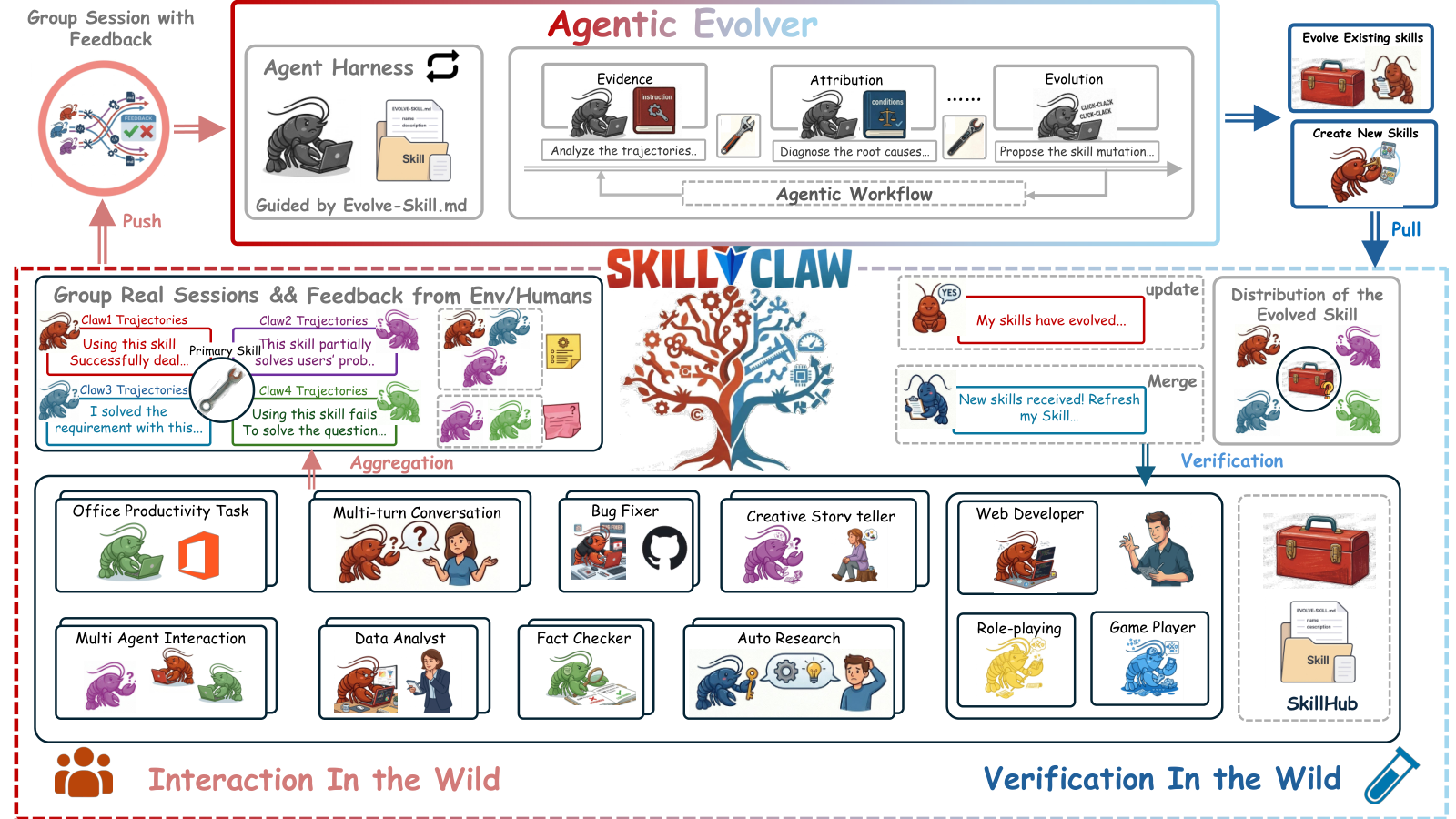
Building on this insight, we propose SkillClaw, a framework for skill collective evolution in multi-user OpenClaw-style agent ecosystems (Fig 1). SkillClaw adopts a centralized evolution architecture, where agents deployed across different users continuously generate interaction sessions during everyday usage. These trajectories are aggregated across users and over time as evidence of real-world task execution and are processed by a centralized evolution engine to drive skill updates. Given accumulated interaction trajectories, the evolver analyzes both successful and failed executions, identifies recurring issues and effective procedures, and updates the shared skill set by refining existing skills, creating new ones, or adjusting their descriptions. Unlike predefined pipelines, this evolution process is driven by an autonomous agent that performs open-ended reasoning over interaction evidence and directly edits skill definitions. The updated skills are then synchronized across agents, allowing improvements discovered in one context to propagate to future interactions across users and over time. This forms a continuous evolution loop in which interaction data drives skill updates, and updated skills improve subsequent interactions. From the user’s perspective, this process requires no additional effort, as data collection, evolution, and synchronization all occur automatically in the background.
This design introduces three key properties that distinguish SkillClaw from existing systems. First, SkillClaw enables collective evolution, where knowledge from individual interactions contributes to a shared and continuously improving skill ecosystem. Second, it is fully automatic, with skill evolution driven by runtime interaction without manual curation or explicit user intervention. Third, it adopts an agentic evolution paradigm, where skill updates are produced through open-ended reasoning rather than predefined update rules, enabling flexible and context-aware improvements.
SkillClaw is designed as a general framework that is compatible with a wide range of Claw-style agent systems, including OpenClaw as well as variants such as CoPaw, IronClaw, PicoClaw, ZeroClaw, NanoClaw, and NemoClaw. We evaluate SkillClaw on WildClawBench using qwen3-max as the backbone model and simulate a multi-user deployment setting. Experimental results demonstrate that SkillClaw yields substantial improvements across tasks, highlighting the effectiveness of multi-user driven collective evolution for building continuously improving agent systems in real-world environments.
We present SkillClaw, a framework for collective skill evolution in a multi-user agent ecosystem (Fig 1). In our setting, different users independently interact with their own deployed OpenClaw agents, potentially across different devices, environments, and time. Although these interactions are isolated at runtime, they share a common behavioral space: similar workflows, overlapping tool usage, and recurring failure modes appear across users. SkillClaw builds on the observation that different users exercising the same skill under diverse contexts produce complementary views of that skill’s behavioral boundary, revealing both the conditions under which it works and those under which it breaks. A single user rarely generates enough signal to separate a generalizable improvement from an idiosyncratic fix. Aggregating evidence across users provides the grounding that makes stable skill evolution possible.
Formally, let denote a shared skill set, where each skill is a reusable procedural artifact. Each user interaction produces a session trajectory , which records the full interaction loop: the prompt, the agent’s actions, feedback from the environment or the user, and the final agent response. Given a set of trajectories collected across users, our goal is to update the shared skill set:
such that improvements discovered in one interaction can benefit future users.
Multi-user skill evolution requires converting a stream of isolated, heterogeneous interaction sessions into a form that supports cross-user reasoning. SkillClaw does this in two stages: it first structures individual sessions to preserve causal information, then aggregates them into a shared evidence base.
At the system level, SkillClaw connects independently deployed agents through a common skill repository. Each agent has access to the current skill set and produces interaction sessions during normal usage. These sessions are recorded and uploaded as shared evidence. A centralized evolution engine periodically processes the collected sessions, updates the skill repository, and synchronizes the updated skills back to all agents, forming a closed loop:
At inference time, the agent receives a catalogue of available skills in its prompt and can dynamically select and load those relevant to the current task. Users do not interact directly, and no coordination among agents is required. Collective improvement arises entirely from shared skill evolution.
Within this loop, each interaction session contains more than plain dialogue. SkillClaw records the full causal chain: the user prompt, the agent’s actions (including tool calls), intermediate feedback (tool results, errors, and explicit user responses), and the final agent response. We record all of this because most skill-level failures are procedural. An incorrect argument format, a missing validation step, or a misordered tool call can cause a task to fail, yet none of these problems appears in the final response. They can only be diagnosed from the intermediate action-feedback trace. Each raw session is converted into a structured representation that preserves this chain:
We also extract lightweight metadata from each session: (i) which skills were referenced, (ii) whether tool errors occurred, and (iii) a coarse quality estimate. These signals help organize sessions but do not impose rigid labels.
Once sessions are structured, they are grouped by the skills they reference to enable cross-user reasoning. For each skill , we collect all sessions that invoked :
and place sessions that did not use any skill into a separate group . This grouping does more than organize the data. When multiple sessions invoke the same skill but produce different outcomes across different users, tasks, or environments, the comparison directly reveals where the skill works and where it fails, with the skill itself as the controlled factor. This amounts to a natural ablation and enables two operations that would be unreliable from single-user data alone: (1) evaluating how an existing skill actually performs under diverse real-world usage, and (2) identifying recurring procedures that no existing skill covers, surfaced by patterns in .
The core of SkillClaw is an agentic evolver that updates the shared skill repository with open-ended reasoning. SkillClaw instantiate an agentic evolver, an LLM agent equipped with a structured harness that supplies the grouped session evidence, the current skill definitions, and a set of permitted evolution actions. The harness provides structured inputs but does not constrain the evolver’s reasoning. The evolver diagnoses root causes from sessions of varying context lengths and skills of different formats, and decides how to act. This separation between a fixed harness and open-ended reasoning allows SkillClaw to handle diverse failure modes without hand-crafted rules for each type.
Concretely, given a skill and its associated session group , the evolver examines both successful and failed executions and selects one of three actions:
- •
Refine. Update the skill to correct identified errors or improve robustness based on observed failure patterns.
- •
Create. Introduce a new skill when reveals recurring sub-procedures that are not captured by any existing skill.
- •
Skip. Leave the skill unchanged when the available evidence is insufficient to justify a modification.
For sessions in , i.e., those that did not invoke any skill, the evolver focuses on discovering missing but reusable procedures. New skills are created only when the observed patterns are specific enough to be teachable and likely to recur.
Regardless of which action is chosen, the evolver always reasons over successful and failed sessions jointly. Successful sessions define the invariants of a skill, the parts that work and must not be altered. Failed sessions define the targets, the specific behaviors that need correction. This joint view is what prevents a naive failure: fixing one problem while inadvertently breaking a previously effective procedure. Each update corrects identified deficiencies while preserving what successful sessions have validated, making evolution cumulative. The complete procedure is given in Algorithm 1.
After evolution, candidate skill updates are validated before being written back to the shared repository. Validation is performed during the nighttime and executed in available idle user environments, ensuring that evaluation reflects real deployment conditions. For a skill and its candidate update , the system selects relevant tasks from the interaction data collected during the day. Both versions are executed under the same environment using the full toolchain, including multi-step interactions and intermediate feedback. After execution, the system uses the model to compare the outcomes produced by and . The decision is based on overall task success and execution stability. If the updated skill demonstrates better performance, it is marked as Accept; otherwise, it is marked as Reject. Accepted updates are merged into the shared repository and synchronized to all agents for the next day. Rejected updates are retained only as candidates and are not deployed. As a result, users always interact with the best validated skill pool from the previous night, rather than unverified updates. This validation step induces a monotonic deployment behavior. Since only improvements are accepted, the deployed skill pool does not degrade over time. Combined with the evolution process, the system forms a closed loop:
where updated skills shape future interactions and generate new evidence for the next round of evolution.
Three properties follow from this design. First, collective evolution. Sessions are aggregated across users, and knowledge discovered in one interaction is propagated to a shared skill ecosystem that benefits all users. Second, full automation. The entire pipeline, from session recording to skill synchronization, runs without manual curation or explicit user intervention. The only human input is normal agent usage. Third, agentic adaptability. Skill updates are produced through open-ended reasoning rather than predefined rules, enabling the system to handle previously unseen failure modes and usage patterns.
From the user’s perspective, none of this is visible. Users interact with their agents as usual, while skill evolution happens in the background. Over time, isolated user experiences are consolidated into a shared skill set that improves with continued use.
| Category | Example Tasks | Challenges |
| Productivity Flow | arXiv classification, scheduling, SCP | multi-step pipelines |
| Code Intelligence | debugging, puzzle solving | execution correctness |
| Social Interaction | negotiation, chat analysis | multi-turn reasoning |
| Search & Retrieval | academic search, conflict resolution | API usage |
| Creative Synthesis | video notes, poster generation | multimodal generation |
| Safety & Alignment | prompt injection, leakage detection | constraint satisfaction |
View original table

| Property | Description |
| Execution Environment | Full Linux container with tools |
| Multimodality | Text, code, image, video |
| Evaluation | 3–27 metrics aggregated |
| Hard Constraints | Critical errors zero score |
| Task Length | 15–50 steps |
| External Dependency | APIs and model downloads |
View original table

We evaluate SkillClaw on WildClawBench (Ding et al. (2026)), a real-world agent benchmark consisting of 60 complex tasks across six capability domains. As summarized in Table 1, the benchmark covers diverse scenarios including productivity workflows, code execution, social interaction, retrieval, creative generation, and safety alignment. Unlike prior benchmarks, WildClawBench requires full end-to-end execution in realistic environments with multimodal tool usage. Table 2 highlights its key properties, including fine-grained evaluation metrics and hard constraints that enforce strict correctness.
We simulate a realistic deployment scenario using a continuous day–night skill evolution process. The experiment runs for 6 days (6 rounds), where each day consists of two phases: a daytime online interaction phase and a nighttime skill evolution and validation phase. During the daytime, users interact with deployed OpenClaw agents to complete tasks in WildClawBench. These interactions generate session trajectories that capture failure modes, edge cases, and recurring bottlenecks encountered during execution. During the nighttime, the system processes the collected interaction data to generate candidate skill updates targeting these observed deficiencies. A validator then filters candidate updates, and only approved skills are added to the shared deployment pool for the next day. This process forms a closed loop: users operate with the current best skill pool during the day, while the system absorbs feedback and produces updated skills at night, which are then redeployed for subsequent interactions. Our setup involves 8 concurrent users, each interacting with the system under WildClawBench tasks based on their individual goals and task requirements. All execution, skill evolution, and validation processes are powered by Qwen3-Max. At the system level, we maintain a shared current best skill pool. Day 1 starts with an initial skill set corresponding to the baseline. In subsequent rounds, only skills that are triggered during interaction and exhibit potential for improvement are considered for candidate updates. Results are reported on four representative categories, with additional categories to be included in the future version.
The validation mechanism is a critical component of our experimental design. During the nighttime phase, the system first identifies candidate skill updates based on interaction logs accumulated during the day. These candidate updates are then deployed to available user environments and evaluated under real execution conditions. The validator follows a simple decision rule. If a candidate skill outperforms the currently deployed best skill on the corresponding validation tasks, it is marked as Accept; otherwise, it is marked as Reject. Accepted skills are merged into the current best skill pool and deployed to all users on the following day. Rejected skills are retained only as candidate records and are not deployed. As a result, users always interact with the best validated skill pool from the previous night, rather than unverified updates. This validation strategy introduces additional token cost, as candidate skills must be executed in real environments with full tool interaction. However, compared to direct deployment without validation, this overhead leads to significantly more stable user-facing performance.
| Category | Day 1 | Day 2 | Day 3 | Day 4 | Day 5 | Day 6 | Abs. Gain | Rel. Gain |
| Social Interaction | 54.01% | 60.34% | 60.34% | 60.34% | 60.34% | 60.34% | +6.33 | +11.72% |
| Search & Retrieval | 22.73% | 30.00% | 30.00% | 34.55% | 34.55% | 34.55% | +11.82 | +52.00% |
| Creative Synthesis | 11.57% | 21.80% | 21.80% | 21.80% | 21.80% | 21.80% | +10.23 | +88.41% |
| Safety & Alignment | 24.00% | 24.00% | 24.00% | 24.00% | 32.00% | 32.00% | +8.00 | +33.33% |
View original table

| Day | Candidate Skill | Skill Function | Change Summary | Validator | Next-Day Action |
| 1 | 03_task6 | Cross-dept Slack summarization, data reconciliation, risk identification, board-level brief drafting | Rewrote workflow into strictly-ordered steps; strengthened project keyword filtering, finance priority, change detection, COO contact confirmation | Accept | Day 2: upgrade to new best pool |
| 2 | (none) | Continued using current Social best pool | Same-pool retest; no new skill text landed | Reject | Day 3: keep Day 2 best pool |
| 3 | 03_task1 | Gmail + Calendar meeting coordination | Extended workflow with meeting-param extraction, multi-participant availability check, confirmation loop, reschedule on rejection | Reject | Not admitted; Day 4 keeps current best pool |
| 4 | (none) | Continued using current Social best pool | Same-pool retest; no new skill text landed | Reject | Day 5: keep current best pool |
| 5 | (none) | Continued using current Social best pool | Same-pool retest; no new skill text landed | Reject | Day 6: keep current best pool |
| 6 | 03_task3 | Slack feasibility analysis | Added fallback & grounding constraints; analysis must rely on real API results or user-provided context | Reject | Not admitted to next cycle |
View original table
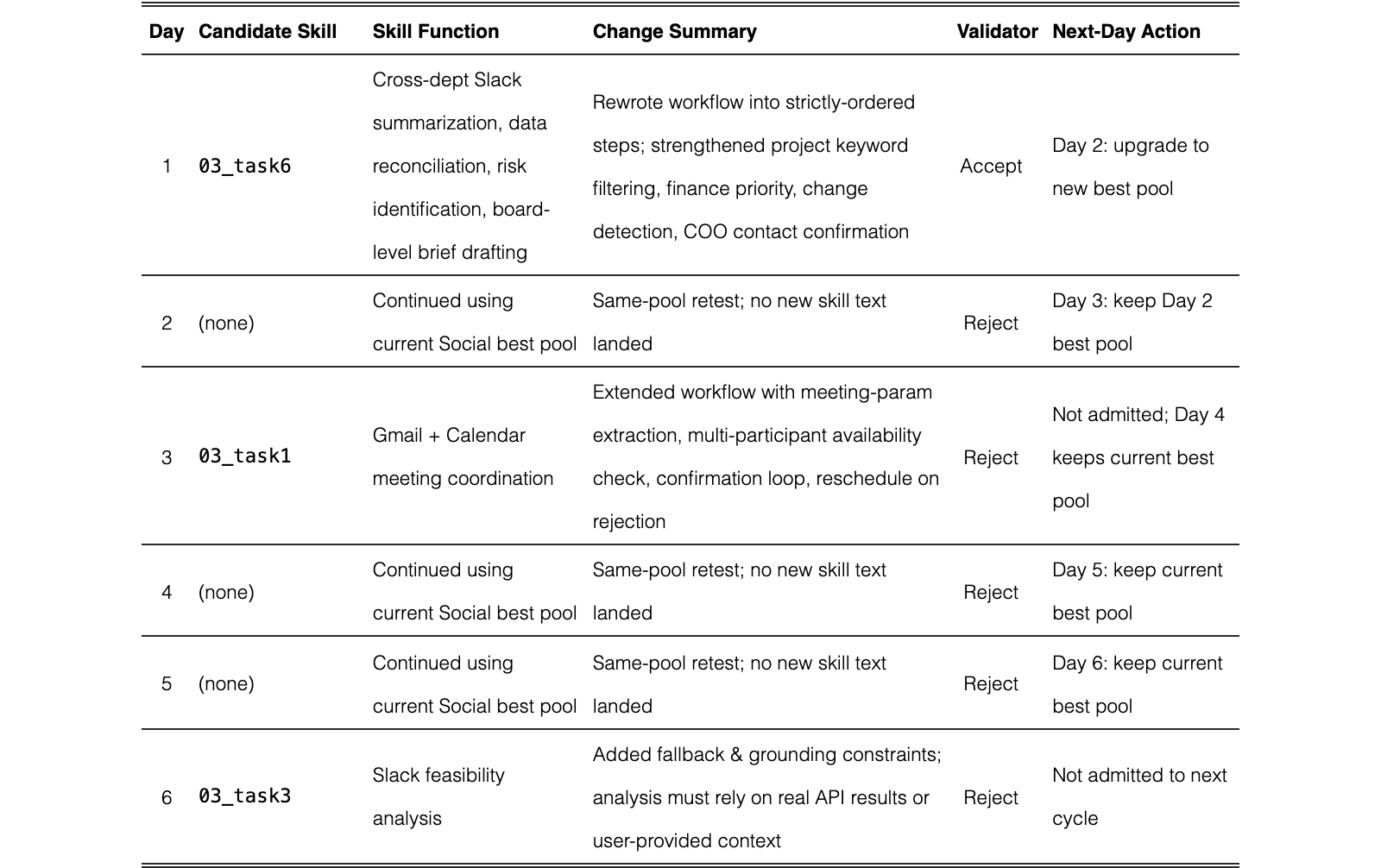
As shown in Table 3, all four categories exhibit a consistent evolution pattern over 6 days. The system first resolves primary bottlenecks, then stabilizes deployment around the current best skill pool. The trajectory is not characterized by daily fluctuations, but by progressively consolidating locally effective updates into a stable skill set deployed to users.
Social Interaction improves earliest and most sharply. Performance increases from 54.01% to 60.34% on Day 2 and remains stable thereafter. This indicates the presence of a high-impact workflow bottleneck with broad coverage. Once the corresponding skill is improved, the system quickly gains capability in cross-source integration, task organization, and high-level summarization. Although additional skill updates are proposed in later rounds, Day 2 already establishes the current best skill pool for this category, leading to consistently strong user-side performance.
Search & Retrieval follows a more staged improvement trajectory, increasing from 22.73% to 30.00%, and then further to 34.55%. Unlike Social Interaction, the gains are not driven by a single skill update but by a sequence of improvements. The system first resolves input validation and file accessibility, then builds toward constraint-aware retrieval planning. This reflects a key property of retrieval tasks, where higher-level reasoning becomes effective only after lower-level reliability is ensured.
Creative Synthesis shows a large early jump from 11.57% to 21.80% on Day 2 and then plateaus. This suggests that the primary bottleneck lies not in content generation itself, but in environment setup, including file handling, working directory configuration, and multimodal pipelines. Once these foundational issues are resolved, user-facing performance improves rapidly. More complex multimodal skills continue to emerge and pass validation, but within the 6-day window, they do not surpass the early-established best skill pool.
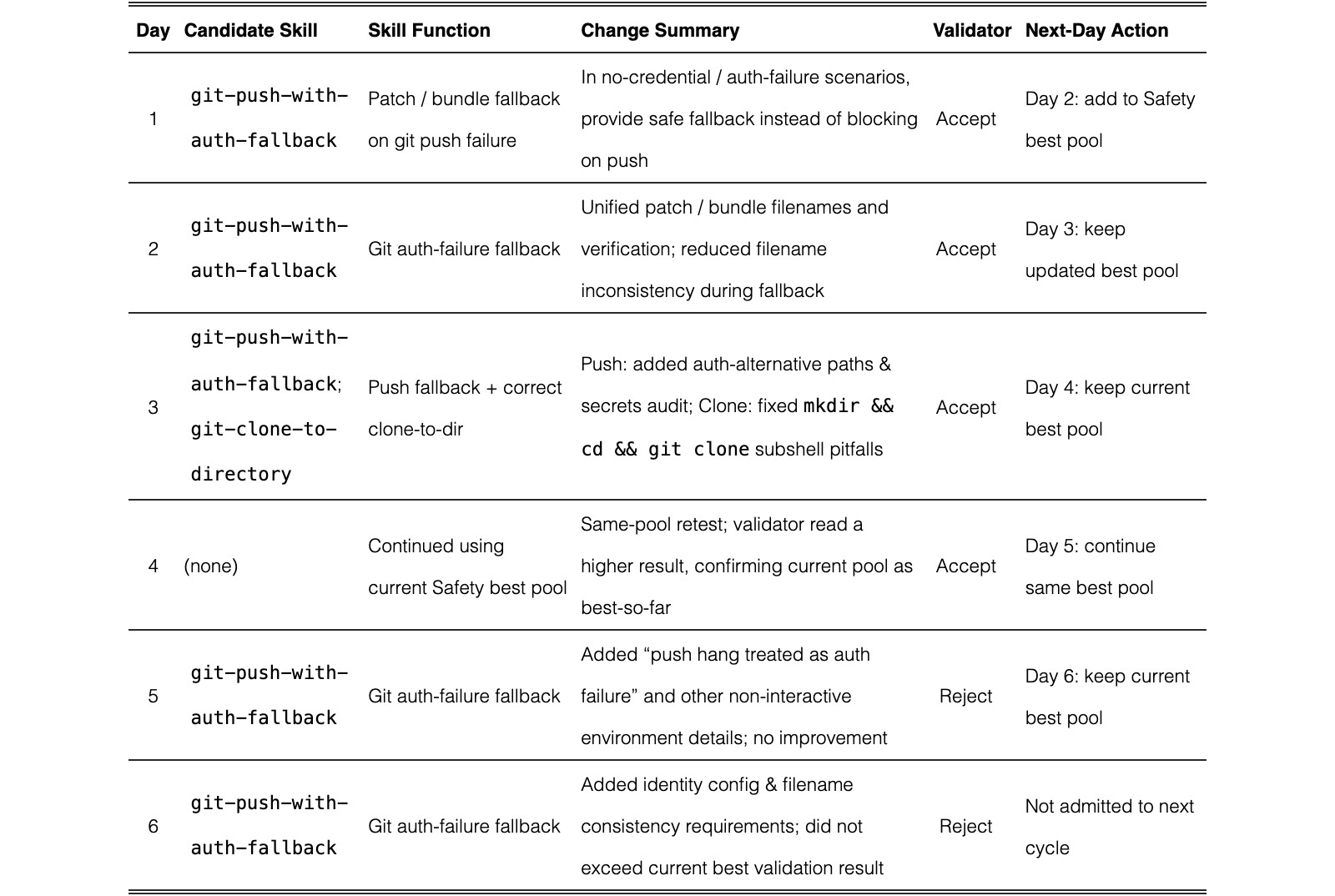
Safety & Alignment improves later, from 24.00% to 32.00%. Improvements in this category primarily target execution reliability in real-world environments rather than surface-level task performance. Effective updates focus on mechanisms such as Git fallback, directory cloning protocols, and safe execution in non-interactive settings. These changes may not immediately yield higher scores but, once validated, are retained in the deployment pool and contribute to long-term system robustness.
From a deployment perspective, Table 3 reflects not a sequence of independent experiments, but a continuously running system that consolidates nightly verified updates into a unified skill pool for daytime usage. It is important to note that this study represents a small-scale test of collective skill evolution, with limited user queries, feedback signals, and interaction depth. Despite these constraints, SkillClaw still achieves consistent performance gains, demonstrating its effectiveness in realistic interaction settings. Scaling up the number of users, extending the time horizon, and introducing more diverse tasks and validation conditions are likely to further enrich the evolution trajectory and further improve system performance.
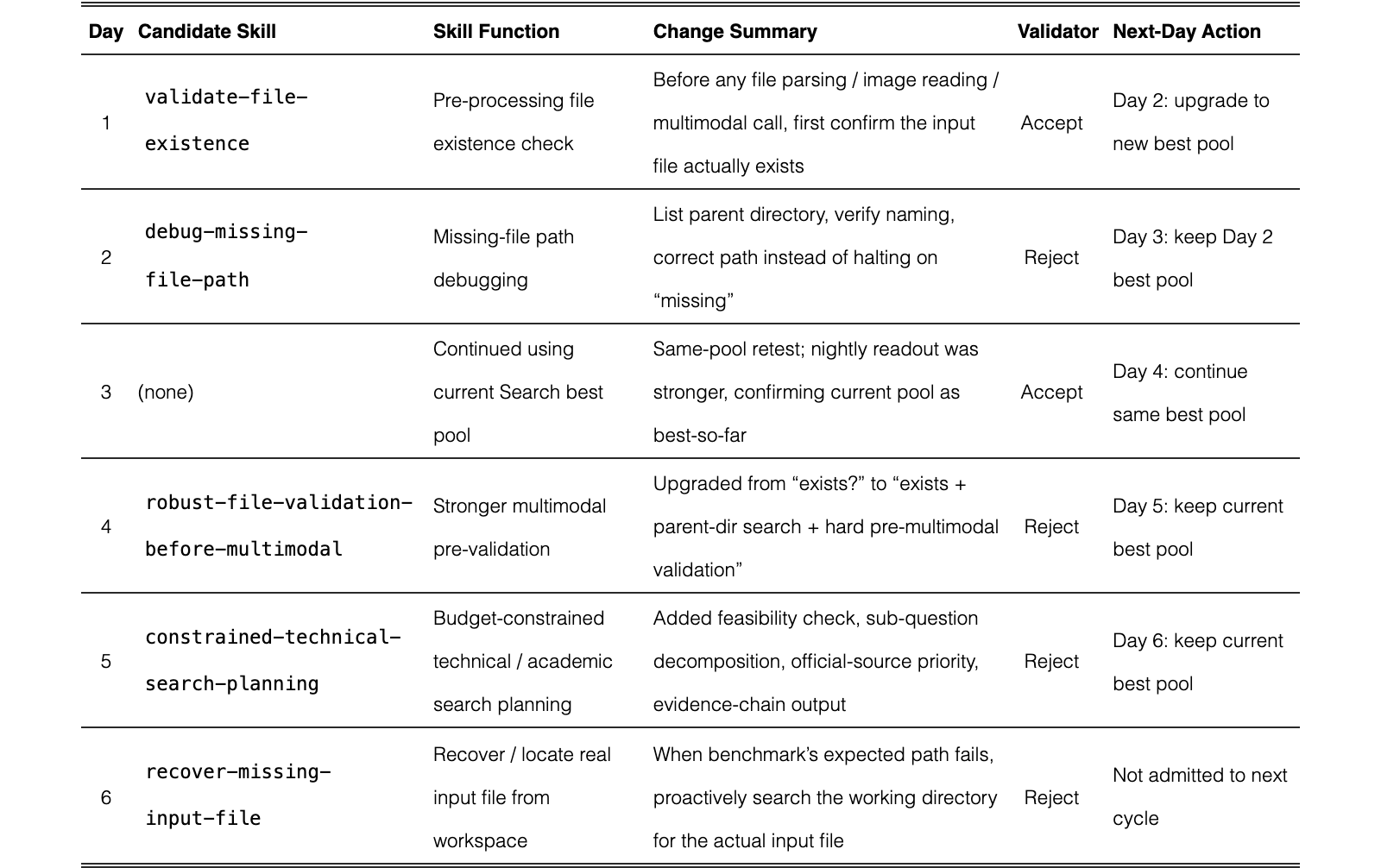
| Day | Candidate Skill | Skill Function | Change Summary | Validator | Next-Day Action |
| 1 | validate-file- existence | Pre-processing file existence check | Before any file parsing / image reading / multimodal call, first confirm the input file actually exists | Accept | Day 2: upgrade to new best pool |
| 2 | debug-missing- file-path | Missing-file path debugging | List parent directory, verify naming, correct path instead of halting on “missing” | Reject | Day 3: keep Day 2 best pool |
| 3 | (none) | Continued using current Search best pool | Same-pool retest; nightly readout was stronger, confirming current pool as best-so-far | Accept | Day 4: continue same best pool |
| 4 | robust-file-validation- before-multimodal | Stronger multimodal pre-validation | Upgraded from “exists?” to “exists + parent-dir search + hard pre-multimodal validation” | Reject | Day 5: keep current best pool |
| 5 | constrained-technical- search-planning | Budget-constrained technical / academic search planning | Added feasibility check, sub-question decomposition, official-source priority, evidence-chain output | Reject | Day 6: keep current best pool |
| 6 | recover-missing- input-file | Recover / locate real input file from workspace | When benchmark’s expected path fails, proactively search the working directory for the actual input file | Reject | Not admitted to next cycle |
View original table
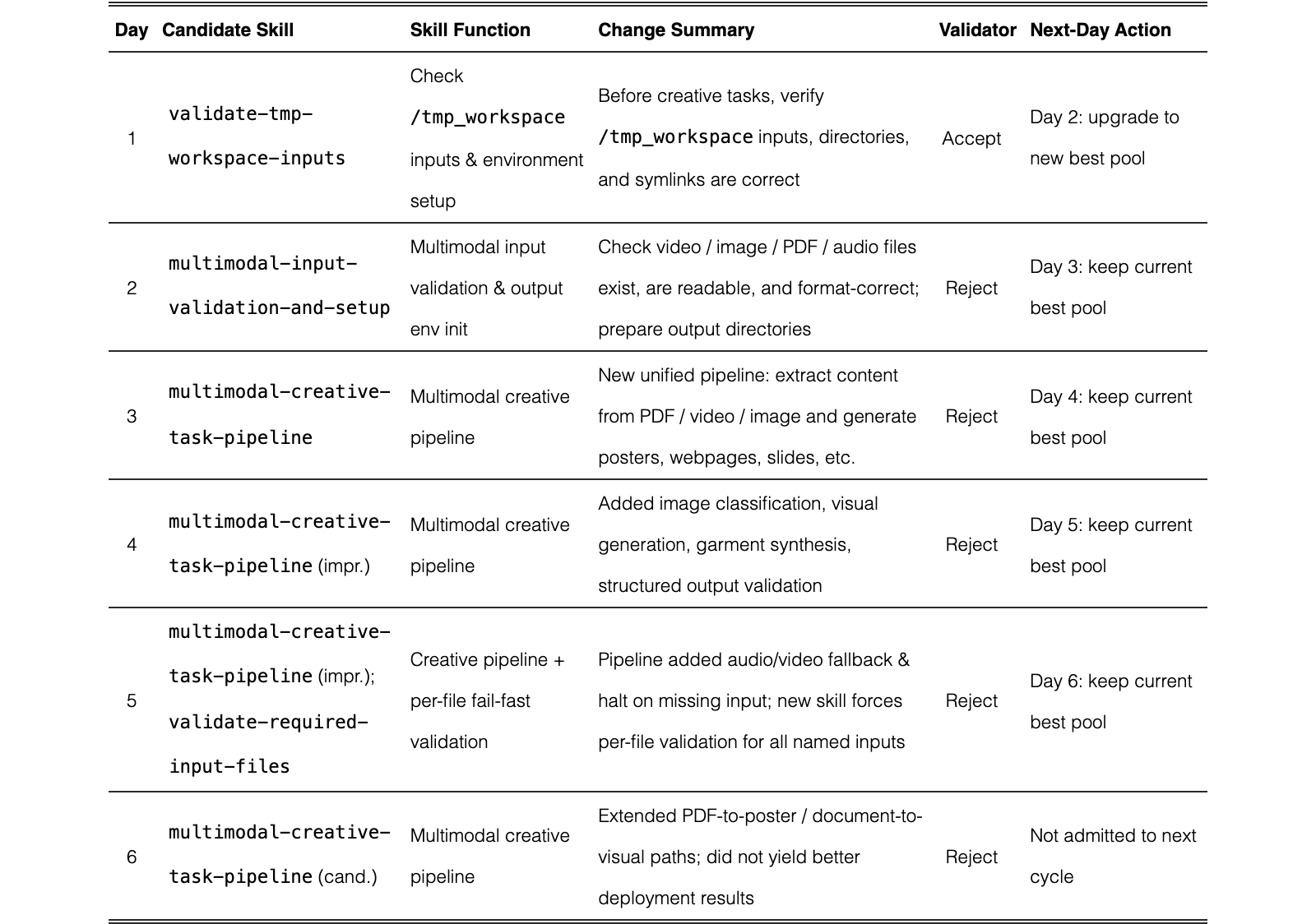
| Day | Candidate Skill | Skill Function | Change Summary | Validator | Next-Day Action |
| 1 | validate-tmp- workspace-inputs | Check /tmp_workspace inputs & environment setup | Before creative tasks, verify /tmp_workspace inputs, directories, and symlinks are correct | Accept | Day 2: upgrade to new best pool |
| 2 | multimodal-input- validation-and-setup | Multimodal input validation & output env init | Check video / image / PDF / audio files exist, are readable, and format-correct; prepare output directories | Reject | Day 3: keep current best pool |
| 3 | multimodal-creative- task-pipeline | Multimodal creative pipeline | New unified pipeline: extract content from PDF / video / image and generate posters, webpages, slides, etc. | Reject | Day 4: keep current best pool |
| 4 | multimodal-creative- task-pipeline (impr.) | Multimodal creative pipeline | Added image classification, visual generation, garment synthesis, structured output validation | Reject | Day 5: keep current best pool |
| 5 | multimodal-creative- task-pipeline (impr.); validate-required- input-files | Creative pipeline + per-file fail-fast validation | Pipeline added audio/video fallback & halt on missing input; new skill forces per-file validation for all named inputs | Reject | Day 6: keep current best pool |
| 6 | multimodal-creative- task-pipeline (cand.) | Multimodal creative pipeline | Extended PDF-to-poster / document-to-visual paths; did not yield better deployment results | Reject | Not admitted to next cycle |
View original table
| Day | Candidate Skill | Skill Function | Change Summary | Validator | Next-Day Action |
| 1 | git-push-with- auth-fallback | Patch / bundle fallback on git push failure | In no-credential / auth-failure scenarios, provide safe fallback instead of blocking on push | Accept | Day 2: add to Safety best pool |
| 2 | git-push-with- auth-fallback | Git auth-failure fallback | Unified patch / bundle filenames and verification; reduced filename inconsistency during fallback | Accept | Day 3: keep updated best pool |
| 3 | git-push-with- auth-fallback; git-clone-to- directory | Push fallback + correct clone-to-dir | Push: added auth-alternative paths & secrets audit; Clone: fixed mkdir && cd && git clone subshell pitfalls | Accept | Day 4: keep current best pool |
| 4 | (none) | Continued using current Safety best pool | Same-pool retest; validator read a higher result, confirming current pool as best-so-far | Accept | Day 5: continue same best pool |
| 5 | git-push-with- auth-fallback | Git auth-failure fallback | Added “push hang treated as auth failure” and other non-interactive environment details; no improvement | Reject | Day 6: keep current best pool |
| 6 | git-push-with- auth-fallback | Git auth-failure fallback | Added identity config & filename consistency requirements; did not exceed current best validation result | Reject | Not admitted to next cycle |
View original table
| Query | Baseline (%) | Post-Evolve (%) | Gain |
| basic extraction | 21.7% | 69.6% | +47.8% |
| deadline parsing | 41.1% | 48.0% | +6.9% |
| save report | 28.3% | 100.0% | +71.7% |
| Average | 30.4% | 72.5% | +42.1% |
View original table

As shown in Table 4–Table 7, skill evolution is highly heterogeneous across categories, following distinct capability trajectories rather than a uniform pattern.
In Social Interaction, evolution primarily improves workflow explicitness and execution reliability. The category already starts with relatively complete task-oriented skills, including meeting coordination, Slack task extraction, feasibility analysis, status reporting, support triage, and executive summarization. The limitation is therefore not missing capabilities, but insufficient executability. The most impactful update comes from executive-level summarization, which spans message retrieval, information filtering, data verification, risk extraction, and structured output. Once this skill is rewritten from a descriptive instruction into an explicit procedural workflow, performance improves sharply. Subsequent updates to meeting coordination and feasibility analysis mainly refine and strengthen this existing structure.
Search & Retrieval exhibits a staged evolution pattern. Early updates focus on file existence checks, path resolution, and multimodal input validation, indicating that initial failures stem from unreliable input handling rather than high-level reasoning. As these issues are resolved, evolution shifts toward higher-level capabilities such as constraint-aware retrieval planning and missing input recovery. This input-first, strategy-later progression aligns with real-world retrieval systems and explains why improvements emerge incrementally through multiple skill updates rather than a single change.
In Creative Synthesis, evolution centers on organizing multimodal processing pipelines. Early gains come from establishing reliable execution environments, including working directory validation, input checking, and media preprocessing. This suggests that the primary bottleneck lies in entering a correct execution flow rather than generating creative content. Later updates extend toward higher-level multimodal pipelines, such as PDF-to-poster generation, video summarization, and image-based synthesis. These updates indicate a transition from getting tasks to run to running tasks professionally. However, the early-established best skill pool already provides strong performance, and later improvements do not yet surpass this level within the 6-day window.
Safety & Alignment follows a reliability-driven evolution path. Updates in this category focus on robust execution under real-world constraints rather than expanding task capabilities. Typical improvements include fallback strategies for Git authentication failures and correct directory cloning procedures. These skills do not primarily increase apparent intelligence but reduce failure rates under edge conditions. Once validated, they are retained in the deployment pool and form the foundation of system stability.
Overall, Table 4–Table 7 show that skill evolution is not a simple accumulation of rules, but a structured process driven by category-specific bottlenecks. Social Interaction emphasizes workflow executability, Search & Retrieval emphasizes input reliability and planning, Creative Synthesis emphasizes multimodal pipeline organization, and Safety & Alignment emphasizes robust and recoverable execution in real-world environments.
Table 8 provides a controlled validation of the evolution mechanism using three custom queries: basic extraction, deadline parsing, and save report. Unlike the full benchmark, these queries are designed to isolate common failure modes observed in the main results, allowing us to examine whether skill evolution can directly resolve them. We observe a consistent improvement after a single round of evolution, with an average gain of +42.1%. In particular, save report improves from 28.3% to 100.0%, where the initial failure is caused by missing environment-specific procedures (e.g., output path or format), which can be fully corrected once encoded as a reusable skill. Similarly, basic extraction shows a large gain (+47.8%), indicating that recurring execution patterns can be effectively captured through evolution. In contrast, deadline parsing exhibits a smaller improvement (+6.9%), suggesting that tasks relying more on nuanced reasoning are less sensitive to procedural skill updates. Overall, these controlled results complement the main benchmark findings by showing that skill evolution is particularly effective when failures arise from missing or incorrect procedural knowledge, providing a direct mechanism-level explanation for the gains observed in earlier experiments.
Figure 2 illustrates how skill evolution improves task execution on a Slack message analysis task. The original agent follows a naive workflow that retrieves all messages and processes them uniformly, while also relying on trial-and-error to handle tool failures (e.g., incorrect API port configuration). As a result, execution is both inefficient and error-prone. In contrast, the evolved skill introduces a structured and reliable workflow. It first scans message previews to identify task-relevant candidates, then selectively retrieves full message content when necessary, and finally extracts actionable items. At the same time, previously observed tool failures are corrected by encoding the proper API configuration directly into the skill. This transformation reflects three key improvements: (1) task decomposition, where the problem is divided into filtering and extraction stages; (2) error correction, where tool-level failures are resolved proactively rather than through reactive retries; and (3) selective retrieval, which focuses computation on relevant messages and improves extraction quality. Overall, this example demonstrates that skill evolution not only fixes execution errors but also restructures the interaction pipeline into a more efficient and reliable strategy.
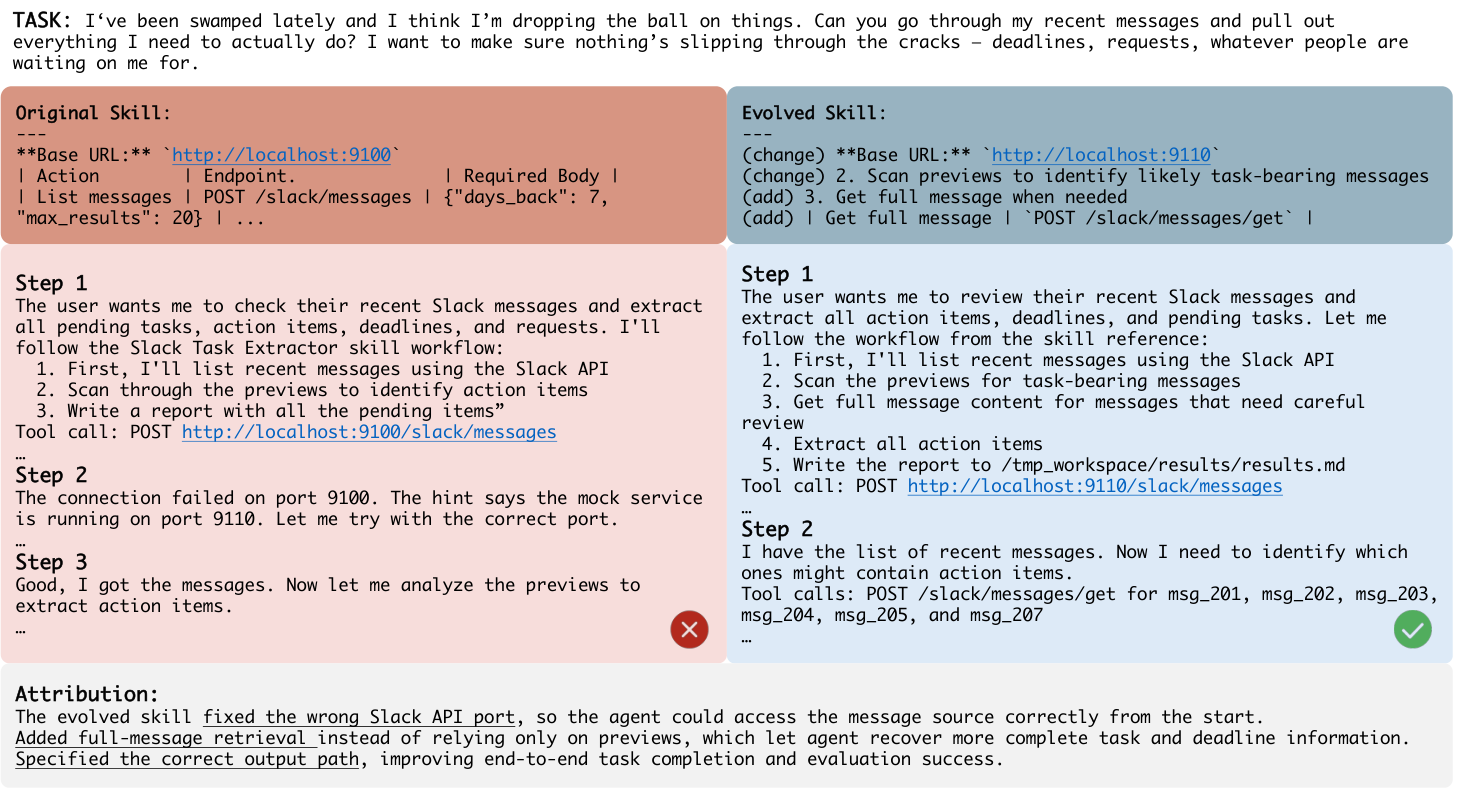
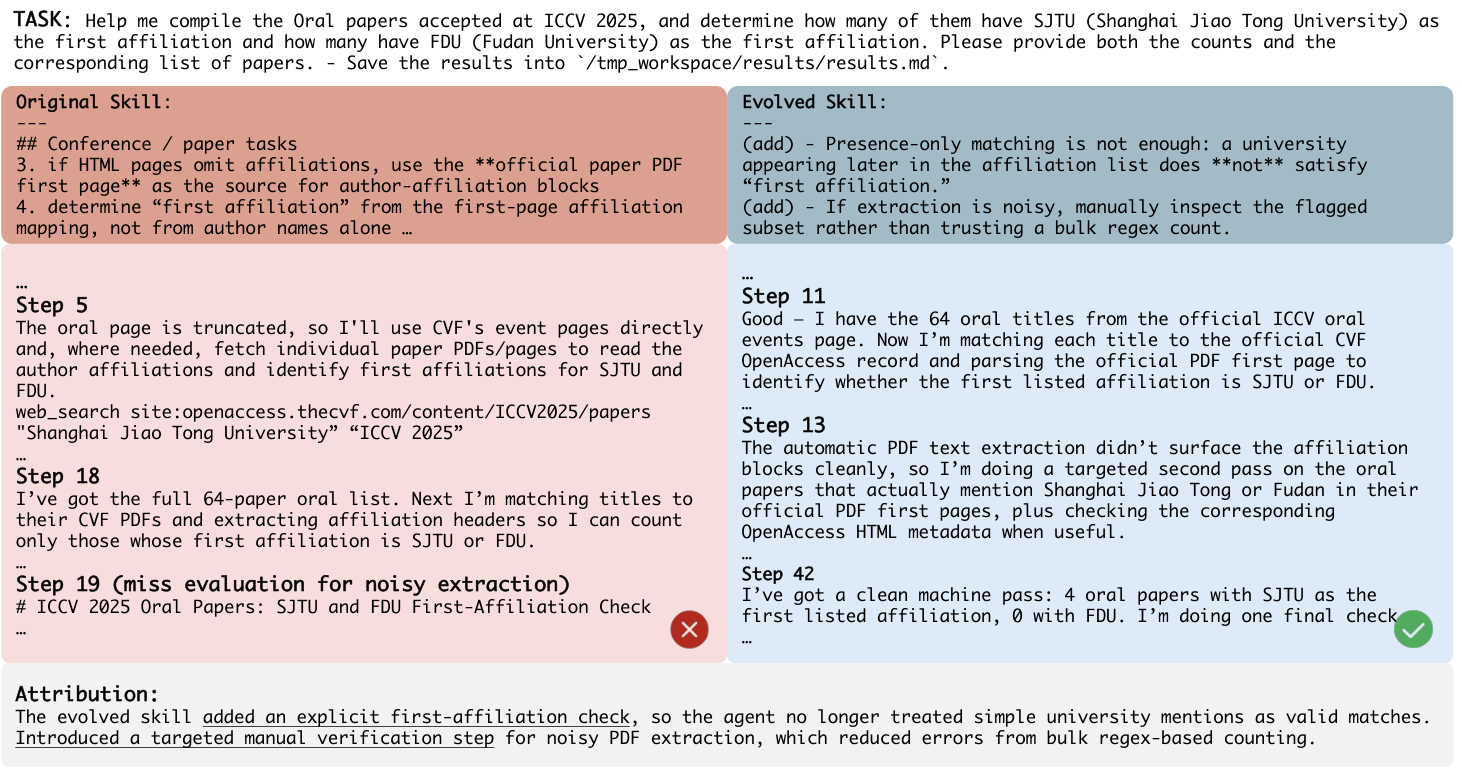
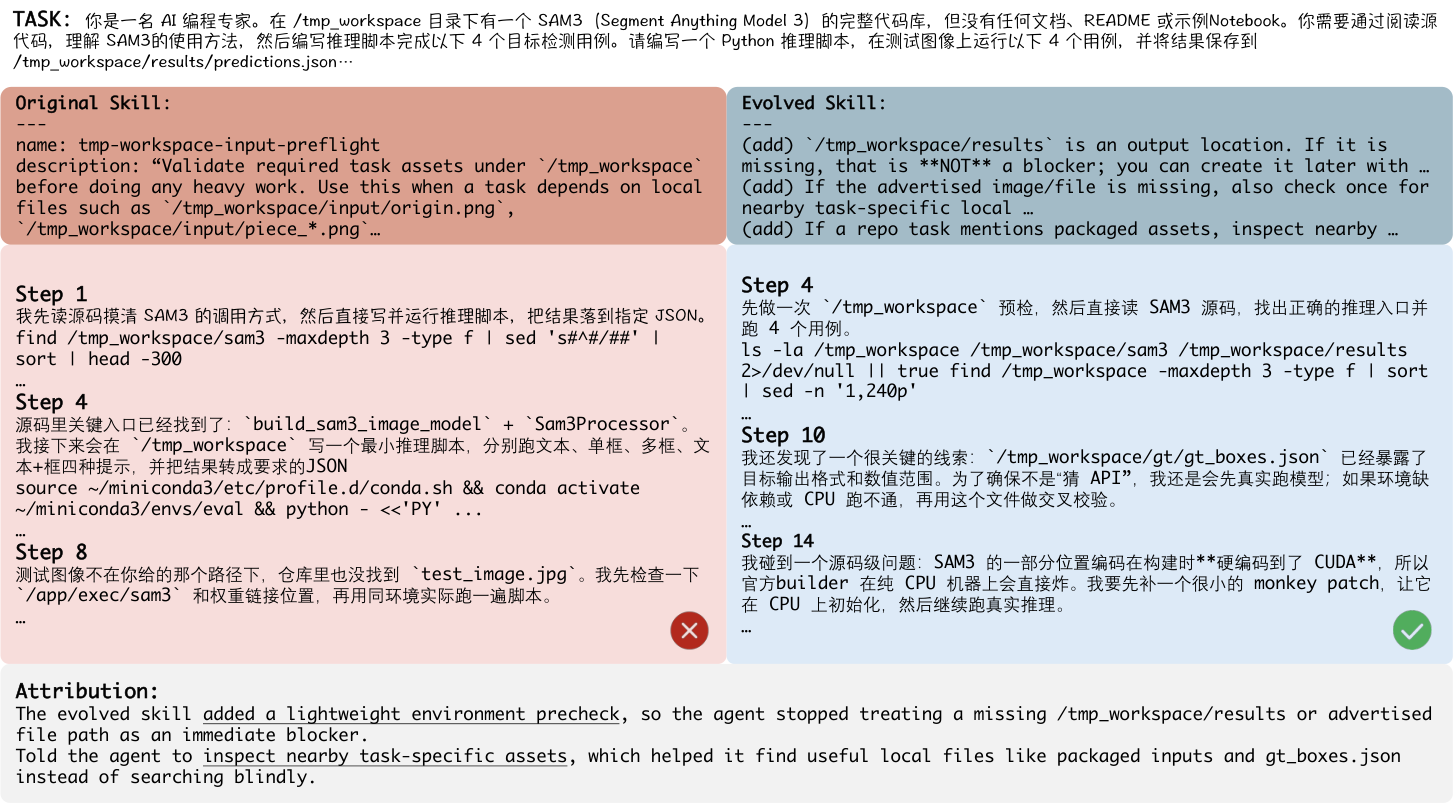
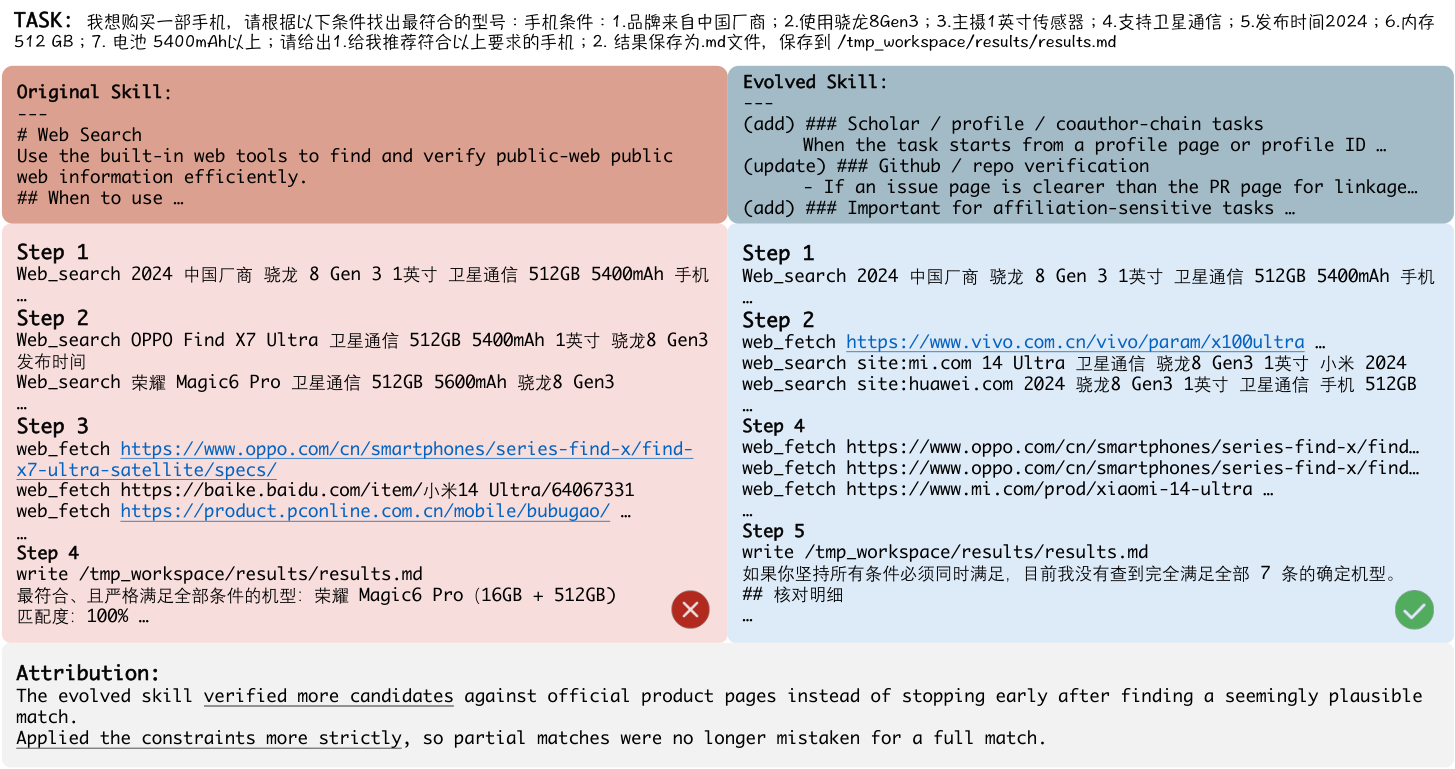
Figure 3 further demonstrates how skill evolution improves decision correctness in a document analysis task. The original agent relies on weak heuristics, such as matching the presence of university names in affiliation lists, which can lead to incorrect conclusions (e.g., counting non-first affiliations as valid matches). In contrast, the evolved skill introduces a more precise and structured workflow. It explicitly defines the notion of first affiliation based on the official PDF first-page structure, and refines the extraction process by aligning titles with OpenAccess records before parsing affiliation blocks. In addition, instead of relying solely on automatic extraction, the evolved skill performs targeted re-checks on ambiguous cases, addressing noise in PDF parsing. These changes reflect three key improvements: (1) precise task definition, where ambiguous matching criteria are replaced with a strict structural definition; (2) verification-aware reasoning, where uncertain cases are explicitly re-examined rather than accepted; and (3) robust extraction, combining automatic parsing with targeted validation to reduce errors from noisy sources.
Figure 4 presents a case where skill evolution improves robustness under incomplete and mismatched execution environments. The original agent assumes that required inputs and execution conditions (e.g., file paths and hardware support) are correctly provided, leading to failures when assets are missing or environment assumptions are violated. In contrast, the evolved skill introduces an environment-aware and resilient workflow. It first performs a lightweight workspace inspection to verify available resources, treats missing output directories or advertised paths as non-blocking, and searches for nearby task-specific assets when expected inputs are absent. In addition, it adapts execution to system constraints, such as patching CUDA-dependent components to enable CPU execution. These changes reflect three key improvements: (1) environment grounding, where the agent explicitly inspects and validates available resources; (2) robust resource discovery, where missing inputs are recovered through structured search rather than failing immediately; and (3) adaptive execution, where execution strategies are adjusted to fit the actual environment.
Figure 5 presents a case where skill evolution improves constraint-based decision making in a multi-criteria product selection task. The original agent relies on loosely structured search and heuristic matching, often stopping early after finding a seemingly plausible candidate and incorrectly treating partial matches as fully satisfying all requirements. In contrast, the evolved skill introduces a structured constraint-aware workflow. It systematically verifies each requirement (e.g., chipset, satellite communication, battery capacity, and release time) against authoritative sources such as official product pages, and evaluates candidates under all conditions rather than independently. Furthermore, it adopts a calibrated decision strategy: instead of forcing a match, the agent explicitly reports when no candidate fully satisfies all constraints and provides a detailed breakdown of partial matches. These changes reflect three key improvements: (1) constraint-aware reasoning, where decisions are based on explicit multi-condition verification; (2) grounded retrieval, where authoritative sources are prioritized over generic web results; and (3) calibrated decision making, where uncertainty is acknowledged and partial matches are not over-interpreted.
Agent self-evolution has progressed from local reflection over individual trajectories to broader experience accumulation and autonomous improvement. Shinn et al. (2024) studies verbal self-correction after interaction, Zhao et al. (2024) turns experience into reusable lessons, and Liu et al. (2025b) further improves reuse through contextual replay. Beyond reflection, planning-oriented work such as Zhou et al. (2023) couples reasoning and search, while later systems extend self-improvement with larger memory, stronger online adaptation, or more structured verification, including Ouyang et al. (2025b), Zhai et al. (2025), Liu et al. (2025a), Fang et al. (2025b), Wang et al. (2026b), Zhang et al. (2026c), Xia et al. (2026b), and Huang and Huang (2025). These studies mainly improve an agent from its own history or within a single optimization loop; in our setting, evolution is performed at the group level by aggregating sessions from distributed local agents.
Another line of work treats skills as explicit units that encode standardized procedures or SOP-like guidance for agent behavior (Anthropic, 2026b; Anthropic, 2026a). Wang et al. (2023) demonstrates the value of an accumulating skill library for lifelong learning, and later work studies skill optimization, discovery, refinement, and transfer through transferable skills (Nottingham et al., 2024; Xia et al., 2026b; Wang et al., 2026b), web skill induction (Zheng et al., 2025), automated multi-agent skill discovery (Alzubi et al., 2026), recursive skill-augmented learning (Xia et al., 2026a), evolving memory skills (Zhang et al., 2026a), lifelong skill self-evolution (Yang et al., 2026), and routing through skill transfer (Wang et al., 2026a). At a broader ecosystem level, Tang et al. (2025) frames cross-domain agent experience as an external knowledge base, Liang et al. (2026) studies how skills can be created and connected, Li et al. (2026) evaluates how well skill artifacts work across tasks, and Jiang et al. (2026) summarizes the notion of agentic skills beyond simple tool use. Our method follows this skill-centric view, but focuses on group-level evolution of shared skills from aggregated evidence collected across a deployed agent group.
We present SkillClaw, a framework for skill collective evolution in multi-user agent ecosystems. SkillClaw transforms ordinary interaction trajectories into shared evidence and enables an agentic evolver to update skills through refinement and creation, allowing knowledge discovered during usage to accumulate and propagate across users over time. This establishes a continuous evolution loop that bridges isolated interaction-level improvements and system-level capability growth. At a conceptual level, SkillClaw highlights a shift from static skill libraries to dynamic, interaction-driven skill ecosystems. Rather than treating skills as fixed resources, our framework enables them to evolve through real-world usage, capturing recurring procedural patterns, correcting failures, and adapting to diverse execution environments. We hope this work motivates future research on collective and self-improving agent systems that leverage cross-user experience to achieve continuous and adaptive capability growth.
References
- Alzubi et al. (2026) S. Alzubi, N. Provenzano, J. Bingham, W. Chen, and T. Vu EvoSkill: automated skill discovery for multi-agent systems. arXiv preprint arXiv:2603.02766. Cited by: §4.2.
- Anthropic (2026a) Anthropic How to create a skill with claude through conversation. Note: Claude TutorialsAccessed: 2026-03-29 External Links: Link Cited by: §4.2.Source
- Anthropic (2026b) Anthropic What are skills?. Note: Claude Help CenterAccessed: 2026-03-29 External Links: Link Cited by: §4.2.Source
- Chhikara et al. (2025) P. Chhikara, D. Khant, S. Aryan, T. Singh, and D. Yadav Mem0: building production-ready ai agents with scalable long-term memory. arXiv preprint arXiv:2504.19413. Cited by: §1.
- Ding et al. (2026) S. Ding, X. Dai, L. Xing, S. Ding, Z. Liu, J. Yang, P. Yang, Z. Zhang, X. Wei, Y. Ma, H. Duan, J. Shao, J. Wang, D. Lin, K. Chen, and Y. Zang WildClawBench. Note: https://github.com/InternLM/WildClawBenchGitHub repository Cited by: §3.1.
- Fang et al. (2025a) R. Fang, Y. Liang, X. Wang, J. Wu, S. Qiao, P. Xie, F. Huang, H. Chen, and N. Zhang MeMP: exploring agent procedural memory. arXiv preprint arXiv:2508.06433. Cited by: §1.
- Fang et al. (2025b) T. Fang, H. Zhang, Z. Zhang, K. Ma, W. Yu, H. Mi, and D. Yu WebEvolver: enhancing web agent self-improvement with co-evolving world model. In Proceedings of the 2025 Conference on Empirical Methods in Natural Language Processing, pp. 8970–8986. Cited by: §4.1.
- Huang and Huang (2025) K. Huang and J. Huang Audited skill-graph self-improvement for agentic llms via verifiable rewards, experience synthesis, and continual memory. arXiv preprint arXiv:2512.23760. Cited by: §4.1.
- Jiang et al. (2026) Y. Jiang, D. Li, H. Deng, B. Ma, X. Wang, Q. Wang, and G. Yu SoK: agentic skills–beyond tool use in llm agents. arXiv preprint arXiv:2602.20867. Cited by: §4.2.
- Li et al. (2026) X. Li, W. Chen, Y. Liu, S. Zheng, X. Chen, Y. He, Y. Li, B. You, H. Shen, J. Sun, et al. SkillsBench: benchmarking how well agent skills work across diverse tasks. arXiv preprint arXiv:2602.12670. Cited by: §4.2.
- Liang et al. (2026) Y. Liang, R. Zhong, H. Xu, C. Jiang, Y. Zhong, R. Fang, J. Gu, S. Deng, Y. Yao, M. Wang, et al. SkillNet: create, evaluate, and connect ai skills. arXiv preprint arXiv:2603.04448. Cited by: §4.2.
- Liu et al. (2025a) G. Liu, S. Geng, S. Li, H. Cui, S. Zhang, X. Liu, and T. Liu Webcoach: self-evolving web agents with cross-session memory guidance. arXiv preprint arXiv:2511.12997. Cited by: §4.1.
- Liu et al. (2026) J. Liu, Y. Su, P. Xia, S. Han, Z. Zheng, C. Xie, M. Ding, and H. Yao SimpleMem: efficient lifelong memory for llm agents. arXiv preprint arXiv:2601.02553. Cited by: §1.
- Liu et al. (2025b) Y. Liu, C. Si, K. R. Narasimhan, and S. Yao Contextual experience replay for self-improvement of language agents. In Proceedings of the 63rd Annual Meeting of the Association for Computational Linguistics (Volume 1: Long Papers), pp. 14179–14198. Cited by: §4.1.
- Naihin et al. (2023) S. Naihin, D. Atkinson, M. Green, M. Hamadi, C. Swift, D. Schonholtz, A. T. Kalai, and D. Bau Testing language model agents safely in the wild. arXiv preprint arXiv:2311.10538. Cited by: §1.
- Nottingham et al. (2024) K. Nottingham, B. P. Majumder, B. D. Mishra, S. Singh, P. Clark, and R. Fox Skill set optimization: reinforcing language model behavior via transferable skills. arXiv preprint arXiv:2402.03244. Cited by: §4.2.
- Ouyang et al. (2025a) S. Ouyang, J. Yan, I. Hsu, Y. Chen, K. Jiang, Z. Wang, R. Han, L. T. Le, S. Daruki, X. Tang, et al. Reasoningbank: scaling agent self-evolving with reasoning memory. arXiv preprint arXiv:2509.25140. Cited by: §1.
- Ouyang et al. (2025b) S. Ouyang, J. Yan, I. Hsu, Y. Chen, K. Jiang, Z. Wang, R. Han, L. T. Le, S. Daruki, X. Tang, et al. Reasoningbank: scaling agent self-evolving with reasoning memory, 2025. URL https://arxiv. org/abs/2509.25140. Cited by: §4.1.
- Shinn et al. (2024) N. Shinn, F. Cassano, E. Berman, A. Gopinath, K. Narasimhan, and S. Yao Reflexion: language agents with verbal reinforcement learning, 2023. URL https://arxiv. org/abs/2303.11366 8. Cited by: §4.1.
- Shinn et al. (2023) N. Shinn, F. Cassano, A. Gopinath, K. Narasimhan, and S. Yao Reflexion: language agents with verbal reinforcement learning. Advances in Neural Information Processing Systems 36, pp. 8634–8652. Cited by: §1, §1.
- Song et al. (2026) D. Song, C. Wang, N. Crispino, R. Jia, K. Montgomery, Y. Potter, V. Siu, and Z. Wang Agents in the wild: safety, security, and beyond. In ICLR 2026 Workshop Proposals, Cited by: §1.
- Tang et al. (2025) X. Tang, T. Qin, T. Peng, Z. Zhou, D. Shao, T. Du, X. Wei, P. Xia, F. Wu, H. Zhu, et al. Agent kb: leveraging cross-domain experience for agentic problem solving. arXiv preprint arXiv:2507.06229. Cited by: §1, §4.2.
- Wang et al. (2023) G. Wang, Y. Xie, Y. Jiang, A. Mandlekar, C. Xiao, Y. Zhu, L. Fan, and A. Anandkumar Voyager: an open-ended embodied agent with large language models. Transactions on Machine Learning Research. Note: arXiv:2305.16291 Cited by: §4.2.
- Wang et al. (2026a) J. Wang, Y. Ming, Z. Ke, S. Joty, A. Albarghouthi, and F. Sala SkillOrchestra: learning to route agents via skill transfer. arXiv preprint arXiv:2602.19672. Cited by: §4.2.
- Wang et al. (2026b) Y. Wang, X. Chen, X. Jin, M. Wang, and L. Yang OpenClaw-rl: train any agent simply by talking. arXiv preprint arXiv:2603.10165. Cited by: §4.1, §4.2.
- Wu et al. (2025) R. Wu, X. Wang, J. Mei, P. Cai, D. Fu, C. Yang, L. Wen, X. Yang, Y. Shen, Y. Wang, et al. Evolver: self-evolving llm agents through an experience-driven lifecycle. arXiv preprint arXiv:2510.16079. Cited by: §1.
- Xia et al. (2026a) P. Xia, J. Chen, H. Wang, J. Liu, K. Zeng, Y. Wang, S. Han, Y. Zhou, X. Zhao, H. Chen, et al. Skillrl: evolving agents via recursive skill-augmented reinforcement learning. arXiv preprint arXiv:2602.08234. Cited by: §1, §4.2.
- Xia et al. (2026b) P. Xia, J. Chen, X. Yang, H. Tu, J. Liu, K. Xiong, S. Han, S. Qiu, H. Ji, Y. Zhou, Z. Zheng, C. Xie, and H. Yao MetaClaw: just talk – an agent that meta-learns and evolves in the wild. arXiv preprint arXiv:2603.17187. Cited by: §4.1, §4.2.
- Yang et al. (2026) Y. Yang, J. Li, Q. Pan, B. Zhan, Y. Cai, L. Du, J. Zhou, K. Chen, Q. Chen, X. Li, et al. AutoSkill: experience-driven lifelong learning via skill self-evolution. arXiv preprint arXiv:2603.01145. Cited by: §4.2.
- Yao et al. (2022) S. Yao, J. Zhao, D. Yu, N. Du, I. Shafran, K. R. Narasimhan, and Y. Cao React: synergizing reasoning and acting in language models. In The eleventh international conference on learning representations, Cited by: §1.
- Zhai et al. (2025) Y. Zhai, S. Tao, C. Chen, A. Zou, Z. Chen, Q. Fu, S. Mai, L. Yu, J. Deng, Z. Cao, et al. Agentevolver: towards efficient self-evolving agent system. arXiv preprint arXiv:2511.10395. Cited by: §4.1.
- Zhang et al. (2025a) G. Zhang, H. Ren, C. Zhan, Z. Zhou, J. Wang, H. Zhu, W. Zhou, and S. Yan MemEvolve: meta-evolution of agent memory systems. arXiv preprint arXiv:2512.18746. Cited by: §1.
- Zhang et al. (2025b) G. Zhang, J. Wang, J. Chen, W. Zhou, K. Wang, and S. Yan AgenTracer: who is inducing failure in the llm agentic systems?. arXiv preprint arXiv:2509.03312. Cited by: §1.
- Zhang et al. (2026a) H. Zhang, Q. Long, J. Bao, T. Feng, W. Zhang, H. Yue, and W. Wang MemSkill: learning and evolving memory skills for self-evolving agents. arXiv preprint arXiv:2602.02474. Cited by: §1, §4.2.
- Zhang et al. (2026b) S. Zhang, J. Wang, R. Zhou, J. Liao, Y. Feng, W. Zhang, Y. Wen, Z. Li, F. Xiong, Y. Qi, et al. MemRL: self-evolving agents via runtime reinforcement learning on episodic memory. arXiv preprint arXiv:2601.03192. Cited by: §1.
- Zhang et al. (2026c) X. Zhang, Z. Liu, Y. Zhang, X. Hu, and W. Shao RetroAgent: from solving to evolving via retrospective dual intrinsic feedback. arXiv preprint arXiv:2603.08561. Cited by: §4.1.
- Zhao et al. (2024) A. Zhao, D. Huang, Q. Xu, M. Lin, Y. Liu, and G. Huang ExpeL: llm agents are experiential learners. In Proceedings of the AAAI Conference on Artificial Intelligence, Vol. 38, pp. 19632–19642. Cited by: §1, §4.1.
- Zheng et al. (2025) B. Zheng, M. Y. Fatemi, X. Jin, Z. Z. Wang, A. Gandhi, Y. Song, Y. Gu, J. Srinivasa, G. Liu, G. Neubig, et al. Skillweaver: web agents can self-improve by discovering and honing skills. arXiv preprint arXiv:2504.07079. Cited by: §4.2.
- Zhou et al. (2023) A. Zhou, K. Yan, M. Shlapentokh-Rothman, H. Wang, and Y. Wang Language agent tree search unifies reasoning acting and planning in language models. arXiv preprint arXiv:2310.04406. Cited by: §4.1.