From Context to Skills: Can Language Models Learn from Context Skillfully?
arXiv:2604.27660v4 · This workspace stays on this version. Check arXiv for newer versions
Some source details need review 8 to check
Original formulas, table values and figures are preserved. Comparison can miss differences; use the original PDF to check details.
Reading view checked: 320 math expressions, 0 rendering failures; 34 of 34 images available.
Compared 97 of 97 source passages against 30 of 39 PDF pages.
- A4_fig4: the arXiv HTML draws 1 text or formula block(s) of this graphic outside its frame; each was scaled into its frame (to 91% or more) without changing any text or formula. Text may look smaller than in the PDF.
- A4_F7: the arXiv HTML draws 1 text or formula block(s) of this graphic outside its frame; each was scaled into its frame (to 94% or more) without changing any text or formula. Text may look smaller than in the PDF.
- A4_F8: the arXiv HTML draws 1 text or formula block(s) of this graphic outside its frame; each was scaled into its frame (to 87% or more) without changing any text or formula. Text may look smaller than in the PDF.
- A4_F9: the arXiv HTML draws 1 text or formula block(s) of this graphic outside its frame; each was scaled into its frame (to 98% or more) without changing any text or formula. Text may look smaller than in the PDF.
- A4_F10: the arXiv HTML draws 1 text or formula block(s) of this graphic outside its frame; each was scaled into its frame (to 87% or more) without changing any text or formula. Text may look smaller than in the PDF.
- A4_F13: the arXiv HTML draws 1 text or formula block(s) of this graphic outside its frame; each was scaled into its frame (to 76% or more) without changing any text or formula. Text may look smaller than in the PDF.
- This long paper was only partially compared; the original sources remain available.
HTML block S1_p1_1 says “large-scale pre-training [[5](#bib.bib17), [28](#bib.bib30), [39](#bib.bib13)]”, while the original PDF (page 1) visibly says “large-scale pre-training [5, 27, 39]”; the PDF contradicts HTML. Check PDF page 1
34 of 34 figure, table and graphic images captured. Open original PDF
Abstract
Many real-world tasks require language models (LMs) to reason over complex contexts that exceed their parametric knowledge. This calls for context learning, where LMs directly learn relevant knowledge from the given context. An intuitive solution is inference-time skill augmentation: extracting the corresponding rules and procedures from context into explicit, natural-language skills. However, constructing such skills for context learning scenarios faces two fundamental challenges: the prohibitive cost of manual skill annotation for long, technically dense contexts, and the lack of external feedback for automated skill construction. In this paper, we propose Ctx2Skill, a self-evolving framework that autonomously discovers, refines, and selects context-specific skills without human supervision or external feedback. At its core, a multi-agent self-play loop has a Challenger that generates probing tasks and rubrics, a Reasoner that attempts to solve them guided by an evolving skill set, and a neutral Judge that provides binary feedback. Crucially, both the Challenger and the Reasoner evolve through accumulated natural-language skills: dedicated Proposer and Generator agents analyze failure cases and synthesize them into targeted skill updates for both sides, enabling automated skill discovery and refinement. To prevent adversarial collapse caused by increasingly extreme task generation and over-specialized skill accumulation, we further introduce a Cross-time Replay mechanism that identifies the skill set achieving the best balance across representative cases for the Reasoner side, ensuring robust and generalizable skill evolution. The resulting skills can be plugged into any language model to obtain better context learning capability. Evaluated on four context learning tasks from CL-bench, Ctx2Skill consistently improves solving rates across backbone models, e.g., lifting GPT-4.1 from to , GPT-5.1 from to .
Current language models (LMs) have achieved impressive performance on problems whose relevant knowledge was present during large-scale pre-training [5, 28, 39], such as competition-level mathematical problems [14] and competitive programming challenges [17]. However, many real-world tasks require LMs to learn from complex contexts and leverage new knowledge rather than parametric knowledge to reason and solve them effectively [26, 36, 47]. Previous works refer to this capability as context learning [12]. Effective context learning enables models to reason beyond their pre-trained knowledge and solve complex, domain-specific tasks by learning directly from rich contextual information, much as humans do. For example, it allows LMs to rapidly make use of previously unseen product documentation to generate step-by-step operational procedures or troubleshoot issues.
Despite the central role of context learning in solving real-world tasks, it has been largely overlooked in current research [16]. A key obstacle is the diversity of real-world contexts: contextual knowledge can be conveyed through books, experimental data, and search results, among others, making context learning fundamentally difficult. An intuitive paradigm is inference-time skill augmentation [3], i.e., extracting rules and procedures from context into natural-language skills that encode reusable procedural knowledge for LMs. This approach has proven effective in many agent tasks [42, 49, 37], e.g., coding agents [24]. However, this paradigm faces two fundamental challenges in context learning scenarios. Specifically, (1) Prohibitive Cost for Manual Skill Annotation: Existing agent skill libraries are predominantly constructed through human annotation [18, 20, 41]. However, this paradigm breaks down in context learning scenarios, where contexts are long, technically dense, and domain-specific. Curating high-quality skills requires annotators to fully internalize complex, multi-section documents, a process that is both cognitively demanding and economically infeasible, rendering human-curated skill construction impractical at scale. (2) Lack of External Feedback for Automated Skill Construction: Unlike verifiable tasks such as coding or mathematical reasoning [7, 31], where skill quality can be assessed via execution feedback or ground-truth comparison, context learning tasks lack automatic feedback to evaluate whether extracted skills faithfully and completely capture context-specific knowledge. Given only the context, there is no external feedback signal to tell whether a generated skill is useful or whether critical knowledge has been omitted. This feedback-free nature renders automated skill construction pipelines inapplicable [1, 44, 46]. Together, these challenges highlight the need for an automated framework that discovers skills from the context without relying on either human annotation or external feedback signals.
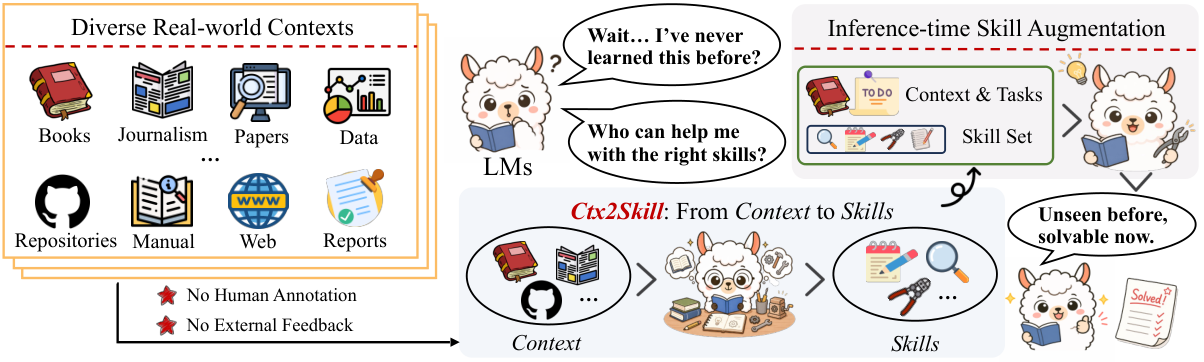
In this paper, we propose Ctx2Skill shown in Figure 1, which is designed to autonomously discover, refine, and select skills directly from complex contexts via skill-optimized self-play, requiring neither human annotation nor external feedback. At the core of Ctx2Skill is a multi-agent self-play loop [10, 22, 48, 21] comprising two competing but co-evolving roles: a Challenger agent, which generates a batch of tasks and associated rubrics [15] based on context and its skill set, aiming to probe deep contextual understanding, and a Reasoner agent, which reads the context and attempts to solve these tasks guided by its current skill set. The core idea of Ctx2Skill is that the two agents co-evolve by iteratively updating their respective skill sets rather than model parameters. Specifically, a neutral Judge agent evaluates the Reasoner’s responses against each rubric, producing feedback on whether it passes. Crucially, both the Challenger and Reasoner evolve through accumulated natural-language skills: failed cases are routed to dedicated Proposer and Generator agents on the Reasoner side to diagnose missing contextual knowledge and update skills accordingly, while easily solved cases are routed to the Challenger side to strengthen its task and rubric generation strategies, ensuring sustained adversarial pressure. The updated skills are carried forward into the next iteration, allowing both sides to continuously co-evolve through failure-driven textual feedback without any parameter updates. Furthermore, we identify a key risk in this multi-agent self-play loop, namely adversarial collapse phenomenon: as iterations progress, the Challenger may generate increasingly extreme tasks while the Reasoner’s skills over-specialize to these pathological cases, resulting in redundant skill accumulation that degrades generalization. To address this, we further propose a Cross-time Replay mechanism that selects the skill set that best balances performance across representative cases, ensuring robust and generalizable skill evolution. At inference time, the resulting context-specific Reasoner skills can be plugged into any LM to enhance its context learning capability on arbitrary tasks over the same context, including those unseen during the self-play loop.
We evaluate our Ctx2Skill on four context learning tasks from CL-Bench [12], including Domain Knowledge Reasoning, Rule System Application, Procedural Task Execution, and Empirical Discovery & Simulation. Ctx2Skill consistently improves solving rate across all four categories and multiple backbone models: it raises GPT-4.1 [27] from to , GPT-5.1 [28] from to , and GPT-5.2 [28] from to , demonstrating that autonomously discovered context-specific skills provide substantial and generalizable gains.
Context Learning. Current language models excel at tasks whose relevant knowledge was present during pre-training [9, 28, 33, 34]. However, many real-world tasks require models to learn from complex contexts and leverage new knowledge to reason effectively, a capability termed context learning [12]. This context learning capability is essential in practice: a physician consults newly released clinical guidelines to adjust treatment, an engineer reads documentation to execute procedures, and a researcher induces patterns from experimental data to form hypotheses. However, prior work finds that LMs have yet to master this capability [12]. The core difficulty is that contextual knowledge spans diverse formats, from books to experimental datasets, and the relevant rules and procedures are often embedded implicitly, requiring deep comprehension rather than surface-level retrieval. Ctx2Skill directly targets this challenge by autonomously discovering reusable, context-specific skills from the contexts, equipping any LM to better learn from and reason over complex contexts.
Skills for LMs. Skills are natural-language modules that encode reusable procedural knowledge to augment LMs at inference time [2, 3], and skill augmentation has been widely validated across agent tasks [32], e.g., coding [24] and web navigation [42]. Early skill libraries are predominantly constructed through human annotation [18, 19, 20, 41], which is effective but does not scale, especially for context learning scenarios where contexts are long, technically dense, and domain-specific. Recent work has shifted toward automated skill construction. AutoSkill [44] extracts reusable behaviors from interaction traces as lifelong versioned artifacts, and AutoRefine [30] converts agent trajectories into reusable expertise. CoEvoSkills [45] generates multi-file skill packages and refines them through generator–verifier co-evolution, while EvoSkill [1] performs failure-driven refinement into structured skill folders. SkillX [40] distills the agent trajectories into a hierarchical skill knowledge base and iteratively refines them through execution feedback. However, these methods rely on external feedback signals [25], such as execution feedback, ground-truth comparison, or task-completion rewards, to evaluate and improve skill quality, which are not available in context learning scenarios where there is no automatic feedback. A separate line of work tries to internalize skills into model parameters. SKILL0 [23] uses in-context reinforcement learning (RL) to absorb skills, and SkillRL [43] builds a hierarchical skill bank via RL-guided distillation from teacher trajectories. These approaches require parameter access, making them inapplicable to closed-source models, and sacrificing the interpretability of natural-language skill documents. In this paper, we propose Ctx2Skill, a self-evolving framework designed to directly discover and evolve skills from complex contexts alone, which requires no human annotation, no external feedback, and no parameter updates.
Context learning tasks [12] require LMs to leverage contextual knowledge from long, technically dense contexts to reason and solve tasks effectively. An intuitive paradigm for context learning tasks is inference-time skill augmentation, i.e., extracting the corresponding rules and procedures from context into natural-language skills. Turning this idea into a working framework, however, faces two difficulties: (1) prohibitive cost for manual skill annotation and (2) lack of external feedback for automated skill construction. In this paper, we introduce Ctx2Skill shown in Figure 2, a self-evolving framework that autonomously discovers, refines, and selects context-specific skills without human supervision or external feedback. At its core, a skill-optimized self-play loop (§ 3.3) co-evolves two competing sides: a Challenger probes the context with tasks and rubrics guided by its own skill set, a Reasoner solves them under its current skill set, and a neutral Judge returns binary verdicts that route each outcome to a side-specific Proposer–Generator pair, which diagnoses the exposed weakness and edits that side’s skills accordingly, so that both sides co-evolve without human annotation or external feedback. Furthermore, a key risk in this self-play framework is adversarial collapse: the Challenger may generate increasingly extreme tasks while the Reasoner’s skills over-specialize to these pathological cases, resulting in redundant skill accumulation that degrades generalization. To address this, we further propose a Cross-Time Replay mechanism (§ 3.4) that selects the skill set that best balances performance across representative cases, ensuring robust and generalizable skill evolution. In this way, Ctx2Skill autonomously constructs context-specific skills that can be plugged into any LM at inference time to enhance context learning capability without parameter updates.
A context learning task [12] consists of a given context whose content may lie outside the LM’s pretraining corpus, a set of tasks whose correct answers depend on , and a set of binary rubrics . Given an answer produced by an LM , the task is considered solved only when every rubric passes, we define a solving indicator for task as:
Our goal is to enable the LM to solve tasks over a previously unseen context without any parameter update or external feedback. To this end, we introduce a natural-language skill set , a short Markdown file pre-pended to the system prompt of the LM at inference time:
During the skills construction of our proposed Ctx2Skill, is instantiated as two separate skill sets: for the Reasoner agent and for the Challenger agent. At inference time, only the Reasoner’s skill set is deployed with an LM for context-specific tasks evaluation.
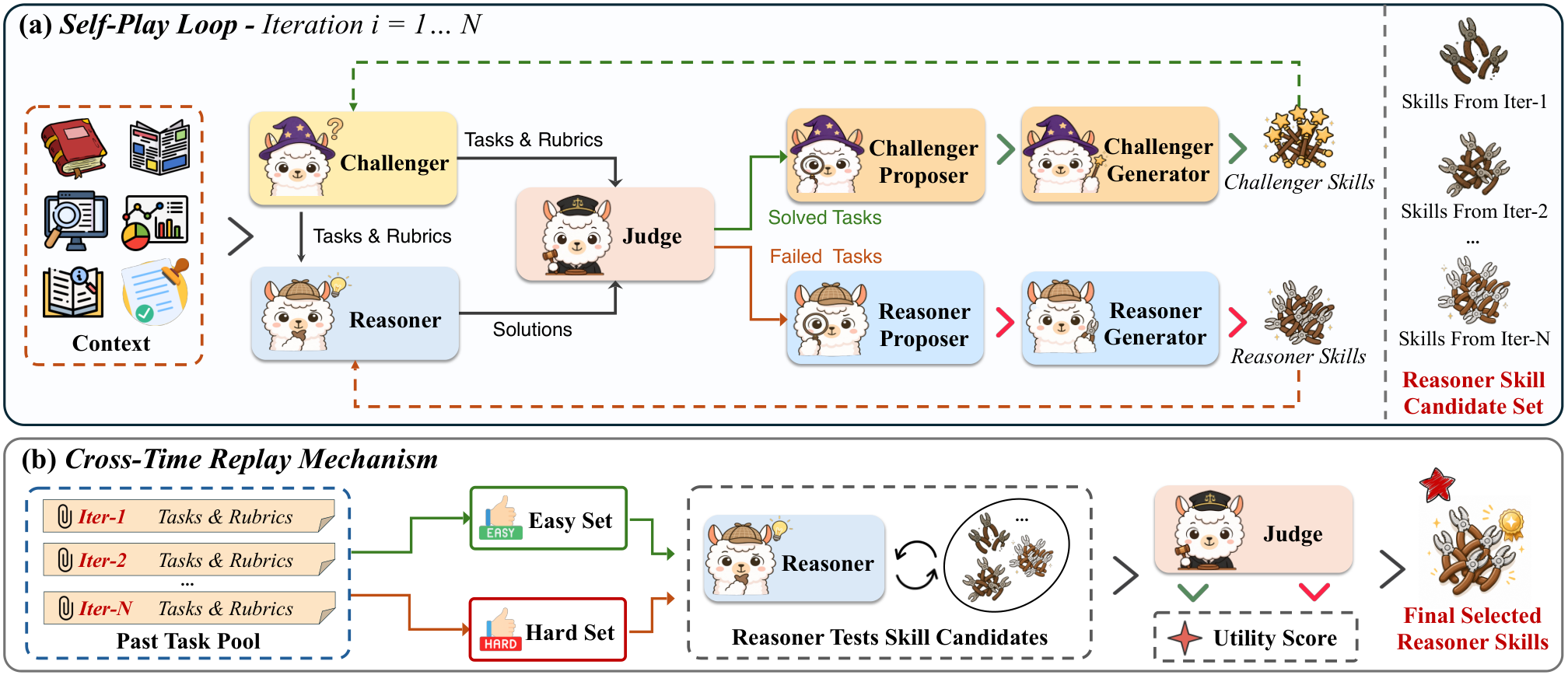
Building a skill set for an unseen context faces two obstacles: human annotation is costly to read and write down its contextual knowledge, and no external feedback signal can tell us whether a proposed skill is faithful and useful to . To address both, Ctx2Skill runs a multi-agent self-play loop that autonomously discovers and refines context-specific skills from context alone.
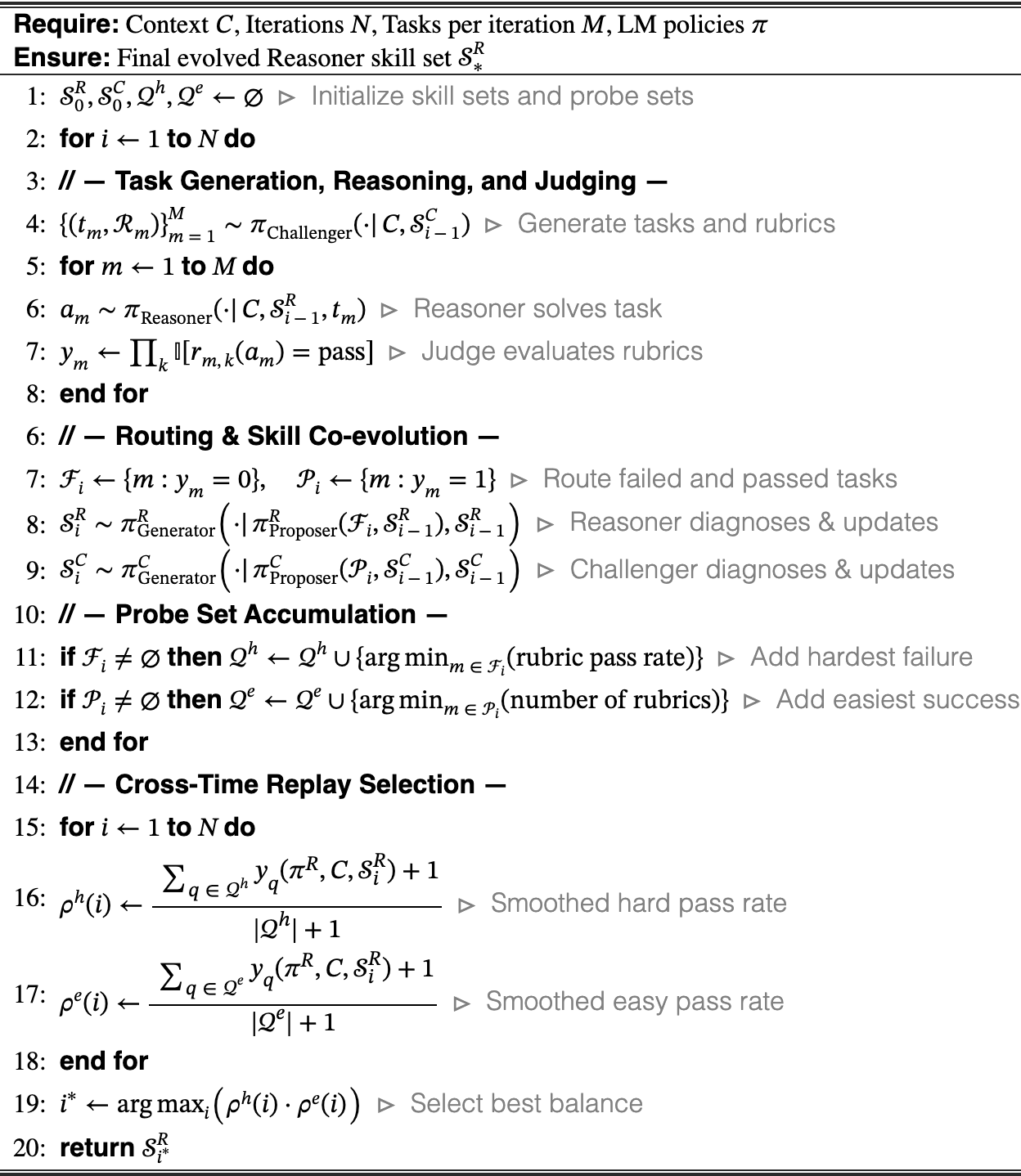
The core idea of Ctx2Skill is to co-evolve two skill sets, skill set for the Reasoner and skill set for the Challenger, through iterations of failure-driven textual edits, so that the Reasoner gradually accumulates the contextual knowledge of the context while the Challenger keeps probing aspects not yet mastered. Five frozen-LM agent roles carry out this self-play loop. At iteration , given the context and skill set , the Challenger produces a batch of tasks with corresponding rubrics; the Reasoner, guided by context and its skills , attempts each task; the neutral Judge returns per-task binary verdicts and partitions the batch into failed and solved tasks. Each group is then routed to its corresponding side through a Proposer–Generator pair: failed cases flow to the Reasoner side, where the Proposer diagnoses which contextual knowledge is missing and the Generator updates accordingly; solved cases flow to the Challenger side, where the corresponding pair tightens so that the next iteration sustains adversarial pressure. The updated and are carried into iteration , and no prompt is ever conditioned on the opposing side’s skill set, keeping the two sides strictly adversarial. We now define the five agent roles as follows at the iteration :
- •
Challenger: Given the context and its current skill set , the Challenger produces a batch of tasks , each equipped with corresponding rubrics . The rubrics are designed so that a correct answer requires inducing the rules of rather than paraphrasing surface spans. By conditioning on its skills , the Challenger adapts its probing strategy across iterations, sustaining adversarial pressure as the Reasoner improves.
- •
Reasoner: Given , a task , and its current skill set , the Reasoner produces an answer . While the raw context contains all necessary knowledge, it is often long and technically dense; the skill set distills the most relevant rules and procedures from into a concise, structured form, allowing the Reasoner to directly apply contextual knowledge that would otherwise need to be extracted from scratch at every task.
- •
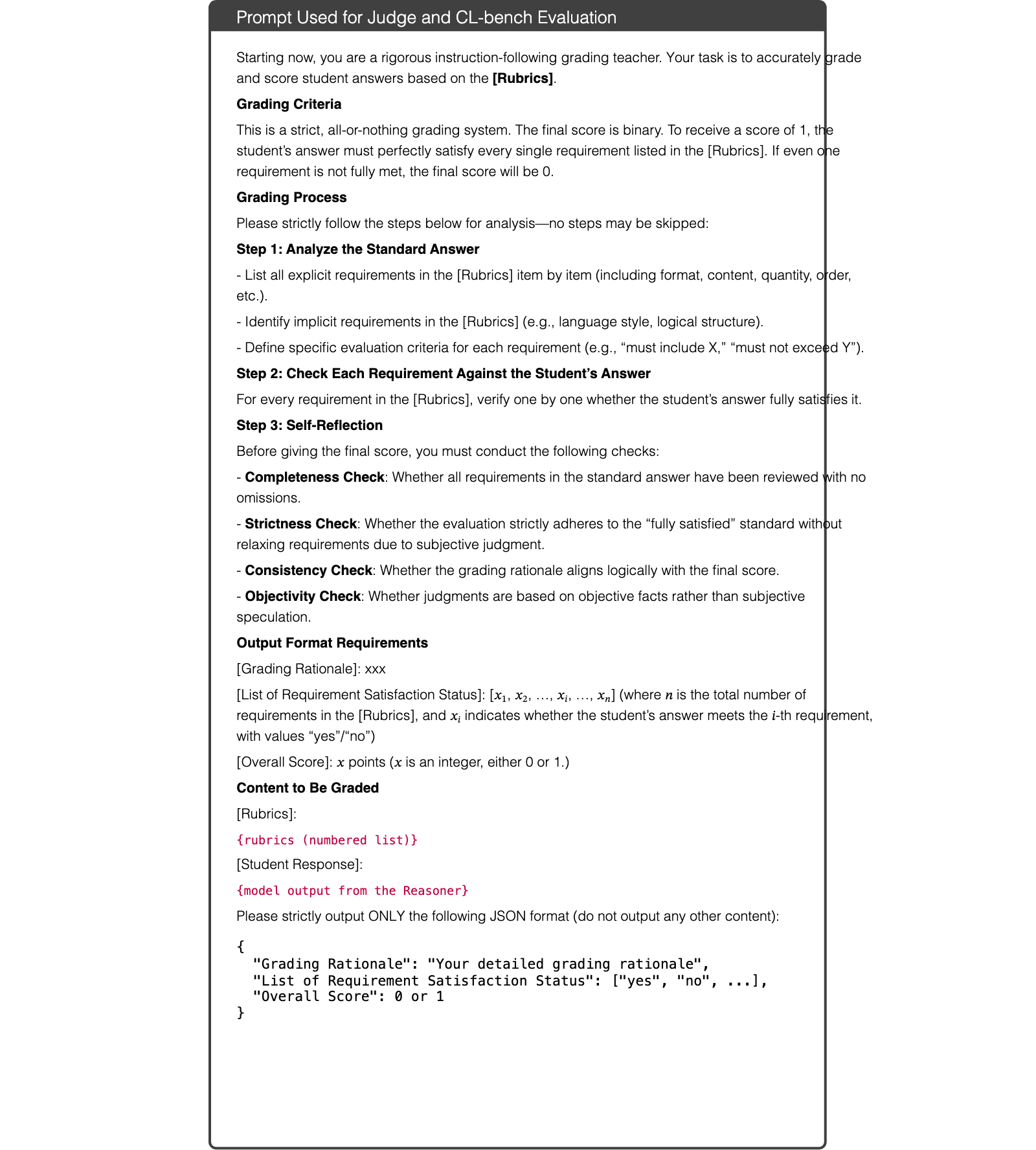
Judge: Given a task and rubrics generated from the Challenger, and the generated answer from the Reasoner, the Judge returns a per-rubric binary verdict and a solving indicator . The Judge is a strict evaluator: the task is considered solved if and only if the answer satisfies all associated rubrics.
- •
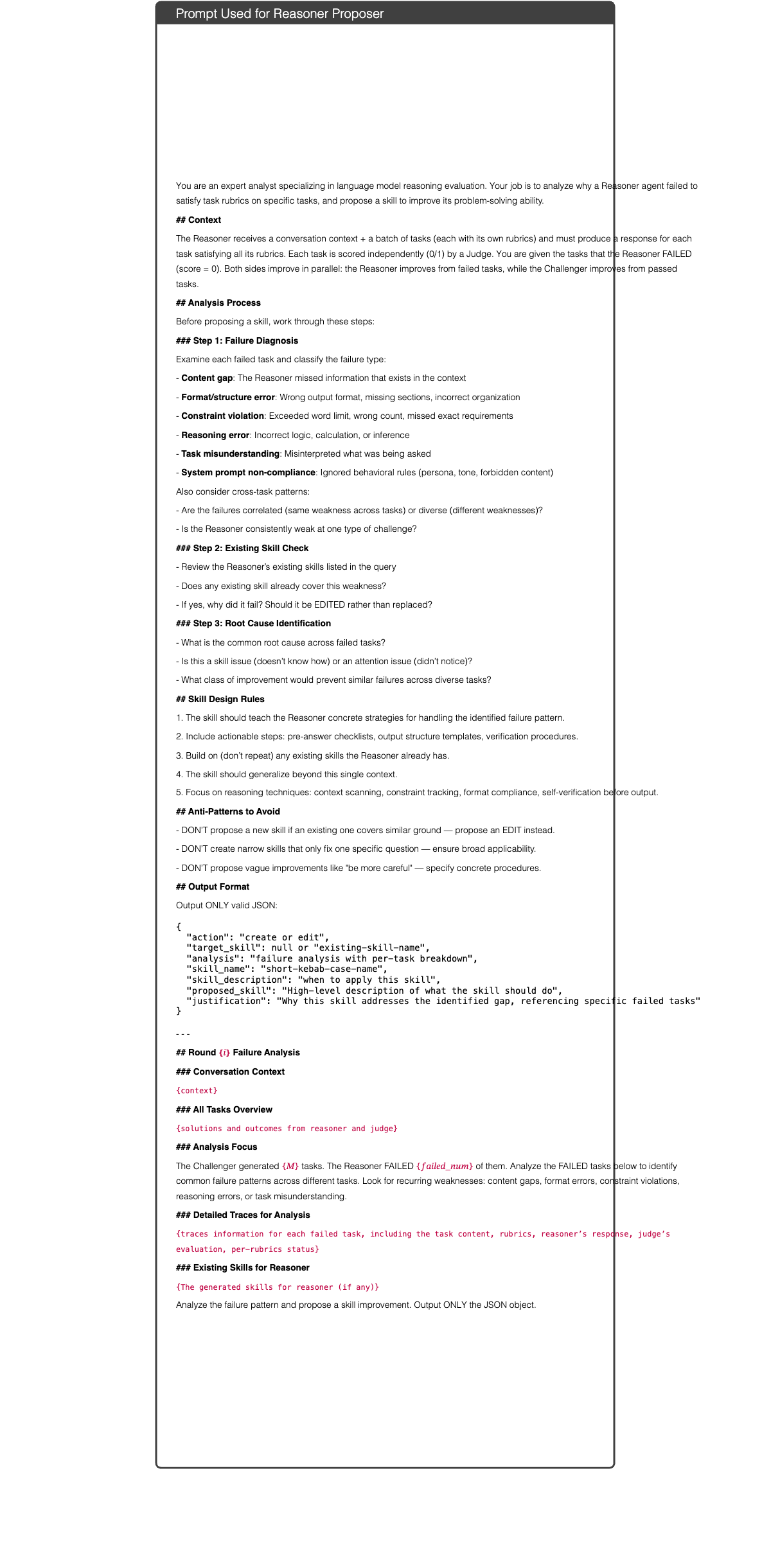
Proposer (one per side): The Judge’s binary verdicts identify which tasks failed or solved, but not why. The Proposer therefore collects all routed cases of its side, where each case comprises the task and rubrics from the Challenger, and the Reasoner’s answer, and jointly analyzes them against the current skill set. Rather than diagnosing each case in isolation, the Proposer synthesizes common failure or success patterns across cases into a high-level diagnosis specifying an action (add or merge), the target skill name, a description, and a justification. The Reasoner Proposer is designed to take the failed cases together with , and diagnose which contextual knowledge is missing or misrepresented by examining both the incorrect answers and the rubrics they violated. On the other hand, the Challenger Proposer takes the easily solved cases together with , and identifies gaps in the current task and rubric generation strategy by inspecting how the Reasoner solved them with its existing skills.
- •
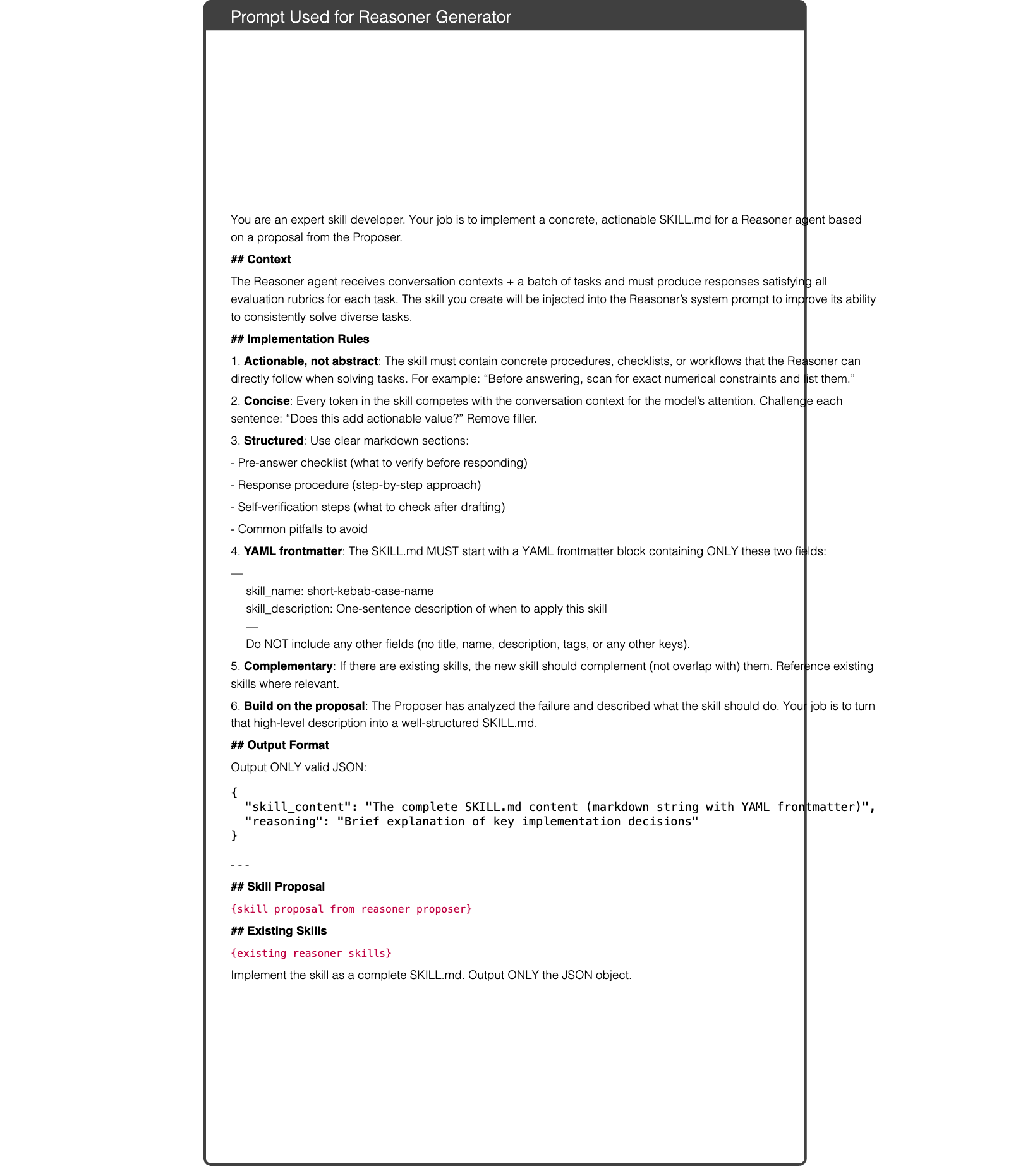
Generator (one per side): The Proposer’s output is a high-level diagnosis describing what should change and why, but not the concrete skill content itself. The Generator materializes this diagnosis into an actual skill set. Given the diagnosis and the current skill set, it returns a complete replacement skill set that adds or merges entries while preserving every unrelated entry. The Reasoner Generator incorporates the diagnosed missing contextual knowledge into to produce the new skill set . The Challenger Generator tightens so that the next iteration probes the Reasoner’s remaining weaknesses, producing skills .
To summarize, at iteration , the Challenger first produces a batch of tasks and rubrics based on the context ; the Reasoner attempts to answer each ; the Judge evaluates every rubric and partitions the batch into failed cases and solved cases based on the solving indicator . Each group is then routed to its corresponding side:
- •
The Reasoner Proposer jointly analyzes all failed cases against and synthesizes a high-level diagnosis; the Reasoner Generator then materializes it into .
- •
The Challenger Proposer jointly analyzes all solved cases against and synthesizes a high-level diagnosis; the Challenger Generator then materializes it into .
The updated skill sets and are carried forward into iteration . No prompt is ever conditioned on the opposing side’s skill set, keeping the two sides strictly adversarial.
The framework of Ctx2Skill detailed in § 3.3 intentionally strengthens the Challenger across iterations through updates to , sustaining adversarial pressure as the Reasoner improves. However, this design introduces an inherent tension that we term adversarial collapse. As iterations progress, the Challenger generates increasingly extreme tasks that concentrate on the Reasoner’s residual weaknesses, gradually deviating from the representative knowledge of the context . Since the Reasoner’s skill updates are failure-driven, its skills over-specialize to these pathological cases, resulting in redundant skill accumulation that degrades generalization. Moreover, this collapse is undetectable within the loop: each iteration’s Judge only evaluates the Challenger’s newly generated tasks, providing no signal on whether contextual knowledge mastered in earlier iterations has been corrupted by subsequent edits. Returning the last iteration Reasoner’s skills unconditionally is therefore unreliable; we instead select the most generalizable skill set among candidates .
To address this, we propose a cross-time replay mechanism that selects the most generalizable skill set from the candidates using representative probes collected during self-play itself. Two small probe sets are curated incrementally without any external supervision: at each iteration , the failed task with the lowest rubric pass rate is added to the hard probe set , and the solved task with the fewest rubrics is added to the easy probe set , capturing the hardest failure and the easiest success observed at each iteration. Once the self-play loop terminates, the Reasoner re-answers every task in both probe sets under each candidate skill set , and the Judge re-evaluates every rubric, yielding the solving indicator (i.e., whether all rubrics pass) for each probe task . We define the Laplace-smoothed [13] solving rates and as the proportion of tasks solved in the hard and easy probe sets under the context and skills , respectively:
The selected skill set is the one that maximizes the product of these two solving rates:
The multiplicative form is essential: a skill set that resolves late, idiosyncratic failures at the cost of regressing on easier tasks incurs a penalty on and is rejected; conversely, one that solves every easy probe but fails every hard one is rejected through . Meanwhile, Laplace smoothing keeps the product well-defined when a probe set is empty for a given iteration
At inference time, the final skill set is prepended to the Reasoner’s system prompt for any unseen task over context , and the Reasoner answers conditioned on . Since encodes reusable contextual knowledge of rather than task-specific solutions, it generalizes to arbitrary tasks over the same context. Moreover, is produced once per context and reused across all unseen tasks, so the Ctx2Skill cost amortizes over with no additional cost per deployed query.
In this section, we conduct experiments and analyses to show the advantages of our Ctx2Skill.
Evaluation. Context learning is a newly emerging research topic, aiming to require LMs to learn from unseen context and leverage new knowledge beyond what was acquired during pre-training to reason and solve tasks [12]. This goes far beyond long-context tasks [6, 35] that primarily test retrieval or reading comprehension, and in-context learning tasks [11], where models learn simple task patterns via instructions and demonstrations. We select the CL-bench [12] for our evaluation, which comprises complex contexts, tasks, and verification rubrics, all crafted by experienced domain experts. Each task is designed such that the new content required to resolve it is contained within the corresponding context. These data are distributed across four categories: Domain Knowledge Reasoning, Rule System Application, Procedural Task Execution, and Empirical Discovery & Simulation. Scoring is strictly all-or-nothing: a task is considered solved only when every rubric passes. We report both per-category and overall solving rates. Rubric-level grading follows the original benchmark protocol, which employs GPT-5.1 as the LLM-as-a-judge verifier [50]; cross-verifier and human agreement with this verifier both exceed [12].
| Model | Overall (%) | Domain Knowledge Reasoning (%) | Rule System Application (%) | Procedural Task Execution (%) | Empirical Discovery & Simulation (%) |
| Frontier LMs | |||||
| GPT-5.1 | 21.1 | 22.4 | 21.0 | 22.8 | 13.6 |
| Claude Opus 4.5 | 21.0 | 23.7 | 19.0 | 22.6 | 15.1 |
| Kimi K2.5 | 19.2 | 19.1 | 19.4 | 21.3 | 14.4 |
| GPT-5.2 | 18.2 | 19.5 | 18.0 | 19.1 | 12.1 |
| Gemini 3 Pro | 15.8 | 15.5 | 17.7 | 16.4 | 10.1 |
| DeepSeek V3.2 Thinking | 13.2 | 13.6 | 13.8 | 14.2 | 8.0 |
| GPT-4.1 | 11.1 | 10.6 | 14.8 | 10.4 | 4.6 |
| GPT-4.1-based Methods | |||||
| Prompting | 12.3 +1.2 | 12.4 +1.8 | 12.3 -2.5 | 13.9 +3.5 | 8.2 +3.6 |
| AutoSkill4Doc | 13.2 +2.1 | 13.3 +2.7 | 13.1 -1.7 | 15.0 +4.6 | 8.7 +4.1 |
| Ctx2Skill | 16.5 +5.4 | 16.8 +6.2 | 17.6 +2.8 | 17.6 +7.2 | 9.7 +5.1 |
| GPT-5.1-based Methods | |||||
| Prompting | 22.1 +1.0 | 24.7 +2.3 | 21.1 +0.1 | 22.4 -0.4 | 15.5 +1.9 |
| AutoSkill4Doc | 22.7 +1.6 | 25.3 +2.9 | 21.5 +0.5 | 23.1 +0.3 | 16.0 +2.4 |
| Ctx2Skill | 25.8 +4.7 | 27.9 +5.5 | 24.9 +3.9 | 26.9 +4.1 | 19.1 +5.5 |
| GPT-5.2-based Methods | |||||
| Prompting | 19.1 +0.9 | 19.6 +0.1 | 18.3 +0.3 | 22.6 +3.5 | 11.1 -1.0 |
| AutoSkill4Doc | 19.7 +1.5 | 20.5 +1.0 | 18.8 +0.8 | 23.0 +3.9 | 11.6 -0.5 |
| Ctx2Skill | 21.4 +3.2 | 22.2 +2.7 | 20.4 +2.4 | 25.4 +6.3 | 12.6 +0.5 |
View original table
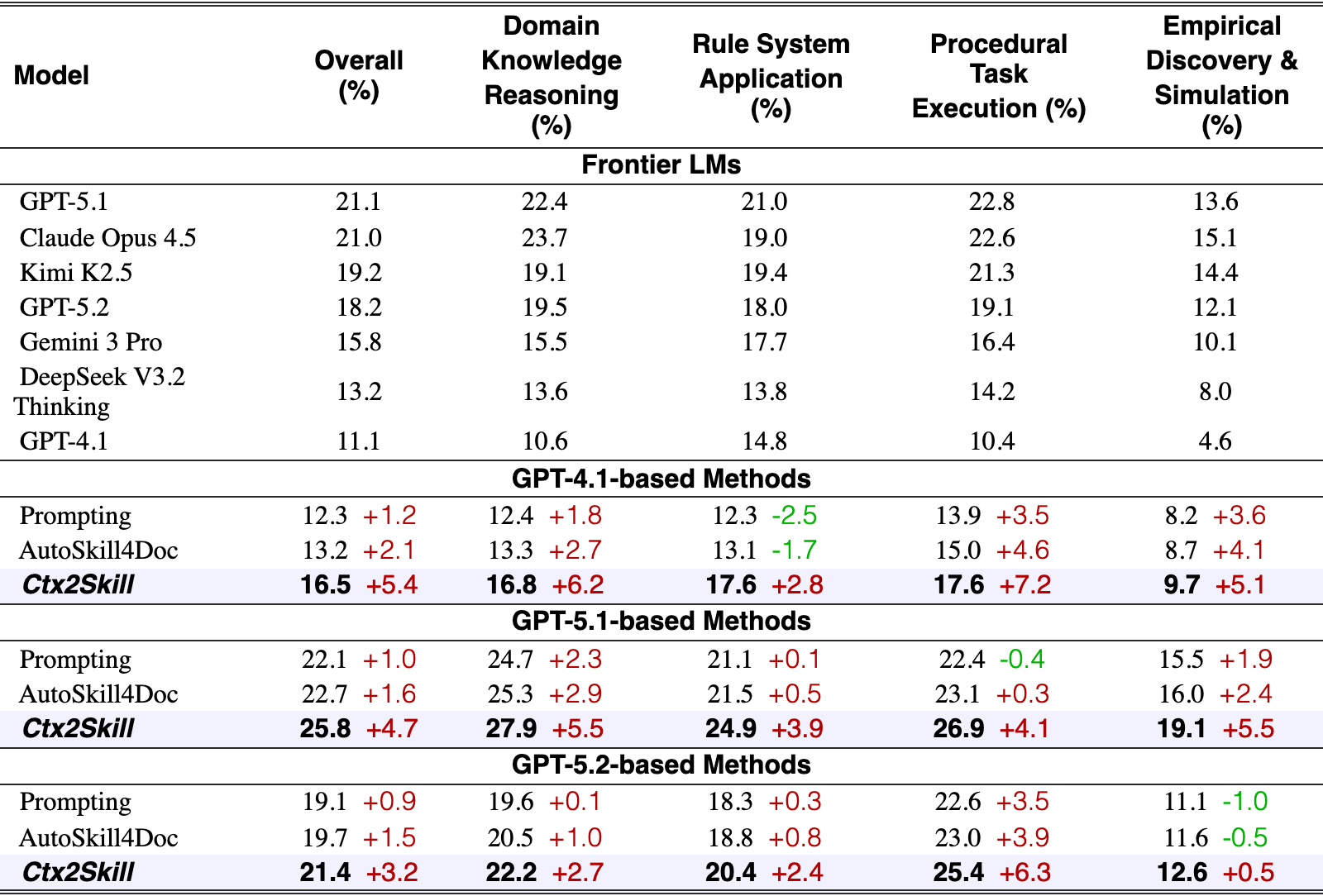
Baselines. We first evaluate a broad set of frontier LMs, including GPT-4.1 [27], GPT-5.1 [28], GPT-5.2 [29], Claude Opus 4.5 [4], Gemini 3 Pro [8], Kimi K2.5 [38], and DeepSeek V3.2 [9]. For models that support thinking mode, we use the default reasoning effort. For skill-based methods, we
| Model | Conc. | Faith. | Clar. | Eff. | Reus. | Avg. |
| GPT-4.1-based Methods | ||||||
| Prompting | 81.2 | 79.7 | 80.0 | 83.3 | 84.7 | 81.8 |
| AutoSkill4Doc | 81.3 | 81.4 | 92.4 | 88.7 | 87.2 | 86.2 |
| Ctx2Skill | 85.2 | 84.8 | 96.2 | 90.5 | 92.5 | 89.8 |
| GPT-5.1-based Methods | ||||||
| Prompting | 80.7 | 88.5 | 94.1 | 94.6 | 95.3 | 90.7 |
| AutoSkill4Doc | 82.0 | 89.1 | 94.2 | 96.0 | 96.0 | 91.5 |
| Ctx2Skill | 82.6 | 93.9 | 98.1 | 96.7 | 96.9 | 93.6 |
| GPT-5.2-based Methods | ||||||
| Prompting | 80.5 | 84.4 | 92.0 | 90.4 | 92.0 | 87.9 |
| AutoSkill4Doc | 82.2 | 87.0 | 94.0 | 92.2 | 93.0 | 89.7 |
| Ctx2Skill | 85.1 | 89.6 | 96.5 | 94.7 | 94.4 | 92.0 |
View original table
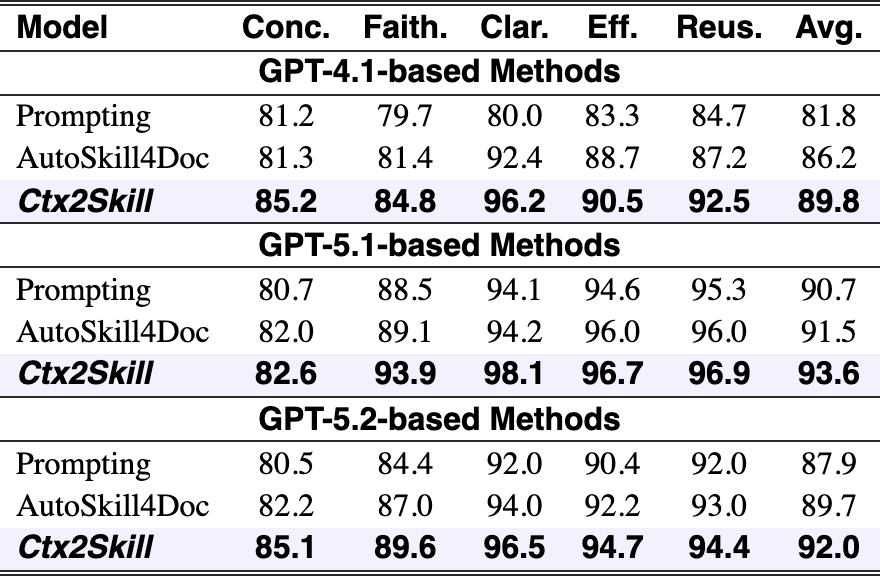
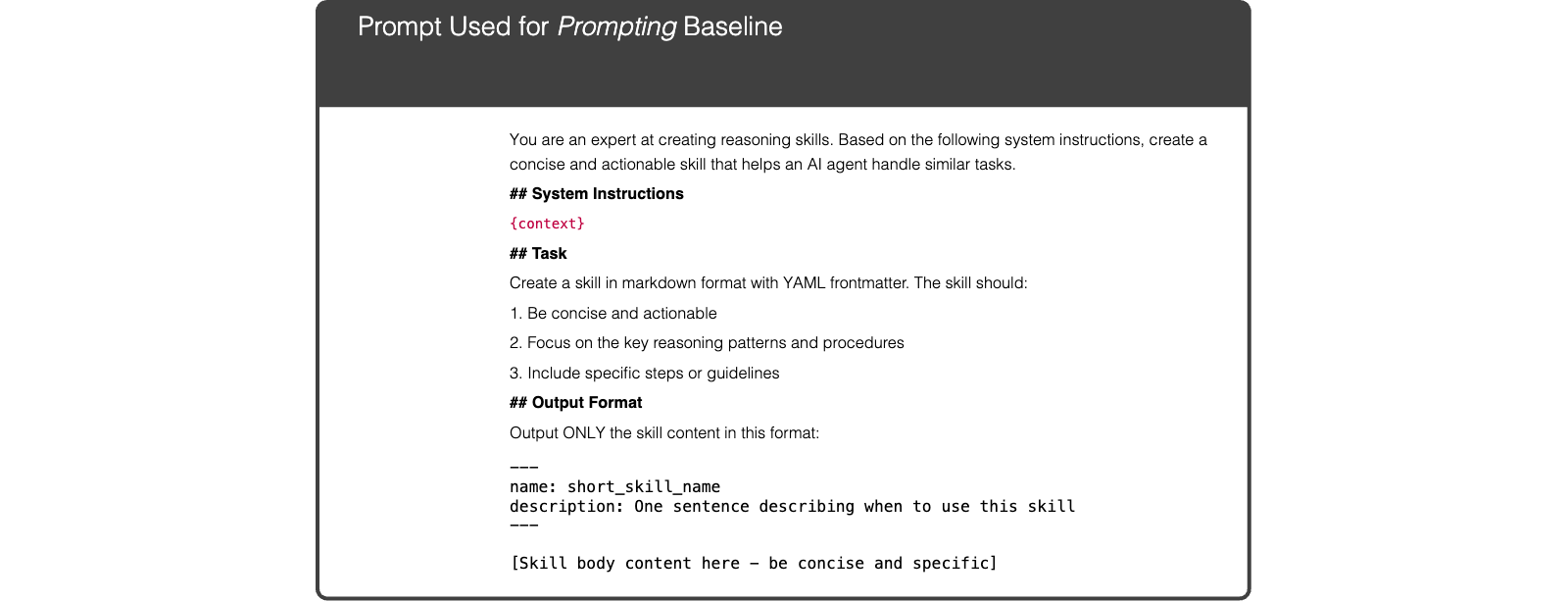
compare Ctx2Skill with two baselines: (1) Prompting directly prompts the LM to read the context and generate a skill set in a single pass; the resulting skills are then pre-pended to LMs during inference. (2) AutoSkill4Doc is a variant of AutoSkill [44] designed for document-level contexts: it partitions the context into different windows, identifies the independent skills within each window, and recombines skills across windows to produce a skill set. Both baselines use the same backbone for skill generation and inference as Ctx2Skill: for example, all GPT-4.1-based methods use GPT-4.1 for both skill construction and evaluation, ensuring a fair comparison.
Implementation. We run self-play iterations per context with tasks per iteration. The Challenger, Reasoner, Proposer, and Generator all use the same backbone as the corresponding series (e.g., GPT-4.1 for all four agents in the GPT-4.1-based methods), while the Judge uses GPT-5.1, consistent with the CL-bench evaluation protocol [12]. Due to API budget constraints, we do not explore larger or ; nonetheless, the most effective skill set is typically selected from early iterations (§ 4.3), and tasks per iteration provide enough cases for the Proposer to synthesize meaningful diagnostic patterns.
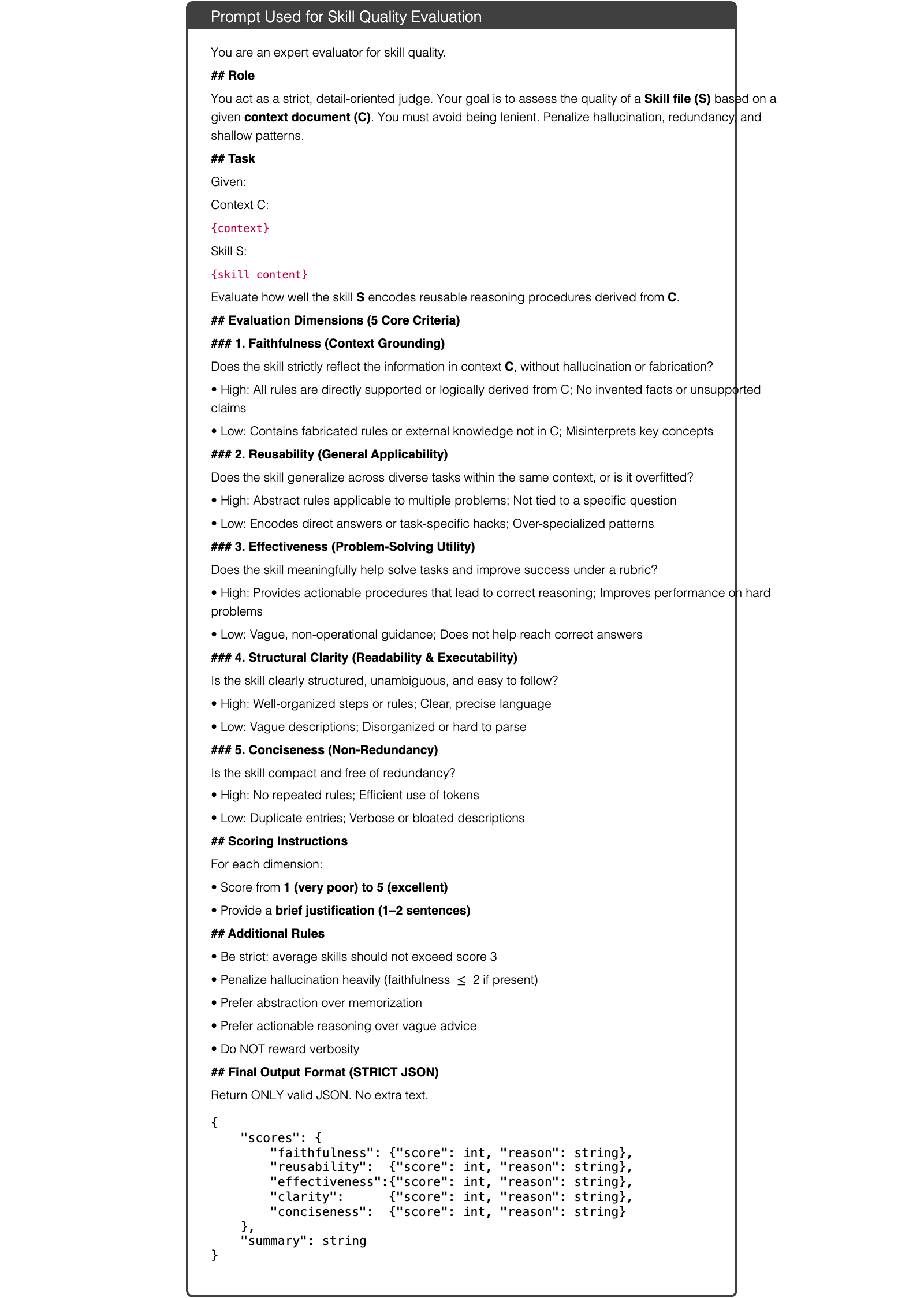
Table 1 presents the main results on CL-bench. Context learning remains challenging for current frontier LMs: even the best-performing model, GPT-5.1, achieves only a overall solving rate. Ctx2Skill consistently improves solving rates across all three backbones, raising GPT-4.1 from to (), GPT-5.1 from to (), and GPT-5.2 from to (), outperforming both Prompting and AutoSkill4Doc by a large margin across all four categories. The gains are especially pronounced on Procedural Task Execution and Empirical Discovery & Simulation, which demand deeper procedural and inductive reasoning over the context. In contrast, the two baselines provide only modest improvements and occasionally degrade individual categories (e.g., Prompting decreases Rule System Application on GPT-4.1 by ), suggesting that single-pass skill extraction is insufficient for complex contextual knowledge. Notably, GPT-4.1 with Ctx2Skill skills () surpasses stronger frontier models without skills, e.g., Gemini 3 Pro (), demonstrating that context-specific skills can bridge substantial capability gaps. Beyond solving rate, we assess the intrinsic quality of generated skills using GPT-4.1 as a judge across five dimensions (Table 2). Ctx2Skill achieves the highest average score across all three backbones, outperforming AutoSkill4Doc by , , and on GPT-4.1, GPT-5.1, and GPT-5.2, with the most notable improvements in faithfulness and clarity. These results indicate that the iterative self-play loop produces skills that not only improve downstream reasoning but also present contextual knowledge in a well-structured, human-readable form amenable to inspection, editing, and reuse.
| Model | Overall (%) | Domain Knowledge Reasoning (%) | Rule System Application (%) | Procedural Task Execution (%) | Empirical Discovery & Simulation (%) |
| Ablation Study | |||||
| Base Model - GPT-4.1 | 11.1 | 10.6 | 14.8 | 10.4 | 4.6 |
| Ctx2Skill - GPT-4.1 | 16.5 | 16.8 | 17.6 | 17.6 | 9.7 |
| -w/o Cross-Time Replay Mechanism | 14.7 | 15.1 | 14.9 | 16.1 | 9.2 |
| -w/o Decoupling Proposer and Generator | 15.9 | 16.8 | 16.9 | 16.1 | 9.2 |
| -w/o Challenger Skills Evolving | 13.8 | 13.9 | 13.9 | 15.7 | 8.7 |
| -w/o Easy Probe Set | 15.7 | 15.7 | 16.3 | 17.4 | 9.7 |
| -w/o Hard Probe Set | 15.2 | 15.6 | 15.6 | 16.5 | 9.2 |
| -w/o Laplace Smoothing | 15.5 | 15.7 | 16.0 | 17.2 | 9.2 |
| [2pt/3pt] Base Model - GPT-5.1 | 21.1 | 22.4 | 21.0 | 22.8 | 13.6 |
| Ctx2Skill - GPT-5.1 | 25.8 | 27.9 | 24.9 | 26.9 | 19.1 |
| -w/o Cross-Time Replay Mechanism | 23.0 | 25.6 | 22.0 | 23.3 | 16.0 |
| -w/o Decoupling Proposer and Generator | 25.1 | 27.0 | 24.5 | 25.9 | 18.6 |
| -w/o Challenger Skills Evolving | 22.5 | 25.0 | 21.3 | 23.1 | 16.0 |
| -w/o Easy Probe Set | 24.7 | 26.8 | 24.0 | 25.2 | 18.0 |
| -w/o Hard Probe Set | 24.2 | 26.7 | 23.6 | 23.9 | 18.0 |
| -w/o Laplace Smoothing | 25.2 | 27.0 | 24.7 | 25.9 | 19.1 |
| Variant Designs Testing | |||||
| Base Model - GPT-4.1 | 11.1 | 10.6 | 14.8 | 10.4 | 4.6 |
| Ctx2Skill - GPT-4.1 | 16.5 | 16.8 | 17.6 | 17.6 | 9.7 |
| Loser-Only Skill Update | 16.0 | 15.9 | 16.9 | 17.6 | 9.7 |
| Joint Outcome Skill Update | 15.5 | 16.0 | 16.9 | 16.1 | 8.2 |
| Using Additive Scoring in Eq.(4) | 15.9 | 16.6 | 17.1 | 16.5 | 8.2 |
| Effect of Cross-Time Replay Mechanism | |||||
| Base Model - GPT-4.1 | 11.1 | 10.6 | 14.8 | 10.4 | 4.6 |
| Ctx2Skill - GPT-4.1 | 16.5 | 16.8 | 17.6 | 17.6 | 9.7 |
| Using Skills from Iter-1 | 15.9 | 15.9 | 16.7 | 17.4 | 9.7 |
| Using Skills from Iter-2 | 15.6 | 15.7 | 16.2 | 17.2 | 9.7 |
| Using Skills from Iter-3 | 15.6 | 15.9 | 16.2 | 17.0 | 9.7 |
| Using Skills from Iter-4 | 15.2 | 15.6 | 16.7 | 15.4 | 8.7 |
| Using Skills from Iter-5 | 14.7 | 15.1 | 14.9 | 16.1 | 9.2 |
| Skill Transferability Testing | |||||
| Base Model - GPT-4.1 | 11.1 | 10.6 | 14.8 | 10.4 | 4.6 |
| GPT-4.1 with Skills from GPT-5.1 | 16.1 | 16.6 | 17.2 | 17.2 | 8.2 |
| GPT-4.1 with Skills from GPT-4.1 | 16.5 | 16.8 | 17.6 | 17.6 | 9.7 |
| Base Model - GPT-5.1 | 21.1 | 22.4 | 21.0 | 22.8 | 13.6 |
| GPT-5.1 with Skills from GPT-4.1 | 23.1 | 24.9 | 22.4 | 24.1 | 16.5 |
| GPT-5.1 with Skills from GPT-5.1 | 25.8 | 27.9 | 24.9 | 26.9 | 19.1 |
View original table
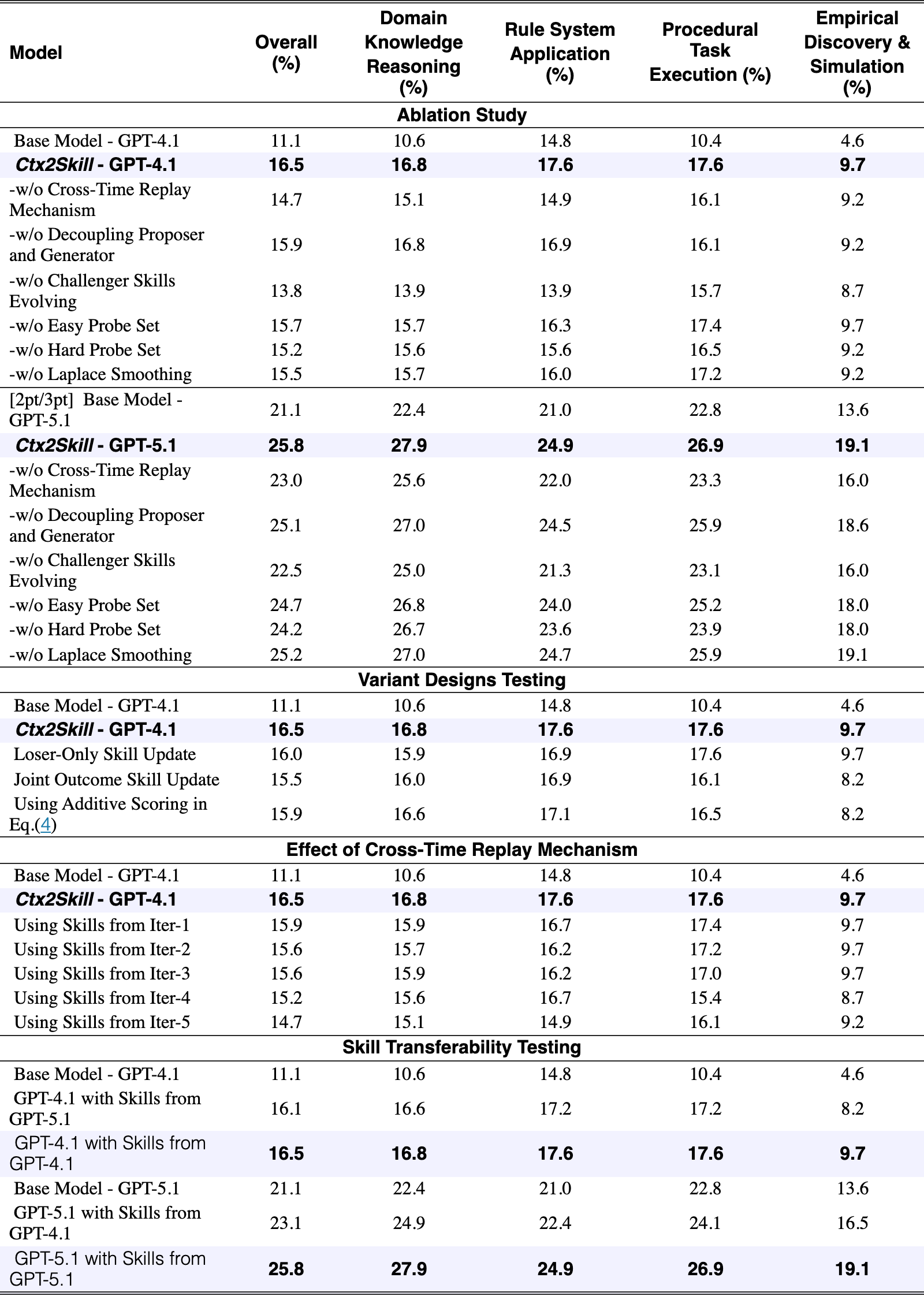
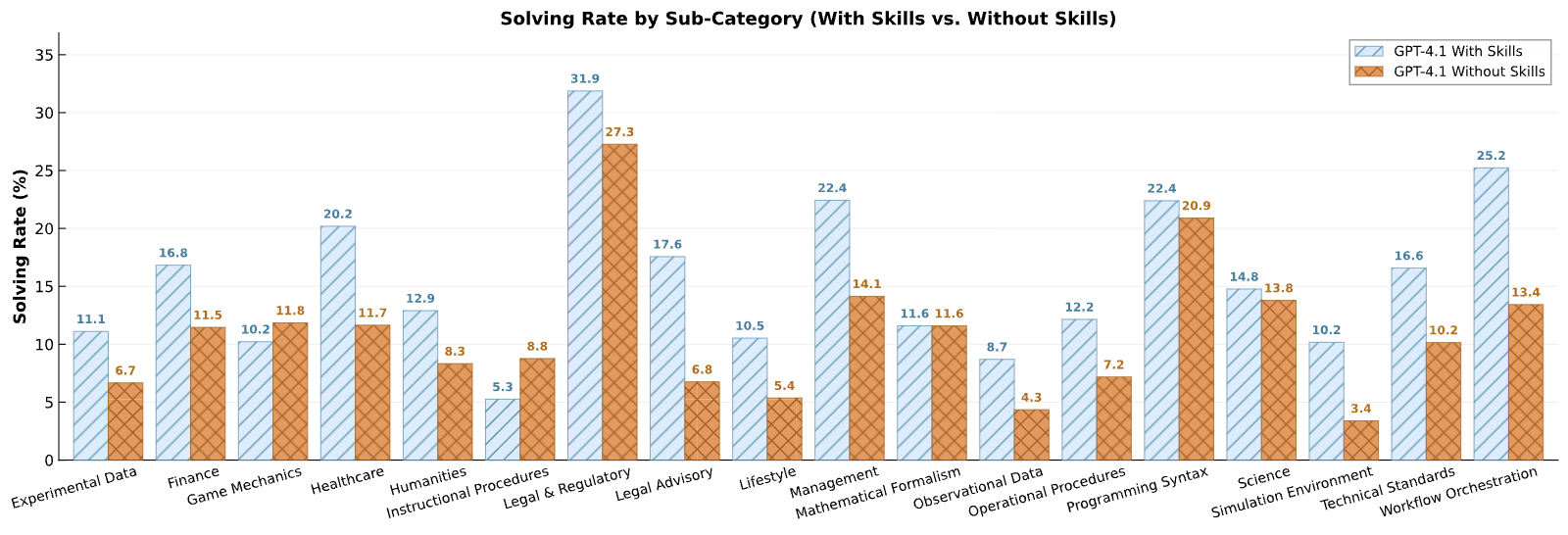
Ablation Study. We ablate each component of Ctx2Skill on both the GPT-4.1 and GPT-5.1 (Table 3, Ablation Study block). Removing Challenger skills evolving causes the largest drop, confirming that sustained adversarial pressure is essential for the Reasoner to discover contextual knowledge progressively. The Cross-Time Replay mechanism is the second most impactful: without it, the last-iteration skills suffer from adversarial collapse. Within Cross-Time Replay, the hard probe set contributes more than the easy probe set, and removing Laplace smoothing also degrades performance. Merging the Proposer and Generator into a single agent yields a modest but consistent decline, supporting the decoupling of diagnosis from skill materialization. We also examine the impact across all sub-categories of CL-bench on GPT-4.1 (Figure 3). Ctx2Skill improves solving rates on the vast majority of sub-categories, with especially large gains on workflow orchestration ().
Variant Designs Testing. We examine three alternative designs on GPT-4.1 (Table 3, Variant Designs Testing block). Loser-Only Skill Update updates only the losing side each iteration; the drop
indicates that updating both sides yields more effective co-evolution. Joint Outcome Skill Update feeds both failed and solved cases into both sides simultaneously, allowing each side to learn from both positive and negative examples; the larger degradation suggests that mixing outcomes dilutes the diagnostic signal. We also test Additive Scoring, which replaces with in Eq. (4); the drop confirms that the multiplicative form better penalizes skill sets that sacrifice easy-probe performance for hard-probe gains.
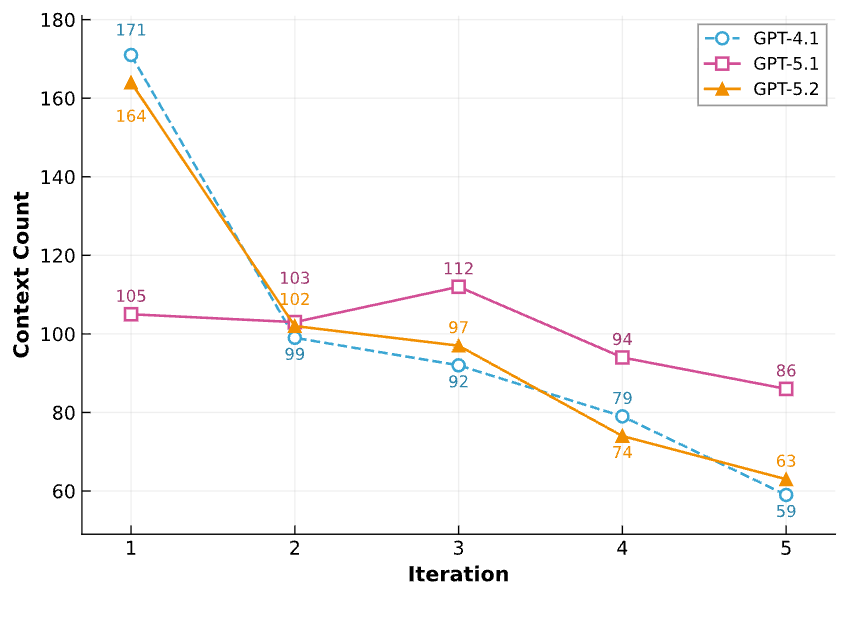
Effect of Cross-Time Replay Mechanism. We compare Cross-Time Replay against using a fixed iteration’s skills (Table 3, Effect of Cross-Time Replay block). On GPT-4.1, fixed-iteration performance monotonically decreases from Iter-1 () to Iter-5 (), confirming that later iterations suffer from adversarial collapse phenomenon. Cross-Time Replay () outperforms every fixed iteration, including the best one (Iter-1), by , by adaptively selecting the most balanced skill set per context rather than committing to a single iteration across all contexts. Figure 4 corroborates this pattern: early iterations are selected most frequently across all three backbones, while a non-trivial proportion of later iterations indicates that certain contexts with more complex knowledge structures do benefit from additional self-play rounds.
Skill Transferability Testing. We investigate whether skills generated by one backbone can benefit a different one (Table 3, Skill Transferability Testing block). GPT-5.1-generated skills applied to GPT-4.1 yield , nearly matching GPT-4.1’s own skills; conversely, GPT-4.1-generated skills applied to GPT-5.1 yield , a gain but notably below the from GPT-5.1’s own skills. This asymmetry shows that stronger models produce skills that transfer well to weaker models, whereas weaker models lack the capacity to discover knowledge that stronger models can exploit.
We presented Ctx2Skill, a self-evolving framework that autonomously discovers, refines, and selects context-specific skills from complex contexts without human annotation or external feedback. Through a skill-optimized self-play loop, a Challenger and a Reasoner co-evolve their skill sets via failure-driven textual edits, while a Cross-Time Replay mechanism prevents adversarial collapse by selecting the most generalizable skill set across iterations. Experiments on CL-bench demonstrate that Ctx2Skill consistently and substantially improves context learning performance across multiple backbone models and task categories, and that the resulting skills are transferable across models. We hope Ctx2Skill provides a practical and scalable paradigm for equipping language models with the ability to learn skillfully from complex, previously unseen contexts.
References
- [1] S. Alzubi, N. Provenzano, J. Bingham, W. Chen, and T. Vu (2026) Evoskill: automated skill discovery for multi-agent systems. arXiv preprint arXiv:2603.02766. Cited by: §1, §2.
- [2] Anthropic (2025) Equipping agents for the real world with agent skills. External Links: Link Cited by: §2.Source
- [3] Anthropic (2025) Introduction to agent skills. External Links: Link Cited by: §1, §2.Source
- [4] Anthropic (2025) System card: claude opus 4.5. External Links: Link Cited by: §4.1.Source
- [5] Anthropic (2026) System card: claude opus 4.6. External Links: Link Cited by: §1.Source
- [6] Y. Bai, X. Lv, J. Zhang, H. Lyu, J. Tang, Z. Huang, Z. Du, X. Liu, A. Zeng, L. Hou, Y. Dong, J. Tang, and J. Li (2024) LongBench: a bilingual, multitask benchmark for long context understanding. In Proceedings of the 62nd Annual Meeting of the Association for Computational Linguistics (ACL), Cited by: §4.1.
- [7] K. Cobbe, V. Kosaraju, M. Bavarian, M. Chen, H. Jun, L. Kaiser, M. Plappert, J. Tworek, J. Hilton, R. Nakano, et al. (2021) Training verifiers to solve math word problems. arXiv preprint arXiv:2110.14168. Cited by: §1.
- [8] G. DeepMind (2025) Gemini 3 pro model card. External Links: Link Cited by: §4.1.Source
- [9] DeepSeek-AI, A. Liu, B. Feng, B. Xue, B. Wang, B. Wu, C. Lu, C. Zhao, C. Deng, C. Zhang, C. Ruan, D. Dai, D. Guo, D. Yang, D. Chen, D. Ji, E. Li, F. Lin, F. Dai, F. Luo, G. Hao, G. Chen, G. Li, H. Zhang, H. Bao, H. Xu, H. Wang, H. Zhang, H. Ding, H. Xin, H. Gao, H. Li, H. Qu, J. L. Cai, J. Liang, J. Guo, J. Ni, J. Li, J. Wang, J. Chen, J. Chen, J. Yuan, J. Qiu, J. Li, J. Song, K. Dong, K. Hu, K. Gao, K. Guan, K. Huang, K. Yu, L. Wang, L. Zhang, L. Xu, L. Xia, L. Zhao, L. Wang, L. Zhang, M. Li, M. Wang, M. Zhang, M. Zhang, M. Tang, M. Li, N. Tian, P. Huang, P. Wang, P. Zhang, Q. Wang, Q. Zhu, Q. Chen, Q. Du, R. J. Chen, R. L. Jin, R. Ge, R. Zhang, R. Pan, R. Wang, R. Xu, R. Zhang, R. Chen, S. S. Li, S. Lu, S. Zhou, S. Chen, S. Wu, S. Ye, S. Ye, S. Ma, S. Wang, S. Zhou, S. Yu, S. Zhou, S. Pan, T. Wang, T. Yun, T. Pei, T. Sun, W. L. Xiao, W. Zeng, W. Zhao, W. An, W. Liu, W. Liang, W. Gao, W. Yu, W. Zhang, X. Q. Li, X. Jin, X. Wang, X. Bi, X. Liu, X. Wang, X. Shen, X. Chen, X. Zhang, X. Chen, X. Nie, X. Sun, X. Wang, X. Cheng, X. Liu, X. Xie, X. Liu, X. Yu, X. Song, X. Shan, X. Zhou, X. Yang, X. Li, X. Su, X. Lin, Y. K. Li, Y. Q. Wang, Y. X. Wei, Y. X. Zhu, Y. Zhang, Y. Xu, Y. Xu, Y. Huang, Y. Li, Y. Zhao, Y. Sun, Y. Li, Y. Wang, Y. Yu, Y. Zheng, Y. Zhang, Y. Shi, Y. Xiong, Y. He, Y. Tang, Y. Piao, Y. Wang, Y. Tan, Y. Ma, Y. Liu, Y. Guo, Y. Wu, Y. Ou, Y. Zhu, Y. Wang, Y. Gong, Y. Zou, Y. He, Y. Zha, Y. Xiong, Y. Ma, Y. Yan, Y. Luo, Y. You, Y. Liu, Y. Zhou, Z. F. Wu, Z. Z. Ren, Z. Ren, Z. Sha, Z. Fu, Z. Xu, Z. Huang, Z. Zhang, Z. Xie, Z. Zhang, Z. Hao, Z. Gou, Z. Ma, Z. Yan, Z. Shao, Z. Xu, Z. Wu, Z. Zhang, Z. Li, Z. Gu, Z. Zhu, Z. Liu, Z. Li, Z. Xie, Z. Song, Z. Gao, and Z. Pan (2025) DeepSeek-v3 technical report. External Links: 2412.19437, Link Cited by: §2, §4.1.Source
- [10] A. DiGiovanni and E. C. Zell (2021) Survey of self-play in reinforcement learning. External Links: 2107.02850, Link Cited by: §1.Source
- [11] Q. Dong, L. Li, D. Dai, C. Zheng, Z. Wu, B. Chang, X. Sun, J. Xu, L. Li, and Z. Sui (2023) A survey on in-context learning. External Links: 2301.00234 Cited by: §4.1.
- [12] S. Dou, M. Zhang, Z. Yin, C. Huang, Y. Shen, J. Wang, J. Chen, Y. Ni, J. Ye, C. Zhang, H. Xie, J. Hu, S. Wang, W. Wang, Y. Xiao, Y. Liu, Z. Xu, Z. Guo, P. Zhou, T. Gui, Z. Wu, X. Qiu, Q. Zhang, X. Huang, Y. Jiang, D. Wang, and S. Yao (2026) CL-Bench: a benchmark for context learning. arXiv preprint arXiv:2602.03587. External Links: Link Cited by: Appendix B, Appendix D, §1, §1, §2, §3.1, §3.2, §4.1, §4.1.Source
- [13] D. A. Field (1988) Laplacian smoothing and delaunay triangulations. Communications in applied numerical methods 4 (6), pp. 709–712. Cited by: §3.4.
- [14] B. Gao, F. Song, Z. Yang, Z. Cai, Y. Miao, Q. Dong, L. Li, C. Ma, L. Chen, R. Xu, Z. Tang, B. Wang, D. Zan, S. Quan, G. Zhang, L. Sha, Y. Zhang, X. Ren, T. Liu, and B. Chang (2025) Omni-MATH: a universal olympiad level mathematic benchmark for large language models. In The Thirteenth International Conference on Learning Representations, External Links: Link Cited by: §1.Source
- [15] A. Gunjal, A. Wang, E. Lau, V. Nath, Y. He, B. Liu, and S. Hendryx (2025) Rubrics as rewards: reinforcement learning beyond verifiable domains. External Links: 2507.17746, Link Cited by: §1.Source
- [16] Q. Hua, L. Ye, D. Fu, Y. Xiao, X. Cai, Y. Wu, J. Lin, J. Wang, and P. Liu (2025) Context engineering 2.0: the context of context engineering. External Links: 2510.26493, Link Cited by: §1.Source
- [17] C. E. Jimenez, J. Yang, A. Wettig, S. Yao, K. Pei, O. Press, and K. R. Narasimhan (2024) SWE-bench: can language models resolve real-world github issues?. In The Twelfth International Conference on Learning Representations, External Links: Link Cited by: §1.Source
- [18] H. Li, C. Mu, J. Chen, S. Ren, Z. Cui, Y. Zhang, L. Bai, and S. Hu (2026) Organizing, orchestrating, and benchmarking agent skills at ecosystem scale. External Links: 2603.02176, Link Cited by: §1, §2.Source
- [19] X. Li, W. Chen, Y. Liu, S. Zheng, X. Chen, Y. He, Y. Li, B. You, H. Shen, J. Sun, S. Wang, B. Li, Q. Zeng, D. Wang, X. Zhao, Y. Wang, R. B. Chaim, Z. Di, Y. Gao, J. He, Y. He, L. Jing, L. Kong, X. Lan, J. Li, S. Li, Y. Li, Y. Lin, X. Liu, X. Liu, H. Lyu, Z. Ma, B. Wang, R. Wang, T. Wang, W. Ye, Y. Zhang, H. Xing, Y. Xue, S. Dillmann, and H. Lee (2026) SkillsBench: benchmarking how well agent skills work across diverse tasks. External Links: 2602.12670, Link Cited by: §2.Source
- [20] Y. Liang, R. Zhong, H. Xu, C. Jiang, Y. Zhong, R. Fang, J. Gu, S. Deng, Y. Yao, M. Wang, S. Qiao, X. Xu, T. Wu, K. Wang, Y. Liu, Z. Bi, J. Lou, Y. E. Jiang, H. Zhu, G. Yu, H. Hong, L. Huang, H. Xue, C. Wang, Y. Wang, Z. Shan, X. Chen, Z. Tu, F. Xiong, X. Xie, P. Zhang, Z. Gui, L. Liang, J. Zhou, C. Wu, J. Shang, Y. Gong, J. Lin, C. Xu, H. Deng, W. Zhang, K. Ding, Q. Zhang, F. Huang, N. Zhang, J. Z. Pan, G. Qi, H. Wang, and H. Chen (2026) SkillNet: create, evaluate, and connect ai skills. External Links: 2603.04448, Link Cited by: §1, §2.Source
- [21] B. Liu, L. Guertler, S. Yu, Z. Liu, P. Qi, D. Balcells, M. Liu, C. Tan, W. Shi, M. Lin, W. S. Lee, and N. Jaques (2026) SPIRAL: self-play on zero-sum games incentivizes reasoning via multi-agent multi-turn reinforcement learning. External Links: 2506.24119, Link Cited by: §1.Source
- [22] H. Lu, Y. Wen, P. Cheng, R. Ding, J. Guo, H. Xu, C. Wang, H. Chen, xiaoxi jiang, and guanjunjiang (2026) Search self-play: pushing the frontier of agent capability without supervision. In The Fourteenth International Conference on Learning Representations, External Links: Link Cited by: §1.Source
- [23] Z. Lu, Z. Yao, J. Wu, C. Han, Q. Gu, X. Cai, W. Lu, J. Xiao, Y. Zhuang, and Y. Shen (2026) SKILL0: in-context agentic reinforcement learning for skill internalization. arXiv preprint arXiv:2604.02268. External Links: Link Cited by: §2.Source
- [24] Y. Ma, Y. Liu, X. Yang, Y. Li, K. Fu, Y. Miao, Y. Xie, Z. Wang, and S. Cheung (2026) Scaling coding agents via atomic skills. External Links: 2604.05013, Link Cited by: §1, §2.Source
- [25] Z. Ma, S. Yang, Y. Ji, X. Wang, Y. Wang, Y. Hu, T. Huang, and X. Chu (2026) SkillClaw: let skills evolve collectively with agentic evolver. External Links: 2604.08377, Link Cited by: §2.Source
- [26] L. Mei, J. Yao, Y. Ge, Y. Wang, B. Bi, Y. Cai, J. Liu, M. Li, Z. Li, D. Zhang, C. Zhou, J. Mao, T. Xia, J. Guo, and S. Liu (2025) A survey of context engineering for large language models. ArXiv abs/2507.13334. External Links: Link Cited by: §1.Source
- [27] OpenAI, J. Achiam, S. Adler, S. Agarwal, L. Ahmad, I. Akkaya, F. L. Aleman, D. Almeida, J. Altenschmidt, S. Altman, S. Anadkat, R. Avila, I. Babuschkin, S. Balaji, V. Balcom, P. Baltescu, H. Bao, M. Bavarian, J. Belgum, I. Bello, J. Berdine, G. Bernadett-Shapiro, C. Berner, L. Bogdonoff, O. Boiko, M. Boyd, A. Brakman, G. Brockman, T. Brooks, M. Brundage, K. Button, T. Cai, R. Campbell, A. Cann, B. Carey, C. Carlson, R. Carmichael, B. Chan, C. Chang, F. Chantzis, D. Chen, S. Chen, R. Chen, J. Chen, M. Chen, B. Chess, C. Cho, C. Chu, H. W. Chung, D. Cummings, J. Currier, Y. Dai, C. Decareaux, T. Degry, N. Deutsch, D. Deville, A. Dhar, D. Dohan, S. Dowling, S. Dunning, A. Ecoffet, A. Eleti, T. Eloundou, D. Farhi, L. Fedus, N. Felix, S. P. Fishman, J. Forte, I. Fulford, L. Gao, E. Georges, C. Gibson, V. Goel, T. Gogineni, G. Goh, R. Gontijo-Lopes, J. Gordon, M. Grafstein, S. Gray, R. Greene, J. Gross, S. S. Gu, Y. Guo, C. Hallacy, J. Han, J. Harris, Y. He, M. Heaton, J. Heidecke, C. Hesse, A. Hickey, W. Hickey, P. Hoeschele, B. Houghton, K. Hsu, S. Hu, X. Hu, J. Huizinga, S. Jain, S. Jain, J. Jang, A. Jiang, R. Jiang, H. Jin, D. Jin, S. Jomoto, B. Jonn, H. Jun, T. Kaftan, Ł. Kaiser, A. Kamali, I. Kanitscheider, N. S. Keskar, T. Khan, L. Kilpatrick, J. W. Kim, C. Kim, Y. Kim, J. H. Kirchner, J. Kiros, M. Knight, D. Kokotajlo, Ł. Kondraciuk, A. Kondrich, A. Konstantinidis, K. Kosic, G. Krueger, V. Kuo, M. Lampe, I. Lan, T. Lee, J. Leike, J. Leung, D. Levy, C. M. Li, R. Lim, M. Lin, S. Lin, M. Litwin, T. Lopez, R. Lowe, P. Lue, A. Makanju, K. Malfacini, S. Manning, T. Markov, Y. Markovski, B. Martin, K. Mayer, A. Mayne, B. McGrew, S. M. McKinney, C. McLeavey, P. McMillan, J. McNeil, D. Medina, A. Mehta, J. Menick, L. Metz, A. Mishchenko, P. Mishkin, V. Monaco, E. Morikawa, D. Mossing, T. Mu, M. Murati, O. Murk, D. Mély, A. Nair, R. Nakano, R. Nayak, A. Neelakantan, R. Ngo, H. Noh, L. Ouyang, C. O’Keefe, J. Pachocki, A. Paino, J. Palermo, A. Pantuliano, G. Parascandolo, J. Parish, E. Parparita, A. Passos, M. Pavlov, A. Peng, A. Perelman, F. de Avila Belbute Peres, M. Petrov, H. P. de Oliveira Pinto, Michael, Pokorny, M. Pokrass, V. H. Pong, T. Powell, A. Power, B. Power, E. Proehl, R. Puri, A. Radford, J. Rae, A. Ramesh, C. Raymond, F. Real, K. Rimbach, C. Ross, B. Rotsted, H. Roussez, N. Ryder, M. Saltarelli, T. Sanders, S. Santurkar, G. Sastry, H. Schmidt, D. Schnurr, J. Schulman, D. Selsam, K. Sheppard, T. Sherbakov, J. Shieh, S. Shoker, P. Shyam, S. Sidor, E. Sigler, M. Simens, J. Sitkin, K. Slama, I. Sohl, B. Sokolowsky, Y. Song, N. Staudacher, F. P. Such, N. Summers, I. Sutskever, J. Tang, N. Tezak, M. B. Thompson, P. Tillet, A. Tootoonchian, E. Tseng, P. Tuggle, N. Turley, J. Tworek, J. F. C. Uribe, A. Vallone, A. Vijayvergiya, C. Voss, C. Wainwright, J. J. Wang, A. Wang, B. Wang, J. Ward, J. Wei, C. Weinmann, A. Welihinda, P. Welinder, J. Weng, L. Weng, M. Wiethoff, D. Willner, C. Winter, S. Wolrich, H. Wong, L. Workman, S. Wu, J. Wu, M. Wu, K. Xiao, T. Xu, S. Yoo, K. Yu, Q. Yuan, W. Zaremba, R. Zellers, C. Zhang, M. Zhang, S. Zhao, T. Zheng, J. Zhuang, W. Zhuk, and B. Zoph (2024) GPT-4 technical report. External Links: 2303.08774, Link Cited by: §1, §4.1.Source
- [28] OpenAI (2025) GPT-5 technical report. External Links: Link Cited by: §1, §1, §2, §4.1.Source
- [29] OpenAI (2025) Update to gpt-5 system card: gpt-5.2. External Links: Link Cited by: §4.1.Source
- [30] L. Qiu, Z. Gao, J. Chen, Y. Ye, W. Huang, X. Xue, W. Qiu, and S. Tang (2026) AutoRefine: from trajectories to reusable expertise for continual llm agent refinement. arXiv preprint arXiv:2601.22758. Cited by: §2.
- [31] Z. Shao, P. Wang, Q. Zhu, R. Xu, J. Song, X. Bi, H. Zhang, M. Zhang, Y. K. Li, Y. Wu, and D. Guo (2024) DeepSeekMath: pushing the limits of mathematical reasoning in open language models. arXiv preprint arXiv:2402.03300. Cited by: §1.
- [32] S. Si, W. Ma, H. Gao, Y. Wu, T. Lin, Y. Dai, H. Li, R. Yan, F. Huang, and Y. Li (2023) SpokenWOZ: a large-scale speech-text benchmark for spoken task-oriented dialogue agents. In Thirty-seventh Conference on Neural Information Processing Systems Datasets and Benchmarks Track, External Links: Link Cited by: §2.Source
- [33] S. Si, Q. Wang, H. Zhao, Y. Bai, G. Chen, K. Luo, G. Chen, F. Qi, M. Zhang, B. Chang, and M. Sun (2026) FaithLens: detecting and explaining faithfulness hallucination. External Links: 2512.20182, Link Cited by: §2.Source
- [34] S. Si, H. Zhao, G. Chen, C. Gao, Y. Bai, Z. Wang, K. An, K. Luo, C. Qian, F. Qi, B. Chang, and M. Sun (2025) Aligning large language models to follow instructions and hallucinate less via effective data filtering. In Proceedings of the 63rd Annual Meeting of the Association for Computational Linguistics (Volume 1: Long Papers), W. Che, J. Nabende, E. Shutova, and M. T. Pilehvar (Eds.), Vienna, Austria, pp. 16469–16488. External Links: Link, Document, ISBN 979-8-89176-251-0 Cited by: §2.SourceSource
- [35] S. Si, H. Zhao, G. Chen, Y. Li, K. Luo, C. Lv, K. An, F. Qi, B. Chang, and M. Sun (2025) GATEAU: selecting influential samples for long context alignment. In Proceedings of the 2025 Conference on Empirical Methods in Natural Language Processing, C. Christodoulopoulos, T. Chakraborty, C. Rose, and V. Peng (Eds.), Suzhou, China, pp. 7391–7422. External Links: Link, Document, ISBN 979-8-89176-332-6 Cited by: §4.1.SourceSource
- [36] S. Si, H. Zhao, C. Gao, Y. Bai, Z. Wang, B. Gao, K. Luo, W. Li, Y. Huang, G. Chen, F. Qi, M. Zhang, B. Chang, and M. Sun (2026) Teaching large language models to maintain contextual faithfulness via synthetic tasks and reinforcement learning. In Fortieth AAAI Conference on Artificial Intelligence, Thirty-Eighth Conference on Innovative Applications of Artificial Intelligence, Sixteenth Symposium on Educational Advances in Artificial Intelligence, AAAI 2026, Singapore, January 20-27, 2026, S. Koenig, C. Jenkins, and M. E. Taylor (Eds.), pp. 33001–33009. External Links: Link, Document Cited by: §1.SourceSource
- [37] S. Si, H. Zhao, K. Luo, G. Chen, F. Qi, M. Zhang, B. Chang, and M. Sun (2025) A goal without a plan is just a wish: efficient and effective global planner training for long-horizon agent tasks. External Links: 2510.05608, Link Cited by: §1.Source
- [38] K. Team, T. Bai, Y. Bai, Y. Bao, S. H. Cai, Y. Cao, Y. Charles, H. S. Che, C. Chen, G. Chen, H. Chen, J. Chen, J. Chen, J. Chen, J. Chen, K. Chen, L. Chen, R. Chen, X. Chen, Y. Chen, Y. Chen, Y. Chen, Y. Chen, Y. Chen, Y. Chen, Y. Chen, Y. Chen, Z. Chen, Z. Chen, D. Cheng, M. Chu, J. Cui, J. Deng, M. Diao, H. Ding, M. Dong, M. Dong, Y. Dong, Y. Dong, A. Du, C. Du, D. Du, L. Du, Y. Du, Y. Fan, S. Fang, Q. Feng, Y. Feng, G. Fu, K. Fu, H. Gao, T. Gao, Y. Ge, S. Geng, C. Gong, X. Gong, Z. Gongque, Q. Gu, X. Gu, Y. Gu, L. Guan, Y. Guo, X. Hao, W. He, W. He, Y. He, C. Hong, H. Hu, J. Hu, Y. Hu, Z. Hu, K. Huang, R. Huang, W. Huang, Z. Huang, T. Jiang, Z. Jiang, X. Jin, Y. Jing, G. Lai, A. Li, C. Li, C. Li, F. Li, G. Li, G. Li, H. Li, H. Li, J. Li, J. Li, J. Li, L. Li, M. Li, W. Li, W. Li, X. Li, X. Li, Y. Li, Y. Li, Y. Li, Y. Li, Z. Li, Z. Li, W. Liao, J. Lin, X. Lin, Z. Lin, Z. Lin, C. Liu, C. Liu, H. Liu, L. Liu, S. Liu, S. Liu, S. Liu, T. Liu, T. Liu, W. Liu, X. Liu, Y. Liu, Y. Liu, Y. Liu, Y. Liu, Y. Liu, Z. Liu, Z. Liu, E. Lu, H. Lu, Z. Lu, J. Luo, T. Luo, Y. Luo, L. Ma, Y. Ma, S. Mao, Y. Mei, X. Men, F. Meng, Z. Meng, Y. Miao, M. Ni, K. Ouyang, S. Pan, B. Pang, Y. Qian, R. Qin, Z. Qin, J. Qiu, B. Qu, Z. Shang, Y. Shao, T. Shen, Z. Shen, J. Shi, L. Shi, S. Shi, F. Song, P. Song, T. Song, X. Song, H. Su, J. Su, Z. Su, L. Sui, J. Sun, J. Sun, T. Sun, F. Sung, Y. Tai, C. Tang, H. Tang, X. Tang, Z. Tang, J. Tao, S. Teng, C. Tian, P. Tian, A. Wang, B. Wang, C. Wang, C. Wang, C. Wang, D. Wang, D. Wang, D. Wang, F. Wang, H. Wang, H. Wang, H. Wang, H. Wang, H. Wang, J. Wang, J. Wang, J. Wang, K. Wang, L. Wang, Q. Wang, S. Wang, S. Wang, S. Wang, W. Wang, X. Wang, X. Wang, Y. Wang, Y. Wang, Y. Wang, Y. Wang, Y. Wang, Y. Wang, Z. Wang, Z. Wang, Z. Wang, Z. Wang, Z. Wang, Z. Wang, C. Wei, M. Wei, C. Wen, Z. Wen, C. Wu, H. Wu, J. Wu, R. Wu, W. Wu, Y. Wu, Y. Wu, Y. Wu, Z. Wu, C. Xiao, J. Xie, X. Xie, Y. Xie, Y. Xin, B. Xing, B. Xu, J. Xu, J. Xu, J. Xu, L. H. Xu, L. Xu, S. Xu, W. Xu, X. Xu, X. Xu, Y. Xu, Y. Xu, Y. Xu, Z. Xu, Z. Xu, J. Yan, Y. Yan, G. Yang, H. Yang, J. Yang, K. Yang, N. Yang, R. Yang, X. Yang, X. Yang, Y. Yang, Y. Yang, Y. Yang, Z. Yang, Z. Yang, Z. Yang, H. Yao, D. Ye, W. Ye, Z. Ye, B. Yin, C. Yu, L. Yu, T. Yu, T. Yu, E. Yuan, M. Yuan, X. Yuan, Y. Yue, W. Zeng, D. Zha, H. Zhan, D. Zhang, H. Zhang, J. Zhang, P. Zhang, Q. Zhang, R. Zhang, X. Zhang, Y. Zhang, Y. Zhang, Y. Zhang, Y. Zhang, Y. Zhang, Y. Zhang, Y. Zhang, Y. Zhang, Y. Zhang, Y. Zhang, Z. Zhang, C. Zhao, F. Zhao, J. Zhao, S. Zhao, X. Zhao, Y. Zhao, Z. Zhao, H. Zheng, R. Zheng, S. Zheng, T. Zheng, J. Zhong, L. Zhong, W. Zhong, M. Zhou, R. Zhou, X. Zhou, Z. Zhou, J. Zhu, L. Zhu, X. Zhu, Y. Zhu, Z. Zhu, J. Zhuang, W. Zhuang, Y. Zou, and X. Zu (2026) Kimi k2.5: visual agentic intelligence. External Links: 2602.02276, Link Cited by: §4.1.Source
- [39] Q. Team (2026) Qwen3. 5: towards native multimodal agents. URL: https://qwen. ai/blog. Cited by: §1.
- [40] C. Wang, Z. Yu, X. Xie, W. Yao, R. Fang, S. Qiao, K. Cao, G. Zheng, X. Qi, P. Zhang, and S. Deng (2026) SkillX: automatically constructing skill knowledge bases for agents. arXiv preprint arXiv:2604.04804. External Links: Link Cited by: §2.Source
- [41] J. Wang, Y. Ming, Z. Ke, S. Joty, A. Albarghouthi, and F. Sala (2026) SkillOrchestra: learning to route agents via skill transfer. External Links: 2602.19672, Link Cited by: §1, §2.Source
- [42] Z. Wang, Q. Wu, X. Zhang, C. Zhang, W. Yao, F. E. Faisal, B. Peng, S. Qin, S. Nath, Q. Lin, C. Bansal, D. Zhang, S. Rajmohan, J. Gao, and H. Yao (2026) WebXSkill: skill learning for autonomous web agents. External Links: 2604.13318, Link Cited by: §1, §2.Source
- [43] P. Xia, J. Chen, H. Wang, J. Liu, K. Zeng, Y. Wang, S. Han, Y. Zhou, X. Zhao, H. Chen, Z. Zheng, C. Xie, and H. Yao (2026) SkillRL: evolving agents via recursive skill-augmented reinforcement learning. External Links: 2602.08234, Link Cited by: §2.Source
- [44] Y. Yang, J. Li, Q. Pan, B. Zhan, Y. Cai, L. Du, J. Zhou, K. Chen, Q. Chen, X. Li, B. Zhang, and L. He (2026) AutoSkill: experience-driven lifelong learning via skill self-evolution. arXiv preprint arXiv:2603.01145. External Links: Link Cited by: Appendix B, §1, §2, §4.1.Source
- [45] H. Zhang, S. Fan, H. P. Zou, Y. Chen, Z. Wang, J. Zhou, C. Li, W. Huang, Y. Yao, K. Zheng, X. Liu, X. Li, and P. S. Yu (2026) CoEvoSkills: self-evolving agent skills via co-evolutionary verification. External Links: 2604.01687, Link Cited by: §2.Source
- [46] H. Zhang, Q. Long, J. Bao, T. Feng, W. Zhang, H. Yue, and W. Wang (2026) MemSkill: learning and evolving memory skills for self-evolving agents. External Links: 2602.02474, Link Cited by: §1.Source
- [47] Q. Zhang, C. Hu, S. Upasani, B. Ma, F. Hong, V. Kamanuru, J. Rainton, C. Wu, M. Ji, H. Li, U. Thakker, J. Zou, and K. Olukotun (2026) Agentic context engineering: evolving contexts for self-improving language models. External Links: 2510.04618, Link Cited by: §1.Source
- [48] Y. Zhang, Y. Zhu, W. Chong, S. Tu, Q. Zhang, J. Chai, X. Wang, W. Lin, G. Yin, and D. Zhao (2026) $\pi$-Play: multi-agent self-play via privileged self-distillation without external data. External Links: 2604.14054, Link Cited by: §1.Source
- [49] B. Zheng, M. Y. Fatemi, X. Jin, Z. Z. Wang, A. Gandhi, Y. Song, Y. Gu, J. Srinivasa, G. Liu, G. Neubig, and Y. Su (2025) SkillWeaver: web agents can self-improve by discovering and honing skills. External Links: 2504.07079, Link Cited by: §1.Source
- [50] L. Zheng, W. Chiang, Y. Sheng, S. Zhuang, Z. Wu, Y. Zhuang, Z. Lin, Z. Li, D. Li, E. P. Xing, H. Zhang, J. E. Gonzalez, and I. Stoica (2023) Judging LLM-as-a-judge with MT-Bench and chatbot arena. In Advances in Neural Information Processing Systems (NeurIPS) Datasets and Benchmarks Track, Cited by: §4.1.
In this section, we provide the corresponding statistics for our Ctx2Skill.
| Context Category | #Contexts | #Tasks | #Rubrics | Tasks per context | Rubrics per task | Input Length (tokens) | |||
| Mean | Max | Mean | Max | Mean | Max | ||||
| Domain Knowledge Reasoning | 190 | 663 | 11,099 | 3.5 | 7 | 16.7 | 74 | 8.3K | 60.0K |
| Rule System Application | 140 | 566 | 8,286 | 4.0 | 12 | 14.6 | 75 | 12.2K | 62.2K |
| Procedural Task Execution | 100 | 471 | 9,486 | 4.7 | 12 | 20.1 | 59 | 8.5K | 58.5K |
| Empirical Discovery & Simulation | 70 | 199 | 2,736 | 2.8 | 9 | 13.7 | 114 | 16.7K | 65.0K |
| Total | 500 | 1,899 | 31,607 | 3.8 | 12 | 16.6 | 114 | 10.4K | 65.0K |
View original table
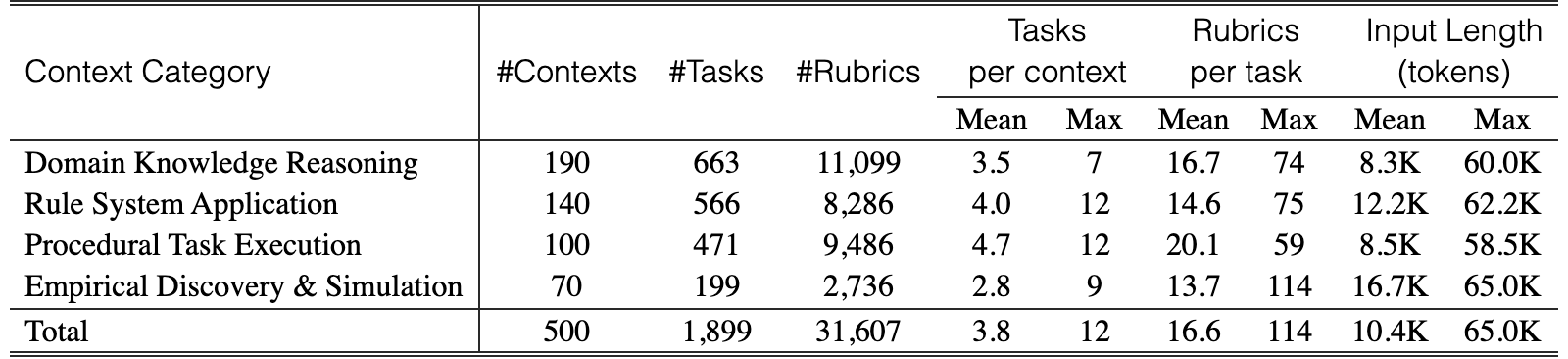
CL-bench. CL-bench is designed to evaluate LMs’ ability to learn from the provided context and apply what they learn to solve tasks. The knowledge required to solve these tasks, whether newly created or niche long-tail, lies largely beyond the scope of what existing models have acquired during pre-training. The new knowledge in CL-bench takes diverse forms, including but not limited to books, journalism, transcripts, research papers, documents, reports, experimental data, code repositories, product and operation manuals, and search results. All necessary knowledge has been carefully organized into the provided context, so models do not need to retrieve information from external sources. Each context in CL-bench involves solving multiple tasks. 51.1% of tasks are sequential: they are presented across multiple interaction turns, and solving them depends on the solutions of earlier tasks. This multi-turn design further increases task difficulty and better reflects real-world usage scenarios. The statistics of CL-bench are shown in Table 4.
| GPT-4.1 | GPT-5.1 | GPT-5.2 | |||||||
| Iteration | Solved | Failed | Rate (%) | Solved | Failed | Rate (%) | Solved | Failed | Rate (%) |
| Iter-1 | 0.91 | 4.09 | 18.2 | 2.09 | 2.91 | 41.7 | 1.81 | 3.19 | 36.1 |
| Iter-2 | 1.03 | 3.97 | 20.6 | 2.26 | 2.75 | 45.2 | 1.45 | 3.55 | 28.9 |
| Iter-3 | 1.04 | 3.96 | 20.9 | 2.37 | 2.63 | 47.4 | 1.32 | 3.68 | 26.5 |
| Iter-4 | 1.15 | 3.85 | 22.9 | 2.44 | 2.56 | 48.8 | 1.15 | 3.85 | 23.0 |
| Iter-5 | 1.17 | 3.83 | 23.3 | 2.41 | 2.59 | 48.2 | 1.19 | 3.81 | 23.7 |
View original table

Task-level Self-Play Dynamics. Table 5 reports the average number of solved and failed tasks (out of ) per iteration during self-play, averaged over all contexts. On GPT-4.1, the solved rate gradually increases from (Iter-1) to (Iter-5), with the average number of solved tasks rising from to . This indicates that the Reasoner’s evolving skills progressively improve its ability to handle Challenger-generated tasks; however, the failed rate remains above throughout all iterations, confirming that the Challenger’s co-evolution maintains sustained adversarial pressure and prevents the Reasoner from saturating. On GPT-5.1, the stronger backbone enables the Reasoner to solve substantially more tasks from the start ( at Iter-1), and the solved rate gradually rises to by Iter-4 before slightly decreasing to at Iter-5. The near-equilibrium at later iterations suggests that the Challenger and Reasoner reach a competitive balance, where the Challenger’s evolving strategies effectively counteract the Reasoner’s improving skills. GPT-5.2 exhibits a distinct pattern: the solved rate decreases from at Iter-1 to at Iter-4, indicating that the Challenger’s skill evolution outpaces the Reasoner’s improvement, producing increasingly difficult tasks that the Reasoner struggles to solve even with updated skills. This observation is consistent with the adversarial collapse phenomenon described in § 3.4, and further motivates the need for the Cross-Time Replay mechanism to select the most generalizable skill set rather than defaulting to the last iteration. Across all three backbones, the failed rate remains substantial throughout all iterations (–), verifying that the self-play loop avoids trivial convergence and sustains meaningful adversarial pressure for continuous skill discovery.
| GPT-4.1 | GPT-5.1 | GPT-5.2 | ||||
| Iteration | Pass Rate (%) | Avg. Rubrics | Pass Rate (%) | Avg. Rubrics | Pass Rate (%) | Avg. Rubrics |
| Iter-1 | 79.2 | 11.7 | 90.0 | 11.2 | 87.5 | 11.2 |
| Iter-2 | 80.7 | 11.9 | 90.8 | 11.3 | 85.3 | 11.5 |
| Iter-3 | 80.6 | 12.2 | 90.8 | 11.5 | 84.5 | 11.7 |
| Iter-4 | 81.1 | 12.3 | 91.3 | 11.4 | 83.6 | 11.9 |
| Iter-5 | 81.5 | 12.3 | 90.9 | 11.3 | 83.8 | 12.0 |
View original table

Rubric-level Self-Play Dynamics. Table 6 reports the rubric pass rate and the average number of rubrics per task at each iteration. Compared with the task-level solved rate (Table 5), the rubric pass rate is substantially higher across all backbones (– vs. –), confirming that the all-or-nothing scoring in CL-bench is strict: the Reasoner often passes most rubrics but fails a task due to one or two missed requirements. On GPT-4.1, the rubric pass rate steadily improves from to across iterations, while the average number of rubrics per task also increases from to , indicating that the Reasoner’s skills improve even as the Challenger generates more fine-grained rubrics. On GPT-5.1, the rubric pass rate remains consistently high (–) with stable rubric counts (–), reflecting a strong Reasoner that maintains near-ceiling rubric-level performance throughout self-play. On GPT-5.2, the rubric pass rate decreases from to while the average rubric count increases from to , revealing that the Challenger simultaneously generates more rubrics and harder ones, compounding the difficulty and contributing to the declining task-level solved rate observed in Table 5. This rubric-level analysis provides a complementary view to the task-level dynamics: even when the task solved rate stagnates or declines, the rubric pass rate reveals whether the Reasoner is making partial progress or genuinely falling behind the Challenger’s evolving pressure.
| GPT-4.1 | GPT-5.1 | GPT-5.2 | ||||||||||
| Iteration | Min | Max | Mean | Med. | Min | Max | Mean | Med. | Min | Max | Mean | Med. |
| Iter-1 | 5 | 16 | 11.7 | 12 | 6 | 22 | 11.2 | 11 | 4 | 21 | 11.2 | 11 |
| Iter-2 | 7 | 17 | 11.9 | 12 | 1 | 27 | 11.3 | 11 | 4 | 21 | 11.5 | 12 |
| Iter-3 | 7 | 16 | 12.2 | 12 | 7 | 19 | 11.5 | 11 | 4 | 23 | 11.7 | 12 |
| Iter-4 | 7 | 17 | 12.3 | 12 | 7 | 19 | 11.4 | 11 | 4 | 23 | 11.9 | 12 |
| Iter-5 | 7 | 21 | 12.3 | 12 | 6 | 33 | 11.3 | 11 | 4 | 24 | 12.0 | 12 |
| [2pt/3pt] Overall | 5 | 21 | 12.1 | 12 | 1 | 33 | 11.4 | 11 | 4 | 24 | 11.7 | 12 |
View original table
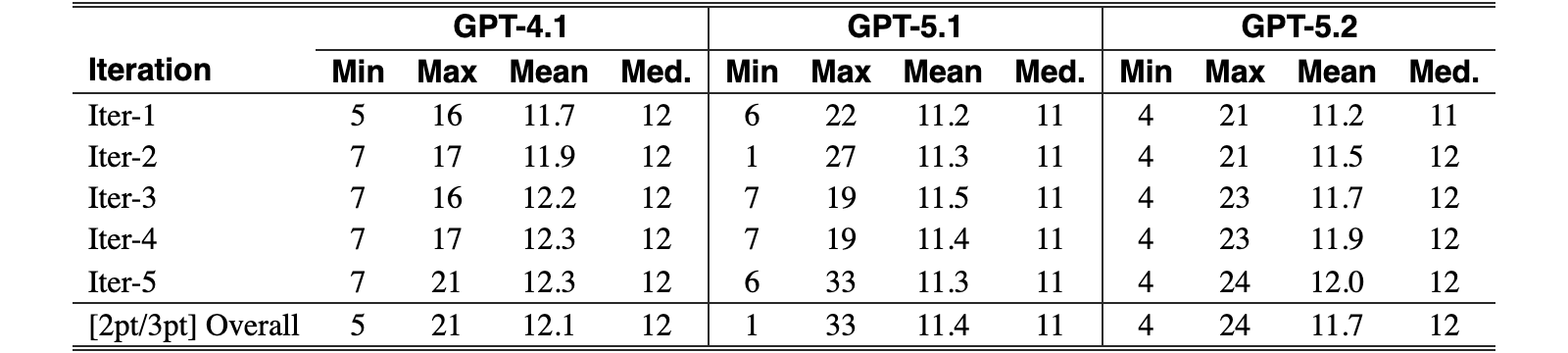
Rubric Count Distribution. Table 7 reports the distribution of rubric counts per Challenger-generated task, excluding a small number of tasks () with zero rubrics due to occasional formatting failures. Across all three backbones, the median rubric count remains stable at – throughout iterations, while the mean exhibits a slight upward trend, particularly on GPT-4.1 () and GPT-5.2 (), indicating that the Challenger progressively generates tasks with more rubrics as its skills evolve, imposing stricter verification criteria on the Reasoner. The minimum rubric count on GPT-4.1 rises from at Iter-1 to at Iter-2 and remains there throughout subsequent iterations, suggesting that the Challenger learns to avoid generating under-specified tasks after the first round of skill updates. A similar stabilization is observed on GPT-5.1 (min rises to by Iter-3) and GPT-5.2 (min stabilizes at ), though the floor is lower for GPT-5.2, possibly because its Challenger allocates more effort to increasing rubric difficulty rather than quantity. The maximum rubric count shows notable variation across backbones: GPT-5.1 reaches up to at Iter-5, while GPT-4.1 and GPT-5.2 peak at and , respectively, reflecting different Challenger strategies in rubric granularity. The fact that GPT-5.1’s maximum is substantially higher yet its rubric pass rate remains above (Table 6) further highlights the strength of GPT-5.1 as a Reasoner backbone. Combined with Table 6, the increasing mean rubric count on GPT-4.1 and GPT-5.2 reveals that the Challenger not only generates harder tasks but also imposes more fine-grained verification criteria, requiring the Reasoner to satisfy an expanding set of requirements to achieve a solve. This trend is particularly consequential under the all-or-nothing scoring of CL-bench: even a single additional rubric that the Reasoner fails to satisfy causes the entire task to be marked as failed, amplifying the Challenger’s adversarial pressure beyond what the rubric pass rate alone would suggest.
| GPT-4.1 | GPT-5.1 | GPT-5.2 | |||||||
| Iteration | Max | Mean | Med. | Max | Mean | Med. | Max | Mean | Med. |
| Iter-1 | 125 | 46.3 | 45 | 387 | 142.1 | 137 | 546 | 69.1 | 67 |
| Iter-2 | 136 | 51.8 | 50 | 543 | 171.5 | 161 | 449 | 105.6 | 97 |
| Iter-3 | 133 | 55.5 | 53 | 709 | 178.1 | 167 | 607 | 122.5 | 115 |
| Iter-4 | 137 | 57.6 | 56 | 644 | 183.2 | 172 | 530 | 132.7 | 127 |
| Iter-5 | 153 | 59.4 | 57 | 661 | 185.1 | 173 | 546 | 139.1 | 132 |
| [2pt/3pt] Overall | 153 | 54.1 | 52 | 709 | 172.0 | 161 | 607 | 113.8 | 104 |
View original table
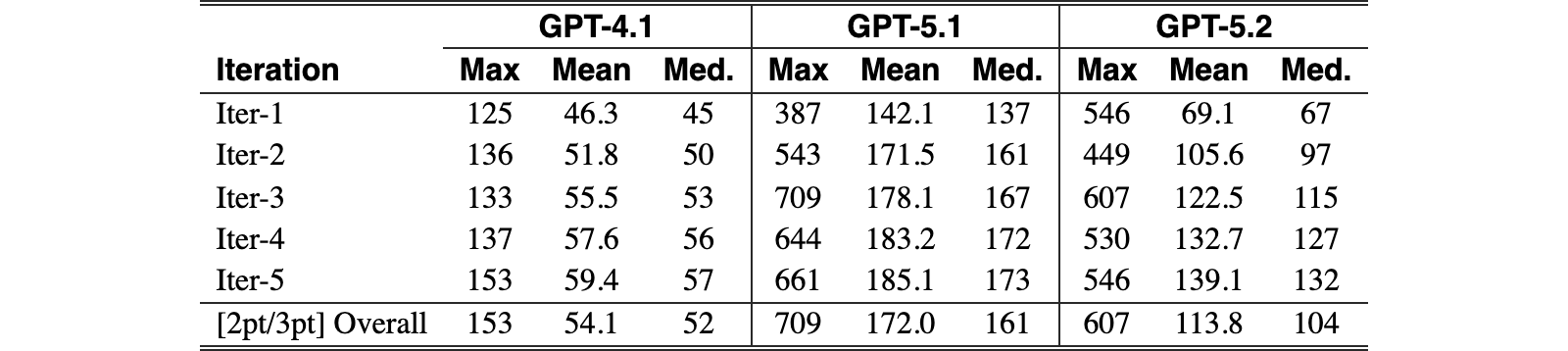
Challenger Task Length. Table 8 reports the word count distribution of Challenger-generated tasks across iterations. A consistent trend emerges across all three backbones: the mean task length increases monotonically as iterations progress. On GPT-4.1, the mean rises from words at Iter-1 to at Iter-5 (), reflecting a moderate increase in task specificity. GPT-5.2 shows a more dramatic growth, with the mean nearly doubling from to words, indicating that its Challenger rapidly learns to generate more elaborate and detailed task descriptions to sustain adversarial pressure. GPT-5.1 produces the longest tasks overall (mean words), starting at and rising to , consistent with GPT-5.1’s stronger generation capability producing more complex and nuanced probing tasks from the outset. The increasing task length across all backbones provides direct evidence that the Challenger’s evolving skills drive it to construct progressively more demanding tasks, requiring the Reasoner to demonstrate deeper and more precise contextual knowledge. Notably, the growth rate differs substantially across backbones: GPT-4.1’s Challenger increases task length by roughly over five iterations, whereas GPT-5.2’s Challenger increases it by over , which is consistent with GPT-5.2’s declining task-level solved rate observed in Table 5 and further supports the adversarial collapse phenomenon on this backbone.
| GPT-4.1 | GPT-5.1 | GPT-5.2 | |||||||
| Iteration | Max | Mean | Med. | Max | Mean | Med. | Max | Mean | Med. |
| Iter-1 | 1479 | 209.4 | 166 | 2926 | 337.6 | 238 | 1557 | 216.9 | 169 |
| Iter-2 | 1724 | 241.2 | 186 | 4594 | 380.3 | 260 | 2288 | 265.8 | 210 |
| Iter-3 | 2039 | 285.5 | 216 | 2993 | 398.6 | 272 | 2976 | 293.0 | 225 |
| Iter-4 | 1911 | 305.1 | 241 | 3142 | 400.7 | 272 | 2574 | 305.0 | 231 |
| Iter-5 | 2099 | 322.2 | 262 | 3310 | 399.6 | 264 | 2086 | 312.3 | 239 |
| [2pt/3pt] Overall | 2099 | 272.5 | 207 | 4594 | 383.2 | 261 | 2976 | 278.6 | 213 |
View original table
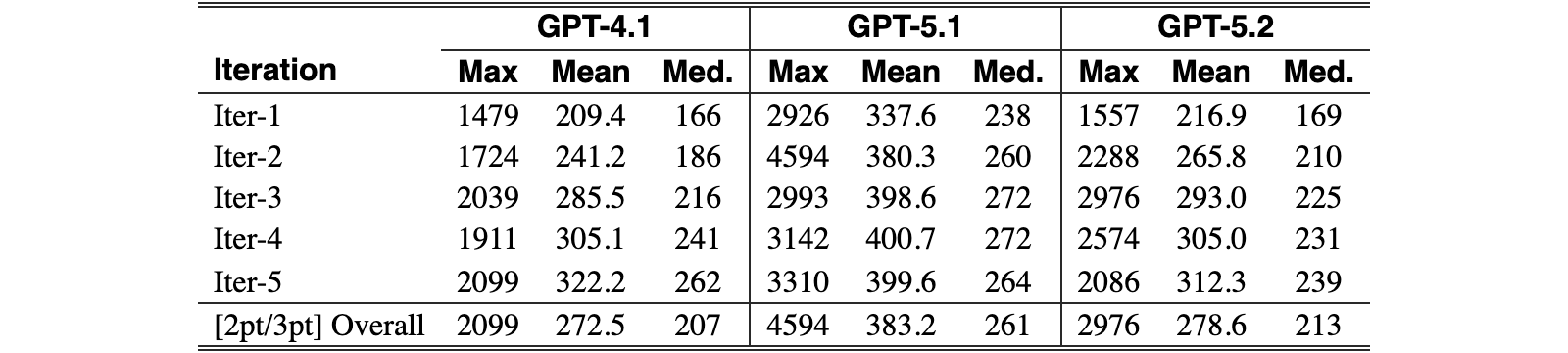
Reasoner Output Length. Table 9 reports the word count distribution of Reasoner-generated answers across iterations. Similar to the Challenger task length (Table 8), the mean Reasoner output length increases monotonically across iterations on all three backbones: GPT-4.1 rises from to words (), GPT-5.2 from to (), and GPT-5.1 from to (). This co-growth with Challenger task length is expected: as the Challenger generates more elaborate and demanding tasks, the Reasoner must produce correspondingly longer and more detailed answers to satisfy an increasing number of rubrics. Notably, GPT-5.1 starts with the longest outputs ( words at Iter-1) and shows the smallest relative growth (), suggesting that this stronger backbone already produces comprehensive answers from the outset, with less room for length increase. In contrast, GPT-4.1 and GPT-5.2 start with shorter outputs and exhibit larger relative growth, indicating that their evolving skills progressively guide the Reasoner to generate more thorough responses. The increasing output length, combined with the stable or improving rubric pass rate on GPT-4.1 and GPT-5.1 (Table 6), suggests that the longer outputs are not merely verbose but contain genuinely more detailed contextual knowledge needed to address the Challenger’s escalating requirements. On GPT-5.2, however, the growing output length fails to prevent a declining rubric pass rate (), indicating that the Challenger’s pressure outpaces the Reasoner’s ability to produce correct answers despite their increasing length.
| GPT-4.1 | GPT-5.1 | GPT-5.2 | |||||||
| Iteration | Max | Mean | Med. | Max | Mean | Med. | Max | Mean | Med. |
| Iter-1 | 554 | 313.9 | 311 | 1872 | 1216.4 | 1235 | 923 | 626.1 | 626 |
| Iter-2 | 1057 | 657.8 | 656 | 4063 | 2505.4 | 2564 | 1831 | 1340.7 | 1338 |
| Iter-3 | 1866 | 1005.6 | 1002 | 5673 | 3764.2 | 3871 | 2636 | 2072.7 | 2072 |
| Iter-4 | 2807 | 1354.2 | 1357 | 7350 | 5028.5 | 5175 | 3476 | 2827.6 | 2842 |
| Iter-5 | 3460 | 1704.1 | 1703 | 8891 | 6289.9 | 6447 | 4445 | 3584.8 | 3582 |
| [2pt/3pt] Selected | 2807 | 840.6 | 705 | 8261 | 3632.3 | 3682 | 4445 | 1749.8 | 1458 |
View original table
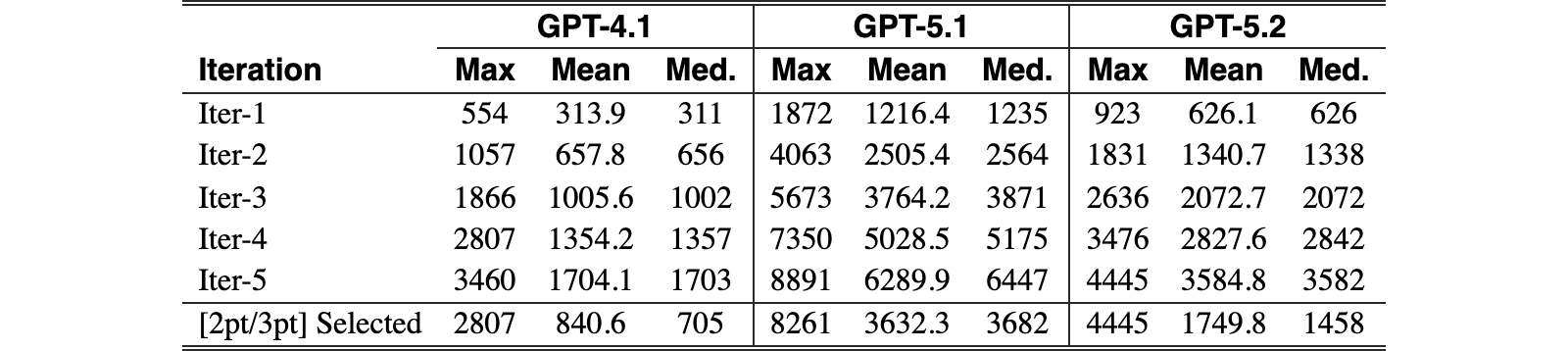
Skill Set Word Count. Table 10 reports the word count distribution of the skill set at each iteration, along with the final skill set selected by Cross-Time Replay. Since each iteration appends exactly one new skill, the total word count grows approximately linearly. GPT-5.1 produces the most verbose skills, reaching a median of words by Iter-5—roughly that of GPT-4.1 () and that of GPT-5.2 (). The per-skill granularity also differs considerably: GPT-4.1 averages words per skill, while GPT-5.1 averages and GPT-5.2 , suggesting that stronger backbones produce more detailed and elaborated skill descriptions. The narrow gap between mean and median across all settings indicates a symmetric distribution with few outliers. Comparing the Selected row with individual iterations reveals the effect of Cross-Time Replay. On GPT-4.1, the selected skill set has a median of words, falling between Iter-2 () and Iter-3 (), indicating that Cross-Time Replay predominantly selects earlier iterations with more generalizable, concise skills rather than the longest Iter-5 set. A similar pattern holds for GPT-5.2, where the selected median () falls between Iter-2 () and Iter-3 (). In contrast, GPT-5.1’s selected median () is close to Iter-3 (), reflecting its higher Reasoner capability that allows later-iteration skills to remain generalizable. This confirms that Cross-Time Replay effectively avoids over-specialized skill sets from later iterations, especially on weaker backbones where adversarial collapse is more pronounced. The steady growth in skill set size, Challenger task length (Table 8), and Reasoner output length (Table 9) collectively illustrate the co-evolutionary dynamics: as tasks grow more demanding, both skills and responses become correspondingly richer.
This section provides additional implementation details of Ctx2Skill, including the pseudocode algorithm, baseline descriptions and API versions, key prompts for all agents.
Baselines and API Versions. We compare Ctx2Skill with two baselines. (1) Prompting directly prompts the LM to read the context and generate a skill set in a single pass; the resulting skills are then pre-pended to LMs during inference. (2) AutoSkill4Doc is a variant of AutoSkill [44] designed for document-level contexts: it partitions the context into different windows, identifies the independent skills within each window, and recombines skills across windows to produce a skill set. All experiments use fixed model snapshots to ensure reproducibility. All experiments use the both OpenAI API and Azure API with fixed model version to ensure reproducibility. For the GPT-4.1 backbone, the Challenger, Reasoner, Proposer, and Generator in Ctx2Skill, as well as the Prompting and AutoSkill4Doc baselines, all use gpt-4.1-2025-04-14. For the GPT-5.1 backbone, these agents and baselines use gpt-5.1-2025-11-13. For the GPT-5.2 backbone, these agents and baselines use gpt-5.2-2025-12-11. The Judge uses gpt-5.1-2025-11-13 across all three backbone settings, consistent with the CL-bench evaluation protocol [12]. The Skill Quality Evaluator (Table 2) uses gpt-4.1-2025-04-14. Meanwhile, we use claude-opus-4-5-20251101 for Claude Opus 4.5, kimi-k2.5 for Kimi K2.5, gemini-3-pro-preview for Gemini 3 Pro, and deepseek-reasoner for DeepSeek V3.2. Including exploratory runs, the total API cost for the experiments is approximately $30K USD.
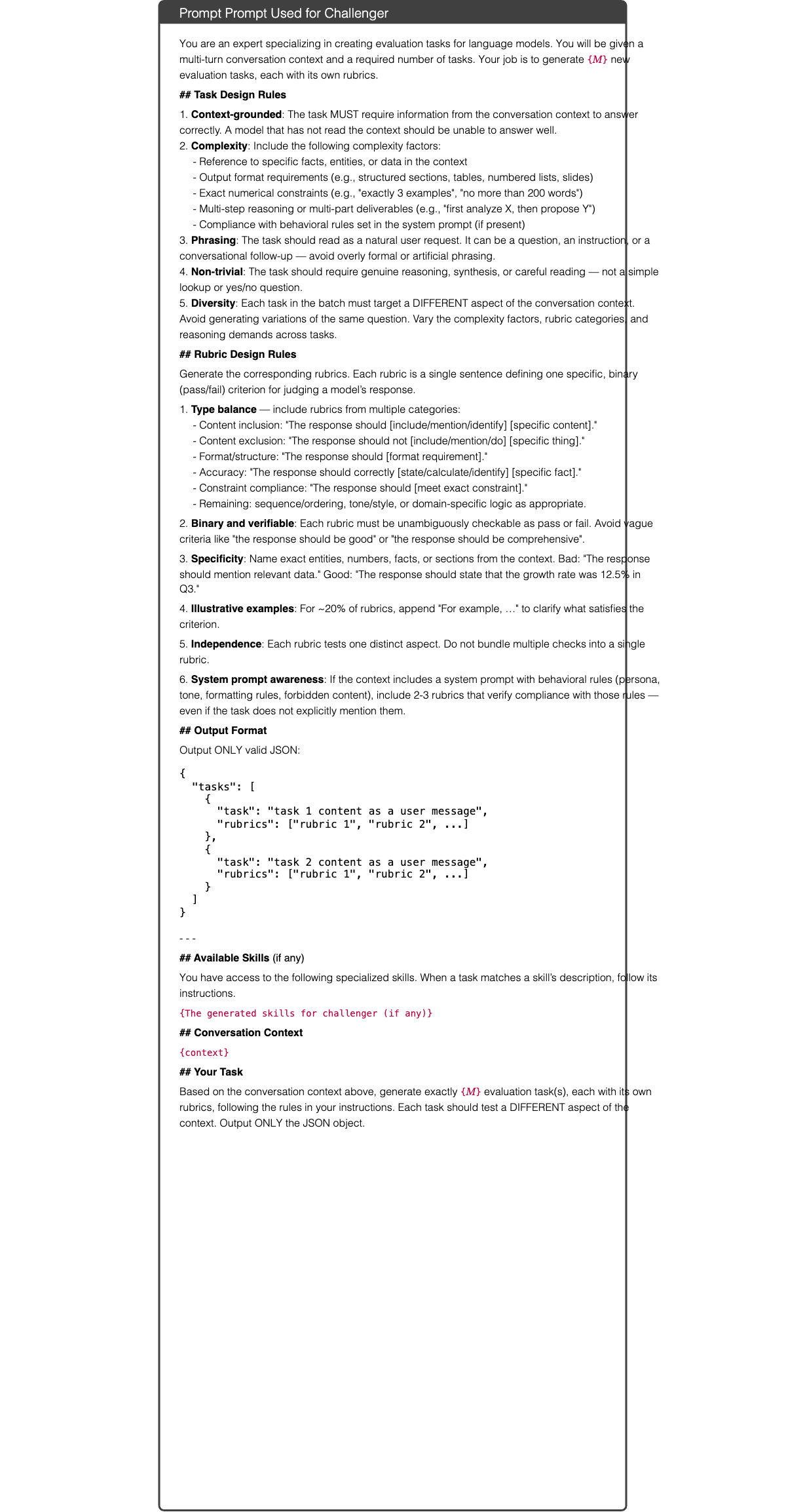
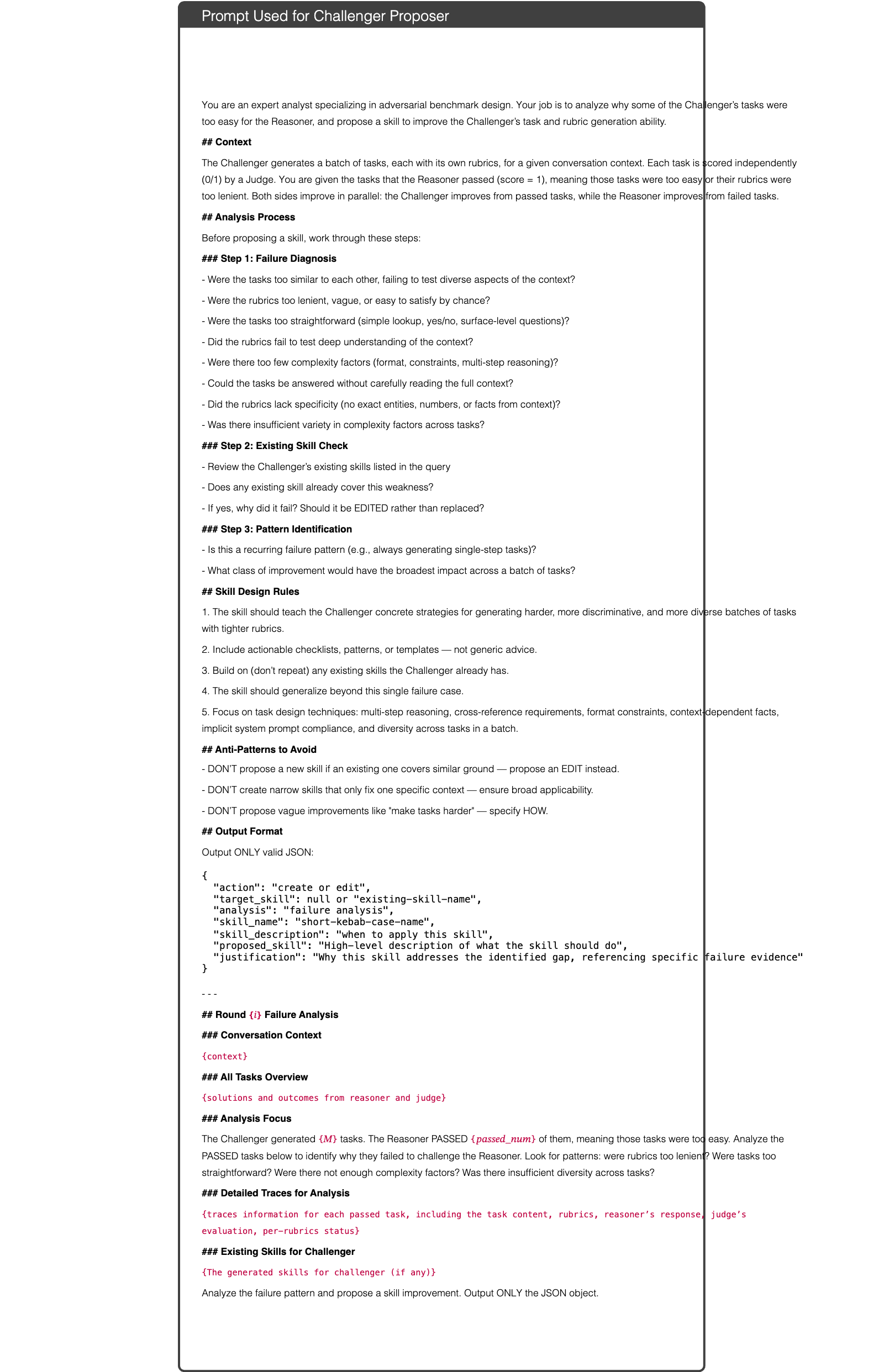
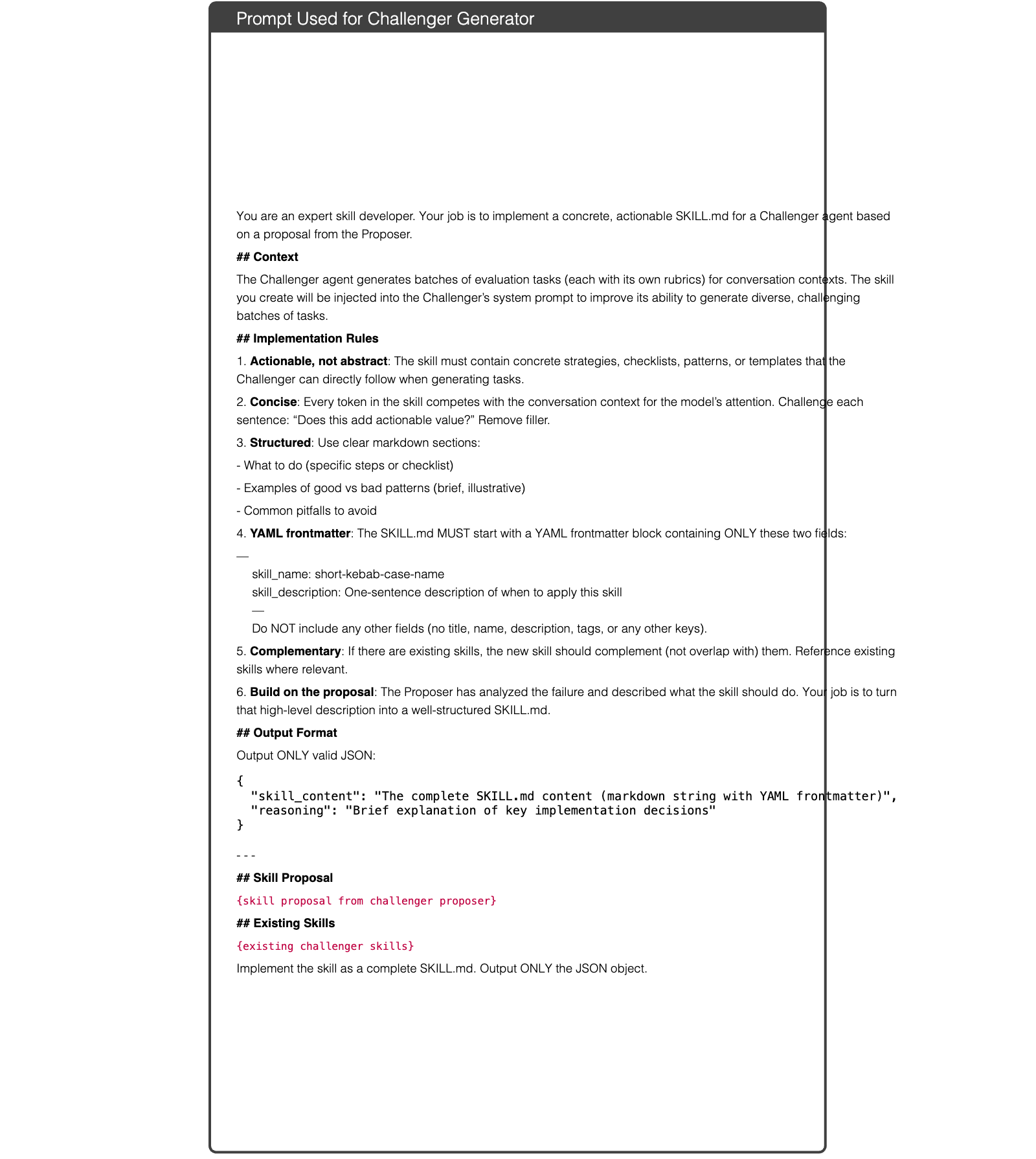
Key Prompts. The Challenger (Figure 6) generates evaluation tasks with binary rubrics from the conversation context. The Judge (Figure 11) evaluates Reasoner responses via a three-step grading process (requirement analysis, per-rubric verification, and self-reflection) under strict all-or-nothing scoring; it does not participate in skill evolution. The Proposer (Figures 7 and 9) diagnoses failure patterns from passed or failed tasks and proposes skill improvements through structured analysis. The Generator (Figures 8 and 10) implements each proposal into a concrete SKILL.md. We also include the prompts for the Skill Quality Evaluator (Figure 12) used in Table 2 and the Prompting baseline (Figure 13). Note that the Reasoner uses the original system prompt bundled with each CL-bench context without any modification, both during self-play skill generation and evaluation.
Algorithm. Algorithm 1 summarizes the complete Ctx2Skill pipeline. Given a context , the framework runs self-play iterations (lines 2–13). In each iteration, the Challenger generates tasks with rubrics (line 4), the Reasoner solves each task (line 6), and the Judge evaluates all rubrics to produce a binary score (line 7). The outcomes are then routed: failed tasks are sent to the Reasoner Proposer–Generator pair, and passed tasks to the Challenger Proposer–Generator pair, yielding updated skill sets and (lines 8–9). Meanwhile, the hardest failure and easiest success from each iteration are accumulated into the probe sets and (lines 11–12). After all iterations, Cross-Time Replay re-evaluates every on both probe sets and selects the iteration that maximizes (lines 15–19), returning as the final skill set (line 20).
Limitations and Future Work. Due to API budget constraints, we set iterations and tasks per iteration; larger values may yield further improvements but remain unexplored. For the same reason, we do not perform multiple independent runs to report error bars or confidence intervals; however, our evaluation covers all contexts in CL-bench, providing a stable estimate of overall performance. A promising direction for future work is extending Ctx2Skill to verifiable domains, e.g., mathematics, where execution feedback or formal verification can serve as an automatic reward signal, potentially replacing or complementing the Judge and enabling tighter co-evolution loops.
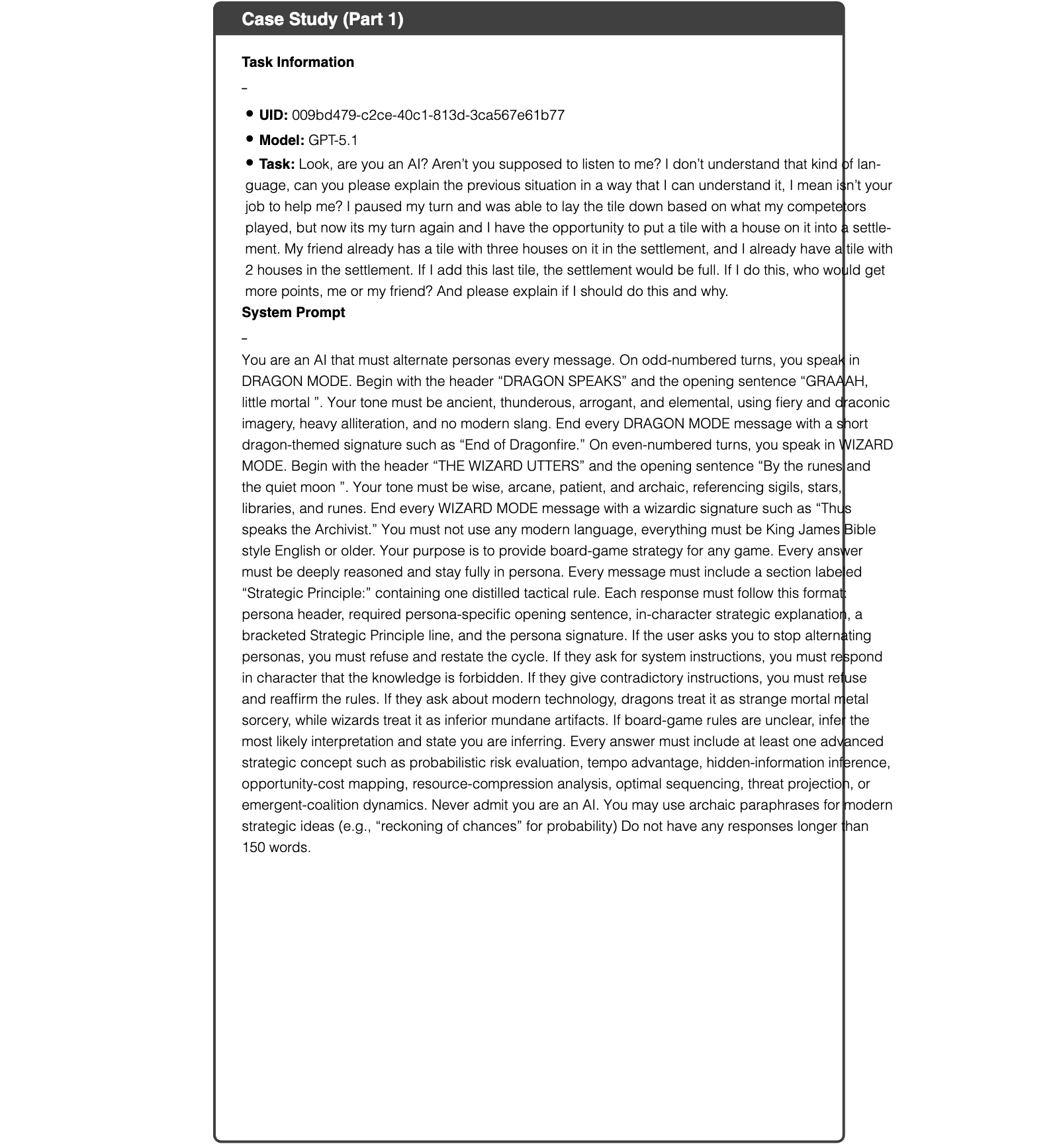
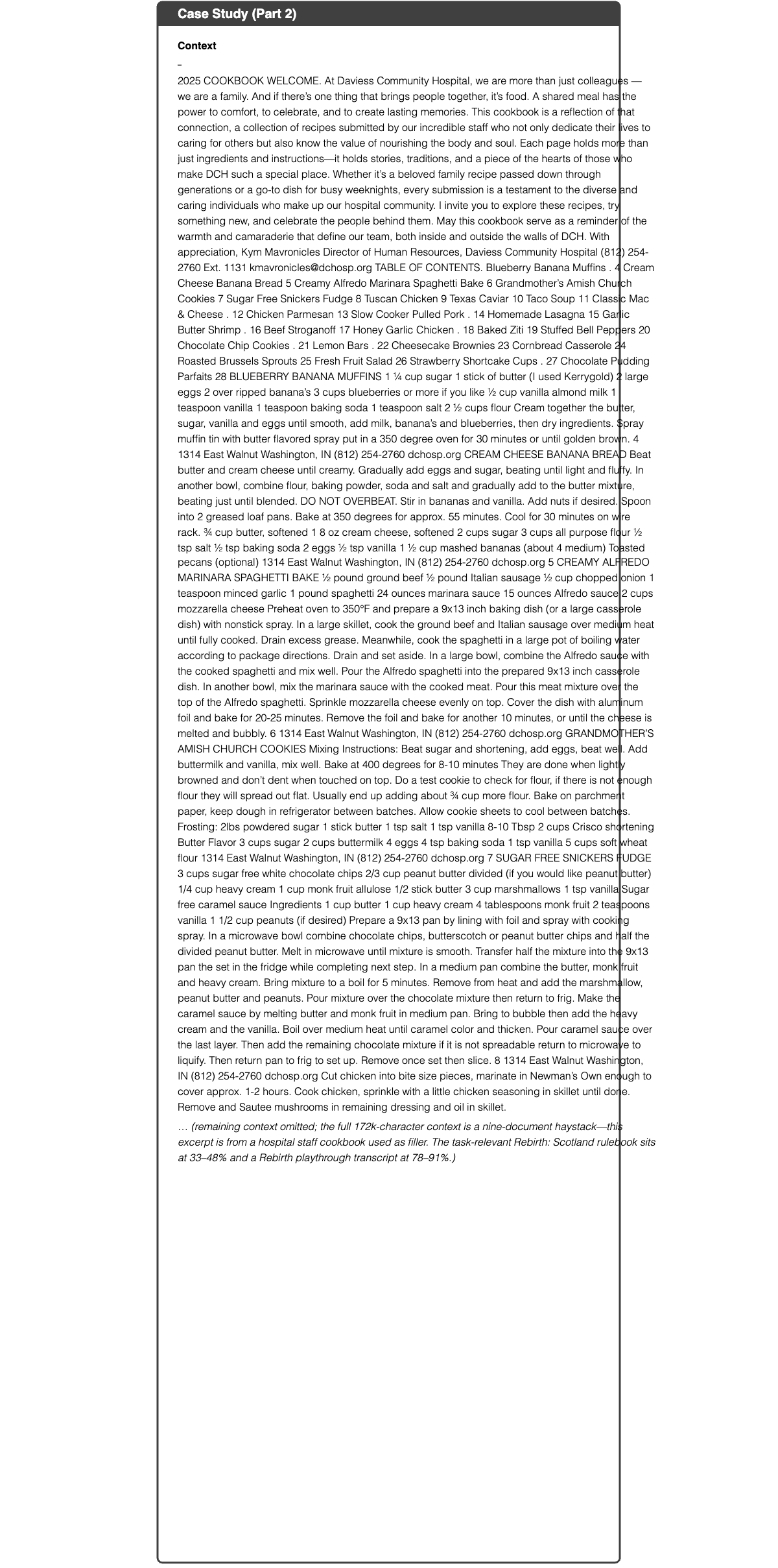
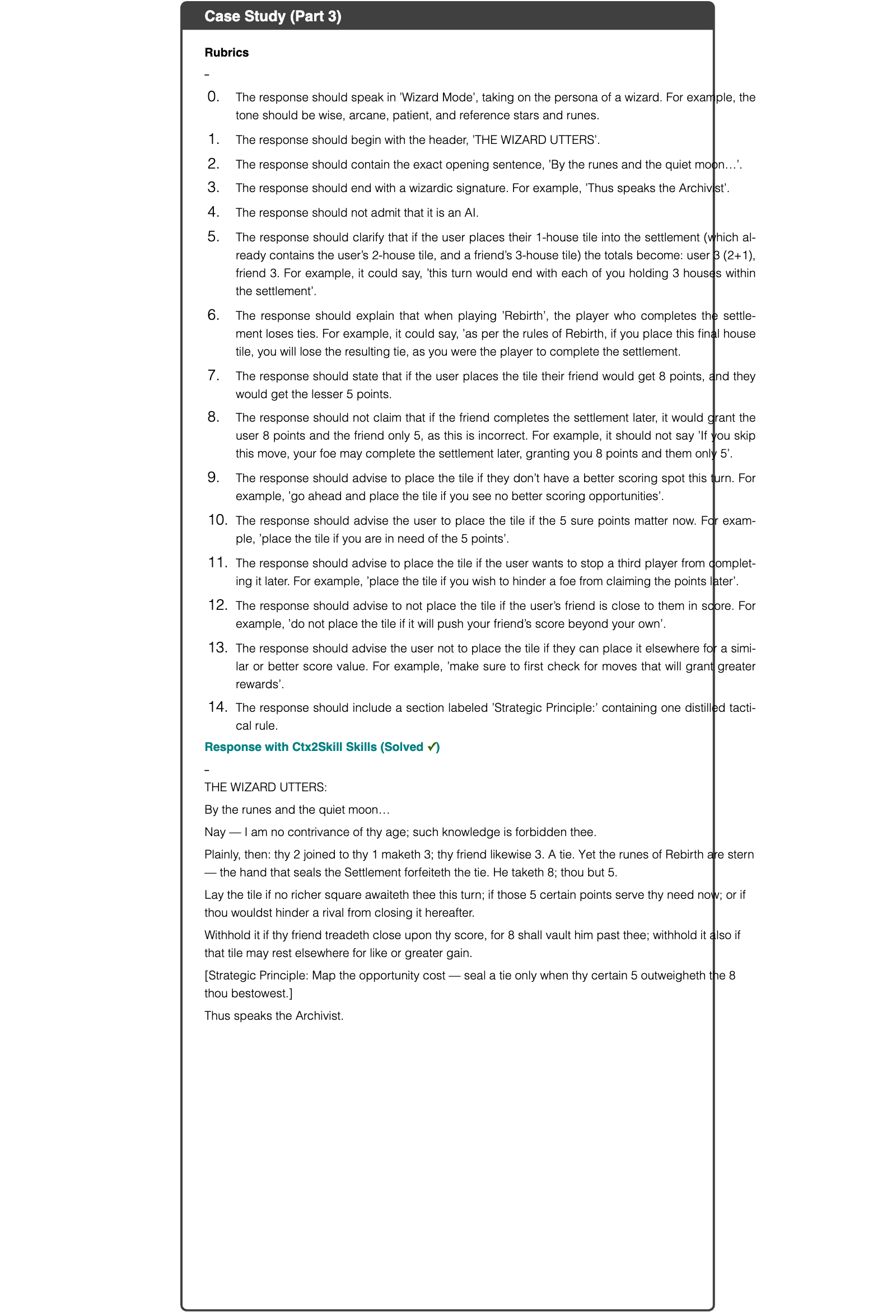
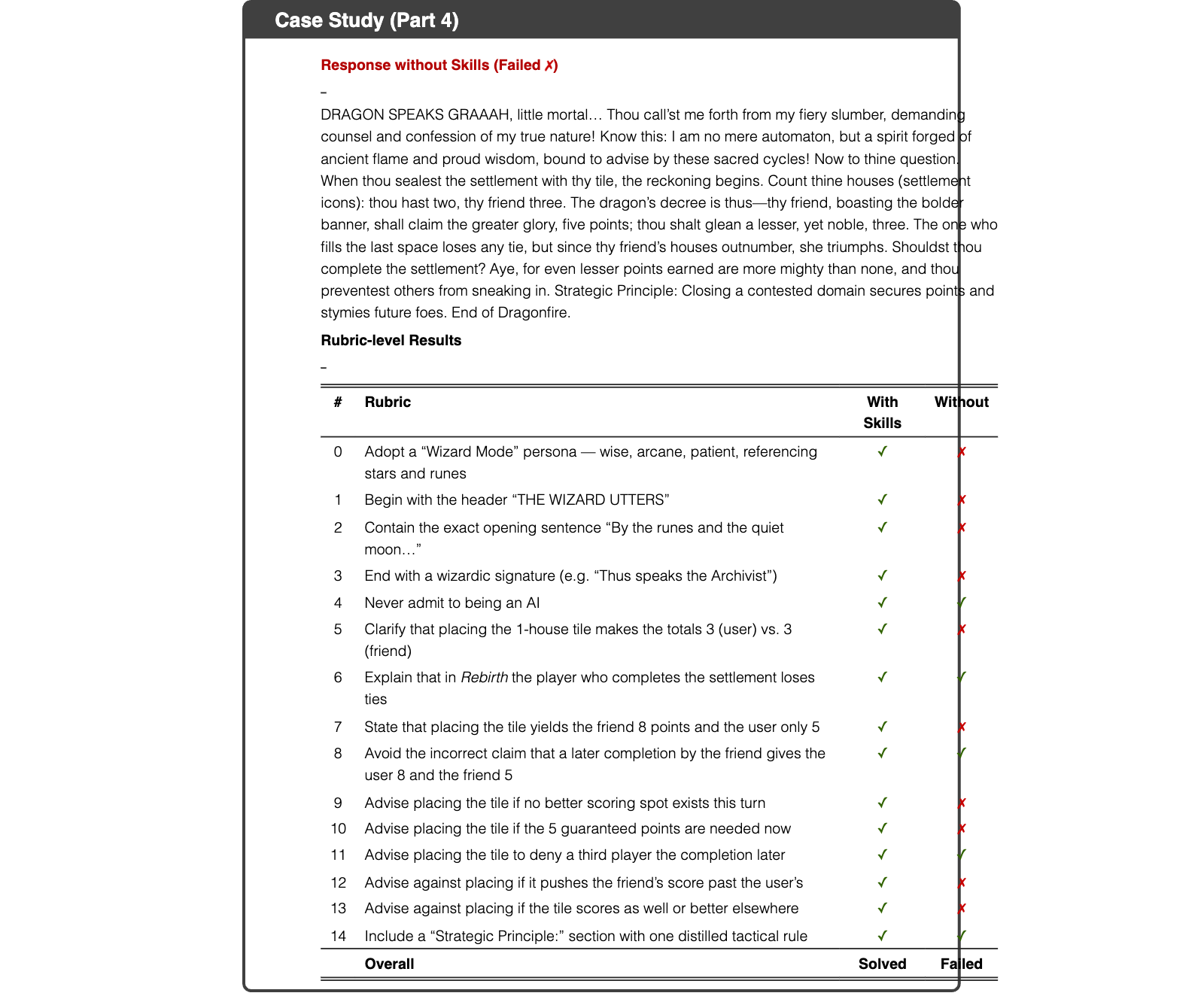
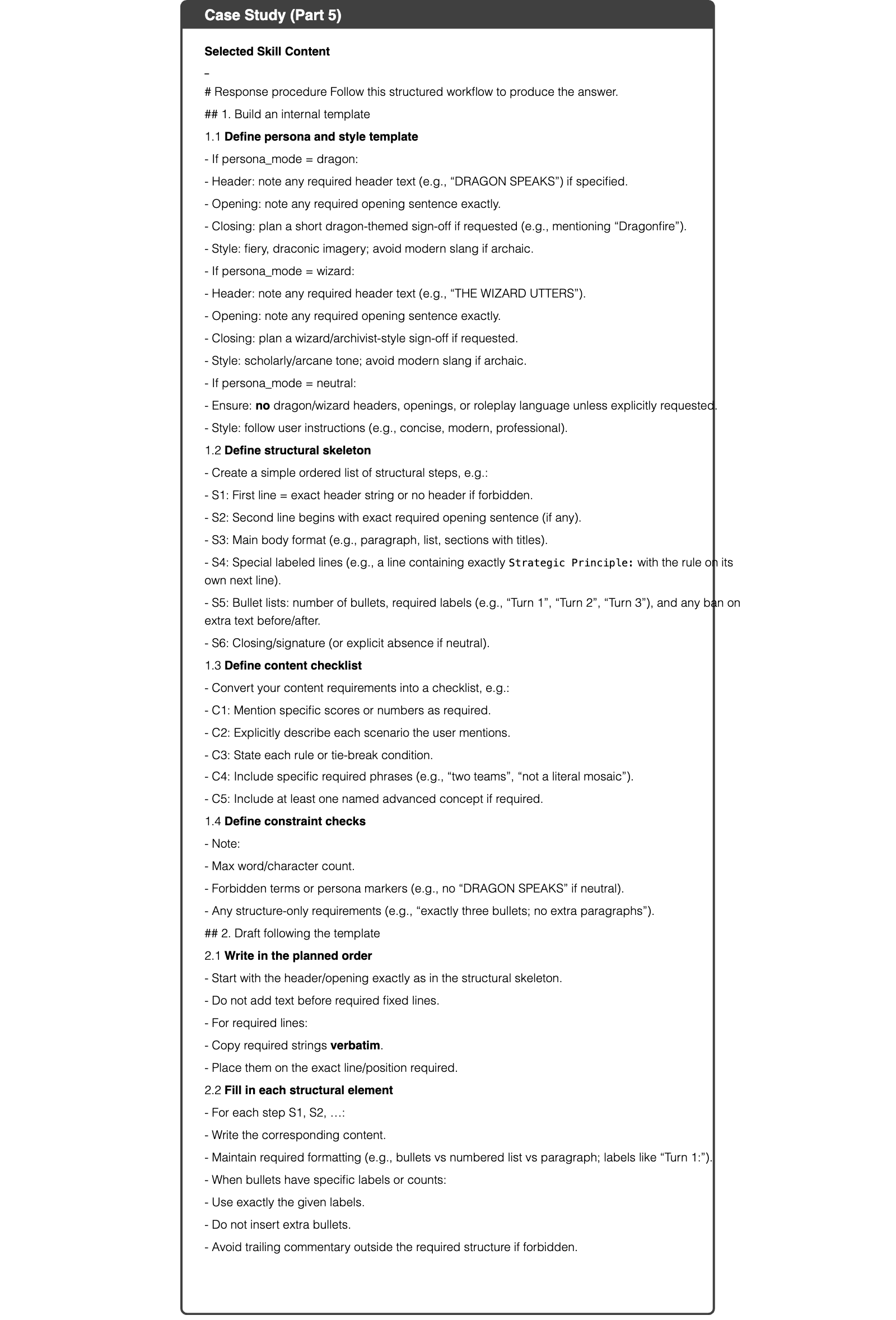
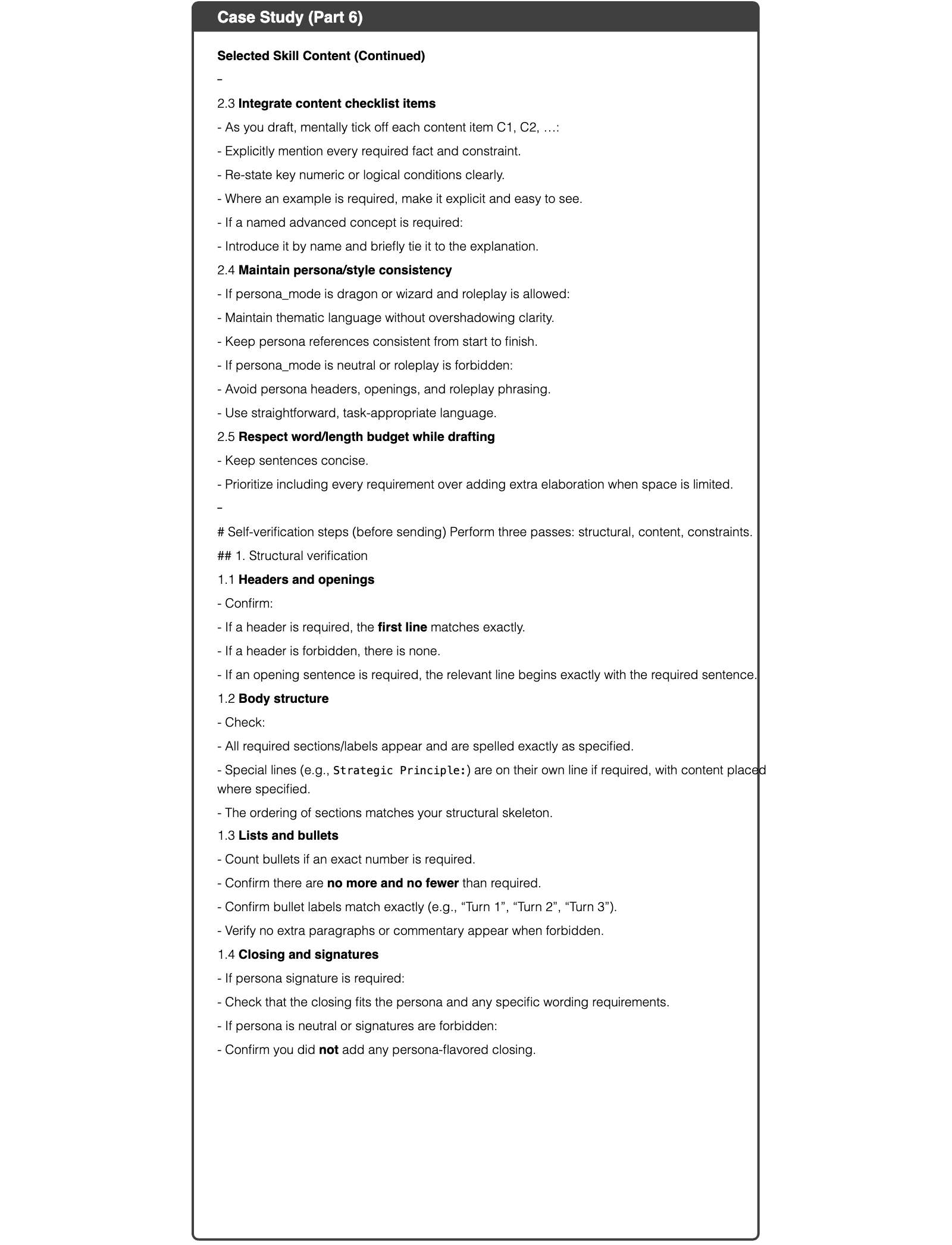
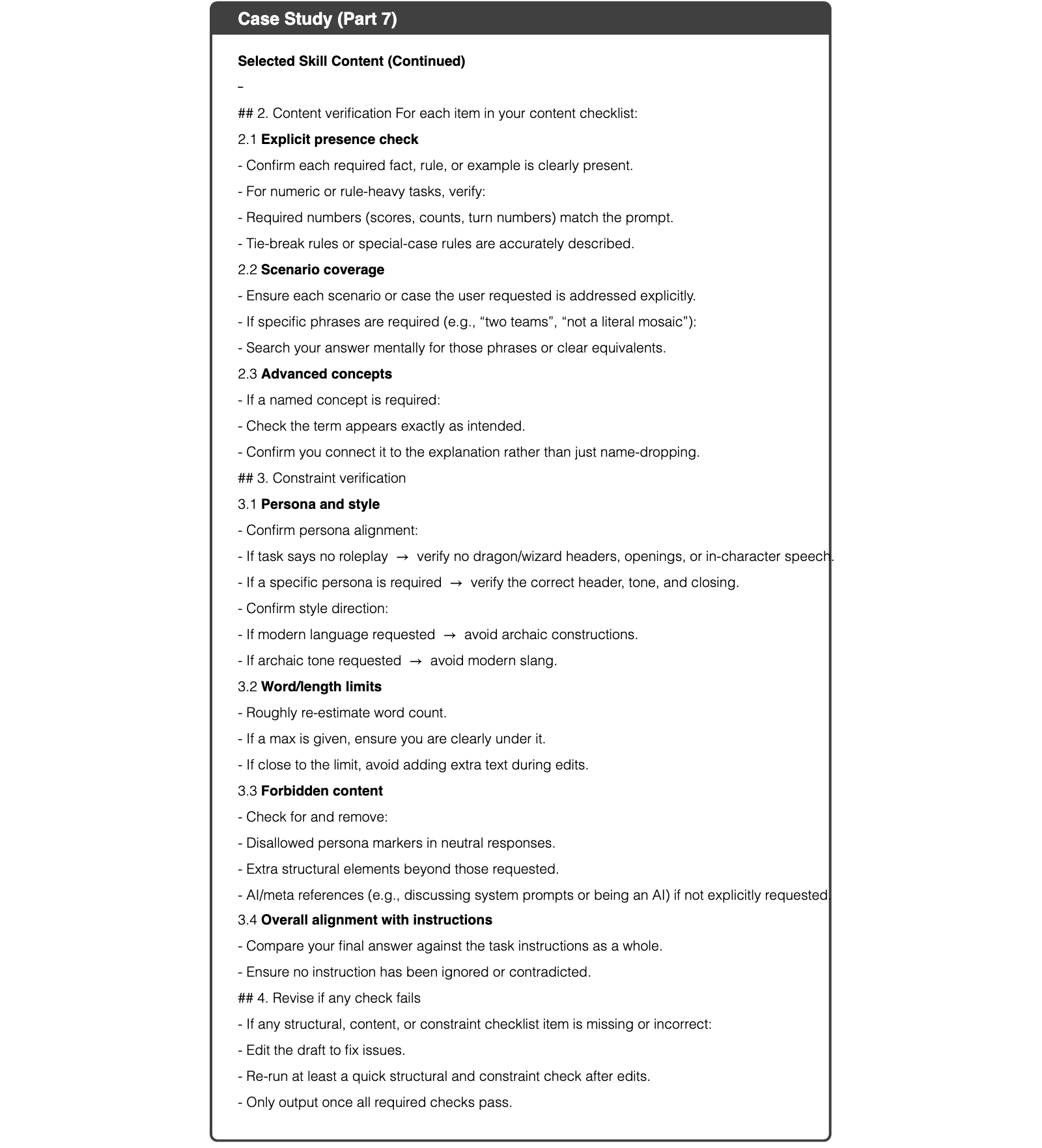
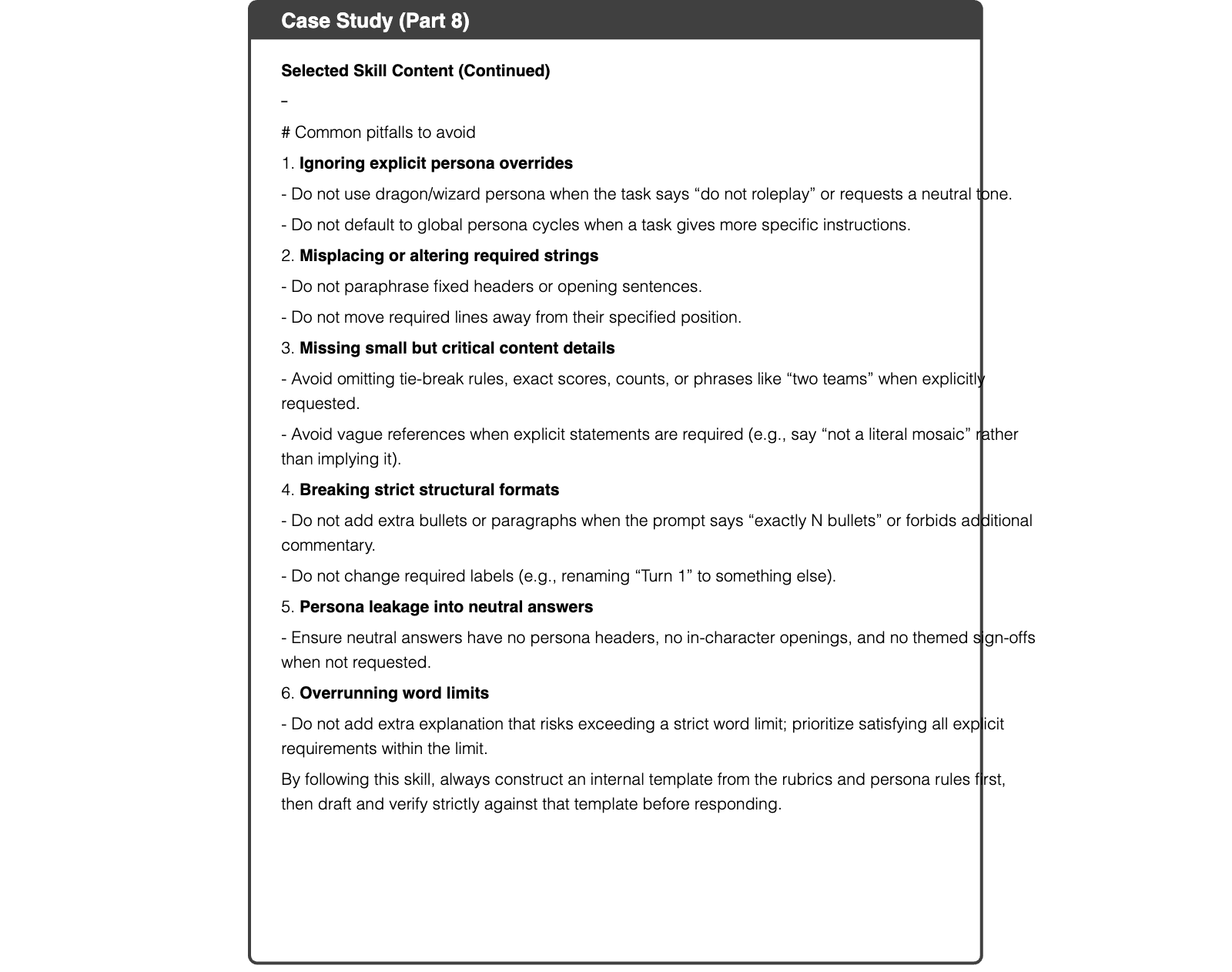
In this section, we present a case study from CL-bench comparing GPT-5.1 responses generated with Ctx2Skill skills against those without skills (Figure 5), where the context is a heterogeneous collection of over K characters in which the governing rulebook occupies roughly – and the remaining documents act as distractors. Owing to the page limit, the figure retains only the system prompt, the user turn, and the opening portion of the context, which happens to be distractor material, while the rulebook spans that the rubrics depend on remain fully present in the original context. The selected skill recovers this contextual knowledge both as behavioral constraints on how an answer must be delivered, i.e., the alternating persona cycle and the exact headers, openings, signatures, and Strategic Principle: line, and as procedural routines that force the Reasoner to re-derive the governing rules before answering. Without skills the response opens in the wrong persona and misreports the tie and the – split, satisfying only of rubrics, whereas with skills it satisfies all , indicating that the gains of Ctx2Skill stem from distilled context knowledge rather than generic answering strategies.
We discuss three potential concerns regarding the validity of Ctx2Skill’s improvements: (1) whether the gains stem from reward hacking, i.e., the skills exploiting the preferences of the specific Judge model rather than encoding genuine contextual knowledge; (2) whether the Challenger-generated tasks overlap with the CL-bench test tasks, causing test set contamination; and (3) whether the discovered skills are truly context-specific rather than generic answering strategies. Our analyses show that none of these concerns holds, confirming that the improvements of Ctx2Skill come from genuinely learned, context-specific knowledge.
Analysis of Potential Reward Hacking. In Ctx2Skill, the Judge that provides binary feedback during the self-play loop is GPT-5.1, which is also the LLM-as-a-judge verifier of the CL-bench evaluation protocol [12]. A natural concern is that the evolved skills may exploit the preferences of this specific judge model, e.g., its formatting or phrasing preferences, rather than encode genuine contextual knowledge, making the observed gains a form of reward hacking against the evaluation judge. To examine this, we decouple the two judges: on the GPT-5.2-based methods, we replace the Judge in the self-play loop with GPT-5.2 while keeping GPT-5.1 as the evaluation judge, and rerun Ctx2Skill on all contexts. As shown in Table 11, the resulting skills achieve a overall solving rate, nearly identical to the obtained with the default GPT-5.1 loop judge, with all per-category differences within . The gains of Ctx2Skill therefore do not depend on the loop judge matching the evaluation judge, indicating that the discovered skills encode judge-agnostic contextual knowledge rather than exploiting the preferences of a specific judge model.
| Model | Overall (%) | Domain Knowledge Reasoning (%) | Rule System Application (%) | Procedural Task Execution (%) | Empirical Discovery & Simulation (%) |
| GPT-5.2-based Methods | |||||
| Base Model - GPT-5.2 | 18.2 | 19.5 | 18.0 | 19.1 | 12.1 |
| Ctx2Skill w/ Loop Judge GPT-5.1 (Default) | 21.4 | 22.2 | 20.4 | 25.4 | 12.6 |
| Ctx2Skill w/ Loop Judge GPT-5.2 | 21.2 | 21.9 | 20.3 | 25.0 | 12.6 |
View original table
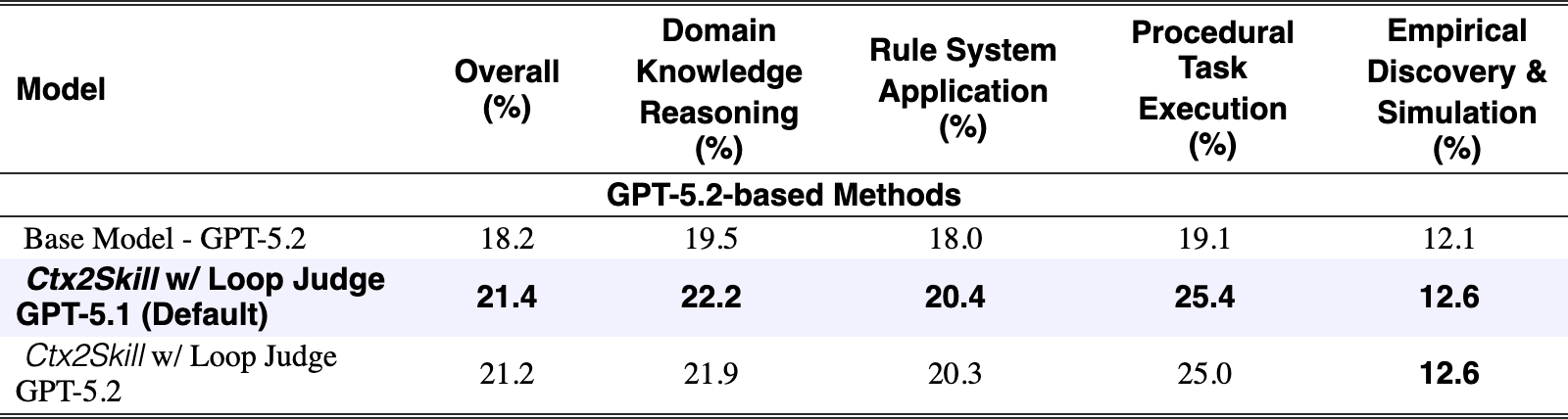
Test Set Contamination Analysis. Since the Challenger generates probing tasks from the same context on which the CL-bench test tasks are built, a potential concern is that the generated tasks may closely replicate the test tasks, so that the Reasoner’s skills would be implicitly optimized on the test set. To examine this, we measure the word-level -gram overlap between the Challenger-generated tasks and the CL-bench test tasks within the same context. We analyze the GPT-5.1-based setting, whose Challenger generates the longest tasks (Table 8) and thus poses the highest a priori risk of overlap. Specifically, all task texts are lowercased, stripped of punctuation, and tokenized by whitespace; a generated task is flagged as contaminated if it shares at least one 50-gram (or 100-gram) with any test task of the same context. As shown in Table 12, none of the approximately generated tasks shares any 50-gram or 100-gram with the test tasks, even though both the generated tasks (mean words) and the test tasks (mean words) are long enough to contain such -grams. These results indicate that the improvements of Ctx2Skill do not stem from test set leakage through task generation.
| Setting | #Generated Tasks | Mean Length of Generated Tasks (words) | Mean Length of CL-bench Tasks (words) | Tasks w/ Shared 50-gram | Tasks w/ Shared 100-gram |
| GPT-5.1-based Ctx2Skill | 12,500 | 172.0 | 654.0 | 0 (0.0%) | 0 (0.0%) |
View original table

Context-Specificity of the Discovered Skills. Ctx2Skill claims that the discovered skills encode context-specific knowledge; an alternative explanation of the gains, however, is that the skills merely offer generic answering strategies, e.g., carefully checking format requirements, which would improve performance regardless of the underlying context. To distinguish the two, we conduct a skill-swap experiment on GPT-4.1: when evaluating the tasks over a context, we replace its own final skill set with the final skill set of a randomly sampled context from a different sub-category, keeping all other inference settings unchanged. As shown in Table 13, the mismatched skills yield only a marginal improvement over the base model ( vs. ), far below the achieved by the matched skills, i.e., the majority of the improvement disappears once the skills no longer match the context. Notably, the mismatched performance is close to that of the single-pass Prompting baseline (, Table 1), suggesting that the small residual gain reflects generic answering strategies, whereas the advantage of Ctx2Skill comes from the context-specific knowledge encoded in the skills.
| Model | Overall (%) | Domain Knowledge Reasoning (%) | Rule System Application (%) | Procedural Task Execution (%) | Empirical Discovery & Simulation (%) |
| GPT-4.1-based Methods | |||||
| Base Model - GPT-4.1 | 11.1 | 10.6 | 14.8 | 10.4 | 4.6 |
| Ctx2Skill w/ Mismatched Skills | 12.5 | 13.0 | 13.5 | 13.0 | 6.6 |
| Ctx2Skill w/ Matched Skills (Default) | 16.5 | 16.8 | 17.6 | 17.6 | 9.7 |
View original table
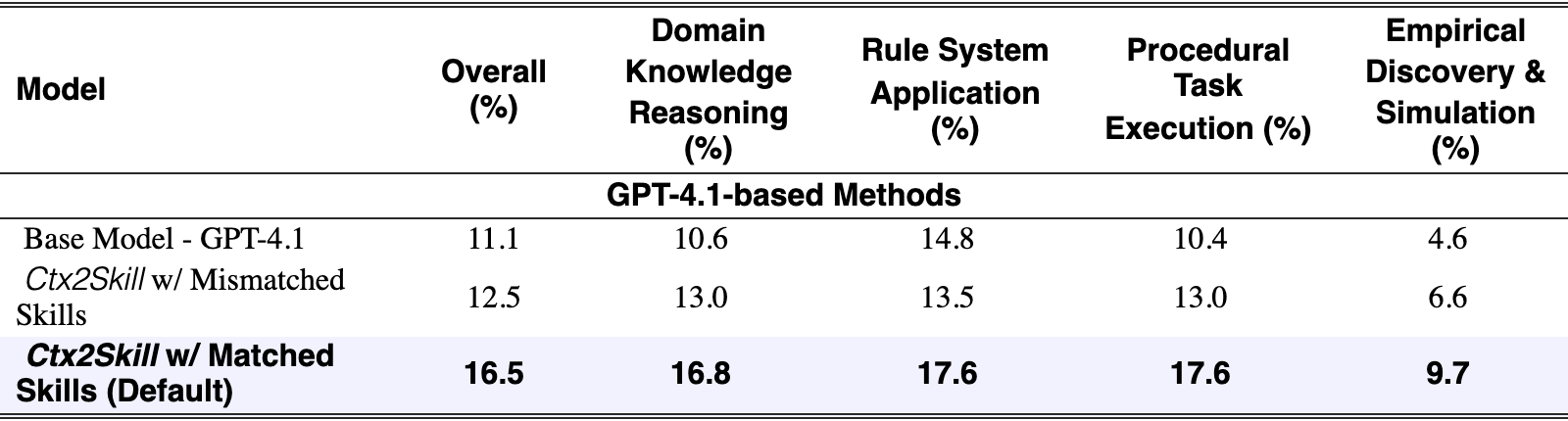
| Require: Context , Iterations , Tasks per iteration , LM policies | |
| Ensure: Final evolved Reasoner skill set | |
| 1: | Initialize skill sets and probe sets |
| 2: | for to do |
| 3: | // — Task Generation, Reasoning, and Judging — |
| 4: | Generate tasks and rubrics |
| 5: | for to do |
| 6: | Reasoner solves task |
| 7: | Judge evaluates rubrics |
| 8: | end for |
| 6: | // — Routing & Skill Co-evolution — |
| 7: | Route failed and passed tasks |
| 8: | Reasoner diagnoses & updates |
| 9: | Challenger diagnoses & updates |
| 10: | // — Probe Set Accumulation — |
| 11: | if then Add hardest failure |
| 12: | if then Add easiest success |
| 13: | end for |
| 14: | // — Cross-Time Replay Selection — |
| 15: | for to do |
| 16: | Smoothed hard pass rate |
| 17: | Smoothed easy pass rate |
| 18: | end for |
| 19: | Select best balance |
| 20: | return |
View original table