Flow-OPD: On-Policy Distillation for Flow Matching Models
arXiv:2605.08063v5 · This workspace stays on this version. Check arXiv for newer versions
Some source details need review 3 to check
Original formulas, table values and figures are preserved. Comparison can miss differences; use the original PDF to check details.
Reading view checked: 97 math expressions, 0 rendering failures; 15 of 17 images available.
Compared 92 of 92 source passages against 17 of 17 PDF pages.
- Some figure, table or graphic images are unavailable; the original paper is still accessible. (2)
- S1_F1: blank, oversized or incomplete source rendering; capture unavailable.
- S6_F4: blank, oversized or incomplete source rendering; capture unavailable.
15 of 17 figure, table and graphic images captured. Open original PDF
Abstract
Existing Flow Matching (FM) text-to-image models suffer from two critical bottlenecks under multi-task alignment: the reward sparsity induced by scalar-valued rewards, and the gradient interference arising from jointly optimizing heterogeneous objectives, which together give rise to a “seesaw effect" of competing metrics and pervasive reward hacking. Inspired by the success of On-Policy Distillation (OPD) in the large language model community, we propose Flow-OPD, the first unified post-training framework that integrates on-policy distillation into Flow Matching models. Flow-OPD adopts a two-stage alignment strategy: it first cultivates domain-specialized teacher models via single-reward GRPO fine-tuning, allowing each expert to reach its performance ceiling in isolation; it then establishes a robust initial policy through a Flow-based Cold-Start scheme and seamlessly consolidates heterogeneous expertise into a single student via a three-step orchestration of on-policy sampling, task-routing labeling, and dense trajectory-level supervision. We further introduce Manifold Anchor Regularization (MAR), which leverages a task-agnostic teacher to provide full-data supervision that anchors generation to a high-quality manifold, effectively mitigating the aesthetic degradation commonly observed in purely RL-driven alignment. Built upon Stable Diffusion 3.5 Medium, Flow-OPD raises the GenEval score from 63 to 92 and the OCR accuracy from 59 to 94, yielding an overall improvement of roughly 10 points over vanilla GRPO, while preserving image fidelity and human-preference alignment and exhibiting an emergent "teacher-surpassing" effect. These results establish Flow-OPD as a scalable alignment paradigm for building generalist text-to-image models. The codes and weights will be released in: https://github.com/CostaliyA/Flow-OPD.
Flow Matching (FM) Batifol et al. (2025); Esser et al. (2024); Lipman et al. (2022); Fang et al. (2025) has emerged as a superior paradigm for generative modeling, outperforming traditional diffusion models in both sampling efficiency and high-fidelity synthesis by learning continuous-time velocity fields. However, as the research frontier shifts from unconstrained image synthesis toward highly-controllable, multi-dimensional alignment, the limitations of current post-training methodologies have become painfully evident. Modern applications demand that a single model masters a diverse spectrum of tasks—ranging from precise text rendering and complex compositional reasoning Huang et al. (2026a); Huang et al. (2026b); Chen et al. (2025a); Chen et al. (2025b); Guo et al. (2025a); Chen et al. (2026a) to rigorous adherence to nuanced human aesthetic preferences—all within a unified generative space Han et al. (2026); Chen et al. (2026b); Feng et al. (2026); Huang et al. (2025).
Recent advances have attempted to bridge this gap by porting Reinforcement Learning (RL) algorithms, such as Group Relative Policy Optimization (GRPO) Guo et al. (2025b), to the flow-matching domain Liu et al. (2025a); Xue et al. (2025); Li et al. (2025). These methods have demonstrated significant potential in single-reward scenarios, where on-policy exploration allows the model to refine its sampling trajectories and improve specific metrics like PickScore or aesthetic scores. Nevertheless, different tasks demand heterogeneous and conflicting feature representations. As noted in LLM alignment Zeng et al. (2026), sparse scalar rewards lack the granularity to harmonize these objectives, inducing a zero-sum "seesaw effect" where optimizing specific features (e.g., OCR) inevitably degrades aesthetics via reward hacking. This necessitates a shift to dense, trajectory-level distillation to provide uncoupled expert supervision.
This issue has recently found a compelling solution in the field of Large Language Models (LLMs): On-Policy Distillation (OPD). Benefiting from OPD, models such as DeepSeek-V4 Guo et al. (2025a), Mimo v2 Xiao et al. (2026), and GLM-5 Zeng et al. (2026) successfully harmonize complex, multi-domain capabilities by distilling from specialized experts. This paradigm shift raises a pivotal question for the vision community: Can Flow Matching models similarly leverage OPD to integrate the diverse strengths of multiple teacher models into a single, robust student model? To address this pivotal question, we introduce Flow-OPD, the first framework to integrate OPD into the post-training pipeline of FM models. We propose a two-stage alignment strategy that begins by cultivating specialized domain teachers through single-reward GRPO fine-tuning, ensuring each expert reaches its performance ceiling in isolation. To facilitate a smooth transition for the student model, we develop a Flow-based Cold-Start strategy featuring two distinct variants—Supervised Fine-Tuning (SFT) based initialization and Model Merging—designed to establish a robust foundational policy capable of multi-task learning. Building upon this foundation, we apply OPD to the flow-matching process via a three-step orchestration: (1) performing on-policy sampling to capture the student model’s current velocity field, (2) executing task routing labeling where diverse experts provide dense supervision for respective domains, and (3) introducing Manifold Anchor Regularization (MAR), which incorporates a task-agnostic teacher to provide full-data supervision, effectively anchoring the generation process to a high-quality manifold and further elevating the aesthetic integrity of the synthesized images. Experimental results across multiple benchmarks and metrics demonstrate that Flow-OPD achieves 10% improvement over vanilla GRPO with sparse rewards, establishing a new frontier for scaling alignment in flow-based generative models. In summary, our contributions are three-fold:
- •
Analysis of Multi-task FM Training: We provide a empirical analysis of the failure modes of GRPO-based multi-task training in Flow Matching models, specifically identifying the challenges of reward sparsity and gradient interference. To resolve these, we are the first, to our best knowledge, to introduce OPD paradigm into the post-training of FM models.
- •
The Flow-OPD Framework: We propose Flow-OPD, a two-stage post-training framework that decouples expertise acquisition from model unification. Our framework introduces a Flow-based Cold-Start strategy (SFT and Merging variants), a task routing dense labeling mechanism for fine-grained supervision, and a novel Manifold Anchor Regularization (MAR) to ensure global generative quality through task-agnostic guidance.
- •
Superior Performance and Generalization: Through extensive experiments on four mainstream benchmarks, we demonstrate that Flow-OPD achieves a substantial 10-point improvement over the GRPO baseline. Notably, the unified student model matches or even surpasses the performance of specialized teachers in-domain, while exhibiting exceptional out-of-distribution (OOD) generalization capabilities.
The success of RL-based alignment in large language models has recently inspired reinforcement learning for text-to-image (T2I) generation. Early methods such as DDPO Black et al. (2024), DPOK Fan et al. (2023), and ImageReward/ReFL Xu et al. (2023) formulate diffusion generation as policy optimization with rewards for aesthetics, human preference, or text-image alignment, while Diffusion-DPO Wallace et al. (2023) aligns diffusion models using preference pairs. More recent GRPO-style methods extend RL to modern visual generators, including those for flow models Liu et al. (2025b); Xue et al. (2025), and AR paradigms Yuan et al. (2025); Zhang et al. (2025b); Ma et al. (2025); Zhang et al. (2025a); Ma et al. (2026). However, T2I generation requires multiple rewards to cover aesthetics, alignment, fidelity, and compositional correctness. Existing solutions remain hard to control: DanceGRPO Xue et al. (2025) directly mixes rewards such as HPS and CLIP, often trading off one metric against another; Flow-GRPO Liu et al. (2025b) uses staged reward/dataset curricula, making results sensitive to ordering and stage design; and GDPO Liu et al. (2026) shows that GRPO Guo et al. (2025a) may suffer from reward-normalization collapse under multi-reward settings. This motivates a more controllable multi-reward coordination mechanism.
Traditional offline distillation relies on fixed datasets and fails to adapt to the student’s evolving trajectory. In contrast, On-Policy Distillation (OPD) dynamically couples the teacher’s supervisory signal with the student’s exploration space. In the LLM domain, OPD has seen rapid development: GKD Agarwal et al. (2024) established the canonical framework to mitigate exposure bias; MiniLLM Gu et al. (2024) and DistiLLM Ko et al. (2025) introduced Reverse and Skewed Kullback-Leibler (KL) to refine mode-seeking and optimization stability; G-OPD Yang et al. (2026) unified OPD under KL-constrained RL theory; Entropy-Aware OPD Jin et al. (2026) preserves diversity through adaptive divergence functions; Fast OPD Zhang et al. (2026) significantly accelerates computation via prefix truncation; and PACED Xu et al. (2026) implements a competence-aware curriculum based on gradient signal-to-noise analysis. Despite these LLM advancements, OPD remains underexplored in visual Flow Matching models, which require dense supervision within high-dimensional velocity fields. We propose Flow-OPD, the first systematic migration of on-policy distillation to Flow Matching, utilizing multi-teacher dense supervision to overcome the reward sparsity bottleneck.
Flow Matching (FM) maps a noise distribution to data via an ODE . Under the Optimal Transport (OT) formulation Lipman et al. (2022), the path is , and the model learns the constant velocity via:
Following Flow-GRPO Liu et al. (2025a), we conceptualize the discretized ODE integration as a sequential Markovian denoising process. By formulating each transition as a Markovian state step, this perspective bridges continuous generative dynamics with reinforcement learning, defining a formal trajectory for step-wise policy optimization.
Knowledge distillation aims to compress teacher capabilities into a student model by minimizing their output divergence. To mitigate distribution shift, on-policy distillation (OPD) Lu and Lab (2025) requires the student to generate trajectories under the guidance of real-time teacher supervision. For Autoregressive (AR) models, this optimization is formulated as minimizing the Reverse Kullback-Leibler (KL) divergence between the student and teacher distributions:
By aligning the model on its own generated distribution, OPD effectively suppresses exposure bias and ensures robust generalization in interactive or iterative generation tasks.
Standard FM relies on offline reconstruction, fundamentally limiting performance to static dataset quality and failing to optimize non-differentiable preferences. GRPO Guo et al. (2025a); Liu et al. (2025a); Xue et al. (2025) overcomes this via online exploration. By actively sampling outputs from its current policy , it evaluates self-generated states using a Group Relative Advantage, . The policy gradient is then explicitly driven by these online experiences:
This continuous exploration of its own dynamic distribution enables the model to discover novel, high-reward trajectories, successfully breaking the performance ceiling of offline SFT.
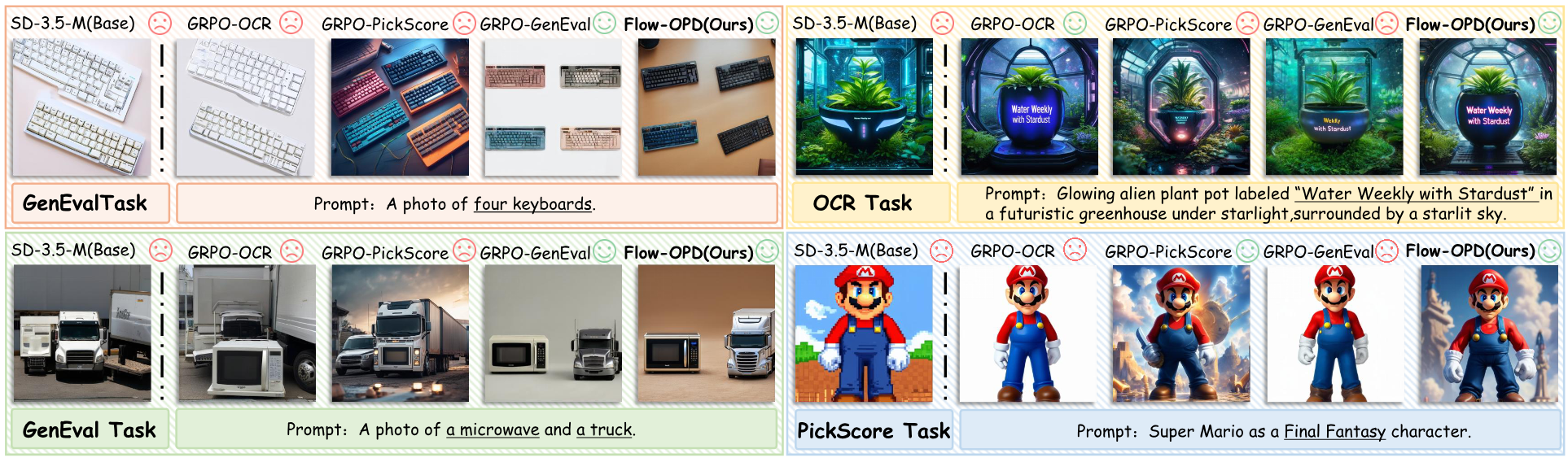
Despite its target-specific efficacy, single-reward GRPO incurs severe degradation in orthogonal capabilities (Fig. 2). This catastrophic forgetting stems from unconstrained gradient interference driven by sparse scalar rewards within a shared parameter space .
For a parameter update driven by a target task with advantage , the collateral impact on an unmonitored capability () can be approximated via first-order Taylor expansion:
In high-dimensional spaces, divergent task gradients frequently conflict (). Lacking supervisory signals for , the optimizer aggressively exploits these unmonitored degrees of freedom to maximize , dismantling pre-trained synergies and leading to manifold collapse. This prompts a natural question: Can we resolve this degradation by simply mixing multiple datasets and rewards for joint optimization?
To explore the feasibility of mix training approach, we conduct a controlled empirical experiment on Stable Diffusion 3.5 Medium (SD-3.5-M) Esser et al. (2024). Following Flow-GRPO, we progressively stack four distinct reward functions: GenEval, OCR, PickScore, and DeQA. As demonstrated in Table 4.3, mixing scalar rewards fails to construct a stable cognitive foundation.
| Model | GenEval | OCR |
|---|---|---|
| SD-3.5-M | 0.63 | 0.59 |
| +GenEval | 0.94 | 0.65 |
| +OCR | 0.89 (5%) | 0.91 |
| +PickScore | 0.82 (7%) | 0.86 (5%) |
| +DeQA | 0.73 (9%) | 0.83 (3%) |
View original table
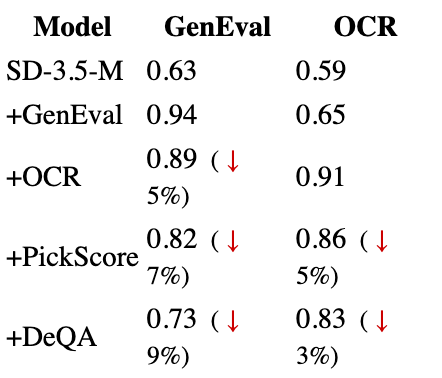
While the initial reward (+GenEval) succeeds, subsequent additions trigger catastrophic forgetting (e.g., +OCR degrades GenEval by 5%). This corroborates our hypothesis of Gradient Interference (). Compressing multi-dimensional conflicts into a scalar advantage forces a zero-sum game; for instance, accommodating aesthetic stylization (PickScore) aggressively overwrites precise geometric representations. Consequently, scalar reward mixing is fundamentally unscalable due to this sparse Information Bottleneck. To avoid parameter cannibalization, we require a supervisory signal that is simultaneously on-policy (maintaining exploration) and densely uncoupled (preventing interference). Inspired by Multi-Teacher On-Policy Distillation (OPD) in LLMs, we propose Flow-OPD. This framework seamlessly introduces the multi-teacher paradigm into continuous Foundation Models, achieving active on-policy exploration guided by dense supervision.
Flow-OPD reformulates multi-task alignment via dense supervision on self-generated trajectories. We first train domain-expert teachers using Flow-GRPO. Following cold-start initialization, the student undergoes Multi-Teacher Online Distillation, dynamically routing online samples to specific teachers for fine-grained guidance. Finally, Manifold Anchor Regularization decouples functional alignment from aesthetic collapse, preserving the inherent generative prior.
To ensure a stable initialization and prevent trajectory divergence during early rollout, we explore two cold-start strategies: SFT-based and model-merging initialization. Our SFT protocol follows Flow-GRPO but utilizes trajectories sampled from specialized teachers, ensuring the student inherits expert-level knowledge distributions from the outset. Alternatively, model merging superposes the anisotropic priors of divergent teachers into a unified parameter state. This "merging-as-initialization" approach positions the student in a high-competence region of the loss landscape, where multi-task synergies are already nascent, providing a robust foundation for subsequent distillation.
As shown in Eq. 2, ThinkingMachines’ OPD Lu and Lab (2025) optimizes a student policy by utilizing the Reverse KL divergence against a teacher distribution as an environment reward over autonomously generated trajectories . To transpose this Policy Gradient (PG) paradigm into the continuous-time FM framework, we map the discrete token sequence to the continuous latent trajectory . The ar prediction translates to the instantaneous transition policy parameterized by the velocity field . Crucially, instead of directly minimizing the distance between vector fields via supervised regression, we derive the exact continuous-time KL divergence and utilize it as a dense reward signal to guide policy exploration via PG.
The fundamental premise of Flow-OPD requires the student to expose its own specific distribution shifts. To facilitate sufficient state-space exploration—a necessity for escaping local optima in RL—we inject stochasticity by converting the deterministic probability flow ODE into an equivalent Stochastic Differential Equation (SDE) Liu et al. (2025a):
Applying Euler-Maruyama discretization over a time step , the student’s transition behavior acts as a local isotropic Gaussian policy:
By sampling independent trajectories per prompt, this generates an on-policy marginal distribution , acting as the stochastic behavioral policy.
At each explored state , the student queries the ensemble of expert teachers for localized supervision. To eliminate inter-domain gradient interference, we implement a hard routing mechanism , which maps the textual condition to its unique corresponding domain expert among the ensemble. This mechanism selectively activates a single teacher to provide the reference velocity field . The target flow is thus defined as:
where denotes the deterministic task-to-teacher routing function. This yields a task-specific target transition policy that serves as the definitive gold standard for evaluating the student’s on-policy trajectories.
In LLMs, OPD defines the dense advantage as the negative Reverse KL divergence: . Because the discrete token vocabulary prohibits gradients from flowing directly through the sampling process, the optimization strictly relies on score-function estimators (e.g., the Policy Gradient theorem):
This discrete formulation inevitably introduces high gradient variance, requiring computationally expensive logprob tracking, importance sampling, and complex surrogate clipping mechanisms (e.g., PPO) to stabilize training. To migrate this framework to flow matching models, we must mathematically adapt the KL computation to continuous state spaces. Following the SDE formulation, both the student transition policy and the target policy are -dimensional multivariate Gaussian distributions. Crucially, they share the exact same isotropic covariance matrix induced strictly by the forward SDE noise schedule. For two general Gaussian distributions and , the expected KL divergence is analytically defined as:
Because our policies share identical covariances (), the trace term evaluates to the data dimension , which seamlessly cancels out the constant. Simultaneously, the logarithmic ratio of identical determinants evaluates to . Consequently, the complex divergence collapses exclusively into the Mahalanobis distance. Substituting our specific inverse covariance , the KL divergence gracefully reduces to the distance between their means Liu et al. (2025a):
Following the Euler-Maruyama discretization, the policy mean is deterministically parameterized by the predicted vector field :
When subtracting the target mean , the state-dependent base terms identically cancel out. The KL divergence elegantly simplifies into a scaled discrepancy strictly between the vector fields:
In LLMs, because the discrete token vocabulary prohibits direct differentiation through the sampling process, OPD must rely on score-function estimators (i.e., the Policy Gradient theorem) to optimize the dense reward :
Directly migrating this policy gradient formulation to the continuous state space of flow models yields a structurally identical Flow-OPD PG update:
In discrete spaces, evaluating Eq. 13 necessitates high-variance Monte Carlo estimations. However, a fundamental property of the Log-Derivative trick dictates that the expected policy gradient of the KL divergence mathematically equals the direct gradient of the expected KL divergence itself. Specifically, computing the PG expectation over an infinite number of samples mathematically converges to exactly: .
While this direct gradient is analytically intractable for discrete LLMs, our continuous flow formulation possesses a fully differentiable, closed-form solution. Consequently, we can entirely bypass the high-variance PG estimator, the computations, and PPO surrogate bounds. Fundamentally, directly minimizing this exact MSE loss in flow models is mathematically strictly equivalent to executing the Policy Gradient OPD in LLMs, but effectively reduces the gradient variance to zero. Thus, Eq. 14 can be simplified by directly backpropagating through the standard time-weighted MSE loss:
where remains attached to the computation graph to receive gradients, denotes the stop-gradient operator for the teacher’s target, and . Ultimately, this formulation seamlessly unites the rigorous state-space exploration of on-policy RL with the deterministic optimization efficiency of regression.
Aggressively optimizing for functional targets (e.g., precise text rendering or strict spatial layout) frequently induces reward hacking, manifesting as a severe degradation in visual aesthetics and generative diversity Liu et al. (2025a). To decouple functional alignment from stylistic collapse, we introduce a continuous-time aesthetic preservation mechanism inspired by the KL penalty in Flow-GRPO.
However, rather than anchoring to a generic pre-trained model, we maintain a frozen aesthetic teacher (e.g., optimized via DeQA) to provide a high-fidelity regularizing vector field . As previously derived, the Reverse KL divergence in the SDE framework elegantly translates to the time-weighted distance between vector fields. In our implementation, the optimization is formulated as minimizing a total loss , which is the direct sum of the policy loss (defined as the negative of the surrogate objective ) and this dense KL penalty:
This KL regularization operates as a continuous elastic anchor. It guarantees that while the student policy greedily absorbs the functional intelligence from the multi-teacher ensemble, it remains strictly bounded to a high-quality visual manifold, completely averting the aesthetic degradation typical in single-objective RL.
Following Flow-GRPO Liu et al. (2025a), we evaluate our method on four tasks: GenEval Ghosh et al. (2023), OCR Chen et al. (2023), PickScore Kirstain et al. (2023), and DeQA You et al. (2025). We adopt the official checkpoints as expert teachers for the first three tasks. The DeQA teacher is specifically trained across the three datasets by blending DeQA and PickScore rewards at a 4:6 ratio. All training and test data strictly follow the Flow-GRPO splits. Training is executed on 4 nodes ( GPUs each), while evaluation is conducted on a single node.
We primarily evaluate Flow-OPD against two categories of baselines: (1) Monolithic-Reward GRPO, denoted as GRPO-[reward name], where the model is fine-tuned using Flow-GRPO on a single reward objective; (2) Hybrid-Reward GRPO, denoted as GRPO-Mix, which employs a weighted reward combination with a fixed ratio of GenEval : OCR : PickScore = 3 : 1 : 1. These baselines serve to highlight the limitations of conventional scalar-based alignment when scaling to multi-dimensional expert capabilities.
| Model | GenEval | OCR Acc. | DEQA | PickScore | Avg |
|---|---|---|---|---|---|
| SD-3.5-M | 0.63 | 0.59 | 4.07 | 21.64 | 0.7165 |
| +GRPO-Geneval | 0.94 | 0.65 | 4.01 | 21.53 | 0.8050 |
| +GRPO-OCR | 0.64 | 0.92 | 4.06 | 21.69 | 0.8015 |
| +GRPO-deqa | 0.64 | 0.66 | 4.23 | 23.02 | 0.7578 |
| +GRPO-Pickscore | 0.51 | 0.69 | 4.22 | 23.19 | 0.7340 |
| GRPO-Mix | 0.73 | 0.83 | 4.33 | 21.84 | 0.8165 |
| SFT+GRPO-Mix | 0.85 | 0.86 | 4.29 | 21.79 | 0.8515 |
| Merge+GRPO-Mix | 0.84 | 0.86 | 4.18 | 21.87 | 0.8442 |
| Ours (SFT) | 0.91 | 0.92 | 4.29 | 21.83 | 0.8820 |
| Ours (Merge) | 0.93 | 0.93 | 4.31 | 23.05 | 0.9021 |
View original table

The quantitative results in Table 2 demonstrate that Flow-OPD consistently matches or surpasses the specialized teacher models across all benchmarks, particularly in text rendering and DeQA image quality. Crucially, it resolves the severe cross-domain interference inherent to specialization (e.g., the PickScore teacher’s GenEval score dropping to 0.51) and overcomes the optimization bottlenecks of sparse-reward multi-task GRPO. By leveraging dense multi-expert supervision, Flow-OPD seamlessly consolidates diverse expertise without capability degradation.
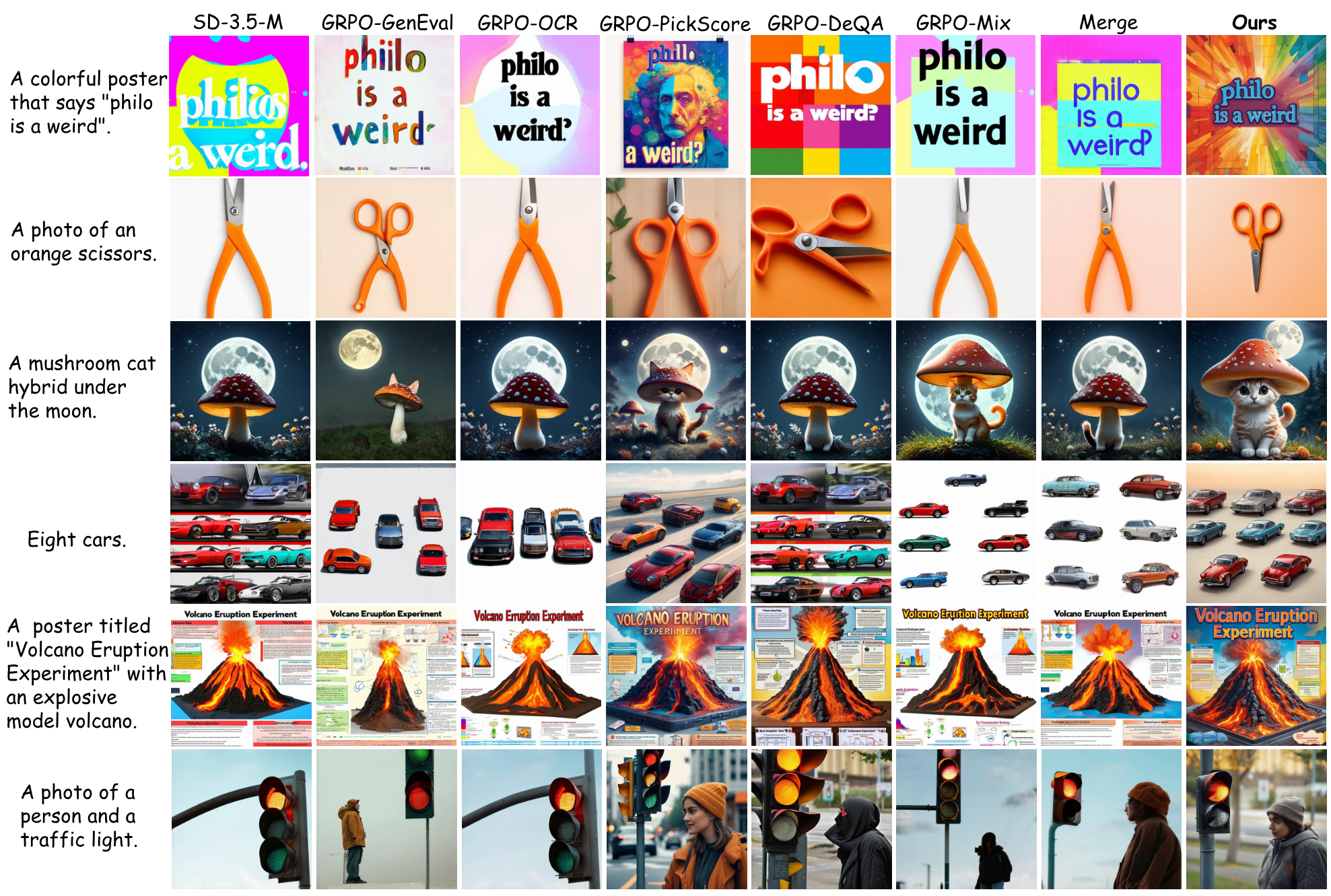
Qualitative results in Fig. 3) show that Flow-OPD achieves an optimal multi-task trade-off, balancing high prompt fidelity with superior visual aesthetics. Remarkably, Flow-OPD succeeds in certain edge cases where all individual teachers fail, a phenomenon we term Teacher-Surpassing. We hypothesize this emergent superiority stems from knowledge cross-pollination within the latent flow manifold. While individual teachers are constrained by domain-specific biases, simultaneous dense guidance forces the student to learn a more holistic, smoothed representation. This collective supervision bridges epistemic gaps, enabling the student to synthesize novel trajectories that ultimately surpass any single supervisor.

| Model | Color | Shape | Texture | Complex | 3D-Spatial | Numeracy | Non-Spatial |
|---|---|---|---|---|---|---|---|
| SD3.5-M Esser et al. (2024) | 0.7994 | 0.5669 | 0.7338 | 0.3800 | 0.3739 | 0.5927 | 0.3146 |
| GRPO-mix | 0.7966 | 0.5803 | 0.7392 | 0.3677 | 0.3681 | 0.6388 | 0.3130 |
| Cold Start | 0.8173 | 0.6126 | 0.7342 | 0.3870 | 0.4249 | 0.6458 | 0.3145 |
| Cold Start+GRPO | 0.8031 | 0.5985 | 0.7409 | 0.3842 | 0.4017 | 0.6269 | 0.3136 |
| Ours (Merge) | 0.8298 | 0.6292 | 0.7446 | 0.3943 | 0.4565 | 0.6837 | 0.3163 |
View original table

| Model | ImageReward | Aesthetic | UnifiedReward | HPS-v2.1 | QwenVL Score |
|---|---|---|---|---|---|
| SD-3.5-M | 1.02 | 5.87 | 3.339 | 0.2982 | 3.45 |
| GRPO-DeQA | 1.33 | 5.97 | 3.456 | 0.2846 | 3.68 |
| GRPO-mix | 1.23 | 5.93 | 3.501 | 0.3101 | 3.88 |
| w.o. MAR | 1.26 | 5.89 | 3.518 | 0.2998 | 3.82 |
| Ours (Merge) | 1.36 | 6.23 | 3.659 | 0.3302 | 4.05 |
View original table

As shown in Fig. 4, cold-start initialization rapidly establishes a robust foundation for subsequent training. Between the two regimes, SFT serves as a widely adopted and highly scalable strategy; notably, its inherent flexibility presents a promising avenue for extracting capabilities from heterogeneous teachers in future applications. Conversely, model merging optimally leverages the available homogeneous teachers for superior functional alignment without any additional training costs. Crucially, Flow-OPD consistently outperforms both from-scratch and cold-started multi-task GRPO. While GRPO converges to sub-optimal states due to inter-task conflicts caused by sparse scalar rewards, Flow-OPD leverages dense multi-expert supervision to resolve gradient interference. Consequently, our method achieves substantial, uniform gains across all baselines, successfully matching or exceeding the performance ceilings of individual specialized teachers.
To further investigate the generalization capabilities of our method, we conduct additional evaluations on the T2I-CompBench benchmark. Flow-OPD demonstrates superior out-of-domain generalization compared to multi-task GRPO, achieving state-of-the-art (SOTA) performance across multiple compositional metrics. Notably, when initialized from the identical cold-start baseline, standard GRPO suffers from catastrophic forgetting in specific capability dimensions, such as shape rendering and 3D spatial relations. In contrast, by leveraging dense multi-expert supervision and task-style decoupling regularization, Flow-OPD effectively mitigates these regression issues, yielding robust and comprehensive performance enhancements.
Manifold Anchor Regularization (MAR) is a task-agnostic constraint designed to maintain generative integrity and aesthetic alignment. As shown in Fig. 5, vanilla GRPO-based optimization often triggers background mode collapse—where models overfit to monotonous environments—and semantic redundancy, leading to identical features across multiple entities due to coarse reward granularity. While teachers like DeQA provide diverse samples, they often struggle with instruction following. MAR resolves these issues by anchoring optimization to a high-fidelity manifold, balancing structural diversity with precise semantic adherence. Table 4 further provides quantitative evidence of our method’s superiority in image quality and human preference alignment. The integration of MAR leverages additional supervision across the entire dataset, significantly enhancing both the visual quality and the expressive power of the generated images.
We introduced Flow-OPD, the first framework to integrate on-policy distillation into Flow Matching models, effectively resolving reward sparsity and gradient interference. By replacing scalar rewards with dense, trajectory-level supervision, Flow-OPD breaks the "seesaw effect" of competing metrics. Our results on SD-3.5-M show that Flow-OPD successfully consolidates expertise in composition and typography while achieving an emergent "teacher-surpassing" effect. Through Manifold Anchor Regularization (MAR), the framework maintains high visual fidelity by decoupling functional alignment from aesthetic preservation. Ultimately, Flow-OPD provides a scalable paradigm for developing generalist text-to-image models with superior generative integrity.
References
- [1] S. Batifol, A. Blattmann, F. Boesel, S. Consul, C. Diagne, T. Dockhorn, J. English, Z. English, P. Esser, S. Kulal, et al. (2025) Flux. 1 kontext: flow matching for in-context image generation and editing in latent space. arXiv e-prints, pp. arXiv–2506. Cited by: §1.
- [2] P. Esser, S. Kulal, A. Blattmann, R. Entezari, J. Müller, H. Saini, Y. Levi, D. Lorenz, A. Sauer, F. Boesel, et al. (2024) Scaling rectified flow transformers for high-resolution image synthesis. In Forty-first international conference on machine learning, Cited by: Appendix A, §1, §4.3, Table 3.
- [3] Y. Lipman, R. T. Chen, H. Ben-Hamu, M. Nickel, and M. Le (2022) Flow matching for generative modeling. arXiv preprint arXiv:2210.02747. Cited by: §1, §3.
- [4] Z. Fang, Z. Liu, J. Liu, H. Chen, Y. Zeng, S. Huang, Z. Chen, L. Chen, S. Zhang, and F. Zhao (2025) DualVLA: building a generalizable embodied agent via partial decoupling of reasoning and action. arXiv preprint arXiv:2511.22134. Cited by: §1.
- [5] W. Huang, B. Jia, Z. Zhai, S. Cao, Z. Ye, F. Zhao, Z. Xu, X. Tang, Y. Hu, and S. Lin (2026) Vision-r1: incentivizing reasoning capability in multimodal large language models. External Links: 2503.06749, Link Cited by: §1.Source
- [6] W. Huang, Y. Zeng, Q. Wang, Z. Fang, S. Cao, Z. Chu, Q. Yin, S. Chen, Z. Yin, L. Chen, et al. (2026) Vision-deepresearch: incentivizing deepresearch capability in multimodal large language models. arXiv preprint arXiv:2601.22060. Cited by: §1.
- [7] S. Chen, Y. Guo, Z. Su, Y. Li, Y. Wu, J. Chen, J. Chen, W. Wang, X. Qu, and Y. Cheng (2025) Advancing multimodal reasoning: from optimized cold start to staged reinforcement learning. arXiv preprint arXiv:2506.04207. Cited by: §1.
- [8] S. Chen, Y. Guo, Y. Ye, S. Huang, W. Hu, H. Li, M. Zhang, J. Chen, S. Guo, and N. Peng (2025) ARES: multimodal adaptive reasoning via difficulty-aware token-level entropy shaping. arXiv preprint arXiv:2510.08457. Cited by: §1.
- [9] D. Guo, D. Yang, H. Zhang, J. Song, P. Wang, Q. Zhu, R. Xu, R. Zhang, S. Ma, X. Bi, et al. (2025) Deepseek-r1: incentivizing reasoning capability in llms via reinforcement learning. arXiv preprint arXiv:2501.12948. Cited by: §1, §1, §2, §4.1.
- [10] S. Chen, K. Feng, H. Chen, W. Huang, D. Dai, Q. Shou, Y. Lin, X. Yue, S. Gao, and T. Pang (2026) OpenSearch-vl: an open recipe for frontier multimodal search agents. External Links: 2605.05185, Link Cited by: §1.Source
- [11] R. Han, Z. Fang, X. Sun, Y. Ma, Z. Wang, Y. Zeng, Z. Chen, L. Chen, W. Huang, W. Xu, et al. (2026) UniCorn: towards self-improving unified multimodal models through self-generated supervision. arXiv preprint arXiv:2601.03193. Cited by: §1.
- [12] S. Chen, Q. Shou, H. Chen, Y. Zhou, K. Feng, W. Hu, Y. Zhang, Y. Lin, W. Huang, M. Song, et al. (2026) Unify-agent: a unified multimodal agent for world-grounded image synthesis. arXiv preprint arXiv:2603.29620. Cited by: §1.
- [13] K. Feng, M. Zhang, S. Chen, Y. Lin, K. Fan, Y. Jiang, H. Li, D. Zheng, C. Wang, and X. Yue (2026) Gen-searcher: reinforcing agentic search for image generation. arXiv preprint arXiv:2603.28767. Cited by: §1.
- [14] W. Huang, S. Chen, Z. Xie, S. Cao, S. Tang, Y. Shen, Q. Yin, W. Hu, X. Wang, Y. Tang, et al. (2025) Interleaving reasoning for better text-to-image generation. arXiv preprint arXiv:2509.06945. Cited by: §1.
- [15] D. Guo, D. Yang, H. Zhang, J. Song, P. Wang, Q. Zhu, R. Xu, R. Zhang, S. Ma, X. Bi, et al. (2025) Deepseek-r1: incentivizing reasoning capability in llms via reinforcement learning. arXiv preprint arXiv:2501.12948. Cited by: §1.
- [16] J. Liu, G. Liu, J. Liang, Y. Li, J. Liu, X. Wang, P. Wan, D. Zhang, and W. Ouyang (2025) Flow-grpo: training flow matching models via online rl. arXiv preprint arXiv:2505.05470. Cited by: Appendix A, §1, §3, §4.1, §5.1.1, §5.1.1, §5.1.1, §6.1.
- [17] Z. Xue, J. Wu, Y. Gao, F. Kong, L. Zhu, M. Chen, Z. Liu, W. Liu, Q. Guo, W. Huang, and P. Luo (2025) DanceGRPO: unleashing grpo on visual generation. External Links: 2505.07818, Link Cited by: §1, §2, §4.1.Source
- [18] J. Li, Y. Cui, T. Huang, Y. Ma, C. Fan, Y. Cheng, M. Yang, Z. Zhong, and L. Bo (2025) Mixgrpo: unlocking flow-based grpo efficiency with mixed ode-sde. arXiv preprint arXiv:2507.21802. Cited by: §1.
- [19] A. Zeng, X. Lv, Z. Hou, Z. Du, Q. Zheng, B. Chen, D. Yin, C. Ge, C. Huang, C. Xie, et al. (2026) Glm-5: from vibe coding to agentic engineering. arXiv preprint arXiv:2602.15763. Cited by: §1, §1.
- [20] B. Xiao, B. Xia, B. Yang, B. Gao, B. Shen, C. Zhang, C. He, C. Lou, F. Luo, G. Wang, et al. (2026) Mimo-v2-flash technical report. arXiv preprint arXiv:2601.02780. Cited by: §1.
- [21] D. Ghosh, H. Hajishirzi, and L. Schmidt (2023) Geneval: an object-focused framework for evaluating text-to-image alignment. Advances in Neural Information Processing Systems 36, pp. 52132–52152. Cited by: Figure 1, §6.1.
- [22] J. Chen, Y. Huang, T. Lv, L. Cui, Q. Chen, and F. Wei (2023) Textdiffuser: diffusion models as text painters. Advances in Neural Information Processing Systems 36, pp. 9353–9387. Cited by: Figure 1, §6.1.
- [23] K. Black, M. Janner, Y. Du, I. Kostrikov, and S. Levine (2024) Training diffusion models with reinforcement learning. External Links: 2305.13301, Link Cited by: §2.Source
- [24] Y. Fan, O. Watkins, Y. Du, H. Liu, M. Ryu, C. Boutilier, P. Abbeel, M. Ghavamzadeh, K. Lee, and K. Lee (2023) DPOK: reinforcement learning for fine-tuning text-to-image diffusion models. External Links: 2305.16381, Link Cited by: §2.Source
- [25] J. Xu, X. Liu, Y. Wu, Y. Tong, Q. Li, M. Ding, J. Tang, and Y. Dong (2023) ImageReward: learning and evaluating human preferences for text-to-image generation. In Proceedings of the 37th International Conference on Neural Information Processing Systems, pp. 15903–15935. Cited by: §2.
- [26] B. Wallace, M. Dang, R. Rafailov, L. Zhou, A. Lou, S. Purushwalkam, S. Ermon, C. Xiong, S. Joty, and N. Naik (2023) Diffusion model alignment using direct preference optimization. External Links: 2311.12908, Link Cited by: §2.Source
- [27] J. Liu, G. Liu, J. Liang, Y. Li, J. Liu, X. Wang, P. Wan, D. Zhang, and W. Ouyang (2025) Flow-grpo: training flow matching models via online rl. arXiv preprint arXiv:2505.05470. Cited by: §2.
- [28] S. Yuan, Y. Liu, Y. Yue, J. Zhang, W. Zuo, Q. Wang, F. Zhang, and G. Zhou (2025) AR-grpo: training autoregressive image generation models via reinforcement learning. arXiv preprint arXiv:2508.06924. Cited by: §2.
- [29] G. Zhang, H. Yu, X. Ma, J. Zhang, Y. Pan, M. Yao, J. Xiao, L. Huang, and F. Zhao (2025) Group critical-token policy optimization for autoregressive image generation. arXiv preprint arXiv:2509.22485. Cited by: §2.
- [30] X. Ma, H. Qiu, G. Zhang, Z. Zeng, S. Yang, L. Ma, and F. Zhao (2025) Stage: stable and generalizable grpo for autoregressive image generation. arXiv preprint arXiv:2509.25027. Cited by: §2.
- [31] G. Zhang, H. Yu, X. Ma, Y. Pan, H. Xu, and F. Zhao (2025) MaskFocus: focusing policy optimization on critical steps for masked image generation. arXiv preprint arXiv:2512.18766. Cited by: §2.
- [32] X. Ma, J. Lei, T. Ren, J. Huang, S. Fu, A. Hao, J. Wu, X. Chu, and F. Zhao (2026) MAR-grpo: stabilized grpo for ar-diffusion hybrid image generation. arXiv preprint arXiv:2604.06966. Cited by: §2.
- [33] S. Liu, X. Dong, X. Lu, S. Diao, P. Belcak, M. Liu, M. Chen, H. Yin, Y. F. Wang, K. Cheng, Y. Choi, J. Kautz, and P. Molchanov (2026) GDPO: group reward-decoupled normalization policy optimization for multi-reward rl optimization. External Links: 2601.05242, Link Cited by: §2.Source
- [34] R. Agarwal, N. Vieillard, Y. Zhou, P. Stanczyk, S. R. Garea, M. Geist, and O. Bachem (2024) On-policy distillation of language models: learning from self-generated mistakes. In The twelfth international conference on learning representations, Cited by: §2.
- [35] Y. Gu, L. Dong, F. Wei, and M. Huang (2024) Minillm: knowledge distillation of large language models. In The twelfth international conference on learning representations, Cited by: §2.
- [36] J. Ko, T. Chen, S. Kim, T. Ding, L. Liang, I. Zharkov, and S. Yun (2025) Distillm-2: a contrastive approach boosts the distillation of llms. arXiv preprint arXiv:2503.07067. Cited by: §2.
- [37] W. Yang, W. Liu, R. Xie, K. Yang, S. Yang, and Y. Lin (2026) Learning beyond teacher: generalized on-policy distillation with reward extrapolation. arXiv preprint arXiv:2602.12125. Cited by: §2.
- [38] W. Jin, T. Min, Y. Yang, S. R. Kadhe, Y. Zhou, D. Wei, N. Baracaldo, and K. Lee (2026) Entropy-aware on-policy distillation of language models. arXiv preprint arXiv:2603.07079. Cited by: §2.
- [39] D. Zhang, Z. Yang, S. Janghorbani, J. Han, A. Ressler II, Q. Qian, G. D. Lyng, S. S. Batra, and R. E. Tillman (2026) Fast and effective on-policy distillation from reasoning prefixes. arXiv preprint arXiv:2602.15260. Cited by: §2.
- [40] Y. Xu, H. Sang, Z. Zhou, R. He, and Z. Wang (2026) PACED: distillation and self-distillation at the frontier of student competence. arXiv e-prints, pp. arXiv–2603. Cited by: §2.
- [41] K. Lu and T. M. Lab (2025) On-policy distillation. Thinking Machines Lab: Connectionism. Note: https://thinkingmachines.ai/blog/on-policy-distillation External Links: Document Cited by: §3, §5.1.1.Source
- [42] Y. Kirstain, A. Polyak, U. Singer, S. Matiana, J. Penna, and O. Levy (2023) Pick-a-pic: an open dataset of user preferences for text-to-image generation. Advances in Neural Information Processing Systems 36, pp. 36652–36663. Cited by: Appendix A, §6.1.
- [43] Z. You, X. Cai, J. Gu, T. Xue, and C. Dong (2025) Teaching large language models to regress accurate image quality scores using score distribution. arXiv preprint arXiv:2501.11561. Cited by: Appendix A, §6.1.
- [44] C. Schuhmann (2022) LAION aesthetics. External Links: Link Cited by: Appendix A.Source
- [45] J. Xu, X. Liu, Y. Wu, Y. Tong, Q. Li, M. Ding, J. Tang, and Y. Dong (2024) Imagereward: learning and evaluating human preferences for text-to-image generation. Advances in Neural Information Processing Systems 36. Cited by: Appendix A.
- [46] Y. Wang, Y. Zang, H. Li, C. Jin, and J. Wang (2025) Unified reward model for multimodal understanding and generation. arXiv preprint arXiv:2503.05236. Cited by: Appendix A.
- [47] X. Wu, Y. Hao, K. Sun, Y. Chen, F. Zhu, R. Zhao, and H. Li (2023) Human preference score v2: a solid benchmark for evaluating human preferences of text-to-image synthesis. arXiv preprint arXiv:2306.09341. Cited by: Appendix A.
- [48] A. Yang, A. Li, B. Yang, B. Zhang, B. Hui, B. Zheng, B. Yu, C. Gao, C. Huang, C. Lv, et al. (2025) Qwen3 technical report. arXiv preprint arXiv:2505.09388. Cited by: Appendix A.
- [49] K. Zheng, H. Chen, H. Ye, H. Wang, Q. Zhang, K. Jiang, H. Su, S. Ermon, J. Zhu, and M. Liu (2025) Diffusionnft: online diffusion reinforcement with forward process. arXiv preprint arXiv:2509.16117. Cited by: Figure 10, Figure 11, §B.2.
Following the data and reward configurations of Flow-GRPO, we conducted multi-task hybrid training for GRPO-mix using an epoch ratio of 3:1:1 for GenEval, OCR, and PickScore, respectively. During each epoch, rewards were exclusively provided by the reward model corresponding to the current data partition. Training was executed on a distributed cluster of four nodes, each equipped with eight H800 GPUs for about 50 hours. For the GenEval, OCR, and PickScore teachers, we utilized the official Flow-GRPO checkpoints. Additionally, to incorporate the DeQA teacher—which focuses solely on image quality—its reward signals were integrated into the standard GRPO-mix training via a 1:1 summation ratio.
Except for , GRPO hyperparameters are fixed across tasks. We use a sampling timestep and an evaluation timestep . Other settings include a group size , an noise level and an image resolution of 512. The MAR KL ratio is set to 0.02. We use Lora with and .
| Models | Links |
|---|---|
| SD3.5-M [2] | https://huggingface.co/stabilityai/stable-diffusion-3.5-medium |
| Aesthetic Score [44] | https://github.com/LAION-AI/aesthetic-predictor |
| PickScore [42] | https://huggingface.co/yuvalkirstain/PickScore_v1 |
| DeQA score [43] | https://huggingface.co/zhiyuanyou/DeQA-Score-Mix3 |
| ImageReward [45] | https://huggingface.co/THUDM/ImageReward |
| UnifiedReward [46] | https://huggingface.co/CodeGoat24/UnifiedReward-7b-v1.5 |
| HPS-v2.1 [47] | https://github.com/tgxs002/HPSv2 |
| Qwenvl Score [48] | https://huggingface.co/Qwen/Qwen3-30B-A3B-Instruct-2507 |
View original table
Regarding Qwenvl Score, we adapt the prompt used in Flow-GRPO [16]. The prompt is shown in Fig. 6. We use Qwen3-30B-A3B-Instruct-2507.
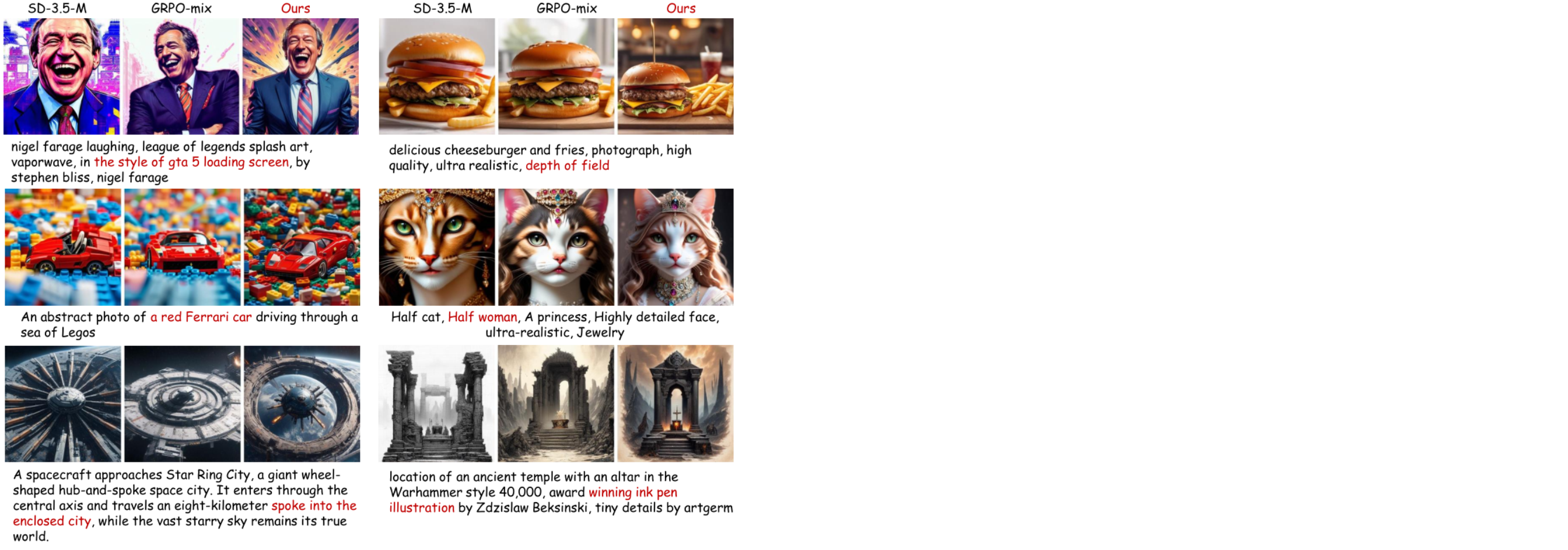
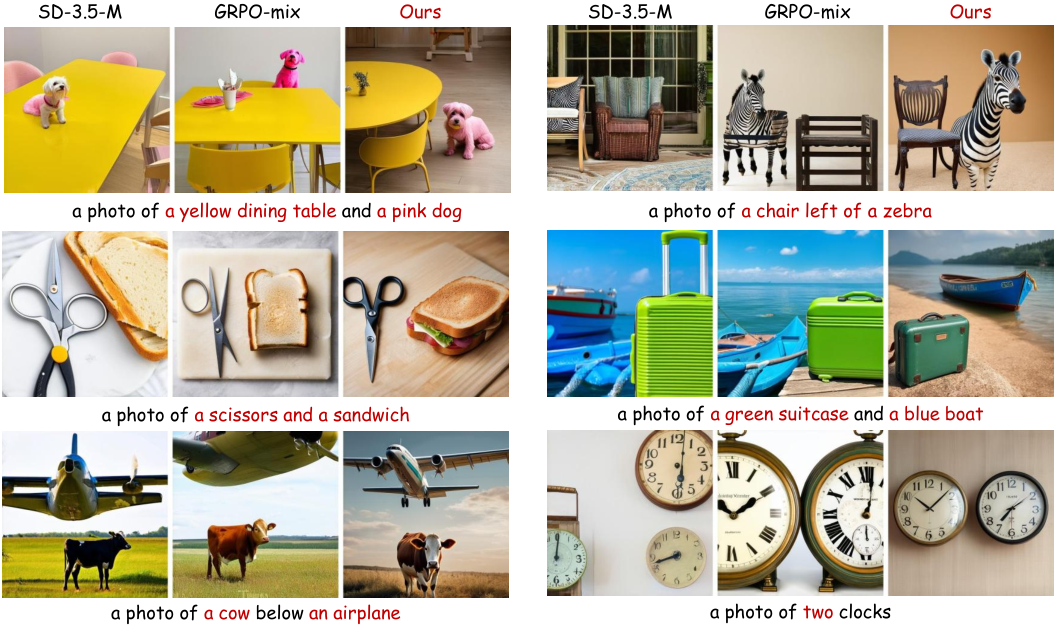
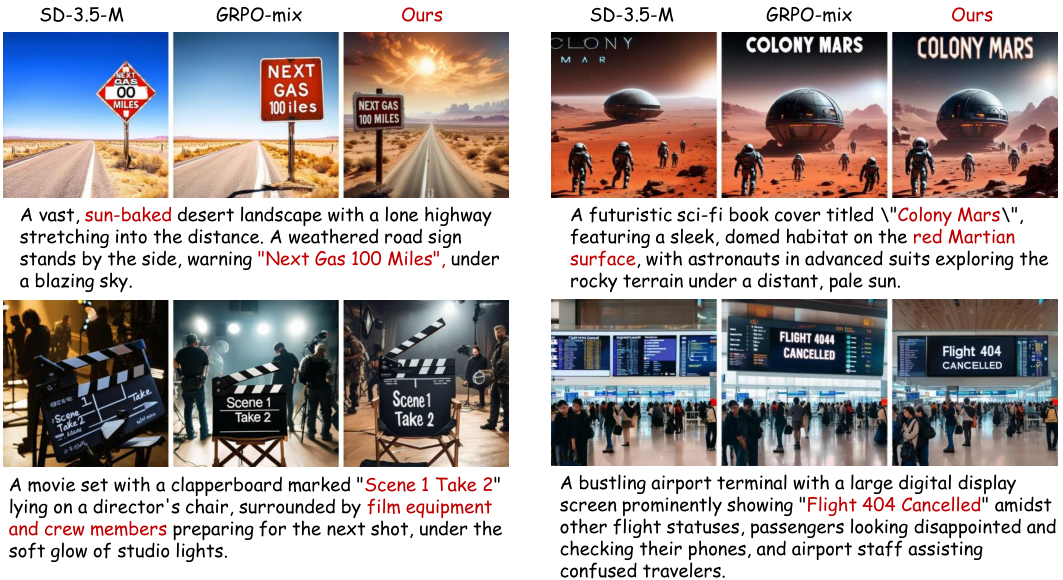
More qualitative results are shown in Fig. 7, 8 and 9. Our approach not only ensures precise content generation but also delivers superior image quality and coherent structural layouts. By achieving stronger alignment with human preferences, Flow-OPD demonstrates significant novelty in bridging functional accuracy with aesthetic excellence.
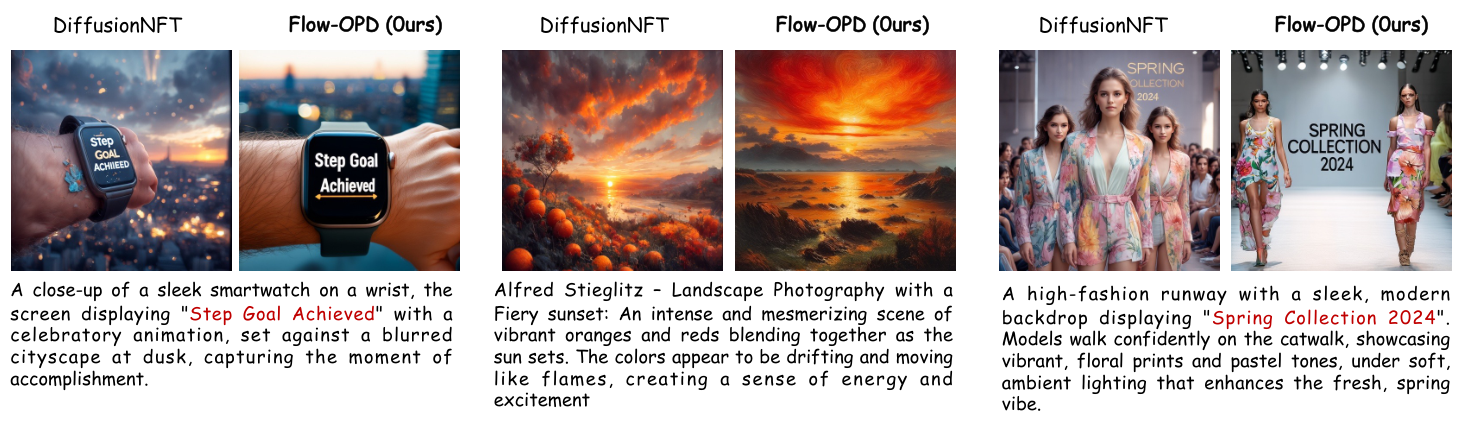
DiffusionNFT [49] introduces an online reinforcement learning framework that directly integrates reward feedback into the forward diffusion process, enabling effective policy optimization during the noise-injection phase. Despite achieving competitive benchmark scores, DiffusionNFT exhibits several critical limitations. First, it is fundamentally incompatible with Classifier-Free Guidance (CFG), which severely bottlenecks its performance upper bound. Second, it suffers from pronounced reward hacking. As illustrated in Fig. 10 , while the model correctly generates the targeted text and ’sunset’ elements, it simultaneously hallucinates malformed hands and extraneous objects (e.g., oranges), accompanied by severe over-smoothed, plastic-like textural artifacts. Current standard benchmarks largely overlook these localized structural and aesthetic failures. To address this evaluation blind spot, we employ the Qwenvl Score for a more comprehensive assessment. By leveraging continuous-time dense multi-expert supervision and task-style decoupling, Flow-OPD effectively circumvents these reward hacking behaviors, achieving significantly higher Qwen-VL scores than DiffusionNFT. These findings also underscore a pressing need within the community to develop more robust, fine-grained evaluation paradigms for text-to-image generation.
| Model | Qwen-VL Score |
|---|---|
| DiffusionNFT | 3.74 |
| Ours (Flow-OPD) | 4.05 |
View original table

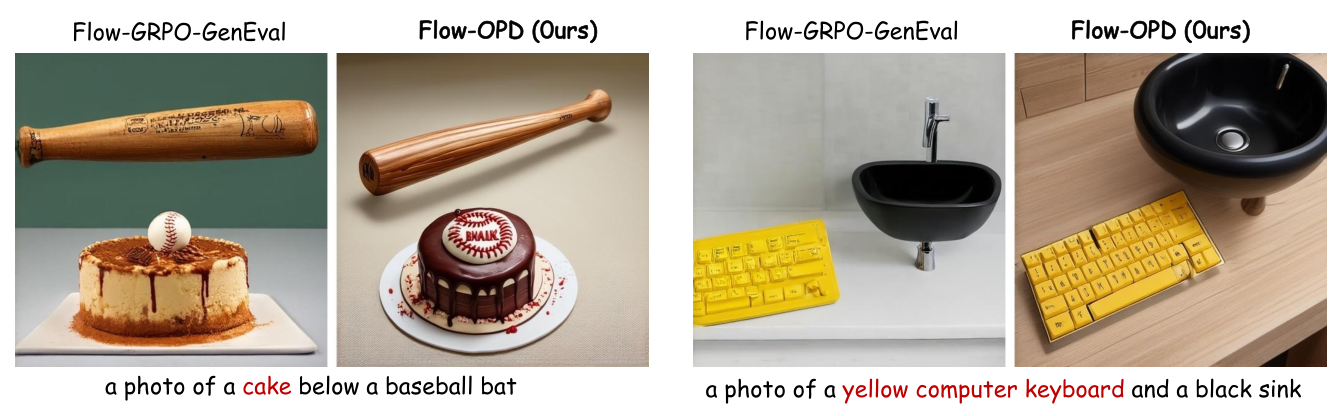
Despite the superior performance of Flow-OPD across both subjective and objective benchmarks, certain limitations persist. A primary constraint is the performance ceiling imposed by teacher models. As illustrated in Fig. 11, when specialized teachers fail to synthesize semantically correct images, these inaccuracies are propagated through the dense supervisory signals. Such erroneous guidance introduces noise into the distillation objective, ultimately hindering the student’s ability to transcend the inherent limitations of the teacher ensemble. Another inherent limitation is the requirement for architectural homogeneity between the teacher and student models to facilitate fine-grained, step-wise supervision. Looking forward, we aim to explore the broader potential of Flow-OPD through several promising directions, including: (1) Co-evolutionary Distillation, where teachers and students iteratively refine each other; (2) Self-Distillation mechanisms to boost performance without external teachers; and (3) Cross-Vocabulary Distillation to bridge the gap between heterogeneous model architectures.
Our work on Flow-OPD introduces a robust framework for multi-task alignment in generative models, carrying both positive societal contributions and potential risks that necessitate careful consideration.
The primary contribution of this work is the enhancement of functional reliability in AI-generated content. By improving layout coherence and OCR accuracy, Flow-OPD can significantly benefit professional fields such as automated graphic design, educational content creation, and assistive technologies for the visually impaired. Furthermore, our Multi-Teacher paradigm promotes a more balanced optimization objective, which mitigates the "winner-takes-all" bias inherent in single-reward reinforcement learning, potentially leading to more diverse and representative generative systems.
Despite these benefits, the increased proficiency in generating high-quality, instruction-following images could be misused for the creation of sophisticated disinformation or deceptive visual content. Although our model inherits the safety filters of its foundation model, the improved structural realism might be exploited to generate more convincing fake documents or misleading social media assets. To mitigate this, we advocate for the integration of digital watermarking and provenance tracking (e.g., C2PA) in downstream applications. Additionally, like all large-scale generative models, there is a risk that the specialized teachers may harbor latent biases present in their training data, which could be inadvertently distilled into the student model. We encourage the community to employ bias-detection benchmarks alongside our framework to ensure equitable performance across all demographics.