AnyFlow: Any-Step Video Diffusion Model with On-Policy Flow Map Distillation
arXiv:2605.13724v1 · This workspace stays on this version. Check arXiv for newer versions
Some source details need review 8 to check
Original formulas, table values and figures are preserved. The web version was not compared with the PDF; use the original PDF to check details.
Reading view checked: 159 math expressions, 0 rendering failures; 13 of 18 images available.
- Some figure, table or graphic images are unavailable; the original paper is still accessible. (5)
- The PDF source is unavailable (SOURCE_TOO_LARGE).
- S1_F1: blank, oversized or incomplete source rendering; capture unavailable.
- S3_F3: blank, oversized or incomplete source rendering; capture unavailable.
- S4_F6: blank, oversized or incomplete source rendering; capture unavailable.
- S4_F9: blank, oversized or incomplete source rendering; capture unavailable.
- S5_F12: blank, oversized or incomplete source rendering; capture unavailable.
- Both HTML and PDF text are needed for source comparison.
13 of 18 figure, table and graphic images captured. Open original PDF
Abstract
Few-step video generation has been significantly advanced by consistency distillation. However, the performance of consistency-distilled models often degrades as more sampling steps are allocated at test time, limiting their effectiveness for any-step video diffusion. We argue that this limitation arises because consistency distillation replaces the original probability-flow ODE trajectory with a consistency-sampling trajectory, weakening the desirable test-time scaling behavior of ODE sampling. To address this limitation, we introduce AnyFlow, the first any-step video diffusion distillation framework based on flow maps. Instead of distilling a model for only a few fixed sampling steps, AnyFlow optimizes the full ODE sampling trajectory. To this end, we shift the distillation target from endpoint consistency mapping () to flow-map transition learning () over arbitrary time intervals. We further propose Flow Map Backward Simulation, which decomposes a full Euler rollout into shortcut flow-map transitions, enabling efficient on-policy distillation that reduces test-time errors (i.e., discretization error in few-step sampling and exposure bias in causal generation). Extensive experiments across both bidirectional and causal architectures, at scales ranging from 1.3B to 14B parameters, demonstrate that AnyFlow achieves performance comparable to or better than consistency-based counterparts in the few-step regime, while supporting flexible and scalable sampling under varying step budgets. In the causal text-to-video setting, AnyFlow-FAR reaches a VBench score of 84.05 at 4 NFEs and further improves to 84.41 at 32 NFEs, surpassing Krea-Realtime-14B (83.25 at 4 NFEs). For image-to-video generation, AnyFlow-FAR achieves a VBench-I2V score of 87.87 at 4 NFEs, comparable to Wan2.1-I2V-14B using 502 NFEs (87.71). In the 14B bidirectional text-to-video setting, AnyFlow reaches 84.04 at 4 NFEs, outperforming rCM-14B (83.73 at 4 NFEs). Code is released at https://github.com/NVLabs/AnyFlow.
Video diffusion models have recently achieved remarkable generation quality at scale [1, 2, 3, 4, 5], but most pipelines remain tied to fixed inference-step budgets. In practice, users require flexible generation: rapid previews for quick iteration and higher-fidelity outputs for final delivery. This motivates the need for any-step models that can trade latency for quality at test time without retraining.
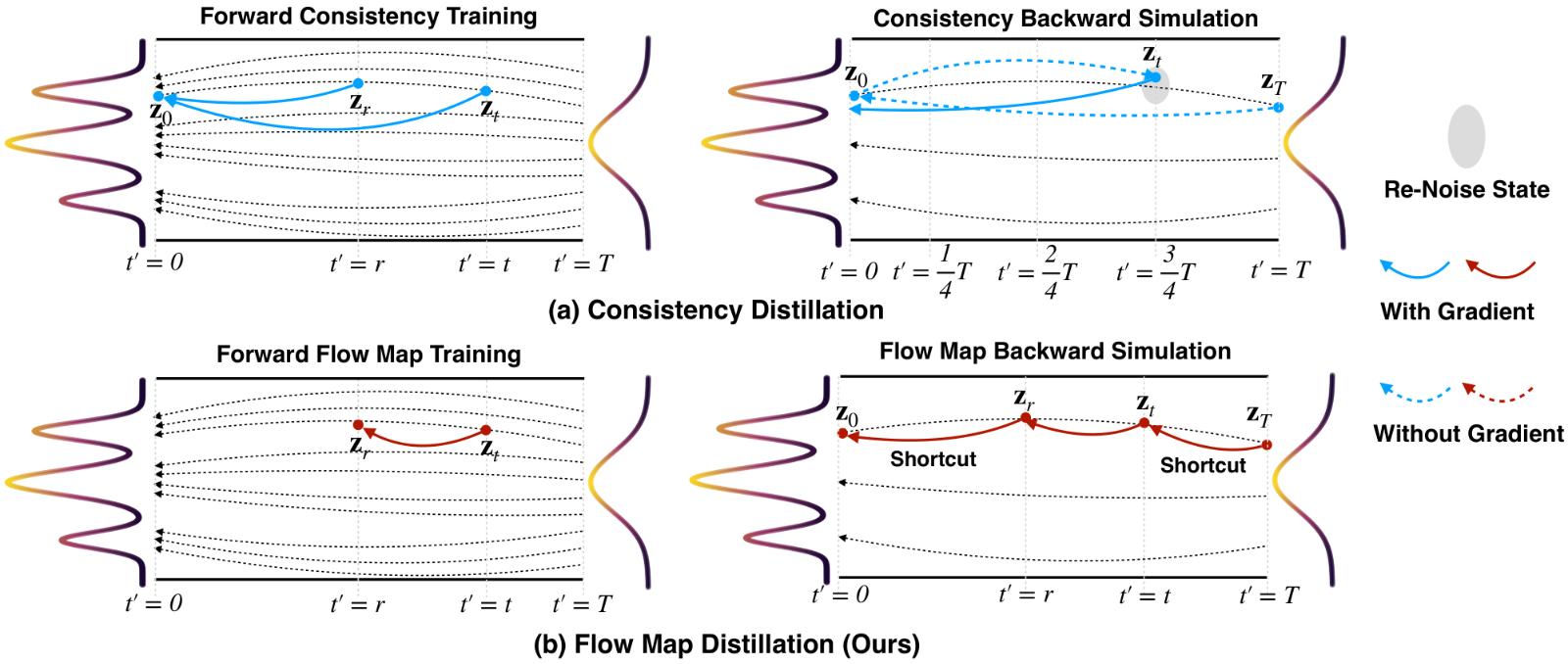
Existing few-step video distillation methods are predominantly built on consistency models [6, 7, 8, 9, 10]. While effective under very small sampling budgets, they do not provide robust any-step behavior. As illustrated in Fig. 1, representative methods (e.g., rCM [9] for bidirectional models and Self-Forcing [10] for causal models) often degrade as the number of sampling steps increases, instead of improving with additional computation. The limitation is structural: consistency formulations emphasize fixed-point mappings to . During multi-step sampling, repeatedly re-noising intermediate states introduces cumulative bias, causing trajectories to drift away from the target PF-ODE path [11] rather than being progressively refined, as shown in Fig. 2(a).
To address this gap, we propose AnyFlow, the first any-step video diffusion distillation framework based on a two-time flow map formulation [12, 11, 13]. Flow maps generalize endpoint consistency by learning transitions between arbitrary time pairs, i.e., rather than only (as shown in Fig. 2(b)), which naturally supports variable step sizes and inference budgets.
Specifically, AnyFlow contains two complementary stages. In the first stage, we develop an improved forward flow map training recipe to convert pretrained video diffusion models into flow map models, providing a strong initialization for any-step generation. However, forward flow map training alone cannot fully remove test-time errors: discretization error remains pronounced under low-NFE sampling, and exposure bias is still severe in causal generation. In the second stage, we introduce on-policy flow map distillation to optimize reverse divergence on model rollouts to mitigate test-time errors. The core design is flow map backward simulation, which replaces expensive full-trajectory simulation with shortcut decomposition, enabling efficient training of intermediate transitions over different time ranges. By combining forward flow map training with reverse-divergence supervision during on-policy distillation, AnyFlow achieves strong few-step quality while continuing to improve with more sampling steps. Moreover, because AnyFlow preserves the fine-grained flow field, the distilled model can be further adapted to downstream datasets through continued fine-tuning.
We validate AnyFlow on both bidirectional and causal video diffusion models, ranging from 1.3B to 14B parameters. Across these settings, AnyFlow matches or surpasses consistency-based counterparts even with few steps and continues to improve as the number of sampling steps increases. In the causal setting, a single AnyFlow model jointly supports text-to-video, image-to-video, and video-to-video generation. For text-to-video, AnyFlow-FAR reaches 84.05 at 4 NFEs and further improves to 84.41 at 32 NFEs on the 14B model, surpassing Krea-Realtime-14B (83.25 at 4 NFEs). For image-to-video, AnyFlow-FAR achieves an 87.87 VBench-I2V score at 4 NFEs, comparable to Wan2.1-I2V-14B using 502 NFEs (87.71). In the 14B bidirectional text-to-video setting, AnyFlow reaches 84.04 at 4 NFEs, outperforming rCM-14B (83.73 at 4 NFEs). Our contributions are summarized as follows:
- •
We introduce AnyFlow, the first any-step video diffusion distillation framework built on flow maps, enabling a single model to support arbitrary inference budgets.
- •
We propose flow map backward simulation for on-policy flow map distillation to mitigate test-time errors (i.e., discretization error and exposure bias) through efficient trajectory decomposition.
- •
We validate AnyFlow across architectures and model scales, establishing it as a scalable solution for high-quality, any-step video generation.
Consistency Models (CMs) [6] accelerate diffusion sampling by directly learning a mapping from to along the probability-flow ODE (PF-ODE) defined by a teacher model. For multi-step generation, CMs repeatedly inject noise into intermediate states and perform iterative denoising. Subsequent studies improve CM training stability through annealed time schedules [7, 14] and segmented consistency objectives [15, 16, 17]. sCM [8] further simplifies these design choices and provides a strong practical baseline. Building on sCM, rCM [9] introduces score distillation as a regularizer, achieving strong performance in both image and video diffusion distillation. In contrast to prior CM-based approaches, we explore flow map distillation to enable any-step video generation.
Flow Map Models [12, 11, 18] offer a unified perspective on diffusion modeling and diffusion distillation by learning a generalized transition operator between arbitrary points along PF-ODE trajectories. From this perspective, the formulation recovers consistency modeling [6] when and reduces to standard flow matching [19, 20] when . However, training flow map models is challenging because it requires accurate transition learning across arbitrary time pairs. MeanFlow [13] is a representative approach that connects instantaneous and average velocities, but it relies on Jacobian-vector products (JVPs), which are difficult to scale under Fully Sharded Data Parallel (FSDP). To overcome this limitation, subsequent studies either approximate JVP terms numerically [21] or derive JVP-free algebraic formulations [22, 23]. Building on these advances, AnyFlow leverages flow map distillation for scalable any-step video diffusion, enabling efficient and flexible inference for high-fidelity generation.
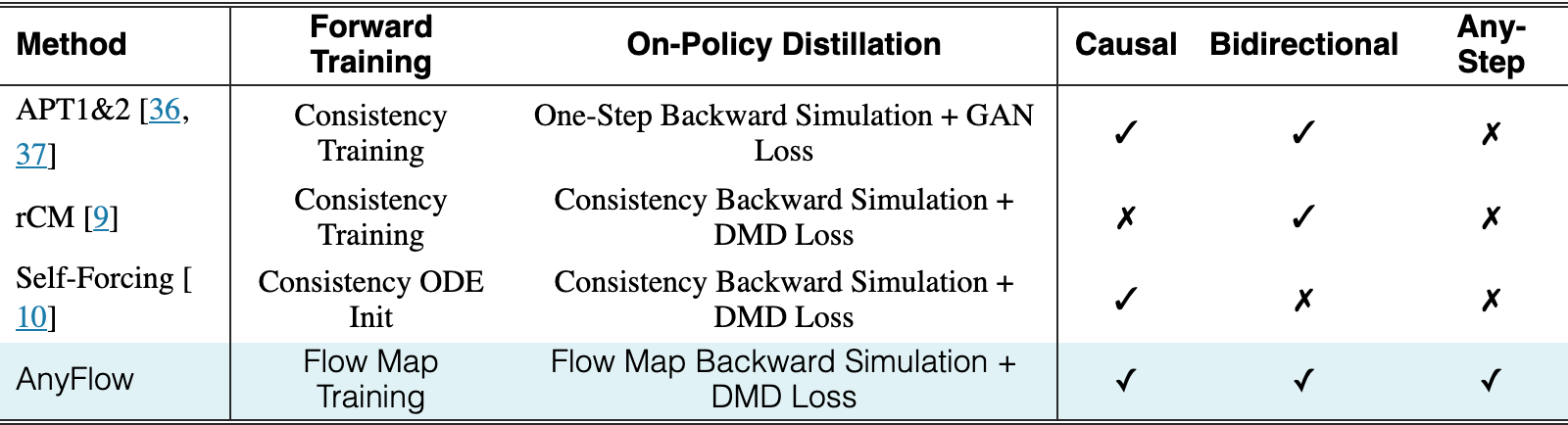
As shown in Tab. 1, recent video diffusion distillation methods typically follow a two-stage pipeline: (1) forward training for initialization and (2) on-policy distillation for refinement. The first stage improves optimization stability, while the second reduces rollout drift during few-step inference. For example, rCM [9] initializes from sCM [8] and then applies consistency backward simulation [24] with distribution matching [25]. In causal video generation, Self-Forcing [10] adopts data-free consistency ODE initialization [26] before performing a similar on-policy refinement stage. Our method follows the same high-level pipeline but replaces consistency modeling with a flow map formulation, enabling stronger any-step performance.
A concurrent work, TMD [27], also studies a flow map formulation for bidirectional video diffusion distillation. The main difference lies in how efficient rollout is achieved. TMD improves rollout efficiency from an architectural perspective by sharing the backbone and introducing an additional flow head. In contrast, our method improves simulation efficiency from the flow-trajectory perspective by decomposing a full trajectory into shortcut transitions based on the composition property of flow maps. As a result, our approach naturally supports arbitrary step budgets and generalizes to both bidirectional and causal architectures.
Causal Video Diffusion. A growing line of work studies causal video diffusion models [28, 29, 30, 31]. These models often suffer from exposure bias, which leads to error accumulation during autoregressive generation. Self-Forcing [10] mitigates this issue through on-policy distillation, but its consistency-based formulation is mainly tailored to few-step settings for rollout efficiency. Another line of work [32] focuses more on multi-step models by explicitly modeling test-time errors during pretraining, but it is not directly designed for efficient few-step sampling. By contrast, our method starts from a flow map formulation and uses flow map backward simulation to support both few-step and multi-step causal video generation within a unified framework.
On-policy distillation mitigates test-time errors by training the student on its own generated trajectories and supervising them with a stronger teacher. This approach has demonstrated benefits in both large language models [33, 34, 35] and diffusion models [25, 10, 24].
For diffusion models, on-policy distillation is typically implemented via Distribution Matching Distillation (DMD) [25, 24] or adversarial distillation [36, 37]. Self-Forcing [10] combines self-rollouts with distribution matching against a bidirectional teacher, while APT2 [37] evaluates one-step video rollouts using a discriminator. Our method follows the same on-policy distillation paradigm but introduces flow map backward simulation, specifically designed for the flow map formulation, enabling any-step video generation.
| Method | Forward Training | On-Policy Distillation | Causal | Bidirectional | Any-Step |
| APT1&2 [36, 37] | Consistency Training | One-Step Backward Simulation + GAN Loss | ✓ | ✓ | ✗ |
| rCM [9] | Consistency Training | Consistency Backward Simulation + DMD Loss | ✗ | ✓ | ✗ |
| Self-Forcing [10] | Consistency ODE Init | Consistency Backward Simulation + DMD Loss | ✓ | ✗ | ✗ |
| AnyFlow | Flow Map Training | Flow Map Backward Simulation + DMD Loss | ✓ | ✓ | ✓ |
View original table
We first introduce the basic flow map formalism used in AnyFlow. Let denote the latent state at continuous time under the probability-flow ODE (PF-ODE):
where is the velocity field.
Define the exact flow map of this ODE as the operator that transports states from time to time , i.e., for . It satisfies two standard properties: identity and composition for .
In practice, a neural flow map model learns an approximation
with boundary condition . Compared with endpoint-only mappings, this parameterization models transitions between arbitrary time pairs, which naturally supports variable step sizes and any-step inference.
| Method | NFEs | Bidirectional Video Diffusion | Causal Video Diffusion | ||||
| Quality | Semantic | Overall | Quality | Semantic | Overall | ||
| Forward Training | |||||||
| Flow Matching Training | 42 | 77.82 | 61.91 | 74.64 | 79.05 | 67.79 | 76.80 |
| 322 | 85.48 | 77.24 | 83.83 | 85.21 | 76.65 | 83.50 | |
| Consistency ODE-Init [26, 10] | 4 | 83.01 | 70.13 | 80.44 | 76.99 | 61.88 | 73.97 |
| 32 | 84.78 | 75.15 | 82.86 | 79.73 | 68.81 | 77.55 | |
| 4 | 84.39 | 71.20 | 81.75 | 82.80 | 71.16 | 80.48 | |
| Flow Map Training | 32 | 85.35 | 75.63 | 83.40 | 85.23 | 74.71 | 83.13 |
| Forward Training + On-Policy Distillation | |||||||
| Consistency ODE-Init + | 4 | 84.77 | 75.71 | 82.96 | 84.37 | 74.97 | 82.49 |
| Consistency Backward Simulation [10] | 32 | 83.70 | 64.18 | 79.80 | 82.43 | 68.48 | 79.64 |
| Flow Map Training + | 4 | 85.47 | 75.88 | 83.55 | 84.99 | 74.97 | 82.99 |
| Consistency Backward Simulation | 32 | 85.15 | 74.19 | 82.96 | 85.67 | 74.78 | 83.49 |
| Flow Map Training + | 4 | 85.24 | 76.41 | 83.48 | 85.60 | 75.30 | 83.54 |
| Flow Map Backward Simulation (Ours) | 32 | 85.70 | 76.99 | 83.96 | 85.92 | 76.12 | 83.96 |
View original table
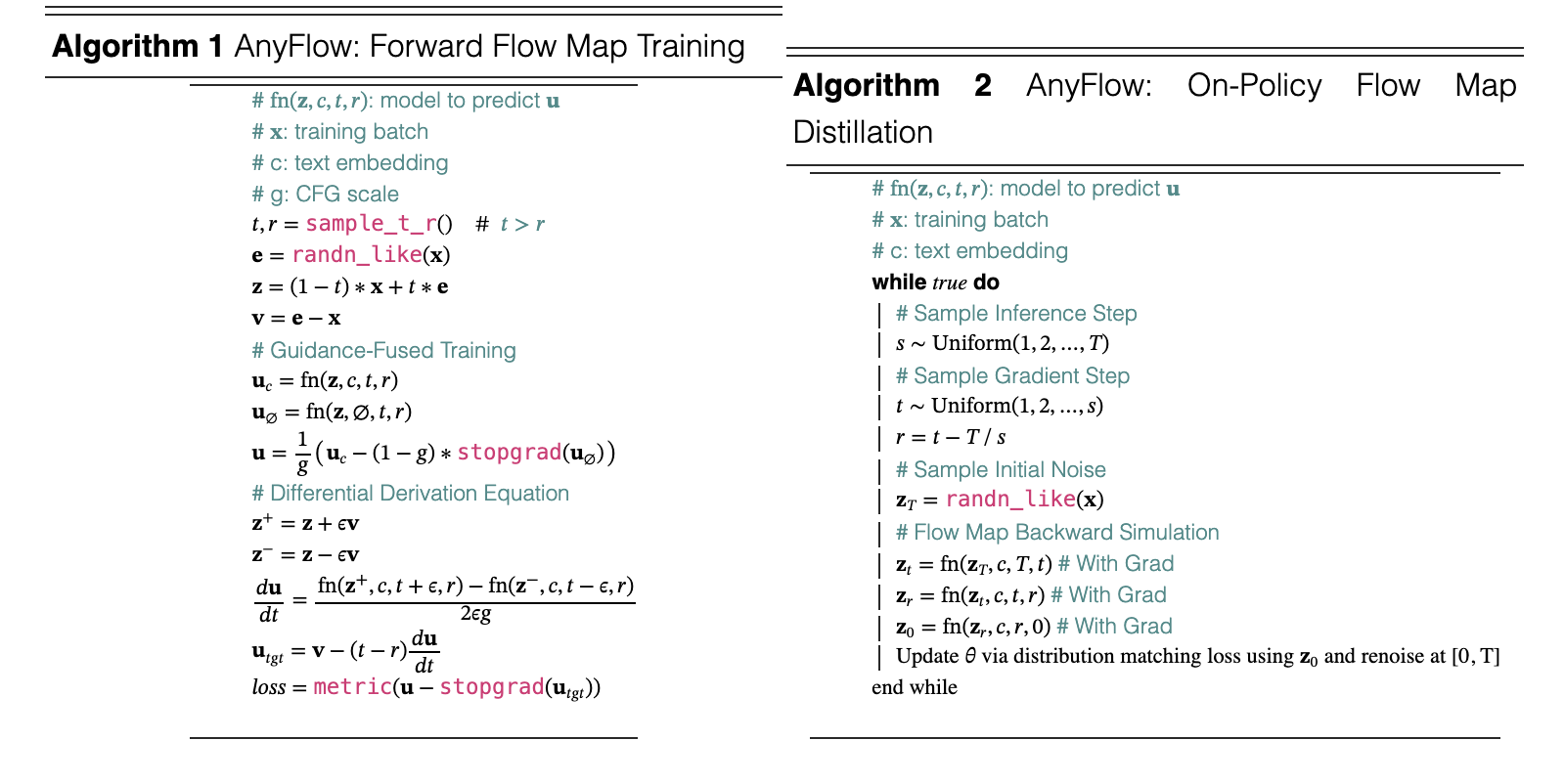
MeanFlow Objective. MeanFlow [13] is a representative algorithm for training flow map models. It parameterizes the averaged transport velocity on and approximates the transition as . Following this formulation, we optimize by:
where . Here, denotes stop-gradient.
Differential Derivation Equation. Computing the Jacobian-vector product (JVP) for the derivative term is expensive and not fully compatible with Fully Sharded Data Parallel (FSDP). Transition Model [21] proposes to approximate this derivative using the finite difference method:
This approximation requires only two forward passes per training step and is compatible with FSDP.
On-policy distillation is designed to reduce train–test mismatch by training the student on its own rollout states while being guided by a strong teacher. In diffusion models, this paradigm is mainly instantiated as Distribution Matching Distillation (DMD). It typically consists of two key components: backward simulation and a distribution-matching objective.
Backward Simulation. Given noise , the student first produces a sample through its inference trajectory, . This self-generated trajectory is then used to compute the distillation loss, which helps mitigate exposure bias and discretization error at test time.
Distribution Matching Objective. We follow DMD-style reverse-KL training [25, 24]. First, DMD re-noises the self-rollout sample at as , where . It then estimates the DMD gradient as follows:
where and are the real and fake score functions, respectively.
As summarized in Tab. 1, most recent few-step video distillation methods are built on consistency models. Although effective under very small sampling budgets, their performance often degrades as the number of sampling steps increases (Fig. 1). The underlying reason is that consistency-style sampling repeatedly performs endpoint projection and re-noising, which gradually drives the trajectory away from the target PF-ODE path during multi-step inference.
Motivation. Our goal is to preserve the strong few-step efficiency of distilled video diffusion models while enabling quality to improve, rather than deteriorate, as more sampling steps are used. To this end, AnyFlow shifts the distillation target from fixed-point endpoint mapping to flow map transition learning, i.e., . Instead of only predicting , the model learns transitions between arbitrary time pairs. This formulation naturally supports both small time gaps for stable local refinement and large time gaps for efficient long-range jumps, making it well suited for any-step generation.
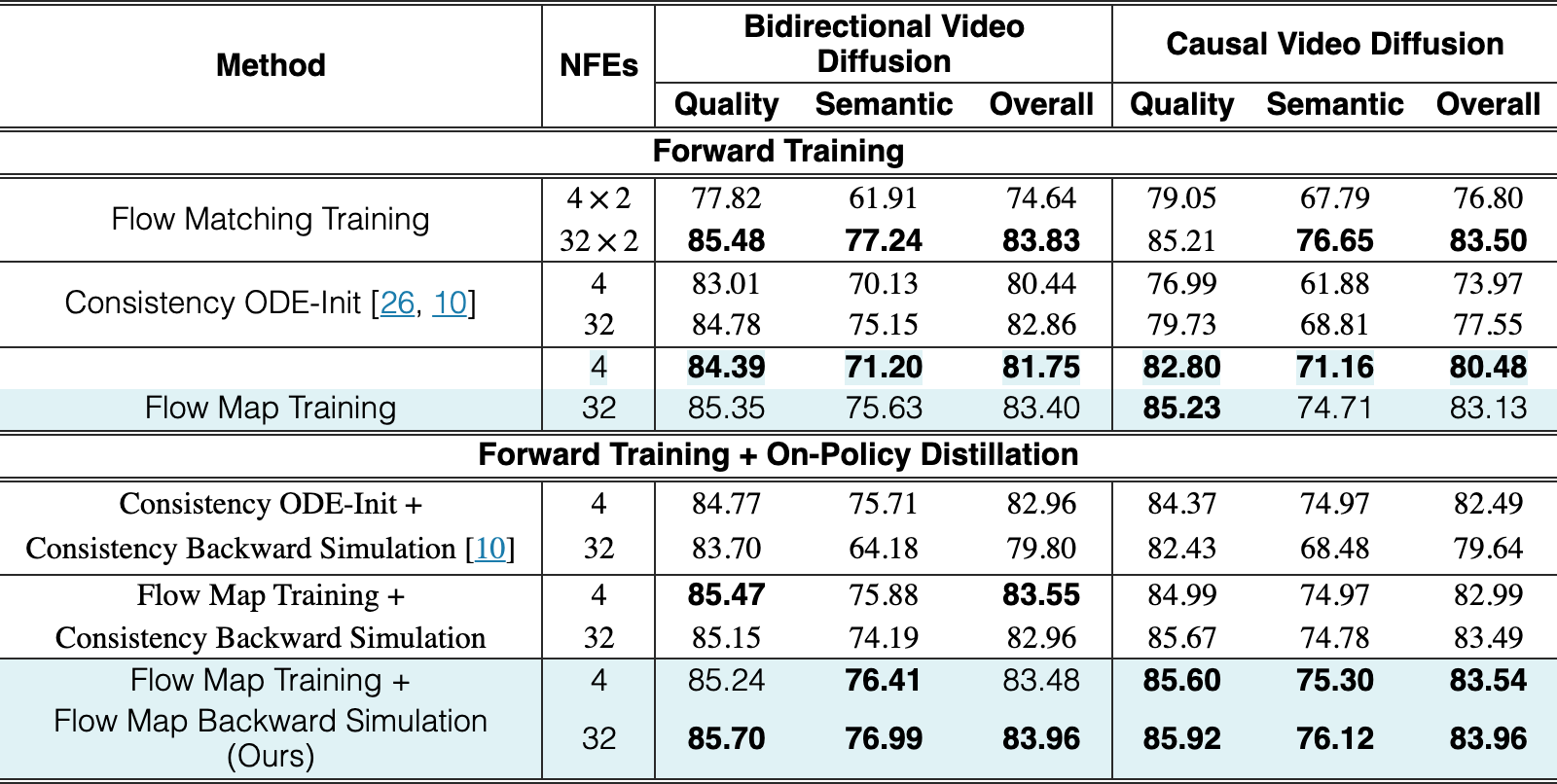
Challenge. Forward flow map training alone (e.g., MeanFlow [13]) is insufficient for strong test-time performance in video generation. As shown in Fig. 3 and Tab. 2, it still suffers from test-time errors, especially discretization error in few-step sampling and exposure bias in causal generation. This motivates an additional on-policy distillation stage to correct rollout mismatch. However, designing such a stage for flow map models is non-trivial. Unlike consistency models, which can naturally reach at intermediate steps and therefore allow KL gradients to be computed directly at endpoint states, flow map models require a new simulation strategy that can accommodate transitions between arbitrary time pairs while remaining efficient for training.
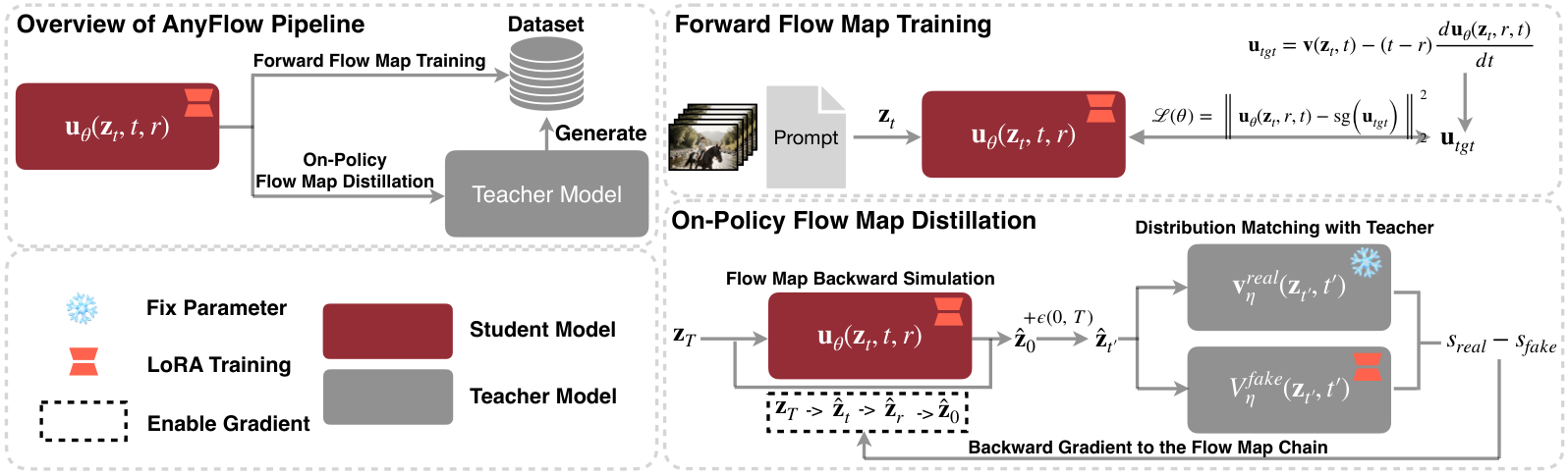
Overview. As illustrated in Fig. 4, AnyFlow is trained in two complementary stages: forward flow map training (Sec. 4.2.1) and on-policy distillation (Sec. 4.2.2). In Stage 1, we fine-tune a pretrained video diffusion model on teacher-synthesized data to learn a stable transition operator , which provides a strong initialization for any-step generation. In Stage 2, starting from the converged Stage-1 checkpoint, we jointly optimize forward flow map training and DMD-based on-policy distillation. This stage uses flow map backward simulation to generate student rollouts and apply reverse-divergence supervision from a strong teacher, thereby reducing discretization error and exposure bias while preserving any-step capability.
We employ the MeanFlow objective (eq. 3) alongside the differential derivation equation (eq. 4) as our primary training framework. Because the original MeanFlow architecture is optimized for pretraining, directly adapting it to post-training for video diffusion models requires several additional design choices for strong performance. To this end, we introduce several modifications: interpolated timestep conditioning, time sampling, guidance-fused training, and adaptive loss reweighting.
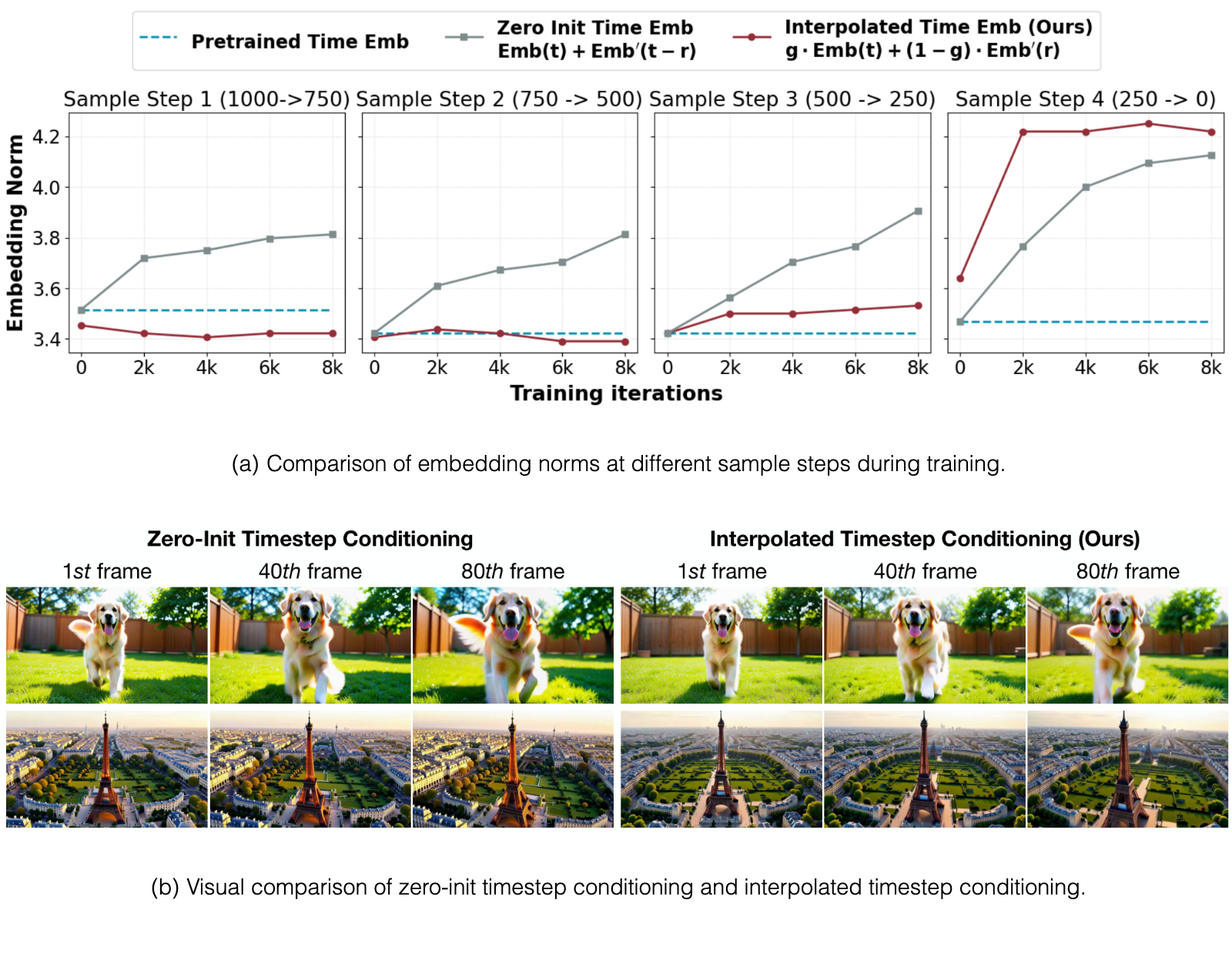
Interpolated Timestep Conditioning. Converting a pretrained diffusion model into a flow map model requires introducing an additional timestep, . A natural choice is to follow MeanFlow [13] and use . Prior work such as TMD [27] further applies a zero-initialized output projection to for a smooth start in post-training. However, we find this design unstable in our setting: it tends to produce timestep embeddings with much larger norms than the pretrained ones, leading to over-saturated generation results, as shown in Fig. 11.
To address this issue, we instead use an interpolated timestep conditioning scheme:
where is initialized from the pretrained emb and is fixed to 0.25 in all experiments. At the beginning of training, this formulation reduces to the pretrained timestep embedding in the boundary case . As verified in Fig. 11, interpolated timestep conditioning keeps the embedding norm well aligned with the pretrained model and suppresses over-saturated results observed in zero-init timestep conditioning.
Time Sampler. Following MeanFlow [13], we first sample and from a uniform distribution and then reorder them as and . We further introduce a reweighting function based on the sampled timestep to balance the training objective across different noise levels. Different choices of are discussed in the Fig. 10.
Guidance-Fused Training. We also incorporate classifier-free guidance (CFG) into flow map training following MeanFlow [13], which allows CFG to be omitted at test time for faster inference. Unlike MeanFlow, which fuses the CFG objective into the target velocity field , we fuse it into the prediction to better align with the guidance scale defined by the pretrained diffusion model:
where denotes the stop-gradient operation and is the model prediction with null conditioning.
Adaptive Loss Reweighting. To stabilize flow map training, we introduce an adaptive loss reweighting scheme. Unlike MeanFlow [13], which uses a weighting function for pre-training, where denotes the regression loss and is a small constant, our approach is designed for post-training, where a reliable instantaneous velocity field has already been established at . We use the loss at as a baseline to dynamically scale the loss for other time steps . In each iteration, we sample 50% of the batch from the boundary cases () and define the adaptive weight as:
where is the average regression loss over the boundary samples. This formulation aligns the loss magnitude at with the well-optimized field at , thereby preserving the learned instantaneous velocity and preventing gradient instability.
Discussion. The full algorithm of our improved forward flow map training is summarized in Alg. 1. As shown in Tab. 2, compared with standard flow matching, flow map training achieves comparable multi-step performance while delivering significantly better few-step performance. Compared with Consistency ODE-Init, it achieves stronger multi-step performance while maintaining comparable few-step quality. Overall, flow map training provides a strong initialization for the subsequent on-policy distillation stage.
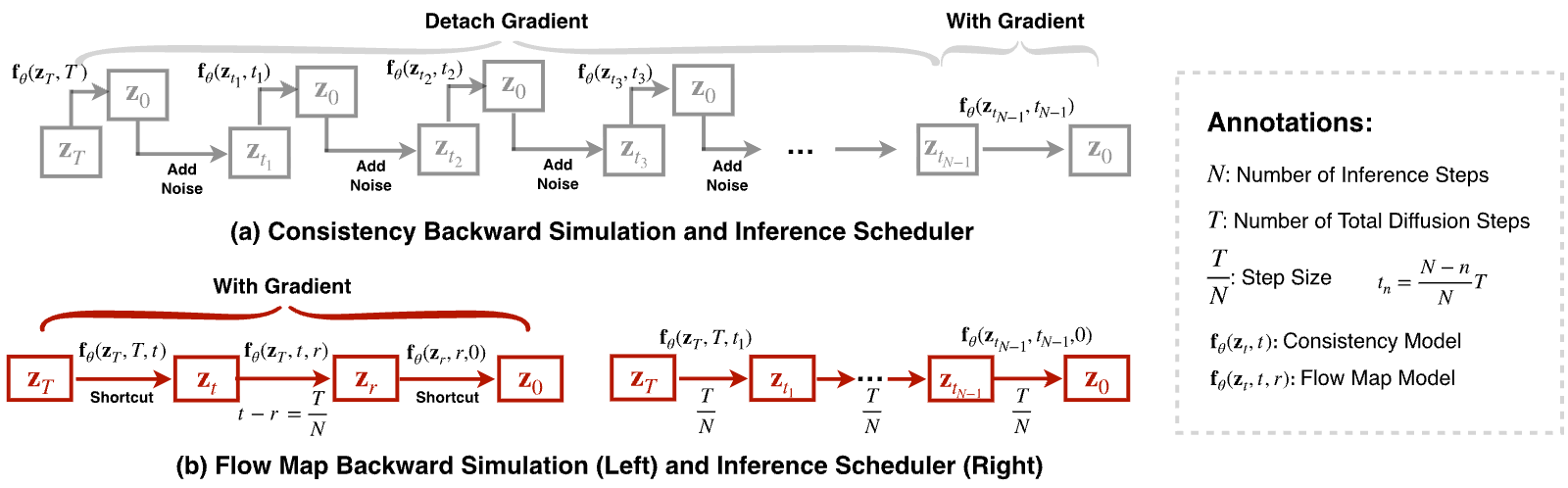
Although forward flow map training provides a strong initialization for any-step generation, it still suffers from test-time errors, especially discretization error at low NFEs and exposure bias in causal generation, as shown in Fig. 3. To correct rollout drift, we further introduce on-policy distillation with teacher guidance. Following prior work [10, 9], we instantiate on-policy diffusion distillation with distribution matching distillation (DMD), which requires the student to perform a self-rollout (i.e., backward simulation) to before re-noising in order to compute the Kullback–Leibler (KL) gradient. Below, we describe our design of backward simulation for flow map models.
Limitations of Consistency Backward Simulation. Existing backward simulation methods for DMD [10, 9] largely follow the logic of consistency models, as illustrated in Fig. 5(a). This design is convenient for on-policy distillation because the consistency scheduler can reach the state at intermediate steps, making endpoint-based supervision straightforward. In practice, gradients are often truncated before the target gradient step to avoid the memory cost and instability of backpropagating through a long rollout chain. In inference time, the same consistency sampler is then reused.
However, unlike ODE trajectories learned through flow-matching pretraining, consistency samplers require additional re-noising to obtain intermediate states during multi-step sampling. These re-noised states deviate from the base PF-ODE trajectory, which limits generalization beyond the simulation step used during simulation. Moreover, simulating arbitrary step counts with consistency backward simulation is computationally expensive because it requires rolling out the full trajectory.
Flow Map Backward Simulation. Unlike consistency backward simulation, our design directly exploits the learned transition capability of flow map models. Since a flow map model is able to predict transitions between arbitrary time pairs, it can naturally shortcut long rollout trajectories instead of explicitly simulating every intermediate step, based on the composition property of flow maps:
Concretely, for a target sampling budget of steps, we first choose an intermediate timestep along the sampled trajectory and then set the next timestep such that . As illustrated in Fig. 5, this decomposes a rollout trajectory from to into three segments: , , and . The first and last segments, and , are handled by shortcut transitions of the learned flow map, while is the target transition along the sampled trajectory. Once the KL gradient is computed at , it is backpropagated through the whole chain. By varying during training, we can efficiently simulate different inference step budgets with the same computation cost.
After on-policy distillation, we can simply use a standard Euler scheduler for sampling. Because flow map backward simulation trains transitions over different time intervals, the same model naturally supports different inference budgets at test time.
Discussion. The full algorithm of our on-policy distillation stage is shown in Alg. 2. As shown in Tab. 2, Consistency ODE-Init combined with consistency backward simulation exhibits the weakest test-time scaling, especially at 32 NFEs. Replacing the forward training stage with flow map training narrows this gap, but noticeable degradation still remains under multi-step sampling. By further adopting our flow map backward simulation, both few-step and multi-step performance are improved through on-policy distillation. As shown in Fig. 6, flow map backward simulation produces a straighter trajectory, which leads to more consistent improvement as the sampling budget increases, whereas consistency-based simulation degrades at 32 NFEs.
AnyFlow for Bidirectional Video Diffusion. For bidirectional video diffusion, we simply follow the established AnyFlow pipeline, as detailed in Alg. 1 and Alg. 2.
AnyFlow for Causal Video Diffusion. For causal video diffusion, we adopt the FAR [38] training pipeline, which uses context compression with asymmetric patchify kernels to encode videos efficiently. Specifically, we keep three full-token chunks with the standard patchify kernel size of 2, while compressing the remaining chunks with a larger kernel size of 4. This design substantially reduces teacher-forcing training cost and KV-cache size during sampling. To jointly support Image-to-Video (I2V) and Text-to-Video (T2V), we use a non-uniform chunk partition: the first chunk has size 1 for precise first-frame conditioning, and subsequent chunks use size 3 to balance motion modeling and throughput. The training objective remains the same as in the bidirectional setting, and we additionally cache and reuse KV states during rollouts to improve simulation efficiency for causal video diffusion models.
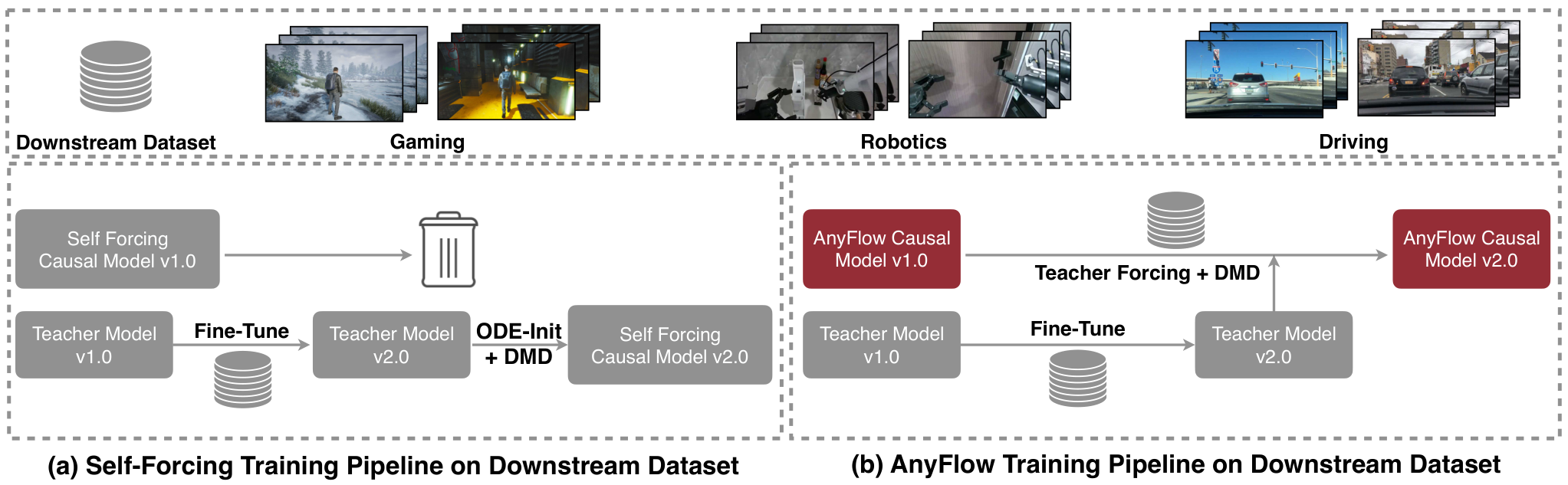
Continued Training on Downstream Datasets. A practical advantage of AnyFlow is that it preserves the pretrained model’s instantaneous flow field, making the distilled model compatible with continued training on downstream datasets. As illustrated in Fig. 7, AnyFlow enables continued training from a pretrained checkpoint, unlike Self-Forcing, where further training of the distilled model is difficult.
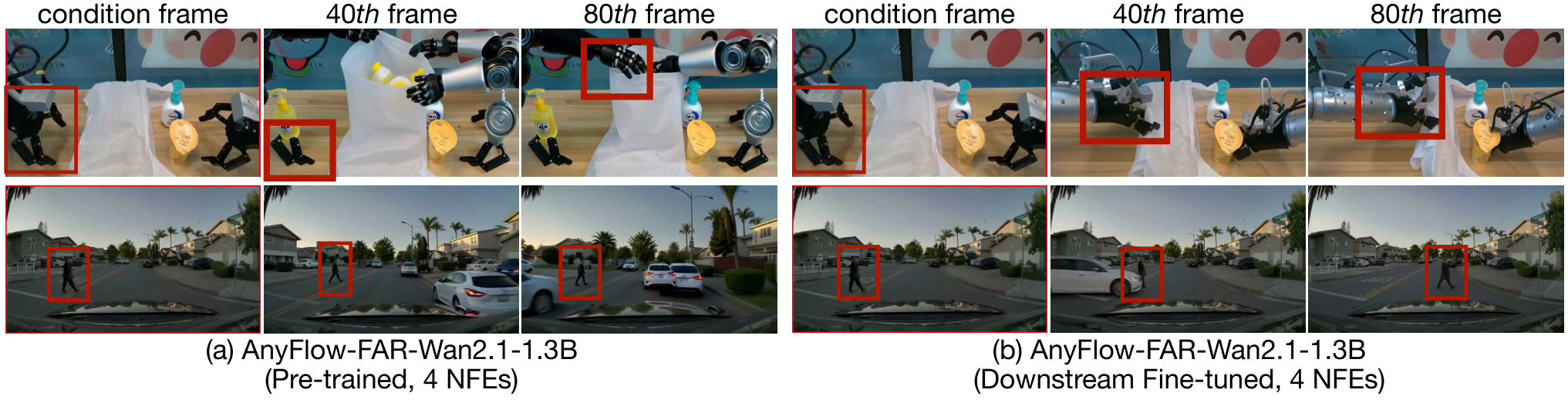
This property is especially useful in specialized domains whose motion patterns and visual statistics differ from those of the original training corpus. As shown in Fig. 8, the base distilled model, AnyFlow-FAR-Wan2.1-1.3B, still struggles with identity preservation in robotics videos and trajectory accuracy in driving scenes. After continued training on downstream data, these errors are substantially reduced.
| Model | #Params | Resolution | NFEs | Evaluation Scores | ||
| Quality | Semantic | Total | ||||
| Bidirectional Video Diffusion Models | ||||||
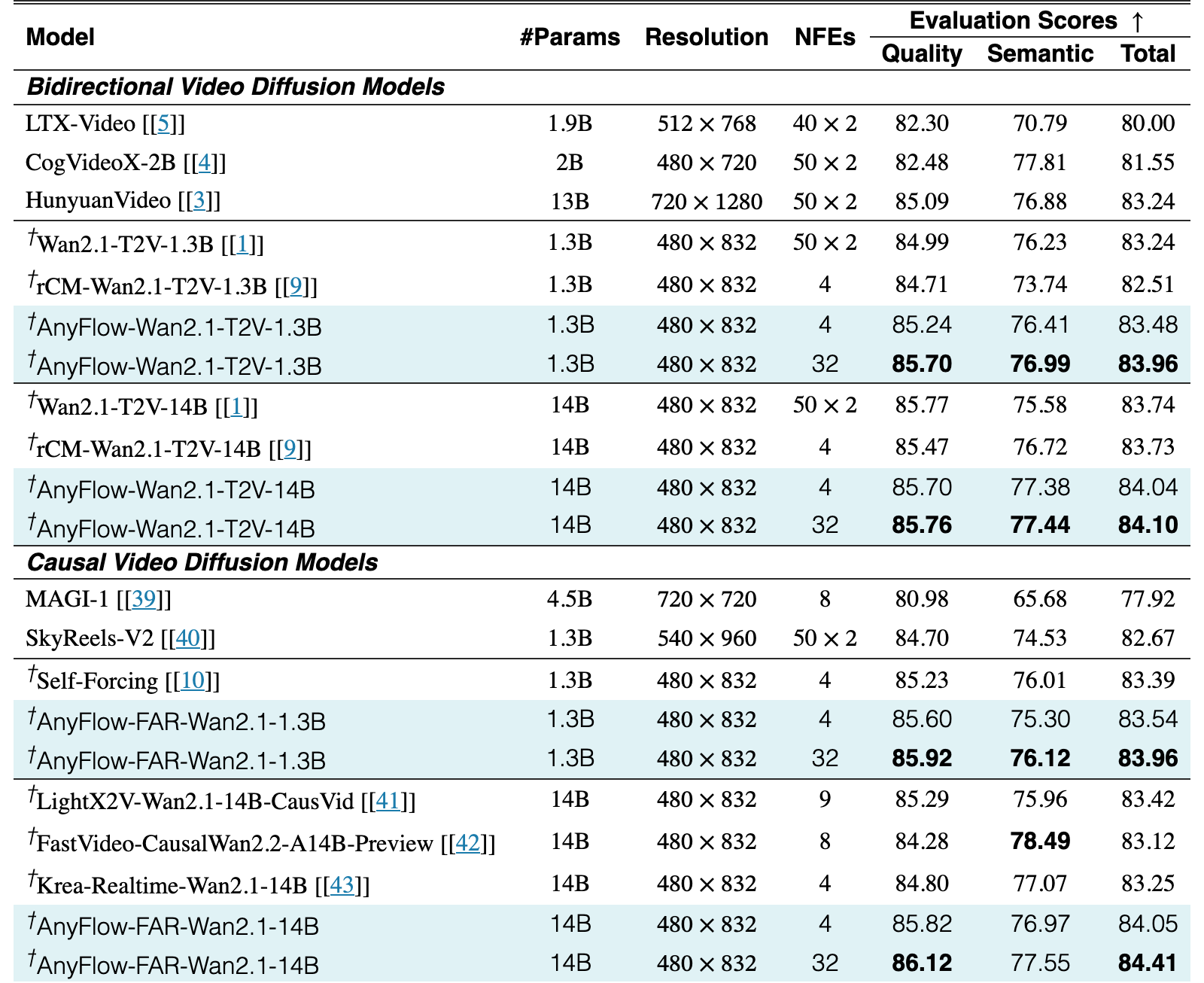
| LTX-Video [[5]] | 1.9B | 40 | 82.30 | 70.79 | 80.00 | |
| CogVideoX-2B [[4]] | 2B | 50 | 82.48 | 77.81 | 81.55 | |
| HunyuanVideo [[3]] | 13B | 50 | 85.09 | 76.88 | 83.24 | |
| †Wan2.1-T2V-1.3B [[1]] | 1.3B | 50 | 84.99 | 76.23 | 83.24 | |
| †rCM-Wan2.1-T2V-1.3B [[9]] | 1.3B | 4 | 84.71 | 73.74 | 82.51 | |
| †AnyFlow-Wan2.1-T2V-1.3B | 1.3B | 4 | 85.24 | 76.41 | 83.48 | |
| †AnyFlow-Wan2.1-T2V-1.3B | 1.3B | 32 | 85.70 | 76.99 | 83.96 | |
| †Wan2.1-T2V-14B [[1]] | 14B | 50 | 85.77 | 75.58 | 83.74 | |
| †rCM-Wan2.1-T2V-14B [[9]] | 14B | 4 | 85.47 | 76.72 | 83.73 | |
| †AnyFlow-Wan2.1-T2V-14B | 14B | 4 | 85.70 | 77.38 | 84.04 | |
| †AnyFlow-Wan2.1-T2V-14B | 14B | 32 | 85.76 | 77.44 | 84.10 | |
| Causal Video Diffusion Models | ||||||
| MAGI-1 [[39]] | 4.5B | 8 | 80.98 | 65.68 | 77.92 | |
| SkyReels-V2 [[40]] | 1.3B | 50 | 84.70 | 74.53 | 82.67 | |
| †Self-Forcing [[10]] | 1.3B | 4 | 85.23 | 76.01 | 83.39 | |
| †AnyFlow-FAR-Wan2.1-1.3B | 1.3B | 4 | 85.60 | 75.30 | 83.54 | |
| †AnyFlow-FAR-Wan2.1-1.3B | 1.3B | 32 | 85.92 | 76.12 | 83.96 | |
| †LightX2V-Wan2.1-14B-CausVid [[41]] | 14B | 9 | 85.29 | 75.96 | 83.42 | |
| †FastVideo-CausalWan2.2-A14B-Preview [[42]] | 14B | 8 | 84.28 | 78.49 | 83.12 | |
| †Krea-Realtime-Wan2.1-14B [[43]] | 14B | 4 | 84.80 | 77.07 | 83.25 | |
| †AnyFlow-FAR-Wan2.1-14B | 14B | 4 | 85.82 | 76.97 | 84.05 | |
| †AnyFlow-FAR-Wan2.1-14B | 14B | 32 | 86.12 | 77.55 | 84.41 | |
View original table
| Model | #Params | Resolution | NFEs | Evaluation Scores | ||
| Quality | I2V | Total | ||||
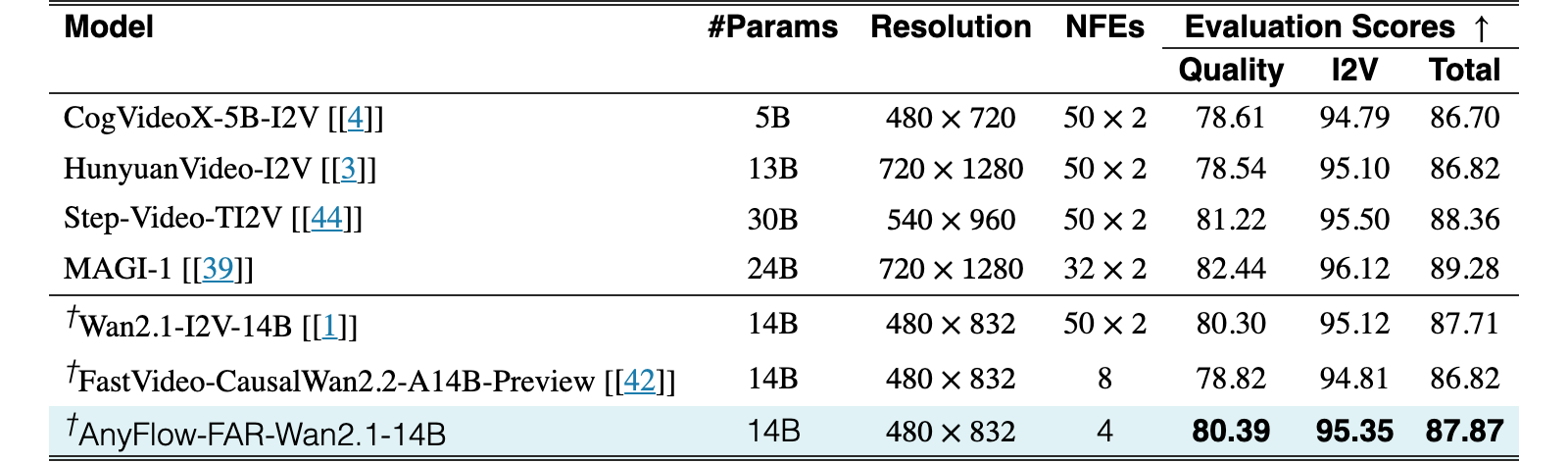
| CogVideoX-5B-I2V [[4]] | 5B | 50 | 78.61 | 94.79 | 86.70 | |
| HunyuanVideo-I2V [[3]] | 13B | 50 | 78.54 | 95.10 | 86.82 | |
| Step-Video-TI2V [[44]] | 30B | 50 | 81.22 | 95.50 | 88.36 | |
| MAGI-1 [[39]] | 24B | 32 | 82.44 | 96.12 | 89.28 | |
| †Wan2.1-I2V-14B [[1]] | 14B | 50 | 80.30 | 95.12 | 87.71 | |
| †FastVideo-CausalWan2.2-A14B-Preview [[42]] | 14B | 8 | 78.82 | 94.81 | 86.82 | |
| †AnyFlow-FAR-Wan2.1-14B | 14B | 4 | 80.39 | 95.35 | 87.87 | |
View original table
We implement AnyFlow on top of Wan2.1 [1] in the Diffusers framework [45]. We train the model on a synthetic dataset of 256K prompt–video pairs generated from Wan2.1-T2V-14B, where each sample contains up to 81 frames at a resolution of . Training is performed in two stages. In Stage 1, we optimize the forward flow map objective using AdamW [46] with a learning rate of and a global batch size of 32 for the 1.3B model and 16 for the 14B model, for 6,000 and 4,000 iterations, respectively. In Stage 2, we perform on-policy distillation by jointly optimizing the forward flow map and on-policy objectives with AdamW at a learning rate of for 800 iterations. In both stages, we use parameter-efficient fine-tuning with LoRA [47] of rank 256.
For text-to-video (T2V) evaluation, we adopt VBench [48], which evaluates generation quality across 16 fine-grained dimensions grouped into two high-level categories: Quality score and Semantic score. For image-to-video (I2V) evaluation, we use VBench-I2V [49] and report both the Quality score and the I2V score.
To ensure a fair comparison, we re-evaluate key counterparts under a unified protocol using the official VBench augmented prompts. These counterparts include the Wan2.1 base model [1], Self-Forcing [10], and rCM [9], as well as community-trained 14B causal models including FastVideo [42], Krea-Realtime-14B [43], and LightX2V [41]. Results for all other methods are taken directly from their original papers.
Quantitative Comparison. As shown in Tab. 3, AnyFlow achieves strong few-step performance and continues to improve as the sampling budget increases. On the 14B bidirectional backbone, AnyFlow-Wan2.1-T2V-14B obtains 84.04 at 4 NFEs, outperforming rCM-Wan2.1-T2V-14B (83.73 at 4 NFEs). On the 14B causal backbone, AnyFlow-FAR-Wan2.1-14B reaches 84.05 at 4 NFEs and further improves to 84.41 at 32 NFEs, outperforming strong community counterparts.
For image-to-video results in Tab. 4, AnyFlow-FAR-Wan2.1-14B achieves a VBench-I2V score of 87.87 using only 4 NFEs. This result is comparable to Wan2.1-I2V-14B with 502 NFEs (87.71) and surpasses FastVideo-CausalWan2.2-A14B-Preview (86.82), showing that AnyFlow improves both visual quality and I2V faithfulness while retaining strong sampling efficiency.
Qualitative Comparison. As shown in Fig. 9, we provide qualitative comparisons at the 14B scale for both T2V and I2V generation. In causal T2V examples, FastVideo-Wan2.2-A14B-Preview exhibits blurry details, LightX2V-Wan2.1-14B-CausVid shows flickering artifacts, and Krea-Realtime-14B produces unrealistic motion in some clips. By comparison, AnyFlow-FAR-Wan2.1-14B delivers the best visual quality and motion with 4 NFEs. In bidirectional T2V examples, AnyFlow-Wan2.1-T2V-14B shows slightly better motion than rCM-Wan2.1-T2V-14B.
For I2V generation, AnyFlow reuses the causal generator through our non-uniform chunk partition and maintains good first-frame faithfulness with smooth motion transitions. Compared with Wan2.1-I2V-14B, AnyFlow-FAR-Wan2.1-14B shows comparable temporal stability and motion quality, while FastVideo-Wan2.2-A14B-Preview exhibits visible flickering and inconsistencies with the input image. Overall, these qualitative results are consistent with the quantitative trends and further support the effectiveness of AnyFlow in few-step sampling.
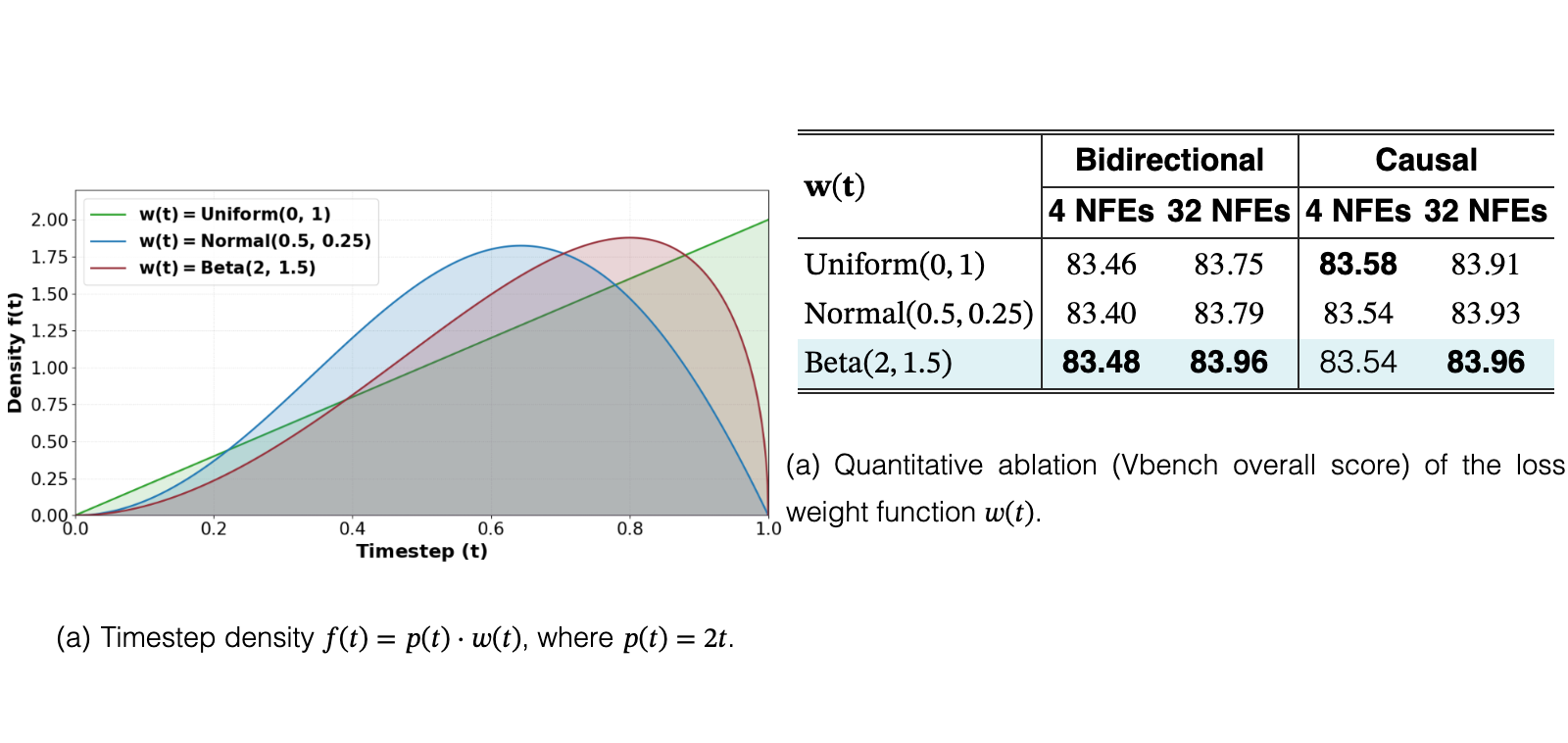
Time Sampler. We investigate different choices of the time sampler, with their induced densities over visualized in Fig. 10(a). The uniform weighting yields the worst test-time scalability, as reflected by its 32-step performance in Tab. 5(a), likely because it mismatches the logit-normal time weighting used in pretraining. Among the other variants, assigning more probability mass to high-noise regions leads to better overall performance. Therefore, we fix in all experiments.
Interpolated Timestep Conditioning. Incorporating an additional timestep embedding during post-training is non-trivial. A baseline design is to add a new embedding projection whose final layer is zero-initialized, as in TMD [27]. However, under zero initialization, the model needs to amplify the influence of the embedding, which causes its norm to keep increasing during training and eventually leads to over-saturated results, as shown in Fig. 11. In contrast, our interpolated timestep conditioning preserves the boundary case for stability while avoiding an overly cold start when . As a result, the embedding norm remains stable after roughly 2K training steps and stays much closer to that of the pretrained model, effectively suppressing the over-saturation effect.
Comparison to ODE-Init. We compare AnyFlow with Consistency ODE-Init for causal video generation in Fig. 12. For a fair comparison, we fine-tune the teacher on the same synthetic dataset, since we do not have access to the original training data of the Wan base model. After flow map training, AnyFlow produces clearer results than Consistency ODE-Init at both 4 and 32 NFEs, indicating that it better preserves the knowledge inherited from the flow-matching-pretrained base model. After on-policy distillation, AnyFlow further reduces test-time errors in few-step sampling and improves the overall sampling trajectory. We also observe that our method preserves the style and content of the pretrained model more faithfully.
| Method | Training Cost (s/iter on H100) | |
| Causal | Bidirectional | |
| Forward Training | ||
| Standard Flow-Matching | 5.8 | 9.7 |
| + Guidance-Fused Training | 7.8 | 12.3 |
| + Guidance-Fused Training + Differential Derivation Equation | 10.4 | 16.8 |
| On-Policy Distillation | ||
| Consistency Backward Simulation (4 Steps) | 45.9 | 41.8 |
| Flow Map Backward Simulation (4 Steps) | 53.1 (+15.7%) | 51.2 (+22.5%) |
| Consistency Backward Simulation (16 Steps) | 93.8 | 96.6 |
| Flow Map Backward Simulation (16 Steps) | 53.1 (-43.4%) | 51.2 (-47.0%) |
View original table
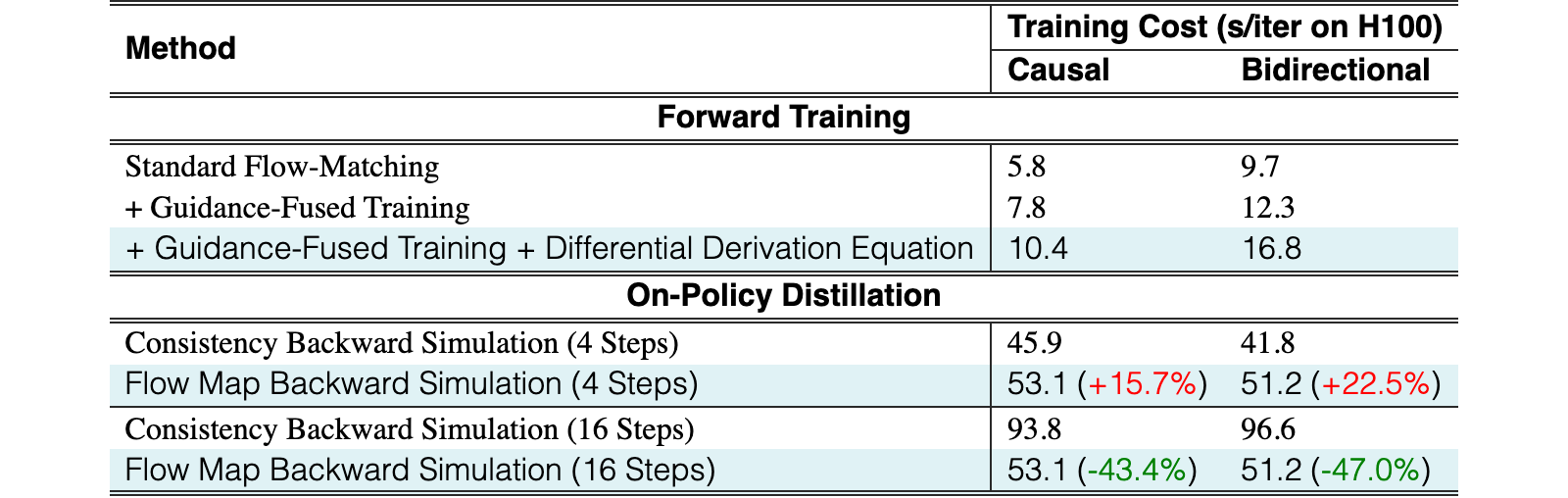
Training Cost Breakdown. Tab. 5 reports the training cost of each component in AnyFlow, measured in seconds per iteration on 8H100 GPUs. In the forward training stage, guidance-fused training and the differential derivation equation introduce additional overhead compared with standard flow matching, but the overall cost remains practical for large-scale training. In the on-policy distillation stage, our flow map backward simulation incurs a slightly higher cost than consistency backward simulation at 4 steps, specifically 15.7% more for the causal model and 22.5% more for the bidirectional model, because we backpropagate through the full rollout chain. However, our method becomes significantly more efficient when simulating larger step counts. At 16 steps, it reduces the training cost by 43.4% for the causal model and 47.0% for the bidirectional model compared with consistency backward simulation, thanks to the shortcut transitions learned by the flow map.
We present AnyFlow, the first any-step video diffusion distillation framework based on a two-time flow map formulation. By learning transitions between arbitrary time pairs, AnyFlow supports a wide range of sampling budgets within a single model. Built on large pretrained video diffusion backbones, it combines an improved forward flow map training recipe with flow map backward simulation for on-policy distillation, thereby reducing discretization error and exposure bias during sampling. Across both bidirectional and causal architectures, and across model scales from 1.3B to 14B, AnyFlow consistently matches or outperforms strong consistency-based counterparts in the few-step regime while continuing to improve as the sampling budget increases. These results highlight a practical and scalable path toward high-quality any-step video generation.
Limitations. The primary limitation of our method is its reliance on external datasets for flow map training. Even when synthetic data are used, the training distribution may still differ from that of the base model, which can introduce mild distribution shift, such as smoother textures. This issue could be mitigated by applying AnyFlow with the same data used to pretrain the base model.
Future Work. Although AnyFlow establishes the first any-step, flow-map-based video diffusion distillation framework, there is still substantial room for improving the training methodology. One important direction is to develop more effective and stable forward flow map training strategies to improve robustness across different NFE regimes. In addition, because AnyFlow provides a scalable recipe for learning any-step causal video diffusion from both data and a teacher model, a natural next step is to extend the framework to autoregressive long-video generation with dedicated long-video training.
References
- [1] T. Wan, A. Wang, B. Ai, B. Wen, C. Mao, C. Xie, D. Chen, F. Yu, H. Zhao, J. Yang, et al. (2025) Wan: open and advanced large-scale video generative models. arXiv preprint arXiv:2503.20314. Cited by: §1, Table 3, Table 3, Table 4, §5.1, §5.2.
- [2] N. Agarwal, A. Ali, M. Bala, Y. Balaji, E. Barker, T. Cai, P. Chattopadhyay, Y. Chen, Y. Cui, Y. Ding, et al. (2025) Cosmos world foundation model platform for physical ai. arXiv preprint arXiv:2501.03575. Cited by: §1.
- [3] W. Kong, Q. Tian, Z. Zhang, R. Min, Z. Dai, J. Zhou, J. Xiong, X. Li, B. Wu, J. Zhang, et al. (2024) Hunyuanvideo: a systematic framework for large video generative models. arXiv preprint arXiv:2412.03603. Cited by: §1, Table 3, Table 4.
- [4] Z. Yang, J. Teng, W. Zheng, M. Ding, S. Huang, J. Xu, Y. Yang, W. Hong, X. Zhang, G. Feng, et al. (2024) CogVideoX: text-to-video diffusion models with an expert transformer. arXiv preprint arXiv:2408.06072. Cited by: §1, Table 3, Table 4.
- [5] Y. HaCohen, N. Chiprut, B. Brazowski, D. Shalem, D. Moshe, E. Richardson, E. Levin, G. Shiran, N. Zabari, O. Gordon, P. Panet, S. Weissbuch, V. Kulikov, Y. Bitterman, Z. Melumian, and O. Bibi (2024) LTX-Video: realtime video latent diffusion. arXiv preprint arXiv:2501.00103. Cited by: §1, Table 3.
- [6] Y. Song, P. Dhariwal, M. Chen, and I. Sutskever (2023) Consistency models. Cited by: §1, §2.1, §2.2.
- [7] Y. Song and P. Dhariwal (2024) Improved techniques for training consistency models. In ICLR, Cited by: §1, §2.1.
- [8] C. Lu and Y. Song (2024) Simplifying, stabilizing and scaling continuous-time consistency models. arXiv preprint arXiv:2410.11081. Cited by: §1, §2.1, §2.3.
- [9] K. Zheng, Y. Wang, Q. Ma, H. Chen, J. Zhang, Y. Balaji, J. Chen, M. Liu, J. Zhu, and Q. Zhang (2025) Large scale diffusion distillation via score-regularized continuous-time consistency. arXiv preprint arXiv:2510.08431. Cited by: Figure 1, Figure 1, §1, §2.1, §2.3, Table 1, §4.2.2, §4.2.2, Table 3, Table 3, §5.2.
- [10] X. Huang, Z. Li, G. He, M. Zhou, and E. Shechtman (2025) Self forcing: bridging the train-test gap in autoregressive video diffusion. In NeurIPS, Cited by: Figure 1, Figure 1, §1, §2.3, §2.3, §2.4, §2.4, Table 1, Table 2, Table 2, §4.2.2, §4.2.2, Table 3, §5.2.
- [11] A. Sabour, S. Fidler, and K. Kreis (2025) Align your flow: scaling continuous-time flow map distillation. arXiv preprint arXiv:2506.14603. Cited by: §1, §1, §2.2.
- [12] N. M. Boffi, M. S. Albergo, and E. Vanden-Eijnden (2024) Flow map matching with stochastic interpolants: a mathematical framework for consistency models. arXiv preprint arXiv:2406.07507. Cited by: §1, §2.2.
- [13] Z. Geng, M. Deng, X. Bai, J. Z. Kolter, and K. He (2025) Mean flows for one-step generative modeling. arXiv preprint arXiv:2505.13447. Cited by: §1, §2.2, §3.1, §4.1, §4.2.1, §4.2.1, §4.2.1, §4.2.1.
- [14] Z. Geng, A. Pokle, W. Luo, J. Lin, and J. Z. Kolter (2024) Consistency models made easy. arXiv preprint arXiv:2406.14548. Cited by: §2.1.
- [15] F. Wang, Z. Huang, A. Bergman, D. Shen, P. Gao, M. Lingelbach, K. Sun, W. Bian, G. Song, Y. Liu, et al. (2024) Phased consistency models. Advances in neural information processing systems 37, pp. 83951–84009. Cited by: §2.1.
- [16] Y. Ren, X. Xia, Y. Lu, J. Zhang, J. Wu, P. Xie, X. Wang, and X. Xiao (2024) Hyper-SD: trajectory segmented consistency model for efficient image synthesis. NeurIPS. Cited by: §2.1.
- [17] S. Lee, Y. Xu, T. Geffner, G. Fanti, K. Kreis, A. Vahdat, and W. Nie (2024) Truncated consistency models. arXiv preprint arXiv:2410.14895. Cited by: §2.1.
- [18] D. Kim, C. Lai, W. Liao, N. Murata, Y. Takida, T. Uesaka, Y. He, Y. Mitsufuji, and S. Ermon (2024) Consistency trajectory models: learning probability flow ODE trajectory of diffusion. In ICLR, Cited by: §2.2.
- [19] X. Liu, C. Gong, and Q. Liu (2022) Flow straight and fast: learning to generate and transfer data with rectified flow. arXiv preprint arXiv:2209.03003. Cited by: §2.2.
- [20] Y. Lipman, R. T. Chen, H. Ben-Hamu, M. Nickel, and M. Le (2022) Flow matching for generative modeling. arXiv preprint arXiv:2210.02747. Cited by: §2.2.
- [21] Z. Wang, Y. Zhang, X. Yue, X. Yue, Y. Li, W. Ouyang, and L. Bai (2025) Transition models: rethinking the generative learning objective. arXiv preprint arXiv:2509.04394. Cited by: §2.2, §3.1.
- [22] T. Luo, H. Yuan, and Z. Liu (2025) SoFlow: solution flow models for one-step generative modeling. arXiv preprint arXiv:2512.15657. Cited by: §2.2.
- [23] Y. Guo, W. Wang, Z. Yuan, R. Cao, K. Chen, Z. Chen, Y. Huo, Y. Zhang, Y. Wang, S. Liu, et al. (2025) Splitmeanflow: interval splitting consistency in few-step generative modeling. arXiv preprint arXiv:2507.16884. Cited by: §2.2.
- [24] T. Yin, M. Gharbi, T. Park, R. Zhang, E. Shechtman, F. Durand, and B. Freeman (2024) Improved distribution matching distillation for fast image synthesis. NeurIPS. Cited by: §2.3, §2.4, §2.4, §3.2.
- [25] T. Yin, M. Gharbi, R. Zhang, E. Shechtman, F. Durand, W. T. Freeman, and T. Park (2024) One-step diffusion with distribution matching distillation. In CVPR, Cited by: §2.3, §2.4, §2.4, §3.2.
- [26] T. Yin, Q. Zhang, R. Zhang, W. T. Freeman, F. Durand, E. Shechtman, and X. Huang (2025) From slow bidirectional to fast autoregressive video diffusion models. In CVPR, Cited by: §2.3, Table 2.
- [27] W. Nie, J. Berner, N. Ma, C. Liu, S. Xie, and A. Vahdat (2026) Transition matching distillation for fast video generation. arXiv preprint arXiv:2601.09881. Cited by: §2.3, §4.2.1, §5.4.
- [28] S. Yang, W. Huang, R. Chu, Y. Xiao, Y. Zhao, X. Wang, M. Li, E. Xie, Y. Chen, Y. Lu, et al. (2025) Longlive: real-time interactive long video generation. arXiv preprint arXiv:2509.22622. Cited by: §2.3.
- [29] Y. Jin, Z. Sun, N. Li, K. Xu, H. Jiang, N. Zhuang, Q. Huang, Y. Song, Y. MU, and Z. Lin (2025) Pyramidal flow matching for efficient video generative modeling. In ICLR, Cited by: §2.3.
- [30] L. Zhang, S. Cai, M. Li, G. Wetzstein, and M. Agrawala (2025) Frame context packing and drift prevention in next-frame-prediction video diffusion models. In NeurIPS, Cited by: §2.3.
- [31] K. Song, B. Chen, M. Simchowitz, Y. Du, R. Tedrake, and V. Sitzmann (2024) History-guided video diffusion. In ICML, Cited by: §2.3.
- [32] Y. Guo, C. Yang, H. He, Y. Zhao, M. Wei, Z. Yang, W. Huang, and D. Lin (2025) End-to-end training for autoregressive video diffusion via self-resampling. arXiv preprint arXiv:2512.15702. Cited by: §2.3.
- [33] K. Lu and T. M. Lab (2025) On-policy distillation. Thinking Machines Lab: Connectionism. Note: https://thinkingmachines.ai/blog/on-policy-distillation External Links: Document Cited by: §2.4.Source
- [34] S. Zhao, Z. Xie, M. Liu, J. Huang, G. Pang, F. Chen, and A. Grover (2026) Self-distilled reasoner: on-policy self-distillation for large language models. arXiv preprint arXiv:2601.18734. Cited by: §2.4.
- [35] T. Ye, L. Dong, X. Wu, S. Huang, and F. Wei (2026) On-policy context distillation for language models. arXiv preprint arXiv:2602.12275. Cited by: §2.4.
- [36] S. Lin, X. Xia, Y. Ren, C. Yang, X. Xiao, and L. Jiang (2025) Diffusion adversarial post-training for one-step video generation. In ICML, Cited by: §2.4, Table 1.
- [37] S. Lin, C. Yang, H. He, J. Jiang, Y. Ren, X. Xia, Y. Zhao, X. Xiao, and L. Jiang (2025) Autoregressive adversarial post-training for real-time interactive video generation. In NeurIPS, Cited by: §2.4, Table 1.
- [38] Y. Gu, W. Mao, and M. Z. Shou (2025) Long-context autoregressive video modeling with next-frame prediction. arXiv preprint arXiv:2503.19325. Cited by: §4.3.
- [39] H. Teng, H. Jia, L. Sun, L. Li, M. Li, M. Tang, S. Han, T. Zhang, W. Zhang, W. Luo, et al. (2025) MAGI-1: autoregressive video generation at scale. arXiv preprint arXiv:2505.13211. Cited by: Table 3, Table 4.
- [40] G. Chen, D. Lin, J. Yang, C. Lin, J. Zhu, M. Fan, H. Zhang, S. Chen, Z. Chen, C. Ma, et al. (2025) Skyreels-v2: infinite-length film generative model. arXiv preprint arXiv:2504.13074. Cited by: Table 3.
- [41] L. Contributors (2025) LightX2V: light video generation inference framework. GitHub. Note: https://github.com/ModelTC/lightx2v Cited by: Table 3, §5.2.Source
- [42] F. Team (2025) CausalWan2.2-i2v-a14b-preview-diffusers. Note: https://huggingface.co/FastVideo/CausalWan2.2-I2V-A14B-Preview-Diffusers Cited by: Table 3, Table 4, §5.2.Source
- [43] Krea realtime 14b: real-time video generation External Links: Link Cited by: Table 3, §5.2.Source
- [44] H. Huang, G. Ma, N. Duan, X. Chen, C. Wan, R. Ming, T. Wang, B. Wang, Z. Lu, A. Li, X. Zeng, X. Zhang, G. Yu, Y. Yin, Q. Wu, W. Sun, K. An, X. Han, D. Sun, W. Ji, B. Huang, B. Li, C. Wu, G. Huang, H. Xiong, J. He, J. Wu, J. Yuan, J. Wu, J. Liu, J. Guo, K. Tan, L. Chen, Q. Chen, R. Sun, S. Yuan, S. Yin, S. Liu, W. Chen, Y. Dai, Y. Luo, Z. Ge, Z. Guan, X. Song, Y. Zhou, B. Jiao, J. Chen, J. Li, S. Zhou, X. Zhang, Y. Xiu, Y. Zhu, H. Shum, and D. Jiang (2025) Step-video-ti2v technical report: a state-of-the-art text-driven image-to-video generation model. External Links: 2503.11251, Link Cited by: Table 4.Source
- [45] P. von Platen, S. Patil, A. Lozhkov, P. Cuenca, N. Lambert, K. Rasul, M. Davaadorj, D. Nair, S. Paul, W. Berman, Y. Xu, S. Liu, and T. Wolf (2022) Diffusers: state-of-the-art diffusion models. GitHub. Note: https://github.com/huggingface/diffusers Cited by: §5.1.Source
- [46] I. Loshchilov and F. Hutter (2017) Decoupled weight decay regularization. arXiv preprint arXiv:1711.05101. Cited by: §5.1.
- [47] E. J. Hu, Y. Shen, P. Wallis, Z. Allen-Zhu, Y. Li, S. Wang, L. Wang, W. Chen, et al. (2022) Lora: low-rank adaptation of large language models.. Iclr 1 (2), pp. 3. Cited by: §5.1.
- [48] Z. Huang, Y. He, J. Yu, F. Zhang, C. Si, Y. Jiang, Y. Zhang, T. Wu, Q. Jin, N. Chanpaisit, Y. Wang, X. Chen, L. Wang, D. Lin, Y. Qiao, and Z. Liu (2024) VBench: comprehensive benchmark suite for video generative models. In Proceedings of the IEEE/CVF Conference on Computer Vision and Pattern Recognition, Cited by: §5.2.
- [49] Z. Huang, F. Zhang, X. Xu, Y. He, J. Yu, Z. Dong, Q. Ma, N. Chanpaisit, C. Si, Y. Jiang, et al. (2025) Vbench++: comprehensive and versatile benchmark suite for video generative models. IEEE Transactions on Pattern Analysis and Machine Intelligence. Cited by: §5.2.