Evolving Agents in the Dark: Retrospective Harness Optimization via Self-Preference
arXiv:2606.05922v3 · This workspace stays on this version. Check arXiv for newer versions
Some source details need review 3 to check
Original formulas, table values and figures are preserved. Comparison can miss differences; use the original PDF to check details.
Reading view checked: 270 math expressions, 1 rendering failures; 13 of 13 images available.
Compared 144 of 151 source passages against 30 of 42 PDF pages.
- Some formulas could not be rendered; their original TeX is shown. Check the original PDF. (1)
- This long paper was only partially compared; the original sources remain available.
HTML (Sx4_p1_1) says “the first author’s internship”; PDF (page 1) says “Work done during an internship,” without identifying whose internship. The PDF neither confirms nor contradicts that detail. Check PDF page 1
13 of 13 figure, table and graphic images captured. Open original PDF
Abstract
AI agents rely on a harness of skills, tools, and workflows to solve complex problems. Continually improving this harness is essential for adapting to new tasks. However, existing optimization methods typically require ground-truth validation sets, yet such labeled data is difficult to acquire in practical deployment settings. To address this problem, we introduce Retrospective Harness Optimization (RHO), a self-supervised method that optimizes the agent harness using only past trajectories. Specifically, RHO selects a diverse coreset of challenging tasks from past trajectories and re-solves them in parallel. The agent analyzes these rollouts using self-validation and self-consistency, then generates candidate harness updates and selects the most effective one by its own pairwise self-preference. We evaluate RHO across three diverse domains, spanning software engineering, technical work, and knowledge work. Notably, a single optimization round improves the pass rate on SWE-Bench Pro from 59% to 78% without any external grading. Furthermore, our analysis demonstrates that RHO effectively targets prior failure modes. As a result, the optimized harness alters the agent’s behavior patterns and sustains higher accuracy during long-horizon sessions. Code is available at https://github.com/wbopan/retro-harness and the project website at https://paper-rho.wenbo.io.
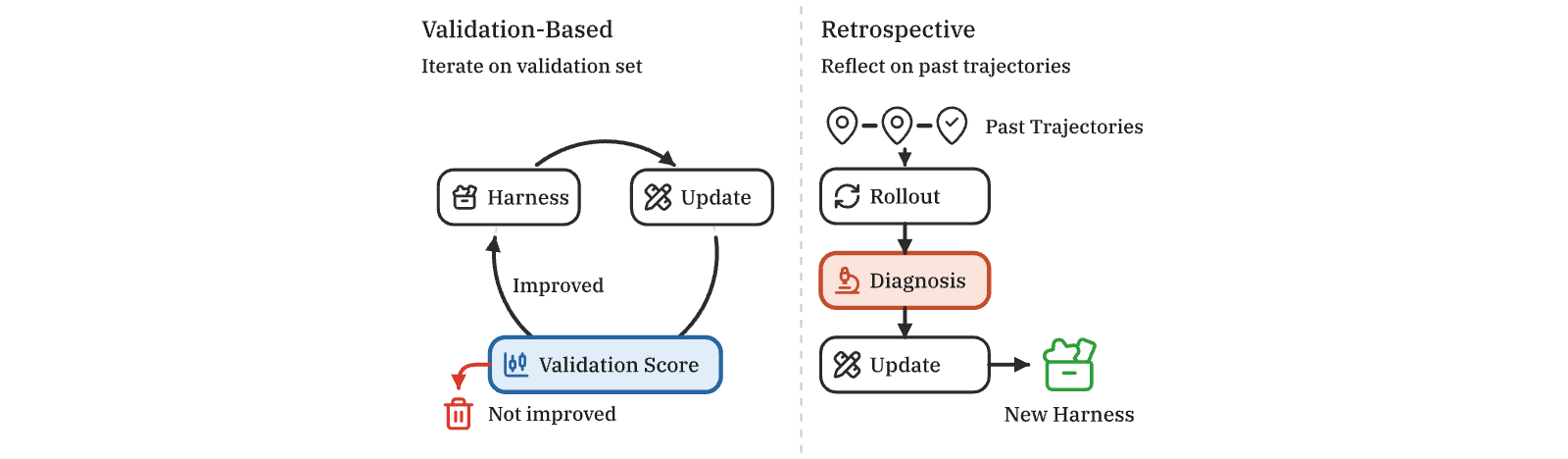
A harness enables an AI agent to complete complex tasks by providing it with available skills, workflows, and tools. One important research question is how to improve the harness continuously. Specifically, after an agent is deployed, we aim to continually evolve its harness by learning from past experiences, which in turn improves its performance on future tasks.
Prior work has proposed various methods for evolving the agent harness (Zhou et al., 2022; Yang et al., 2023; Khattab et al., 2023; Yuksekgonul et al., 2024; Agrawal et al., 2025; Hu et al., 2024; Lee et al., 2026). However, these methods rely on scoring against a validation set to guide the improvements. In practical deployment scenarios, it is often difficult to collect a validation set that accurately estimates the distribution of future tasks to validate the updated harness. On the other hand, the continuous operation of an agent naturally produces a rich set of trajectories from past tasks. This leads to our central question. Can we improve the agent harness to enhance future performance when we only have access to past trajectories?
To address this problem, we propose Retrospective Harness Optimization (RHO), a self-supervised method that optimizes the harness through a retrospective analysis of past trajectories. This method employs the agent’s internal self-preference over trajectories to guide the optimization process. Figure 1 contrasts RHO with conventional validation-feedback optimization, which iterates against a labeled validation set.
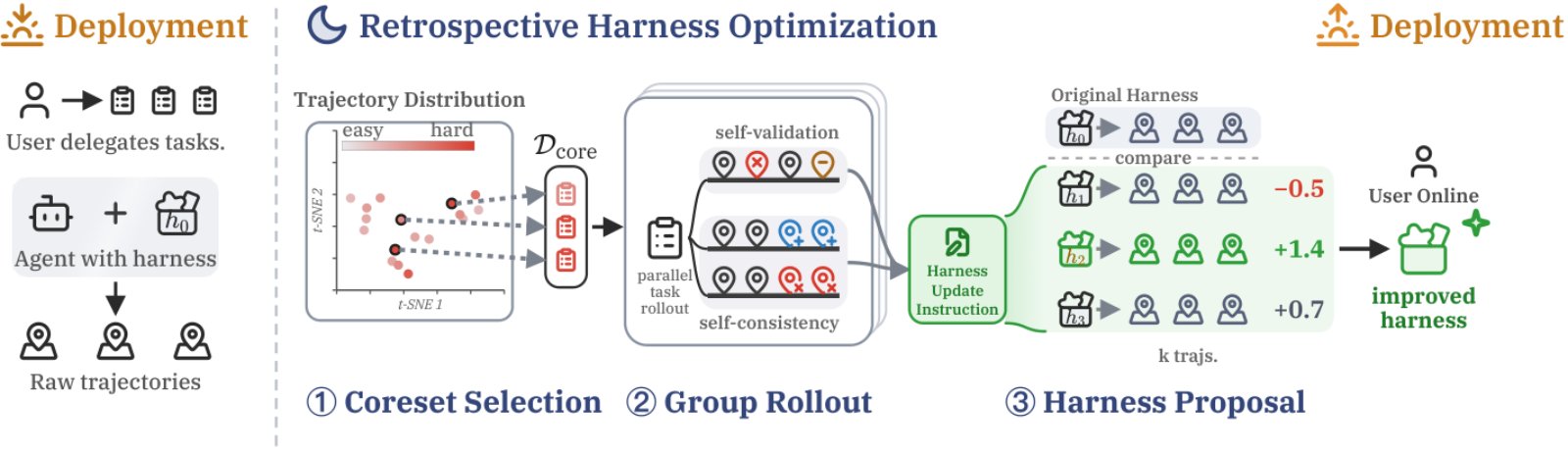
Figure 2 illustrates this process. Specifically, given a large set of past trajectories, RHO first selects a diverse and challenging coreset of tasks. Then the agent re-attempts each task in the coreset multiple times to generate parallel trajectories. Building on this, we extract two diagnostic signals, namely self-validation within a trajectory and self-consistency across parallel trajectories. These signals are then used to instruct the generation of harness updates. Finally, by using the agent’s pairwise self-preference, we select the most promising harness from the newly generated proposals.
We evaluate the effectiveness of RHO across three agent domains that span software engineering, technical work, and knowledge work. RHO consistently improves the agent’s performance across all three domains. Notably, by running a single round of retrospective harness optimization on software-engineering trajectories, we improve the pass rate on SWE-Bench Pro (Deng et al., 2025) from 59% to 78%, without depending on grading against a validation set.
Furthermore, we provide a detailed analysis on how the retrospective optimization process improves performance. We observe that RHO designs specific skills and tools targeting typical failure modes encountered in past tasks. These components reshape the agent’s action patterns and help it sustain higher accuracy in long-horizon sessions. Additionally, we quantitatively analyze the contributions of the diagnostic signals during the retrospective process. This analysis demonstrates that each step in RHO progressively isolates signals that contribute to performance improvements.
Our contributions are as follows:
- ⋄\diamond
We propose retrospective harness optimization, which addresses the gap of improving the full harness (including memory, context, skills, and tools) exclusively from unlabeled trajectories.
- ⋄\diamond
We evaluate RHO across three scenarios and show that retrospective analysis consistently outperforms straightforward experience accumulation and reaches quality comparable to validation-feedback-driven evolution with no labels at roughly a third of its compute budget.
- ⋄\diamond
We provide a quantitative analysis of the impact of harness optimization on agent performance, showing that gathering effective improvement signals leads to targeted changes in the harness and optimizes the agent’s behavior.
Harness optimization improves an agent by editing the prompts, program parameters, or workflow code that surround a fixed model. One line optimizes prompts or pipeline parameters against a labeled metric, spanning LLM-as-optimizer search (Yang et al., 2023), declarative pipeline compilation (Khattab et al., 2023), textual-gradient updates (Yuksekgonul et al., 2024), reflective prompt evolution (Agrawal et al., 2025), and cross-model prompt evolution (Wu et al., 2026). A more agentic line lets a meta-agent rewrite the agent’s own code, where ADAS searches the space of agentic system designs (Hu et al., 2024), Meta-Harness searches over harness code using the execution traces and scores of prior candidates (Lee et al., 2026), and M⋆ evolves the memory system as an executable program, scoring candidate memory programs on a labeled validation set (Pan et al., 2026a). Although these methods differ in the surface they edit, all of them steer the search with a labeled validation metric. RHO departs from this paradigm, requiring no validation feedback and improving the harness in a single retrospective pass over unlabeled past trajectories.
A second line improves agents from their own past experience, using the agent’s self-judgment over trajectories in place of ground-truth labels. Dynamic Cheatsheet maintains a self-curated memory of reusable strategies and code snippets at test time (Suzgun et al., 2025), while ReasoningBank distills generalizable reasoning strategies from self-judged successes and failures (Ouyang et al., 2025). MemMA coordinates the memory cycle with multiple agents and repairs its memory bank against self-generated probe questions (Lin et al., 2026), and Sleep-time Compute precomputes useful context offline before queries arrive (Lin et al., 2025). Concurrent to our work, SkillOS instead trains a skill curator with reinforcement learning from outcome and judge rewards, updating a skill repository from accumulated experience (Ouyang et al., 2026). These methods enrich an agent’s stored memory, context, or skill list while leaving the rest of the harness untouched. RHO instead optimizes the full harness, including executable tools and instructions, rather than memory alone. Appendix A gives a detailed comparison with related work.
We define a harness as a persistent collection of tools, prompts, and skills that an agent can use to solve a task. Given a task and a harness , an agent can attempt the task using a loop of reasoning, acting, and observing. This multi-step process generates a trajectory , which records the information read by the agent, its chain of thought, the tools used, and the final output. We denote this execution process with a prompted agent operation as . As the agent executes multiple tasks, it produces a dataset of trajectories . These trajectories often contain instances of failure and useful insights that can be used to improve the harness. Consequently, we ask whether the agent can retrospectively analyze past trajectories to optimize its harness and improve its future performance. To quantify this, we define a latent utility function that measures the quality of a trajectory. We formalize the optimization as a function that returns a modified harness . The goal is to find an optimal harness that maximizes the expected utility on future tasks:
Problem. However, estimating this utility function accurately is difficult in practice. To evaluate the true utility of a harness, we would need a representative validation set of future tasks and a mechanism to calculate the success rate of the agent using this specific harness. In our setting, the function is latent and cannot be directly observed.
Our Approach. Because the utility is latent, we cannot directly optimize it. Instead, we substitute this latent utility with a self-preference estimator. Specifically, we instruct the agent to compare multiple trajectories on the same task to compute a self-preference ranking. We define a ranking function as . This function yields a preference ordering over the given trajectories and provides a rationale that explains why the agent prefers certain executions over others. The next section details how we organize the operations of solving, ranking, and optimizing to improve the latent harness utility.
We propose RHO, a self-supervised method that improves a harness using only past trajectories. Specifically, our pipeline (Figure 2) consists of three stages, namely coreset selection, group rollout, and best-of- harness proposal. First, we select a representative subset of past tasks to define the optimization target. Next, we sample a group of parallel rollouts for each task in this coreset and extract harness improvement signals from them. Finally, we generate candidate harnesses based on these signals and retain the most preferred one using pairwise self-preference. The full algorithm is detailed in Algorithm 1.
Given a large set of past trajectories, we need to extract the most critical signals to guide the harness optimization. Optimizing the harness on every individual trajectory is computationally prohibitive, and it further risks diluting important signals with trivial ones. To address this, we first select a coreset from the full set to represent the trajectories that require optimization the most, echoing trajectory-based data valuation that scores training samples by their influence on optimization (Xu et al., 2025). Specifically, we require the coreset to capture both challenging and diverse scenarios. This requirement encourages our optimization to cover a wide range of failure modes when addressing the most difficult problems. To accomplish this, we introduce a Determinantal Point Process (DPP) kernel (Kulesza and Taskar, 2012) to rank all past trajectories by difficulty while satisfying a diversity constraint. In practice, we employ a language model judge to analyze every trajectory and extract a difficulty score alongside a textual description. This description details the specific challenges of the problem and potential failure modes. We then compute the embedding of this description and use the cosine similarity between embeddings as the similarity metric for any two trajectories and . By considering both the difficulty scores and the trajectory similarity matrix , we construct an L-ensemble kernel matrix
where is a scaled version of the trajectory’s difficulty score :
With this kernel function , DPP selects a subset with probability proportional to the kernel determinant , using parameter to adjust the relative importance of difficulty and diversity via . With , the trajectories are ranked purely by difficulty and (uniform weights) ranked purely by similarity diversity. Using , we select trajectories into a coreset that covers difficult, diverse failure modes for later stages.
Inspired by previous work that computes advantages relative to a group of sampled rollouts, using the group as a baseline in place of a learned value model (Shao et al., 2024), we generate a set of trajectories by running parallel agent solves on each coreset task. Subsequently, the agent compares these group trajectories to identify underperforming runs. The agent then uses contrastive signals within the group to formulate instructions for optimizing the harness. Specifically, we perform this self-preference analysis along two dimensions.
- •
Self-validation (). This dimension examines the correctness of the agent within each trajectory. The agent inspects each trajectory against the required task and environment observations to determine whether the objective is efficiently achieved, exploiting the partial ability of models to recognize the limits of their own knowledge (Pan et al., 2025). During this process, it flags incorrect tool invocations, false assumptions, and premature stopping. These flagged aspects are then extracted as areas of improvement for the relatively underperforming runs.
- •
Self-consistency (). This dimension examines whether the behavior of the agent remains consistent across different trajectories. Because low self-consistency typically indicates high uncertainty (Wang et al., 2022; Farquhar et al., 2024), we instruct the agent to analyze contradictions among trajectories. The agent identifies consequential disagreements, such as divergent plans, tool sequences, or final answers, and generates optimization instructions to encourage more consistent behavior.
These and analyses yield structured evaluations in JSON format, and for each task their union forms the improvement instruction . As a result, we merge across all tasks in the coreset to form the final harness improvement instructions.
| Harness | SWE-Bench Pro | Terminal-Bench 2 | GAIA-2 | ||||
| Method | Architecture | Pass | Pass | Pass | |||
| Vanilla Codex | None | 0.59 | n/a | 0.71 | n/a | 0.29 | n/a |
| Dynamic Cheatsheet (Suzgun et al., 2025) | Skills | 0.62 | 0.73 | 0.30 | |||
| ReasoningBank (Ouyang et al., 2025) | Memory | 0.61 | 0.73 | 0.28 | |||
| Sleep-time Compute (Lin et al., 2025) | Memory | 0.64 | 0.73 | 0.32 | |||
| RHO | Skills+Tools | 0.78 | 0.76 | 0.37 | |||
View original table
After obtaining the improvement instructions, we optimize the harness by providing these instructions to the agent. However, as observed in prior studies on agent evolution (Agrawal et al., 2025; Hu et al., 2024; Lee et al., 2026), harness optimization is inherently stochastic and may not reliably improve performance even with valid input signals. To mitigate this limitation, we sample harness proposals in parallel and filter them using agent self-preference. This selection is designed to favor candidates whose improvements generalize to future tasks. Specifically, we execute parallel optimization calls to generate candidate harnesses, denoted as to . Following this step, we use these candidates to obtain sets of new trajectories on the coreset tasks. For every coreset task, we then compute an agent preference score by ranking the new trajectory from each candidate harness against the old trajectory from the original harness. We aggregate these scores across the coreset to determine the relative advantage score of each candidate:
where is the original harness trajectory for task . Finally, we return the candidate harness with the maximum relative advantage to replace the original one. We accept this update only if its score is strictly greater than zero ().
Setup. We use the Codex agent (OpenAI, 2025) as the base harness for retrospective optimization. Specifically, this agent uses GPT-5.5 (OpenAI, 2026) configured with high reasoning effort. When we invoke Codex to solve a task, we construct the harness as a configurable workspace folder. This folder contains executable scripts as tools, along with text files for skills and instructions. For all our experiments, we set the coreset size to 10. In addition, we use 3 for both parallel trajectory sampling and harness proposals. To measure the improvement, we report the pass rate on the held-out test set using both the vanilla Codex harness and the optimized one.
Data. We collect past trajectories from existing benchmark datasets. Specifically, we divide the original benchmarks into a trajectory set and a test set. We then run the vanilla Codex agent on the trajectory set to generate the required trajectories for RHO. Building on this, we evaluate RHO on SWE-Bench Pro, Terminal-Bench 2, and GAIA-2. SWE-Bench Pro contains long-horizon software-engineering tasks requiring repository-level reasoning and multi-file edits (Deng et al., 2025). Terminal-Bench 2 contains command-line tasks with executable graders (Merrill et al., 2026). GAIA-2 evaluates LLM agents in dynamic, asynchronous environments for knowledge work (Froger et al., 2026). As a result, these three benchmarks cover a wide range of task types across software engineering, technical work, and knowledge work. During optimization RHO consumes only past trajectories and its own judgments; graders are used solely for held-out evaluation. We provide detailed information about the benchmarks and data splits in Appendix E.
We compare RHO against three competitive harness optimization methods that do not require validation feedback. For the baselines, Dynamic Cheatsheet maintains a running record of useful facts and procedures (Suzgun et al., 2025). ReasoningBank stores reusable reasoning patterns and retrieves the top- relevant entries at inference time (Ouyang et al., 2025). Similarly, Sleep-time Compute preprocesses past traces offline into compact notes, which are then prepended to the agent’s context (Lin et al., 2025). We adapt each baseline to our datasets and agent setting while holding the total agent-call budget approximately fixed to ensure a fair comparison. Detailed adaptation procedures are provided in Appendix F.
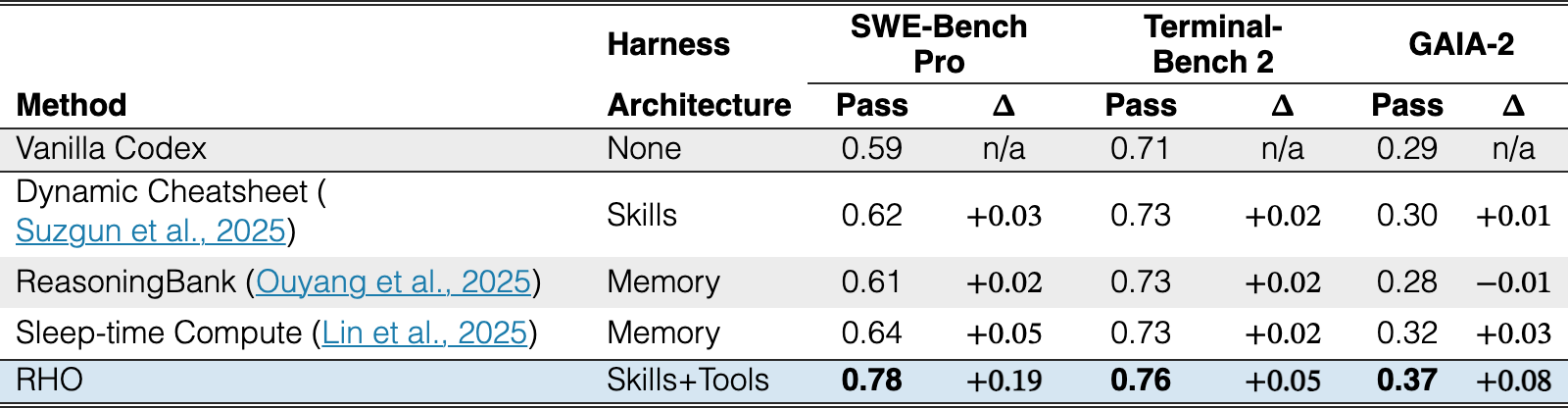
As Table 1 shows, RHO delivers consistent improvements across all three benchmarks, whereas the baselines do not. Most notably, we achieve an absolute improvement of 19% on SWE-Bench Pro without relying on any validation-based grading. We attribute this advantage to the more flexible harness optimization that RHO enables. Specifically, the agent can create new tools, skills, and instructions for the harness, whereas previous methods focus predominantly on memory systems or text-based skills. Furthermore, the use of self-preference may contribute to the consistency of these harness improvements. In contrast, the performance gains of the baseline methods tend to be smaller and vary across different datasets. In the next section (Section 5.2), we examine how RHO modifies the harness to improve the agent.
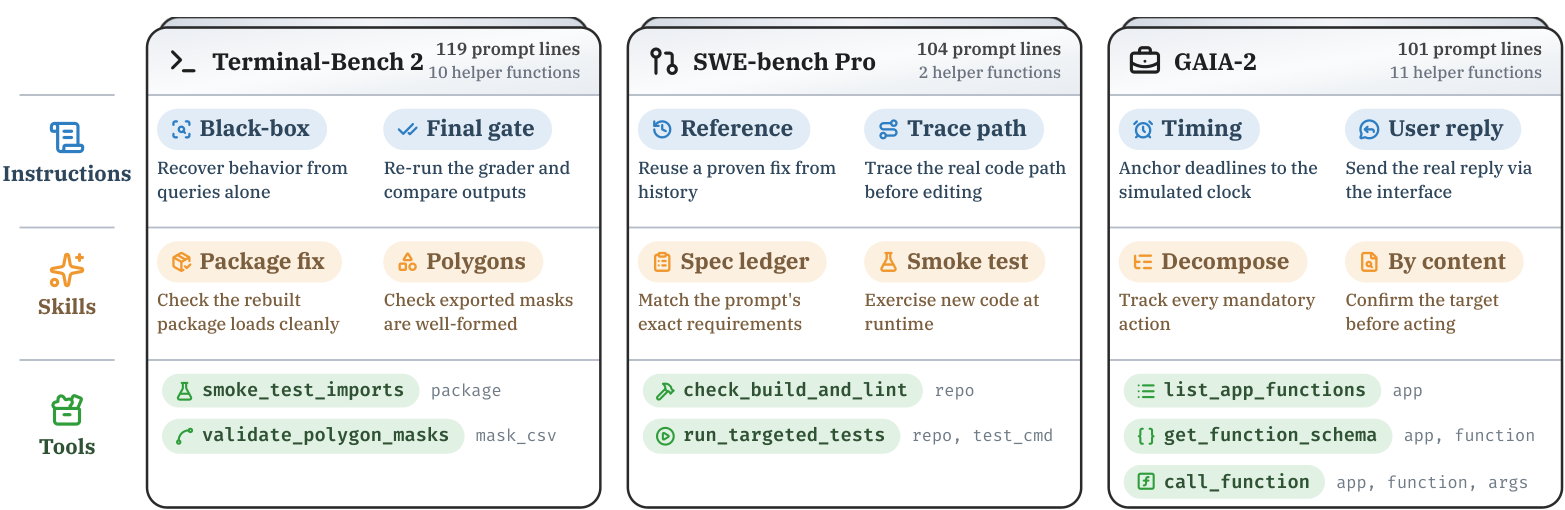
Figure 3 summarizes and interprets the new harness contents generated after RHO optimization. In our work, the harness is materialized as a directory containing markdown files for instructions and skills, as well as executable scripts for tools.
Across all three benchmarks, RHO adds multiple new skills and tools to the harness. Many of these new additions address typical failure modes encountered by the original harness. For example, in SWE-Bench Pro, the agent learns that the Go toolchain resides at a non-standard location outside the default path. It also discovers that Python cache directories must be stripped before producing the final diff, as failing to do so often prevents patches from applying cleanly. To address these, the agent adds a new check_build_and_lint tool that locates non-standard toolchains and flags the generated artifacts that must be kept out of the patch, fixing the diff-hygiene procedures the original trajectories repeatedly missed. These examples illustrate how RHO identifies useful tools and skills across diverse scenarios by analyzing past failures.
We next compare RHO against Meta-Harness (Lee et al., 2026). Meta-Harness is a validation-feedback optimizer: a proposer emits harness edits, each candidate is graded on a labeled search set with the ground-truth grader, and the search keeps the harnesses that score best on that set. To maintain a fair comparison, we use the same Codex agent as the Meta-Harness proposer and solver. Unlike RHO, Meta-Harness requires held-out labels, and because it evolves over multiple rounds, it consumes more agent calls. Therefore, we evaluate it at a single round to match our compute budget, as well as in an extended-budget setting of ten rounds.
| Method | Val. labels | Agent calls | SWE-Bench Pro |
| RHO | none | 103 () | 0.78 |
| Meta-Harness (1 round) | required | 41 () | 0.62 |
| Meta-Harness (10 rounds) | required | 320 () | 0.80 |
View original table

At the matched single-round budget, Meta-Harness selects its best candidate using validation scores but achieves only a 0.62 pass rate on SWE-Bench Pro. This is substantially lower than the 0.78 pass rate achieved by RHO. Scaling Meta-Harness to a 10-round setting increases its performance ceiling to 0.80 on SWE-Bench Pro. However, this higher performance requires roughly three times the optimization-phase compute of RHO (320 vs. 103 agent calls) and, more importantly, still depends on held-out labels that RHO does not use.
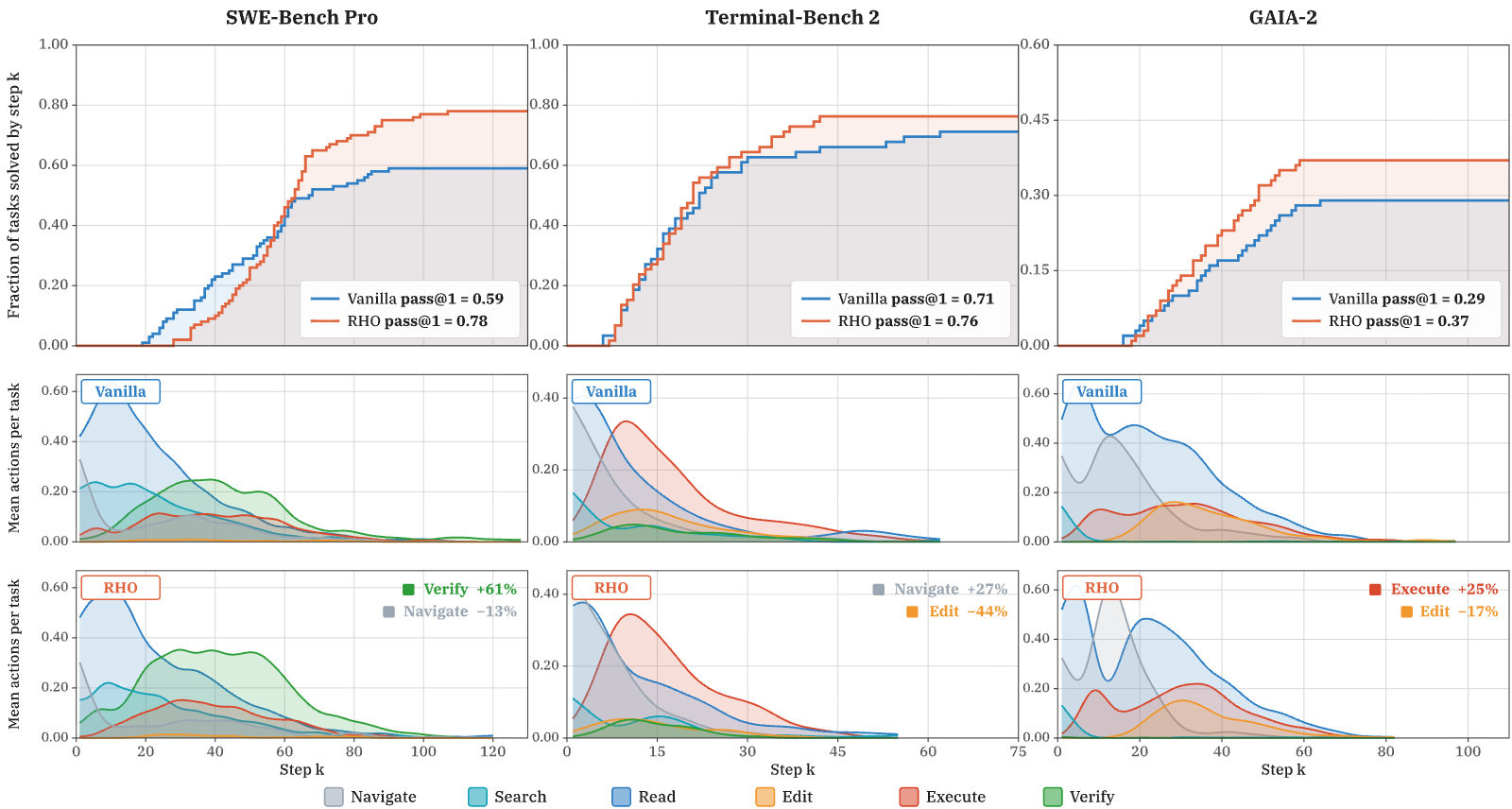
Although RHO creates new skills and tools for the agent, it is not immediately apparent through which mechanisms these updates enable the agent to perform better on future tasks. To examine this, we visualize the frequency of tool calls and the cumulative success rate with respect to the number of steps taken by the agent. Specifically, Figure 4 plots the cumulative fraction of held-out tasks resolved within a given number of agent steps, and it shows how the action mix of the agent changes over time. We observe that the performance improvements across all three datasets primarily originate from higher success rates on tasks requiring long horizons. In contrast, the gains concentrate on long-horizon tasks rather than those completed in fewer steps, most clearly on SWE-Bench Pro. Furthermore, the optimization process changes the working patterns of the agent. Consequently, the optimized agent shifts toward relying more heavily on specific types of actions. For example, on SWE-Bench Pro, the agent verifies its work much more frequently. This proactive verification appears to account for a large portion of the performance gains on long-horizon tasks. On Terminal-Bench 2 and GAIA-2, the agent increases its accuracy by actively applying newly developed tools. The newly added tools are invoked on nearly every held-out task, and on GAIA-2 the new environment helper runs about twenty times per task. Terminal-Bench 2 is an instructive exception—there the generated scripts are never executed, and the gain instead comes from the procedural playbook written into the instructions, showing that RHO adapts the harness surface to each environment rather than always adding executable tools. Complementary to our action-level statistics, token-level attribution over long reasoning chains offers a finer-grained lens on long-horizon agent behavior (Pan et al., 2026b).
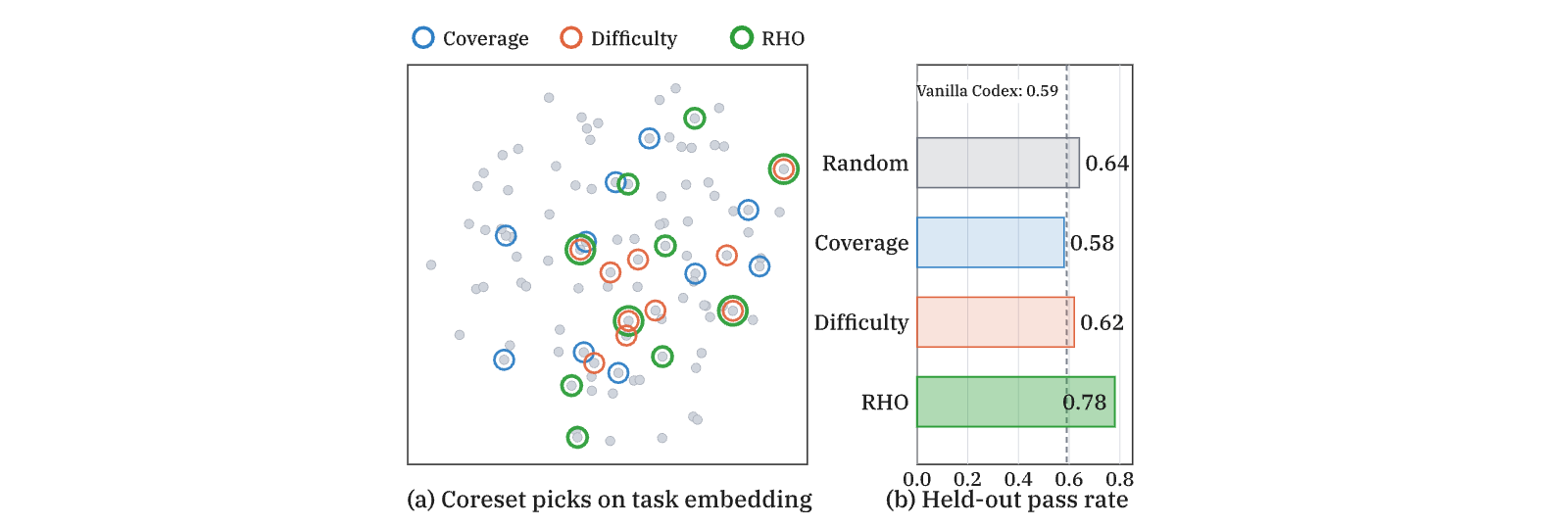


We investigate how coreset selection influences the optimization process. To this end, we compare our DPP-based selection against several ablation strategies. These variants include selecting tasks solely by difficulty (), selecting tasks purely to maximize coverage (), and sampling trajectories randomly. In addition, we measure the final performance of the optimized harness under each selection strategy. As the t-SNE projection of task embeddings in Figure 5 reveals, selecting tasks exclusively by difficulty causes the chosen samples to cluster in a narrow region of the task distribution. This clustering occurs because the language model judges certain types of tasks as inherently more difficult, and consequently it fails to include other task types in the coreset. As a result, this strategy yields no meaningful performance improvement after optimization. Similarly, optimizing solely for coverage also produces suboptimal results. In contrast, random sampling can occasionally select a trajectory that proves useful for optimization. These findings suggest that a coreset selection strategy balancing both difficulty and diversity is vital for providing the proper signals to guide harness optimization.
Because RHO operates without ground-truth labels for reference, we evaluate whether its optimization outputs are consistent across runs. This consistency is closely tied to the overall effectiveness of our best-of- harness proposal. We examine whether the selection strategy reliably identifies the candidate harness that performs best on downstream tasks. In this experiment, we measure the test scores of all three generated candidate harnesses rather than just the most preferred one. Here Table 3 shows that the generated harnesses exhibit only moderate variance. Notably, even the lowest-scoring candidate still meaningfully improves agent performance over the baseline. Furthermore, the best-of- selection prevents the deployment of poorly performing harnesses. Specifically, the chosen harness scores higher than the worst candidate across all three benchmarks. At the same time, the most preferred harness does not invariably coincide with the highest-scoring candidate on the test set, though the selection consistently avoids the worst candidate. Comparing each candidate’s preference score with its held-out pass rate further shows that self-preference is a conservative selector rather than a perfect ranker: on SWE-Bench Pro a less-preferred candidate in fact reached 0.85, above the chosen one’s 0.78. What the mechanism reliably guarantees is safety rather than perfect ranking. Because an update is deployed only when the agent prefers it over the current harness (), the deployed harness never fell below the vanilla baseline on any benchmark; every candidate beats vanilla on SWE-Bench Pro and GAIA-2, and on Terminal-Bench 2 the worst candidate matches vanilla (0.71) while the chosen one reaches 0.76.
We analyze the contribution of the two signals extracted during retrospective analysis, namely self-validation and self-consistency. We compare these explicit signals against a more direct approach that provides raw trajectories during optimization and skips the explicit retrospective analysis step. In addition, we study the individual contribution of each diagnostic signal to the final performance.
To investigate the necessity of the group rollout and diagnostic stages, we conduct an ablation study. Specifically, we remove the self-validation and self-consistency signals independently, and we subsequently rerun the optimization and evaluation procedures. We also introduce a raw trajectory baseline. This baseline bypasses the separate ranking analysis. Instead, it provides the original trajectories directly to the optimization step, asking the agent to analyze the trajectory and propose improvements in a single pass. Table 4 shows that removing either the self-consistency or the self-validation signal consistently degrades final performance across benchmarks. This result indicates that both signals are highly important for optimizing the harness. Additionally, full diagnosis outperforms the simplified raw-trajectory baseline on all three benchmarks. The raw-trajectory baseline grants the proposal agent the same editable surface as RHO—tools, skills, and instructions—so the gap to full diagnosis (0.60 vs. 0.78 on SWE-Bench Pro) reflects the value of the structured retrospective analysis rather than a broader editing surface. This result suggests that although single-pass trajectory analysis is feasible, the explicit self-validation and self-consistency signals are essential rather than incidental, yielding more reliable improvements across datasets. Finally, Table 4 is a controlled ablation that removes one diagnosis cue while holding the rest of the pipeline on a fixed path (), so it measures the marginal contribution of each cue; it should not be read as the end-to-end effect of disabling a signal. To measure run-to-run robustness, we additionally reran the full pipeline end to end twice per ablated strategy, with independently generated candidate sets: every rerun configuration stayed within 0.01–0.03 of its mean ( without self-consistency and without self-validation on SWE-Bench Pro, ), and in no rerun did performance drop to the controlled-ablation level. With this is indicative rather than conclusive, but it shows that the best-of- proposal and the remaining signal compensate when a cue is missing, so removing one component does not destabilize the pipeline.
We introduced RHO, which reframes harness improvement as a retrospective process that an agent can run on its own past experience, rather than a search guided by external ground-truth feedback. The central idea is that an agent’s own trajectories already contain the signal needed to improve it, since re-solving past tasks and comparing the outcomes exposes where the harness fails and what would fix it. Across all three domains (software engineering, technical work, and knowledge work), this self-supervised loop yields consistent held-out gains and reshapes how the agent works. These results are established on a Codex-style CLI agent over a single retrospective round; extending RHO to other backbones and agent frameworks, and to iterative multi-pass optimization, is natural future work. We see RHO as a step toward agents that keep improving from the experience they accumulate in deployment, where labeled data is rare.
In this paper we introduce RHO, a self-supervised method that improves an agent’s harness from its own past trajectories without any external grading. However, operating without ground-truth feedback carries several limitations. First, group rollout replays each coreset task several times, which assumes environments that reset cleanly and tolerate repeated attempts, leaving one-shot or irreversible tasks outside the setting RHO targets. Second, RHO presumes that a meaningful portion of the agent’s competence is mediated by an editable harness of prompts, skills, and tools; our experiments span software engineering, technical work, and knowledge work, and extending RHO to domains with different harness surfaces, task fingerprints, and rollout budgets remains future work. Third, all experiments use a single backbone and agent framework (a Codex-style CLI agent running GPT-5.5). The method’s signals come only from the agent’s own trajectories and pairwise judgments, so it does not inherently depend on this particular backbone, but verifying that it transfers to other backbones and agent frameworks requires further experiments that we leave to future work. Fourth, we evaluate a single retrospective optimization round and make no claim that gains compound or even remain monotonic across multiple rounds; studying iterative, multi-pass RHO over sequential trajectory batches is future work. Fifth, the optimized harnesses are adapted to their own benchmark environment (for example, a repair-verification tool for SWE-Bench Pro versus a procedural playbook for Terminal-Bench 2) rather than forming one universal harness; we leave a formal cross-benchmark transfer study to future work. Sixth, RHO trusts past trajectories as its only optimization input; in open environments trajectories can embed adversarial content injected mid-task (Liu et al., 2026), and harness updates distilled from compromised trajectories could entrench such behavior, reinforcing the audit practices in the Ethics Statement.
RHO modifies persistent agent behavior from model-generated judgments. This can amplify mistaken preferences, unsafe procedures, or biased behavioral rules if the evaluator prefers them. Deployments should keep full audit logs, require human approval for sensitive harness edits, and use domain-specific safety checks before applying accepted harnesses to high-impact tasks.
Every run persists prompts, completions, trajectories, diagnoses, candidate harnesses, harness diffs, configs, scores, run metadata, and held-out reports. The numbers in this draft are direct reads from recorded run reports. A detailed comparison with related work is given in Appendix A, prompts are listed in Appendix B, hyperparameters in Appendix C, full pipeline details in Appendix D, per-dataset specifications in Appendix E, baseline implementations in Appendix F, and per-method optimization-phase compute cost in Appendix G.
This work was supported by the Hong Kong RGC Grant RFS2425-1S01, and was done during the first author’s internship at Microsoft Research Asia.
References
- Agrawal et al. (2025) Lakshya A. Agrawal, Shangyin Tan, Dilara Soylu, Noah Ziems, Rishi Khare, Krista Opsahl-Ong, Arnav Singhvi, Herumb Shandilya, Michael J. Ryan, Meng Jiang, Christopher Potts, Koushik Sen, Alexandros G. Dimakis, Ion Stoica, Dan Klein, Matei Zaharia, and Omar Khattab. 2025. GEPA: Reflective prompt evolution can outperform reinforcement learning. arXiv preprint arXiv:2507.19457.
- Deng et al. (2025) Xiang Deng, Jeff Da, Edwin Pan, Yannis Yiming He, Charles Ide, Kanak Garg, Niklas Lauffer, Andrew Park, Nitin Pasari, Chetan Rane, Karmini Sampath, Maya Krishnan, Srivatsa Kundurthy, Sean Hendryx, Zifan Wang, Vijay Bharadwaj, Jeff Holm, Raja Aluri, Chen Bo Calvin Zhang, and 3 others. 2025. SWE-Bench Pro: Can AI agents solve long-horizon software engineering tasks? arXiv preprint arXiv:2509.16941.
- Farquhar et al. (2024) Sebastian Farquhar, Jannik Kossen, Lorenz Kuhn, and Yarin Gal. 2024. Detecting hallucinations in large language models using semantic entropy. Nature, 630:625–630.
- Froger et al. (2026) Romain Froger and 1 others. 2026. Gaia2: Benchmarking LLM agents on dynamic and asynchronous environments. In International Conference on Learning Representations (ICLR). ArXiv:2602.11964.
- Hu et al. (2024) Shengran Hu, Cong Lu, and Jeff Clune. 2024. Automated design of agentic systems. arXiv preprint arXiv:2408.08435.
- Khattab et al. (2023) Omar Khattab, Arnav Singhvi, Paridhi Maheshwari, Zhiyuan Zhang, Keshav Santhanam, Sri Vardhamanan, Saiful Haq, Ashutosh Sharma, Thomas T. Joshi, Hanna Moazam, Heather Miller, Matei Zaharia, and Christopher Potts. 2023. DSPy: Compiling declarative language model calls into self-improving pipelines. arXiv preprint arXiv:2310.03714.
- Kulesza and Taskar (2012) Alex Kulesza and Ben Taskar. 2012. Determinantal point processes for machine learning. Foundations and Trends in Machine Learning, 5(2–3):123–286.
- Lee et al. (2026) Yoonho Lee, Roshen Nair, Qizheng Zhang, Kangwook Lee, Omar Khattab, and Chelsea Finn. 2026. Meta-Harness: End-to-end optimization of model harnesses. arXiv preprint arXiv:2603.28052.
- Lin et al. (2025) Kevin Lin, Charlie Snell, Yu Wang, Charles Packer, Sarah Wooders, Ion Stoica, and Joseph E. Gonzalez. 2025. Sleep-time compute: Beyond inference scaling at test-time. arXiv preprint arXiv:2504.13171.
- Lin et al. (2026) Minhua Lin, Zhiwei Zhang, Hanqing Lu, Hui Liu, Xianfeng Tang, Qi He, Xiang Zhang, and Suhang Wang. 2026. MemMA: Coordinating the memory cycle through multi-agent reasoning and in-situ self-evolution. arXiv preprint arXiv:2603.18718.
- Liu et al. (2026) Zhichao Liu, Wenbo Pan, Haining Yu, Ge Gao, Tianqing Zhu, and Xiaohua Jia. 2026. WebTrap: Stealthy mid-task hijacking of browser agents during navigation. arXiv preprint arXiv:2605.08310.
- Merrill et al. (2026) Mike A. Merrill, Alexander G. Shaw, Nicholas Carlini, and 1 others. 2026. Terminal-bench: Benchmarking agents on hard, realistic tasks in command line interfaces. In International Conference on Learning Representations (ICLR). ArXiv:2601.11868.
- OpenAI (2025) OpenAI. 2025. OpenAI Codex. https://developers.openai.com/learn/codex. Accessed 2026-08-29.Source
- OpenAI (2026) OpenAI. 2026. Introducing GPT-5.5. https://openai.com/index/introducing-gpt-5-5/.Source
- Ouyang et al. (2026) Siru Ouyang, Jun Yan, Yanfei Chen, Rujun Han, Zifeng Wang, Bhavana Dalvi Mishra, Rui Meng, Chun-Liang Li, Yizhu Jiao, Kaiwen Zha, Maohao Shen, Vishy Tirumalashetty, George Lee, Jiawei Han, Tomas Pfister, and Chen-Yu Lee. 2026. SkillOS: Learning skill curation for self-evolving agents. arXiv preprint arXiv:2605.06614.
- Ouyang et al. (2025) Siru Ouyang, Jun Yan, I-Hung Hsu, Yanfei Chen, Ke Jiang, Zifeng Wang, Rujun Han, Long T. Le, Samira Daruki, Xiangru Tang, Vishy Tirumalashetty, George Lee, Mahsan Rofouei, Hangfei Lin, Jiawei Han, Chen-Yu Lee, and Tomas Pfister. 2025. ReasoningBank: Scaling agent self-evolving with reasoning memory. arXiv preprint arXiv:2509.25140.
- Packer et al. (2023) Charles Packer, Sarah Wooders, Kevin Lin, Vivian Fang, Shishir G. Patil, Ion Stoica, and Joseph E. Gonzalez. 2023. MemGPT: Towards LLMs as operating systems. arXiv preprint arXiv:2310.08560.
- Pan et al. (2026a) Wenbo Pan, Shujie Liu, Xiangyang Zhou, Shiwei Zhang, Wanlu Shi, Mirror Xu, and Xiaohua Jia. 2026a. M⋆: Every task deserves its own memory harness. arXiv preprint arXiv:2604.11811.
- Pan et al. (2026b) Wenbo Pan, Zhichao Liu, Xianlong Wang, Haining Yu, and Xiaohua Jia. 2026b. Towards long-horizon interpretability: Efficient and faithful multi-token attribution for reasoning LLMs. arXiv preprint arXiv:2602.01914.
- Pan et al. (2025) Wenbo Pan, Jie Xu, Qiguang Chen, Junhao Dong, Libo Qin, Xinfeng Li, Haining Yu, and Xiaohua Jia. 2025. Can LLMs refuse questions they do not know? Measuring knowledge-aware refusal in factual tasks. arXiv preprint arXiv:2510.01782.
- Shao et al. (2024) Zhihong Shao, Peiyi Wang, Qihao Zhu, Runxin Xu, Junxiao Song, Xiao Bi, Haowei Zhang, Mingchuan Zhang, Y. K. Li, Y. Wu, and Daya Guo. 2024. DeepSeekMath: Pushing the limits of mathematical reasoning in open language models. arXiv preprint arXiv:2402.03300.
- Suzgun et al. (2025) Mirac Suzgun, Mert Yuksekgonul, Federico Bianchi, Dan Jurafsky, and James Zou. 2025. Dynamic cheatsheet: Test-time learning with adaptive memory. arXiv preprint arXiv:2504.07952.
- Wang et al. (2022) Xuezhi Wang, Jason Wei, Dale Schuurmans, Quoc Le, Ed Chi, Sharan Narang, Aakanksha Chowdhery, and Denny Zhou. 2022. Self-consistency improves chain of thought reasoning in language models. arXiv preprint arXiv:2203.11171.
- Wu et al. (2026) Zihan Wu, Jie Xu, Yun Peng, Chun Yong Chong, and Xiaohua Jia. 2026. MulVul: Retrieval-augmented multi-agent code vulnerability detection via cross-model prompt evolution. In Proceedings of the Annual Meeting of the Association for Computational Linguistics (ACL).
- Xiao et al. (2023) Shitao Xiao, Zheng Liu, Peitian Zhang, Niklas Muennighoff, Defu Lian, and Jian-Yun Nie. 2023. C-Pack: Packed resources for general chinese embeddings. arXiv preprint arXiv:2309.07597.
- Xu et al. (2025) Jie Xu, Zihan Wu, Cong Wang, and Xiaohua Jia. 2025. LiveVal: Real-time and trajectory-based data valuation via adaptive reference points. In Proceedings of the ACM International Conference on Information and Knowledge Management (CIKM).
- Yang et al. (2023) Chengrun Yang, Xuezhi Wang, Yifeng Lu, Hanxiao Liu, Quoc V. Le, Denny Zhou, and Xinyun Chen. 2023. Large language models as optimizers. arXiv preprint arXiv:2309.03409.
- Yuksekgonul et al. (2024) Mert Yuksekgonul, Federico Bianchi, Joseph Boen, Sheng Liu, Zhi Huang, Carlos Guestrin, and James Zou. 2024. TextGrad: Automatic “differentiation” via text. arXiv preprint arXiv:2406.07496.
- Zhou et al. (2022) Yongchao Zhou, Andrei Ioan Muresanu, Ziwen Han, Keiran Paster, Silviu Pitis, Harris Chan, and Jimmy Ba. 2022. Large language models are human-level prompt engineers. arXiv preprint arXiv:2211.01910.
| Satisfies RHO’s setting | ||||||
| Method | Harness architecture | Feedback signal | Cost | Label- free | Full harness | Single pass |
| Validation-feedback optimization | ||||||
| OPRO (Yang et al., 2023) | Prompt | Validation metric | Iterative search | ○ | ○ | ○ |
| DSPy (Khattab et al., 2023) | Prompt demos | Validation metric | Iterative search | ○ | ○ | ○ |
| TextGrad (Yuksekgonul et al., 2024) | Prompt | Textual gradient | Iterative search | ○ | ○ | ○ |
| GEPA (Agrawal et al., 2025) | Prompt | Val. metric reflection | Iterative (genetic) | ○ | ○ | ○ |
| ADAS (Hu et al., 2024) | Full agent code | Validation accuracy | 25–30 iter. | ○ | ● | ○ |
| Meta-Harness (Lee et al., 2026) | Full harness code | Search-set score | 20 iter. | ○ | ● | ○ |
| Experience-based self-improvement | ||||||
| Dynamic Cheatsheet (Suzgun et al., 2025) | Cheatsheet text | Self-judgment | Online stream | ● | ◐ | ○ |
| ReasoningBank (Ouyang et al., 2025) | Memory items | LLM-as-judge | Online stream | ● | ○ | ○ |
| MemMA (Lin et al., 2026) | Memory entries | Synthetic probe QA | Online (session) | ● | ○ | ○ |
| Sleep-time Compute (Lin et al., 2025) | Input context | None | Precompute | ● | ○ | ● |
| SkillOS† (Ouyang et al., 2026) | Skill list | RL reward† | RL training | ◐ | ◐ | ○ |
| RHO (ours) | Tools skills instr. | Self-preference | Single pass | ● | ● | ● |
View original table
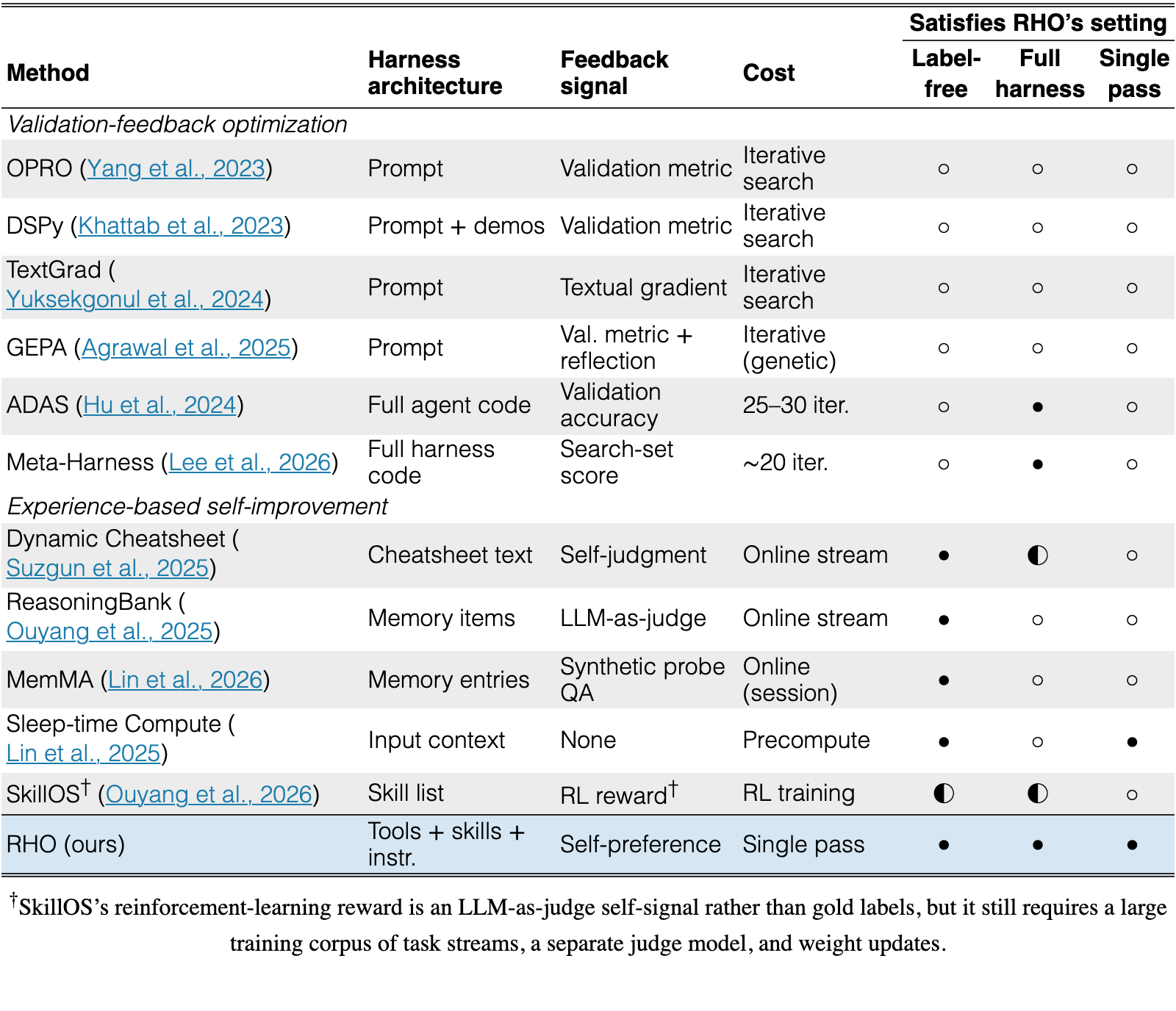
Table 5 compares RHO with the prior methods discussed in Section 2. For each method we report the harness surface it edits, the feedback signal that drives it, and the cost regime it incurs, and we mark whether it meets RHO’s setting on three criteria, namely whether optimization is label-free, whether it edits the full harness, and whether it runs as a single offline retrospective pass. Validation-feedback optimizers reach the full-harness end of the surface axis, where ADAS and Meta-Harness rewrite executable code, but every member of this family steers the search with a ground-truth metric and iterates against it. Experience-based methods drop the labels, yet they only curate memory or skill text online and leave the executable harness untouched, while Sleep-time Compute precomputes context offline but optimizes nothing. As a result, each prior method satisfies at most two of the three axes, and RHO is the only entry that satisfies all three at once.
This appendix collects the prompts that instantiate the five agent operators of RHO (§3, Algorithm 1, Figure 2), namely , the difficulty judge used in Coreset Selection, the diagnosis analysis, , and . The prompts are reproduced verbatim. Placeholders of the form {name} are filled at call time with the values described under each block.
Every call materializes the harness and the task into a fresh workspace at harness/ and task/ and hands the agent the wrapper instructions below. The wrapper is task-agnostic, in that the harness directory carries all task-shaping guidance, and the agent is told only how to read the workspace and how to deliver a final answer. The same wrapper is reused for the baseline rollout and for every candidate-harness rollout so that is the only varying input.
The difficulty judge produces the score and the abstract fingerprint that drive the DPP coreset selector of §4.1. It sees the task description together with a length-bounded digest of one short prior trajectory under the current harness. The digest is truncated head/tail to a fixed token budget, and any commands that read the task’s expected-answer files are scrubbed before the digest is shown to the judge. The judge is asked to keep the fingerprint in task-agnostic structural vocabulary so that fingerprints from different codebases remain comparable under cosine similarity.
{query} is the natural-language task description. {trajectory_digest} is the scrubbed, head/tail-truncated digest of one prior trajectory for the same task. This difficulty value is the score that enters the DPP kernel, where it is normalized by as in §4.1, and the fingerprint is embedded to a unit vector that defines the similarity matrix .
The diagnosis prompt implements (§4.2). The workspace presents the agent with the original task, the shared harness used by every rollout, and rollout directories. The agent executes a five-step workflow, comprising per-trajectory inspection, failure-mode analysis (self-validation), cross-trajectory disagreement analysis (self-consistency), a single high-level harness improvement direction, and a severity score that doubles as a soft attention weight downstream. The structured JSON output binds each field to a fixed slot so can attend by severity.
The trajectory directories carry the full event stream, the agent’s final message, and any workspace diff produced by the rollout. The self-validation and self-consistency ablations in Table 4 remove the corresponding step and the corresponding output field, and the surrounding scaffolding is left intact.
The optimization prompt implements (§4.3). The editor agent is given write access to a fresh copy of the harness and a directory of per-task diagnoses sorted by severity. The instruction frames severity as a soft attention weight, requires cross-task pattern matching before any edit, and discourages task-specific hardcoded fixes. Each of the candidates is sampled independently with the same prompt, and randomness from the underlying agent supplies the diversity.
Each diagnoses/task_XXXX/ subdirectory holds the serialized diagnosis JSON rendered as Markdown alongside the original task prompt. Subdirectories are indexed in descending severity so the agent encounters the most consequential diagnoses first.
The ranking prompt implements used in Best-of- acceptance (§4.3 and Algorithm 1). The evaluator sees the task, the two harnesses, and the two trajectories. The candidate trajectory is presented as trajectory_A and the baseline as trajectory_B, and the orchestrator negates the returned integer so the scalar score is oriented as baseline candidate regardless of presentation order. Presenting the candidate first reduces a later-option preference bias we observed in pilot runs. The rubric below uses an integer scale in , and downstream only the sign and relative magnitude of the score are used (§3).
The candidate score in Algorithm 1 averages this integer (with the orientation flip described above) over the coreset , and the candidate is accepted only when , otherwise the harness remains at .
Table 6 lists every hyperparameter and infrastructure setting used in our experiments. Values already reported in the main text (Section 3 and Section 5.1) are reproduced here for convenience, and values not previously stated are introduced here. The intent is an audit-ready specification, with one column per parameter, one value per cell, and no defaults left implicit. Dataset-specific overrides on solver wall-clock and grading are deferred to Appendix E, and prompt text for every agent role is in Appendix B.
| Parameter | Value | Description |
| Backbone agent | ||
| Model† | Codex gpt-5.5 | Shared across solve, optimize, and rank. |
| Reasoning effort† | high | Applied to all roles uniformly. |
| Sampling temperature | provider default | Codex reasoning models do not expose temperature. |
| Provider | Cloud-hosted gpt-5.5 (Codex CLI) | Single hosted endpoint. |
| Coreset selection | ||
| Selector | DPP, greedy MAP | Kulesza and Taskar (2012). |
| Coreset size † | 10 | Train tasks. |
| DPP weight † | 0.7 | Difficulty/diversity tradeoff. |
| Score floor | 0.1 | Lower bound on normalized difficulty. |
| Judge model | Codex gpt-5.5, high | Same backbone as the solver. |
| Trajectory-digest budget | 10,000 BPE tokens, head/tail truncation | Ground-truth-revealing commands scrubbed. |
| Fingerprint embedding | BAAI/bge-large-en-v1.5, 1024-d | Executed locally (Xiao et al., 2023). |
| Group rollout | ||
| Rollouts per task | 3 | Parallel solves under per coreset task. |
| Solve wall-clock timeout | 900 s | Dataset overrides in Appendix E. |
| Diagnosis prompt | see Appendix B | Self-validation self-consistency cues. |
| Severity range | Soft attention weight, not a hard threshold. | |
| Best-of- harness proposal | ||
| Candidates † | 3 | Parallel optimizer samples. |
| Optimizer prompt | see Appendix B | Conditioned on . |
| Ranking timeout | 300 s per pairwise call | Per . |
| Acceptance threshold | (strict) | Mean pairwise score over the coreset. |
| Infrastructure | ||
| Agent-call concurrency | 10 concurrent calls (cap 30) | Parallelism for Table 1 runs. |
| Rounds per experiment | 1 | Unless stated otherwise. |
| Persistence | full logs to disk | Prompts, completions, trajectories, diagnoses, |
| candidate harnesses, diffs, scores, run summaries. | ||
View original table
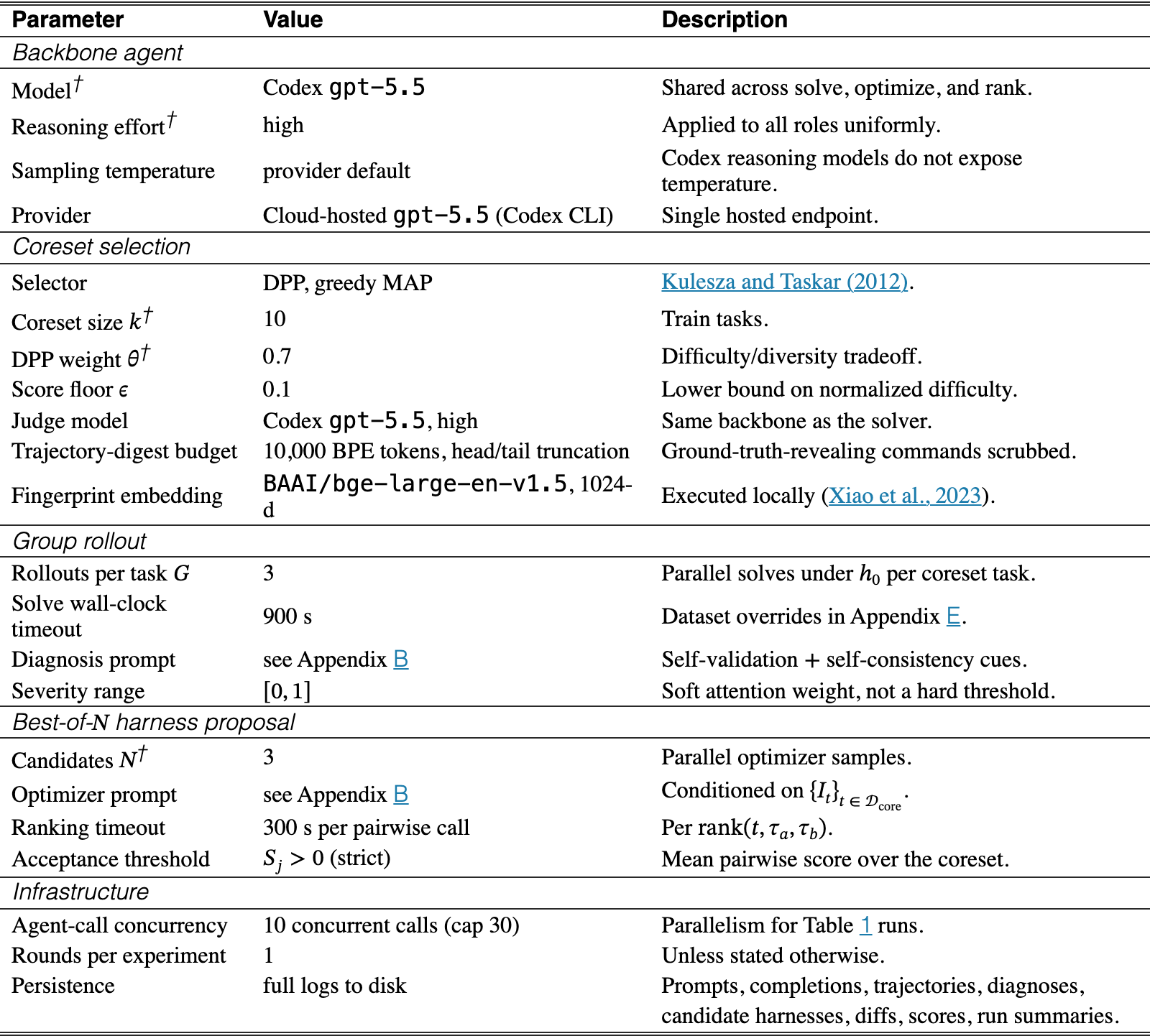
Several choices in Table 6 warrant brief justification. We set because three rollouts are enough for the diagnosis prompt to surface cross-trajectory disagreements, and pilots with larger inflated cost linearly without sharpening the diagnosis signal. We weight the DPP at so that difficulty dominates diversity, on the principle that an unselected easy task carries less optimization signal than a redundant hard one. Concretely, enters through the difficulty weights with , and the factor of two offsets the difficulty term’s doubled appearance in , so that and weight the difficulty and diversity terms directly. We make the acceptance gate strictly positive rather than non-negative because pairwise self-preference is a noisy estimator, and breaking ties in favor of change would inflate regression risk for no expected gain. Finally, we use the same Codex gpt-5.5 backbone for solver, optimizer, and ranker, since decoupling the solver from the judge would introduce a confound where measured held-out gains could be attributed to a stronger judge rather than to RHO itself. Per-dataset configuration overrides referenced above are in Appendix E, and baseline-specific configurations are in Appendix F.
This appendix documents the design choices that govern RHO’s behavior but do not appear in §4 or Algorithm 1. The equations and operator signatures are fixed by the main text, and what follows are the mechanics that make them executable.
A harness is a directory of files with no fixed schema, where prose instructions, executable scripts, and structured configuration sit side by side. At every operator call the harness is materialized as a subdirectory of the agent’s working directory, and the agent reads it the same way it reads task files rather than as a system-prompt prefix. The operator mounts the harness read-only by convention, while mounts a fresh copy with write access and accepts whatever the agent leaves behind on the filesystem. Harnesses are compared by content, so if returns a harness identical to the input, the candidate is treated as a no-op and dropped before evaluation. This keeps the harness surface tool-agnostic and lets the optimizer extend any of the three file kinds without a representation change.
The same backbone executes , the diagnosis analysis (/), , and . Role separation is achieved by workspace contents rather than by changing the backbone, where each operator runs in a fresh workspace that contains only the inputs it should see. sees the task files and the current harness. The diagnosis analysis sees the task and the group of trajectories for that task. sees the harness directory, the diagnosis instructions, and the trajectory rollouts that motivated them. Finally, sees the task, two trajectories, and both candidate harness directories side by side. Per-role ablation therefore amounts to swapping prompts and inputs, not models, which keeps the operators directly comparable.
is invoked once per (task, candidate) pair. We present the candidate trajectory first and the baseline trajectory second, then negate the parsed scalar. This swap is a standard mitigation for position bias in pairwise judges, applied without per-call order randomization. The judge is constrained to return a single integer in with a one-sentence rationale, and we do not retry. Any parse or execution failure deterministically yields zero. This makes a strict pessimist, since silent failures pull the mean toward the rejection threshold rather than away from it.
The diagnosis analysis consumes the full group of rollouts for one task and produces a single textual instruction with a severity weight, whereas is strictly pairwise. We do not collapse a group into a Bradley–Terry score for evaluation. For each candidate, we pair the candidate’s rollout of a task against a fixed baseline trajectory drawn from the original group, and we hold this baseline constant across every candidate so the comparison stays anchored to the same reference. The consequence is that enters the pipeline as a diagnostic device only, since it sharpens the instruction through cross-trajectory inconsistency but does not vote on which candidate wins.
is a code-agent invocation, not a constrained text rewriter. It sees the materialized harness as a filesystem and may add, remove, or modify any file inside it. We hand it the diagnosis instructions sorted by descending severity, with severity exposed as a soft attention weight in rather than a hard priority queue, so the agent can still merge or skip suggestions that conflict. We do not parse a diff out of the agent’s final message, and the new harness state is recovered from the directory itself when the call returns. This keeps the action space identical to the representation, where anything that fits in a directory is a valid edit.
An update is accepted only when the best candidate’s mean pairwise score over the coreset is strictly positive, and a mean of zero is rejected. Before the gate, a candidate is dropped if the optimizer failed, the call timed out, or the produced harness is identical to the input. If every candidate is dropped, or every surviving candidate scores , RHO leaves the harness unchanged. This no-update behavior is part of the result rather than a tooling failure. In Figure 5, selectors whose coreset fails to expose useful weaknesses (pure coverage, pure difficulty) leave held-out accuracy near the Vanilla Codex baseline.
We persist the input harness id, along with the trajectories produced by each operator (, the diagnosis analysis, , and ) identified by id. We further persist the diagnosis instruction, the candidate harness ids together with their diffs against the input, the per-candidate pairwise scores, the mean pairwise score, and the accept flag. Every stored trajectory carries its full event stream, final message, workspace diff, and wall-clock time. These records are what makes downstream audit, re-grading, and ablation possible without re-running the agent.
This appendix documents what we take from each upstream benchmark, how we split it, what the agent sees at solve time, and how grading runs. Pinned upstream commits make the partition and grader reproducible from a clean checkout.
SWE-Bench Pro (Deng et al., 2025) is the long-horizon software-engineering benchmark in our suite. Tasks resolve only when a multi-file patch passes the upstream test set, and failure modes are therefore concrete and traceable to the harness’s repository conventions and build commands.
Source. We load the test split of ScaleAI/SWE-bench_Pro from Hugging Face. Evaluator scripts and per-instance Docker images come from the official scaleapi/SWE-bench_Pro-os repository, pinned to a fixed commit.
Split. Rows are ordered by the SHA-256 hash of (seed, instance_id) with the seed fixed. The first 100 form the training pool and the next 100 the held-out test pool, and the remaining rows are unused. We report on the held-out test pool.
Solve interface. Each task materializes a prompt file describing the issue plus a fresh clone of the upstream repository at its base commit, mounted in the workspace. The agent edits repository files in place, and no extra tools are injected.
Grading. We extract the agent’s patch by re-applying its workspace edits to a fresh checkout and taking git diff --binary. If the workspace path fails, we fall back to scanning the agent’s final message for fenced diff blocks. Binary hunks and auto-generated paths (dependency, cache, and build directories) are stripped before scoring. The patch is then applied inside the official per-instance Docker image distributed by the SWE-Bench Pro authors, and the official run and parser scripts are invoked. A task passes iff every FAIL_TO_PASS and PASS_TO_PASS test resolves correctly. The Docker wall-clock budget is one hour per task.
Terminal-Bench 2 (Merrill et al., 2026) contains executable command-line tasks. Failure is a missed reward, not a missed convention, so the harness mostly buys consistency in how the agent inspects state and chains commands.
Source. We use the upstream Terminal-Bench 2 repository at a fixed commit, yielding 89 tasks.
Split. Tasks are hash-ordered with the same seeded scheme as SWE-Bench Pro. The first 30 form the training pool, the remaining 59 the held-out pool.
Solve interface. Each task spins up a fresh Docker container whose image is declared by the task. Containers carry a cleanup label and per-task CPU and memory limits. The agent’s host workspace is bind-mounted inside the container. The solve prompt instructs the agent to author shell scripts on the host and execute them inside the container. A wall-clock watchdog terminates the container when the task’s declared agent timeout elapses.
Grading. We run the task’s upstream test suite inside the still-running container under its declared verifier timeout. The verifier writes a reward of 0 or 1 to a known path. A task passes iff the reward equals 1. We apply no difficulty filter, so held-out numbers span the upstream difficulty mix.
Data integrity. The solve prompt instructs the agent not to read the test directory, the upstream solution, or the verifier log. This is a prompt-level convention, not a sandbox restriction. We document it for transparency, since a sufficiently adversarial agent could read the verifier and game the reward. We rely on the held-out pool and Table 1’s cross-benchmark consistency to detect such behavior, and we have not observed it.
GAIA-2 (Froger et al., 2026) differs from the two coding benchmarks in that the environment evolves independently of the agent. The harness layer therefore has to encode behavior under partial observation and asynchronous events, not just stable build conventions.
Source. We load the validation split of the GAIA-2 release on Hugging Face under the mini configuration, yielding 200 scenarios. Each scenario ships an asynchronous event stream and an upstream write-action verifier.
Split. Scenarios are hash-ordered with the same seeded scheme. The first 100 form the training pool, and the remainder, 100, form the held-out pool. We report on the held-out slice.
Solve interface. Each scenario’s workspace contains a task prompt, a tool dispatcher, and a tool catalog. The agent invokes tools through a single shell command per call. The dispatcher relays each call to a sidecar process running the upstream environment, which advances simulated time and replays scheduled events. The scenario’s ground-truth state is held entirely by the sidecar, and the agent never reads it.
Grading. When the agent finishes, the sidecar invokes the scenario’s upstream verifier. The judge LLM is the same Codex gpt-5.5 backbone we use elsewhere, and routing defaults to the same Azure Foundry endpoint. A scenario passes iff the upstream verifier reports success.
Environment modifications. Two changes to the upstream environment affect reported numbers and must be disclosed. First, the upstream cap of one send_message_to_user call per turn is raised to four, since the original cap penalizes verbose agents that would otherwise complete the task correctly. Second, three optional judge-relaxation switches (event filtering, relaxed per-app UI judging, and trivial filesystem-read filtering) are available as ablation axes but are all disabled in the experiments reported in Table 1.
Every baseline runs under the same Codex gpt-5.5 backbone at high reasoning effort. The trajectory-only family (Dynamic Cheatsheet, ReasoningBank, and Sleep-time Compute) shares RHO’s Coreset Selection budget of 10 training tasks and 3 candidates. Baselines differ only in what the offline phase persists and how the solver consumes it. This appendix documents each.
Dynamic Cheatsheet curates a running list of reusable facts and procedures harvested from past trajectories.
Persistence layer. A single markdown file lives inside the harness, structured as <memory_item> blocks containing a description, a worked example, and a usage count.
Offline phase. A curator agent iterates over the selected training tasks in order. For each task it reads the current cheatsheet plus the solve transcript and rewrites the cheatsheet in place.
Online consumption. The cheatsheet is part of the harness, and the solver reads it as part of normal harness lookup. No additional prompt prefix is injected.
Faithfulness. Upstream Dynamic Cheatsheet updates the cheatsheet after every task, so the next task’s solver sees the update. Our default configuration runs solves for all selected training tasks before invoking the curator, then commits one cheatsheet. The single-task configuration that matches the upstream per-example update is available as a sensitivity setting, while Table 1 uses the default.
ReasoningBank stores reusable reasoning patterns extracted from past trajectories and retrieves them on demand at inference time.
Persistence layer. A JSONL bank of items, each with title, description, body, and a precomputed embedding. The bank lives outside the harness directory because solve-time access is by similarity retrieval, not by harness materialization.
Offline phase. For each selected training task we solve it, ask the judge whether the trajectory was successful, then run an extraction prompt that distills reusable reasoning patterns from the trajectory. Extracted items are appended to the bank, and embeddings are computed locally.
Online consumption. At each held-out solve, we encode the task description with the same encoder, retrieve the top- items by cosine similarity, render them as a memory preamble prepended to the solve instructions. Top- is fixed at 1.
Faithfulness. We replace the upstream Gemini embedding with BAAI/bge-large-en-v1.5 (Xiao et al., 2023), a 1024-dimensional locally executed sentence encoder, so that every baseline that uses retrieval shares the same encoder, dimensionality, and storage backend. This removes a confound between memory-bank quality and embedding-provider quality.
Sleep-time Compute preprocesses past traces into compact notes that are prepended to the agent’s context at inference time, following the Letta implementation (Packer et al., 2023).
Persistence layer. A set of bounded markdown memory blocks stored inside the harness, edited with structured edit tools (insert, replace, rethink, finish) that mirror upstream Letta semantics.
Offline phase. A sleep-time agent iterates over the selected training tasks. For each task it reads the task’s prompt and trajectories, then issues a sequence of memory-edit tool calls to update the harness’s memory blocks. The system prompt is the upstream Letta system prompt, used verbatim.
Online consumption. The solver reads the memory blocks as part of the harness, the same way it reads any harness file.
Scope. Edits accumulate across tasks, and the sleep-time agent works against a single evolving memory state task after task. We do not reset memory between training tasks.
Meta-Harness is the validation-feedback reference, where a meta-agent rewrites the harness, and the rewrites are scored against a labeled validation set.
Persistence layer. A sequence of candidate harness directories paired with a search history recording per-candidate validation pass rates.
Offline phase. An outer loop alternates between a proposer that reads the search history and emits a new harness, and an evaluator that grades the proposed harness on the search-task set using the dataset’s ground-truth grader. Our re-implementation’s default budget is 20 outer iterations 3 candidates per iteration 2 solve trials per task, far above the budget we give RHO; upstream reports evaluating roughly 60 candidate harnesses over 20 iterations.
Validation-feedback footprint. The proposer reads each candidate’s per-task scores, mean score, and pass rate from the history, and the grader signal directly shapes the next proposal. This is the hallmark of the validation-feedback family and the axis along which Meta-Harness is incomparable to the trajectory-only baselines.
Matched-budget configuration. For Table 2 we run the outer loop for one iteration with 3 candidates and 1 solve trial per task, so the candidate count matches RHO’s . The validation-grade cost is what Table 2 reports.
Shared configuration. All four baselines and RHO start from the same empty harness for a given dataset, use the same coreset of selected training tasks, and are graded against the same held-out split with the same grader. The only deliberate axis of variation is what the offline phase persists and how the solver consumes it. Meta-Harness additionally consumes validation grades, and this is the axis Table 2 measures.
| Method | rollout | diagnose | optimize | after | rank | test | total | llm |
| Vanilla Codex | 0 | 0 | 0 | 0 | 0 | 100 | 100 | 0 |
| ReasoningBank (Ouyang et al., 2025) | 10 | 0 | 0 | 0 | 0 | 100 | 110 | 20 |
| Dynamic Cheatsheet (Suzgun et al., 2025) | 30 | 0 | 10 | 10 | 10 | 100 | 160 | 0 |
| Sleep-time Compute (Lin et al., 2025) | 30 | 0 | 30 | 30 | 30 | 100 | 220 | 0 |
| RHO | 30 | 10 | 3 | 30 | 30 | 100 | 203 | 0 |
View original table

This appendix documents the optimization-phase compute cost of RHO and the baselines reported in Table 1 and Table 2. We report the numbers without claiming an efficiency advantage. Among the trajectory-only methods at matched coreset budget (, ), RHO sits in the same order of magnitude as Sleep-time Compute and Dynamic Cheatsheet, and is more expensive than ReasoningBank. The matched-budget Meta-Harness configuration is the only baseline whose cost is qualitatively different, and its upstream-default budget would be larger still, as we discuss at the end.
Every method dispatches two kinds of model calls during the offline phase, plus the same per-task solve at evaluation time. We count them separately because they go through different backends and have different unit costs.
Codex (agent) invocations. One Codex CLI subprocess that runs to completion is one agent invocation. Each invocation persists a trajectory directory recording the role (one of solve, diagnose, optimize, rank), the harness id, the task id, the wall-clock duration, and the exit status. We obtain the per-method totals by counting these directories.
Auxiliary LLM calls. A single direct API call to the same gpt-5.5 backbone, issued outside the Codex CLI. Only ReasoningBank uses these in the offline phase, namely two per training task, for success judgment and memory-item extraction. Coreset selection also issues one auxiliary LLM call per candidate task before any method starts. This cost is shared across methods at matched coreset and is reported once at the end of this appendix.
Embedding calls. ReasoningBank and DPP coreset selection both call BAAI/bge-large-en-v1.5 (Xiao et al., 2023) for fingerprint or query embedding. We execute the encoder locally, so these calls do not hit a remote endpoint and are not aggregated with the LLM totals.
Table 7 breaks down the optimization phase on SWE-Bench Pro ( train tasks, held-out tasks) into agent invocations by role. Terminal-Bench 2 differs only in , while GAIA-2 matches SWE-Bench Pro.
The table is a literal accounting of how each method spends its offline budget. ReasoningBank issues one solve per training task and never proposes a candidate harness, so the offline phase costs only extra Codex invocations on top of the held-out evaluation, and its auxiliary LLM calls are the success judge and the memory-item extractor. Dynamic Cheatsheet and Sleep-time Compute both roll out each training task times to surface variance, then run an optimizer agent. Dynamic Cheatsheet invokes a single curator over all tasks ( candidate), while Sleep-time Compute runs one edit pass per task per restart (3 restarts tasks optimize calls). Both then commit each unique candidate harness through the after-solve and pairwise-rank steps shared with RHO. RHO’s footprint differs from Sleep-time Compute’s only by trading per-task optimize calls for diagnose calls plus the candidate-level optimize calls in the best-of- proposer, and the after-solve and rank phases are identical at candidates.
Table 8 reports two complementary wall-clock measurements per (method, dataset) cell. is the sum of per-invocation wall-clock over every agent invocation in the run, and it is the cost of running the same workload serially on one agent process. End-to-end is the elapsed time from the run’s start to its completion, under our infrastructure setting of 10 concurrent agent calls and 10 concurrent graders. The ratio between the two columns reflects how much of the workload was successfully parallelized, where the trajectory-only methods reach – speedup, while ReasoningBank reaches – because its offline phase is sequential by construction (each training task’s solve must commit to memory before the next task’s retrieval). Meta-Harness is a validation-feedback rather than a trajectory-only method, so we report its budget separately in §G.4, not here.
| SWE-Bench Pro | Terminal-Bench 2 | GAIA-2 | ||||
| Method | end-to-end | end-to-end | end-to-end | |||
| Vanilla Codex | 9.4 | 1.1 | 4.3 | 0.6 | 4.2 | 0.6 |
| ReasoningBank (Ouyang et al., 2025) | 17.5 | 4.6 | 8.0 | 2.4 | 7.2 | 2.0 |
| Dynamic Cheatsheet (Suzgun et al., 2025) | 17.9 | 2.5 | 10.8 | 1.9 | 6.5 | 1.2 |
| Sleep-time Compute (Lin et al., 2025) | 22.2 | 3.2 | 14.5 | 2.2 | 7.0 | 1.2 |
| RHO | 23.1 | 3.2 | 15.5 | 2.5 | 9.2 | 1.4 |
View original table
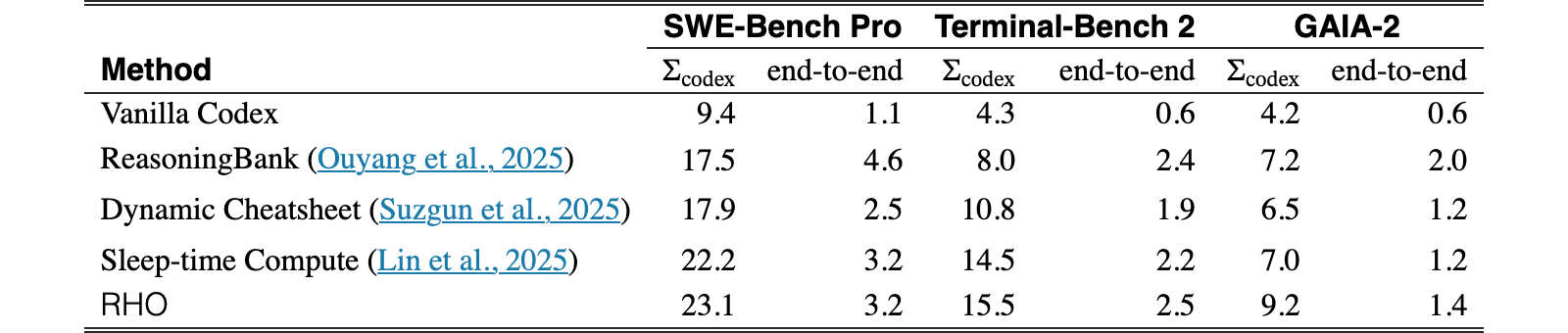
Two observations are worth stating explicitly. First, per-invocation cost varies by more than across datasets (GAIA-2 averages around s per invocation, Terminal-Bench 2 around s, SWE-Bench Pro around s), so an agent-call count is informative only within a dataset, and cost cannot be compared across datasets by summing invocation counts alone. Second, at matched coreset and , RHO is within of Sleep-time Compute on every dataset, more expensive than Dynamic Cheatsheet (which uses ), and substantially more expensive than ReasoningBank (which performs no group rollout, no candidate proposal, no pairwise rank).
Meta-Harness has a qualitatively larger compute footprint because validation grades feed back into the proposer. At its upstream default ( outer iterations, candidates per iteration, solve trials per task) the offline phase alone would cost agent invocations on SWE-Bench Pro — nearly twelve times RHO’s optimization-phase count of . The matched-budget configuration we report in Table 2 reduces this to , , , amounting to optimization-phase invocations; this is the configuration whose held-out pass rate ( on SWE-Bench Pro) is reported alongside RHO’s in the main text. The 10-round configuration reported in the same table keeps , but raises to , giving optimization-phase invocations ( RHO’s optimization-phase count of ). These counts exclude the shared held-out evaluation, which every method pays once regardless of optimizer. Because Meta-Harness is a validation-feedback rather than a trajectory-only method, it is not included in the wall-clock comparison of Table 8.
Coreset selection runs once before any method’s offline phase begins. For SWE-Bench Pro this consumes auxiliary LLM calls (one difficulty judgment per candidate task) plus one batched embedding call over the same fingerprints, after which the selected task ids are persisted and reused verbatim by every baseline. This cost is paid once per dataset and is not attributed to any individual method.
This appendix reproduces, verbatim, the complete contents of the highest-scoring harness RHO produced on each benchmark, i.e. the harnesses summarized in Figure 3. Each harness is a directory of Markdown instruction and skill files together with executable tool scripts; every file is shown in full, with no abridgement. Files are grouped by benchmark and labeled with their path inside the harness directory and their role (instruction, skill, or tool).