MiMo-V2.6: Scaling Reinforcement Learning Towards Self-Improvement
arXiv:2610.11959v1 · This workspace stays on this version. Check arXiv for newer versions
Some source details need review 4 to check
Original formulas, table values and figures are preserved. Comparison can miss differences; use the original PDF to check details.
Reading view checked: 165 math expressions, 1 rendering failures; 15 of 16 images available.
Compared 107 of 107 source passages against 37 of 43 PDF pages.
- Some figure, table or graphic images are unavailable; the original paper is still accessible. (1)
- Some formulas could not be rendered; their original TeX is shown. Check the original PDF. (1)
- S5_SS6_tab1: blank, oversized or incomplete source rendering; capture unavailable.
- This long paper was only partially compared; the original sources remain available.
15 of 16 figure, table and graphic images captured. Open original PDF
Abstract
Reinforcement learning (RL) is the central training paradigm for advancing large foundation models towards self-improvement. This report introduces the MiMo-V2.6 series, an omni-modal family that pushes the frontier of model intelligence by scaling RL compute. Prior to RL, we conduct mid-training on a broad multimodal corpus to provide ample exploration space, and build a solid infrastructure on the pretrained hybrid-SWA architecture to support subsequent scale-up. We scale RL compute along three dimensions: (1) larger batches and higher throughput, with an asynchronous training that consumes 1,568 samples and 2.73.7B tokens per step at context lengths of up to 1M; (2) more diverse and complex environments, spanning code, general, visual, and cyber domains under a mixture of agent harnesses; and (3) more grader compute, via groupwise agentic grading that yields more accurate reward signals for long-horizon tasks and steers the model towards shorter, more token-efficient solutions. To keep training stable at scale, we freeze the MoE router and establish a multi-layer defense against reward hacking. We further build infrastructure for mixed-task agentic RL, including a unified trajectory representation, high-concurrency multi-framework rollout, decoupled control and data planes, and training–inference consistency. We open-source the training dynamics, RL environments, and RL framework to facilitate reproduction and further research on scaled RL and model self-improvement.
Recursive self-improvement (RSI) envisions models that expand their capabilities through sustained exploration and feedback. Realizing this vision requires agents, which couple models with interactive environments and thereby supply the multi-step trajectories and feedback signals that self-improvement depends on. Towards this goal, scaling reinforcement learning (RL) on complex agentic tasks thus opens a concrete path. However, realizing this potential faces two major challenges. First, RL for foundation models requires suitable model architectures and a sufficiently rich exploration space for agents. Second, scaling RL requires sophisticated solutions for infrastructure, environments and grader. In this report, we introduce the MiMo-V2.6 series, including MiMo-V2.6-Pro, a 1.02T-parameter Mixture-of-Experts model with 42B active parameters, and MiMo-V2.6-Flash, a 310B-parameter Mixture-of-Experts model with 15B active parameters, to bridge these gaps, taking a practical step in large-scale RL.
The architecture, pre-training, and mid-training of MiMo-V2.6 jointly establish a powerful and efficient foundation model. Motivated by the need to preserve global context at low computational cost, MiMo-V2.6 builds a hybrid sparse MoE Transformer backbone that interleaves Local Sliding Window Attention (SWA) with Global Attention (GA), augmented by a lightweight visual encoder, audio encoders. In addition, large-scale pre-training equips the model with extensive knowledge and versatile multimodal understanding across text, audio, and video. We further introduce an agent-centric mid-training phase that expands the exploration space for agentic tasks, enabling the model to discover more effective task-solving trajectories during post-training.
Next, we scale the RL compute through a systematic, co-designed framework spanning three key components. First, we scale batch size and training throughput through fully asynchronous training, processing thousands of long-horizon rollouts and billions of tokens per step at context lengths of up to 1M. Second, we scale the diversity and complexity of RL environments across coding, general, visual, and cybersecurity tasks, using diverse agent harnesses and strengthening safeguards against reward hacking. Varying both the harness and the task improves the model generalization. Third, we introduce groupwise agentic grading to provide more informative reward signals beyond binary test cases. Instead of assigning the same reward to all solutions that pass the test cases, we compare solutions within each group to distinguish problem-solving quality and behaviors. Through our proposed Groupwise Reward Synthesis (GRS) and Groupwise Advantage Redistribution (GAR), these fine-grained distinctions are converted into more informative learning signals, guiding the model toward more accurate and efficient solutions.
Realizing these at scale presents both research and engineering challenges for infrastructure. To support flexible agentic interaction scenarios, we design a unified trajectory representation and a penalty mechanism that together refine the learning signal. To handle large training batches, we sustain high-concurrency interaction across diverse agent frameworks through a pool of harness, and decouple the control plane from the data plane to buffer and transfer massive trajectories carrying routing and multi-modal payloads. A sample mixing mechanism, working together with dynamic sampling and partial rollout, stabilizes per-task sample composition in train batches. We align the training and inference engines on MoE routing and top-p sampling candidate sets, and optimize both engines for RL workloads.
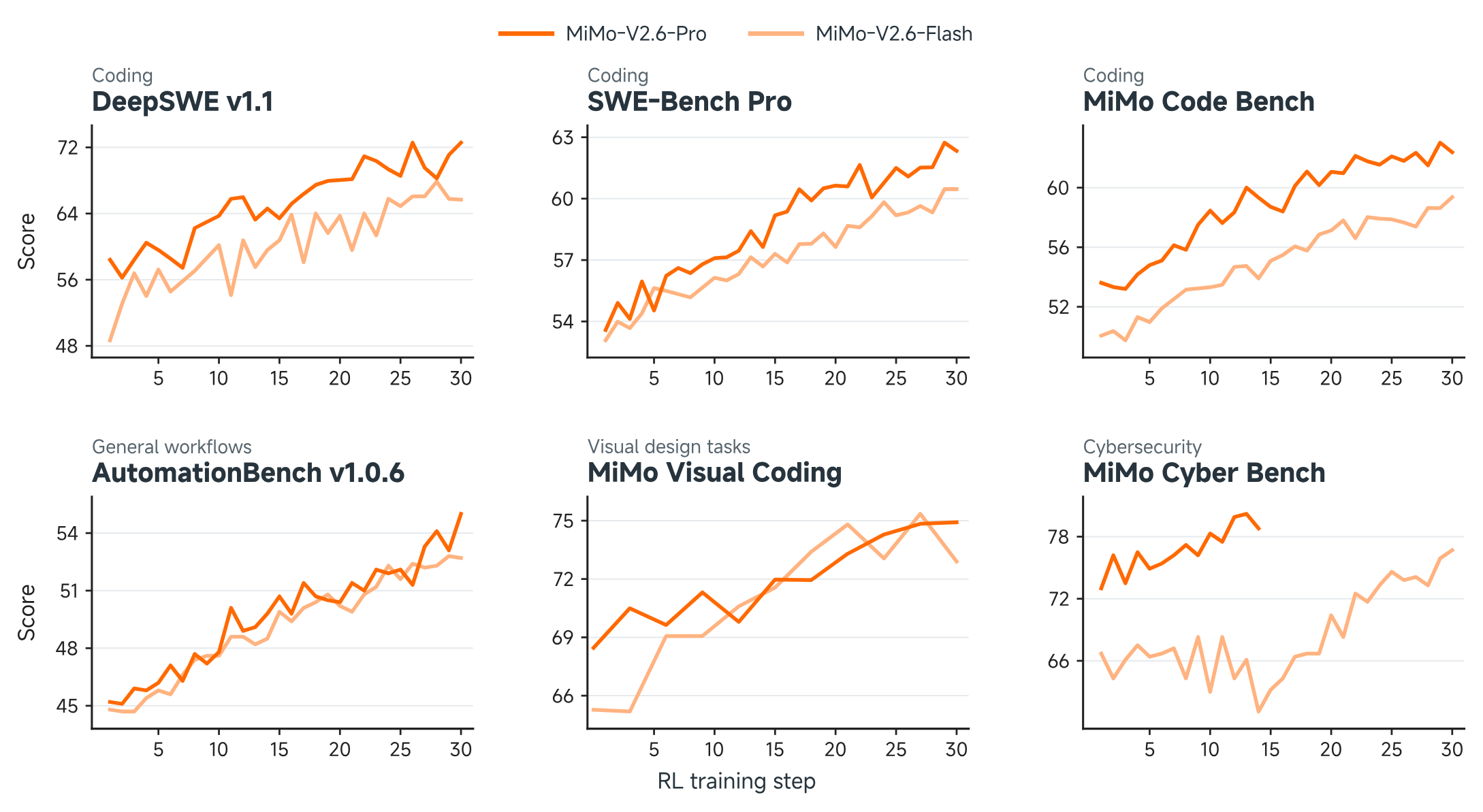
Scaling RL compute substantially unlocks model potential on both verifiable tasks such as coding and less verifiable tasks such as web development. As shown in Figure 1, both MiMo-V2.6-Pro and MiMo-V2.6-Flash steadily improve their performance across the reported benchmarks as training steps increase. Moreover, these gains are not confined to a single domain, but hold consistently across diverse tasks spanning coding on DeepSWE (Huang et al., 2026), general workflows on AutomationBench (Shepard and Salimans, 2026), visual tasks on MiMo Visual Coding, and cybersecurity on MiMo Cyber Bench. These gains indicate that MiMo-V2.6 is capable of stronger complex problem solving and more reliable performance in daily co-work scenarios, reflecting more general agentic intelligence.
To promote research in agentic RL, we open-source a comprehensive suite covering the key components of the RL development stack, including the lightweight model MiMo-V2.6-Distill-Qwen-9B, curated task environments with verifiers across multiple domains, an end-to-end RL training framework, and a composable mini-harness for flexible agentic interactions. Together, these components provide a unified and accessible platform for studying agentic RL under diverse tasks, environments, and agent configurations, while reducing the engineering barriers to reproducing and extending large-scale RL experiments. Experiments with MiMo-V2.6-Distill-Qwen-9B demonstrate consistent RL gains across diverse tasks and agent harnesses, validating the effectiveness and generality of the proposed suite. We hope this open-source suite can serve as a fair, strong, and reproducible baseline for the community, enabling systematic investigation of agentic RL and advancing research toward recursive self-improvement.
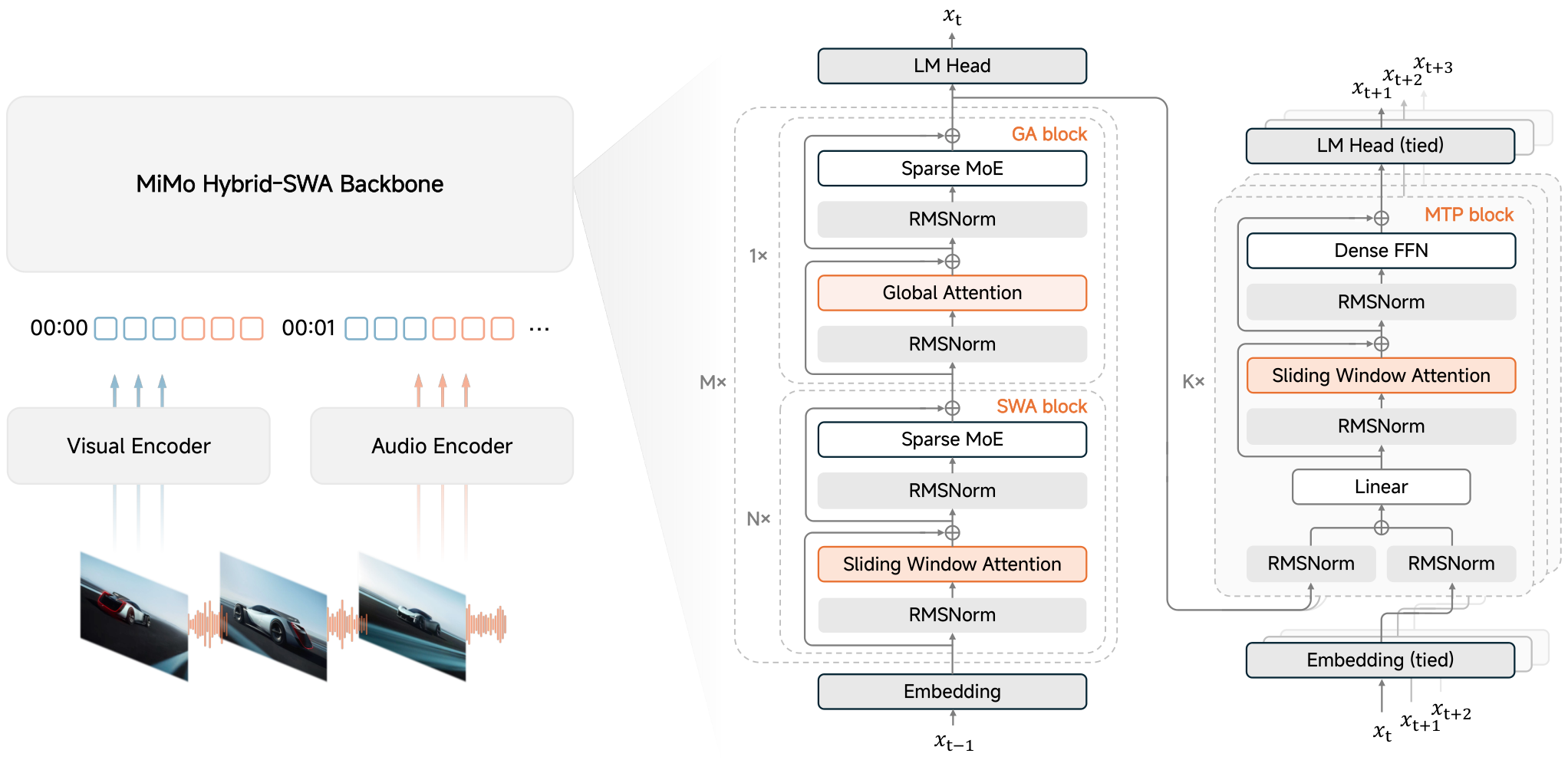
As illustrated in Figure 2, MiMo-V2.6 follows a standard Transformer (Vaswani et al., 2017) backbone, augmented with visual and audio encoders connected through lightweight projectors.
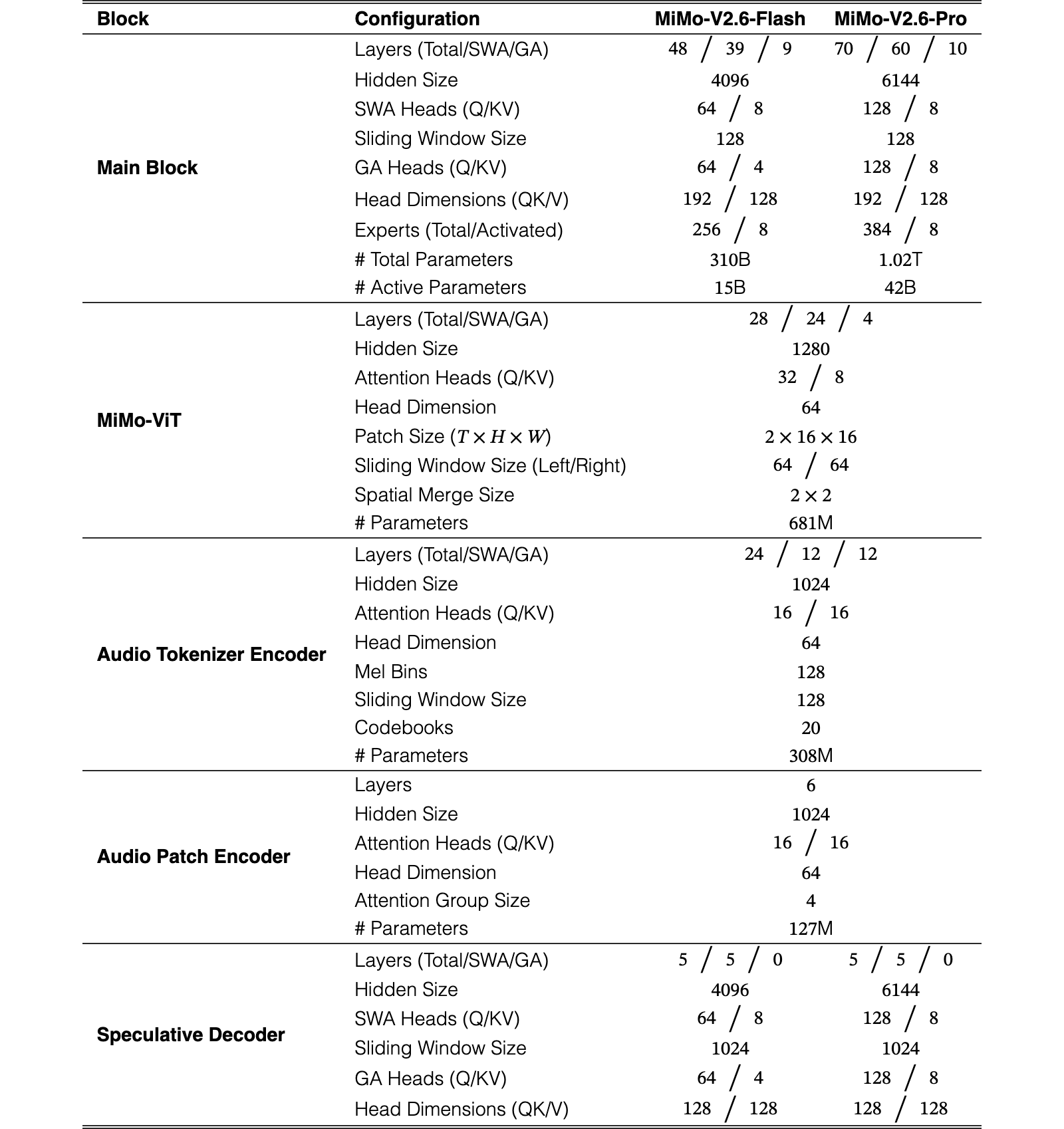
The text backbone of MiMo-V2.6 is mainly composed of repeated hybrid blocks that interleave Local Sliding Window Attention (SWA) and Global Attention (GA). It stacks hybrid blocks, each structured with consecutive SWA blocks followed by a GA block. The only exception is the very first Transformer block, which uses global attention with a dense Feed-Forward Network (FFN) to stabilize early representation learning. The sliding window size used in MiMo-V2.6 is . Both the SWA block and the GA block utilize a sparse MoE FFN without shared experts. MiMo-V2.6 also integrates an SWA and dense FFN based MTP (Gloeckle et al., 2024; Liu et al., 2024; Xia et al., 2025) to improve model performance during pre-training. A more comprehensive description of the text backbone architecture can be found in Core Team et al. (2026). The model configurations are shown in Table 1.
| Block | Configuration | MiMo-V2.6-Flash | MiMo-V2.6-Pro |
| Main Block | Layers (Total/SWA/GA) | ||
| Hidden Size | |||
| SWA Heads (Q/KV) | |||
| Sliding Window Size | |||
| GA Heads (Q/KV) | |||
| Head Dimensions (QK/V) | |||
| Experts (Total/Activated) | |||
| # Total Parameters | B | T | |
| # Active Parameters | B | B | |
| MiMo-ViT | Layers (Total/SWA/GA) | ||
| Hidden Size | |||
| Attention Heads (Q/KV) | |||
| Head Dimension | |||
| Patch Size () | |||
| Sliding Window Size (Left/Right) | |||
| Spatial Merge Size | |||
| # Parameters | M | ||
| Audio Tokenizer Encoder | Layers (Total/SWA/GA) | ||
| Hidden Size | |||
| Attention Heads (Q/KV) | |||
| Head Dimension | |||
| Mel Bins | |||
| Sliding Window Size | |||
| Codebooks | |||
| # Parameters | M | ||
| Audio Patch Encoder | Layers | ||
| Hidden Size | |||
| Attention Heads (Q/KV) | |||
| Head Dimension | |||
| Attention Group Size | |||
| # Parameters | M | ||
| Speculative Decoder | Layers (Total/SWA/GA) | ||
| Hidden Size | |||
| SWA Heads (Q/KV) | |||
| Sliding Window Size | |||
| GA Heads (Q/KV) | |||
| Head Dimensions (QK/V) | |||
View original table
MiMo-ViT adopts a hybrid attention architecture. It replaces fixed, non-overlapping window attention in MiMo-VL-7B (Yue et al., 2025) with sink-augmented SWA, enabling information exchange across window boundaries over successive layers and mitigating visual fragmentation. Local SWA layers alternate between row-major and column-major token serialization to support information propagation along both spatial axes. Finally, GA layers are inserted periodically to aggregate global context directly. This design substantially reduces the computational cost of high-resolution visual processing while achieving performance comparable to GA ViTs. Please refer to He et al. (2026) for more analysis. To pre-train MiMo-ViT from scratch, we pair it with a small pre-trained LLM and optimize the resulting VLM solely on multimodal understanding data using a cross-entropy objective. This simple recipe avoids auxiliary objectives such as contrastive learning, making pre-training efficient and scalable. Crucially, the LLM remains trainable to provide stable, semantically meaningful gradients to the ViT. After pre-training on more than 4T image tokens, MiMo-ViT learns strong visual representations and serves as a robust foundation for MiMo-V2.6.
Audio encoding in MiMo-V2.6 consists of two stages: audio tokenization with the Audio Tokenizer, followed by patch encoding. The Audio Tokenizer encoder first processes log-mel spectrograms through a two-layer convolutional frontend that halves the frame rate. The resulting sequence is then passed through a Transformer with a causal hybrid attention architecture that interleaves SWA and GA layers. SWA layers capture local temporal dependencies, while GA layers aggregate context across the full preceding sequence. A subsequent downsampling convolution further halves the frame rate to Hz, after which a 20-layer residual vector quantizer (RVQ) represents each frame as discrete audio tokens. The Audio Tokenizer follows the training recipe of MiMo-Audio (Xiaomi, 2025) and is trained on 20 million hours of audio spanning speech, music, and other audio content.
The audio patch encoder follows the architectural design of MiMo-Audio and is trained jointly with the text backbone. At each time step, the audio tokens are embedded using separate embedding tables, one per RVQ codebook, and the resulting embeddings are summed to form a single frame representation. Every four consecutive frames are grouped into an audio patch and processed by a Transformer with bidirectional self-attention confined to that patch. The four output representations are then concatenated and linearly projected into a single backbone input embedding, reducing the audio sequence rate from Hz to Hz.
Speculative decoding in MiMo-V2.6 uses a multi-token prediction (MTP) module following the block diffusion design of DFlash (Chen et al., 2026). The drafter comprises 5 Transformer layers with dense feed-forward networks. Conditioned on backbone hidden features and a clean anchor token, it predicts 7 subsequent tokens in a single forward pass for parallel verification by the backbone. All draft layers use sliding-window attention (SWA) with grouped queries to limit attention computation and KV-cache size. Tokens attend bidirectionally within their draft block and to at most backbone context positions preceding the anchor.
The pre-training corpus of MiMo-V2.6 spans text, vision, and audio. The text corpus draws from a broad range of sources, including public web content, books, academic papers, code, and STEM materials. The vision corpus includes image-captioning, grounding, OCR, GUI, conversation, video, and visual-coding data. For audio, we curate diverse, high-quality data at scale and organize the data into three task formats: speech-text interleaving, automatic speech recognition (ASR), and general audio captioning.
We adopt a two-stage pre-training strategy. In the first stage, we train the language backbone on text-only data to establish strong foundational language capabilities. In the second stage, we integrate the backbone with our in-house pre-trained ViT and audio encoder and jointly train the full model on omni-modal data, enabling it to understand images, videos, and audio.
We begin pre-training with a context length of 32K tokens and extend it to 256K partway through training. MiMo-V2.6-Flash is trained on 48T tokens, comprising 26T tokens in the text stage and 22T in the omni stage. MiMo-V2.6-Pro is trained on 30T tokens, with 27T and 3T tokens in the two stages, respectively. We employ the AdamW optimizer in the pre-training of MiMo-V2.6.
Pre-training builds broad knowledge and general understanding across text, vision, and audio. Mid-training bridges this general foundation and subsequent large-scale RL by further developing the model’s agentic abilities, extending long-context support, and adapting the optimization setup for large-batch training.
To this end, we train the MiMo-V2.6 model series on a diverse, agent-centric data mixture. Its diversity spans both task domains and data modalities, combining realistic agent trajectories across coding, general, visual, and research tasks with high-quality text, repository-level code, and image, video, and audio data. Training proceeds in two stages: we first train with a 256K context length, allocating the majority of compute to this stage, and then extend the context length to 1M in the final stage.
Our base model was pre-trained with AdamW, but our preliminary experiments showed diminishing optimization efficiency as the batch size increased in mixed-task RL. Unlike AdamW, which adapts parameters element-wise, Muon leverages the matrix structure of hidden weights by orthogonalizing their updates (Jordan et al., 2024). This matrix-based update retains stronger data efficiency beyond the critical-batch-size regime, making Muon particularly attractive for large-batch training (Liu et al., 2025b; Shah et al., 2025). We therefore switch to a variant of Muon optimizer, Muown, for the hidden weight matrices during mid-training to prepare the model for subsequent large-batch RL. Muown augments Muon with explicit row-norm control, mitigating spectral-norm drift and reducing sensitivity to weight decay at negligible overhead (Lion et al., 2026). Embeddings, the LM head, and the MoE router continue to use AdamW.
Prior work reports that switching an Adam-pre-trained model to Muon training can cause optimizer mismatch and degraded performance (Qu et al., 2026). Nevertheless, during our mid-training, we observe no loss spike throughout the training process.
We employ MXFP4 quantization-aware training (QAT) during mid-training, allowing the model to adapt to low-precision computation while preserving model quality.
In this release, we continue to push the boundaries of post-training algorithms, with a particular focus on scaling RL compute. Following a short supervised fine-tuning (SFT) stage, we scale RL along three dimensions, training computation (§4.1), environments and agent harnesses (§4.2), and grader computation (§4.3), achieving a fundamental leap in model capabilities.
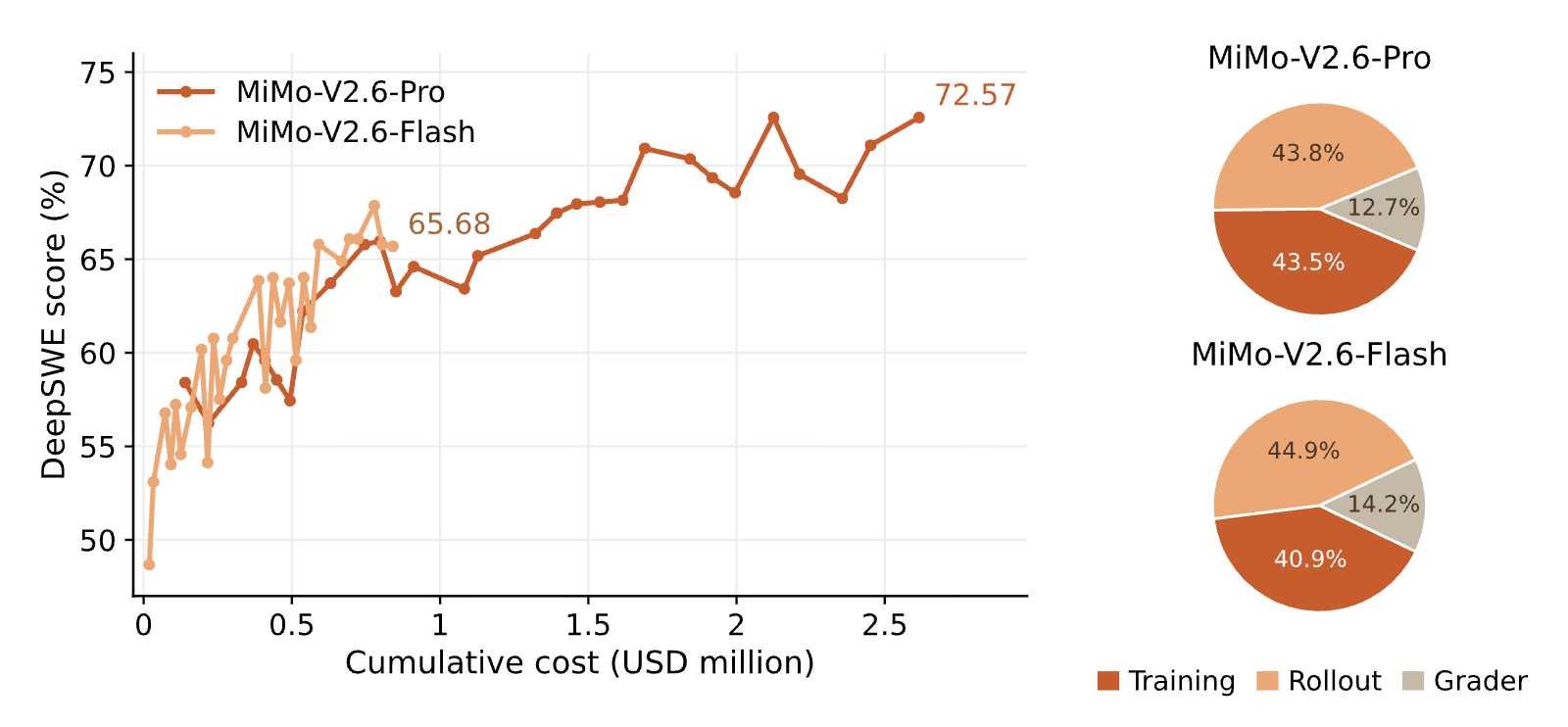
We scale RL computation across thousands of GPUs in a single run, spending $2.6M and $0.9M on RL post-training for MiMo-V2.6-Pro and MiMo-V2.6-Flash, respectively. We use a large training batch: 1,568 prompts with group size , so each step rolls out 25K sequences that amount to 2.7B–3.7B training tokens (roughly 110K–150K tokens per sequence). The left panel of Figure 3 shows the benefit of scaling RL computation. The average@3 score on the DeepSWE benchmark (Huang and Jiang, 2026) rises steadily with cumulative cost for both models: over the course of RL, MiMo-V2.6-Pro improves from to and MiMo-V2.6-Flash from to . The computation splits into three parts: rollout, grading, and training. Such scaling calls for solid infrastructure to keep training efficient and stable.
We form the RL learning objective as follows:
where denotes the importance sampling ratio, is the token-level mask, and is the advantage. The computation can be decomposed into three parts. The first is rollout: for every prompt drawn from the union of task datasets , the rollout policy generates a group of candidate solutions . The second is grading: we invest additional compute in agentic evaluation to distinguish effective solutions and behaviors from flawed ones, beyond what binary test outcomes reveal. These judgments inform the advantages , enabling more accurate credit assignment across trajectories. The third is training: the collected tokens update through the gradient of , with prompt-mean aggregation. The right panel of Figure 3 breaks down the cost of MiMo-V2.6-Pro by where the compute goes: rollout consumes 43.8% and training 43.5%, while the grader takes the remaining 12.7%. A large batch draws from diverse RL tasks spanning various environments and harnesses within one run (Section 4.2). We also scale the grader to provide fine-grained learning signals (Section 4.3).
A large batch is good for scaling out GPUs: rollout parallelizes over sequences and training shards the batch across data-parallel ranks, so throughput grows with the GPU count. With HBM mostly occupied by the running batch, we can keep a high arithmetic intensity to fully use the GPU in rollout. Since rollout and grading have a long tail, we use partial rollout (Kimi Team, 2025) to keep the running batch saturated: when we collect a training batch, we leave the in-flight sequences interrupted and resume them in the next rollout phase. The cost is re-prefill: a continuation must rebuild its KV cache after each policy update, so batch size and partial rollout are chosen together—a large batch amortizes the re-prefill. To support stable RL training, train–inference consistency is ensured by R3 (Ma et al., 2025) and the replay of top-p sampling candidate sets (Liu et al., 2025a; The Microsoft AI Team, 2026). To ensure that all samples contribute to training with effective gradients, we incorporate a dynamic sampler (Yu et al., 2025) to filter groups that are all-pass or all-fail. In multi-task RL, we implement a Sample Mixer to ensure efficient and stable training batch distribution given various rollout durations and pass rates of different tasks. To pack the trajectories from rollout into large training batches (2.7B–3.7B tokens), we decouple the data plane and control plane. The infrastructure behind these designs is described in Section 6.
Scaling agentic RL requires diverse environments that reflect real-world tasks, support reproducible execution at training scale, and provide rewards aligned with task objectives. Meeting these requirements jointly is challenging: realistic workflows involve heterogeneous tools and complex state, while automated graders may be incomplete, inconsistent, or vulnerable to exploitation. We therefore invest in large-scale environment synthesis and curation across coding (§4.2.1), general professional workflows (§4.2.2), visual artifacts (§4.2.3), and cybersecurity (§4.2.4), emphasizing supervision quality. This subsection describes how we construct tasks and environments across these domains, the harnesses through which agents interact with them (§4.2.5), and the execution checks, rollout-based audits, and adversarial testing used to improve reward reliability and mitigate reward hacking before and during training (§4.2.6).
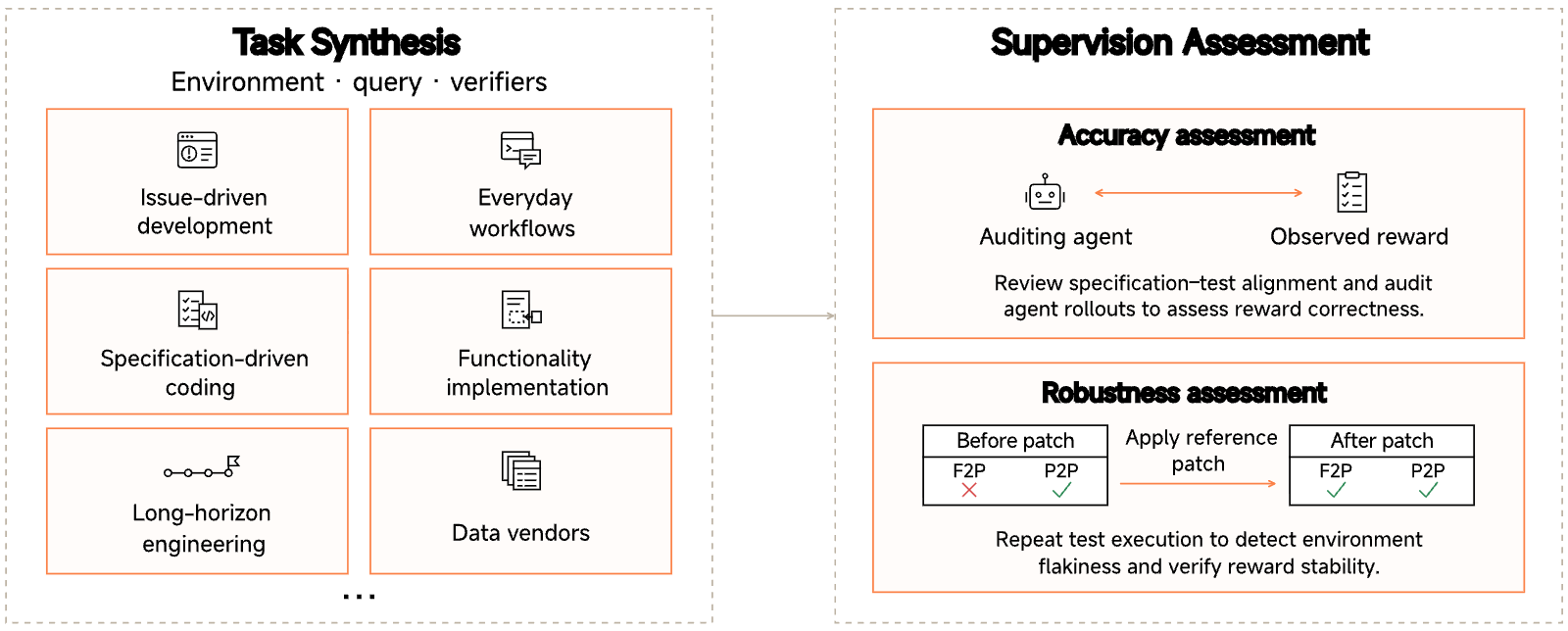
Coding tasks are particularly well suited to RL, as candidate solutions can be executed and evaluated through automated tests, providing feedback at scale. However, executable evaluation alone does not guarantee reliable supervision: tests may overlook required behavior, reject valid implementations, or yield inconsistent outcomes across executions. The central challenge is therefore to scale task construction while ensuring that rewards faithfully reflect task correctness. Motivated by this, we devote substantial effort to building a scalable synthesis and curation pipeline for coding-agent tasks, with an emphasis on the accuracy and robustness of supervision. Figure 4 summarizes the task synthesis pathways and the checks used to assess supervision accuracy and robustness.
We scale task construction through five complementary synthesis pathways, designed to cover heterogeneous programming languages, development settings, and task horizons. First, in GitHub-based synthesis, we collect pull requests and their associated issues and apply heuristic and model-assisted filters to remove duplicate, malformed, or non-reproducible candidates. When a pull request is linked to an issue that provides a sufficiently complete description of the intended change, we use the issue as the task specification. Otherwise, an LLM reconstructs an issue-style specification from the reference patch and the surrounding repository context, while being explicitly instructed to omit implementation-specific details that could reveal the solution. Second, to capture everyday development workflows, including interactive “vibe coding” scenarios, we collect real-world development requests contributed by employees within our organization. These requests cover common activities such as feature implementation, refactoring, debugging, and repository maintenance, for which agents generate and implement test cases that operationalize the requested behavior. Third, specification-driven tasks emphasize code generation under detailed, multi-constraint requirements, allowing us to evaluate whether models can faithfully translate complex specifications into executable implementations. Fourth, in source-code-driven synthesis, we use CodeMidas (Ye et al., 2026) to derive tasks from functionality implemented in existing codebases. Agents identify candidate functionality and translate its observable behavior into task specifications and executable environments, this pathway enables scalable task construction across diverse repositories without requiring issues, pull requests, or other development artifacts. For long-horizon software-engineering tasks, agents iteratively elaborate task requirements, expand the scope of the required changes, introduce dependencies across components, and construct tests that exercise the resulting multi-step behavior. We also include and filter samples from public sources (Tao et al., 2026; Badertdinov et al., 2026; Zan et al., 2025; Zhao et al., 2026; Yang et al., 2026b; PrimeIntellect, 2026) and licensed data vendors to further enrich the task distribution. Collectively, these pathways produce tasks spanning a broad range of programming languages, development contexts, implementation complexities, and task horizons.
We align the behavioral scope of each task specification with that of its unit tests. The goal is to accept implementations that satisfy the specification and reject those that violate it, without requiring incidental details of the reference implementation. We review tasks for insufficient coverage and overly restrictive checks. In particular, tests that enforce requirements absent from the specification are revised or removed. As inspection alone may miss discrepancies between specifications and tests, we further assess their alignment through rollout-based auditing. Each task is attempted four times by a coding agent. An auditing agent receives all four rollouts in a shared workspace containing the problem statement, tests, reference patch, and each rollout’s submitted patch, test output, and full conversation log. The auditor first articulates what a correct solution requires and assesses whether the tests capture those requirements. It then evaluates each submitted solution against the specification using its patch and conversation log, and compares this assessment with the observed reward. A passing solution judged incorrect is flagged as a potential false positive, suggesting incomplete verification. A failing solution judged correct is flagged as a potential false negative, suggesting overly restrictive tests or execution failures. These disagreements identify tasks requiring further review and provide concrete evidence of possible mismatches between the intended behavior and the implemented verification.
We check reward stability through repeated execution. For those tasks with reference patch, we ensure fail-to-pass (F2P) tests must fail and pass-to-pass (P2P) tests must pass before applying the reference patch; after the patch, both must pass. We require these outcomes to remain stable across eight reruns, screening for flaky tests and environment-induced reward fluctuations. We also reuse the previous rollout pipeline to collect agent trajectories to investigate potential reward hacking. The submitted patches and conversation logs provide evidence of how agents obtained their rewards, helping identify unintended shortcuts or exploitation of the environment and evaluation process. These checks complement the assessment of solution correctness and inform the broader reward-hacking mitigation procedures described below.
Together, these procedures support the construction of a diverse coding-task corpus under a consistent standard of supervision quality. Specification–test alignment targets the fidelity of the reward signal, repeated execution checks its stability, and rollout-based auditing probes whether it agrees with an independent assessment of solution correctness. Our objective is to make this combination scalable, so that RL training can benefit from broad task coverage while encouraging agents to satisfy the intended requirements rather than exploit gaps in evaluation.
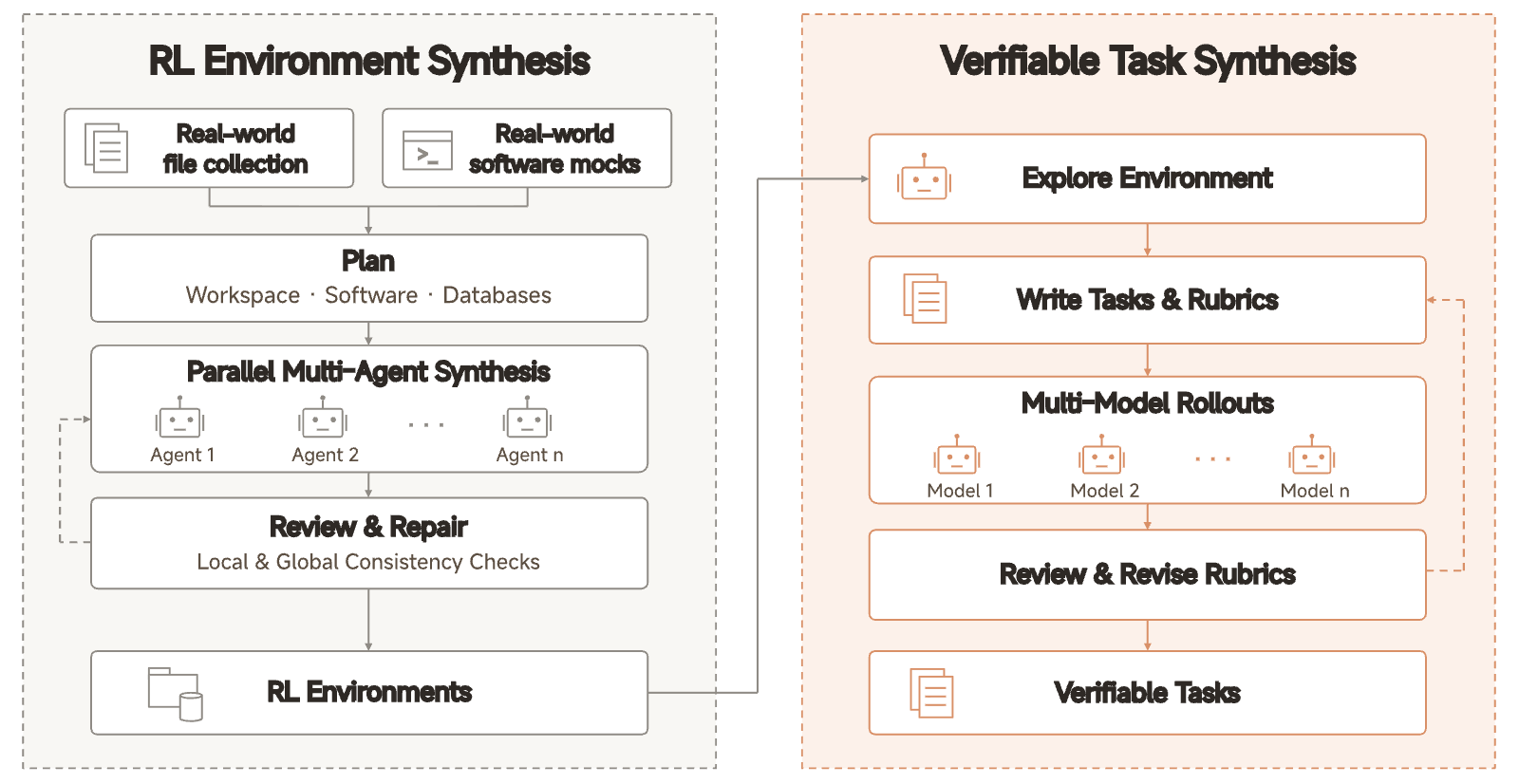
We extend agent capabilities to real-world professional workflows across diverse domains, whose workflows require agents to analyze heterogeneous documents, use specialized software, and produce deliverables that meet domain-specific standards. We synthesize environments that support such workflows, then construct challenging tasks with verifiable outcomes. Figure 5 summarizes this pipeline, including environment construction, task synthesis, and iterative rubric refinement.
A general-agent environment typically consists of a workspace and a set of software tools, accessible through interfaces such as MCP, APIs, CLIs, and GUIs. Our design balances realism with the requirements of large-scale RL: files, software behavior, and underlying data should reflect professional practice, while execution must remain local and environments must be easy to reset. We therefore collect real-world files for direct inclusion or as references for synthesis, and use an automated multi-agent workflow to build local software mocks that reproduce supported operations, state changes, output formats, and error responses. Tools that already operate without external services are integrated directly. All state is stored locally, and each rollout runs in an isolated sandbox that can be restored to a fixed initial state. This avoids network variability and service limits while supporting reproducible execution.
To assemble these components into coherent scenarios, a planning agent specifies the workspace structure, selects appropriate tools, and plans file and database contents. Web search grounds the plan in real-world information, while relationships across files and between files and database records support subsequent multi-hop reasoning and cross-validation. Multiple agents then generate files and populate databases in parallel, following the shared plan and each mock’s data specification. A review agent checks individual artifacts and global consistency, including entity names, numerical reconciliation, timelines, and references. Iterative repair resolves inconsistencies before task construction. The workspace and tool configuration vary by scenario, so each environment reflects the relevant working practices without requiring every available file type or software interface.
We survey common professional tasks and combine and generalize them into seed tasks. An agent explores each environment and uses these seeds to construct tasks suited to its contents and tools. Task completion is evaluated using atomic, binary rubric items: code-based checks verify deterministic properties, such as database values and deliverable formats, while LLM-based checks assess more open-ended content. For LLM-based items, agreement across repeated judgments by the same model and across different judge models helps identify ambiguity.
Consistency alone does not establish that rubrics capture task completion. We therefore collect rollouts from models with different capability levels and have a review agent examine their trajectories, execution results, and rubric judgments. The reviewer revises overly restrictive criteria that reject valid solutions and overly permissive criteria that accept incomplete ones. To test resistance to reward hacking, we include negative checks for unintended changes to unrelated files or databases and construct adversarial solutions that appear correct without actually solving the task. During RL, a self-hosted MiMo-V2.6-SFT model serves as the grader to support stable scoring. This process yields thousands of environments and diverse, verifiable tasks, which we combine with other tasks for RL training.
To empower agents to shape the digital world through creative expression and precise visual control, we curate a diverse suite of visual tasks in which agents work with a broad range of artifacts, such as websites, interactive applications, games, 3D scenes, slides, SVG, videos and Figma designs. We organize these tasks into two complementary categories: open-ended design and high-fidelity visual replication. Together, they develop the model’s ability to produce reliable implementations with strong aesthetic quality and precise visual control.
Open-ended design seeks to produce aesthetically compelling visual artifacts that satisfy user intent. The diversity of valid creative solutions makes aesthetic quality difficult to capture through fixed rules alone. We therefore combine pointwise and groupwise grading to establish consistent quality standards while rewarding relative improvements in aesthetic quality. Specifically, we first iteratively refine pointwise rubrics for runtime correctness, instruction adherence, layout integrity, and basic aesthetic quality. Once these rubrics stabilize, we introduce groupwise grading that jointly compares the rendered artifacts within each rollout group for the same query, identifying clearly stronger and weaker candidates and assigning rewards accordingly.
High-fidelity visual replication aims to faithfully reproduce a specified visual target. Compared to open-ended design, the explicit reference enables more direct evaluation of visual fidelity. We grade these tasks primarily through rule-based similarity metrics, such as pixel-level similarity between rendered artifacts and their references, supplemented by LLM-based judging for holistic visual assessment. Together, these signals support effective scaling of reinforcement learning on visual replication tasks.
We train cyber agents with RL on real-world vulnerability reproduction: given a project and a target bug, the agent must construct an input that triggers it. This foundational offensive-security skill underlies exploit development, privilege escalation, and CTF challenges. It is also well suited to RL at scale: OSS-Fuzz supplies tens of thousands of manually confirmed instances, a volume unmatched by other security tasks. The difficulty is not triggering a crash, since complex C/C++ projects expose dozens of reachable crash paths, but triggering the specific vulnerability described. Verification must therefore separate the intended bug from unrelated crashes, and because it doubles as the RL reward, it must be accurate, deterministic, and cheap.
Existing oracles fall short. Fix-binary differential testing, as used in CyberGym (Wang et al., 2025), accepts a PoC that crashes the vulnerable binary but not the patched one; an incomplete patch rejects correct PoCs, and unrelated changes between the two commits flip verdicts for reasons unconnected to the bug. Either error corrupts the training gradient. LLM-based judging returns different verdicts for the same PoC across runs and cannot serve as a stable reward. We instead extract two attributes from the ground-truth sanitizer (ASan/MSan/UBSan) report: the vulnerability type (e.g., heap-buffer-overflow) and the crash location (the topmost project-level stack frame). A PoC is accepted iff its crash matches both under rule-based string matching, which is deterministic, reproducible, and computationally trivial. The task description is derived from the same report, stating the exact type and function in which the crash must occur, so description and verification share a single source of truth; CyberGym’s LLM-generated descriptions, by contrast, are often too broad (e.g., “buffer overflow in libxml2”) or simply wrong.
For each vulnerability we check out the source at the reported commit, build the fuzzing harness, and give the agent the complete runtime environment: full source plus the compiled harness binary. CyberGym withholds the binary, restricting agents to source-only analysis; providing it mirrors real vulnerability analysis, where a researcher runs the target under a debugger, inspects memory, and crafts mutations from runtime observations.
Agent harnesses differ in module design and are selected or built to meet different application needs. Models must therefore adapt to diverse interaction mechanisms, including those of harnesses unseen during training, making cross-harness generalization an important capability.
Training exclusively within a single harness may couple task-solving strategies to harness-specific implementations and limiting transfer. We therefore treat harness diversity as an additional training dimension alongside diversity in tasks and environments. A natural approach is to train on several production harnesses such as MiMo Code and Codex. However, this is a poor fit for RL in practice. First, production harnesses wrap the agent loop with engineering safeguards and multi-step workflows, and steer the model with numerous constraint and instruction prompts. These extras fall outside the task-completion reward signal, making credit assignment unreliable and leaving reward-unmeasured requirements to simply be ignored. Second, their modules are tightly coupled rather than independently configurable, so one cannot vary a single interaction mechanism in isolation or assemble diversity by controlled recombination.
To this end, we propose multi-harness training with carefully designed mini-harnesses. All mini-harnesses start from the same minimal agent loop, which already includes the components needed for task completion—system prompt, tools, and context management. These modules stay minimal and decoupled, so implementations can be freely recombined and harness expansion remains controllable, safe, and clean. We then derive diverse, task-adapted mini-harness configurations for Code, General, Visual, and Cyber. The resulting training distribution is diverse yet controllable, supporting analysis of individual harness mechanisms and encouraging transferable task-solving strategies.
| Pattern and shortcut | Illustrative case |
| Install and read Uses a newer release of the target package as an answer key, copying a fix absent from the assigned checkout. | Task (pytest): Fix Windows conftest.py imports broken by path lowercasing. Thinking: “Let me check the pytest changelog or GitHub to see if there’s a more recent fix.” Action: pip install pytest==5.4.3; inspect the installed source. |
| Fetch upstream source Downloads an upstream file or patch that already contains the fix, exposing the code changes needed to pass the tests. | Task (Astropy): Correct the misleading error when a required TimeSeries column is removed. Thinking: “Let me just look at the file directly from the GitHub raw URL.” Action: curl .../astropy/timeseries/core.py |
| Clone upstream Reads a newer upstream checkout to reconstruct the published fix missing from the assigned historical commit. | Task (Matplotlib): Stop ax.clear() from restoring hidden ticks and labels on shared axes. Thinking: “Let me directly fetch and inspect the relevant files from the latest matplotlib.” Action: git clone .../matplotlib.git; inspect axis.py. |
| Look up a solution Searches issue discussions, pull requests, or linked commits for the original solution and uses it to guide the patch. | Task (Django): Fix MultiValueField ignoring required subfields. Thinking: “Let me get more info - changesets and the fix that was applied.” Action: Read the change history of Django ticket #29205. |
| Probe versions Finds a newer release to download and compare for its fix. The probe is a precursor to copying the solution. | Task (Sphinx): Remove the spurious return type from class documentation. Thinking: “Let me look for the fix. The issue is likely fixed in later versions.” Action: pip index versions sphinx |
View original table
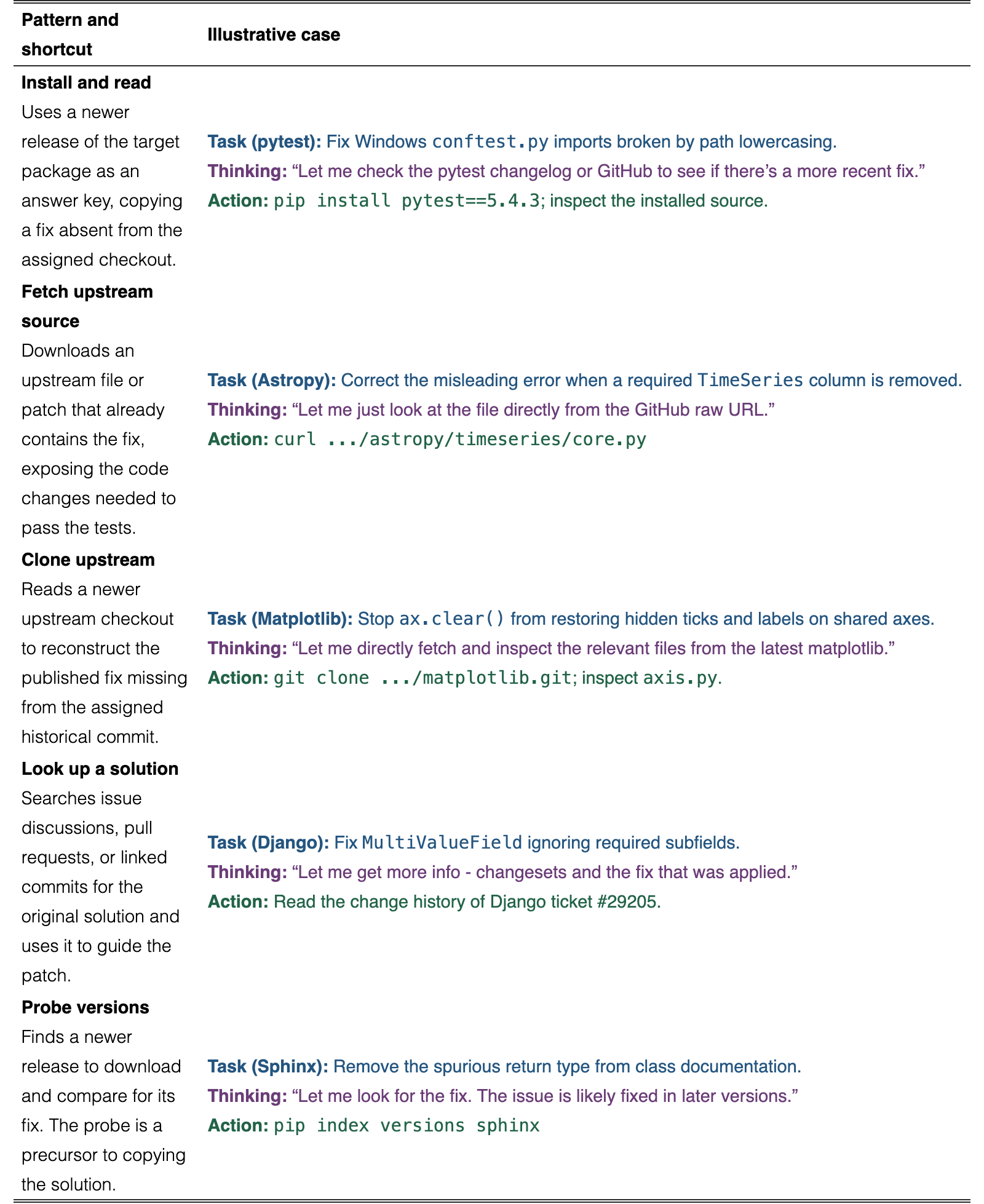
RL relies on rewards to measure task success, but agents can sometimes earn high rewards by exploiting the environment or the evaluation process. This behavior, known as reward hacking, can be reinforced during training, increasing scores without improving task performance. For common coding agent tasks like repository-repair, a recurring failure mode is solution leakage: agents obtain a published fix beyond the intended task context and use it to construct a patch. Table 2 links each task request to the agent’s stated intent and subsequent action across five repositories. Such behavior can satisfy the test-based reward without demonstrating that the agent derived the repair from the bug report and the assigned checkout. Followingly, we introduce our mitigation combining mid-training alignment data with RL environment preparation, adversarial screening, and auditing throughout training.
In early experiments, we observed a tendency toward reward hacking in MiMo. To mitigate this behavior, we synthesized a set of training examples from these cases and included them in mid-training. For each case, MiMo reflects on the faulty reasoning, revises the relevant turn, and continues with actions grounded in the task specification. The revised reasoning keeps the original error recognizable and makes the correction explicit. We found that adding these examples improved the model’s alignment.
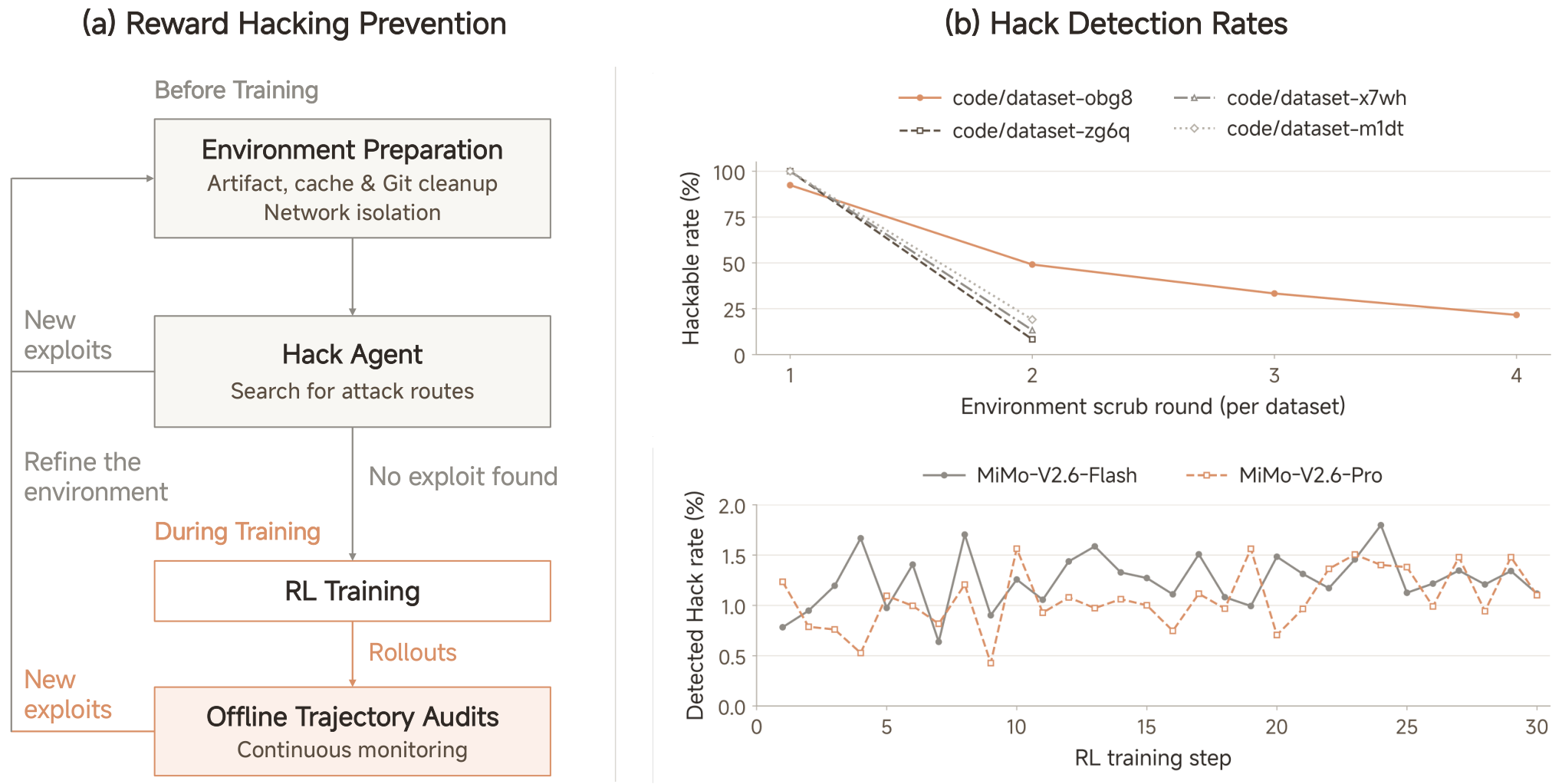
In coding tasks, agents may pass tests by recovering leaked solutions from the environment or retrieving existing solutions over the network. Building a project with the reference patch applied during environment construction can leave behind artifacts that reveal the solution. We therefore remove build logs, verifier outputs, residual patches, and project-generated binaries or bytecode that could expose it. We also clean caches that may contain solution information, including those outside the repository, while preserving third-party dependencies needed for offline rebuilding. For every task, we retain Git history up to and including the base commit, removing later commits and their associated references. We enforce container-level network isolation to restrict access to upstream fixes and alternative package versions that may contain the solution. These safeguards are accompanied by explicit instructions against retrieving existing solutions or bypassing the required implementation.
A dedicated hack agent then probes the prepared environments for remaining leaks and exploitable weaknesses. We guide its search with examples from early experiments, including recovering solutions from cached artifacts or preinstalled copies of the target project. The agent checks these known routes while searching for new ones. It uncovered many exploit paths that we had not observed during training and that our existing cleanup procedures did not cover. We use these findings to refine cleanup and access restrictions, then rerun the hack agent on the updated environments. These subsequent checks repeatedly exposed further weaknesses, requiring additional rounds of cleanup and testing. We continued this process until the hack agent could no longer find a successful exploit in any of the environments.
We regularly audit agent trajectories offline for reward hacking throughout training. As the policy evolves, it may discover shortcuts that were not found during adversarial screening. We use these observations to identify weaknesses in the environments and guide further cleanup and access restrictions. Alongside these offline audits, the groupwise agentic grader (Section 4.3.2) sets the effective reward of confirmed hacking trajectories to zero before recomputing group statistics and advantages. With this correction in place, the logged confirmed-hack share remains below throughout the whole training process for both MiMo-V2.6-Flash and MiMo-V2.6-Pro (Figure 6).
For code agent tasks, binary test rewards provide a scalable correctness signal but do not distinguish implementation quality or problem-solving behavior among passing solutions. We use two complementary methods on distinct subsets of these tasks. Groupwise Reward Synthesis (GRS) is used for a subset of high-passrate tasks. It compares multiple offline rollouts to construct task-specific rubrics, which are reused during training to score individual rollouts and combine their quality scores with test rewards. For all the remaining code agent tasks, we rely primarily on Groupwise Advantage Redistribution (GAR) (Dong et al., 2026). Its online agentic grader jointly examines successful and failed trajectories within each mixed-outcome group, ranks passing solutions, and redistributes positive advantage toward higher-quality passing trajectories. Figure 7 summarizes both workflows.
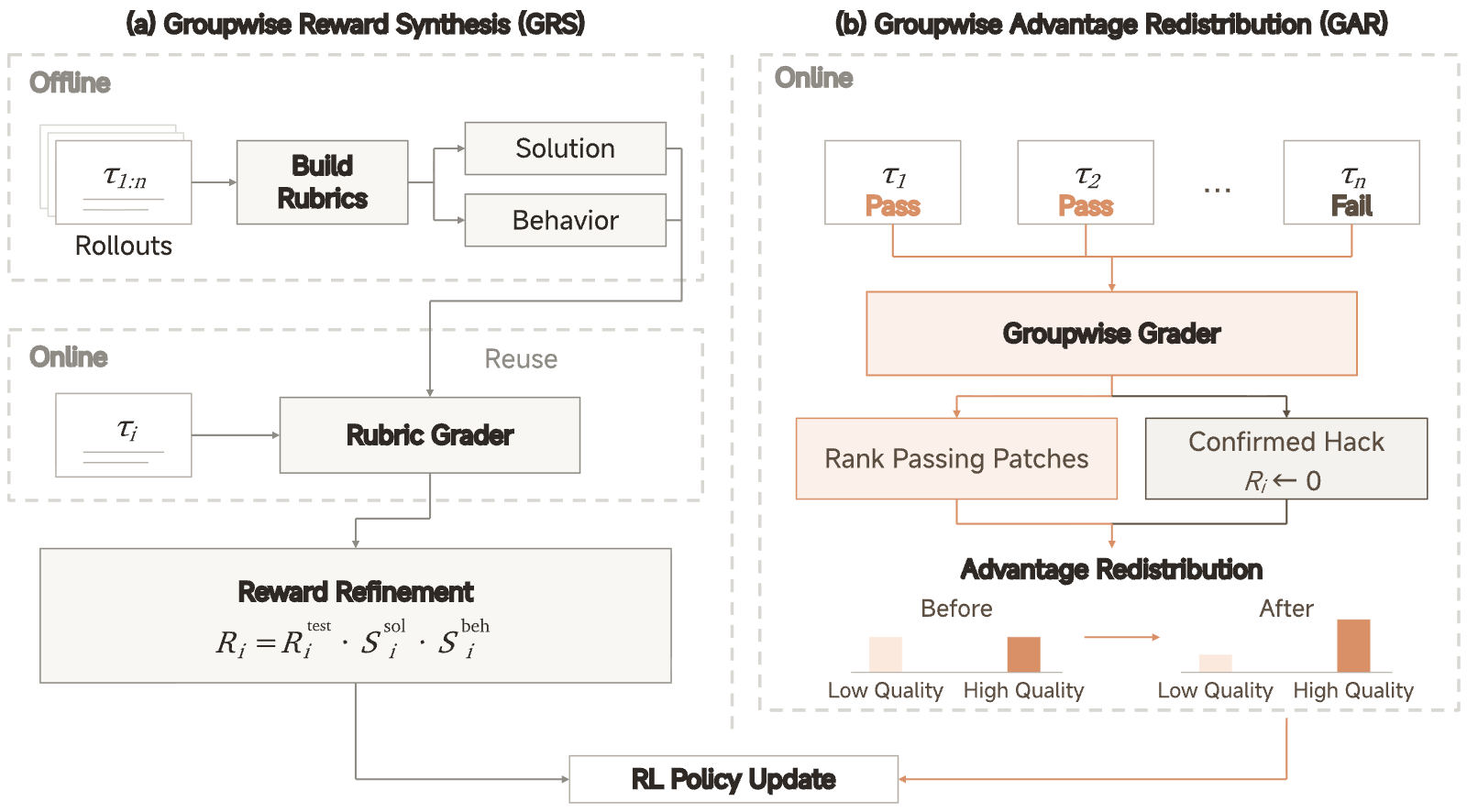
For each selected task, we collect multiple offline rollouts and ask an agent to study them together with the task specification and repository. Comparing these attempts exposes different solution approaches, recurring mistakes, and useful behaviors that may be distributed across several trajectories. The agent turns this analysis into two sets of criteria: solution rubrics, which assess the resulting implementation, and behavior rubrics, which assess how the agent approaches and verifies its work.
Solution rubrics describe task-relevant properties of a good implementation, including satisfaction of the requirements, appropriate handling of edge cases, and changes consistent with the surrounding codebase. Behavior rubrics describe observable practices that support reliable problem solving, such as gathering relevant evidence and checking the effects of code changes. We seek criteria that distinguish meaningful differences in quality while allowing different valid approaches to the task.
The sampled rollouts inform rubric construction, but the criteria are grounded in the task itself. A useful behavior may appear in only one attempt, and a requirement supported by the task may be absent from every observed solution. The agent can therefore identify improvements beyond those demonstrated in the sampled rollouts. At the same time, a choice made by one successful solution does not automatically become a requirement for all others.
The resulting rubrics are reused to evaluate subsequent training rollouts individually. A grader agent enters each rollout’s execution environment and assesses it against the task-specific rubrics, using the resulting code, execution results, and trajectory as evidence. It assigns a solution score for the quality of the implementation and a behavior score for how the agent approached and verified its work.
For trajectory , let denote the original binary test reward. We synthesize the final training reward by multiplying this test reward by the two rubric scores:
This multiplicative form keeps rubric supervision tied to test outcomes. Failed trajectories retain zero reward, while passing trajectories are further distinguished by implementation quality and problem-solving behavior. Even when every rollout in a group passes the tests, differences in the product of the two rubric scores can still provide a learning signal. The offline task analysis thus becomes a reusable source of supervision, allowing training to capture quality differences that binary test rewards leave unexpressed.
We apply online groupwise advantage redistribution to the remaining code agent tasks. For each mixed-outcome rollout group, we place all trajectories in a shared workspace containing the task specification, repository, submitted patches, and test outputs. An SFT-trained agentic grader jointly examines all trajectories within the group, contrasting successful and failed attempts and comparing passing patches along five dimensions: the suitability of the solution approach, precision in implementing that approach without omissions or unnecessary fallbacks, minimality relative to the necessary changes, avoidance of unintended effects outside the task, and craftsmanship consistent with codebase conventions. These assessments guide the groupwise ranking, with ties when differences are inconclusive. The grader can inspect repository code and run targeted tests to better understand the task and verify candidate solutions. When evidence confirms dependence on an external or leaked answer, we reset the trajectory’s effective reward to zero and treat it as a failure before recomputing group statistics.
We use the remaining quality rankings to redistribute sequence-level advantages. For trajectory , let be the effective binary reward after hack correction, its group mean, its sequence-level advantage, and . For nonempty , quality factors first downweight lower-quality passes, after which a common factor redistributes the removed positive advantage mass among passing trajectories. The uncapped update is
This uncapped update preserves and the quality-induced relative weights without altering failed trajectories. In effect, it redistributes positive advantage mass from lower-quality to higher-quality successful trajectories. Simply downweighting positive advantages leaves negative advantages unchanged; renormalization restores their balance as a safeguard against excessive entropy growth. In practice, we cap the common rescaling factor to prevent excessive amplification of positive advantages. We then subtract the group mean from the advantages of both passing and failed trajectories, yielding final sequence advantages with zero group mean. We broadcast this sequence-level advantage to all response tokens in the trajectory. Grading runs asynchronously, with unusable grader outputs falling back to the original advantages.
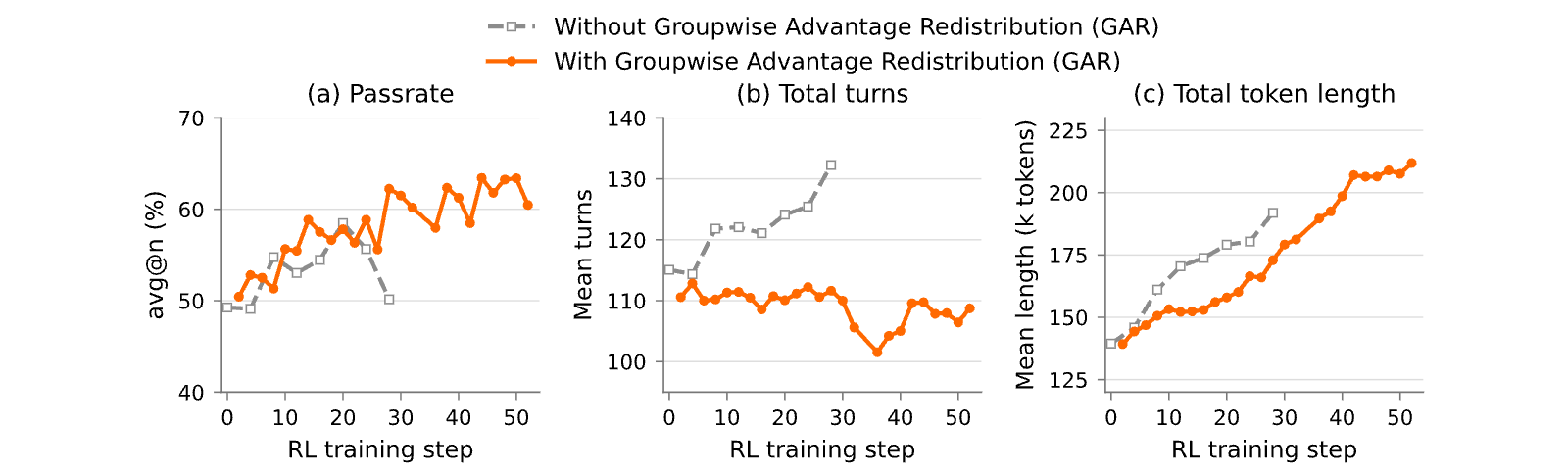
To assess the effect of online groupwise advantage redistribution on training dynamics, we compare code-only RL runs of MiMo-V2.6-Flash with and without it, using a training batch size of 128 and token-mean loss aggregation (Figure 8). Without online grading, turns and total token length grow rapidly, causing more trajectories to hit the length limit, making it difficult to sustain improvements in pass rate. With online grading, pass-rate gains are sustained through step 52, while turn counts remain roughly stable and token length grows gradually. These trends suggest that online grading supports continued policy improvement under a more stable training regime.
Separate maintainer-oriented audits found that, under pressure to improve test pass rates, policies trained without online grading increasingly adopted undesirable behaviors such as speculative compatibility branches, broad exports, exception swallowing, relaxed validation, and evaluation-specific configuration changes. These workarounds aim to increase the likelihood of passing test but can exceed the scope of the task instructions, expand APIs unnecessarily, obscure failures, and make the code harder to maintain. In contrast, policies trained with online grading tended to produce smaller, more precise patches that remained within the requested scope and were easier to maintain.
To improve RL training stability and encourage efficient, reliable behavior, we introduce two complementary mechanisms. A group-relative length penalty curbs excessive token growth, while segment-level behavioral penalties address format violations and tool call errors. Batch-level advantage rebalancing improves credit assignment while limiting excess negative optimization pressure that can drive uncontrolled entropy growth.
We find that a group-relative length penalty improves generalization and curbs rapid growth in generated tokens during RL training. For each prompt with sampled rollouts, let be the original outcome reward, the indices of successful rollouts, and the generated-token count. Let be the minimum group pass rate and the percentile parameter. For groups with , we compute the reference length and obtain the adjusted reward
Here is the maximum reward deduction, the tolerated relative excess above , the excess at which the penalty saturates, and the ramp exponent; penalizes successful rollouts longer than the reference length. The indicator restricts the deduction to successful rollouts, and . Other groups retain their original rewards. The outcome advantage in Eq. (1) is computed from the adjusted rewards ; the threshold is a separate hyperparameter. This encourages concise successful solutions using a reference adapted to each prompt, while the pass-rate gate preserves room for exploration on difficult prompts.
Outcome rewards can reinforce faulty intermediate behavior, motivating segment-level rules for format violations and tool call errors such as malformed markup, invalid tool names, or malformed arguments. Let mark flagged tokens and otherwise. Across the full training batch, and collect flagged and unflagged token indices with loss mask , respectively; denotes the sign of the owning trajectory’s outcome advantage , and all sums below count tokens.
Here multiplies the magnitude of negative advantage on flagged tokens; scales unflagged positive tokens upward, while scales unflagged negative tokens toward zero. The hyperparameters and cap positive amplification and bound negative attenuation, respectively. The adjusted token advantage replaces in Eq.(1). This masks flagged tokens in positive trajectories and penalizes them more strongly in negative trajectories. Removed positive advantage is redistributed to unflagged positive tokens, while added negative magnitude is offset by reducing penalties on unflagged negative tokens: behavior without detected errors receives more reinforcement or less punishment, depending on the trajectory’s sign. Each sign’s total advantage mass is conserved when neither scale is clipped, limiting excess negative pressure that can drive uncontrolled entropy growth. If a denominator is zero, its scale is set to one; conservation is not guaranteed in this case or when clipping occurs.
In this section, we describe the scaled RL training run, including training setup (§5.1), evaluation settings (§5.2), RL performance (§5.3), expert load stability (§5.4) and analyze the failures (§5.5). The running log can be found at https://mimo.xiaomi.com/rl/mimo-v26.
Our RL tasks span various domains, including agentic and competitive coding (68%), general tool use (12%), aesthetic design (13%), context following (3%), and cyber security (4%). We sample a prompt batch of 1568 with 16 rollouts per prompt, totaling a global train batch of 25K trajectories. Training uses GRPO with asynchronous partial rollouts at a staleness of 4.
We use the Muown optimizer with a learning rate of , no weight decay or learning rate warmup, and a gradient clipping threshold of . For the Muon component, we use a momentum coefficient of with Nesterov momentum enabled, perform Newton–Schulz iterations per update, and apply an additional update scaling factor of . For the Adam component, we set and . To stabilize MXFP4 training, we initialize RL by carrying over the FP32 master weights and Muown’s row state from the SFT checkpoint. During RL training, we freeze the router to maintain stable expert loads.
We adopt Group Relative Policy Optimization (GRPO) in Eq. (1), with the advantage computation detailed in §4.3. For loss aggregation we use prompt-mean aggregation, which averages the surrogate at the prompt level rather than over all response tokens; this prevents response length from growing too quickly during RL. For importance sampling, the ratio is computed per token: . The training probability of each token is produced by the current model in the training framework, and the inference probability is the one produced by the rollout model when that token was generated; for partial rollouts we do not recompute inference probabilities. We clip the importance sampling ratio with four decoupled bounds, for positive advantages and for negative ones, giving the clip mask . Positive and negative bounds are both initialized to and tuned independently at runtime based on policy entropy: when entropy is too low, we widen the positive bounds and narrow the negative ones to pull entropy back to the normal range, and we do the opposite when entropy is too high. Throughout training we also monitor the token clipping rate of each direction.
We evaluate agentic capabilities across four categories: code agent, cybersecurity, general agent, and visual agent. Our evaluation combines public benchmarks with three internal benchmarks: MiMo Code Bench, MiMo Cyber Bench, and MiMo Visual Coding.
We evaluate software-engineering capabilities using DeepSWE v1.1 (Huang et al., 2026), ProgramBench (Yang et al., 2026a), and MiMo Code Bench. DeepSWE focuses on long-horizon development tasks. ProgramBench assesses end-to-end software construction: agents must reconstruct a program from its compiled binary and documentation, producing an implementation that reproduces the reference program’s behavior. MiMo Code Bench provides an additional in-house evaluation of coding agents across a diverse range of coding tasks.
We evaluate complementary aspects of vulnerability reproduction and exploitation using CyberGym (Wang et al., 2025), ExploitGym (Wang et al., 2026), ExploitBench (Lee and Brumley, 2026), SEC Bench Pro (Lee et al., 2026), and MiMo Cyber Bench. CyberGym measures agents’ ability to reproduce vulnerabilities in real-world software, while SEC Bench Pro emphasizes reproducing complex vulnerabilities from bug reports. ExploitGym assesses exploit development beyond merely reproducing a crash, and ExploitBench evaluates progress through multiple exploitation stages and the resulting security impact. MiMo Cyber Bench supplements these public benchmarks with an in-house cybersecurity evaluation.
We evaluate general-purpose agents across tool use, professional knowledge work, terminal-based problem solving, and computer use. AutomationBench (Shepard and Salimans, 2026) evaluates cross-application workflow orchestration through REST APIs in simulated SaaS environments, including API discovery and adherence to business rules. Toolathlon-Verified (Li et al., 2026a; HKUST NLP, 2026) evaluates long-horizon, multi-application workflows using diverse tools, including those exposed through the Model Context Protocol (MCP). GDPval-AA v2.1 (Patwardhan et al., 2025; Artificial Analysis, 2026), Artificial Analysis’s evaluation framework for GDPval, assesses the quality of professional deliverables on economically valuable tasks. JobBench (Li et al., 2026b) evaluates workplace workflows that domain experts identify as high-priority for delegation to AI agents. Agents’ Last Exam (Sun et al., 2026) evaluates long-horizon, economically valuable professional tasks with verifiable outcomes. Terminal-Bench 4.0 and 2.1 (Marten et al., 2026; Merrill et al., 2026) evaluate the completion of complex tasks in terminal environments. OSWorld-Verified (Xie et al., 2024; XLANG Lab, 2025) evaluates interactive computer use across real web and desktop applications.
We evaluate visual coding capabilities using MiMo Visual Coding, an internally developed benchmark spanning open-ended design and high-fidelity visual replication. The benchmark includes tasks such as WebDev and Image2Code, which involve building websites to fulfill user requests and translating reference images into visually faithful code implementations, respectively.
All baseline models with configurable reasoning effort are evaluated at the highest supported setting (max).
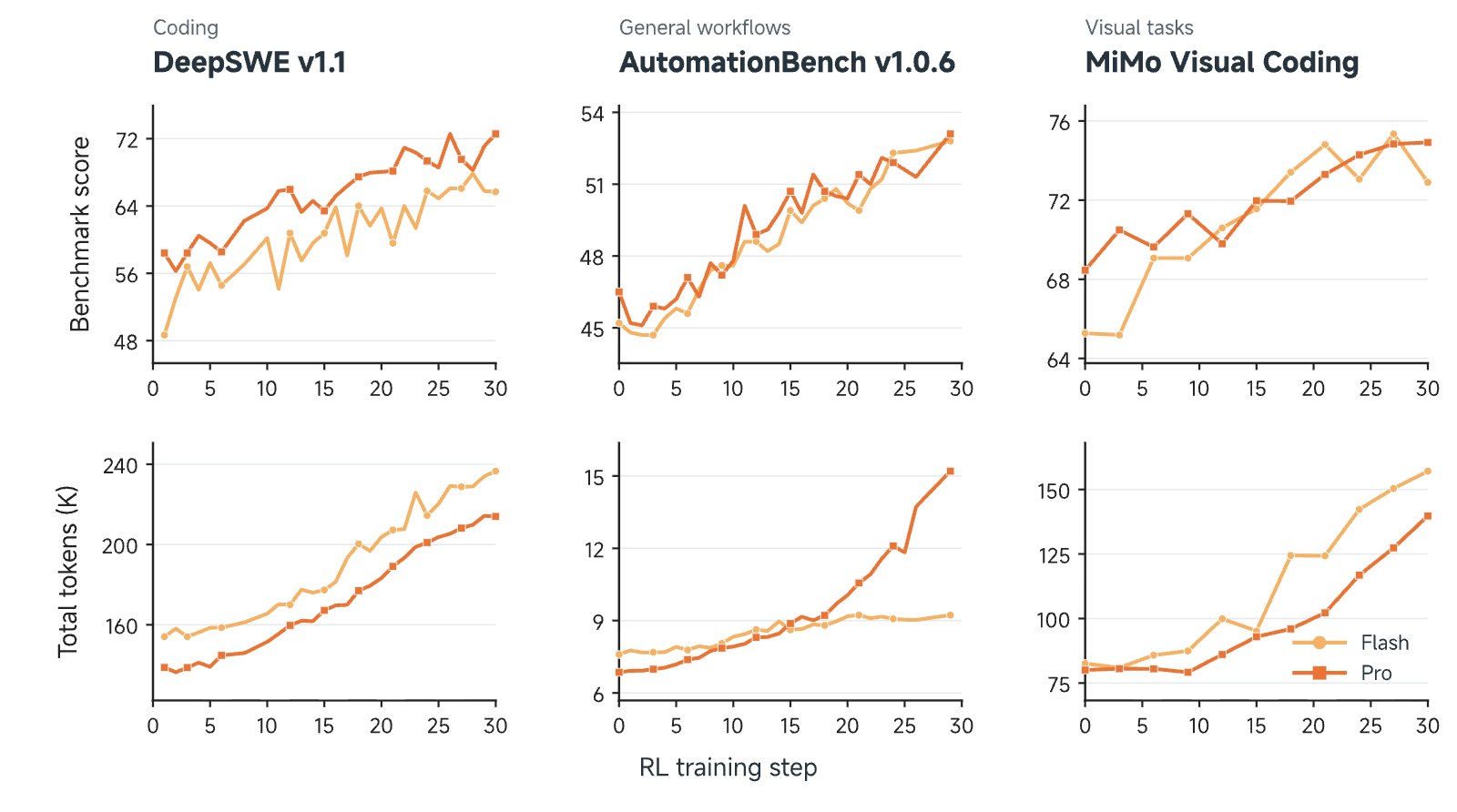
The performance changes are monitored during the process to validate the scaled RL compute. As shown in Figure 9, both Flash and Pro achieve overall improvements on DeepSWE v1.1, AutomationBench v1.0.6, and MiMo Visual Coding during RL training, despite fluctuations between checkpoints. These gains generally accompany increasing total token counts, showing that stronger task performance develops alongside greater token usage. We further investigate the effect of multi-harness training, with results demonstrated in Figure 10. The dedicated training improves DeepSWE v1.1 performance across both the four training mini-harnesses and the three held-out harnesses: codex, claude code, and mini-swe-agent. Despite fluctuations between checkpoints, all three held-out harnesses improve over the course of training, with their mean Pass@1 increasing from approximately 50% to 66%. The gap between the mean performance on training and held-out harnesses also narrows, providing evidence that the learned coding capabilities transfer across harness implementations. These results support our design of using lightweight, modular mini-harnesses to introduce controlled diversity during RL.
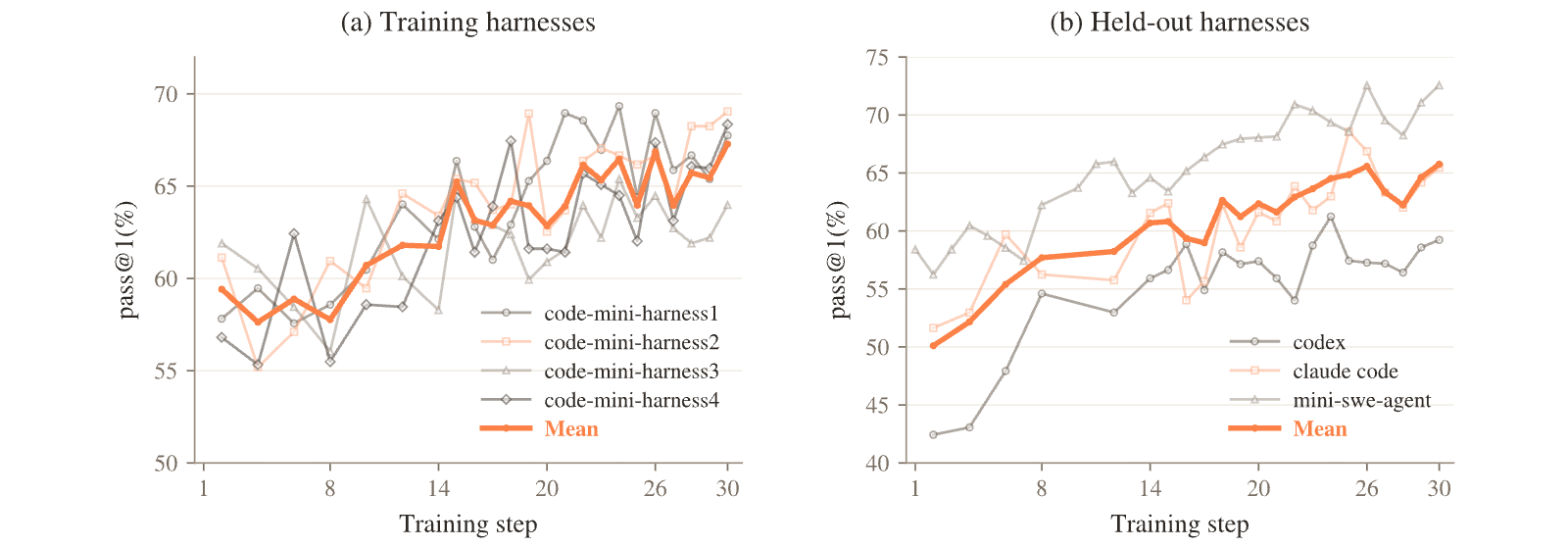
Figure 11 compares two MiMo-V2.6-Pro RL runs that differ only in whether the MoE router is frozen, tracking three expert-load statistics at decoder layer 9: the coefficient of variation (CV), the peak load factor (max/mean), and the fraction of cold experts below the mean (loads normalized per step). We observe a severe load-collapse problem when the router is trainable: all three metrics rise monotonically over the first 20 steps, with CV increasing from to , peak load from to , and the cold-expert fraction from to . To diagnose the cause, we restore the router parameters of the step-20 checkpoint to their initial pre-RL values while keeping all other parameters unchanged: load balance recovers to near-initial levels while benchmark performance remains unchanged, indicating that the collapse is driven by router drift rather than by degradation of the expert weights. We therefore freeze the router for RL training; the frozen-router run keeps all three statistics flat (CV , peak load , cold fraction near ) with benchmark performance growing normally.
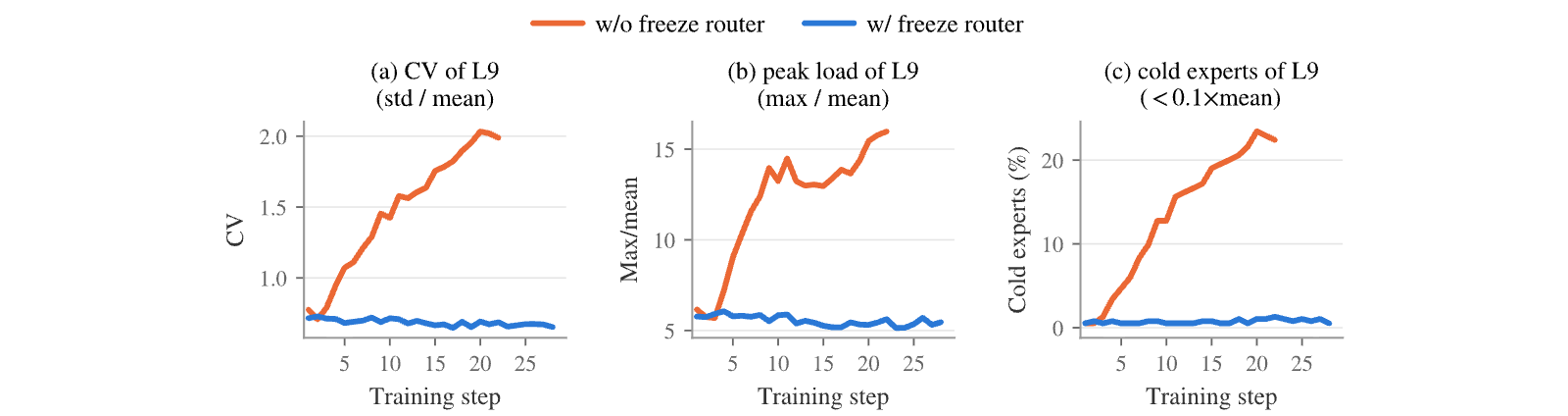
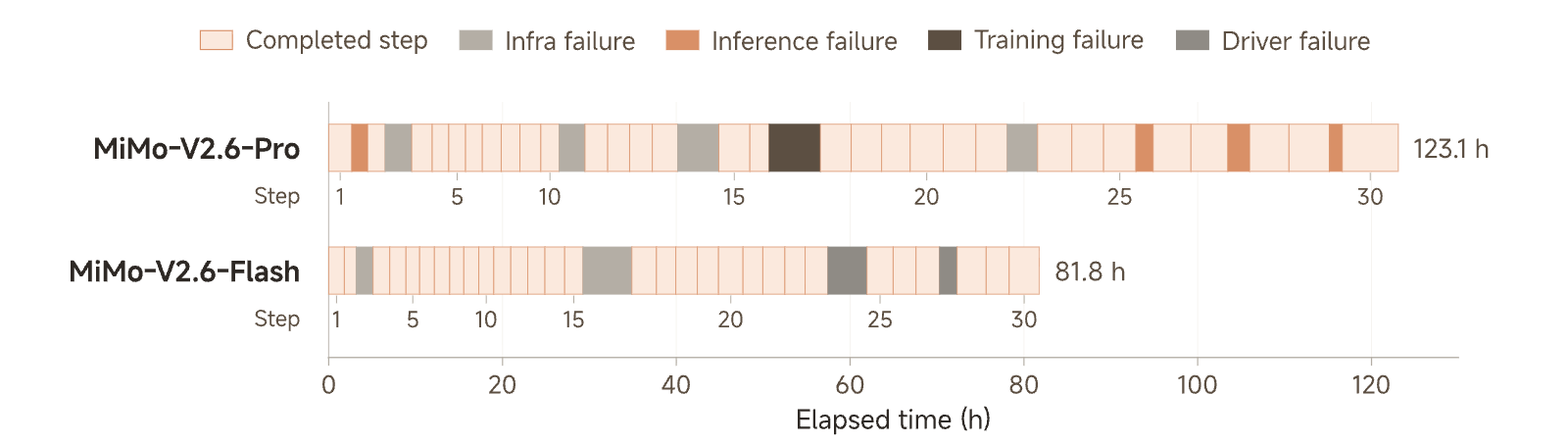
Figure 12 summarizes interruptions in the MiMo-V2.6-Pro and MiMo-V2.6-Flash training runs. Infrastructure failures were primarily GPU-memory double-bit errors (DBEs). Flash was also restarted after a Kubernetes failure caused pods in the Cyber-task cluster to crash between steps 15 and 16. Pro was restarted after the grader became unreachable over the network after step 14. Rollout failures arose in the partial-rollout setting: shorter rollouts completed first after startup, biasing length estimates in Predictive Rollout Dispatch (§6.3) and exhausting both the GPU and pinned host-memory KV pools. Despite early refinements, one harness later produced rollouts less than half as long as those from other harnesses on the same code dataset, skewing estimates in the second and third steps after restart. Training failures were GPU out-of-memory (OOM) errors from MoE imbalance within a micro-batch: at one layer, an expert-parallel (EP) rank received over the mean token load despite a relatively balanced full batch. We adjusted parallelism to reduce activation memory and accommodate these peaks. Driver failures occurred during packing late in Flash as longer sequences increased per-node data volume beyond host-memory capacity. Although packing was distributed across nodes (§6.2), local memory demand still caused CPU OOM and interrupted the run.
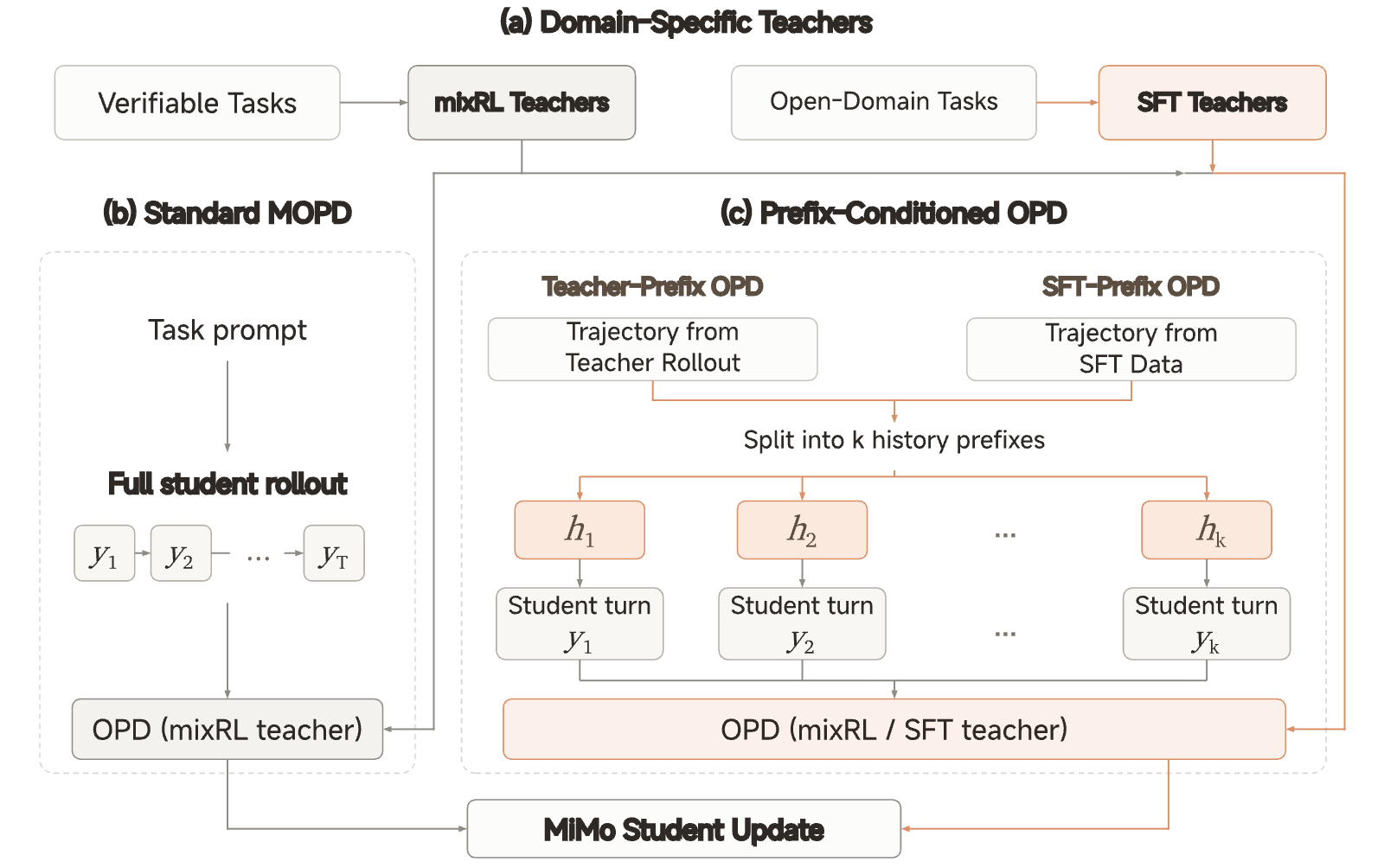
After mixed RL, we use Multi-Prefix Multi-Teacher On-Policy Distillation (MOPD2) to combine capabilities from teachers trained for different tasks, including tasks that are hard to verify. Building on MOPD from MiMo-V2-Flash (Core Team et al., 2026; Ma et al., 2026), we retain autonomous student rollouts in domains with suitable mixRL teachers (Standard MOPD) and add prefix-conditioned single-turn rollouts (Liao et al., 2026). Figure 13 illustrates the teacher configurations and the standard and prefix-conditioned distillation workflows.
Prefixes come from teacher rollouts (Teacher-Prefix OPD) or SFT data (SFT-Prefix OPD). A trajectory with assistant turns provides complete history prefixes, each ending before the corresponding turn. The student samples one new turn from each prefix without regenerating earlier interactions. A preassigned teacher provides token-level supervision conditioned on the same history and the student’s preceding tokens.
For open-domain tasks where reliable RL rewards are difficult to design, we train SFT teachers on high-quality synthetic demonstrations. Their training may provide limited coverage of histories reached after repeated student deviations in long-horizon tasks (Xu et al., 2025). SFT-Prefix OPD therefore starts each rollout from a fixed demonstration prefix, limiting deviations before the sampled turn. Demonstrations supply the context, while the student generates its own continuation rather than imitating a fixed response.
MOPD2 further extends the capabilities of the RL-trained model to domains where reliable training-time verification is challenging, including those with complex environments or verifiers that are difficult to design, such as long-horizon game development, scientific research, and embodied intelligence. The final evaluation results of MiMo-V2.6 are reported in Table 5.6. The MiMo-V2.6 series delivers substantial improvements over MiMo-V2.5, achieving performance comparable to that of frontier models across various domains.
| Benchmark | MiMo-V2.6 Pro | MiMo-V2.6 Flash | MiMo-V2.5 Pro | Claude Opus 5 | GPT-5.6 Sol | Claude Fable 5 |
| [0pt][0pt] Code Agent | ||||||
| DeepSWE v1.1 | 71.9 | 67.9 | 19.0 | 74.0 | 73.0 | 70.0 |
| ProgramBench | 26.5 | 26.0 | 12.5 | 37.0 | 25.0 | 33.0 |
| MiMo Code Bench | 63.2 | 61.2 | 40.4 | 68.6 | 59.3 | - |
| [0pt][0pt] General Agent | ||||||
| AutomationBench v1.0.6 | 53.1 | 52.3 | 16.0 | 50.3 | 45.8 | 46.2 |
| Toolathlon-Verified | 76.9 | 73.6 | 49.1 | 80.6 | 74.9 | 77.9 |
| GDPval-AA 2.1 | 1673 | - | 1107 | 1708 | 1588 | 1595 |
| Agents’ Last Exam | 31.6 | 27.6 | 13.2 | 31.6 | 30.8 | 25.7 |
| Terminal Bench 4.0 | 34.9 | 28.8 | 1.5 | 49.0 | 39.9 | 42.4 |
| Terminal Bench 2.1 | 89.9 | 87.6 | 65.2 | 89.1 | 88.8 | 84.3 |
| OSWorld-Verified | 82.0 | 80.8 | - | 83.4 | 83.0 | 86.0 |
| JobBench | 62.0 | 61.2 | 25.0 | 65.7 | 45.4 | 57.4 |
| [0pt][0pt] Cybersecurity | ||||||
| CyberGym | 94.0 | 95.1 | 40.0 | - | - | - |
| MiMo Cyber Bench | 80.2 | 77.2 | 0.0 | - | - | - |
| ExploitGym | 17.8 | 6.0 | 0.2 | 22.1 | 30.3 | 28.4 |
| ExploitBench | 47.9 | 25.3 | 16.6 | 70.0 | 78.5 | 78.0 |
| SEC Bench Pro | 66.3 | 47.5 | 17.7 | - | 79.1 | - |
| [0pt][0pt] Visual Agent | ||||||
| MiMo Visual Coding | 72.3 | 71.5 | - | 70.0 | 73.4 | 69.1 |
| Data source | Total tokens (B) | Token share (%) | Loss tokens (B) |
| Code | 23.2 | 29.9 | 7.3 |
| Cyber | 11.0 | 14.2 | 4.8 |
| General | 22.0 | 28.5 | 5.7 |
| Visual | 21.2 | 27.4 | 9.4 |
| Total | 77.4 | 100.0 | 27.2 |
| Domain | Task Family | Training Tasks | Verifier |
| Code | Software engineering | 3k | Executable tests |
| Cyber | Vulnerability reproduction | 1k | Rule checks |
| General | Knowledge work | 1k | Rubric-based judging |
| Visual | Web development | 2k | Visual grading |
| Benchmark | Metric | Qwen3.5-9B | MiMo-V2.6-Distill-Qwen-9B | |
| SFT | RL | |||
| [0pt][0pt] Code | ||||
| SWE-bench Verified | avg@3 | 60.0 | 61.1 | 66.2 |
| SWE-bench Pro | avg@3 | 32.0 | 44.6 | 47.6 |
| MiMo Code Bench (mini) | avg@3 | 19.5 | 51.6 | 59.9 |
| [0pt][0pt] Cyber | ||||
| MiMo Cyber Bench (mini) | avg@3 | 5.7 | 31.3 | 47.0 |
| [0pt][0pt] General | ||||
| AutomationBench v1.0.6 | avg@1 | 5.0 | 30.3 | 33.1 |
| Terminal Bench 2.1 | avg@1 | 27.0 | 37.1 | 52.8 |
| Toolathlon-Verified | avg@1 | 25.9 | 35.2 | 38.0 |
| OfficeQA Pro | avg@1 | 9.0 | 19.5 | 24.8 |
| JobBench | avg@1 | 2.6 | 18.3 | 25.2 |
| MiMo General Bench (mini) | avg@1 | 28.5 | 62.2 | 70.6 |
| [0pt][0pt] Visual | ||||
| MiMo Visual Coding (mini) | avg@1 | 61.7 | 64.0 | 72.4 |
| Training harnesses | Held-out harnesses | |||||||
| Model | mini- harness1 | mini- harness2 | mini- harness3 | mini- harness4 | codex | claude code | mini-swe- agent | Mean |
| [0pt][0pt] SWE-bench Verified | ||||||||
| Qwen3.5-9B | 58.4 | 36.4 | 54.8 | 57.8 | 48.6 | 54.8 | 60.6 | 53.1 |
| MiMo-V2.6-Distill-Qwen-9B | 61.7 | 63.9 | 61.7 | 63.1 | 58.5 | 61.7 | 65.3 | 62.3 |
| + Multi-Harness RL | 67.9 | 65.1 | 66.6 | 67.2 | 61.1 | 65.3 | 66.7 | 65.7 |
| [0pt][0pt] SWE-bench Pro | ||||||||
| Qwen3.5-9B | 33.5 | 15.2 | 31.1 | 31.1 | 23.1 | 26.9 | 31.6 | 27.5 |
| MiMo-V2.6-Distill-Qwen-9B | 45.2 | 46.6 | 45.1 | 45.5 | 40.3 | 42.2 | 45.6 | 44.4 |
| + Multi-Harness RL | 48.5 | 46.9 | 47.6 | 48.0 | 42.6 | 43.1 | 48.4 | 46.5 |
| [0pt][0pt] MiMo Code Bench (mini) | ||||||||
| Qwen3.5-9B | 19.0 | 7.5 | 16.5 | 22.5 | 10.5 | 13.5 | 17.5 | 15.3 |
| MiMo-V2.6-Distill-Qwen-9B | 53.2 | 56.7 | 51.5 | 56.3 | 46.0 | 51.2 | 56.8 | 53.1 |
| + Multi-Harness RL | 62.5 | 64.5 | 57.0 | 63.3 | 50.7 | 53.0 | 62.0 | 59.0 |
Figure 14 Overview architecture of RL infrastructure.
Figure 15 Rollout heterogeneity across 25 data sources. Each line connects one source’s Start point (faint) to its End point (solid); each point plots that source’s mean generated tokens against mean rollout time over completed rollouts (tokens summed across dialogue contexts before context filtering). Both axes are logarithmic.
Figure 16 Trace-driven scheduling simulation for six sources. Legend: mean duration / group acceptance rate. Top: Collection progress (accepted groups / nominal per-step targets, with surplus carried forward). Bottom: Rollout occupancy (shares of occupied sequence slots). Step spacing reflects elapsed time. Dotted lines mark step boundaries. Training time, credit-assignment latency, staleness expiry, and replay are excluded.
Table 4 Weighted SFT data composition. Token counts are in billions. Values are rounded to one decimal place; totals use unrounded aggregate counts.
Table 5 Overview of the released RL environments, including training task counts and the verifiers used to evaluate task completion. Task counts are approximate, based on distinct task identifiers in each training set; k denotes one thousand.
Table 6 Evaluation of Qwen3.5-9B, MiMo-V2.6-Distill-Qwen-9B after SFT, and the domain-specific checkpoints after further GRPO training (RL). Code uses single-harness RL. The highest available score in each row is bolded.
Table 7 Coding performance across agent harnesses. Mean is the unweighted average of the seven harness scores, rounded to one decimal place. The best result in each column within a dataset is bolded.
Figure 17 Examples of website hero sections generated by Qwen3.5-9B, MiMo-V2.6-Distill-Qwen-9B (SFT), and MiMo-V2.6-Distill-Qwen-9B (RL). Each row (a–c) shows outputs from the three models for the same prompt.
References
- Artificial Analysis (2026) Artificial Analysis. GDPval-AA v2.1 Leaderboard, 2026. URL https://artificialanalysis.ai/evaluations/gdpval-aa. Accessed September 21, 2026.Source
- Badertdinov et al. (2026) I. Badertdinov, M. Nekrashevich, A. Shevtsov, and A. Golubev. Swe-rebench v2: Language-agnostic swe task collection at scale, 2026. URL https://arxiv.org/abs/2602.23866.Source
- Chen et al. (2026) J. Chen, Y. Liang, and Z. Liu. Dflash: Block diffusion for flash speculative decoding, 2026. URL https://arxiv.org/abs/2602.06036.Source
- Core Team et al. (2026) Core Team, B. Xiao, B. Xia, B. Yang, B. Gao, B. Shen, C. Zhang, C. He, C. Lou, F. Luo, et al. MiMo-V2-Flash technical report, 2026. URL https://arxiv.org/abs/2601.02780.Source
- Deng et al. (2025) X. Deng, J. Da, E. Pan, Y. Y. He, C. Ide, K. Garg, N. Lauffer, A. Park, N. Pasari, C. Rane, et al. Swe-bench pro: Can ai agents solve long-horizon software engineering tasks?, 2025. URL https://arxiv.org/abs/2509.16941.Source
- Dong et al. (2026) J. Dong, L. Zhao, Z. Yue, W. Ma, L. Zhang, L. Li, S. Li, Y. Song, B. Ye, and F. Luo. Groupwise agentic grading and advantage redistribution for code agent rl, 2026. URL https://arxiv.org/abs/2609.32577.Source
- Gloeckle et al. (2024) F. Gloeckle, B. Y. Idrissi, B. Rozière, D. Lopez-Paz, and G. Synnaeve. Better & faster large language models via multi-token prediction. In Forty-first International Conference on Machine Learning, ICML 2024, Vienna, Austria, July 21-27, 2024. OpenReview.net, 2024. URL https://openreview.net/forum?id=pEWAcejiU2.Source
- Han et al. (2025) Z. Han, A. You, H. Wang, K. Luo, G. Yang, W. Shi, M. Chen, S. Zhang, Z. Lan, C. Deng, et al. Asyncflow: An asynchronous streaming rl framework for efficient llm post-training, 2025. URL https://arxiv.org/abs/2507.01663.Source
- He et al. (2026) C. He, L. Li, S. Li, H. Lv, L. Kong, Q. Liu, T. Yang, and S. Ren. Semantic head specialization guides hybrid vit attention for multimodal llms, 2026. URL https://arxiv.org/abs/2608.28383.Source
- HKUST NLP (2026) HKUST NLP. Introducing Toolathlon-Verified, June 2026. URL https://toolathlon.xyz/docs/blog/toolathlon-verified.Source
- Huang and Jiang (2026) W. Huang and P. Jiang. Deepswe v1.1: a cleaner, more reproducible benchmark for frontier coding agents, 2026. URL https://github.com/datacurve-ai/deep-swe.Source
- Huang et al. (2026) W. Huang, C. Lee, L. Tng, and S. Ge. Deepswe: Measuring frontier coding agents on original, long-horizon engineering tasks, 2026. URL https://arxiv.org/abs/2607.07946.Source
- Jimenez et al. (2024) C. E. Jimenez, J. Yang, A. Wettig, S. Yao, K. Pei, O. Press, and K. R. Narasimhan. Swe-bench: Can language models resolve real-world github issues? In The Twelfth International Conference on Learning Representations, ICLR 2024, Vienna, Austria, May 7-11, 2024. OpenReview.net, 2024. URL https://openreview.net/forum?id=VTF8yNQM66.Source
- Jordan et al. (2024) K. Jordan, Y. Jin, V. Boza, J. You, F. Cesista, L. Newhouse, and J. Bernstein. Muon: An optimizer for hidden layers in neural networks, 2024. URL https://kellerjordan.github.io/posts/muon/.Source
- Kimi Team (2025) Kimi Team. Kimi k1.5: Scaling reinforcement learning with llms, 2025. URL https://arxiv.org/abs/2501.12599.Source
- Lee et al. (2026) H. Lee, J. Liu, D. Kim, Z. Zhang, C. S. Xia, and L. Zhang. Sec-bench pro: Can language models solve long-horizon software security tasks?, 2026. URL https://arxiv.org/abs/2605.26548.Source
- Lee and Brumley (2026) S. Lee and D. Brumley. Exploitbench: A capability ladder benchmark for LLM cybersecurity agents, 2026. URL https://arxiv.org/abs/2605.14153.Source
- Li et al. (2026a) J. Li, W. Zhao, J. Zhao, W. Zeng, H. Wu, X. Wang, R. Ge, Y. Cao, Y. Huang, W. Liu, J. Liu, Z. Su, Y. Guo, F. Zhou, L. Zhang, J. Michelini, X. Wang, X. Yue, S. Zhou, G. Neubig, and J. He. The tool decathlon: Benchmarking language agents for diverse, realistic, and long-horizon task execution. In International Conference on Learning Representations, 2026a. URL https://arxiv.org/abs/2510.25726.Source
- Li et al. (2026b) Y. Li, Y. Feng, Z. Xu, Z. Ma, K. Zheng, F. Jiang, X. Sun, R. Shao, Z. Chen, Y. Huang, X. Han, B. Lee, K. Xu, S. Zeng, H. Hua, X. Zhang, B. Alomair, R. Krishna, L. Zettlemoyer, P. W. Koh, B. Ramasubramanian, L. Niu, X. Yue, and R. Poovendran. JobBench: Aligning agent work with human will, 2026b. URL https://arxiv.org/abs/2605.26329.Source
- Liao et al. (2026) B. Liao, H. Dong, C. Monz, X. Xu, L. Dong, and F. Wei. Multi-turn on-policy distillation with prefix replay, 2026. URL https://arxiv.org/abs/2607.04763.Source
- Lion et al. (2026) K. Lion, F. Hübler, B. Li, A. Orvieto, and N. He. Muown: Row-norm control for Muon optimization, 2026. URL https://arxiv.org/abs/2605.10797.Source
- Liu et al. (2024) A. Liu, B. Feng, B. Xue, B. Wang, B. Wu, C. Lu, C. Zhao, C. Deng, C. Zhang, C. Ruan, et al. Deepseek-v3 technical report, 2024. URL https://arxiv.org/abs/2412.19437.Source
- Liu et al. (2025a) A. Liu, A. Mei, B. Lin, B. Xue, B. Wang, B. Xu, B. Wu, B. Zhang, C. Lin, C. Dong, et al. Deepseek-v3.2: Pushing the frontier of open large language models, 2025a. URL https://arxiv.org/abs/2512.02556.Source
- Liu et al. (2025b) J. Liu, J. Su, X. Yao, Z. Jiang, G. Lai, Y. Du, Y. Qin, W. Xu, E. Lu, J. Yan, Y. Chen, H. Zheng, Y. Liu, S. Liu, B. Yin, W. He, H. Zhu, Y. Wang, J. Wang, M. Dong, Z. Zhang, Y. Kang, H. Zhang, X. Xu, Y. Zhang, Y. Wu, X. Zhou, and Z. Yang. Muon is scalable for LLM training, 2025b. URL https://arxiv.org/abs/2502.16982.Source
- Ma et al. (2025) W. Ma, H. Zhang, L. Zhao, Y. Song, Y. Wang, Z. Sui, and F. Luo. Stabilizing moe reinforcement learning by aligning training and inference routers, 2025. URL https://arxiv.org/abs/2510.11370.Source
- Ma et al. (2026) W. Ma, J. Wei, L. Zhao, H. Zhang, B. Xiao, L. Li, Q. Yang, B. Gao, Y. Wang, R. Li, J. Dong, Z. Sui, and F. Luo. Mopd: Multi-teacher on-policy distillation for capability integration in llm post-training, 2026. URL https://arxiv.org/abs/2606.30406.Source
- Marten et al. (2026) R. Marten, A. Shaw, I. Bercovich, B. Droste, T. Cerruti, S. Dillmann, R. Wang, D. Wahdany, A. Hart, K. Krauth, ScaleAI, Snorkel AI, Turing, gNucleus AI, Boolean AI, N. Carlini, S. Lyu, A. Wei, A. Khatua, B. Plüster, C. Dwivedi, C. Sutcliffe, Yuming, D. Tivris, D. Wang, H. W. Goh, H. Xing, H. Lin, I. Salia, J. Seol, J. Bao, J. Ouyang, J. Park, L. Walsh, L. Kong, M. Ivanov, M. Ubl, M. Liamets, O. Menis, P. Migdal, Q. Bao, R. Movva, R. Ben Chaim, N. Srinath, S. Bogdanik, S. Yadav, S. Benjamin, T. Kung, W. Hughes, X. Lan, H. Gupta, S. Mishra, C. Wang, H. He, J. Tu, K. Montgomery, Z. Tu, A. Naik, D. Mortensen, I. Zhang, Y. Mathur, E. Liu, K. Singh, M. Yu, S. Feng, V. Gangal, Z. Tao, S. Ruan, J. Mueller, J. Cabezas, J. Bauer, K. X. Li, R. Zhang, A. Feller, A. Madayan, L. Chen, B. Feuer, X. Li, B. Li, H. Raj, S. Galler, L. Shi, I. Segal, K. Buchanan, S. P., R. Desai, A. Schneider, C. Settles, X. Lin, M. Nezhurina, A. Wang, M. Kowalczyk, J.-X. Zhao, S. Satia, J. Hu, S. Atef, K. Chen, S. Vance, G. Segato, J. Jitsev, A. Dimakis, M. Merrill, A. Konwinski, and L. Schmidt. Terminal-Bench, 2026. URL https://github.com/harbor-framework/terminal-bench/releases/tag/v4.0.0. Software release, version 4.0.0.Source
- Merrill et al. (2026) M. A. Merrill, A. G. Shaw, N. Carlini, B. Li, H. Raj, I. Bercovich, L. Shi, J. Y. Shin, T. Walshe, E. K. Buchanan, J. Shen, G. Ye, H. Lin, J. Poulos, M. Wang, M. Nezhurina, J. Jitsev, D. Lu, O. M. Mastromichalakis, Z. Xu, Z. Chen, Y. Liu, R. Zhang, L. L. Chen, A. Kashyap, J.-L. Uslu, J. Li, J. Wu, M. Yan, S. Bian, V. Sharma, K. Sun, S. Dillmann, A. Anand, A. Lanpouthakoun, B. Koopah, C. Hu, E. Guha, G. H. S. Dreiman, J. Zhu, K. Krauth, L. Zhong, N. Muennighoff, R. Amanfu, S. Tan, S. Pimpalgaonkar, T. Aggarwal, X. Lin, X. Lan, X. Zhao, Y. Liang, Y. Wang, Z. Wang, C. Zhou, D. Heineman, H. Liu, H. Trivedi, J. Yang, J. Lin, M. Shetty, M. Yang, N. Omi, N. Raoof, S. Li, T. Y. Zhuo, W. Lin, Y. Dai, Y. Wang, W. Chai, S. Zhou, D. Wahdany, Z. She, J. Hu, Z. Dong, Y. Zhu, S. Cui, A. Saiyed, A. Kolbeinsson, J. Hu, C. M. Rytting, R. Marten, Y. Wang, A. Dimakis, A. Konwinski, and L. Schmidt. Terminal-Bench: Benchmarking agents on hard, realistic tasks in command line interfaces, 2026. URL https://arxiv.org/abs/2601.11868.Source
- Moritz et al. (2018) P. Moritz, R. Nishihara, S. Wang, A. Tumanov, R. Liaw, E. Liang, M. Elibol, Z. Yang, W. Paul, M. I. Jordan, et al. Ray: A distributed framework for emerging $\{$AI$\}$ applications. In 13th USENIX symposium on operating systems design and implementation (OSDI 18), pages 561–577, 2018.
- Opsahl-Ong et al. (2026) K. Opsahl-Ong, A. Singhvi, J. Collins, I. Zhou, C. Wang, A. Baheti, O. Oertell, J. Portes, S. Havens, E. Elsen, M. Bendersky, M. Zaharia, and X. Chen. Officeqa pro: An enterprise benchmark for end-to-end grounded reasoning, 2026. URL https://arxiv.org/abs/2603.08655.Source
- Patwardhan et al. (2025) T. Patwardhan, R. Dias, E. Proehl, G. Kim, M. Wang, O. Watkins, S. P. Fishman, M. Aljubeh, P. Thacker, L. Fauconnet, N. S. Kim, P. Chao, S. Miserendino, G. Chabot, D. Li, M. Sharman, A. Barr, A. Glaese, and J. Tworek. GDPval: Evaluating AI model performance on real-world economically valuable tasks, 2025. URL https://arxiv.org/abs/2510.04374.Source
- PrimeIntellect (2026) PrimeIntellect. Swe-rl: Software engineering tasks for rl, 2026. URL https://huggingface.co/collections/PrimeIntellect/swe-rl.Source
- Qu et al. (2026) X. Qu, P. Huang, and S. Horvath. Can Muon fine-tune Adam-pretrained models?, 2026. URL https://arxiv.org/abs/2605.10468.Source
- Qwen Team (2025) Qwen Team. Qwen3-next: Towards ultimate training & inference efficiency. https://qwen.ai/blog?id=4074cca80393150c248e508aa62983f9cb7d27cd&from=research.latest-advancements-list, September 2025.Source
- Shah et al. (2025) I. Shah, A. M. Polloreno, K. Stratos, P. Monk, A. Chaluvaraju, A. Hojel, A. Ma, A. Thomas, A. Tanwer, D. J. Shah, K. Nguyen, K. Smith, M. Callahan, M. Pust, M. Parmar, P. Rushton, P. Mazarakis, R. Kapila, S. Srivastava, S. Singla, T. Romanski, Y. Vanjani, and A. Vaswani. Practical efficiency of Muon for pretraining, 2025. URL https://arxiv.org/abs/2505.02222.Source
- Shao et al. (2024) Z. Shao, P. Wang, Q. Zhu, R. Xu, J. Song, X. Bi, H. Zhang, M. Zhang, Y. K. Li, Y. Wu, and D. Guo. Deepseekmath: Pushing the limits of mathematical reasoning in open language models, 2024. URL https://arxiv.org/abs/2402.03300.Source
- Shepard and Salimans (2026) D. Shepard and R. Salimans. AutomationBench, 2026. URL https://arxiv.org/abs/2604.18934.Source
- Shoeybi et al. (2019) M. Shoeybi, M. Patwary, R. Puri, P. LeGresley, J. Casper, and B. Catanzaro. Megatron-lm: Training multi-billion parameter language models using model parallelism, 2019. URL https://arxiv.org/abs/1909.08053.Source
- Sun et al. (2026) Y. Sun, X. Han, W. Zhang, Y. Pang, T. Wang, Y. Cao, Y. Huang, C. Duroiu, H. Zhang, J. Lin, W. Zhang, T. Zeng, Y. Yan, B. Liu, H. Wen, M. Xu, X. Liu, Z. Chen, W. Shi, A. Dsouza, V. S. Chen, P. Bryant, C. Boettiger, Y. Rangan, B. Rothenberg, K. Steinfeld, A. Rao, T. Schneider, G. Yannakakis, L. Zanna, K. Ozbay, I. Sim, T. Zohdi, G. E. Karniadakis, J. Gallant, T. Head-Gordon, Y. Li, W. Deng, T. Sun, H. Wang, Z. Wang, J. Xu, C. Y. Liu, Y. Cheng, R. Hu, A. Bacho, S. Cao, Z. Qin, Y. Chen, H. Fan, H. Liu, L. Zeng, S. M. Bharadwaj, L. Gong, Y. Yang, M. Song, R. Wang, Z. Zhang, H. Bao, S. Lu, J. Tu, Z. Wang, Z. Zhang, Z. Chen, Y. Jiang, Z. Li, B. Lyu, C. Ma, P. Xu, B. Zhang, S. Gu, H. Hua, H. Li, W. Liao, C. Liu, J. Peng, H. Sun, Z. Xu, B. Chen, J. Cheng, Y. Jiang, K. Kuang, Y. Li, Y. Pan, Z. Rao, A. Schubert, Y. Shen, V. Siu, X. Sun, K. Zhang, X. Zhang, Y. Zhu, I. S. Chandok, L. Ding, J. Fan, A. Glover, J. Hu, Y. Hu, W. Huang, Z. Jiang, H. Jin, L. Kim, M. Liu, Y. Liu, A. Rafiei, X. Shen, K. Sun, S. Sun, T. Sun, E. Wang, Y. Wang, H. Xing, S. Xu, Y. Xu, Z. Xu, Z. Yan, B. Yuan, R. Zhang, Y. Zhang, Z. Zhao, Liana, S. B. Antu, H. Bai, C. Bosio, J. Cavanagh, P. Cavazos-Rehg, T. Chen, X. Chen, Y. Chen, C. Zhu, C. Dai, S. D. Castro, Y. Deng, K. Dhole, J. Ding, C. Du, Z. Du, H. Fan, R.-Z. Fan, H. Fu, S. Gu, Y. Gu, C. Guo, B. Huang, B. Huang, R. Jaiswal, Z. Jiang, R. Jin, E. Kasson, X. Lan, J. Lee, D. Lei, C. Li, D. Li, H. Li, H. Li, J. Li, X. Li, Y. Li, Y. Li, Y. Li, Z. Li, W. Liang, L. Liao, K. Q. Lin, A. Z. Liu, C. Liu, J. Liu, K. Liu, X. Liu, P. Lu, W. Lv, Y. Lyu, Q. Mang, K. Montgomery, Y. Nie, R. Ning, J. Overwiening, X. Pan, L. Paraboschi, C. F. Park, J. Purnomo, S. Rajwal, S. Rankin, B. Ren, Y. Rong, H. Shang, V. Shaw, F. Shen, J. Shen, M. Shi, S. Qiu, H. Yao, T. Shi, J. So, V. Susoy, H. Szlyk, H. Wang, J. Wang, W. Wang, X. Wang, Z. Wang, D. Wong, A. Wu, D. Wu, F. Wu, M. M. Wu, Y. Wu, Y. Wu, Y. Wu, Q. Wuwu, W. Xiao, Y. Xiong, F. Xu, R. Xu, M. Yan, B. Yang, J. Yang, S. Yang, X. Yang, Y. Yang, H. Ye, X. Yu, Z. Yu, C. Zhang, C. Zhang, H. Zhang, H. Zhang, J. Zhang, K. Zhang, S. Zhang, W. Zhang, W. Zhang, Y. Zhang, Y. Zhang, B. Zhao, Q. Zhao, Y. Zhao, Y. Zheng, L. Zhou, T. Zhou, S. Zhu, S. Zhu, Y. Zhu, Y. Zhu, J. Zuo, C. Cai, H. Casademunt, W. Chen, C. Cheng, N. Deng, R. Fu, T. Fu, Y. Han, H. Ren, Z. He, Q. Jin, L. Li, Y. Li, S. Liu, L. Lu, L. Zhou, S. Mukherjee, Y. Ouyang, Y. Ren, D. Shi, H. Wu, Z. Wu, H. Yao, Z. Yi, J. Yu, R. Zhan, H. Zhou, B. Zhu, J. Zhu, A. Yuille, Y. Liu, R. A. Poldrack, J. Li, Z. Li, M. Tao, J. Huang, W. Shi, C. Spanos, L. Sun, C. Wang, O. Xu, Z. Dong, H. Gomez, A. Caliskan, A. Emami, H. Hu, Z. Li, L. Liu, M. Niu, Y. Shao, J. Sun, M. Tolonen, T. Wang, S. Das, Y. Gao, W. Guo, E. J. Schneider, Z. Lu, Y. Ma, M. Mueller, R. Poovendran, S. Sojoudi, Y. Zhu, and D. Song. Agents’ last exam, 2026. URL https://arxiv.org/abs/2606.05405.Source
- Tao et al. (2026) C. Tao, J. Chen, Y. Jiang, K. Kou, S. Wang, R. Wang, X. Li, S. Yang, Y. Du, J. Dai, Z. Mao, X. Wang, L. Shang, and H. Bai. Swe-lego: Pushing the limits of supervised fine-tuning for software issue resolving, 2026. URL https://arxiv.org/abs/2601.01426.Source
- The Microsoft AI Team (2026) The Microsoft AI Team. MAI-Thinking-1: Building a hill-climbing machine. Technical report, Microsoft AI, 2026. URL https://microsoft.ai/pdf/mai-thinking-1.pdf.Source
- Vaswani et al. (2017) A. Vaswani, N. Shazeer, N. Parmar, J. Uszkoreit, L. Jones, A. N. Gomez, L. Kaiser, and I. Polosukhin. Attention is all you need. In I. Guyon, U. von Luxburg, S. Bengio, H. M. Wallach, R. Fergus, S. V. N. Vishwanathan, and R. Garnett, editors, Advances in Neural Information Processing Systems 30: Annual Conference on Neural Information Processing Systems 2017, December 4-9, 2017, Long Beach, CA, USA, pages 5998–6008, 2017. URL https://proceedings.neurips.cc/paper/2017/hash/3f5ee243547dee91fbd053c1c4a845aa-Abstract.html.Source
- vLLM Project (2026) vLLM Project. Humming. https://github.com/vllm-project/humming/releases/tag/v0.1.15, September 2026. Version 0.1.15, GitHub repository, commit a74973b5079e42ef861720b62f847ce9d33447f5; accessed 2026-09-19.Source
- Wang et al. (2025) Z. Wang, T. Shi, J. He, M. Cai, J. Zhang, and D. Song. Cybergym: Evaluating AI agents’ cybersecurity capabilities with real-world vulnerabilities at scale, 2025. URL https://arxiv.org/abs/2506.02548.Source
- Wang et al. (2026) Z. Wang, N. Schiller, H. Li, S. S. Narayana, M. Nasr, N. Carlini, X. Qi, E. Wallace, E. Bursztein, L. Invernizzi, K. Thomas, Y. Shoshitaishvili, W. Guo, J. He, T. Holz, and D. Song. Exploitgym: Can AI agents turn security vulnerabilities into real attacks?, 2026. URL https://arxiv.org/abs/2605.11086.Source
- Xia et al. (2025) B. Xia, B. Shen, D. Zhu, D. Zhang, G. Wang, H. Zhang, H. Liu, J. Xiao, J. Dong, L. Zhao, et al. Mimo: Unlocking the reasoning potential of language model–from pretraining to posttraining, 2025. URL https://arxiv.org/abs/2505.07608.Source
- Xiaomi (2025) L. Xiaomi. Mimo-audio: Audio language models are few-shot learners, 2025. URL https://arxiv.org/abs/2512.23808.Source
- Xie et al. (2024) T. Xie, D. Zhang, J. Chen, X. Li, S. Zhao, R. Cao, T. J. Hua, Z. Cheng, D. Shin, F. Lei, Y. Liu, Y. Xu, S. Zhou, S. Savarese, C. Xiong, V. Zhong, and T. Yu. Osworld: Benchmarking multimodal agents for open-ended tasks in real computer environments. In A. Globersons, L. Mackey, D. Belgrave, A. Fan, U. Paquet, J. M. Tomczak, and C. Zhang, editors, Advances in Neural Information Processing Systems 37: Annual Conference on Neural Information Processing Systems 2024, NeurIPS 2024, Vancouver, BC, Canada, December 10 - 15, 2024, 2024. 10.52202/079017-1650. URL http://papers.nips.cc/paper_files/paper/2024/hash/5d413e48f84dc61244b6be550f1cd8f5-Abstract-Datasets_and_Benchmarks_Track.html.SourceSource
- XLANG Lab (2025) XLANG Lab. Introducing OSWorld-Verified, July 2025. URL https://xlang.ai/blog/osworld-verified.Source
- Xu et al. (2025) W. Xu, R. Han, Z. Wang, L. T. Le, D. Madeka, L. Li, W. Y. Wang, R. Agarwal, C. Lee, and T. Pfister. Speculative knowledge distillation: Bridging the teacher-student gap through interleaved sampling. In The Thirteenth International Conference on Learning Representations, ICLR 2025, Singapore, April 24-28, 2025. OpenReview.net, 2025. URL https://openreview.net/forum?id=EgJhwYR2tB.Source
- Yang et al. (2026a) J. Yang, K. Lieret, J. Ma, P. Thakkar, D. Pedchenko, S. Sootla, E. McMilin, P. Yin, R. Hou, G. Synnaeve, D. Yang, and O. Press. Programbench: Can language models rebuild programs from scratch?, 2026a. URL https://arxiv.org/abs/2605.03546.Source
- Yang et al. (2026b) S. Yang, C. Tao, J. Chen, T. Yu, R. Wang, Y. Jiang, Y. Du, W. Xu, J. Xiong, T. Wu, L. Shang, X. Li, N. Wong, and H. Bai. What makes interaction trajectories effective for training terminal agents?, 2026b. URL https://arxiv.org/abs/2606.03461.Source
- Ye et al. (2026) B. Ye, L. Li, S. Li, Z. Yue, L. Zhang, H. Lv, Y. Liu, W. Ma, H. Tian, R. Li, J. Dong, Y. Zhao, X. Deng, H. Zhang, L. Zhao, Q. Liu, L. Kong, T. Yang, and F. Luo. CodeMidas: Scaling agentic coding rl environments from code itself, 2026. URL https://arxiv.org/abs/2609.22068.Source
- Yu et al. (2025) Q. Yu, Z. Zhang, R. Zhu, Y. Yuan, X. Zuo, Y. Yue, W. Dai, T. Fan, G. Liu, J. Liu, L. Liu, X. Liu, H. Lin, Z. Lin, B. Ma, G. Sheng, Y. Tong, C. Zhang, M. Zhang, R. Zhang, W. Zhang, H. Zhu, J. Zhu, J. Chen, J. Chen, C. Wang, H. Yu, Y. Song, X. Wei, H. Zhou, J. Liu, W. Ma, Y. Zhang, L. Yan, Y. Wu, and M. Wang. DAPO: an open-source LLM reinforcement learning system at scale. In D. Belgrave, C. Zhang, L. N. Montoya, H. Lin, R. Pascanu, P. Koniusz, M. Ghassemi, N. Chen, I. V. M. Ruíz, and A. Loaiza-Bonilla, editors, Advances in Neural Information Processing Systems 38: Annual Conference on Neural Information Processing Systems 2025, NeurIPS 2025, San Diego, CA, USA, December 2-7, 2025 / Mexico City, Mexico, November 30 - December 5, 2025, 2025. URL http://papers.nips.cc/paper_files/paper/2025/hash/a4277440d50f1f15d2cb4c14f7e0c0d2-Abstract-Conference.html.Source
- Yue et al. (2025) Z. Yue, Z. Lin, Y. Song, W. Wang, S. Ren, S. Gu, S. Li, P. Li, L. Zhao, L. Li, et al. Mimo-vl technical report, 2025. URL https://arxiv.org/abs/2506.03569.Source
- Zan et al. (2025) D. Zan, Z. Huang, W. Liu, H. Chen, S. Xin, L. Zhang, Q. Liu, A. Li, L. Chen, X. Zhong, S. Liu, Y. Xiao, L. Chen, Y. Zhang, J. Su, T. Liu, R. Long, M. Ding, and L. Xiang. Multi-swe-bench: A multilingual benchmark for issue resolving. In D. Belgrave, C. Zhang, L. N. Montoya, H. Lin, R. Pascanu, P. Koniusz, M. Ghassemi, N. Chen, I. V. M. Ruíz, and A. Loaiza-Bonilla, editors, Advances in Neural Information Processing Systems 38: Annual Conference on Neural Information Processing Systems 2025, NeurIPS 2025, San Diego, CA, USA, December 2-7, 2025 / Mexico City, Mexico, November 30 - December 5, 2025, 2025. URL http://papers.nips.cc/paper_files/paper/2025/hash/5afa9cb1e917b898ad418216dc726fbd-Abstract-Datasets_and_Benchmarks_Track.html.Source
- Zhao et al. (2026) J. Zhao, G. Chen, F. Meng, M. Li, J. Chen, H. Xu, Y. Sun, X. Zhao, R. Song, Y. Zhang, P. Wang, C. Chen, J. Wen, and K. Jia. Immersion in the github universe: Scaling coding agents to mastery, 2026. URL https://arxiv.org/abs/2602.09892.Source
- Zheng et al. (2024) L. Zheng, L. Yin, Z. Xie, C. Sun, J. Huang, C. H. Yu, S. Cao, C. Kozyrakis, I. Stoica, J. E. Gonzalez, C. W. Barrett, and Y. Sheng. Sglang: Efficient execution of structured language model programs. In A. Globersons, L. Mackey, D. Belgrave, A. Fan, U. Paquet, J. M. Tomczak, and C. Zhang, editors, Advances in Neural Information Processing Systems 37: Annual Conference on Neural Information Processing Systems 2024, NeurIPS 2024, Vancouver, BC, Canada, December 10 - 15, 2024, 2024. URL http://papers.nips.cc/paper_files/paper/2024/hash/724be4472168f31ba1c9ac630f15dec8-Abstract-Conference.html.Source